
By Tom Wadelton, Virtual CFO and Partner, Anders
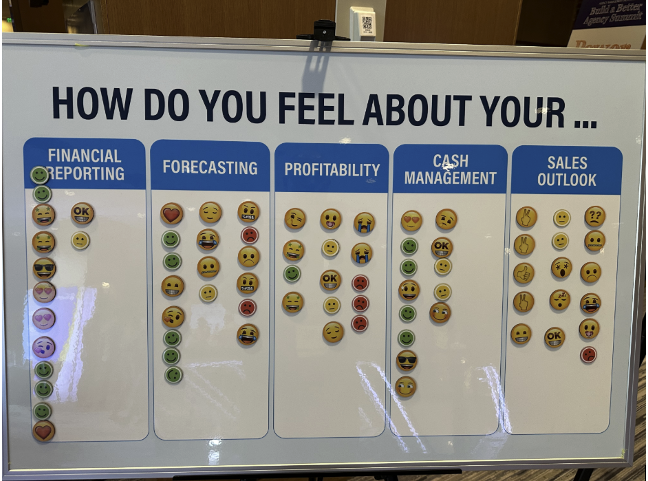
At this year’s Build a Better Agency Summit, hosted by the Agency Management Institute in Denver, our Virtual CFO team ran a simple exercise at the Anders booth. We put up a board with five categories that are the foundations of marketing agency financial management — Financial Reporting, Forecasting, Profitability, Cash Management, and Sales Outlook — and asked attendees to rate how they felt about each one using an emoji sticker.
No surveys. No spreadsheets. Just honest gut reactions from a room of more than 300 agency owners and leaders.
The pattern that emerged across the five categories gave us some food for thought. Here’s what we learned.
The Confidence Gradient: Looking Backward Feels Good. Looking Forward Doesn’t.
When it came to Financial Reporting, the board was overwhelmingly positive. Nearly every sticker landed in the “good” zone. Agency owners feel confident they know what happened last month.
But as the categories shifted from historical to forward-looking — from reporting to forecasting to profitability to cash management discipline to sales outlook — confidence eroded steadily. In Sales Outlook, more stickers sat in the “poor” zone than anywhere else, and the emoji choices shifted from smiles to visible worry.
The takeaway is clear: most agency owners feel good about looking backward but increasingly uneasy about looking forward. And that gap — between knowing where you’ve been and knowing where you’re going — is where financial risk builds.
- Financial Reporting Is Necessary, but It’s No Longer Enough
Strong financial reporting is table stakes, especially when your agency accounting is accurate and timely. Agencies need accurate, timely financials — and most have them. That’s the good news on the board.
The risk is assuming that good reporting equals good financial management. Reporting tells you what happened. It doesn’t tell you what’s coming, whether your margins are sustainable, or how a slow quarter will impact cash three months from now.
We see this frequently with agency clients. The financials look clean. The P&L is delivered on time. But when we ask, “What does your next quarter look like?” the answer is often a pause — or a guess.
If your reporting is solid, you’ve built the foundation. The question is whether you’re building anything on top of it.
- Forecasting Confidence Is All Over the Map
Forecasting produced the widest spread of any category on the board — roughly equal numbers of good, fair, and poor responses. Some agency owners clearly have a forecasting process they trust. Many do not.
We’re used to seeing this kind of inconsistency in the agency space. Building a reliable financial forecast in project-based businesses is inherently harder than in subscription or product companies. Revenue is lumpy. Scopes shift. Client decisions create timing uncertainty that can swing a quarter from profitable to flat.
But the agencies that build even a basic forecasting discipline — connecting their sales pipeline to expected revenue in a structured, measurable way; tracking utilization trends; and modeling cash impact — consistently make better decisions than those flying by intuition.
In our experience, the difference isn’t sophistication. It’s consistency. A simple process to build a reliable financial forecast that’s maintained and reviewed will outperform a complex model that’s built once and abandoned.
- Profitability Is the Quiet Concern
Profitability didn’t produce dramatic negative reactions on the board — it produced uncertain ones. The emojis in this category leaned toward confused and concerned rather than confident. Agency owners seem to sense that margins aren’t where they should be but may not have the visibility to diagnose why.
This is a pattern we encounter often. An agency is growing, staying busy, and landing new clients — but profitability doesn’t improve proportionally. These challenges almost always come down to a lack of visibility into the metrics that reveal performance and capacity across the agency. Specifically, the culprit is usually one of a few things:
- Service mix erosion — taking on lower-margin work to fill capacity
- Scope creep — delivering more than what’s priced without adjusting fees
- Utilization gaps — carrying production capacity that isn’t consistently billable
- Lack of project-level profitability data — knowing the firm is profitable overall but not knowing which clients, services, or teams are actually driving it
Profitability in agencies is about understanding margin by service line, by client, and by team — and making decisions accordingly.
- Cash Management Is Functional but Reactive
Cash Management landed in the middle of the board — not a crisis, but not a source of confidence either. Most agencies appear to be managing cash adequately in the short term without a structured approach to cash planning.
The danger here is that reactive cash management works until it doesn’t. A delayed client payment, an unexpected expense, or a slow new-business month can create pressure quickly — especially in agencies that distribute most of their profits and maintain thin reserves.
We typically encourage agencies to maintain a defined cash reserve target — often 10% of annual revenue — and to build a rolling cash flow forecast that reflects how money moves through the business. It’s a relatively simple discipline that turns cash management from a source of anxiety into a source of control.
- Sales Outlook Is the Biggest Source of Anxiety
This was the most striking result on the board. Sales Outlook had the highest concentration of negative responses and the most emotionally charged emoji choices — worried faces, uncertain expressions, and visibly anxious reactions.
Agency owners are uneasy about what’s ahead. Whether it’s pipeline visibility, client retention uncertainty, pricing pressure, or broader market dynamics, the forward-looking sales picture is where confidence is lowest.
This is significant because sales outlook uncertainty cascades into everything else. If you don’t know what revenue looks like in 90 days, you can’t forecast accurately, you can’t make confident hiring decisions, and you can’t plan cash with any precision.
One of the most effective ways to address this is to connect the sales pipeline directly into the financial forecast — translating opportunities and probabilities into projected revenue and cash impact. When sales visibility improves, confidence across every other category tends to follow.
What This Means for Your Agency
The emoji board at the Build a Better Agency Summit wasn’t a scientific survey, but the pattern it revealed is consistent with what we see across the agency landscape every day. Agencies have generally solved the reporting problem. The next frontier is forward-looking financial management — the ability to forecast revenue, model profitability scenarios, plan cash strategically, and connect the sales pipeline to the financial picture.
If you recognize your own agency in any of these categories, consider a few questions:
- Do you have a forecasting process you trust — or are you relying on gut feel?
- Can you identify which services, clients, and teams drive your strongest margins?
- Is your cash management proactive or reactive?
- How visible is your sales pipeline — and is it connected to your financial plan?
These are the disciplines that separate agencies running on momentum from agencies building durable value. And the good news is that none of them require massive investment — they require consistency and the right framework.
Reporting tells you where you’ve been. Advisory tells you where you’re going. The emoji board in Denver made it clear which one agency owners still need.
Ready to see where your agency stands and where it could go next? Our Profit-Focused Maturity Assessment will help you identify opportunities to strengthen your financial confidence and scale with clarity. Take the assessment below.
CTA url: https://anderscpa.com/virtual-cfo-services/maturity-model-assessment/