
Episode 558

Welcome to another can’t-miss episode of Build a Better Agency! Drew McLellan hosts Noel Andrews, founder and CEO of Job Rack, for a deep dive into how AI recruitment is revolutionizing the hiring landscape. Andrews shares eye-opening insights about the dramatic changes agencies face when building teams in today’s AI-powered world.
In this episode, you’ll discover how Andrews and his team are adapting their vetting processes as AI tools make traditional recruitment methods obsolete. You’ll learn about the shocking reality that resumes are now largely AI-optimized, making them nearly useless for evaluation. If you’ve ever wondered how to identify genuine talent when candidates can use AI to generate perfect interview responses in real-time, Andrews reveals the specific questioning techniques and AI recruitment strategies that separate authentic candidates from those hiding behind technology.
Andrews and Drew explore advanced tactics for evaluating AI fluency in candidates, including the critical importance of assessing judgment over technical skills. They discuss practical frameworks for writing outcome-focused job descriptions, conducting screen-sharing interviews, and probing deeper into candidates’ real experiences to bypass AI-generated responses.
Whether you’re hiring your first international team member, expanding your leadership team, or simply trying to navigate the complexities of modern recruitment, this episode delivers actionable strategies for success. Tune in to master the art of hiring exceptional talent in an AI-driven world!
A big thank you to our podcast’s presenting sponsor, White Label IQ. They’re an amazing resource for agencies who want to outsource their design, dev, or PPC work at wholesale prices. Check out their special offer (10 free hours!) for podcast listeners here.
What You Will Learn in This Episode:
- Discover why traditional resumes are now largely useless due to AI optimization and how to adapt your evaluation process
- Learn specific interview techniques to identify when candidates are using real-time AI assistance during conversations
- Master the art of outcome-based job descriptions that attract genuine talent while deterring AI-generated applications
- Understand how to evaluate AI fluency in candidates without being an AI expert yourself
- Explore advanced questioning strategies that bypass AI tools and reveal authentic candidate experiences
- Gain insights into hiring international talent for senior-level positions including directors and department heads
- Learn practical methods like screen-sharing interviews and the three-finger test to verify candidate authenticity
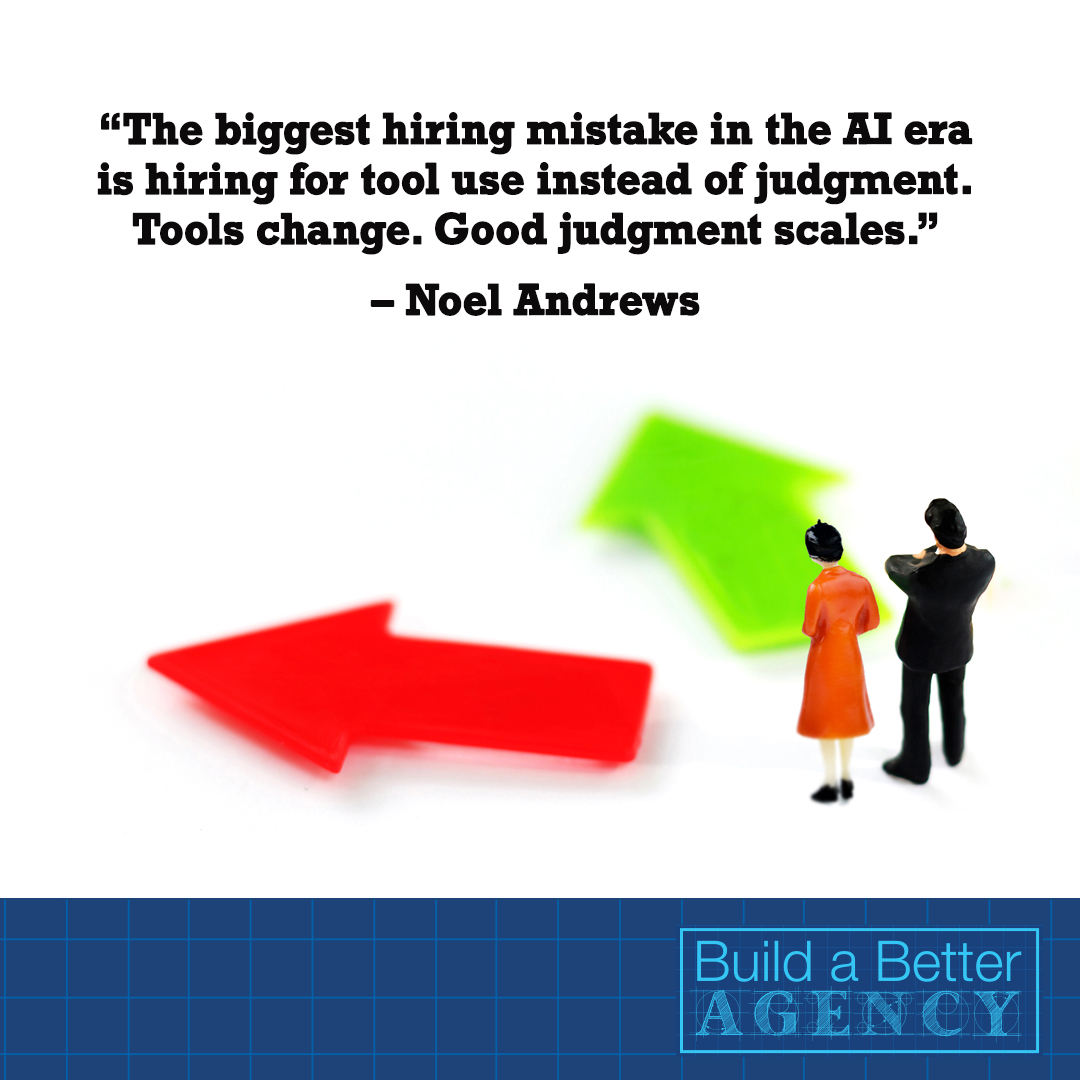
- Understand why focusing on judgment and decision-making processes matters more than technical outputs in AI recruitment
Ways to contact Noel:
- LinkedIn: https://www.linkedin.com/in/noelandrews/
- Website: https://jobrack.eu/
Resources:
- Drew’s Book: Sell With Authority
- AMI Facebook Group: https://www.facebook.com/agencymanagementinstitute
- AMI Preferred Partners: https://agencymanagementinstitute.com/ami-preferred-partners/
- Agency Edge Research Series: https://agencymanagementinstitute.com/agency-tools/agency-edge-research-series/
- Upcoming workshops: https://agencymanagementinstitute.com/advertising-agency-training/workshop-calendar/
- Weekly Newsletter: https://agencymanagementinstitute.com/newsletter-sign-up-form/
- Agency Coaching and Consulting: https://agencymanagementinstitute.com/advertising-agency-consulting/agency-coaching-consulting/
Danyel McLellan [00:00:01]:
Running an agency can be a lonely proposition, but it doesn’t have to be. We can learn how to be better faster if we learn together. Welcome to Agency Management Institute’s Build a Better Agency podcast presented by White Label iq. Tune in every week for insights on how small to mid sized agencies are surviving and thriving in today’s market. With 25 plus years of experience as both an agency owner and agency consultant, please welcome welcome your host, Drew McLellan.
Drew McLellan [00:00:37]:
Hey everybody, Drew McLellan here with another episode of Build a Better Agency. Always glad to be back with you. Thanks for coming back week after week. I think you’re going to love this conversation that we’re going to have with our guest. Before I tell you a little bit about him and why I asked him to come back to the show, I just want to remind you that we wouldn’t be here at all and if it weren’t for our friends at White Label iq. They have been the presenting sponsor of this podcast for many years and we are super grateful to them. And you know, White Label, what I love about them is that they understand, all they do is work with agencies. That’s it. And they understand your world because they came from an agency. They were born out of a full service agency who was looking for back then web dev partner couldn’t find it and so that was how White Label came to be. But they’ve evolved quite a bit over the years and one of the things they’re spending a ton of time on now is like all of you, AI. So they know that a lot of agencies need an extra set of hands when it comes to thinking through the strategy of AI, maybe building out automations or things like that. So just like all of you, they are trying to really figure out in the grand scheme of things the big picture, how, where, when and why AI helps what’s smoke and mirrors what’s real and they are helping many agencies all across the world build out their AI tech stack and thinking through how AI can serve not only the agency’s clients but also the agency internally. So if you are anxious to explore, maybe go a little faster than you’ve been going or a little deeper than you’ve been going with just your own internal team. Check out White Label and talk to them about what they’re doing for agencies just like yours when it comes to AI. So head over to whitelabeliq.comami learn a little bit more about them, reach out to them and as I always ask you to do, if nothing else, just let them know you appreciate the podcast. And you appreciate their support of the podcast and just say thank you. Okay. All right. So the episode for today I was having a conversation with with Noel Andrews. Noel is the founder and owner of Job Rack. Many of you are familiar with Job Rack. They place full time employees with agencies, and most of those full time employees are based in either Eastern Europe or South Africa. But it’s different. It’s not like hiring a VA or getting like somebody from Fiverr or upwork. This is a full time employee that they help you find and place who just happens to live in another part of the world. Anyway, Noel and I were talking and we were talking about how AI has changed recruiting and interviewing and some of the crazy stuff that they’re seeing candidates doing with AI And I said, oh my gosh, I got to get you back on the show so we can talk about that. So that’s what we’re here to do today is to talk about how do you hire in the world of AI A, how do you, how do you know that you are actually talking to a real human being? Or how do you know how they’ve used AI to prep the answers to an interview? But also just what are you looking for in employees? If you’re adding team members, whether it’s full time or part time or contractor or, you know, for those of you in the US a W2 employee, regardless of their employment status or structure, what should you be looking for right now and what kind of skills should you be watching for? So we’re going to dig into all of that with Noel and if you will, please welcome him back to the show with me. No. Welcome back to the podcast. Thanks for joining us.
Noel Andrews [00:04:27]:
Thanks, Drew. Great to be here.
Drew McLellan [00:04:29]:
So remind everybody about your role at Job Rack and the kind of work you do before we, before we dig in and talk about how hiring has changed, whether it’s full time hiring in your hometown or the work that you do, which is, you know, nearshore hiring internationally in the world of AI, because I know it’s changed a lot of things. So remind everybody about Job Rack and the work that you do.
Noel Andrews [00:04:56]:
Sure. So, yeah, I’m Noel Andrews, founder, CEO of Job Rack, based here in London. And our focus at Job Rack is helping agencies hire really great team members, specifically out of Eastern Europe and South Africa. And increasingly today, that’s much more about hiring AI fluent team members. The ones with the taste, the discernment, you know, the judgment to know when and when not to be using AI to actually help help agencies do what they need to do.
Drew McLellan [00:05:22]:
And I think one of the things that makes you different from a lot of other firms is that for you, and I know this has worked amazingly well for a ton of AMI agencies, but you’re helping agencies hire full time employees, team members who happen just to live in another country. And so it’s not a, it’s not like a va couple hours a week kind of thing, but it’s a dedicated employee who is all in on your agency and your work 40 hours a week. Right.
Noel Andrews [00:05:53]:
Yeah, exactly that. And you use the word that I use a lot as team members. Right. And for me, like, you know, really, really great agencies are built around a really great team that are, you know, you’re kind of getting the shower thoughts right. You know, there’s a time and a place to use freelancers to some fill in some gaps. But for me, what we really need is the people that are really invested that really get our clients that want to grow as we do and that are around for the long term. And so that’s, that’s our thing. Right. Really great team members. Yep. Working internationally, it’s super simple. On the, you know, the legals and finance side of things, we help a lot of people with that. So they’re independent contractors, keeps it super simple, but in every other way they look and feel like a permanent employee.
Drew McLellan [00:06:34]:
Yeah. So all of that said, as you were saying, the world has changed. And last time we had you on the show, we were just talking about sort of, you know, the basic nuts and bolts of how do you hire an international team member and how. And how do you make them feel like a real team member? Super invested in the agency, like you said, invested in the clients. But today what I want to dig into is okay, in the world of AI where I’m not even sure if you’re a real person that I’m talking to right now. I mean, fortunately we’ve met, so I know that you’re real, but it’s pretty tough today. So how, how has AI let’s start with how has AI changed the way you vet candidates? Because I know you do a ton of vetting before you put candidates in front of agencies. How has AI changed the way you vet good and bad candidates before we would ever meet them?
Noel Andrews [00:07:29]:
Yeah. So it’s changed it. The primary way it’s changed it is. It’s made it so much more work for us. I was talking to my team earlier on today and the stat used to be that around 5% of what was on a resume was inaccurate. This is going back maybe five or 10 years. And that was the general stat. There would be some inaccuracies or maybe some embellishments. Now, well, their name is probably accurate and their contact details are probably accurate. The rest of it, well, it’s a little bit more of a sliding scale because the vast majority of resumes have been AI optimized, right. So that candidates are using various tools to take your job post and then optimize their resume for it. So that means that resumes are useless, right? We stop using them. Candidates are using all kinds of tools to, I’ll say, support their application and make the application process easier for them. But what that often means is that the quality of what’s actually coming through is so much lower. So you know, what it means is that the hard work for anyone hiring, whether it’s us as a recruitment service or, you know, an agency owner, hiring got harder, a lot harder. And it’s all the more important to, you know, the fundamentals that, you know, great hiring always comes down to is there’s three questions, right? Do you actually know what you need them to do, like, before you start hiring? Right. Then, you know, number two is can they genuinely do it? And increasingly now, are they AI fluent enough to do it well? And then number three is, are they really who they say they are?
Drew McLellan [00:09:02]:
Yeah. How crazy is that? Like, are they even a human or are they are who they say they are? That’s insane.
Noel Andrews [00:09:09]:
Yeah, I mean, Drew, like you said, I mean, we’d met each other, but just in case, we can do the three finger test, which you put three fingers up in front of your face and if I was using a virtual avatar, it would glitch.
Drew McLellan [00:09:19]:
Right.
Noel Andrews [00:09:20]:
Right now at least. But it’s getting, you know, there’s a video out there. A security company released this because they had this exact instance know instead of a virtual background, someone’s using a virtual face. You ask them to turn their head, you ask them to wave. And most where the software is today, most will glitch. But it’s getting better and better.
Drew McLellan [00:09:37]:
Crazy.
Noel Andrews [00:09:38]:
Crazy how you look at it.
Drew McLellan [00:09:40]:
Yeah, that’s right. So as we are looking for team members, and this probably applies whether they’re, you know, in our, in our country of origin or they’re not in our country of origin. How are you advising agency clients to think differently about hiring in the, with, with these new job skill sets, with all of these new tools? Like, what do we have to think about differently when it comes to hiring because of the AI accessibility that we all Have, Yeah.
Noel Andrews [00:10:11]:
I think more than ever it’s important to spend the time upfront getting really clear and clear on like, what do you need them to do today? What are you going to need them to do in six months time? And where is your agency going? Your recent research, Drew, called this out perfectly. Only 29% of agents of clients are expecting agencies to drop their fees because of AI. So the vast majority, that’s not what they’re looking for. They want leadership. They want AI leadership from their agencies. You’ve got to be thinking ahead and saying, right, what does that mean? In my team, this is the bit that, you know, a lot of agency owners and a lot of business people and anyone hiring, they, you know, I need a, an account manager, right? I need a really great client account manager. So they go on ChatGPT or their LLM of choice and they ask it to create them a client account manager job description, right? Maybe they’ve got one from a while ago and they say, hey, increase, improve this for me, right? Maybe they make some tweaks and then they post it. And the problem is that is rarely accurate to what the agency actually needs. And it does two things. One is it tells the candidates that you’re looking for something that isn’t accurate. But also they can see that it’s ChatGPT generated. So you’ve just put out the signal that AI slop is okay, AI generated stuff without real proper review. That is the standard that you set for your agency. Right? And I get it. Job descriptions are hard to write. That’s why we do it for our clients, right? You know, and so that’s one of the first bits. It’s spending the time to get really clear. And, you know, one of the questions that I love is all about, you know, outcomes, not adjectives. So, for instance, before you start hiring for a role, you want to say something like, you know, in the first 90 days, this person will have, you know, dot, dot, dot, right? What will they done? What are the outcomes? And you want to answer that three to five times, right? So if you’re, let’s say you’re looking for a head of operations, right? In the first 90 days, this person will have taken ownership and solved three chaotic workflows. They will have achieved a 20% cut in turnaround times for our clients. They will have implemented the weekly metrics review that the leadership team runs on, right? That’s like if it’s ahead of ops role, right? Really clear outcomes that you can then interview against that the right candidates can go yeah, that’s in my wheelhouse. I can do that. So I think that’s the most important thing is being really, really clear up front. Don’t outsource all of this thinking to AI.
Drew McLellan [00:12:54]:
Right.
Noel Andrews [00:12:54]:
The clarity is on you. You can get help with it, obviously, that we all do. Right. But make sure it’s really, really real and accurate because that is going to be your, your crutch all through the hiring process that you’re le. Basically validate and say, this is what I said I needed them to do. Can they do it? And so the first start, starts there. The first bit starts right there. Get really, really clear.
Drew McLellan [00:13:17]:
How do you get really clear? And, and how do you interview for skill sets? If perhaps. And this has been an age old problem. So, you know, back in the day when I was actively running my agency, I didn’t know code. I still don’t know code. But if I have to hire someone who does that. Right. How, how do you interview in this world of AI? How are people using AI either in a helpful way or, or a detrimental way to interview around AI if they aren’t fluent? So, you know, it’s, it’s like me saying to you, you know, no, I know you speak French. Show me, you know, show me your fluency in French. Well, I don’t speak French, so you could say whatever you want. You can make whatever noise you want. And I could say, well, what did you just say? And you could say, you know, the petal fell off the flower. And, and I would go, oh, that sounded lovely. And really what you said is, you know, Drew, you’re a jackass. And I wouldn’t know the difference. Right. So how do you, in this world where everything is hard to discern if it’s true or not or, or AI driven or AI generated, how are you helping agencies interview differently?
Noel Andrews [00:14:31]:
So the big piece, you, you’re right. The, you know, what they did is harder to discern. Right. You know, did they, did they do it all themselves manually? Did they. Is it just AI, etc. The how they did it is kind of straightforward, right. And it’s about asking them to either show you or explain to you how they did it. So I’m a big fan of, during an interview, just asking the candidate, just, hey, share your screen to give you a scenario. Show me how you do it right. Or even just get them to explain their thinking. Because actually increasingly with AI tools and the tools today are going to be very different from the tools tomorrow and the ones next year. Right? Right. So the Thing we need is their judgment. Right. So if I was to say to them, right, you know, I want to improve our client experience or I want to reduce our client turnaround time by 20%. Right. How would you go about that? Right. I want them to explain to me and I want them to start by asking me questions. Right, right. Some people will just jump to the AI and go, I need to reduce client turnaround time by 20%. Here’s everything about our stuff, tell me what to do. But the real people that have got the right judgment are going to ask you questions about it, right? Yeah. So a lot of the time if, I mean, if you’re really recruiting for a role. So let’s say you were hiring an agency is bringing in their first developer. Right. And it’s a non technical agency owner. Right. I’m, you know, we can do technical interviews, Right. We will often, you know, lean and say to the agency owner, hey, you know, do you know anyone that’s running a tech agency that could do almost like an interview swap with you? Right, right. Well, to give you that confidence. But you know, we do that on our side and we’ve, we’ve always done those kinds of things. But the big thing is it’s, it’s no longer about just about the output, it’s about how they got there, what was their decision making process, what judgment did they apply and what did they know up front to look out for. Right. So some people can do an incredible prompt, but have no idea that the LLMs hallucinate and make stuff up.
Drew McLellan [00:16:23]:
Right.
Noel Andrews [00:16:24]:
They don’t know that the output gets worse as the context window fills up or that the memory gets lost. These kinds of things. So this is what I’ve done a lot of work with my team to increase their AI fluency. They don’t need to be able to do the things that an AI fluent SEO specialist can do, but they do need to be able to talk the language and be able to discern whether someone has the right level of judgment and, and can confidently talk about the different tools that they use and when they don’t use them or when they wouldn’t trust them or how they’d validate them. So it’s more than ever, it’s actually about saying, when we’re talking to people, how can they show us that they know when to use AI and when not to.
Drew McLellan [00:17:08]:
Yeah, interesting. You’re right, because it’s an ever changing landscape. So, you know, one of the things I talked about in my keynote at the summit is we have to get super comfortable with the. The reality that we just don’t know. Like we’re not. We’re never going to know all the things anymore. And so we have to get comfortable with the unknowing. And so you’re right. Even more important for us is that the person doesn’t have to have all the answers, but they do have to ask the right questions to get to the right answers. Because the right answers are gonna. Is a moving target today.
Noel Andrews [00:17:46]:
Right, exactly that. Yeah. And it’s super important. You know, the same is true when you’re interviewing. Right. So there’s this. There’s a very, very well known software called Cluli, which blew up a little bit because a student wrote it to get an internship at one of the big tech companies. Right. And then he’s now made millions out of it because it basically allows people to cheat on anything. And so how candidates use it is in real time in this instance, Drew, let’s say you were interviewing me. I would have it open on my screen and it is hearing your questions to me and it would be giving me ideal answers. Right. Perfect in having quote marks.
Drew McLellan [00:18:23]:
Crazy.
Noel Andrews [00:18:24]:
Yeah. And it’s there and it’s happening and people are using it all the time now. We saw it live and we actually saw it quite a while ago last year, and there was something a little bit off. Right. But it was very good. And I’ve watched a video of this and the candidate had said something like, oh, I’m really sorry, my Internet connection’s a little bit laggy. Right. And he was trying to explain why his answers were a tiny bit delayed. Right, Right. It wasn’t like dial up days. It was like a second delay. That was it.
Drew McLellan [00:18:50]:
Right.
Noel Andrews [00:18:51]:
And there was something off. The answers were just too polished. It didn’t sound fully human. Right. And one of my.
Drew McLellan [00:18:58]:
Cause he’s just reading them. He’s not even. He’s not even paraphrasing them.
Noel Andrews [00:19:01]:
Right, Exactly. Right. And one of my recruiters who was on the interview, she. She just felt that something was off and she was looking really carefully and then she saw the reflection of his screen in his glasses changing. And she was like. And so she didn’t figure out what it was on the call, but she knew something weird. And we looked it back, we looked it up and we’re like, that’s what he was doing right? Now that’s going to happen.
Drew McLellan [00:19:25]:
Right.
Noel Andrews [00:19:25]:
And candidates are going to get help. And I’m all right with him getting help. As interviewers, what we need to do is Then probe. Right, right. So we then, you know, dig deeper into it and go, well, look, tell me what really happened when you were working for, you know, ami, right? Tell us what, tell me what really happened at situation. Why did you do it in that way? The tools cannot help talk about a real experience.
Drew McLellan [00:19:50]:
Right, right, right.
Noel Andrews [00:19:51]:
If you dig deeper and go numerous levels deeper. Right. Challenge people on it. And I mean, I want to be clear, right? There’s lots of scaremongering and fear mongering and scary stuff around this, but the vast majority of candidates are honest, right. They are who they say they are. And really this is about. It’s always been the case for interviewers to help candidates show us why they’re the right people. And there’s a real skill in interviewing and some of these things make it harder. So it is very much about, you know, getting them to tell us, why did you do that? Right. When did you decide to go that direction? Like how. What would you actually do differently about that specific scenario? So getting them to talk about, well, I was working with Drew and the team at ami, and this was what they needed. If they’re speaking really generally, that’s when you know, you’ve got to dig in.
Drew McLellan [00:20:37]:
So you said something that reminded me. So I think when a lot of. I think a lot of agency owners and when I talk to them about expanding their team and, you know, they’re looking for maybe a skill they haven’t been able to find here in the States or they’re trying to manage their costs a little bit. One of the things that you said, which I think bears digging in a little bit, is you were like, okay, I said to a candidate, hey, I want to reduce my, you know, my client onboarding time by 20%. Right. I have like, a problem I want to solve. I think when people think about hiring international talent, they think of. Of a job that is very task based. Like, I want you to manage my, you know, CRM or I want, like that it’s skills based, but it’s task as opposed to knowledge and discernment. So talk a little bit about that misunderstanding because I know one of the. I know one of the things that I hear from agency owners all the time that work with you is they’re using you guys not to hire doers. I mean, sometimes they’re hiring doers, but for a lot of times they’re hiring people who are directors of departments or are sitting on the leadership team or are at a much higher level in terms of really guiding the agency in their area of expertise. So talk about that misunderstanding and the kinds of people that you’re finding. In terms of the kinds of people, what I mean by that is, you know, experience levels and skill sets and things like that that you’re helping agencies find to add to their team.
Noel Andrews [00:22:24]:
Yeah. So the almost in reverse, the caliber of people we can find is phenomenal. Right. Pretty much anyone that you can find in the US I can find someone equal or better, around half the price. That is generally going to have a harder work ethic as well. Right. We’re dealing with an interest in. We chatt before about, you know, entitlement expectation, etc. I think that is the history really. I think as you know, before the pandemic, you know, before 2020, remote work and offshore and nearshore hiring and international hiring was just less common. Right. Most U.S. agency owners had everybody in the office local to them. If you were working high, I mean, hybrid wasn’t a word really, nor really think about that.
Drew McLellan [00:23:05]:
That was five years. That was five years ago. Right, that’s right. And, and that reality for some agencies is still true, but for most agencies, they are so different than that now. It’s. It’s insane. But anyway, go ahead.
Noel Andrews [00:23:18]:
Yeah, you, you’ve now got options that were really there before. So then you come into that, like that confidence angle and that trust and people are like, well, you know, what can I hire remotely and what’s safest? Right. So, you know, if I’m going to do my first international hire, you know, am I going to hire my, you know, top salesperson or my client account manager, or am I going to dip my toe in maybe with a, you know, a marketing assistant perhaps or, you know, SEO person. Right. Some of it’s about building confidence. And particularly in the early days, that was definitely true. Like now, what happens as the world’s moved on and more and more agency owners are doing this and talking about it and you know, we’ve got lots of AMI members as clients and you know, we’ve placed, you know, 5, 6, 8, 10 roles in some of them, including directors of SEO, heads of PPC, director of client Account management. These are not inflated title. These are the same level as you would hire locally. And what people are realizing is that, oh, the caliber of people in other regions of the world is just as good, sometimes better than hiring locally in the US and so I think that’s just taken a little bit of time as people woke up to this or realized there was this opportunity to hire remotely. And then it’s like they just Go down that little bit, go down the rabbit hole of what’s possible. And so for us, you know, we don’t do any very many kind of junior hires at all. You know, the classic, you know, virtual assistant from Philippines. The Philippines just is not our wheelhouse, right? We’ve always been about the real specialists. So, you know, SEO specialists with five plus years experience, you know, ppc, paid media, you know, really great marketing specialists and marketing leaders, software developers, you know, so all of these kinds of roles and increasing, you know, I’ve got a good friend of mine, runs an agency in the US and his best account managers and he has them in the us he has them in South Africa and he has Eastern Europe. His best account managers are from Eastern Europe and he absolutely loves them. And I think they’d probably be closely followed by the South Africans. There’s just a different approach that is really powerful and so it’s very compelling for agency owners to be able to not reduce the caliber of people that they hire. I think that’s really important. We should not reduce that. Our team members and agency are everything, right? We should 100% look for efficiencies through AI, etc, but our people are everything. And I think we’re going to see a real shift in the messaging. We’re already seeing it with Sam Altman from OpenAI just last week talking, you know, almost retracting on where he was a few years ago, the effect of AI on jobs.
Drew McLellan [00:25:49]:
A couple of years ago it was like, none of you are going to have jobs. AI is going to do everything. And I just saw that and it was like, well, okay, maybe not.
Noel Andrews [00:25:57]:
I think he’s trying to address some of the anti AI sentiment in the us but what agency owners are seeing more and more. And I was chatting to one agency owner just a few days ago and he was saying that, you know, they’ve done a good job of implementing ChatGPT. They’ve got projects, they’ve got shared workspaces, things are good. One of their team was being proactive, got his own Claude account, started playing, built a few little internal tools, but then they kind of got a bit stuck and they’d been playing around with it, but they couldn’t really see the use cases and things kept falling over and they were like, you know what? This we’re not sure. And I think there are lots of incredible use cases. I think there’s loads of ways in that I can help us. But you know, you look at what Uber have just said, right? They spent their entire 2026 AI budget by April. Right. In four months. And there is no discernible improvement in shipment of product or efficiency.
Drew McLellan [00:26:49]:
Right.
Noel Andrews [00:26:51]:
So it does. We’ve got to be discerning about how we use these things and where so that we get the results that we want. And crucially, you know, as your study kind of pointed out so perfectly so that we then give our clients what they really want. You know, they want leadership, they want partnership from us. They want, you know, real humans and real agencies taking accountability for what they’re doing, whether that’s the good or the bad from time to time. Right. And I think that’s more important than ever.
Drew McLellan [00:27:17]:
Yeah, you said something and I want to. We need to take a break. But when we come back, I want to talk about the idea of using international talent in account service. Because I think that’s the. That is the place where if I hear an agency go, I would do it for any role, except it’s always account service. So I want to dig into that a little bit when we come back. But let’s first take a quick break. As we take a quick pause from our conversation, I want to talk about something that I see agencies struggle with. Hiring mistakes are expensive, especially when you’re expanding your team or thinking about hiring internationally. When agency owners ask me who helps them slow down, get clear and avoid these mistakes, we often point them to jobrack. We trust Noel and jobrack and their approach. I’ve seen how he thinks about hiring and AMI agencies working with him have strong positive experiences. Because of that, we were happy to welcome Noel and jobrack as a paid sponsor of this show. If you want a smart place to start before your next hire, Noel’s hiring playbook is [email protected] AMI again, that’s jobrack.com AMI there’s a thief loose in your agency. They don’t wear a mask or sneak in at night. They’re stealing from you in broad daylight. A missing hour here, an unlogged revision there, and poof. 15 to 30% of your profits have disappeared without a trace. It’s time to call in the detectives at Toggles Agency profit heist. They’ll investigate your workflows, expose where the money is leaking out, and hand you a 90 day plan to recover what is rightfully yours. The clues are [email protected] AMI that’s T O G G L.com backslash AMI. Use code AMI10. So that’s AMI and the number 10 at checkout for 10% off annual plans or just mention this podcast during your demo. Case closed. All right, we are back with Noel Andrews from Job Rack and we’re talking about hiring international talent in the age of AI and how that has changed hiring. But we kind of got off on a tangent that I think is important enough that I want to pull on the string a little bit. So you were talking about sort of the, the caliber level of the employees that their department heads and they’re at the leadership team level. It’s not just hiring someone to do a task. And I think for some people, that’s how they think about international talent is more the VA route than the team member at a high level route. So. But in, in talking about that, you said something about director of account service. So I want to pull on that a little bit because I think that there’s a misperception that international folks can do everything but account service. So can you talk to that for a second?
Noel Andrews [00:30:22]:
I think a lot of it comes down to kind of fear. I think some of it comes down to time zones and some of it comes down to people just having that experience of that. Oh, hang on a minute. Someone that’s not in the US can relate to my clients and can put across the, you know, because client services is all. Ultimately it’s about, you know, it’s about understanding the client. Right. And where they’re at. And, you know, it doesn’t mean necessarily bending over backwards every single time. It’s, you know, being robust with them from time to time. So I think the first thing that used to happen was about the time zones. I remember an agency owner a few years ago had said to me, we’re talking about time zones, right. And we don’t get people to work night shifts in order to overlap with US hours, but we do get a lot of overlap. So typically, you know, six to seven hours overlap with U.S. east coast time, maybe five to six, with kind of central time perfectly possible. And people love doing it. And he says, he’s like, oh, no, that wouldn’t work for me. Like, my clients are screamers, right. They want someone on the phone at 6pm every night. And I was like, cool, no worries. Not a fit for us to help you hire this role. Then we had a conversation about whether he should adjust the expectation of his clients. Right, right, yeah. That you want. Right, right. So, you know, there are instances where you might need that fully asynchronous time, but it’s pretty rare. The big thing is about, you know, setting expectations with your clients about what they can expect. You know, we are very responsive with our own clients at Job Rack. However, we tell them really openly. We go into focus mode. Right. We do not have notifications on email. We do not have notifications on Slack. We check them every few hours. Nothing’s an emergency. That is worth. Yeah, everything interrupts. Right. And so that’s a big thing. So that actually, if you go, well, actually, what responsiveness do we need? Right. That kind of puts aside then for most people that the time zone fit, then it’s just about someone’s ability to build rapport, build a relationship, you know, dig into what a client’s needs are. And that there is nothing, with the greatest of respect, there is nothing special about someone from the US that means someone from South Africa or Eastern Europe can’t do that. They’ve got to have great communication skills. Right. Their English language must be good, which it consistently is.
Drew McLellan [00:32:36]:
I think they do worry a lot about that, like, will my clients be able to understand them? You know, is it. Will there be a thick accent or something like that? And do they really have the command of the English language at the. At the ability to communicate abstract thoughts or concepts as opposed to just, you know, I can get by if I go on vacation to someplace that uses English.
Noel Andrews [00:33:05]:
Yeah. And that’s why we, you know, when we’re hiring particularly for client services, we’re always looking for exceptional levels of English. You know, South Africa is great for that because it’s one of. It’s, you know, English is a first language. It’s one of the many. They’ve got 11 kind of main languages there, and English is one of them. So the standard is, you know, it’s as good as you or me. So I think it’s a common fear until someone experiences it and they’re suddenly like, oh, hang on a minute, this person’s amazing. And it builds out from there. And you get, you know, we’ve got some great case studies with. With US agencies doing this that then almost opens people’s eyes to it, that it’s not just that this is there and is available, but this is something that agencies are doing. And, you know, whether it’s the more junior roles or whether it’s going straight into the senior roles.
Drew McLellan [00:33:48]:
Right.
Noel Andrews [00:33:48]:
There is nothing about hiring internationally or globally that, you know, means one role should be or must be, you know, onshore or not, that kind of. That shift has definitely happened a lot. And, you know, a lot of the time, what is accelerating that is the difficulty of hiring locally. That’s getting Harder and harder, particularly in the US and here in the UK as well.
Drew McLellan [00:34:08]:
Yeah, well. And I think the expense of that, I think that’s part of the advantage. One of the things that I find fascinating is that we have a lot of agencies that have literally hired old departments with you skill sets and departments and that. And you had mentioned, you know, that the work ethic is a little different sometimes and that people are finding that really that one of the things I hear is that hiring internationally actually changes the attitude of the US based employees because they’re working with people who are more appreciative, work hard, are grateful for the work, kind of don’t have that entitlement attitude that we see a lot of times in the US and so it’s interesting that the international team members are influencing the US based team not only by helping them do great work and serve clients, but also just in terms of company culture.
Noel Andrews [00:35:10]:
Yeah, usually. And it is why we, you know, lots of times people refer to like, I want to find someone who’s a culture fit.
Drew McLellan [00:35:15]:
Right.
Noel Andrews [00:35:16]:
We look for a culture ad. Right. We want someone that’s going to add something to the culture. And you’re right, that is really, really common. We also see it extending into AI adoption as well. There is often a little bit less fear and a little bit less ego around adopting AI tools. Right. And I think.
Drew McLellan [00:35:33]:
Right, yeah.
Noel Andrews [00:35:34]:
If I’m a senior copywriter and I’m seeing how good copy can be when AI is driven by someone that really understands it and is doing it well with good judgment, I’m fearful for my job. Right. I get that now. The opportunity that I think every agency owner has got is to actually really with their teams, give them comfort and say, hey, if you plus AI is 10x the output, I can go and sell 10x worth of work. Right. Your job is safe. As houses resisting AI, that’s where the future’s not bright. Right, right. And so I think we also see that with the international hires that there is a real excitement, a real desire and just perhaps whether it’s ego, I’m not sure if that’s quite the right word, but a real openness to going, hey, I’m up for doing this better. Let’s go, let’s, let’s make the difference. I think there’s a big, big opportunity for me. This isn’t about AI replacing humans. This is about, you know, for an app for many, many agencies. You know, what if you took the contrarian view? So instead of being the agency that gets rid of all your Junior team members, you know, gets rid of people and has AI agents and whatever. What if you added AI to all of your humans? Right. And all of your team, and what could that mean?
Drew McLellan [00:36:52]:
Right.
Noel Andrews [00:36:52]:
And I think that’s really exciting. I think there’s a really interesting angle around, you know, junior team members as well. But I think that’s the first bit for me is just going, hey, what if we add AI and then make them feel empowered to find the ways that we can make things so much better for our clients without the fear that that means that they’re going to be made redundant?
Drew McLellan [00:37:10]:
Yeah. So let’s talk about how. How agencies that have international team members, how are they leveraging AI to make that work better? To make the. Not only the work better, but the communication better. The. I know one of the really important things, and you. You talk about this a lot, is if you. And this is true regardless of where your employee lives, if you have a team member that is good at what they do and you want them to stay a long time, you want them to feel connected to everybody else and embedded in the team and like they’re valued. So how are you seeing agencies using AI to enhance the employee relationship, but also to make the work of not being in the same place? Which, by the way, to our point earlier, could mean that one’s in Philadelphia and one’s in L A or, you know, one is in South Africa and one is in L A. But either way, how are you seeing agencies using AI tools to bring the team together better and to do better work together?
Noel Andrews [00:38:17]:
Yeah, I think in some ways it’s early days, but there are some really, really good use cases. One of the big ones is sharing of information. Right. So particularly if you have a hybrid team. So if you’ve got people in office and some people remote, whether down the road remote or across the ocean remote, one of the things you want to make sure is that everyone’s got. Everyone is up to speed and everyone knows about that client. So the ability now for us to have a central hive or a central brain of information where maybe all of our fathom recordings or call recordings go into, all of our client notes go into. So that everyone is, you know, kind of working from the same hymn sheet effectively.
Drew McLellan [00:38:56]:
Right.
Noel Andrews [00:38:56]:
Which that, I think historically has been harder because no one wants to update the CRM. Right, right. That, like, that is much easier now, and the power of that is incredible. So I think I’m seeing a few agencies I’ve spoke to recently are investing in that and are putting the effort into saying, right, let’s build this central repository and you can start very gently. I think that makes a big difference because then instead of it being like, you know, your, your international team members having to find out information, it’s like everyone’s working from the same thing. So I think that’s the big one, like access to information. I think there’s other interesting things going about, you know, kind of fun things that you can do. And also if AI is taking more of the drudge work offers. So for instance, right, for marketing agency that needs to produce client reports, right. Previously you’d have a junior analyst going into Google Search Console, going into Google Ads Manager, Facebook business manager, etc. And pulling all of this information manually. Well, that’s an area right now that has been revolutionized. Right click on a button, you can pull the information in. But what that means is that we’re spending less time doing, you know, button clicking and drudge work, more time doing the more interesting things and having those internal conversations about how can we help this client better?
Drew McLellan [00:40:10]:
What does this mean we do, Right?
Noel Andrews [00:40:12]:
Yeah, exactly, right. You know, the time is that we freed up some time and for me, the smartest agencies, the agencies that are leveraging the best are then saying, hey, what else can we do? How can we over deliver? How can we perform more? Instead of just saying, let’s remove the people. I am really fascinated for the first time. I spoke to a, an email marketing agency just last week and they’re hiring for six roles. They’re absolute experts in Klaviyo. They work with some really great econ brands and they are hiring for a email marketing Internet. And I was like, huh, been a while since I saw an intern role, right? Yeah, like there’s not that common. And I had a great conversation with the founder about it and he’s like, I’m going to bring this person as an intern and in one year they’re going to be a Klaviyo expert and in two years they’re going to be an account strategist. Because I can use AI to compress their learning, right? I can give them so much more. And he said if I don’t bring them in as an intern, I have no senior account strategists in two or three years.
Drew McLellan [00:41:18]:
Right?
Noel Andrews [00:41:18]:
And it was a really interesting view and saying, you know, we’re looking right now and we’re, you know, we are seeing lots of agencies are not hiring juniors or removing junior team members. And it’s a really interesting view going, well, where are you going to get your seniors from in three years? Right.
Drew McLellan [00:41:32]:
I’m worried about that for the industry is 100%. If all the entry level jobs go away, you know, to your point, fast forward three, five years, who are your, who are your senior leaders at that point? Because you’ve got a bunch of people who have 10, 15, 20 years now experience, they’re all going to retire. And who are you going to fill that, who are you going to fill that gap with?
Noel Andrews [00:41:55]:
Yeah. And the power of a junior today. Right. Or even if you take someone with a couple of years experience, a junior plus AI.
Drew McLellan [00:42:04]:
Right.
Noel Andrews [00:42:05]:
That’s exciting for me. Right. Especially the cost base that you can hire them at. So you know, if you bring in, you know, someone, yeah. Three years marketing experience or SEO experience or even someone lower, you know, more junior than that, you know, salary costs, very, very reasonable, you know, especially if you’re hiring, you know, internationally. And then you give them AI.
Drew McLellan [00:42:23]:
Right, right.
Noel Andrews [00:42:24]:
And then you encourage them to spend their time learning. They are operating at a level of mid level people and probably a team of three to five mid level people. They’re going to need some guidance, they’re going to need some help in Judg. But you can develop that as, as this agency owner said, AI compresses this learning piece. And so I think that is actually a fascinating opportunity that I’m going to be talking about a lot because I think it’s something that, you know, all of us have always wanted to know. How do we grow our succession plans? How do we, you know, kind of create this funnel that right now there’s a lot of almost anti junior rhetoric that people are not doing it. And this was a contrarian view that I was like, this makes complete sense, right? Absolutely makes complete sense. And the power of it, instead of previously spending, I don’t know, three, $4,000 a month in the US or maybe $2,000 globally, to have someone who really is juniors pushing buttons, pulling reports now they can do so much more. And that I think is a real exciting opportunity.
Drew McLellan [00:43:19]:
Well, and if you think about it from their perspective, to be able to advance in their career that fast and to be able to do work that feels really meaningful and you know, that they’re, that they’re driving or leading a team or whatever it may be in a few years, you know, that’s pretty exciting for on, on the job candidate or the employee side too.
Noel Andrews [00:43:42]:
Yeah, 100%.
Drew McLellan [00:43:45]:
So what right now are, where are the AI driven or influenced mistakes that agency owners are making when they’re hiring right now. What, what are we, what are we getting wrong? Yeah.
Noel Andrews [00:44:00]:
I think we are hiring for tool use and not judgment. Right. So we’re asking people like, you know, tell me what, tell me what you’ve done, right? Not tell me how you think about it. So my favorite interview question right now is tell me how you have used AI to support your application. Right, Right.
Drew McLellan [00:44:22]:
Yeah.
Noel Andrews [00:44:23]:
And it. You get an interesting moment, right. It’s a bit like in the old days asking someone, where’s the lie on your cv, Right. And they panic going, which one do I tell you about?
Drew McLellan [00:44:31]:
Right.
Noel Andrews [00:44:32]:
So here. So how have you used AI to support your application? If they say they have not used AI, then one of, well, they’re a hell no straight away. Right?
Drew McLellan [00:44:43]:
Why?
Noel Andrews [00:44:43]:
Because either they’re lying or they didn’t use it. And frankly, they should have done. Right? I mean, let’s be clear, right? They are preparing a resume. They are preparing for an interview. They are researching you or me, whoever’s interviewing them. Right. They’re preparing scenarios. They should be using AI, of course. Now how they explain it to you about how they’ve used it gives you a really great insight into did they just use one tool? Did they use multiple? Did they go, what level did they go to? How much were they preparing? Right. So it’s a great question that you can then dig into and you could be like, okay, so what did it give you that you threw away, that you discarded? Why? Right. Where, you know, if you had more time, what would you have done differently? So that question, ironically, about their application process can be really, really illuminating. So I think, yeah, the mistake is focusing on tools, because tools are not going to matter. Right?
Drew McLellan [00:45:36]:
Right.
Noel Andrews [00:45:36]:
The thing that matters already so much more is the judgment.
Drew McLellan [00:45:39]:
Yeah.
Noel Andrews [00:45:40]:
And you know, I’m talking a lot about finding AI fluent team members. You know, for me, fluency is the ability to know what to do when. Right. You mentioned if we’re in France and you know, we’re ordering a coffee, it’s making sure that I use the right words in the right moment. The same thing with tools. Right. Knowing that, okay, for this I’m going to go and use Nano Banana for an image. Right. For this, I’m going to use Claude. And I’ve set Claude up with the right skills, for instance. Right. And they don’t need to be an AI ninja or an AI expert. Not for most roles we can hire those people. But most agencies don’t need 10 of those. They might need one. And then they need AI fluent account managers, AI fluent PPC specialists, SEOs, et cetera. So I think that’s focusing on tools instead of judgment. I think that is really, really important. And ultimately it’s like lead with the outcome. Right. You know, we don’t, you know, someone that says I use AI or an agency that says we use AI, that’s fluff. Right. We want the outcome.
Drew McLellan [00:46:38]:
Yeah. So look in your crystal ball and tell me what you think the next two or three years looks like. You know, right now our whole summit was focused on what’s coming for the next three years. Like how do we future proof ourselves? How do you see international hiring as part of an agency’s playbook in the next couple years? Is it going to stay the same? Do you think it’s going to change? What do you, what are you anticipating agencies will need, want and do when it comes to international talent?
Noel Andrews [00:47:14]:
I think it’s going to increase for a couple of reasons. I think it’s going to continue to get harder to hire locally in the US Particularly, the reason for that is because if we think culturally it’s a very, you know, enabled nation.
Drew McLellan [00:47:30]:
Right.
Noel Andrews [00:47:30]:
Entrepreneurship is hugely valued and supported and driven. Right. And so as people have got certain expectations, certain costs of living and I think AI is going to increase the ability for a lot of people to do their own thing. Right. And start their own business.
Drew McLellan [00:47:45]:
Yeah.
Noel Andrews [00:47:45]:
There are other reasons of the world and Eastern Europe and South Africa are two of them, where stability is really valued. Right. So lots of entrepreneurs there too. But actually stability working for another company is valued very, very strongly. So I think we’re going to see that combination agencies need great people. Right. Fundamentally that’s, I don’t think that’s going to change. I think what an agency can do with the same number of people is going to change. And that’s exciting. Right. Because that allows us to serve more clients. Like, you know, I was chatting some agency owners and it was like, how big a team would you like?
Drew McLellan [00:48:21]:
Right, right.
Noel Andrews [00:48:22]:
There is a certain type of agency owner that’s kind of gets excited by having 100 person team or a 200 person team. There’s a lot of agency owners that are just like, nah, I don’t want that.
Drew McLellan [00:48:34]:
Right.
Noel Andrews [00:48:34]:
But what if you could have 20 people or 25 incredible people, not having to do Drudge that are performing at the level of a multinational agency.
Drew McLellan [00:48:44]:
Yeah.
Noel Andrews [00:48:45]:
I think is the reality, what it takes is getting the right people right, the right work ethic, the right skills, the right judgment and increasingly the right AI fluency so that each of those, let’s say, 25, 35 people are, you know, the absolutely right people. And then for those that are in the 100, 200 person agency space, again, tremendous opportunity, right? You 10x every person, suddenly the accounts that you can go after are at a whole different level. Right? Suddenly the volume that you can take on without it being overwhelming is phenomenal. So I think we’re going to see it increase. I think we’ll see it shift. I think people’s, you know, as you said, people have gone on a journey, agency owners have gone on a journey. And more and more are realizing we can do higher, you know, heads of and directors of account management or directors of function globally. Our barrier and resistance to hiring from anywhere in the world, I think will reduce dramatically.
Drew McLellan [00:49:39]:
The other thing I think, I think all, I agree with all of that, but the other thing I think is, I think many agencies have thought of international talent as someone that they needed to keep in the background. Not that they were ashamed, but they were worried about communication style or time zones or the things we talked about earlier. And so they, they were meant to be utility players that did stuff in the back room. And what I’m seeing more and more of is people actually leveraging the fact that they have an international team as advantage and bringing those international talent into the meetings and into client relationships. Even if they’re not in account service. They might be the, like you said, the director of SEO or something else, but they are. I think that Americans are getting less. Territorial isn’t the right word, but I can’t find the right word. Like they’re just more comfortable with the idea that. I think, interestingly, I think in some cases they were worried that if they said to a client that they hired internationally, it was going to be a hired cheaply, therefore the quality isn’t there. Right. And now what they’re learning is they have these team members on their team and to your point, not only are they great skills, but they’re good thinkers or good communicators and they’re actually influencing their culture for the positive now they’re kind of pushing them out in front of clients and saying, you know, aren’t we as an agency, you know, sort of cosmopolitan and advanced? Because we do have team members in three or four different countries and, you know, we literally will hire anyone in the world who can help you solve your problem. So it’s a really different attitude shift. And I think we’re going to see more of that where having team members from all over the world in Client meetings and interacting directly with clients is more commonplace. And I think clients are going to see that as an advantage as opposed to a, oh, they hired someone from the Philippines for $5 an hour and they’re not at the same caliber as my American counterparts. I think that’s going away.
Noel Andrews [00:52:03]:
Yeah, agreed. It’s like, it’s like the stigma. It’s very similar. Again, back to AI. It’s like the stigma in the very early days of AI, it’s like, you know, agencies were using AI and they were like, wow, I can do this so much cheaper. Right. Don’t let the clients find out. Right, right, right. Now, in a lot of instances, if you’re not using AI, the client’s gonna be like, well, why not? Right. Come on. Same thing here. The stigma against it as long as you do it well. And that again, comes back to the caliber, you know, nobody wants. No, clients want you using AI badly. Same thing is no one, none of them want you hiring, you know, low end team members that aren’t, you know,
Drew McLellan [00:52:37]:
from anywhere in the world. Right.
Noel Andrews [00:52:38]:
From anywhere in the world, US or anywhere else.
Drew McLellan [00:52:40]:
Right.
Noel Andrews [00:52:41]:
If you hire in and doing things really well. And that’s fundamentally, as an agency, that’s our job. Right. Do the things really, really well. Be a great partner. You bring the offerings and strategic thinking to the clients because they’re not the ones that want to live and breathe the things that you’re doing. Right. You’re, you know, we are the experts.
Drew McLellan [00:52:57]:
Right.
Noel Andrews [00:52:58]:
And so I think that I completely agree with you. It’s rem that stigma around it. And some of it is about how we show up. So back to the account service example earlier on, I advise someone years and years ago, the way that you get ahead of it, if you’re about to introduce someone who is not in the US as an account manager, if I was bringing someone to you, Drew, I’d be like, hey, Drew, want to introduce you to Esther. She’s one of my senior account managers. She’s absolutely incredible. Right. Our client, other clients love her. I know she’s going to take incredible care of you. Right. If you introduce someone like that. Right, right. You as a client are like, oh, great, I can’t wait to work with Esther. Right, right, right. And so it’s almost like owning it. Right. It’s a bit exactly the same as when a comedian or a band or whatever get introduced on stage. Right. You pick them up and you let them own. It’s got to be genuine. But then they’re like, oh, I can’t wait to work with Esther. She sounds amazing. Right, right. And that it’s all about how we approach it and not there should be no stigma against it because, you know, you should have amazing people on your team and if you don’t, then that’s a. That’s a different conversation.
Drew McLellan [00:54:04]:
Right. Yeah. I think we’re going to see. I think it’s going to be so commonplace and so valued that we’re just going to see a very different and very interesting attitude shift, which, which I think is going to be great. I think it’s going to be great for agencies. I think it’s great for our clients. I think it’s great for, you know, building a team. And you know, honestly, at the end of the day, it’s great for the agency’s profitability. So every. Everybody wins.
Noel Andrews [00:54:33]:
Everybody wins. And our clients want to spend more money with us.
Drew McLellan [00:54:36]:
Right.
Noel Andrews [00:54:37]:
They want more help, they want to grow. Let’s help them spend that money.
Drew McLellan [00:54:40]:
Right.
Noel Andrews [00:54:40]:
And, but do it well and as you said, and then increase the profit margins as a result, but without compromising on, you know, quality, whether that be through AI or through team members.
Drew McLellan [00:54:49]:
Yeah, for sure. I know that you have a resource that you want to make sure that we get to the listeners, so let’s, let’s talk about that for a quick second.
Noel Andrews [00:54:59]:
Yeah, sure thing. So all of the examples we’ve talked about, about AI, so you know, how to get set up in the first place with a really great scorecard. Right. The, you know, how have they supported their application with AI, all of these resources, all of the ways that you can make sure you’re hiring AI fluent people and also the kind of the gotchas to look out for. All available in our how to hire in the Age of AI resource. That’s at jobrack. EU AI nice and simple. You can just grab that. It’s got everything you need in there, nice and short, but just gives you those. Those kind of key things to look out for, both to help you get set up. Right. And you know what you need to look out for in this, in this interesting time? Job rack eu/AI.
Drew McLellan [00:55:40]:
And we’ll stick that in the show notes as well. So if you’re driving or on a treadmill or doing something where you should not stop and write it down, just head over to the show notes and you’ll have that. You’ll have that resource link there as well. Noel, this has been, as always, super helpful. Thank you so much for coming back on the show and being for such a great partner to so many AMI agencies. I. I love hearing about the work that you’re doing with our agencies and how you are helping them build their agency, build their team, grow their capabilities. I’m just super grateful for what a great resource you are. So thanks. Thanks for being with us and thanks for caring about our agencies the way we do.
Noel Andrews [00:56:19]:
Really, really appreciate it. And we love working with them and it’s. We’ve done it for many years and look forward to many, many more years.
Drew McLellan [00:56:24]:
Yep. For sure. All right, everybody, this wraps up another episode. And you know what? It’s interesting. A lot of what we talked about while we were talking about international talent, you got to think about this stuff when you’re hiring domestically, too. I mean, most of you are still doing interviews on Zoom, and so I don’t care if they’re in Poughkeepsie or they’re in Poland. You have, like, it’s a whole new world out there for hiring. And so grab that resource. Even if you’re like, I am never going to hire internationally, which I believe you’re going to change your tune about, but nonetheless, grab the resource because it’ll help you locally as well, or in the States or wherever you are. I know a lot of you are not in the States to begin with, but grab the resource and be thinking about. I think one of the more interesting things Noel said was rather than thinking about how to use AI to reduce the team and have fewer people, which that math I get. But what happens if you think of AI as the additive? So I’m going to keep the same number of people. I’m just going to make them super humans in terms of their ability to serve clients and to have better insights and depth. And, you know, the agency edge research, which we’ve referred to a couple times in this conversation, tells us that that’s what clients want. They don’t want cheaper. They want deeper, more, bigger ideas. They want faster. Which, that’s fine. We can do that. But they’re not asking for less. They’re saying, look, I’ll keep giving you the same amount of money. I just want more for my dollar. And, you know, before that really felt like a pressure point for us, but now it’s absolutely doable. So take all of this in. Think about how you’re building your team and what you want for the future, and how hiring internationally may be the perfect way for you to sort of blend your cost concerns with the talent needs that you and your clients have. There is a way to solve that problem that is Getting more and more common, more and more accepted, and honestly, I think more and more held in high esteem by our clients than ever before. And so check out job rack. Go. Go check them out. If you want a personal introduction to Noel, shoot me an email. I am happy to do that. I send people to him every single day, connecting him to folks because I know he’s going to do a good job and help people find the right talent. But think differently. Let. Let this be an opportunity for you to think differently about what your team should look like, what your team should be capable of doing, and how you build that team in the future. Okay, that’s your homework for today. Before I let you go, I want to thank our friends at White Label iq. As I told you at the top of the hour, they are the presenting sponsor here at Build a Better Agency and we are super grateful for them and all the support they provide for us and our agencies. So check them [email protected] AMI and I don’t really ever like to end an episode without reminding you that I get that you have choices and that you don’t have to listen to this. You have lots of other things you could be doing. So I am really, really grateful that you spend the time with me every, every week that I get the opportunity to hang out with you and talk about things that I think are important to put on your radar screen. So I am grateful for you and that you keep coming back. So thanks for listening. I’ll be back next week and I’m counting on you to show up too. Okay? All right, see you next week.
Danyel McLellan [00:59:55]:
That’s all for this episode of AMI’s builds a better agency podcast. Be sure to visit agencymanagementinstitute.com to learn more about our workshops, online courses and other ways we serve small to mid size agencies. Don’t forget to subscribe today so you don’t miss an episode there.