
Episode 555

Welcome to a pivotal solo episode of Build a Better Agency! This week, host Drew McLellan takes listeners on an honest and insightful journey through the real work of agency leadership, exploring the mental and emotional shifts required to move from talented employee or manager to confident agency owner.
Drawing on more than 25 years of experience and candid stories from agency owners nationwide, Drew unpacks the identity shift every leader must make—from seeking permission and sticking to their craft, to taking full, radical responsibility for the outcome of their business. You’ll hear powerful confessions from new owners as they share those “aha” moments when the weight of ownership finally hit home, from financial scares to difficult personnel decisions.
This episode tackles three essential lenses that shape the growth of agency leaders: developing a growth mindset (inspired by Carol Dweck), evolving from technician to true entrepreneur (with a nod to Michael Gerber’s E-Myth), and embracing an ownership mentality as described by Carrie Siggins’ “Ownership Mindset.” Drew provides actionable advice on shifting beliefs that hold leaders back, such as hesitancy around finances, reluctance to delegate, and resistance to uncomfortable decisions.
Whether you’re a new or soon-to-be owner, an emerging leader, or a veteran still wrestling with self-doubt, this episode is packed with practical steps, introspective challenges, and resources to help you own your power and build an agency you’re truly proud of. Don’t miss this empowering discussion.
A big thank you to our podcast’s presenting sponsor, White Label IQ. They’re an amazing resource for agencies who want to outsource their design, dev, or PPC work at wholesale prices. Check out their special offer (10 free hours!) for podcast listeners here.
What You Will Learn in This Episode:
- Understand why the identity shift from employee to owner is the hardest part of the transition
- Learn the three critical lenses for developing an ownership mindset: growth mindset, role clarity, and responsibility ownership
- Discover the common triggers that make ownership feel real for most agency leaders
- Recognize why true leaders act like owners long before they own equity in the business
- Understand the difference between collaboration and abdication in leadership decisions
- Learn how to move from execution-focused to strategy-focused thinking as an owner
- Gain insights from real owner confessions about pivotal moments of realization
- Understand why financial literacy becomes critical when you truly own the outcomes
- Discover how accepting responsibility also grants you permission to change what’s broken
Ways to contact Drew:
- Email: [email protected]
- LinkedIn: www.linkedin.com/in/drewmclellan
- Website: https://agencymanagementinstitute.com/
Resources:
- AMI Ownership Mindset Guide
- Book: Sell With Authority
- AMI Facebook Group: https://www.facebook.com/agencymanagementinstitute
- AMI Preferred Partners: https://agencymanagementinstitute.com/ami-preferred-partners/
- Agency Edge Research Series: https://agencymanagementinstitute.com/agency-tools/agency-edge-research-series/
- Upcoming workshops: https://agencymanagementinstitute.com/advertising-agency-training/workshop-calendar/
- Weekly Newsletter: https://agencymanagementinstitute.com/newsletter-sign-up-form/
- Agency Coaching and Consulting: https://agencymanagementinstitute.com/advertising-agency-consulting/agency-coaching-consulting/
Danyel McLellan [00:00:01]:
Running an agency can be a lonely proposition, but it doesn’t have to be. We can learn how to be better faster if we learn together. Welcome to Agency Management Institute’s Build a Better Agency podcast presented by White Label iq. Tune in every week for insights on how small to mid sized agencies are surviving and thriving in today’s market. With 25 plus years of experience as both an agency owner and agency consultant, please welcome, welcome your host, Drew McLellan.
Drew McLellan [00:00:37]:
Hey everybody, Drew McLellan here with another episode of Build a Better Agency. Super glad to get to spend this time with you. This week’s episode is one of my solo casts, so if you are a regular listener, you know that every fifth episode, just you and me, no guest, and all I want to do is I want to talk about something that’s been on my mind or maybe I’ve been working on or a conversation I’ve been having with a lot of agency owners and leaders. But whatever it is, it’s something that I want you to be thinking about. And so we’re going to spend a little time just kind of working through it together. So hopefully that works out all right for you.
The other thing you know about our solo cast, if you are a regular listener, is that we give away a free workshop seat every time we do a solo cast. So here’s how that works. All of you as listeners are eligible to put your name in the hat for a free workshop. And you know our workshops are around $2,000, so it’s not a small prize. All you have to do is leave a rating and review somewhere, wherever you download the podcast. What I need you to do is take a screenshot of the actual review or the actual rating because even though we read them all, usually when you leave a rating or review, it’s based on a username and we don’t have any idea who. You know, Spring is my favorite. Season 62 really is. We have no way to get a hold of you, so we need you to take a screenshot and then I want you to email me that screenshot. So email it to drewagencymanagementinstitute.com and your name goes in the hat and your name stays in the hat until you win. So sooner or later, odds are you’re going to win. And so all you have to do is get yourself to Denver and you can join us for one of our owner workshops absolutely free. Free. So this podcast’s winner is Samantha Crawford from Jaw Design. So Samantha, congratulations. It will be circling back with you to tell you about the workshop that you want or which workshop you can choose from. And we can have a conversation about that. But congratulations to you. So thanks for sending in that review.
All right, last thing I need to do before I jump into my conversation with you today is of course I want to say thanks to our friends at White Label iq. They are the presenting sponsor of this podcast and have been for several years. And for many of you as owners and leaders, one of the things that you should be thinking about is not just what is the work we do for clients. And a lot of you, especially with AI becoming more and more common inside your agency’s realm, you’re starting to not only do work, but you’re starting to create actual intellectual property. And so one of the things I want you to understand is sometimes you have the great idea for something, but you don’t know how to make it. You don’t know how to actually create it. Well, that’s one of the things that really impresses me about our friends at White Label IQ is they don’t just crank out code. They can actually take an idea that you have and turn it into something real. So it might be a piece of software, it might be something tied to AI. It could be something that’s based on the web. Whatever it may be, they will help you think through how to actually bring it to life. So a great example is a project called Collage. And this started as an idea inside one of the AMI agencies. They called upon the White Label team to build it out and now it’s a full blown commercial web app that ended up getting sold to another company. And remember this, this is what they do every day for agencies, whether it’s design, dev, AI, paid media, they know how to take an idea off your whiteboard and make it real. So if you want to learn more about them, you want to reach out to them, or maybe you have a great idea you want to talk to them about, head over to whitelabeliq.com ami and you’ll learn about a special deal that they have for you if you’ve never worked with them before. And you also have their contact information so you can schedule some time to talk. I love that they, at the end of the day, come alongside agencies who always have great ideas. But these guys have shown that they can actually bring that intellectual property to life. So reach out to them and have a conversation.
Okay. All right, so let’s talk a little bit about what we are going to cover today. Right, so here at the podcast, what we really try and talk about is what I think of as the real work of running an agency that’s profitable, that’s sustainable, and it doesn’t chew you up in the process. So I’ve been working on a series specifically for emerging leaders and new and soon to be owners. And in fairness, many of you who’ve owned your agency for several years are still learning some of the truths that we’re working on. So no matter how long you’ve been a leader or an owner, or if you’re in the middle of the transition to becoming an owner, you are in an amazing moment in time. You are in the middle of what I believe is the greatest season of opportunity that agencies like yours have seen in decades. So whether you’re in leadership or ownership, wherever you are in that journey, I promise there’s going to be something for you in this episode.
Absolutely. And here’s what I want you to recognize right up front. A true leader acts like an owner long before they own a single share. We have done so many M and A transactions where founders are selling to somebody inside their organization. And without exception, one of the things that the founder says about the person that they’ve decided is going to buy their agency is, you know what? They’ve been acting like an owner for a really long time. So even if you’re not an owner yet, even if you don’t aspire to ever own an agency someday, this episode is for you. Now. If you’ve just taken over the shop, you’ve bought into the shop, and you’re a minority owner, or you can see that day coming, this episode is for you. If you’ve owned your agency for a decade or longer, but you still feel like you’re winging it some days, this episode is for you.
Today, I want to talk about the hardest part of that transition, and it’s not your operating agreement or your line of credit. The hardest part of being a good leader or owner is what happens between your ears. The title changes quickly, but that identity shift takes a lot longer and is a lot harder. You have to stop thinking like a really good employee or a really good department head, and you start thinking like the person who is responsible for everything. The money, people, the clients, the future value of the business. And by the way, if you’ve just been added to a leadership team, that’s also the same transition. You have to stop thinking like you’re the creative director or the digital director or the VP of Account service. You can’t just think about that very narrow lane now. You’re responsible for the entire thing. And you have to really think about you have responsibility for this bigger picture inside the agency than just your department. Most owners don’t talk a lot about this, and they certainly don’t talk about it out loud. So we’re going to. And I actually have reached out to several owners, several of your peers, and I’ve gathered from them what I’m calling owner confessions. So what I asked them was, tell me the moment you realized you actually owned the agency, like, ownership became real to you. And so we’re going to talk about that in this episode. But here’s the first thing I want you to hear. No one, absolutely no one, steps into ownership fully formed. Nobody. I don’t care how confident you are. I don’t care how great they looked on LinkedIn or on stage when they’re giving a presentation. Every owner or leader has a season where the business card has a title, but their brain is still thinking, I just. And then fill in the blank. I just run a department or I just run a team. They have not fully evolved into that leadership mindset, that ownership mindset. And that in between, space feels super confusing. And you catch yourself waiting for permission that really never comes. You look around for they, as in, are they going to fix this? And then you remember, oh, wait, you are they. Now you have to fix it. And oftentimes it is a tough moment that makes it very real for someone is rarely the happy moment. It’s usually something where you are at a crossroads or facing a challenge. And here’s what makes it even more complicated for agency owners. Specifically, most of you got to be an owner because you were exceptional at the craft. You were the strategist everyone wanted on their client. You were the creative director who won the pitches. You were the account person who saved relationships when things went sideways. That’s your identity. That’s how you’ve been rewarded your entire career. And now you’re being asked either by yourself or by the company or by your peers. You’re being asked to step away from that at least partially and become something you’ve never been before, which is the person who worries about utilization rates and making payroll and employee retention. And what happens if two clients leave? All of a sudden, those are on your plate in a very different way.
So what I’ve tried to do in this episode is I want to give you three lenses to make sense of that pretty dramatic shift. So the first one is I want. We’re going to talk about how you think about your ability to grow and in Academia, they call that your mindset. This is Carol Dweck’s work and it matters more in ownership than almost anything else. So we’re going to dig into that. Then we’re going to talk about how do you view and think about your role. Are you really a technician, a manager, or truly an entrepreneur or an owner? Many of you have read Michael Gerber’s best selling book E. Myth and in that book Michael nails something about small businesses that absolutely applies to agencies. And then the third thing we’re going to talk about is how do you think about responsibility? Do you still behave like someone who has a job or do you behave like a person who owns the entire outcome? So Carrie Siggins talks about that in a book called the Ownership Mindset. And I cannot recommend that book enough for this transition that you may be going through or you may already be at the leader owner level, but you want to get better at it. We’ve put together something that we call the Ownership Mindset Resource Guide. And if you want to go deeper after this episode, that’s going to be your roadmap and you will find a link to the PDF in our show notes.
All right, let’s start with something more personal. I will tell you my oh, I guess I really own this joint story. And then we’re going to hear from a couple other agency owners. For me, it wasn’t the day that we stepped out and start and hung up the shingle. It was about six months in and we had had a perfect storm. A couple clients paid late, we had quarterly taxes due and payroll was coming up. So I had to make a very quick decision. Do I delay my own paycheck or do I tell the team, you know what, we can, we’re just going to delay payroll a couple days. Up to that day, in the back of my mind there was still this idea that, I don’t know, somebody would else would swoop in if something went wrong. I mean I had worked in agencies my whole career. I was used to someone else saving the day that there was some version of a higher up, or maybe it was the bank or maybe it was just grown ups who know what they’re doing would step in that day sitting at my desk at gosh, it was probably 10 o’ clock at night and looking at the cash flow spreadsheet and it was like something clicked. There is no safety net, there is no higher up to bail us out. There is no mysterious. They it’s just me and this agency and if we’re going to make payroll, and I’m going to keep this team together, and we’re going to serve our clients. And then guess what? I have to be the one to make the hard call. And no one else is going to help me do it, and no one else is going to tell me what to do. I remember calling my dad and saying, you know what? I think I just figured out what ownership actually means. And he said. He said, what do you mean? And I said, it means when things go wrong, I don’t get to just complain about somebody else. I actually have to fix it. And he said he had been in business for many, many years. And he said, that’s absolutely right. The buck stops with you.
That’s the identity shift. You stop asking, who’s going to fix this? And you start asking, what am I going to do about this situation. Yeah, sometimes it’s heavy. And it also explains why ownership can feel very lonely. There’s a lot of decisions you have to make. You can’t really discuss with all of your employees. You really need a safe place to talk about it outside of the agency. But there’s also an upside. Once you accept that responsibility, you also gain permission. What I mean by that is you are allowed to change things that have been broken for years. You are allowed to say, you know what? We don’t work that way anymore. You’re allowed to fire the client that’s been making everybody miserable. You’re allowed to build the agency you actually want to own. And I will tell you, that freedom, that feeling of autonomy and power and authority, is really intoxicating. And it really does sort of fuel and fire up your desire to be the leader that you are meant to be. And that permission, that’s the gift on the other side of this identity shift. Yes, it’s the hard stuff, but it’s also the good stuff. But you have to earn it. And you earn it by accepting that when the buck stops, it stops right at your desk. It stops with you.
So I reached out to a few relatively new owners, and I asked them this question, right? They’ve owned their agency for less than five years, and all of them have are now today a part of our AMI peer groups or have been through coaching with us, or maybe they attended a few of our workshops. I changed their names, but everything else is the truth. And what I asked them was these two questions. I said, tell me about the moment that you realized, oh, I own this now, and what changed in your head after that? So here’s what they said.
First person is a Woman named Beth. Beth owns a 12 person digital agency in the Midwest. She bought the agency from the founder about three years ago. Here’s what she said to me. She said, I thought I owned the day, the agency the day that we closed, but I didn’t really feel like an owner until about eight months later. Our largest client cut their budget in half. And I had to make some really tough decisions on my own and I had to make them quickly. I was looking at the numbers and, and I realized that if I screw this up, 12 people don’t have jobs. Their mortgages, their kids, daycare, their health insurance, all of it depends on me making good decisions. Danielle and I get a lot of calls and texts about this kind of situation. This is often the first time ownership really hits you between the eyes. You realize that this is just part of ownership. The weight doesn’t go away, but you do get stronger at carrying it. What changes for an owner or a leader after a situation like this is that they stop treating the P and L like something that the bookkeeper handles and that they glance at once a month and they start realizing it’s actually their responsibility, even if they don’t prepare it. They start asking better questions. They start understanding their cash conversion cycle. They get serious about payment terms and pricing. And they realize if I don’t understand the money, I’m not really the owner. I’m just someone with a title and a responsibility that I don’t understand.
So in, in this story, in Beth’s story, the trigger was money. A surprise expense or a thin payroll week. It’s very common. On the outside it’s about dollars, but on the inside, the. It’s the realization that no one is coming to rescue you. I am responsible for protecting this business. And that means I’m going to have to make tough decisions. And so notice what Beth did. She didn’t panic. She took ownership of the things she’d been avoiding, the financials. That’s the pattern we see over and over in successful leaders and owners taking responsibility. And sometimes the responsibility is, I don’t know enough about this. I have to educate myself very quickly and, and sometimes the responsibility is simply I have to make a hard decision.
All right, so I reached out to an owner named Carla and she had a different story. So Carla owns a creative agency on the East coast. There are about 18 people and she’s been the owner for about four years. So here was her aha moment. She says, I had a long term freelance team member, somebody who’d been with the agency for almost a decade. And a very sensitive situation came up that I had never encountered in all of my years in leadership. That’s for me, when it became real, the responsibility, the weight of it, and the fact that the decision and its impact was entirely mine. What I heard in my head eventually was, carla, you are the owner. If you don’t make this call, no one else is going to. And I realized this is exactly the kind of decision that, that when I didn’t own the agency, I used to complain about when I wasn’t the owner and the owner wasn’t making decisions, I used to say, why don’t they deal with this? And now I get it. I understand why they didn’t deal with it. Because it was hard, but it was emotional and it’s never the right time like now. I get why it sometimes took the former owners a while to make the decision, but it’s also part of the job. And so I did the hard thing. I made the call. We had the difficult conversation. And honestly, it was one of the hardest things that I’ve done. But afterwards, I also knew I had done the right thing. And honestly, that’s when I understood ownership isn’t just about the good stuff. It’s about making the calls that no one else wants to make because you’re the one responsible for. For the whole picture.
So in her case, the trigger was people, which is often the case. Having to let go of a long term employee or move someone out of a role that they’ve had forever. That’s often when you feel the weight of the culture and the legacy and all the emotions that come with it. These aren’t just random strangers. These are people that odds are you’ve worked with for a long time. And now you have to make a really tough call that’s going to impact their life. Owners don’t just manage projects. They steward people’s careers. And sometimes that means making a hard call when it comes to people. You also have to remember that your team is watching. They’re watching, just like she said, they’re watching to see if you’ll make the hard call. They’re watching to see if you’ll protect the culture and the standards. And even when it’s uncomfortable, that’s part of what earns you credibility as an owner. All right, so the previous owner might have let it slide, but you don’t get to hide behind what any previous owner or leader would have done. You have to decide what you’re going to do. That is ownership.
Okay, so I reached out to a guy named Jack. So Jack runs a digital strategy shop in the south, about 10 people. He’s been owner for just over two years and he. Here’s. Here’s what he said. He said. For me, the moment was realizing that my indecision was starting to cost us opportunities. I present an idea in a leadership team meeting and then say what do you all think? Which sounds collaborative, but really I was just avoiding making the call. I noticed that people were increasingly lining up at my door of my office to ask questions. Being a bit of a perfectionist and a classic overthinker, I would hear their question or inquiry, tell them I’d think about it, and then I would take too long to get back to them. I learned quickly the risk in not making a decision versus making the wrong one. Through some reflection, after enough inaction on my part, I realized that if I don’t make a decision, the repercussions come back on me. Owning a business and being an entrepreneur has risks. I had to embrace those risks and own them to truly move forward. That was one big moment or season in the first three to six months. For me. The biggest realization was when I got into my second year. That’s when I really went from being a caretaker or a steward of sorts to a full on owner. Was not fun to go through some of the deep evaluation of the overall business model and make fundamental decisions for the agency and the direction of it in terms of positioning, service offerings, resourcing and finances. However, when I look back now, I can point to that painful, stressful and deep work as very meaningful. That season in my second year was when it was truly clear that I, my agency was a ship and I was the captain and no one was going to come and rescue me. I had to be a leader. I had to do hard things and not hold on to nostalgia or idealistic visions and become hyper focused on how to chart the course of what it takes in this season to right the ship to get us where I wanted to go. Yes, I had great outside advisors and peers in the journey, but at the end of the day I had to own the actions and outcomes. And that was when it became 100% real in any area where it hadn’t fully set in.
Here’s the trigger in Jack’s here. In this case, the trigger was Jack’s own behavior and we see this a lot. Realizing that he needed to show up differently and more definitively. He realized that everyone is looking to him and at him, that it’s okay not to know. But you’d better have a plan for figuring it out, and quickly. Owners drive the business, and you can’t get caught up in indecision. This is such a common trap for new owners, especially in agencies, because we’re trained to be collaborative. We’re trained to workshop everything. But there’s a difference between collaboration and abdication. Collaboration is, hey, here’s what I’m thinking. Help me pressure test it. Abdication is, I don’t know, what do you think? And then, crickets. Your team needs you to lead. They need you to make the call. You can and should ask for input, but at some point, you have to say, here’s the decision, and own it.
The fourth agency owner that I reached out to is an agency owner named Lily. So Lily owns a full service agency in the northwest, about 15 people. She bought into the agency as a minority owner about five years ago and then became the sole owner two years ago. Here’s her story. I spent nearly 28 years as an employee, including the last 15 as president, essentially running the agency day to day. But those years were complicated. The owner had largely checked out. He’d lost interest in the work, and he wasn’t keeping up with where the industry was going. There wasn’t any mentorship. I had limited transparency into the financials and very little room to influence meaningful change beyond sell more or cut costs. I carried the responsibility, but not the authority or the visibility that comes with true ownership. So when I bought the agency, it honestly felt like a big leap of faith. Didn’t scare me because I knew I could make it fly, but I totally did not have the proof. However, I did have 28 years of informed gut feelings, and that’s what I went with. The financial picture I inherited was incomplete at best. But at the same time, I was fortunate to bring over the team and the clients to my new company. So we had a strong foundation. We just needed clarity and structure. We essentially started fresh new systems, new processes, new financial tracking, new everything. I had been part of an AMI peer group for many years as a minority owner, so I knew how to set everything up from the beginning. But for the first time, I had full visibility into every dollar coming in and going out. And that’s when it hit me. At the end of the first month, I sat down with our P and L and our balance sheet, and there was no ambiguity. It was all mine, the good, the bad, and the opportunity. I could clearly see how revenue aligned with costs, how we stacked up against the industry benchmarks I had learned and where we needed to adjust. More importantly, I had the ability to actually do something about it. That was the moment I truly felt like an owner. Not because of the title, not because of the loan I took out. Because of the clarity, accountability and control.
Here the trigger was finally having all of the pieces. No matter how good the previous owner was or how transparent, you won’t see it all until you’re an owner. This is when you can move from gut to data and from data to decisions. Owners do everything they can to run their business based on best practices and information. And Lily’s point about the difference between making a manager’s decisions and an owner’s decisions is huge. A manager decides based on how do we get this project done? An owner decides based on should we even be doing this project? Is this the right work for us? Does this move us closer to where we want to be? That shift from execution to strategy is part of the identity shift we are talking about today.
Of course, there are quieter versions of that light bulb moment of wow, I actually own the joint. It’s signing a lease, it’s putting your name on a line of credit, or seeing your name on the bank documents for the first time. No fireworks, just a quiet okay, this is real. Now. I’ve heard from hundreds of owners over the years and it’s always some version of the same thing. There is a moment where the weight of responsibility becomes undeniable. It might be money, it might be people. It might be a decision that only you can make. It might be seeing your name on a legal document. Different details, same pattern. Something happens that makes it crystal clear that you are not an employee anymore. You are the owner. And from that day forward, you experience the agency differently.
So let’s talk about what helps you grow into that identity instead of getting stuck in fear. Because that happens more often than you’d think. But first, we’re going to take a quick break.
There’s a thief loose in your agency. They don’t wear a mask or sneak in at night. They’re stealing from you in broad daylight. A missing hour here, an unlogged revision there, and poof. 15 to 30% of your profits have disappeared without a trace. It’s time to call in the detectives at Toggles Agency profit heist. They’ll investigate your workflows, expose where the money is leaking out, and hand you a 90 day plan to recover what is rightfully yours. The clues are [email protected] ami that’s T O G G L.comi use code AMI10 so that’s AMI and the number 10 at checkout for 10% off annual plans. Or just mention this podcast during your demo. Case closed.
I want to take a quick moment to reassure you that when we bring sponsors on the show, these are people that we know and trust. And that is absolutely true of our friends at Job Rack. When agencies ask us about long term remote hiring, we often introduce them to Noel at jobrack. We’ve spent time with him. We see how he approaches hiring decisions. We’re confident sending AMI agencies his way. That’s why we’re thrilled to have them on board as a paid sponsor of this podcast. If international hiring is something you’re thinking about this year, they’ve put together a really thoughtful hiring playbook with lots of tips and [email protected] AMI Again, one more time jobrack.com backslash AMI. You’re definitely going to want to take advantage of some of the great advice that’s in that playbook. So go grab it now while you can and let’s get back to the show.
All right, we are back. And remember, what I want to talk about now is what helps you grow into the identity of owner or leader instead of getting stuck in fear. In her book Mindset, Carol Dweck talks about two ways of seeing yourself fixed or growth. So it’s In a fixed mindset, you believe that your abilities are basically set. I’m good at this. I’m bad at that. In a growth mindset, you believe you can learn and improve with effort, feedback, and time. Now ownership and leadership puts a spotlight on every area where you feel weak. You might be great with clients and terrified of financials. You might be an incredible strategist and hate sales. You might be comfortable with the numbers but dread tough conversations with employees if your inner voice says I’m not a numbers person or I’m just not a natural leader, or that is fixed mindset language. And it is poison for leaders and new owners because and actually it’s poison for all owners because I hear it from people who’ve owned their agency for 20 years and beyond. It is poison because you will avoid the exact situations that actually turn you into a better leader or owner. Now a growth oriented leader or owner says something different. They say, I’m learning how to read my financials or I’m learning how to sell, or I’m getting better at having direct conversations that are still kind.
Let me give you a specific agency example. I’ve worked with thousands of agency owners over the years and one of the most common fixed mindset statements I hear is, I’m a creative, I’m not a business person. And I get it. You didn’t go to art school or portfolio school or journalism school so you could read P. Ls and negotiate lines of credit. Totally get it. You went because you wanted to make great work. But here’s the truth. If you are a leader in an agency or you own the agency, you are a business person whether you like it or not. So if you’re running a business and you don’t learn the business side, the business will not survive. If you are running as a leader or an owner an agency, and you do not learn the business side of that agency, the agency will not survive. It’s that simple. The good news is you don’t have to be a cfo. You don’t have to love spreadsheets. You just have to be willing to learn enough to make good decisions. And that is absolutely learnable. I’ve watched creative directors who swore they would never understand the numbers become some of the most financially savvy owners I know how because they adopted a growth mindset. They said, I don’t understand this yet, but I’m going to learn. You actually don’t have the luxury of deciding that you’re not good at something when you are a leader or an owner. That fixed mindset will keep you stuck. It’s not something you can indulge yourself in. You have to take on this growth mindset.
So these creative directors who became financially savvy, they sat in on our money matters workshop and they asked what thought were dumb questions. Of course they weren’t dumb because they there aren’t such a thing. Or they hired a fractional CFO or a financial coach. They met with their bookkeeper every month and said, walk me through this or explain this to me. They joined a peer group and they learned from other owners who’d been where they are. However they tackled it, what they didn’t do was give up. And slowly, over six months or a year, they started to get it. Not because they were different people, but because they were willing to be uncomfortable long enough to learn. One of the things that is very true in this season of agency ownership or agency leadership. The world is changing so fast. We have economic upheaval. We have AI chomping at the bit. We have all these crazy things we’ve never had to deal with before. We have to keep learning, which means we have to be willing to be uncomfortable enough to say, I don’t know. But I need to learn, and I’m going to learn. That is not an optional mind shift anymore for agency leaders or owners have to get there.
So here’s another one I hear all the time. I’m not a salesperson, okay? But if you own an agency, you have to sell. Maybe you’re not the one doing all the pitches. Although in most small agencies, the owner is absolutely driving or at the very least a part of new business. Even if you have a salesperson or a biz dev team, you still have to understand your agency’s positioning. You have to know how to talk about what makes your agency different. You have to be able to close a deal when it matters. It’s part of your job. So whether you’re good at it or not, you doesn’t mean that you can abdicate the responsibility. So the question is not, am I a salesperson? The question is, am I willing to learn how to sell in a way that feels authentic to me? That’s a growth mindset.
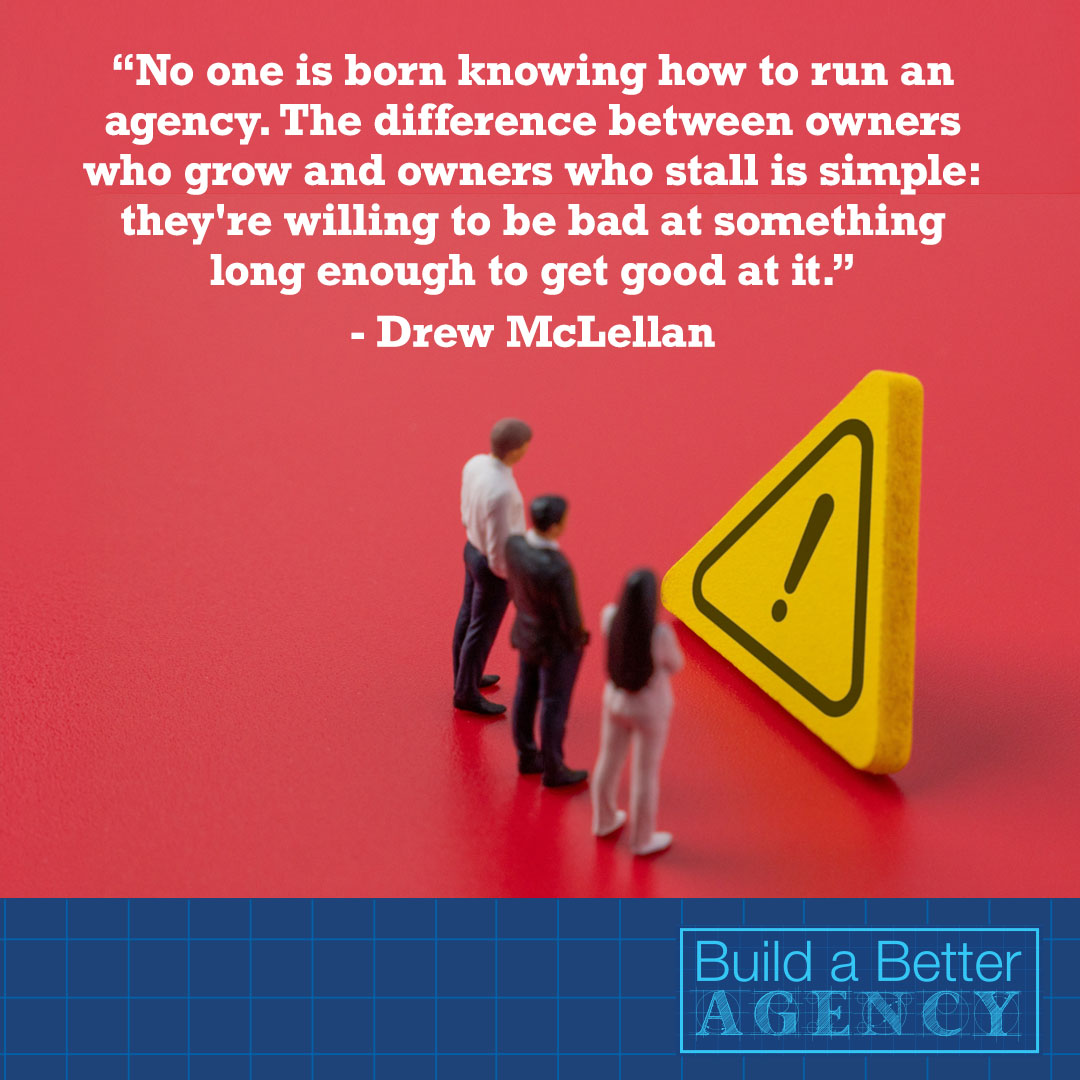
So one simple exercise I want you to do now, or maybe when you’re done listening to this episode, is this. I want you to think about the one part of leadership or ownership that, that you’re currently avoiding. And I want you to be honest with yourself. Maybe it’s the financials. Maybe it’s having hard conversations. Maybe it’s sales. Maybe it’s delegation. Maybe it’s firing a client who needs to go. Whatever it is, I want you to listen for the sentence that you said to yourself about it. Is it I’m bad at or I’m not a fill in the blank person? That’s the fixed mindset that you have to change? Or was it I’m learning how to or I haven’t figured out. I haven’t figured this out yet. That’s a growth mindset that you want to embrace, that you want to say out loud that you want to seek counsel and help with. Because the minute someone else knows that you’re trying to get better and grow, most people are more than happy to help you learn what you don’t know. Switching that one phrase changes how you show up. If you’re learning that it’s okay to ask dumb questions at a workshop, it’s okay to sit in on a peer group and say, I don’t really fully understand my P and L yet. Will you help me? That’s how every savvy agency owner you admire actually got there. No one is born knowing how to run an agency. No one. Every single agency owner that you look up to or that, you know, that you think is running a successful shop had to learn all of this stuff. The only difference between them and someone who is stuck is that they were willing to be bad at it for a while in order to eventually get better. That is the sign of leadership that you identify what you’re not great at and you decide that you are going to get great at it. But you’re willing to acknowledge that right now it is not your strength.
That’s the mindset shift from I am or I’m not to I’m learning. And I have. I. I’ve been in this business a long time and I’m telling you, there has never been more demand on us as leaders and owners to keep learning. If we don’t, we are going to be irrelevant in a blink. We must continue to learn. And I’m not talking just the basic skills of reading a P and L. I’m just saying in general, we have to keep getting better. And so the more we set that example, the more the employees around us also adopt that attitude and that behavior and that belief that we should all keep learning. So that growth mindset is critical for you, and it’s also critical for your team.
All right, so let’s talk about the way you think about the roles. So many of you have read the book E. Myth, and I love that book because it gives language to a trap that I see agency leaders and owners fall into all the time. This may be one of the greatest Achilles heels of agency owners and leaders. So Michael Gerber, who wrote E Myth, says, in every business there are three roles. There’s the technician who does the work. There’s the manager who organizes the work, and there’s the entrepreneur who designs and owns the business.
Most agency owners are world class technicians. You are an amazing copywriter, designer, strategist, media planner, whatever. That’s why you got promoted or why you started the agency in the first place. You were so good at the work that someone said, you should run this, or you said, I can do this better on my own. But if you stay primarily in technician mode as the owner, you will absolutely cap your agency’s growth and crush your own sanity. You become the bottleneck. The work is great, but the business is fragile because it revolves around you.
So let me paint you a picture. You are the owner. You are also the lead strategist on your three biggest clients. You’re the one that does all the pitches because no one else gets it the way you do. You are the ones that clients ask for by name. On the surface, that feels awesome. It feels like you’re valuable. It feels like proof that you’re still good at the craft. But here’s what’s actually happening. You’re working 60 hour work weeks. You don’t have time to think about where the agency is going, or writing the mission, vision and values, or putting together a vision statement because you’re buried in client work. You can’t take a vacation because everything falls apart. Or you work on your vacation. Yeah, you’re making good money, but the business has no value to anyone else because the business is you. That’s the technician trap. And it is incredibly common in agencies because we are in a talent business. The work is personal, the work is creative, and it feels wrong to just hand it off, especially when you’re so good at it and you can do it so much faster than anyone else. But if you want to build an agency that can grow, that can run without you, that has real enterprise value, you have to let go of being the best technician in the building.
Managers help, but their job is still mostly about today. Schedules, deadlines, deliverables. How do we get this project done? How do we keep the client happy this week? The owner’s job is to hold today and tomorrow at the same time, to ask questions like, is this business model actually profitable? Are these the right clients for us? Do we have the right people in the right seats? What does this agency need to look like in three to five years and what do we need to do now to get us there? What are we building and why? Those are entrepreneurial questions, Those are owner questions. And if you’re spending all of your time in technician mode, you are not asking those questions now in a small shop, you’re going to wear all three hats. That’s just reality. I’m not suggesting that you stop doing client work entirely, especially in the first few years. But I want you to look at your calendar for the last week and say, which hat did I wear the most? And if the answer is the technician hat, you have a problem. If you’re spending 80 to 90% of your time as a technician, you don’t really own an agency yet you own a job, your job, and probably a job that pays less and has worse hours than the job you left to start the agency, or to buy the agency, or to become the leader of the agency. Your 18 month goal is not to stop the work completely, but it is to start shifting your time and your identity towards that owner or entrepreneurial role.
So here’s what that looks like practically you start blocking time every week to work on the business, not in the business. Maybe it’s Friday mornings, maybe it’s Monday afternoons, but it’s sacred time where you’re thinking about strategy, not execution. You start handing off parts of client relationships. Maybe you’re still in the big meetings, but someone else is running the day to day. Maybe you’re part of the pitch, but you’re not writing every slide slowly start stepping away. Another thing you do is you start asking yourself, who else could do this? Before you automatically say, I’ll do it. You start building systems and processes so the work can happen without you. Now, that might feel like slowing down in the short term, but it’s what lets you scale, it’s what lets you step away. And here’s the hard part. You have to be willing to let other people do it differently than you would. And I know for a lot of you that is hard. It’s not wrong, it’s just different. Because if your standard is. It has to be exactly how I would do it, you will never let go and your agency will never grow. And that’s okay if that’s what you decide. But make sure it’s a conscious decision. But if you can start making these changes, that’s what frees you up later to do things like implement Agency Advantage, which is sort of our version of traction, or work through Built to Sell or actually take a two week vacation without checking your email 47 times a day.
The shift from technician to owner is one of the hardest shifts that agency owners make. And I will tell you, there are many of you listening who have 20 or 30 years of experience as an agency owner that are still very entrenched in the technician box right now, today. But the shift is also one of the most important because if you can’t start making that shift, you don’t have a business, you have a job with a few extra steps. You don’t have anything to sell down the road. You don’t have a way to keep growing. You don’t have a way to keep making more money because you are the bottleneck. Okay, so again, shifting from technician to entrepreneur, owner, that’s a, that is a 18 month. It’s not an 18 day, it’s an 18 month goal that you’re going to just chip away at every week.
All right, let’s talk about one more angle, one more lens I want us to think about which is responsibility. So Carrie Siggins wrote a book called the Ownership Mindset. And that book talks about this ideal of radical responsibility. Managers say, you know what? I did my part. And what owners say is, if it’s broken and if it touches my business, it is my problem to solve.
So here’s how that plays out in agency life. A manager looks at the P and L and says, you know what? Finance didn’t explain this well or the bookkeeper didn’t get me the report on time. An owner says, I do not understand this yet, but I’m going to sit down with someone until I do. And if the bookkeeper isn’t getting me what I need, I’m going to change that because I need this information to run the business. I am going to fix what’s broken. I will not accept something and as broken and not finish it until it is no longer a problem. See the difference? The manager blames the system or the person. The owner takes responsibility for the outcome. Another example of this is a manager says, I flagged this issue with a client three weeks ago and nothing has happened. And an owner says, you know what? I flagged it. But clearly I didn’t push hard enough or escalate effectively. What do I now need to do to make sure that I fix this and how do I need to change in how we operate so this does not happen again? I, I, I versus they they they. That is a huge sign. The manager thinks their job ends when they raise the flag. And whatever, whoever got the flag raised on them, now it’s their responsibility. The owner knows that their job is to make sure the problem gets solved and even if it means they have to do something uncomfortable. Okay, let me give you a third example. This is a, this is a team example. So a manager thinks leadership won’t let me hire or HR won’t let me fire this person. And an owner remembers, I am leadership now. I am hr. If I do not like the answer, I either need to make a better case or make a different decision. But I can’t blame some phantom they anymore. Ultimately, the buck stops here.
None of that means you have to do it all by yourself. In fact, good owners are pretty ruthless about not doing everything. They delegate, they build teams, they create task forces, they hire experts. But what they don’t do is outsource responsibility. Even when they delegate the work, they still own the outcome. Here’s a test. Listen to how you talk about your agency for the next week. How often do you say they when you’re talking about a problem or a situation? They won’t fix pricing, they don’t share the numbers. They Keep saying yes to bad clients. Every time you hear yourself say they stop and ask who is they? And then translate it to we or I. They won’t fix pricing becomes I haven’t fixed pricing yet. They don’t share numbers, becomes I haven’t insisted that we share the numbers yet, or I haven’t built a reporting system that works. They keep saying yes to bad clients becomes I have not set clear criteria for what clients we take, or I haven’t held people accountable to that standard. That’s the ownership sentence. It’s uncomfortable, but it’s where your power actually lives. Because as long as you’re blaming they, you’re powerless. But when you say I own this outcome, you’re also saying, I can change this and you can. That’s radical responsibility.
Now, I want to be clear. This is not about beating yourself up. This is not about saying every problem is your fault. Sometimes stuff happens that’s outside of your control. A client goes out of business, the economy tanks, A key employee gets a life changing opportunity and leaves. We’ve all had things like that happen. But even in those situations, what the owner says or the leader says is, okay, what do I do about this? How do I respond? What do I control here? You can’t control the client going out of business, but you can control whether or not you have enough clients that losing one doesn’t kill you. You can’t control the economy, of course, but you can control your pricing and your cash reserves. You can’t control an employee leaving, but you can control whether you have a plan to replace them and whether you’ve documented all of the good things that they carry around in their head around their clients. And also you control whether you’ve built a culture where people want to stay. Those are all within your control. Radical responsibility is not everything is my fault. It is. I’m the owner, so I’m the one who has to solve. I have to solve all the problems. At the end of the day, even if I’m not coming up with the solutions, I have to authorize that someone has the authority and the responsibility to solve that problem. But ultimately, if the problem does not get solved, it’s on me. Once you accept that, and I mean really accept it, it’s actually kind of freeing because you stop waiting for someone else to fix your problems. You stop hoping the problem will go away. You just say, okay, this is mine, let’s handle it.
All right, so we’ve talked about mindset. We’ve talked about the role, the technician, the manager, the Entrepreneur, the owner. And we’ve talked about that radical responsibility. Now I want to share with you a few beliefs that new owners have to drop in order to step into their identity.
Belief number one, I’m not a numbers person. We’ve already talked about this. This came from an owner named Mark. He runs a branding agency, about 10 people. He’s been an owner for about three years. And here’s what he said. I told myself for years that I am not a numbers person. I’m a designer, I’m visual, I’m creative. Numbers just do not make sense to me. And then I went to Ami’s Money Matters, and I realized I was using I’m not a numbers person as an excuse to avoid something that scared me. Because if I understood the numbers, I’d have to make hard decisions, and I’d have to maybe raise prices or fire clients, or maybe I’d have to trim staff. I’d have to admit we were doing some things that didn’t make financial sense, and I didn’t want to do that. So I decided I had better learn this. I am not going to become a cfo, but I am going to understand my P and L, my cash flow, and my unit economics well enough to make good decisions, because I want my business to be around for a really long time. I want to be able to create a great career opportunity for my employees, and I want to be able to make great money for me and my family. Can’t do that if I don’t understand the numbers. And you know what? It wasn’t that hard. It took a few months of asking what some might have thought of as dumb questions, sitting down with my bookkeeper and actually reading the reports. But now that I look at the numbers every month, I can make decisions based on that data, not just trusting my gut. And I got to tell you, my gut was wrong more often than I thought. And my agency is healthier because of it. We’re more profitable. We’re more intentional. I sleep better. All because I dropped the belief that I’m not a numbers person in that story. The belief was I’m not a numbers person. Super common. The shift was I can learn enough about my financials to make good decisions, and that is my radical responsibility as the business owner. Once Mark owned that, he started showing up differently with his cpa, with his leadership team. He stopped avoiding numbers and started using them to actually lead his business.
All right, belief number two. If I am not in the middle of every project, something will fall apart. So this one came from an owner named Lisa. She runs a content marketing agency, has about 35 people. She’s been an owner for about four years. She said I was the best writer in the agency. I knew it, everybody knew it. So I kept myself on every major project because I thought if I’m not involved, the quality will drop. What I didn’t realize was that I was capping everyone else’s growth. No one could get better because I never gave them room to try. And I was capping the agency’s growth because we could only take it as far as as much work as I could personally touch. So I was the bottleneck. Drew finally said to me in a coaching call, lisa, do you want to be the best writer in a 35 person agency or do you want to build a 35 person agency that does great work without you? And I realized I can’t have both. So I started letting go. I started trusting my team. I started giving them high profile projects and yeah, sometimes the work wasn’t exactly what I would have done, but it was still good and the clients were happy and my team got better and I got my life back. I wasn’t working 70 hour weeks anymore. I could actually think about strategy and growth and where we’re going. The belief I had to drop was I’m the only person who can do this right. The belief I adopted was my job is to build a team and a system that can deliver without me. That’s when we started moving towards an agency that has real enterprise value and was not just a busy owner creating a job for herself and a few other people. Here the belief was, if I’m not in the middle of every project, something will fall apart. That’s technician brain talking. The owner, Lisa, became so entrenched in thinking she had to do all the work that she couldn’t get out of it until she decided, my job is actually not to do the work. My job is to build a team and a system that can deliver without me. That’s when you start moving towards building an agency that has real value that someday you can sell. Not just creating a job for yourself because you’re good at the craft.
If you’re hearing a theme, you are. Every agency owner and every agency leader has to outgrow some old identity, Star, performer, people pleaser, creative hero, and grow into, I am running this business or I own this business. And that growth happens when you identify the belief that’s holding you back and consciously choose a new belief.
All right, let’s make this useful. I want you to pause after this episode and literally take five to 10 minutes and answer one question. Where am I? Still thinking like a great employee instead of the leader or owner of the entire agency. It might be you keep saying yes to unprofitable work because you don’t want to upset a client. It might be that you’re avoiding the P and L because you’re afraid of what you’ll see and the decisions that it may force you to make. It might be that you’re clinging to work that someone else on your team could do because that’s where you feel like you’re the most valuable and it’s where you feel the most confident. It might be that you’re waiting for someone else to make a decision that’s really yours to make. Write it down and be honest with yourself. Be blunt with yourself. No one else is going to see this. Then I want you to pick one decision that you’re going to make this week as the leader or the owner, not the employee. Maybe you raise prices with a client that has been undercharged for years. Maybe you say no to an RFP that doesn’t fit your positioning, even though you need the revenue. Maybe you schedule a working session with your bookkeeper and ask all of the air quote dumb questions until you actually understand what the PNL is telling you. Maybe you hand off a big chunk of a client project to your team and use that time to work on the business rather than in it. Maybe you have the conversation with the employee who’s been underperforming, the one you’ve been avoiding for two or three months. Don’t try and reinvent yourself in a single week. Just practice thinking and acting like an owner once. Just once this week, on purpose. That’s how this identity shift actually happens. One decision at a time. One uncomfortable conversation at a time. One moment of okay, this is mine to own at a time. You don’t wake up one day and suddenly feel like an owner. You make owner decisions over and over and over again until you look back and realize, oh, I actually think automatically like an owner today. I didn’t always do that, but today I do.
Today we talked about identity shift of ownership. How you see yourself, how you see your role, how you see your responsibilities. Be honest with yourself about where you’re at in all three of those places and where you have room to grow. Talked about mindset. The difference between I’m not a numbers person versus I’m learning the numbers. We talked about role. The difference between being the best technician in the building and being the entrepreneur that owns and builds the business. And we talked about responsibility. The difference between I did my part and I own the outcome. If this feels uncomfortable, that’s good news. It means you’re actually in the shift. It means that you are moving in the right direction. That’s exactly why we built this owner mindset resource guide that you can download and why AMI exists in the first place.
In the meantime, I would love to hear your owner confession. Send me a quick email. Tell me about the moment you realized, oh shoot, I really own this place. What was the trigger? What changed for you after that? Or if you haven’t had that experience yet, then let me know how it’s going, where you’re stuck, where you think you are in these three areas. We may be able to share a few of these in future episodes and I think it’ll be super valuable for other people to hear that other owners are in exactly the same place that they are. And they’re not alone in that. You don’t have to do ownership alone. That’s what AMI is here for. That’s what the podcast is here for. But you do have to own it. That is when you know that you actually own the joint.
Okay, all right, before I let you go, a couple things. Number one again, a quick thanks to our friends at White Label iq. Super grateful for their sponsorship over the years. And I am incredibly grateful that you listen week after week and that we get to do this together. I love learning with you. I love helping you learn. I love learning from you. And so I’m going to keep coming back and I hope you will too. Talk to you next week.
Danyel McLellan [01:03:15]:
That’s all for this episode of AMI’s Build a Better Agency podcast. Be sure to visit agency agencymanagementinstitute.com to learn more about our workshops, online courses and other ways we serve small to mid size agencies. Don’t forget to subscribe today so you don’t miss an episode.