
Episode 512

Welcome to another insightful episode of Build a Better Agency! This week, host Drew McLellan sits down with longtime friend and agency leader Jeff Eisenberg for a candid conversation about the art and practice of agency leadership. Whether you’re a seasoned agency owner or new to the business, this discussion is packed with real-world lessons and thoughtful perspectives that will help you elevate your leadership game and set your agency up for lasting success.
Jeff shares the compelling journey that led him from sports marketing with major league teams to purchasing and running his own ad agency. Now, as he transitions into author, teacher, and mentor, Jeff unveils the leadership strategies and philosophies that have served him throughout his decades-long career. The focal point of the conversation is Jeff’s new book, Beyond the Big: The Tiny Moments of Leadership, which takes a fresh, practical look at how small, everyday actions define truly great leaders.
Together, Drew and Jeff unpack the power of “tiny moments”—those micro-interactions and subtle choices that shape agency culture, empower teams, and foster real trust. They discuss actionable ways to be more present, why giving away power is essential, and how agency owners can break the habit of doing in order to focus on being and leading. Jeff also opens up about his own growth as a leader, offering relatable anecdotes, hard-won advice, and encouragement for leaders at every stage.
Whether you’re planning for succession, looking to strengthen your core values, or simply hoping to increase your presence and impact, this episode is a treasure trove of actionable wisdom. Tune in for strategies you can start applying today, and get inspired to become the kind of leader your team will remember for years to come.
A big thank you to our podcast’s presenting sponsor, White Label IQ. They’re an amazing resource for agencies who want to outsource their design, dev, or PPC work at wholesale prices. Check out their special offer (10 free hours!) for podcast listeners here.
What You Will Learn in This Episode:
-
- Embracing leadership as a series of tiny, everyday moments
- The power of vulnerability and humility in strong leadership
- Developing other leaders as a core responsibility for agency owners
- Transitioning from “doing” to “being” present as a leader
- Building and living authentic core values within your agency
- Creating a culture of honesty, care, and “carefrontation”
- The incremental, lifelong journey of improving as a leader
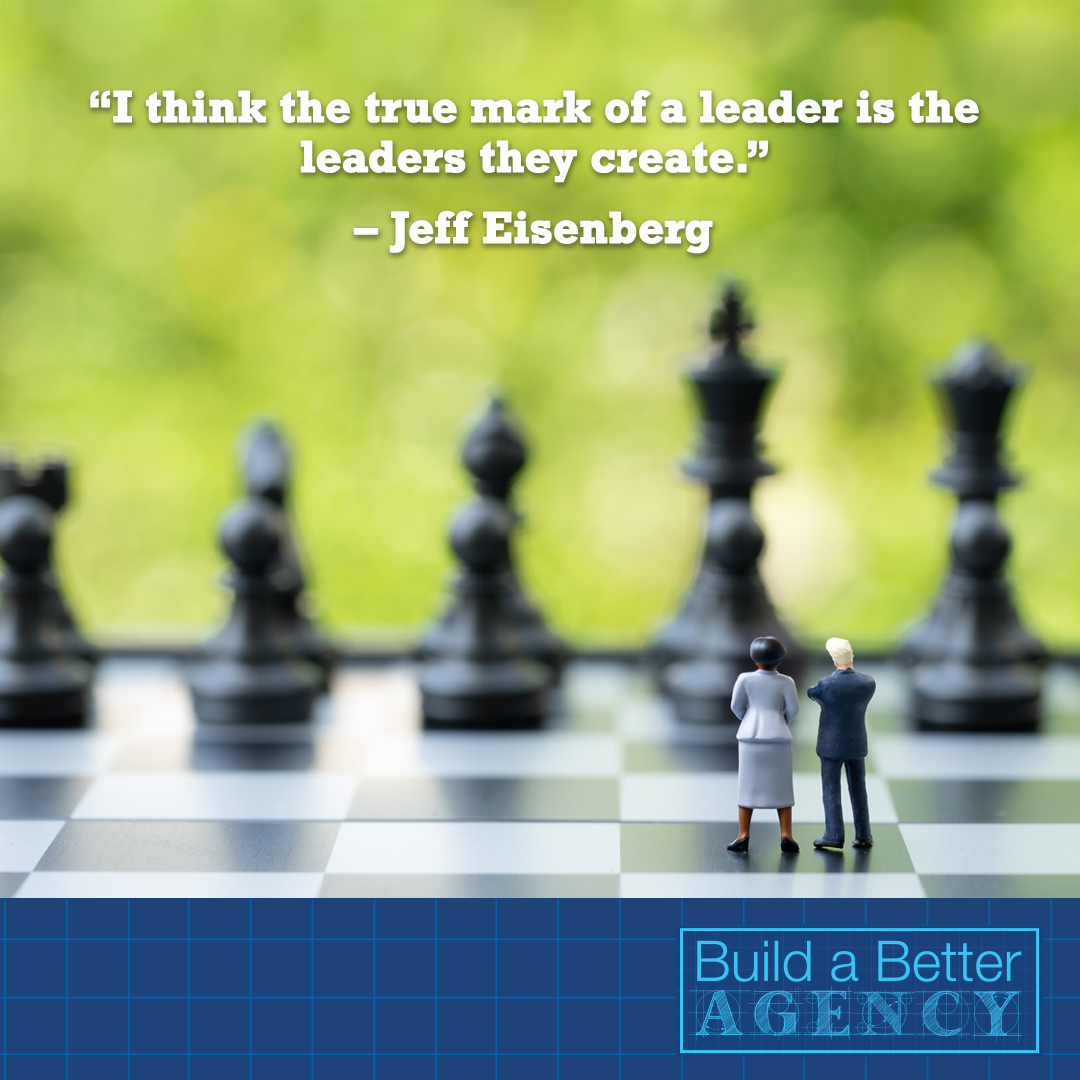
“I think the true mark of a leader is the leaders they create.” - Jeff Eisenberg Share on X
“If you're not growing people, if you're not transforming people around you, you're just an autocrat.” - Jeff Eisenberg Share on X
“You’ve got to want to get out of the work and you’ve got to separate your ego from that.” - Jeff Eisenberg Share on X
“You have to walk the walk or it’s just empty, and it won’t work, and you lose your credibility.” - Jeff Eisenberg Share on X
“Carefrontation—it's corny, but it really works. It’s caring, it’s having a confrontation, but it’s out of true caring.” - Jeff Eisenberg Share on X
Ways to contact Jeff:
- LinkedIn (Personal): https://www.linkedin.com/in/jeffeisenberg1/
- Website: https://jeff-eisenberg.com/
Resources:
- Jeff’s book: Beyond the Big: The Tiny Moments of Leadership
- BaBA Summit May 18-20, 2026: BaBA Summit May 18-20, 2026: https://agencymanagementinstitute.com/babasummit/
- Drew’s Book: Sell With Authority
- AMI Facebook Group: https://www.facebook.com/agencymanagementinstitute
- AMI Preferred Partners: https://agencymanagementinstitute.com/ami-preferred-partners/
- Agency Edge Research Series: https://agencymanagementinstitute.com/agency-tools/agency-edge-research-series/
- Upcoming workshops: https://agencymanagementinstitute.com/advertising-agency-training/workshop-calendar/
- Weekly Newsletter: https://agencymanagementinstitute.com/newsletter-sign-up-form/
- Agency Coaching and Consulting: https://agencymanagementinstitute.com/advertising-agency-consulting/agency-coaching-consulting/
Drew McLellan [00:00:37]:
Hey everybody, Drew McLellan here from agency Management Institute. Back with Yep, you guessed it. Another episode of the Build a Better Agency podcast. Super grateful and glad to be back with you today. Have a great guest and we’re going to talk about one of the most important aspects of running a successful, profitable agency. So if you have just stumbled upon us and this is your very first podcast, welcome. If you are a regular listener, welcome. For those of you who aren’t familiar with us, we focus at AMI or Agency Management Institute. We focus on the behind the scenes, the back of the house kind of things, how we as agency owners and leaders, what the decisions we need to make, where we need to focus to run an agency that is more profitable, more sustainable, more stable and hopefully down the road something that you have that you could sell. And so it’s really about the business side of the business. How do you run the business of your agency better? And today’s topic is right on point with that. But before I tell you about our guest, I want to remind you we do a lot of consulting work, coaching work, and we develop a lot of tools that we use in that work and some of those tools we like to make available to you. So if you want to do the work on your own, you absolutely can. And one of the tools, one of my favorite tools is the agency health checkup. It’s 20 questions that everybody on the leadership team would answer independently and then you would share the answers. And very quickly it identifies the aspects of the business that need the most focus and attention from you and the leadership team. Where do you need to level up? And so you can download that agency [email protected] health checkup all one word. So again, agencymanagementinstitute.com health checkUP. So grab that and use it with your leadership team and happy to chat with you more about it and how we use it at our next Q and A or any other time that we have the opportunity to chat with you. So let me tell you a little bit about our guest. So I have known our guest, gosh, for probably almost 20 years, if not probably at least that. And I met him, actually, I met him when he was looking at buying an agency. He ended up buying a different agency and we have worked together for many, many years. His name is Jeff Eisenberg, and Jeff has did quite a professional journey, which I’ll let him tell you about. But after owning his agency for a couple decades, he is ready to do a couple of things. One, he’s in the process of selling his agency to a couple of his employees, and two, he’s sort of embarking on this new world of teaching and mentorship for young entrepreneurs. And so as a result of that, he wrote a book, a fantastic book about leadership. And it’s, it’s a very different take on leadership and I think it’s a really interesting one, especially given that his leadership lessons were born out of his role as an agency owner. So lines right up with you and your world. And I think he’s going to have a lot to say to us. So grab the health checkup. And without further ado, let’s welcome Jeff to the show. Jeff, welcome to the podcast. Thanks for joining us.
Jeff Eisenberg [00:03:53]:
Hey, Drew, thanks for having me.
Drew McLellan [00:03:55]:
So some of the listeners who’ve been part of the AMI community for a while are probably familiar with you, but for those that are not, give everybody a little bit of background of sort of who you are and what you’ve been up to for the last couple decades and then we’ll talk about the book.
Jeff Eisenberg [00:04:10]:
Few decades. Yeah. So I spent many of my years in sports marketing. Came out of college, went to grad school for sports marketing, got a job with the Philadelphia Phillies, bright eyed and bushy tailed and stayed there for almost nine years. I made my track through ticket sales, which was affiliated with marketing. Then I went to the Milwaukee brewers where I was director of ticket sales. Made it to VP of ticket sales and marketing from there. So I’m doing my baseball thing, right? And I worked for Bud Selig and his daughter, which is a tremendous experience. That’s another story. Oh yeah. Oh yeah. And then I went to the, as my baseball friends would say, I went to the dark side. I went over to hockey. Now I’m from Memphis, Tennessee. I don’t even skate. Didn’t know blue blue line from icing. But here I went. I went from Milwaukee to Buffalo, joined the Buffalo Sabres as VP of marketing, and then I was in hockey from there. The LA Kings hired me to. Well, I actually I went to the Portland Pirates of the American Hockey League from the Sabres, which was a Lot of fun because I went from VP to running an organization, being the face and the. The kind of the top dog at the AAA of hockey, which was the Portland Pirates. And then the Kings hired me to move to Manchester to open up their new AHL team and a building here in Manchester, New Hampshire. And I’ve been here for 25 years, 10 years into the Monarchs, when I was running the Monarchs. I like building things. And I. And I said, and I’d always worked with agencies, advertising agencies, all my life. I said, you know, if I ever got out of this sports thing, maybe I’d do the agency gig. And that’s what I did. I didn’t want to leave New Hampshire. I love New Hampshire. And I bought an ad agency 15 years ago, made a nice run. That’s when I met you. Obviously, you’re largely instrumental in our success. So everything I’ve learned from AMI over the years and then. So for the last 15 years, I’ve been running this agency doing well, and it’s time to pass it on to two of my fantastic leaders. They’re. They’re buying the agency from me in December. Pete Ritchie, McKenzie Fraser, shout out to them. And then I’m kind of moving into my next thing, whatever that is. Right. That’s kind of what this is all about.
Drew McLellan [00:06:31]:
Yeah. Yeah. So. So an interesting trajectory to go from being on the client side in sports, but still on the client side for a long time, buying an agency. So I’m curious, and then we’ll talk about the book. I’m curious. I know when I started my agency back in the day and I had grown up in agencies, so I had never been on the client side, but I was convinced I was going to do it differently. And part of why I wanted to start my own agency is because I worked for somebody who I did not think did it well, and I didn’t have a lot of respect for. And I thought, if he can be successful at this, then I can too. And for a long time, whenever I would make a decision, I would think about what he would do and then just do the opposite. So I had. I had this vision of how I wanted to run my agency. So I’m curious, as you were buying an existing agency, what was important to you as an agent? Like, as you were going into it? It’s one of those things. It’s like you think you know what being a parent is till you have a baby, and then you’re like, oh, crap, this is what being a parent is. I think agency ownership is a Little like that too. Right. Like you think you know what it’s going to be like and then you are in it and you’re like, oh, wow, this is, this is not exactly what I thought it was going to be. Or it’s more or different. So I’m curious what your vision was when you went to buy the agency. What did you want to create?
Jeff Eisenberg [00:07:49]:
So when you ask that question, it’s interesting. I reflect on all the podcasts, the Build a Better Agency podcast I’ve listened to over the years and I remember when you launched your first one and because my answer is not going to be run in the mill, I don’t think it’s going to be. So when listeners, you throw all these things into the mix and then you pick which ones you like or you reflect on and one comes back to you. Because you know what? I really was a bit, it was a combination of being bold and incompetent and naive. Yeah. And I think a little bit of naivete is not bad in life because if you don’t have it, then you’re trying to overanalyze everything. You’ll never do anything or you’d be.
Drew McLellan [00:08:32]:
So scared you wouldn’t do it. Right.
Jeff Eisenberg [00:08:34]:
You would not do it.
Drew McLellan [00:08:35]:
That’s what I always say. I was the perfect combination of arrogant and ignorant when I started my agency.
Jeff Eisenberg [00:08:41]:
That’s just another way of saying what I just said.
Drew McLellan [00:08:43]:
Yeah, I totally agree.
Jeff Eisenberg [00:08:45]:
Absolutely. Absolutely. So I remember coming out of college and I’ve always been competent myself, hopefully not bordering on any kind of arrogance that you self profess to. But I always just thought whatever I was going to do is going to succeed. I just always felt that way. Not trying to be boastful.
Drew McLellan [00:09:03]:
Yeah.
Jeff Eisenberg [00:09:03]:
Like I say, confident, little ne and knock on wood, things have generally gone pretty well. So when I went into the agency, I’m, you know, I’m talking to this, the person I’m buying. I bought a little boutique. There were like eight basically designers. Yep. Creating for the sake of art, but we won’t get into that. But so I was kind of the business guy, the suit coming in, you know. But when I bought it, I just said, I used to say, what’s the worst thing that can happen? And that’s the thing I learned in Dale Carnegie, which I took a long time ago. That one stuck with me. What’s the worst thing that can happen? I lose all my money. We’re not going to die, we’re going to eat. My kids will have to pay for college, yada yada. Yada. So I’m exaggerating a little bit, but I think it was just, hey, I don’t want to move. I love it here. Let’s do this. It’ll probably work. Yeah, that was it.
Drew McLellan [00:09:54]:
Yeah. And now, many years, many years later, you’ve grown the agency significantly. You’ve. You’ve built a great team. So obviously it did work. So what prompted you to think you wanted to be an author? So your book beyond the Big the Tiny Moments of Leadership came out, but about a year ago.
Jeff Eisenberg [00:10:12]:
No, no, no, no. Only in May. Just a couple months ago.
Drew McLellan [00:10:15]:
Okay. Okay. All right. So a couple months ago.
Jeff Eisenberg [00:10:17]:
Yeah.
Drew McLellan [00:10:17]:
So what made you go? You know what? On top of everything else I got going, I want to write a book. So, one, why do I want to write a book? And two, why this topic?
Jeff Eisenberg [00:10:26]:
So I’m a fan of leadership.
Drew McLellan [00:10:29]:
Yeah.
Jeff Eisenberg [00:10:29]:
Always have been. Didn’t even really self identify with that early on. I just was. And then I began to realize, oh, this is kind of a science. It’s a craft. You know, maybe we should put some meat on the bone. But I would. I kept a list. I started a list early on of what I came to know as are called my leadership axioms. I would hear something or read something, and I would just. I would log it. And I made it up to 114 of these things over the years, my leadership axioms. And the people who work for me, you know, got a dose of them along the way, because I would take talk. I would go, here, let’s talk about these, you know? Right. So when they read the book, it’s like they’re living. Living it. You know, they can hear me talking to them. But, you know, things like leadership is action, not a title. Things that might be obvious to us, but sometimes we just don’t think about it or maybe it hadn’t occurred to us. Eat the frog. Which is kind of. What does that mean? That means if you got something. Mark Twain said, if you got something very difficult to do, it was in reference to that concept. He said, if you have to eat a frog once a day for the rest of your life, do it first thing in the morning.
Drew McLellan [00:11:38]:
Right, Right. I think Brian Tracy wrote a whole book about that topic, Right?
Jeff Eisenberg [00:11:42]:
Oh, he did? I don’t think so. Yeah. Originally attributed to Mark Twain. Then he said, and if you need to eat two, you know, eat both of them right there.
Drew McLellan [00:11:51]:
Right.
Jeff Eisenberg [00:11:51]:
And, you know, eat them fat. So anyway, you know, things like that. True characters revealed in the face of adversity. Worst idea goes first so all these kinds of little things I would hear, like, really cool. So what happened was as I embarked on the succession, my succession plan, I, you know, starting to think about what I was going to do. I love leadership. And I said, well, I think I want to teach, which is not unusual for old guys like me.
Drew McLellan [00:12:17]:
Right.
Jeff Eisenberg [00:12:17]:
You think you’ve got a few things to say. And I also was interested in doing, like, little workshops for companies in the area. So I. To be honest with you, I said, well, let me put these into a book, and I can trade on it, if you will, to be, you know, and I can memorialize all this stuff.
Drew McLellan [00:12:35]:
Right.
Jeff Eisenberg [00:12:35]:
And it just seemed like it seemed like a good idea at the time, you know, four years ago, because I’m working while I’m doing it. And then I was listening to a podcast one day, and I heard somebody refer to the tiny moments of something. It wasn’t leadership. It was whatever it was, and bam, the light bulb went off. I said, oh, my God. That’s what it is. It’s the tiny moments of leadership.
Drew McLellan [00:12:58]:
Yeah.
Jeff Eisenberg [00:12:59]:
And that is what great leadership is based on. And it all just came together, and that’s what started it. And it’s truly the basis of my view of leadership. And I am teaching. I’m teaching at a local university, doing a MBA class in leadership, and am starting to do some workshops for companies. So that’s what I’m going to do for a little while. Yeah.
Drew McLellan [00:13:18]:
You know, it’s interesting. I think sometimes we think of leadership with a capital L, Like. Like, it’s a big. Like, it’s like how you show up at the annual meeting or how you, you know, create a vision. And I’m not saying that’s not important, but it’s a little like parenting. Right? Like, you got to show up every day, and you got to show up to your point in these tiny little moments consistently every day, to be a great parent or to be a great leader. It really is those micro interactions where you either earn your stripes or you sort of prove that you’re a hypocrite, one of the two. Right. I think anybody can fire up for the big annual meeting or the big whatever, but how you show up on a Wednesday when something’s late or someone’s having a personal problem or fill in the blank, like, how you show up in those tiny little micro moments really does define your leadership style, I think so. I think you’re. I think you’re spot on.
Jeff Eisenberg [00:14:18]:
I would agree. And I think it’s kind of embedded in A lot of us, we naturally kind of think it in our subconscious somewhere, some, some, maybe we don’t. Some maybe we don’t put enough emphasis on those little notes. We may be, we are showmen. And, and like you say, that is valuable. It is important. Now you present yourself and how you speak to a large audience. But if we think back on the leaders that impacted us, right. The ones we remember that resonate and made a difference in our life, it’s most likely not the one that stood in front of a huge group and told a compelling story. It’s the one that had a moment with you and stopped and talked to you and asked you how your kids play was over the weekend or whatever it is. And it’s all about, you know, being abundant, which is kind of one of the three, the big three I call in my book, you know, having vision. We talk about what that means and having character, which is, which trust is, is of course the foundation and embedded. And you cannot lead without trust. And then that third, third one, being abundant, being abundant, walking around, you know, and sharing those tiny moments with people, that’s what they remember. That’s what they remember.
Drew McLellan [00:15:29]:
So let’s talk about abundance because I think that’s an interesting concept. I agree with all three, but the idea of abundance. So I think everyone listening probably feels like their most challenged resource is time and attention. Right?
Jeff Eisenberg [00:15:45]:
Yeah. Yes.
Drew McLellan [00:15:46]:
So as you have led throughout your entire career, because you were certainly a leader before you bought your agency, but as you’ve led throughout your entire career, how do you create abundance in a world that wants to rob us of that?
Jeff Eisenberg [00:16:01]:
Yeah. When you talk about abundance, it is that personal time that you have with people. And what we’re going to have to just understand is that. And you, you’ve preached it from, you know, the, the working on the business, not working in the business and.
Drew McLellan [00:16:15]:
Right.
Jeff Eisenberg [00:16:15]:
And having the business not need you. And the last five years have been a lot of fun for me because I have been saying I need to make myself irrelevant. Right. So. Right. And oh my God forbid, you know, our egos are wrapped around a lot of that stuff. But I’ve always thought that people can really only have six direct before to six to seven direct reports. And when you have, when you hear somebody that has 10 to 12, it’s not working. So I think the true mark of a leader is the leaders they create. The purpose of power is to give it away.
Drew McLellan [00:16:49]:
Yeah.
Jeff Eisenberg [00:16:49]:
And if you give your power away, then you don’t have to be there. Right. I truly believe Every time I dive in and I put out that fire and we all do it, right. It’s not my highest calling. I should be walking around, I should be stopping at somebody’s office saying, three, how you doing today? How’s Dana? What’s going on? Are you kidding me? Oh, my God. How are we going to deal with just spending that moment that just says they care? So I think you have to identify your top, the ones you interface with and make sure that they understand how you lead and how they carry it on through their six and so on to the next six. And you have to cascade this thing, somebody out in a designer. I’m not going to have that same relationship that I’m going to have with the six people that directly report. But you know what? I know Keith’s son just started first grade, and I’m going to ask him about that, those kinds of things. And so I think there’s a difference between, you know, we talk a lot about this being and doing right. And anytime a leader starts to shade too much to doing too much doing, they’re not being. So we talk about just be. Just be there. So you have to craft your world and your life and your business, and it ain’t easy because you get sucked in. But every time you get sucked in, you got to say, why’d that happen? And how can I not make that happen next time so that you can be available? I think that’s the highest calling of a leader.
Drew McLellan [00:18:15]:
I think so, too. I think it’s challenging because most people who are running agencies today were great doers early in their career. They were productive and they were high achievers. And so I think one of the challenges to really step into leadership is to get comfortable with the idea that not doing is okay, that is acceptable. It’s actually your job to not do right.
Jeff Eisenberg [00:18:42]:
It’s unacceptable not to accept that.
Drew McLellan [00:18:44]:
Right.
Jeff Eisenberg [00:18:45]:
And you know, when that’s. It’s tricky. You know, when you’re trying to identify that next, that leader, it is tricky because sometimes you really, you’re looking for signs. And I have, you know, I see signs when people buy. I tell people, when I talk to young people, volunteer for anything and everything you can.
Drew McLellan [00:19:06]:
Right.
Jeff Eisenberg [00:19:06]:
Don’t ask for any money. You’ll make the money, the money will follow. Grab as much as you can. So, you know, and that’s a leader. Those are leadership qualities. I believe that’s not so much. Is it a doer? It could be a doer. Quality. It could be, but. So you’re looking for these Signs. And you’re right, it doesn’t always translate. It doesn’t all. But, you know, when you’re fostering leadership, you’re not giving them the, you know, all the rope. You’re giving them a little bit of rope and you’re testing them out and seeing how they do. So another one of my little tiny moments is trust yet verify. Right. Which had its origins in the cold water and Reagan and the Soviet Union. But it’s like, give them a little something, trust them. But, you know, just come loop back, verify it.
Drew McLellan [00:19:47]:
Right.
Jeff Eisenberg [00:19:48]:
And I often tell them, I’ve told them, some people work for me. That’s what I do. I will. I’m pretty organized. I will remember. I’ll come back and ask and we’ll see how if it’s on track and if I keep coming back and it’s always well done and it’s really kicking, you know, in all cylinders, I start getting bored.
Drew McLellan [00:20:06]:
Yeah.
Jeff Eisenberg [00:20:06]:
So I’m feeling like I. I don’t. You know what? I don’t need to talk to Mackenzie. I know she’s got it, so I’m going to talk to her less. Right. So there’s all these things that are kind of happening underneath that allow you to move on to the next thing if you do them right.
Drew McLellan [00:20:22]:
So I can remember early in your agency ownership, because I have sort of walked that whole journey with you. You were a pretty big doer. Like, you were in. You were in the mix of all of it, right?
Jeff Eisenberg [00:20:35]:
Oh, yeah. Oh, yeah.
Drew McLellan [00:20:37]:
How did you break that habit? Because I think for a lot of the listeners, they’re stuck in the doing. So how did you successfully free yourself of that burden, both mentally and actually doing the work so that you could be more present, you could have that abundance, you could lead rather than do.
Jeff Eisenberg [00:20:59]:
My orientation coming to the table is to be. Let’s. I’m being honest here, right. Do I love the agency? I love the agency business. I love the average. I love marketing. That’s what I. You know, I love sports. I did sports marketing. But oftentimes I think that I would be quite happy running a widget company. I just don’t. At the end of the day, I really. I mean, I want to love what I do. We have to have a passion. We have a passion, and it does match up to marketing, you know what I mean? But anyway, so I had that orientation coming in that I like, because I know that if I’m. The less I’m doing, the more exponential I am on those around me. And the more I Get sucked into the doing. I am going to impact less people. And that’s always been a calling of mine in my mind. So how do you do it? You have to find leaders. And when, you know, I, when I bought the agency, it was eight people, right. And Pete, who you know well and who’s half the group buying my agency, he was, he was 35, working for two other people. There was something I saw in Pete and I wasn’t happy. And one day Pete comes in, I said, pete, come on, I talk to you. What do you think about being the creative director or whatever that title was, to run the creative department. And he gulped and you know, soon thereafter he walks in and those two people are working for him. A bit awkward, but necessary. So I found Pete and Pete and then I met you. So you’ve got to create the people. You’ve got to want to get out of the work. You’ve got to want to get out of the work and you got to separate your ego from that. Too many, I think a lot of our egos are wrapped up in the work. And I just don’t care if we came up, if we come up with an award winning idea, I promise you I didn’t come up with it. That’s too valuable for something to give to somebody else. Right. I don’t need to pump me up. So it’s a matter of just getting really strong leaders. And then here’s the tricky part. You got to get them to be able to create new leaders. So it’s one thing learning how to gather some leaders around you at the next level and nurture them. It’s another thing to teach them how to go out and foster leadership. So, you know, I’ve never run a huge company, whatever that’s defined as 2,000 people. And I am so curious about how that works.
Drew McLellan [00:23:27]:
Yeah.
Jeff Eisenberg [00:23:28]:
Because at some point it starts to break down. Unless you’ve got such systems or some establishment of the way you work in place. It’s fascinating to me. I’ll never have that opportunity, but it’s an interesting concept.
Drew McLellan [00:23:41]:
Well, I think, I think one of the reasons why most people listening own their own agency is because they, they want to run. I mean, even 300 people is a relatively small company. They know everybody. Like, I think part of what makes agency ownership appealing for all of us is that we can be very hands on and that we can have intimate relationships with all the employees. We can know the kids about to start first grade or whatever it is, which I think is a different path than choosing to be the CEO of a 5,000 person company. And I think leadership looks very different in those. Probably in the microcosm of I’m the CEO and I have the C suite that reports to me that probably looks about the same. Right. I’m going to treat those people the same, but five layers down. Do I know that somebody on the assembly lines, kid, you know, just the tooth fairy camera for the first time? Probably not. Right. So I think it would be a very different experience.
Jeff Eisenberg [00:24:37]:
It would be a different experience. But I do believe there’s one fundamental that runs across all of them and that is just baking in core values. And not core values in the sense that that’s a throwaway term. A lot of people just say core values. It’s a different topic. But we have to live our core values. They can’t just be words. And how do we live them? We can talk about how we live them, but. But I think that if there, there’s a reason I had my windshield replaced my car the other day and I called and this was the most amazing customer service that you can have. Right? And about the third call, consistently positive customer service, I stopped, I said, can I ask you a question? I said, do they talk to you about customer service and how you treat customers? She said, oh yeah, that’s a big deal around here. And it was the answer. I kind of knew what I was. That I was going to hear. That stuff doesn’t happen by accident. Right. And so that’s a real, that’s. They have eight locations throughout the state. And I think in a mass. That’s a big place. So it can be done. I just think that you have to bake these core values in, you have to mean them and they have to be, I hate the word usually enforced. And when I say enforced, that doesn’t mean you have to have the core value police walking around. No enforcement when it’s really working is self enforcement. You’ve got the culture such that it rejects those who don’t behave properly. That’s when you know you got something.
Drew McLellan [00:26:05]:
Well, and I think leadership is also about. You have to live it, you have to talk about it, you have to point out, you have to recognize when people do it so that people understand that it’s not just words on a wall. Right. I mean, I think for a lot of agencies, if they have core values at all, maybe they live in their employee handbook or their words on a wall, but they don’t really live them the way that you could or should. And so I do think it again, it starts with us and it is critical to again, tiny little moments all the time that you’re constantly referencing them and that you demonstrate through your actions how those things come to life.
Jeff Eisenberg [00:26:47]:
You gotta walk the walk or it’s just empty and it won’t work and you lose your credibility. And we don’t as leaders sit up there on a whiteboard and write our core values. If you’re doing them right, you’re getting them from your people. But the fact of the matter is, if the people aren’t kind of giving you what you’re kind of feeling good about, you probably got the wrong people. I mean, you want them to tell you, but it’s a good test, isn’t it, to hear what your people are giving you back and hearing what they say. But yeah, it’s got to be living it. It’s got to be felt and it’s got to be, like I said, it’s got to be enforced by the culture.
Drew McLellan [00:27:20]:
To our point earlier, if you’re a 5,000 person company, it’s different. If you’re a 30 person agency, those core values better be the owner’s core values too, right? I mean those, whether they’re built by committee, whether they are guided through a process, if they don’t reflect your core values, then you’re not going to be able to hold the team accountable to them. Right? To your point.
Jeff Eisenberg [00:27:43]:
Yeah, of course. But I do think it’s important to have everyone feel that they are a part of giving it back. So, you know, there might, I was going to say earlier one, but one of the things that we’ve got to demonstrate in those little moments and when you’re talking about growing and everybody growing and buying in, you have to be willing to be told that something you did was not the best. And you have to have this culture where people talk and we call it carefrontation. I know that’s corny, but it really works. It’s caring, it’s having a confrontation, but it’s really not. It’s out of true caring. And when, you know, when does gossip and the insidious little talk behind people’s back happen? When people don’t say it to the person they have something to say to, they’ll tell everybody else.
Drew McLellan [00:28:29]:
That’s right.
Jeff Eisenberg [00:28:29]:
So that is unacceptable to do that, but because it’s very damaging and destructive. But if you’re going to tell people that, then you have to be willing to be told that. Right. Welcome the messenger of conflict. Right. I admit, I like debate, you know, so I welcome people who disagree with me. And I also say, tell me if I do something that annoys you or I did something wrong. It’s like you’re giving me the answer. Why wouldn’t I want to hear it?
Drew McLellan [00:28:57]:
Right?
Jeff Eisenberg [00:28:57]:
And I just really. And if you demonstrate a genuine orientation to that way of thinking and behaving, then people are going to do the same thing around you. But, you know, the apple hopefully blooms from the top, but it can rot from the top.
Drew McLellan [00:29:13]:
Yeah, that’s for sure. We need to take a quick break, but when we come back, of all of the lessons in the book, I’m curious what one surprised you as you were writing the book? I find that with every book I’ve ever written, there’s something, even though it’s in my brain, it’s in my heart, when I put it down on paper, I’m like, oh, that surprised me a little bit. So think about that while we take a break, and then we’ll come back and find out what surprised you in your own book. We’ll be right back. Hey, everybody. Just want to remind you before we get back to the show that we have a very engaged Facebook group. It’s a private group just for podcast listeners and agency owners that are in the AMI community. And to find it, if you’re not a member, head over to facebook.comgroupsbabaPodcast. so again, facebook.comgroupsbabpodcast. all you have to do is answer a few questions to make sure that you are an actual agency owner or leader. And we will let you right in. And you can join over 1700 other agency owners and leaders. And I’m telling you, there’s probably 10 or 15 conversations that are started every day that are going to be of value to you. So come join us. All right. We are back with Jeff Eisenberg, the author of beyond the Tiny Moments of Leadership and Agency Owner out of Manchester, New Hampshire. So before the break, I asked you, as you were writing the book, what surprised you or what caught you off guard?
Jeff Eisenberg [00:30:38]:
Perhaps it was the flashbacks that appeared. Not because any activity I did in college. No.
Drew McLellan [00:30:46]:
Right, right.
Jeff Eisenberg [00:30:49]:
I know one of my agencies along the way, the artistic. The creative director used to say, where are all those flashbacks they promised us?
Drew McLellan [00:30:56]:
That’s right.
Jeff Eisenberg [00:30:57]:
Always thought that was kind of a funny line. I think it was. What crystallized and perhaps surprised me is just looking back in the evolution of my leadership and where I am now as an old guy and where I was and. And identifying the little tiny moments, because there’s 62 of these little things that are kind of a handbook, kind of how to that, like, be vulnerable. Right. Or you’re on stage always. These are things that, like, said to me that, I don’t know. When I was 35, I was kind of a bull in a china shop. Right?
Drew McLellan [00:31:33]:
Yeah.
Jeff Eisenberg [00:31:34]:
And being vulnerable, you know, or being felt, thinking that everybody’s watching me every moment of every day, these weren’t things. So I think what surprised me is the number of things that I couldn’t have been expected to be really good at at 35. I hate to say it, but once you go, you start to get more experience, you start working more people, you start to see what works. And I’m sorry, the most direct line from two points is the straight line. So I’m going that way.
Drew McLellan [00:32:05]:
Right.
Jeff Eisenberg [00:32:06]:
You know, ego. I. Ego has nothing to do with it. So I think it was just the combination of things like that and looking back and understanding that I got to the point over time, and this is what I realized in writing the book, is that I can know where I want to go. It’s like the core values. I know where I want to go. Right. But I need to let them get there.
Drew McLellan [00:32:29]:
Right.
Jeff Eisenberg [00:32:30]:
Right. And so tell me what you. You know, so it might mean, you know, so just stop. Just listen as hard as it can be for us, you got something in your mind. And sometimes I fail.
Drew McLellan [00:32:41]:
Yeah.
Jeff Eisenberg [00:32:41]:
But at least when I fail now, I know I’m failing, and I slap myself on the wrist and say, you got to be better. Stop. Right. So it’s just a matter of letting your organization be better, breathe, you being there, them knowing what you stand for without you having to say it, and letting them do their thing and feel like they’re doing their thing and, you know, praise in public and criticize in private. Right. You know? Right. So if you see something that’s not great, just write it down. Next, one on one, you have spring it up and talk to them. So I think it was just that, you know, when you’re conducting the orchestra, you don’t have to conduct every note. Right. You’re just making sure that everybody’s playing in tune from the same sheet of music. And at the next rehearsal, you can correct whatever you see. I think that’s what it was, kind of this amalgamation of all this stuff over my years, realizing that, wow, I’ve come a long way. I’ve come a long way.
Drew McLellan [00:33:37]:
Yeah. There is certainly a maturation, Right. In leadership. In the book, you talk about sort of that leadership is not bullying and it’s not micromanaging because then you’re just, you know, you’re managing tasks, not people, and you’re not really growing people. And I think when people start to manage in their career, and I think some people get stuck there, that they manage and micromanage tasks as opposed to really grooming and growing people who have their own thoughts and ways of getting things done and supporting that. And I think one of the reasons why you’re able to walk away from your agency after, you know, almost 20 years of ownership and leaving it in the good hands of Pete and McKenzie is because you’ve groomed them to be good leaders. Right? So. So had you overseen their every task until this, this year, they wouldn’t have been ready to own an agency. They wouldn’t have been ready to run it. And in fact, I think part of the wisdom of how you’ve done it is really they’ve been running the agency for the last couple of years, right? I mean, you haven’t been absent, but they have taken on more and more, and so you’ve given them the opportunity to mature their leadership. That’s. I think one of the takeaways for me from the book is that we can’t expect someone to be a good leader right off the bat, but the only way to, for them to become good leaders is, as you say, is sort of trust and verify. Give them little leadership opportunities, get out of their way, let them learn, have candid conversations about what they did well, what they could have done better, but none of that. So for me, sort of the kernel of truth in your book that everything else grows out of is this idea of vulnerability, this. This willingness to be wrong, this willingness to have feedback, this willingness to recognize that your idea may not be the best of the ideas. And if you cannot, like, everything in the book, I think, is born from that original seed, which is if you go in humble and vulnerable and be willing to admit to your team. I’m frustrated by this. I’m confused by this. I have no idea how we’re going to do this. I need some help. I need some feedback. If you’re willing to do that on a regular micro nano moment basis, then all of your other lessons are possible. But it feels to me like when I was reading the book, it feels to me like if you’re not willing to do that, then the rest of this is window dressing, right? It stays on the surface. It’s not really leadership, it’s pretend leader. It’s like dress up leadership.
Jeff Eisenberg [00:36:24]:
Well put. You could have written this book.
Drew McLellan [00:36:27]:
No, I don’t believe that. You know, when you read it and you think what is interesting to me about. About your book is, to your point, there’s probably nothing in here that someone hasn’t thought about in some way, shape or form. Right. But thinking about it and embodying it and living it every day are two very different things.
Jeff Eisenberg [00:36:51]:
Absolutely. Eat the frog. I mentioned it earlier. MacKenzie just two weeks ago mentioned it to me. She said that. Eat the frog. I’m doing it, I’m doing it. Everybody’s aware. It’s called procrastination. Hello. We procrastinate things we don’t want to do. That’s all. All that is is saying, don’t procrastinate because then it hangs over y’. All. So she said to me, because she’s starting to have more difficult conversations with more employees because they. And she said, I mean, she had one of these. And she said, yes, I did it. I did it. I did it this morning. I ate the frog. Ate the frog. So just. Right. You know, just writing them down and being aware of them. We’re aware of a lot of things in life that we don’t necessarily do, but we’ve got to make sure that we’re purposeful about every moment we spend. And, you know, you were talking a little earlier about the word transformational. Leadership is a very fundamental concept. Of course we have transformational versus transactional.
Drew McLellan [00:37:46]:
Right.
Jeff Eisenberg [00:37:47]:
Kind of the manager who is transactional. So Seth Godin writes about Burger King, hires managers. They take a process of making hamburgers and they do it the fastest they can. Boy, if we did this, what if we did this different? And then put the mustard on. We do two more hamburgers an hour. Whereas a leader transforms, creates a vision, it creates followers. Comes up with a whole new idea. Oh, no, no, no, no. We’re not making the hamburgers like this anymore. We’re taking this machine and then we’re buying this new machine and then, you know, transforms the whole process. So there’s a distinct difference between management leadership that we have to understand. I don’t. There was a period of time I really disliked the word management. I’ve come to accept it because it’s important. Both are important management leaders. But how do you take a manager and identify whether they can be a leader? Because at some point, like you said earlier, we are managers. When I bought the eight age, eight person agency, you know, I. There wasn’t a lot of room for leaders. You got to pay leaders, but then you have to Be able to shift and transform yourself and be. Get to the point where you’re transforming others. So, so if you’re not growing people’s leadership, you got to identify the people. Anybody can be a manager because you can learn the skills you have to want to be a leader. And there’s surprisingly you that are really good.
Drew McLellan [00:39:15]:
Right.
Jeff Eisenberg [00:39:16]:
Isn’t it shocking? And the world just is dying for them, looking for. Everybody wants to be led. And not enough leaders are truly stepping up the ones that are really good, the ones that can be humble and be wrong while not giving up your core fundamental personality. And, and those things you hold true, you can still have your style. Just adapt to where you’re growing. If you’re not growing people, if you’re not transforming people around you, you’re just an autocrat.
Drew McLellan [00:39:48]:
Yeah.
Jeff Eisenberg [00:39:49]:
That will not grow in an organization.
Drew McLellan [00:39:51]:
Right. Well. And you know, I think a lot of people aspire to the path that you have. Whether they sell it internally or externally doesn’t really matter. You still have to have an intact leadership team who can run the business when you exit, you know, as the, as the founder or the, or the owner. And so the other thing that, that I sort of took away from this book is again, this idea of tiny moments is leadership is not something that you. It’s not your New Year’s resolution. I’m gonna, I’m gonna be a better leader. Right. It’s. It’s a. Every day I have to get incrementally better at this. And so some of that is exposure, some of that is experience, some of that is age, some of that is opportunity. But it starts with the idea of whether I am an official leader. Like I have a title that gives me the leadership role. Or to your point, you know, when you bought the agency, Pete was not a leader. Pete was a rank and file designer. But there was something about him that he chose to lead even from that position. And I think that’s. I think that’s the thing. Sometimes we forget. So most people listening are leaders because they own the joint or they run a department.
Jeff Eisenberg [00:41:01]:
Right.
Drew McLellan [00:41:02]:
But probably odds are, I mean, if you think back to how you were early in your career. I think back to how I was early in my career, I took a leadership role in everything I did kind of by default. It wasn’t even conscious. But then I had to be very conscious about being a better leader. Like stepping in and taking the responsibility is just how I’m wired and it’s how Pete was wired. Right. But now you can be a crappy leader. I mean, you can be a leader and be bad at it. Right. So to me, your book is about the nuance of being a leader, I think, over my career, and I’m sure you do too. Like the people that I tell stories about, my bosses in the past. Right.
Jeff Eisenberg [00:41:44]:
Yes.
Drew McLellan [00:41:44]:
It was never about some big moment. It was about this little side conversation or we were on the way to a client in a car together and we had this great conversation, or, you know, I was doing something and, and the way they took me aside and said, you know what? I really am grateful that you’re doing it, but you’re doing it wrong. Here’s, here’s how to do it right. Let me help you be better at this. Like it was those tiny little moments. That’s the nuance of leadership. And that’s really, I think what your book is all about is it’s about the nuances of leadership that actually makes someone a memorable leader.
Jeff Eisenberg [00:42:21]:
Yeah. Because if you don’t walk the walk, then you’re going to be an empty suit. People just aren’t going to buy it. And it has to be genuine. But everything you said is absolutely true. So you got to be able to engender that upon other leaders so they can have their special moments, you know, and, but yeah, it’s, it’s like you say you don’t wake up. It’s not doing one thing 100% better, it’s doing a hundred things 1% better. And we’ve heard athletes say that. Oftentimes you’re hearing athletes say something like that. You’ve heard it often. It’s like, if I can get 1% better, you know, every day, every week, then that’s the. And because you don’t wake up every, you know, in the morning, you’re a great baseball player either. Imagine what it took to go into becoming a great basement. Whether you’re born with the talent or not. We’ve seen a lot of wasted talent. So it’s a matter of instilling that. And the. And then you start collecting those around you and rejecting those who don’t fit that mold. And I have you to thank because I believe it was 2015 when at one of our agency breakout, breakout meetings, you got up and during your State of the Union said, if you’re thinking about succession, start it way before you ever think you’re going to have to 2015. And I was, you know, that was the ten year. That became known as the ten year run because, because here we are ten years later. It took ten years. Ten years because I had Pete. But Pete didn’t know what he was saying yes to.
Drew McLellan [00:43:44]:
No. Right, of course.
Jeff Eisenberg [00:43:45]:
Hey, Pete, I came back from true young. Oh, Pete, you want to be. You want to own this place someday? Sure, Jeff. Now I gotta run, go finish this Adam working on. And then I had to find the other person. And I burned through a couple of dumpster fires, I’m afraid along the way.
Drew McLellan [00:44:02]:
Hey, wrong, Wrong fit. Right. I remember.
Jeff Eisenberg [00:44:06]:
Yeah, right. Yeah, I know. I. I remember. Yeah. So it’s a matter of Pete and I, because I had Pete and he continued to exemplify everything I wanted out of him and I wouldn’t know, knew we needed out of him. And. And then we went on our search and we used to say, you know, do they run to the fire? And. Yeah, right. That was our little, our little catchphrase. Do they run to the fire? And then we got somebody that seemed to run to one. Came out of it a little singed, but, you know, no worse for the wear and ran into next one and we started saying, so the point is, is that, yes, this is not. This has to be baked. This has to be. But, you know, there’s no time to start. Then today, you know, if you think there’s some things you. And we can all get, you know, there’s things that I need to do or it’s a continuing journey, but it’s not an overnight journey. No, but that’s for sure.
Drew McLellan [00:44:57]:
But honestly, that if people are listening and they’re like, okay, I. I can get 1% better.
Jeff Eisenberg [00:45:02]:
Right?
Drew McLellan [00:45:02]:
Every day I can do that. The book is a variety of ways you can get better. And the way you’ve written it, none of it is so off putting or so big that it’s scary. I mean, the idea of living your own values, the idea of being really clear about why we’re doing something, not just what we’re going to do, again, not necessarily rocket science, but. But that we know it and that we do it are two different things. And if somebody just said, you know, every. There’s more than 52 ideas here. But if somebody said, okay, one, one. Every week I’m going to read one chapter in Jeff’s book and I’m going to focus on being a little better at that this week. Some of it will stick more than others. Some of it is, you’re already probably great at. But if you did that, if you read this book and you just said, every week I’m going to take on one chapter, which. And the chapters are short There are only a couple, a few pages, so you could easily read it on Sunday and go, okay, this week I am. I’m just randomly opening the book. I am going to. The purpose of power is to give it away. I’m going to look for ways to give away power this week. Then incrementally, you would get incredibly better. So the good news is this is not rocket science. We’re not asking you to get a PhD. We’re just asking you to get a little better every week. And the book is a great primer to that. So with that, how do people get a copy of the book?
Jeff Eisenberg [00:46:30]:
It’s on Amazon and Barnes and Noble. It’s called beyond the Big the Tiny Moments of Leadership. It’s available on Amazon and Barnes and Noble. And I have a website as I exit the agency and move into more teaching and workshops. And that kind of thing is jeff-eisenberg.com, j e f f e dash eisenberg e I s e n d e r g.com so that’s where you can learn about what I’m doing.
Drew McLellan [00:46:54]:
Awesome.
Jeff Eisenberg [00:46:55]:
The only thing is I got to make sure I leave enough time for the stuff I’m supposed to be doing, like golfing and sailing on my lake here. You know, I got to do that, too.
Drew McLellan [00:47:04]:
I am confident you will find a way to make a little bit of room for that. I am confident.
Jeff Eisenberg [00:47:09]:
Thank you.
Drew McLellan [00:47:10]:
Yes. This has been a great conversation. Well, we’re going to stay in touch. I’m not worried about that. Love the book. Grateful for all the lessons that you shared in the book and that you’ve shared with your agency, peer, owner peers throughout the years. So thanks for. Thanks for being on the show.
Jeff Eisenberg [00:47:24]:
Thanks for having me, Drew. It was fun.
Drew McLellan [00:47:25]:
You bet. All right, you guys, so this wraps up another episode. I’m not kidding. This book is a great primer of, like, just read three pages of a book and go, okay, I’m going to focus on that. And even if you just say, I’m going to identify three ways, I’m going to get better at that this week. I’ll bet you money your team notices and actually says to you that something feels different, which is when you’re going to know that you’re having impact, which is when you’re going to know you’re becoming a more meaningful leader, when you are going to be a more memorable leader. I think the idea of being a memorable leader that people way down in their career go, you know what? I can remember a conversation I had with my boss that actually stuck with me for 20 years. Imagine being the kind of leader that can leave that kind of mark on your people and every one of you has the capacity to do that. And Jeff’s book is a great way to start doing that. So grab a copy of the book, Barnes and Noble, Amazon, or go to Jeff’s website. But grab it and just, just start working through it. And then at the end of the year, do it again. And at the end of the year, do it again. Because these are the core lessons of what a true leader looks like. And you absolutely can get incrementally better at it no matter how good you are at it today. So great read, great homework for you. Want to Before I let you go, two things. As always, huge shout out and thank you to our friends at White Label iq. As you know, they’re the presenting sponsor of the podcast. They come alongside agencies that look just like you. They do white label design, dev and PPC for agencies all over the world. They are born from an agency. They understand the pricing that you need. They understand the customer service. They know how to delight agency clients because that’s what they’ve done for decades. So check them [email protected] AMI and last but never least on my list is I’m super grateful. I know how busy you are. I know that we get to hang out together for an hour. And some of you, we’re on a commute together or a treadmill or whatever we’re doing. I am happy to be your companion in those activities and I’m really grateful that you keep listening. So I’ll be back with another guest next week. Hope you will join me then. All right, thanks for listening. Have a great week. That’s a wrap for this week’s episode of Build a better agency.
Jeff Eisenberg [00:49:45]:
Visit agencymanagementinstitute.com to check out our workshops.
Drew McLellan [00:49:50]:
Coaching and consulting packages and all the other ways we serve agencies just like yours.
Jeff Eisenberg [00:49:56]:
Thanks for listening.