
Episode 541

Welcome to another impactful episode of Build a Better Agency! This week, host Drew McLellan sits down with AI strategist and data tinkerer Cade Dannels to demystify the true potential of artificial intelligence for agencies. If you’re tired of hearing the same surface-level conversations about AI writing blog posts, buckle up—this conversation digs deeper. Drew McLellan and Cade Dannels break down how agencies can move beyond basic content generation and leverage AI for operational excellence, lead generation, and creating scalable efficiencies that truly impact the bottom line.
Cade Dannels shares his journey from automation enthusiast to agency consultant and reveals the untapped goldmine lurking in most agencies: mountains of unstructured data, from transcripts to emails to proposals. You’ll learn practical strategies for onboarding AI as you would a new employee, structuring your agency’s unique frameworks into these systems, and using time-tracking to identify tasks ready for automation. The episode also covers step-by-step DIY approaches agencies can start today—no massive tech team or budget required.
Together, Drew McLellan and Cade Dannels unpack the real-world process of using AI for smarter lead qualification, nurturing, and personalized outreach—without losing that human touch. They address common concerns about errors, model selection, and how to experiment meaningfully as you climb the AI learning curve. You’ll also hear creative ways to motivate team engagement and discover actionable prompts and experiments you can implement immediately.
Don’t miss this episode if you’re ready to stop dabbling in AI and start harnessing its full agency-transforming power. Whether you’re an agency owner taking your first experimental steps or already integrating AI but unsure where to go next, this conversation will help you confidently build a roadmap for impactful, ongoing innovation.
A big thank you to our podcast’s presenting sponsor, White Label IQ. They’re an amazing resource for agencies who want to outsource their design, dev, or PPC work at wholesale prices. Check out their special offer (10 free hours!) for podcast listeners here.
What You Will Learn in This Episode:
-
- Rethinking agency AI: beyond content creation to business operations
- Experimentation as the foundation for AI success in agencies
- Leveraging your agency’s unique data and frameworks to unlock AI’s full potential
- Practical lead generation automation with AI—sourcing, qualifying, and nurturing prospects
- The importance of “onboarding” AI like a new team member for better, more relevant outputs
- Humanizing AI-driven outreach through strategic inputs and oversight
- Start small, experiment broadly, and engage your whole team in AI discovery
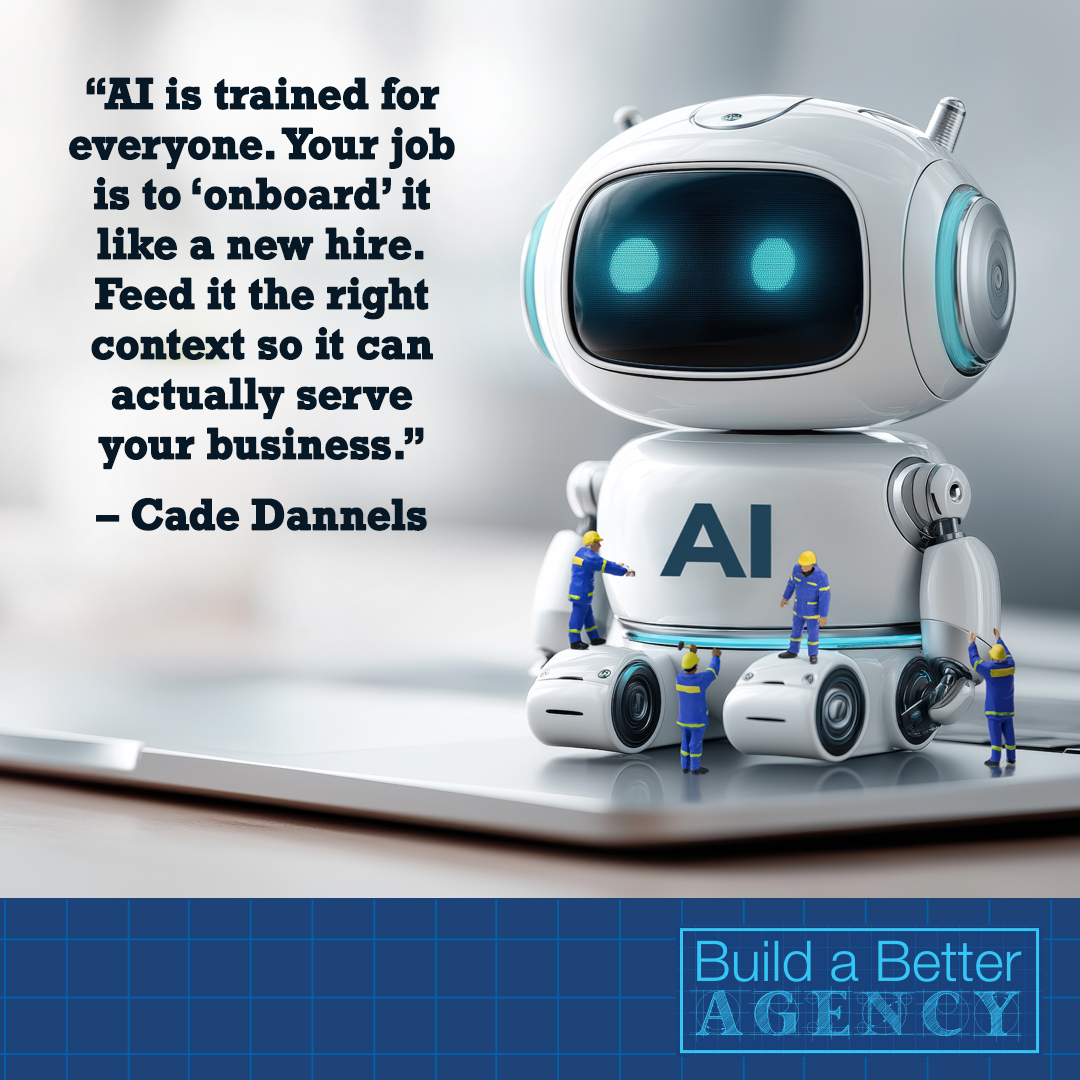
“AI is trained for everyone. Your job is to ‘onboard’ it like a new hire. Feed it the right context so it can actually serve your business.” - Cade Dannels Share on X
“Experimentation is the key.” Cade Dannels encourages agency owners to play with AI across teams, learn, and discover new ways to improve their business. Share on X
If you think AI is just for content creation, think again. Cade Dannels explains why your best ROI lies in automating and optimizing your agency’s core processes. Share on X
Many agencies dabble in AI, but few know what’s possible. Cade Dannels breaks down where to start experimenting for the highest impact. Share on X
Misconceptions about AI’s complexity hold agencies back. Cade Dannels emphasizes that effective solutions often require only familiar and accessible tools. Share on X
Ways to contact Cade:
- LinkedIn: https://www.linkedin.com/in/cade-dannels-b2a4651b7/
- Website: https://daitadynamics.com/
Resources:
- Here’s a sample app for the BABA podcast that Cade built based on our conversation
- BaBA Summit May 18-20, 2026: https://agencymanagementinstitute.com/babasummit/
- Drew’s Book: Sell With Authority
- AMI Facebook Group: https://www.facebook.com/agencymanagementinstitute
- AMI Preferred Partners: https://agencymanagementinstitute.com/ami-preferred-partners/
- Agency Edge Research Series: https://agencymanagementinstitute.com/agency-tools/agency-edge-research-series/
- Upcoming workshops: https://agencymanagementinstitute.com/advertising-agency-training/workshop-calendar/
- Weekly Newsletter: https://agencymanagementinstitute.com/newsletter-sign-up-form/
- Agency Coaching and Consulting: https://agencymanagementinstitute.com/advertising-agency-consulting/agency-coaching-consulting/
Danyel McLellan [00:00:01]:
It doesn’t matter what kind of agency you run— traditional, digital, media buying, web dev, PR, or brand— whatever your focus, you still need to run a profitable business. The Build a Better Agency podcast presented by White Label IQ will expose you to the best practices that drive growth, client and employee retention, and profitability. Bringing his 25+ years of experience as both an agency owner and agency consultant, please welcome your host, Drew Mclellan.
Hey everybody, Drew Mclellan here with another episode of Build a Better Agency. Super excited about this episode. I think you’re going to have a lot of takeaways and a lot of experiments to play with after you listen to this episode. So I’m excited about that.
Before I tell you a little bit more about our guest, I want to remind you that we are mutually grateful to our friends at White Label IQ Why? Because they are the presenting sponsor of this podcast. So they make it possible for me to bring great guests and interesting ideas to you over and over and over again, week after week. And I am super grateful for their continued support. If you’re not familiar with them, White Label is a team of people who are born out of an agency and they work with agencies. They partner with agencies to do design, dev, and paid media. What’s interesting about them is that one of the things that they’re knee-deep in right now is, just like everybody else, AI. And so for many of their agency clients, they are kind of the technicians who are helping. So the agencies are saying, I want to be able to do this with AI, and White Label is helping them experiment with different AI tools and automations to make that possible. And so if you are anxious about playing with AI or you don’t have time or you don’t have the team members to do that, White Label might be a great resource for you. So check them out at whitelabeliq.com/ami ’cause they’ve got some free hours for you if you’ve never worked with them before. And maybe an AI project would be a perfect place for to kick their tires and to get to know them a little bit. They are putting serious time and money into experimenting with and learning more about AI every day, just like everybody is, but they’re coming alongside agencies and helping them do that. So check them out again at whitelabeliq.com/ami.
All right, so speaking of AI, like we all are every day, my guest today is gonna talk to us a little bit about how he’s coming alongside agencies and helping them begin to think differently. And I think in a bigger way, in a deeper way about how AI can serve their agency and in some cases serve their clients, but really about serving the business of your business with AI. And so without further ado, Kay Daniels is going to join us and talk a little bit about how he’s helping agencies explore and experiment with AI to the bottom line profitability benefit of that agency. So without further ado, let’s welcome him to the show. Cade, welcome to the podcast. Thanks for joining us.
Cade Dannels [00:03:28]:
Yeah, thanks for having me on, Drew.
Drew McLellan [00:03:30]:
Give everybody a little bit of background, sort of how you came to have this knowledge and where you came from and your agency background. And then I have a ton of questions to ask, so we’ll just jump right in after that.
Cade Dannels [00:03:42]:
Awesome. You know, that sounds great. And so first thing I want to clear up is, you know, the podcast might say I’m some sort of AI expert. I can assure you I’m not a quote unquote expert, right? I don’t think anyone is. Maybe some, some super smart PhD people somewhere. But I think what I am and kind of my background is just that I’ve always been fascinated by these models the past 3 years. Right. And so kind of my background has just been tinkering and trying things, experimenting with these things the past 2.5 years. And so before, you know, 2.5 years ago, I had different jobs. I was working at a conversion rate optimization agency doing stuff, but it wasn’t really my passion. But again, I was tinkering with these tools and I was automating a lot of my work. And I’m like, this is pretty cool. Like it’s going to be the future. I don’t know. And I was just kind of working on it in the background. Then I got a different job helping a flooring business with all sorts of stuff like data and automation. And of course, I was sprinkling in AI there just because it was fascinating to me and I was finding ways to help them out. And I was working there again. I was kind of the only tech person. It’s a flooring business of 200 people because they’re flooring, but they had no tech people, right? So I was just a tech guy there and I was doing automation and AI. And at the end of that, this was 2024. And so the end of 2024, I was like, hey, you know, I think I can actually do this for other businesses. So I was able to strike a deal with that company I was working for where I just turned them into one of my clients. And I became kind of my own consultancy, practice, agency, whatever you want to call it, of doing AI and automation services for other businesses. And so, yeah, again, just because I’ve been tinkering with these systems, I feel like I’ve gained a little bit of knowledge of how to use them, how to use them a little bit to their, their better potential. And so what Data Dynamics does, that’s my, my consultancy, is we help agencies and B2B service businesses leverage AI to its maximum potential by building AI systems powered by their own data. And so the key thing there is just powered by their own data. I’m sure we’ll get into this a lot in the podcast, so I don’t want to dig too much into it now. But really just you helping, know, agencies and businesses figure out what’s their goldmine of unstructured data, right? So it’s like you as an agency owner, founder, person out there, probably sitting with a ton of transcript recordings, calls, proposals, SOPs, SOWs, Slacks, emails, all of this data, right? And so there’s just a ton of data, which is probably valuable in some way, but you as a human are probably not going back and reading it, right? It’s like, it’s boring, or it’s just like, how is this going to help me in the moment? And so all of this great data is getting lost. And so what my company does is help, you know, get all of this data into one place. And so it’s a bunch of data engineering sort of stuff on the background, but we get it into one place and we’re able to call it at the right moments at the right times to actually leverage AI to use your data and get some, some pretty great results and insights out of it.
Drew McLellan [00:06:41]:
So when you go into an agency, what is the, what is the mindset they have around how they think about how they should be using AI? Versus how you believe they should be using it?
Cade Dannels [00:06:55]:
Yeah, great question. So a lot of it is when I first go into an agency, typically it’s one of two things, right? So you’ve got agency one where they’re using AI and they like it, but they just want to do it more and more and more. They’re like, yes, let’s do it. Then agency two is, oh my gosh, this— we’re hearing that this AI stuff is good, but we don’t know what to do, right? It’s like, I’m busy with other tasks as a, you know, a founder CEO running an agency. I don’t have time to be looking into this. We’re not really doing anything yet. Hey, Cade, what should we be focusing on? So in that you second, know, mindset, it’s really just boiling down to, all right, know, you let’s look at your workflows. Let’s look at your teams. Look at your data. What are you actually doing? How can we actually build stuff that’s going to go into your workflows to you actually, know, help ROI for your business? And so for that agency too, it’s really about identifying the stuff. And so that’s a big thing that I do just because I’ve been tinkering with this stuff for so long. That I feel like I’ve got a pretty good understanding of, hey, let’s actually identify where we can use AI. So it’s a big thing I do. Then for that mindset, one of people who are already using it, it’s really just, hey, how can we take this to the next level? So maybe they’ve, you know, all their employees are using ChatGPT all the time and they’re producing some great stuff, but they’re like, hey, I think we can do more here. Okay, how do we go to the next level? So that’s kind of the two agencies there.
Drew McLellan [00:08:18]:
Yeah, I think actually most agencies are in between. So I don’t, I don’t think there are many agencies anymore that are not at least dabbling in it. It, right? They’re doing something with it, even if it’s just ChatGPT’s writing blog posts for them, but they’re, they’re doing something. And I think what my observation is, is they don’t know what’s possible. So they know it can produce content, and they know that it can take copy they’ve written or old proposals, and they can run an RFP through and say, hey, here’s an RFP we have to answer. Take these— what are the salient answers in these last 5 proposals that could apply to this RFP? And sort of draft that. Like, I think most agencies are doing that. I think they are using it as a— often as a writing platform more than anything else, whether it’s for themselves or for their clients. But where I don’t see a lot of agencies thinking about AI is How can this help me run my business better? How can I use these tools to actually create automations or efficiencies that make my agency faster, better, more profitable, fill in the blank, that I have access to data that to your point is probably somewhere, but I don’t even know how to, I don’t even know where it is, let alone how to connect those dots in the moment that I need to connect them. So. Talk about sort of when you, when you meet an agency and they’re using it for what I think of as sort of AI 101 sort of tasks, like make this writing better or make me, you know, produce something faster. How do you help the, I, how do you help them think differently? What kind of questions do you ask them to get them thinking about the possibilities that they don’t even know are out there?
Cade Dannels [00:10:14]:
Right. Yeah, that’s a great question. So the first thing, well, not the first thing, but one of the key things I like to ask them is how they’re actually onboarding their employees. Because it’s sort of a weird way to think about it, but one of the pitfalls I see with a lot of businesses using AI is that they just go in and maybe they’ll throw in a transcript or they’ll throw in something and they’ll ask a question and it’s pretty generic, pretty basic. And then maybe they don’t get exactly the answer they’re looking for and they’re like, okay, this is good, but now I’ve got to spend an extra 20 minutes working on it. And so they don’t really see the potential of it because they’ve just— they don’t understand that these models are being built for 8 billion people. So it’s like it’s built to serve the masses and it’s not built to serve you, Mr. Joe Smith, who lives at 123 Main Street. So it’s like our goal when we’re going in to use these AI tools should be how can we give this AI model, how can we put it in a position to succeed. And so that’s why I ask, you know, how are you onboarding your employees? Because, hey, you’re probably giving your employees onboarding documents, things about your company, tools and systems. And so you can kind of take the same mindset of, okay, how can we onboard this AI? How can we onboard this AI tool? Even if it’s just ChatGPT, even if you’re making a custom GPT, something, you know, you can go in right now and spend 20 minutes on doing that, right? So it’s like, how can you onboard this new AI to be an employee of your team? What are the documents you can give it? So a big thing I always ask is like, do you have like a business philosophy document of like, hey, this is what our agency does. These are our core values. This is what we like to do. These are our clients we serve. All of this just contextual information, right? And then you can upload this to some of these AI systems or custom GPT, whatever you want to do, right? So that way it just has a better understanding of who you are and what your goals are. So that way when you ask questions, it can give you a much better output because of that. So that’s one of the main questions I ask when I go in. The other question is always just time tracking stuff, right? So it’s like, where are you spending a ton of time and where can we potentially identify some areas to use AI to automate some of this stuff? So what I like to do is a time tracking thing where we get some employees and for a week, you know, everyone’s just filling out, hey, I’m working on this this task for 2 hours on Monday and this task for 4 hours on Wednesday. And it can be pretty loose. You know, it doesn’t have to be, you know, super tight or anything like that. But that way you have a pretty good understanding of, okay, here are our main tasks that we’re working on. And then once you have that and you’ve identified some of those key processes, then it really turns into my favorite part, which is inputs and outputs thinking. And so a huge thing with AI and one of the core values of kind of my company and kind of core values of how I like to work with AIs entirely thinking in terms of inputs and outputs. So like your goal, obviously, when using AI is to get a good output, right? Like that’s your goal. I want a good output to help me out. And so basically you need to think about how can we get the best possible inputs we can put in there. So that’s why we’re putting in other information about our companies. We’re putting in, hey, here’s what I’m struggling with. We’re giving it as much relevant context as it possibly can, giving it those good inputs like you would an employee. Just like an employee who comes in, you’re not going to be like, all right, go write this blog post. I’ll come back to you in 4 days. You’re going to give it some— you’re going give to that person some information. You’re going to put them in a position to succeed. So it’s the same thing with AI systems.
Drew McLellan [00:13:51]:
I think part of the challenge is all of that sounds great if you know what output you want. And I think for a lot of agency owners and leaders, Contextually, they understand sort of the vastness of AI, but from a very practical point of view, they don’t know what it could do for them. So how would you ask questions that would help me, the agency owner, figure out what AI could do that would actually be valuable to me?
Cade Dannels [00:14:22]:
Right. So a big thing for agency owners and where I like to start with them is kind of 3 main areas. And typically my questions will revolve around these 3 areas. Of first of all, what are you doing for, you know, lead generation, right? So there’s so much that AI can do in terms of qualifying leads, sourcing leads, even, you know, personalizing messages. A lot there, whether you choose to do it or not, it’s a different story. But the fact of the matter is there’s a lot you can do around the lead generation side. So that’s a big question I like to ask because then that leads to, you know, what are the key processes they’re doing? And it also oftentimes reveals Oh wait, you’re spending 20 minutes on this. Why don’t we just build a quick automation that does this, right? So that actually unveils a lot of room for, okay, we can use automation, whether that’s just traditional automation with code or whether that’s actually with AIs, you know, could be one or the other. So that’s a key thing I like to ask about. The second part is managing all the moving parts of a client, right? So agencies are unique that, hey, we’ve got 20 different clients, 50 different clients, 100 different clients, whatever it may be. So there’s just a lot of moving parts, right? So you’ve got multiple multiple employees, probably managing multiple different clients, and you as the founder, CEO, or, or head of the agency don’t have insight and visibility into all of those employees and all of those different clients. And so what AI can really help you do is actually manage all that stuff. So that’s where I go in and ask them, you know, how are, how do you think your visibility is into those areas of your business? Do you feel like you’ve got a good understanding of what, what your employees are doing managing your, your clients? Do you feel like you’ve got a good understanding of, you know, how long it takes to deliverables or your outputs to your clients or whatever that may be? Because then that really gets into the actual work of what we’re actually building for a client and how we feel in terms of managing them. Are we worried they’re going to churn? That sort of thing, right? So the managing of a client unveils a lot of information about where are we actually spending too much time on that we could be automating or using some AI. And the third thing being actually kind of touched on this last one is the building the deliverables. So AI is so good, as you know, just the content generation, Building decks, building all sorts of things, right? Just AI is so good at, first of all, taking in data and putting out data, which leads directly in for a lot of what agencies are doing, are building deliverables. So a key thing I’ve helped a lot of my agencies who I work with build, like a fractional CRO, is actually leveraging his IP of— he’s worked the past 30 years of, you know, building his frameworks for how he’s building his deliverables and how he manages his company. So a big thing I’m asking my clients who I’m working with is, all right, do you have frameworks? Do you have intellectual property for how you’re conducting your business? What are your unique differentiators compared to other people who are doing the same thing, right? All those other agencies who are doing the same thing, how are you different than them? So what is your framework, right? And how can we bake that into our AI systems that they can kind of be mini yous, right? And kind of produce similar content because we’re baking those frameworks into the systems.
Drew McLellan [00:17:28]:
All right, so let’s take each one of those and unpack it a little bit. So let’s talk about lead generation. What could— if I wanted to automate as much of my lead generation as possible, what could AI do to check that box?
Cade Dannels [00:17:43]:
Sure, great question. It’s also a million-dollar question, right? Yeah, there’s a ton you can do there, a lot of demand for it for sure. But things I’ve helped my clients do So first of all, I like to break it down in terms of just lead sourcing, lead qualification, and lead outreach. So inside the box of lead generation, or at least outbound lead generation, right? Different for inbound. But for outbound, in my eyes, it’s the sourcing, qualification, and outreach. So there’s different things you can do for all of those. For sourcing, in my experience, it’s been a lot of actually just traditional automation. For automating the sourcing. So you can of course use those tools like ZoomInfo or Apollo or those sorts of things to build databases. Then you can do a number of automations off of those. I like to call it the, like, the jumping off point, right? The diving point of how are you first just coming up with a company that is potentially a lead, right? So again, using those B2B service businesses, or you can also use lots of tools for scraping LinkedIn stuff and for scraping who likes certain posts or who are in certain groups. Of course, there’s LinkedIn Sales Navigator, lots of tools for generating the sources of leads. But where I think AI is really helpful is in terms of the qualification, because it’s like, of course, anyone could go to those tools and pull 5,000 companies, right? And that’s not very helpful. You’re sitting there looking at 5,000 companies on an Excel file. What am I supposed to do with this? And so where AI, I think, is super valuable is you then, know, rather than you hire an admin to, you know, work minimum wage and to, you know, research all of these companies one at a time and, you know, click through all of their website and their news postings and look at the CEO’s LinkedIn and look at all these things. And they’re spending 3 hours, you know, hypothetically spending 3 hours on one company and they’re like, okay, all right, Joe, I’ve got all of this done. Here’s the research on this company. Looks like they are a fit for us. And here are the reasons why. Here’s how we should approach our outreach to them. Well, everything I just described is something that a human can do, but it’s also very much so something AI can do is automating that research, going and reading a ton of websites, a ton of LinkedIn posts, everything about a company pretty much, right? As long as you’re feeding in the good inputs, then what you’re also feeding in is, hey, here’s our agency, we’re Agency ABC, and we help, you know, small businesses with SEO or whatever it may be, right? And here’s our target market and here’s kind of what we really help with, right? And so if you’re like a CRO agency, because I worked at CRO, so I’ll use that as an example. And we’re really good at e-commerce product pages, right? So we do really good work on product pages. Well, you can bake that into your, your qualification AI who’s going and looking at those, all those different leads and sees if they’re e-commerce. So then if they’re e-commerce, they look at the product pages and rates those on a scale of 1 to 10 and hey, flags the ones that are really bad. And so boom, you’ve got all that data once you set up that system. So then you take your list of 5,000 leads and you know you’ve got your top 100 and I’m just kind of using random numbers here, but you’ve got them qualified pretty much. And then from the qualification, you can then do that third step, the outreach, because you’ve, you know, generated that here’s it, they are a good fit and here’s why. So then you feed that into the next AI system if you want. A lot of people don’t like to do the AI personalized messaging, but if you want to, you know, you’ve got that brief so you can do very personalized, customized messaging.
Drew McLellan [00:21:11]:
And to do all of that, is that 97 different tools? Is that a tool? Is that like— how complicated is that? Like, that all sounds great, but you know, again, as you said, agencies, they don’t have like an AI specialist on staff. They may not be in a position to hire someone like you. So if they’re going to build it themselves, how complicated is that?
Cade Dannels [00:21:32]:
Absolutely. Great question. Yeah. So you can make it as complicated as you want to be, and you can make it pretty simple too, right? So the simplest version, something you could do literally right now, that’s a great place to get started. So I’m glad you asked the question, Drew. You’re clearly an expert at this podcast stuff. So well done. Is what you can do is you can take, you know, a lead, right? So you’ve got, you know, companyabc.com and you just go to ChatGPT and you put that domain in there and say, first of all, give it the context. This is my business. Here’s what we do. We’re a CRO agency who help e-commerce businesses with PDP pages. Here’s the link of a potential lead. Do research here and let me know if we’re a good And you could do that to your heart’s content. You could do that, you know, you could hire an admin to do that for you all the time, and they could just then take the output there, put it in an Excel file for you that then you have your list of your qualifications and the reasons why. But what I’d encourage you to do is if you’re doing that ChatGPT route is structured a little bit, right? Because if you kind of did exactly what I just said, you’re going to get different outputs every time you put stuff in there. You’re probably just going to get a paragraph output. But how you can think about it, and again, again, you can absolutely do all of this yourself in 5 minutes on ChatGPT, is structure it in terms of, hey, I want to go into the system and get the same output every time so that I can put it in an Excel file. So you can say, hey, ChatGPT, every time I feed you a new lead, give me on a scale of 1 to 10, you know, just total how much of a fit it is. And then give me a 2-sentence thing about key findings, 1 sentence about the CEO or the decision maker who I’ll reach out to, and then 1 sentence potential email, right? Or whatever you want, any data points you want. And that way you’re getting a clear output every single time. And so that’s what I would definitely start with. Then you can scale infinitely from that, right? Then you kind of the next level is using an automation tool. You could use Zapier or Make.com or something. Again, not too hard of an automation to set up. Probably take, you know, 15 minutes, 20 minutes for someone who knows what they’re doing. But what you could do is just say, Hey, you know, make a quick automation that every time a new URL or new company pops into a Google Sheet or an Excel file, run the script and output that back into the Google Sheet. And so that way, you know, if your admin’s putting stuff in there, you can go in and you can see all of them pop in. So that would probably be the simplest way of doing the qualification and, you know, generating the, the outreach from that.
Drew McLellan [00:24:02]:
Okay. I want to ask about the outreach, but let’s take a quick break first and we’ll come back and we’ll talk about about how you would instruct an agency to DIY an ongoing engagement or conversation or nurturing a lead without a lot of manual effort. So let’s take a break and then we’ll come right back and we’ll talk about that. Are you tired of juggling multiple tools to manage your agency? Meet Deltek Workbook, the all-in-one solution for marketing and communications agencies. Streamline your projects, resources, and finances all in one place. With real-time dashboards and reporting, you’ll have full project visibility. You can plan team capacity weeks ahead to avoid bottlenecks and keep your budgets on track to maximize profitability. It’s perfect for both agencies and in-house marketing teams looking to work more efficiently. PCI is a certified Deltek partner offering expert implementation and support to ensure your success. If you’re ready to transform your operations, visit pci.us/podcast for a free consultation today. Hey everybody, just want to remind you before we get back to the show that we have a very engaged Facebook group. It’s a private group just for podcast listeners and agency owners that are in the AMI community. And to find it, if you’re not a member, head over to facebook.com/groups/ami. /groups/babapodcast. So again, facebook.com/groups/babapodcast. All you have to do is answer a few questions to make sure that you are an actual agency owner or leader, and we will let you right in. And you can join over 1,700 other agency owners and leaders. And I’m telling you, there’s probably 10 or 15 conversations that are started every day that are going to be of value to you. So come join us. All right, we are back with our guest Kay Daniels, and we are talking about how agencies could be thinking about AI. And really what we’re talking about is going from how can AI help me create content faster or write something faster to how can AI start running parts of my business that right now either I’m doing manually or someone on my team is doing manually. Or in some cases I can’t get to it at all. Like it’s just not happening. And, you know, one of the examples that Cade served up right away was on the new business side, which I think is one of the places for many of you, it is the default thing you give up when you are— when you get sucked into client work or you’re doing too many operational things. The thing that pays the price is the new business effort. And so you’re not really, you know, as you know, I think you should be spending 50% of your time, agency owners, on cultivating relationships and new opportunities for the agency. But if you’re the main point of contact for the biggest client or you’re getting pulled into other fires, you’re not spending 20 hours a week on new business. You know, for a lot of you, if you’re getting a couple hours a week in, that’s great. So that’s where we dug in before the break. And so, Cade, you talked a little bit before the break about sort of how do how do we, we source potential leads, and then how do we in essence score potential leads to decide who’s worthy, who’s a close enough fit that they are worthy of us making some outreach so that if we did, if they did actually respond to us, then, you know, we would have a decent shot of winning that business because we actually would be a good fit. So let’s talk a little bit about— I think of new business as dollar cost average investing, right? You never know when a prospect is going to need to hire an agency, so you have to be ever-present. So that on the day they want to hire an agency, you’re top of mind. And so for agencies that know that they have to nurture a lead for, you know, anywhere from a day to a decade, I’m assuming that we can use AI to do that in a way. But I want to— I want— so I want you to talk to us a little bit about the automation, but also how do you guard against the thing that I think a lot of agencies are afraid of, which is I don’t want someone feeling like they’ve been AI’d. And that I don’t really give a crap about their business, and I don’t even know that I’m sending them something. So talk about the automation of it, but also how do you humanize the content or the contact so that it feels genuine? And when you actually do interact with that person, there’s not a disconnect, right?
Cade Dannels [00:28:40]:
Yep, great question. So first thing is, I noticed— so totally agree with you that you don’t want to have your outreaches, you know, come across as, oh, this person using AI. That’s super clear, right? And when I see that happens is when you are just being basic and being very general and you’re going in and you’re saying, hey, here is what this company does. Right now, go ahead and make me a 3-step email campaign for this. And ChatGPT is pretty good. It spits out a pretty good answer. And you read that and you’re like, hey, that’s pretty good. But it’s pretty easy to get to good. And so that’s something I say a lot to my employees when we’re building these systems is that it’s easy to get to good. It’s hard to get to exceptional, especially with AI, right? Like AI has just raised the bar, you know, where it’s very easy. A 6-year-old could get in there and write, you know, if they know how to type, right? They could say, make me a 3-email thing, right? And they could misspell things and it would spit out something pretty good. So it’s easy for a 6-year-old to do it. So hey, as agency owners, as a great agency, which you’re trying to be, think about how can we strategically put in the best inputs possible to get better outputs than everybody else doing this. The way I like to think about is, so what I think about is if there’s 100 different AI automation agencies doing it, how can I be the top one? But if you’re a CRO agency, if there’s 100 CRO agencies and they’re all doing this where they’re using AI to make these custom personalized messages, how can you be the best one out of all of those 100? So what are you doing strategic? And when you ask that question, it kind of puts you in the strategic mindset of, okay, well, let’s make sure we’re feeding in the right inputs. Let’s make sure we’re really doing a lot of research on who we’re reaching out to. Let’s make sure we’re feeding in the voice of me as the whoever’s emailing. So if the CEO’s emailing, let’s put in some context of here are 20 examples of here’s how I’d like to communicate. Here’s my typical email style. So you can feed that into, right? So then you’re actually, when you’re feeding in all of this context, AI’s got a much better understanding. And again, now when it has that context, it’s not producing an output for the 8 billion people on the planet. It’s producing an output for Joe Smith at 123 Main Street specifically for you. And that is your goal every time you use AI. So when you do that is when you can get actually that very good, you know, human-sounding messaging that you can then feed through your automations.
Drew McLellan [00:31:10]:
So let’s talk about the automation. So I, I, it, as I was listening to you talk, it seems to me that that one of the key elements that would allow my nurturing outputs to be better would be the level of criteria and research I do to put someone on the list to begin with. So the more, the more I ask whatever tool I’m using when I’m asking them to grade. So I go out to clay.ai or clay.com or whatever it is, or I go to, you know, Sales Navigator or whatever, and I get a list. And so I ask it to do the research on the list. It seems to me the more detailed I’m asking Chat or Perplexity or whatever tool I’m using to get about those prospects, to rank them in order of the likelihood that they are a good fit for me, the more detailed that is, then the better my outreach can be because then I can feed all of that data into whatever’s drafting the emails or the LinkedIn messages or however I’m reaching out to these folks. Am I wrong about that?
Cade Dannels [00:32:19]:
No, I’d say you’re spot on, right? So it’s like it’s inputs to outputs, as in because that’s 2 steps, it’s, it’s an input into an output, which that output becomes the next input, right? So it’s like if you go back a couple of steps, it’s how good we’re doing that first input, right? And so I’d say the only caveat is you don’t want to to kind of overengineer it. Like, these models are smart, right? They’ve been, you know, they’re very great reasoning models where you don’t have to overengineer and just feed, here are the 100, you know, 150 clear characteristics about this company. Like, that’s probably going to overwhelm it. So you don’t have to, you know, get too much detail into there. But as long as you’re hitting the key things that you think you as a human would need to craft a pretty good message, then I’d say that that’s good. You don’t have to go past that.
Drew McLellan [00:33:06]:
Okay. I know one of the things a lot of agency owners are worried about is, is they hear a lot about the fact that there are a lot of errors and mistakes in the data output of AI. So for example, if I put together— if I put together a list, so if I showed up on someone’s list, so I, Drew McLellan, show up on someone’s list and it said, do some research on Drew McLellan, So there’s another famous Drew McLellan who wrote the software that anybody under 30 has never heard of, but he wrote Dreamweaver software. So he, like when you Google Drew McLellan, it used to be that we would sort of fight for page one of Google, right? Because back then when his software was really popular, we were both producing a lot of content.
Cade Dannels [00:33:51]:
So have you overtaken him now?
Drew McLellan [00:33:53]:
I have. Yeah.
Cade Dannels [00:33:54]:
Nice. Good job, Drew.
Drew McLellan [00:33:55]:
Thanks. How do you make sure that the person that the tool is researching— you’re giving them the name, you’re giving them some data— how do you make sure that they’re talking to you about the right Drew McClellan? How do you double-check that?
Cade Dannels [00:34:13]:
Sure. So luckily we don’t have to worry about that too much because typically the jumping off point is like a LinkedIn profile, or— and you’re getting that LinkedIn profile from a lot of those tools where it’s tied to the company anyways. Luckily, because these are all kind of intertwined tools in some way when they’re researching around, you’ve got your Apollo or your ZoomInfo or your Clay, but then it’s kind of tying that company to the LinkedIn that because of that profile makes it a lot easier. It’s harder for those businesses out there where none of the executive team is on LinkedIn. I have a client of mine who none of their executive team is on LinkedIn. So they would be a tough one to do that. But yeah, typically with that LinkedIn profile, it makes it pretty easy.
Drew McLellan [00:34:59]:
Okay, so I’ve done some research. I’ve got my— let’s say I’ve got my top 50. I am now having a tool draft a 3, 5, 12, whatever it is, messaging sequence. Again, whether I’m going to talk to them through LinkedIn or I’m going to send them emails or however I’m going to do that. And then am I connecting the dots? So all of that is happening without me lifting a finger. Like literally it’s there, there’s automation from grab the list, research the list, keep re-ranking the list, start emailing the list. Where is the human? Where are the human checkpoints in all of that? Like where should they be to make sure that I’m not sending something that I’m like, like, oh crap, that’s wrong, or doesn’t sound like me, or whatever the concern may be.
Cade Dannels [00:35:52]:
Right, right. So first question, you absolutely can set it up where, you know, you just automate the whole thing. You don’t have to touch a finger. But like you’re saying, it is best to have those human touchpoints. Like my favorite one to have— or favorite’s a weird way to say that— but the one I think is most critical is right before you send that message. Message, right? You want to make sure that, hey, this— is does this sound weird? Does this make sense? All right, give this quick look over. So I never schedule anything to automatically send. I always have it create as like a draft, you know, it’s like a draft email, draft message. And then you actually, as the person, or whether that’s your admin or whoever, is actually going into your inbox and looking through all the drafts. All right, that looks good. Send. That looks good. Send. And of course, you’re always going to have like when you’re playing this game, let’s say you’re sending out out 50 messages a day, of course you’re going to have maybe 7 that are just terribly wrong, whatever. There’s, you know, with AI and automation, when you’re automating these things, there’s little you can do about that. I’m sure if you designated lots of hours, you could, you know, minimize those, those false positives, but that’s just going to happen, right? But the goal is, hey, if you’re trying to automate a lot of this stuff, how can we make sure that 80% of what we’re sending out is really One thing I wanted to add for, for all of this, which I think is just a helpful mindset, because I think a big thing with all of this AI stuff is just the mindset that everyone needs to adopt because it’s such a new tool. I feel like a lot of people are going straight to, okay, I’m going from nothing knowing about this tool to what is the absolute, like, what is the workflow that I’m automating? And you’re like, wait, that’s a big jump. I knew nothing about this. I barely used this. How am I supposed to dive deep into something that’s giving me a $10,000 ROI every month. Like, that’s hard, right? So what I like to start with is just what are the values or the core values, mindset, thinking that I should be approaching, or you as the agency owner should be approaching AI with. And so a big thing I like to focus on is just experimentation. So experimentation, experimentation, experimentation. So like, as you’re doing that lead sourcing, that lead qualification stuff, like, try it out one way. And if you don’t like it, you may not like it the first time. You probably won’t. So then experiment with it. Try throwing in you know, a news article, try having it output different data, try having it output, you know, a 3-paragraph reasoning for why it’s coming to the conclusion it did. And you’re going to experiment with it 10 different ways and maybe 9 of them suck, but one of them is amazing, you know, and it changes everything. So that’s just a big way to approach all of this stuff is we can’t go from, you know, this tool has been around 3 years basically, right, to having all of the answers and knowing exactly what $10,000 what workflow we should be automating, but actually, all right, let’s put on our experimentation hat. How can we approach some of the stuff we’re working on, really use test AI out, get our feet wet with it, and then just keep going from there? Because once you experiment with it, you’re seeing the value in it and you’re using it more and more, and it’s leading you down the route to where you’re actually going to discover those really high ROI things.
Drew McLellan [00:38:57]:
So for an agency that’s been sort of using ChatGPT to write some RFP responses or write some stuff for clients or whatever, where would you start the experimentation? Like if you owned an agency, where would you start the experimentation? In what category of your business? Would it be client-facing? Would it be operational? Would it like, where would you begin your experimentation? Because I think a lot of agency owners are like, I want to do all of this stuff, but I have like 5 minutes of free time and I need to sort of start somewhere. And I’m not sure who on my team I can task this to. So I’m probably playing with it at night and on weekends. Like, how do I, how do I begin the experimentation phase and how do I start to bring other team members into those experiments?
Cade Dannels [00:39:54]:
Yep. Awesome. So what I would say, the easiest thing to start with and get a ton of value out of, I think, is first of all, if you as an agency, probably meeting with your clients a lot or having sales calls, whatever it may be. First of all, I would make sure you have, you know, an AI note taker in there, just collecting those transcripts for your calls. It’s so valuable. You know, even if you’re not doing anything with it now, maybe 6 months from now you’re doing something different. You’re like, oh, I wish I was recording those calls because you’re just collecting golden data that you can really leverage. But anyways, once you have one of those in there, you know, and you’re getting that transcript, so I would encourage you to copy and paste that transcript into ChatGPT and then start asking it questions, right? So say, hey, this was a sales call. How did I do? Please, you know, give me some feedback on how I could do better on the next sales call. What did I talk too much on? Did I, you know, did I let them talk? What are some questions I missed that I should have asked? That sort of thing, right? So you can use it to critique you. Other things you can do is if your employees, maybe your project managers, have transcripts in there, you can take their calls into ChatGPT and say, Hey, how’s this employee doing? How’s this client relationship going? You know, just giving a little bit of visibility into there and how they’re handling calls. So that’s a great way to get started. The other thing I would say to kind of bring in the team, so like say you’re doing that and it’s going well, how I would bring in the team and you also, know, touch on experimentation too is one thing I like to tell my clients is to actually make it sort of like a game, right? So like tell your employees, Hey, we’re doing this, I don’t know, trial promotion where for the next month, the person, the employee who can come up with the most unique, interesting way of using AI wins $100 gift card or whatever it may be, right? So that way you’ve got your team trying out a bunch of stuff, getting their feet wet with it, using it more than they have before. And it’s a fun game and people are coming up with interesting, unique ways of using their data probably and using stuff to actually help your company. And that’s going to be very valuable for you seeing all the different ways they’re using it.
Drew McLellan [00:42:01]:
Where wouldn’t you use AI? Where would you say, nope, not there?
Cade Dannels [00:42:08]:
It’s tough because I use it everywhere. So trying to think. No, I use it pretty much 99% of places. I’d say, of course, you don’t want to throw in sensitive data, right? So it’s like if you are working in an industry where you’re getting bank account info, social security numbers, anything that’s really sensitive. Of course you don’t want to throw that in there, but that’s kind of a given. I feel like people know that. But yeah, I’d say it’s something you can experiment with, right? So it’s like if you, you can start with anything. I feel like it’s the default. A lot of people’s default is, hey, this is a new tool. I haven’t used it before. I’m 50 years old. You know, I’ve I’ve gone through it. I’ve learned what works for me. I’m not going to use this tool. So they don’t even think to use it in most cases. But what if you approached it as I’m just going to experiment and try it with everything? And if it doesn’t work, maybe I’ll experiment a couple other ways and still doesn’t work. All right, maybe I’ll focus on other stuff, right? So I would always default to trying it. It’s a big thing people miss a lot of times. Like I’ll build great tools or what I think are great tools for clients. And a lot of some of the employees don’t use it, right? And it’s like, why aren’t you using it? And it’s like, oh, I never thought to use it like that in this specific use case, right? So it’s a— it’s changing that mindset. It’s again the mindset thinking of let me first just try something out. And a big thing you can do is, you know, you’re busy, right? You’re an executive on an agency. You’ve got a lot going on. But what you can do is you can go to ChatGPT. You can spend 2 minutes writing something fancy, some complex task, complex prompt, make it as complex as you want it to be. You press go, then you just go do what you were doing before. Then you can come back in 15 minutes because a lot of these, you know, these models now, they’re reasoning, so they take multiple minutes to run if it’s something complex. And so you as the agency owner probably don’t want to sit there on ChatGPT for 5 minutes, right? So let it run, go do something else, come back and see the output. And it’s a, it’s a habit I have, right? So it’s like every day before, and mine are pretty complex just because I’ve been doing them for a while and a lot of my stuff is coding and outputs like that. So I’m always running things in the background because these reasoning models, when I give it a good complex task, I’ve been working on a prompt for 5 minutes. It’s a great complex, hey, you know, really go research this, really go look into this, Mr. Claude, Mr. ChatGPT, is I will put that in there, then I’ll go back to what I was working on. So that way, I’ve almost got a different employee working on the team all the time. He’s just running in the background, and then I go back to it. I’m able to read it and keep working from there.
Drew McLellan [00:44:41]:
I know one of the things you recommend is that you ask the same question of different AI tools. Talk a little bit about that.
Cade Dannels [00:44:51]:
Yeah, absolutely. Like, you think about these models, they’re, they’re not all the same. They’ve almost got different personalities, right? So maybe one of them, just totally making this up, but like, say you go to college, right? You’ve got 3 friends. One’s a surfer dude from California. One’s a girl from, you know, Florida. One’s an exchange student from France, right? They’re all different, right? They’re different humans. They’re different people. And so obviously these, these aren’t humans, but they’ve got different personalities, right? They’ve been trained in different ways. They’ve been built by different companies who are using them to do different things. And so they think differently. And so if they think differently, you’re going to get different outputs and you’re going to you get, know, different outputs. It’s going to lead you to different thoughts, right? So whenever I have something that’s very important, Maybe I’m working on a proposal for a client or something, something that really matters, really matters to my business is I will put the same exact prompt into ChatGPT, into Claude, into Gemini. Those are the 3 I use the most because it’s going to give you different answers. And so maybe you read the ChatGPT version, you’re like, you know, that’s all right, not very good. And you read the Claude version, you’re like, oh, that’s amazing. And you read the Gemini version, it’s like, oh, that one sentence is awesome, right? So it could be something like that because you’re getting— you’re basically asking 3 different humans. If you’re struggling with something in real life that you don’t know the answer to and you want people’s advice, you’re probably calling up 3 smart people or talking, going out to lunch with 3 smart people and getting multiple insights. And so it’s the same thing when you’re using these AI tools.
Drew McLellan [00:46:23]:
So there’s a million AI tools out there, and you mentioned probably the 3 most popular, 3 best known— ChatGPT, Claude, and Gemini. Are there tools? First of all, two questions. One, do we have to be using 97 different tools? And are there, are there tools that are underrated because they’re not famous like ChatGPT that we should know about?
Cade Dannels [00:46:50]:
So first of all, no, you don’t have to be using 97 tools. You can absolutely be using one. For the majority of people, you know, ChatGPT does just fine. I think they’re winning the race just because, you know, they were quick to get their product out there and they’ve got a simple-to-use interface and everything. My favorite one is Claude. I think the 3 most popular ones are the 3 most popular for a reason because they’re very good models. You know, they produce the highest quality output over, you know, thousands of different prompts. You’re typically going to get the best result from these 3. And they can do all sorts of things. They can do research and everything. So I don’t really use the Perplexities. I don’t really use things like that. That, I stick to Claude and Gemini. Those are my two favorite. ChatGPT isn’t my personal favorite, but in my opinion, it’s not about the model, especially if you’re getting new into this sort of stuff. It’s like, it’s like you’re going to the car dealership. It doesn’t matter if you’re getting a Ford or a Chevy or whatever. I’m not a car guy, so I feel like I can’t come up with good examples off the top of my head of cars. But yeah, right, it’s going to, you just want it to get you from point A to point B. So especially if you haven’t been using these things before, So don’t get overwhelming. Don’t make things harder than they need to be by making sure you’re using the best tool. Just use what’s easy, what you’ve heard of. You can start with ChatGPT. That’s totally fine. Just get your feet wet. And then naturally, as you’re using it more and more, you’ll find the tools that make the most sense for you.
Drew McLellan [00:48:17]:
So other than yourself, are there 3 or 4 people that you think agency owners should be following and learning from that are giving good practical you know, hands-on advice that they can— that it’s not too, you know, esoteric, it’s not too, uh, futuristic, but it’s like just good practical, here’s some things that you can do with some of these tools that, that everybody should have on their radar screen. So given you’re a one, okay, who other than, other than Cade, who should they follow, right?
Cade Dannels [00:48:52]:
Yeah, no, it’s, it’s, it’s tough because I feel like a lot of the stuff I see on LinkedIn And to be honest with you, is a lot of the— there’s a lot of posts I see and it drives me crazy. There’s these people who post on LinkedIn who are like, these are the 50 automations you need to scale as an agency or whatever. And then like, DM me and I’ll send it to you. And I’ve DM’d multiple of them and normally it’s not very good. So just FYI, if you see those and you’re like feeling overwhelmed, like, oh gosh, I should be DMing all these people. I’m missing all of this valuable content. Like you’re not, you’re probably not unless these other new people are amazing. So I just want to put that out there. I see that on LinkedIn a ton. One person who I love, who I love him because he’s not selling anything. I don’t even know what he does for work because he does not sell anything on LinkedIn, not even like subtly, but his name is Lorenzo Carreri, C-A-R-R-E-R-I, and he’s just using he’s just, he’s a tinkerer. So he’s tinkering with all of these models in unique and fascinating ways. And he’s truly just, he’s so genuine with just the value that he’s providing. So I would look into him for sure. He’s kind of the main person I’m following on LinkedIn to get new ways of thinking about these tools.
Drew McLellan [00:50:09]:
Okay.
Cade Dannels [00:50:10]:
All right.
Drew McLellan [00:50:10]:
If folks want to track you down, if they want to ask more questions, what’s the best way for them to connect with you, Cade?
Cade Dannels [00:50:18]:
Yeah, so if you go on LinkedIn and search Cade Dannels, C-A-D-E Dannels, D-A-N-N-E-L-S, please just connect with me on there. I’d be happy to connect with you. Or you can go to my website and book a call with me if you want to have a chat. It would be datadynamics.com, but data is spelled D-A-I-T-A dynamics.com. So data with an AI at the end.
Drew McLellan [00:50:43]:
Dynamics.com. Awesome. This has been a great conversation. I think you probably have gotten people thinking, A, that this is possible, and B, they probably have some ideas of where they want to start, which is exactly how I wanted this conversation to go. I just want people to not be afraid and to be willing to, as you said, to just experiment a little bit and play and discover what’s possible. One of the things that I find fascinating is a lot of people ask whatever tool of choice they have, they ask them for data, but they don’t ask them for advice or opinion or recommendations. And I think that’s, I think people are missing, like, they don’t use it. They don’t use AI like a thinking partner. I know for me, I’ll say, you know, I’m working on this for agency owners and here’s what I’ve come up with. Like, what am I missing? What else should I be thinking about? Like, it’s a great thought prompter for me. That’s one of the ways that I use it. So I’m hoping everybody heard all this and was like, okay, I can, I can, I can befriend one of these tools and start having more meaningful conversations with that tool to try and get a different perspective or a different idea or a fresh idea that perhaps I didn’t get before. So I’m, I’m grateful for your help. Your, your time today and, and your sharing your thoughts about where we can get started, because I think that’s where everybody’s at is we just want to get started.
Cade Dannels [00:52:11]:
Absolutely. And last thing I’ll say is kind of a challenge to the, the listeners here, and it relates directly to what you’re saying as getting some advice from it. So I’d encourage you to take the transcript of this podcast, just download that, upload it to ChatGPT, and then say something like, hey, you’re a senior consultant read this transcript, then ask me 5 clarifying questions about my business. And then after you ask me the 5 questions, generate me a custom AI roadmap. And so then you’re going to take all the valuable things we’ve talked about in this podcast and you’re going to have it ask you questions about you, and then you’re going to have ChatGPT actually create you a roadmap from that. I think that would be very valuable for whoever’s listening to this.
Drew McLellan [00:52:53]:
Yeah, that’s great homework. Work. Perfect. Thank you, Cade. Thanks for your time. Appreciate it.
Cade Dannels [00:52:58]:
Awesome. Thank you, Drew.
Drew McLellan [00:52:59]:
You bet. All right, guys, lots of action items coming off of this podcast. Please don’t just listen to this and think it was interesting, but do something with it. So I don’t care if you feel like you are super proficient at AI or you’re feeling like you’re just a beginner, but there are, there are new things for you to learn and explore, and hopefully we triggered at least a couple of those in this conversation. And if nothing else, do what Cade said, download the transcript, script and then use your inputs about who you are and who you serve and what your agency does, your AI sort of experience and comfort level, and ask the tool to help you get better at it. Here’s the one thing that I know for a fact: this is not something we can ignore. This is not going away. This is not going to be something that is just a trend for a day or two or a year or two. This is absolutely changing the way way the we run our businesses and we do business with our clients. And so we can’t really afford to stay ignorant for very long. So it’s time to jump in the water and splash around and do some experiments. So do that. And I would love to hear what you did, what you learned, and what more you need from us on the show that— to be helpful around this topic, because obviously this is something we’ll be talking about together for a long time. So thanks for listening. A huge shout out and thanks to our friends at White Label IQ. As you know, they’re the presenting sponsor of the podcast. So like I told you at the top of the hour, whitelabeliq.com/ami to check them out. And I am grateful that you hang out with me every week. I get to talk to interesting people like Cade because you listen. And so I am really, really glad that, that you keep coming back and I will make you this deal. You keep coming back and I will too. So I’ll be back next week with another guest. Okay. Have a great week. Thanks for listening. Come back next week for another episode designed to help you build a stronger, more stable, and sustainable agency. Check out our workshops, coaching and consulting packages, and other professional development opportunities at Agencymanagementinstitute.Com.