
Episode 545

Welcome to another insightful solo episode of Build a Better Agency! This week, host Drew McLellan draws on his 25+ years of agency experience to tackle a game-changing reality for agency owners: the ways buyers find, vet, and select agencies have shifted—and your approach needs to shift too. Based on the latest industry research and buyer behavior data, this episode serves as both a wake-up call and a practical roadmap, ensuring your agency is “future-proofed” for today’s—and tomorrow’s—client expectations.
Diving deep into what really happens before an RFP hits your inbox, Drew McLellan reveals that the majority of buying decisions are made before agencies ever take the stage for a pitch. He shares eye-opening statistics—like Forrester’s finding that 92% of B2B buyers have a preferred vendor before the pitch even starts—and illustrates why visibility, authority, and trust are now your most important assets. Listeners will discover why authority-building and relationship nurturing trump old-school charm, and why consistent, outcome-focused content is now essential for remaining discoverable in both human and algorithm-driven searches.
Beyond theory, Drew McLellan provides a series of targeted, actionable “homework assignments” you can start right away, from the “5-minute stranger test” to case study revamps and trust broker mapping. You’ll learn how to make your agency’s value instantly obvious and compelling across every digital touchpoint—website, LinkedIn, third-party mentions—while cultivating the patterns of social proof and authority that today’s buyers demand. Drew also explains how algorithms and AI tools are shaping client shortlists, and why crafting machine-readable, buyer-friendly positioning is now non-negotiable.
If you’re ready to break old sales habits, update your growth strategies, and implement repeatable steps to increase your agency’s desirability, this episode is a can’t-miss. Whether or not you attend the Build a Better Agency Summit, Drew McLellan’s guidance will challenge you to rethink your approach and take meaningful action toward winning the clients of the future.
A big thank you to our podcast’s presenting sponsor, White Label IQ. They’re an amazing resource for agencies who want to outsource their design, dev, or PPC work at wholesale prices. Check out their special offer (10 free hours!) for podcast listeners here.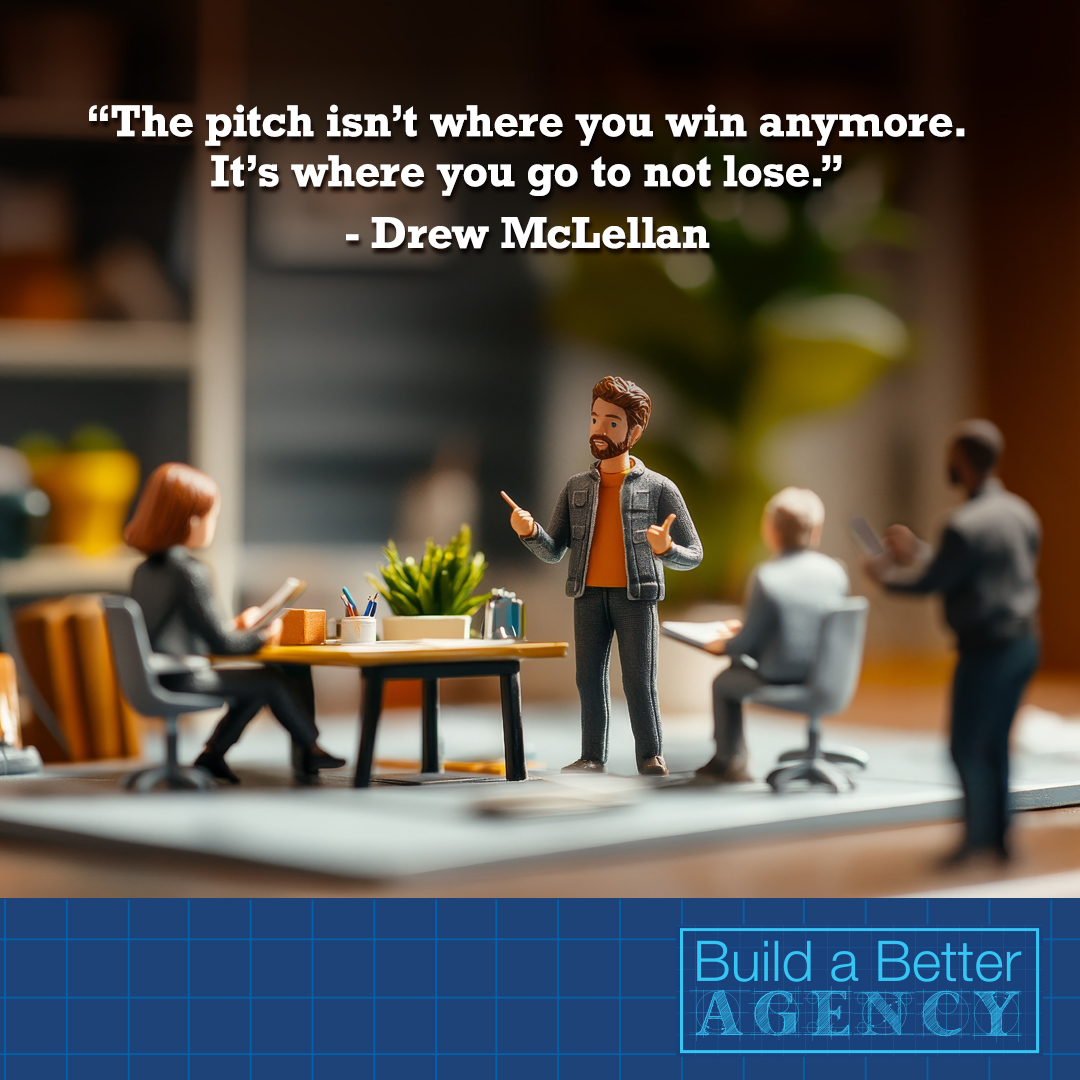
What You Will Learn in This Episode:
- How today’s agency buyers make decisions long before the pitch
- The growing impact of authority, visibility, and trust in landing new clients
- Future-proofing your agency for AI-driven and algorithm-shaped discovery
- The four pillars every agency must communicate: clarity, evidence, social proof, and humanity
- Why building consistent, outcome-focused case studies is non-negotiable
- The importance of nurturing trust brokers and relationships across your industry
- Actionable homework to ensure your agency is findable and desirable to the future buyer
Ways to contact Drew:
- Email: [email protected]
- LinkedIn: www.linkedin.com/in/drewmclellan
- Website: https://agencymanagementinstitute.com/
Resources:
- BaBA Summit May 18-20, 2026: https://agencymanagementinstitute.com/babasummit/
- Book: Sell With Authority
- AMI Facebook Group: https://www.facebook.com/agencymanagementinstitute
- AMI Preferred Partners: https://agencymanagementinstitute.com/ami-preferred-partners/
- Agency Edge Research Series: https://agencymanagementinstitute.com/agency-tools/agency-edge-research-series/
- Upcoming workshops: https://agencymanagementinstitute.com/advertising-agency-training/workshop-calendar/
- Weekly Newsletter: https://agencymanagementinstitute.com/newsletter-sign-up-form/
- Agency Coaching and Consulting: https://agencymanagementinstitute.com/advertising-agency-consulting/agency-coaching-consulting/
Danyel McLellan [00:00:01]:
It doesn’t matter what kind of agency you run— traditional, digital, media buying, web dev, PR, or brand— whatever your focus, you still need to run a profitable business. The Build a Better Agency podcast presented by White Label IQ will expose you to the best practices that drive growth, client and employee retention, and profitability. Bringing his 25+ years of experience as both an agency owner and agency consultant, please welcome your host, Drew McLellan.
Drew McLellan [00:00:37]:
Hey everybody, Drew McLellan here from Agency Management Institute, back again with another episode of Build a Better Agency. This is one of my solo casts. So what that means is for many of you, as you know, it means that I don’t have a guest with me today. It’s just you and me hanging out, talking about something that I want you to give thought to. I want you to talk to your leadership team about. I want it to bang around in your head and see how it fits for you. And I have some ideas about how you can sort of move forward on the topic. But before we talk about the topic, I have a couple pieces of business that I need to get to.
As you know, we are super grateful at AMI for our friends at White Label IQ. They are the presenting sponsor of the podcast and they serve many, many agencies all over the world, helping them do web dev, design, paid media. They also are building out AI automations and helping clients sort of tackle AI. But what I love about them is they are on top of all of the changes that are going on in our world right now. And so they have subject matter experts that you can actually talk to Not just folks who will show up when there’s a project, but people who are genuinely invested as partners. They love to talk to agency owners and leaders about what’s going on in your shop and how they could potentially be supportive. And because they work exclusively with agencies on design, dev, and paid media AI applications, those conversations are always relevant to the work that we are really doing inside our agencies. And that’s critical because when you see an opportunity pop up, you want to know that you’ve got someone right there who can help you seize that opportunity, think it through, and bring it across the finish line. White Label IQ are those people. So check them out at whitelabeliq.com/AMI. And if nothing else, please just pop them a quick note and let them know how much you appreciate the podcast.
Okay. The other piece of business that I need to do today is at every solo cast, we give away a free seat to either one of our workshops or the Build a Better Agency Summit. So the way that you get in the drawing for, for this prize, and again, these tickets are a couple grand apiece. So this is no small prize. The way you get in the hat, if you will, to be picked as a winner for this prize is pretty simple. All you need to do is go wherever you download the podcast and leave a rating and review. Then what I need you to do is I need you to take a screenshot of that rating and review. Why? Even though we read all of them, it’s really hard to know based on a username who left the review. I have no way to contact you. In a lot of cases, you’re not using your name. You’re using a nickname or something else about you that makes you unique, but I can’t decipher that. So I need you to take the screenshot and then I need you to shoot that screenshot to me at [email protected] and your name goes in the drawing. And your name stays in the drawing until you win. So sooner or later, you can spend 5 minutes now, and sooner or later you’re going to win a $2,000+ free seat at a workshop or the Build a Better Agency Summit. So seems like a great transfer of 5 minutes to get something much more valuable in return.
All right. So would love for you to do that. This episode, I want to announce that the winner of the free seat at either a workshop or the summit is Riley Grimm from Verdin Marketing. So Riley, congratulations. Thank you for the kind things you said in your review. Glad that you are a regular listener. I’ll shoot you an email, uh, in case you don’t hear this episode for a little while and, uh, let you know that you’ve won and hopefully we’ll see at the summit this May.
Okay. So here’s what I want to talk about today. I want to talk about the people who buy agency services and where their heads are at. So if you’ve been hanging around me for any length of time on the podcast, in a peer group, at a workshop, you’ve heard me say this a million times. Our world is changing faster than our habits, and nowhere is that more true right now than in how clients find, vet, and select agencies. That’s why the whole theme of this year’s Build a Better Agency Summit is future-proofing your shop for this new kind of buyer in this new world.
Here’s the thing. Most of us are still selling a little like it’s 2010. We assume that the magic is in the pitch. We assume the buyer is starting from a blank slate. We assume our reel and our charm can overcome everything that happens before the RFP lands. And yet the data, Forrester Research, the B2B Buyer Reports, the Edelman Trust Barometer, All of that is screaming that the game is actually being won or lost long before that pitch ever gets scheduled. So today we’re going to unpack that future buyer, how they actually behave, who they trust, how AI and algorithms are quietly shaping their decisions, and what you need to do so that when they finally raise their hand, you are already the obvious safe choice. And because you know me, I’m not gonna let you just nod along and say, boy, that was kind of interesting. You’re gonna walk away with this episode with some very specific homework, things you can do in the next 7, 30, and 90 days to start future-proofing your agency right now.
We’re also gonna connect the dots to this year’s Build a Better Agency Summit in Denver, because this topic is going to be at the heart of what we talk about. We’ve engineered the agenda around these exact evolutions in buyer behavior, in what technology is doing to our business, in what buyers are gonna want from us in 3 to 5 years. The summit this year is not a random assortment of good sessions. It is future buyer future-proofing survival kit baked just for you.
All right, so let’s dig in. The reality is the pitch isn’t where you win anymore. The pitch is really where you go to not lose. I want to start this conversation with a really tough truth because I care too much about you to let you believe a lie. Most of us are wildly overestimating how much the pitch matters and wildly underestimating how much of this has already been decided before we ever walk in the room or log into the Zoom. Forrester’s B2B Buyer’s Journey work from 2025 found that 92%, 92% of B2B buyers start their process with at least one vendor already in mind, and about 41% start with a clear favorite already chosen. So in almost half the opportunities you’re chasing, the buyer has already got a front runner and is basically asking, Is there any reason not to go with them? They’re using the pitch and the RFP to confirm their choice, not to create it from scratch.
Okay, if we’re honest with ourselves and each other, that stings a little bit. A lot of us grew up in a world where the agency shootout was the main event. The big conference room presentation was where deals were won. We coached our teams like they were prepping for a Broadway opening night. And don’t get me wrong, the way you show up in that meeting still matters. But today it’s more like the final exam in a class that you’ve either been attending all semester or you’ve been skipping. Now, if you’ve been attending class, meaning they’ve seen your thought leadership, they’ve heard your name from peers, they’ve read your case stories, they noticed your point of view, then the pitch is just a chance for them to meet the humans behind the reputation that they’ve already formed. Now, if you’ve been skipping class, meaning you’re invisible in their circles, your website looks like every other agency, and your proof is either buried or worse, generic, then the pitch is you trying to cram an entire relationship into 60 minutes. And in a world where buyers are already skeptical and overwhelmed, that is often a losing strategy.
At the BABAsummit, we’re going to be talking about how buyers are showing up to that final exam. Already thinking they know who you are or that you don’t exist at all. That’s future-proofing in action.
Let me give you an example from an AMI agency. They were competing for a large B2B tech client. After they won, the CMO said to them, honestly, we knew who we wanted before we sent the RFP. The document was just for procurement and the board. In other words, everybody was just going through the motions. Why did this agency win? The CMO had been reading the owner’s LinkedIn posts for over a year. They had heard the owner on a podcast talking about exactly their problem, and a peer in their CMO network said, we’ve worked with this agency, they’re the real deal. By the time the pitch rolled around, it was almost a formality. Unless they lit themselves on fire in the room, they were going to get the business. That’s the future buyer reality.
The question you have to ask is how many of your prospects show up to the pitch already wanting you, and how many show up never having heard of you hardly at all? We’re going to come back to this because one of your homework assignments is to honestly audit how discoverable and how desirable you are before the pitch. And at the summit, we’re going to give you the tools to change the results of that audit for the better. And then next year, when you go back to repeat the audit, if you actually implement what you’re going to learn, you won’t drift back to those 2010 habits.
All right, so let’s talk about what happens before you even know a prospect exists. Multiple B2B buyer studies show that buyers typically consume around a dozen pieces of content before they ever talk to a potential partner, often 11 to 13 touchpoints between your content and third-party sources. So that content might be your website pages, your case studies, your agency owner’s LinkedIn posts, guest articles you’ve written, podcasts you’ve appeared on, conference talks on YouTube, mentions in newsletters or trade pubs. They’re also hanging out in communities and peer groups, Slack channels, private forums, LinkedIn groups, association meetings, and they’re asking questions like, hey, has anyone worked with an agency that specializes in X? Or who do you trust for Y? And here’s the nuance. They’re doing this over time, not just when they’re in active buying mode. The new head of marketing at your dream client may have been quietly watching you for months before they have the budget or permission to hire agency. So by the time the buying motion officially starts, they already have opinions about you and a sense of your expertise, your values, and stories from their peers about your work, or they have none of that.
There’s an invisible shortlist that we need to know about and we need to be on. Research from Forrester and others tells us that by the time a deal becomes visible, By the time we know a buyer is in the market, most buyers have already built a shortlist and usually a favored partner on it. And most of the time, the favored partner wins. Here’s what they do. They jot down 2 or 3 names of agencies they’ve heard of or that they already know. They Google around to see who else shows up, or maybe they’re searching on ChatGPT. Today about who shows up, and then they ask their trusted peers to validate or add to the list. If you’re on that invisible shortlist, you start the race halfway down the track. If you’re not, you end up as the extra name that procurement added, or the local agency our CFO likes, or the one my board chair insisted we invite. Those are not positions of strength.
So here’s a question I want you to actually write down. What are we doing today that deliberately gets us onto those invisible shortlists 6 to 18 months before an RFP ever hits our inbox? I’m going to repeat that so you can write it down. What are we doing today that deliberately gets us onto those invisible shortlists 6 to 18 months before an RFP ever hits our inbox. That’s what authority, visibility, and trust are really all about. And we’re gonna break those down in a way that leads directly into your homework. At the summit, this is where the future-proofing theme really comes to life. You’ll hear directly from agency owners who have rebuilt their positioning and content so that they consistently make that early cut.
Now let’s stack something on top of all of that. The trust crisis. The 2026 Edelman Trust Barometer paints a pretty sobering picture. Roughly 7 in 10 people say they are unwilling or hesitant to trust someone who is different from them. Different values, different information sources, different worldviews. People still trust my employer and business leaders more than media or government, but even that trust is fragile and easily lost. There’s also real concern about misinformation, disinformation, and AI-generated nonsense flooding the zone. So now your buyer is more skeptical of marketing claims, more sensitive to BS, more reliant on people they already trust, to help them navigate a big decision. When hiring an agency is a big decision.
Edelman uses the phrase trust brokering to describe how trust now moves, not top down from institutions, but across networks of people who are already trusted by different sides. So what does that mean for us as agencies? Your ability to win new business is increasingly dependent on the peers who talk about you when you’re not in the room, the community where— the communities, hopefully— where your name shows up in a positive context, the creators and voices who mention you, host you, or endorse you, the clients and former clients who are willing to vouch for you. That’s where it shows up.
So one of our AMI owners landed a 7-figure account last year, and when they asked the CMO What tipped the scales? The answer wasn’t your deck was better or your pricing was lower. The answer was honestly, 3 different people I really trust, all from different parts of my world, mentioned you in a positive way within the same quarter. So when we got serious about hiring an agency, you were the only one I felt 100% safe bringing forward. That’s trust brokering. It wasn’t one thing. It was a pattern of trust signals from different human beings over time that made the buyer feel safe.
At the summit this year, we’re not just talking about trust in the abstract. We’re going to dig into questions like, how do we intentionally build those patterns? How do we get into the communities and conversations where our ideal buyers already hang out? And how do we show up in ways that don’t feel salesy, but do build familiarity and respect for our expertise? That’s future-proofing. Because when whatever new channel or technology comes along, humans are still going to ask, who do I know that knows? Who do I know that can help me make a trusted big decision without as much risk as possible. Because if your growth strategy is basically do good work and hope people talk about us, that is a plan, but it is not really a strategy, and it is certainly not a strategy for 2026 and beyond.
But it’s not enough to appeal to the humans now. Today, as agencies, we have to market to the algorithms too. Let’s pivot to something a little geekier but hugely important. You are now marketing not just to human beings, but also to AI systems and algorithms that are helping those human beings make decisions. Picture the CMO at your dream client. They open up their AI assistant, could be ChatGPT, Gemini, Perplexity, whatever it is, and they type things like, who are the top agencies that specialize in B2B SaaS demand gen? Give me a list of agencies with a strong track record in franchise lead generation. Who are some of the agencies that focus on multi-location retail marketing? That AI doesn’t have a secret backdoor into your soul. It’s not interviewing your mom. It’s just crawling what is visible and structured on the internet. So it’s crawling your website, your LinkedIn pages, your case studies, your media mentions, your conference bios, the articles and podcasts that you show up in. Are linked to, and it’s looking for patterns. It’s looking for repeated phrases about who you serve, repeated topics that you talk about, clear outcome language. We increase demos, we reduce, reduce churn, we lifted sales, third-party sites that describe you in a similar way. It’s looking for those patterns.
Now, if your digital footprint is scattered, Today, let’s say you’re a full-service integrated marketing agency, and tomorrow you might be a digital storyteller, and next week you might be a growth partner. The AI has no idea how to categorize you. You become generic, or worse, you become irrelevant. If, on the other hand, your footprint is consistent— same niche, same problem, same outcomes— reinforced across multiple channels, then the AI can confidently say, here are 3 agencies who clearly specialize in X. And now suddenly you are showing up even though you have no idea someone is looking.
That does not mean you start writing for the robots. Please don’t do that. It does mean that you make your expertise human-readable, which is clear, compelling, and specific, using language that your buyers instantly understand, and machine-readable, consistent terminology, structured case studies, and repeated themes that algorithms can recognize and surface. So for example, if you’re the multi-location restaurant marketing agency, then that phrase had better show up on your homepage, in your LinkedIn taglines, in your case study headings, in your speaker bios, and in your trade pub articles.
We’re going to build a checklist as a follow-up to this episode, how to make your authority visible to both humans and machines without turning your brand into keyword salad. And at the summit, we’ll have working sessions where you can literally sit with other owners and talk about how you can tune your agency’s digital footprint so both buyers and bots recognize what you’re really great at. This is new territory for everybody. And as you know, at AMI, we are firm believers in the idea that we learn faster and better when we learn together, which is what we’re doing in this podcast. It’s what we’re doing in our newsletter, certainly what we’re doing in our workshops and at the summit. And we want you to be a part of all of those things so that you can future-proof your agency.
We’re gonna take a quick break and then I wanna talk about the 4 pillars of being obvious and safe. We’ll be right back.
One of the things that’s really important to us at AMI is that we know our sponsors and we are actually genuinely happy to recommend them. And so over the past couple of years, I’ve seen more and more AMI agencies successfully build long-term remote teams with the help of Noel at JobRack.. I consistently hear good things from agencies working with him and his team, and I’m comfortable introducing him to agency owners because he understands how agencies actually operate. That’s why we are proud to partner with Nolan Jobrack as a sponsor of this podcast. If hiring is on your radar at all, Nolan’s put together a hiring playbook that is well worth reading. You can find it at jobrack.com/ami. Again, jobrack.com/ami to get some good words of advice from our friends at JobRack.
There’s a thief loose in your agency. They don’t wear a mask or sneak in at night. They’re stealing from you in broad daylight. A missing hour here, an unlogged revision there, and poof, 15 to 30% of your profits have disappeared without a trace. It’s time to call in the detectives at Toggl’s Agency Profit Heist. They’ll investigate your workflows, expose where where the money is leaking out and hand you a 90-day plan to recover what is rightfully yours. The clues are waiting at toggl.com/ami. That’s T-O-G-G-L.com/ami. Use code AMI10, so that’s AMI and the number 10, at checkout for 10% off annual plans, or just mention this podcast during your demo. Case closed.
All right, we are back. And before the break, I told you I wanted to talk about the 4 pillars of being obvious and safe. So let me pull this together for you. When a future buyer, human, AI, or some combo is evaluating you or evaluating the agencies that they would put in their consideration set, they’re looking for 4 big things. First one is clarity. Do I instantly understand Who you’re for and what you do. Second one is evidence. Can you prove that you do it well? The third one is social proof. Do other people I trust say that you’re legit? And number 4 is humanity. Do you seem like real human beings, real people that I want to work with? So I want to walk us through each of these because they tie directly to the homework at the end of this episode.. And also a lot of this is about how we’ve built out the summit content.
So first we have clarity. This is your positioning. If your homepage could belong to any one of 1,000 agencies, you have a clarity problem. If your elevator pitch takes 3 minutes and 3 disclaimers, you’ve got a clarity problem. If your own team can’t say the same simple sentence about who you serve and what you deliver, You have a clarity problem. The buyer is asking, are these my people? Do they solve my kind of problem? And if they can’t answer that quickly, then they just move on.
Pillar number 2 is evidence. Evidence is your case studies and your outcomes. Are you showing real numbers? Are you tying your work to business results? Are you telling stories that look like the buyer’s world in their language? Raising awareness doesn’t cut it. They want things like increase qualified demo requests by 37% in 6 months. Uh, we reduced cost per acquisition by 22% year over year. With our help, our client improved same-store sales by 9% across 40 locations. That’s the kind of thing the buyer’s looking for. They are asking, Can you do for us what you’ve done for people like us?
Third pillar, social proof. Social proof is everything that happens off your site. Testimonials, referrals, podcast appearances, guest articles, conference talks, awards, LinkedIn posts from happy clients. At this point, the buyer is asking, do other smart people trust them? Are they a known quantity in my world? Remember, they’re looking for the safe choice.
And then that fourth pillar, that fourth pillar is humanity. Humanity is your face. It’s your voice. It’s your values. Do you and your leaders show up as actual human beings online? Do you have a point of view or are you just parroting what everybody else says? Do you talk about how you think, how you work, and what matters to you? The buyer is asking, do I like these people? Do I believe them? Can I picture my team working with their team?
Now, let’s take all of this insight and information and get to the part where my inner 7th grade teacher comes out. I want to talk about homework. All right. So grab a pen or open a doc on your laptop, unless of course you’re driving or on a treadmill, then don’t do either of those things. And let’s walk through some concrete assignments.
Homework number 1: the 5-minute stranger test. Step number 1, I want you to become a stranger. Set aside 30 minutes. Pretend you know nothing about your own agency. Open an incognito browser window so your personalization does not bias the results. And then what I want you to do is I want you to search for your agency name, number 1. Then I want you to search for whatever your niche is. So healthcare marketing agency or your service PPC agency. And then I want you to search again for your name and marketing or agency. Pay attention to what those results are. Then I want you to click around on your website, your LinkedIn company page, your LinkedIn profile, or any other founder or partners’ profiles and any obvious third-party results, articles, directories, podcast pages.
And then after you’ve done that sort of due diligence, you’ve poked around, I want you to answer these questions, but answer them in writing because that’s when you get really serious about these answers. Answer these questions in one sentence. Now remember, you’re a stranger. How would I describe what this agency does? Next one, who do they seem to be for? Is it crystal clear or kind of fuzzy? Next question I want you to answer in writing: What is the evidence that they’re any good? How easy is that evidence to find? Fourth question I want you to answer: If I were a real buyer, would I feel safer or more nervous after these 5 minutes, and why? The last one is: On a 1 to 10 scale, how likely am I to put them on my shortlist based on this 5-minute snapshot.
And then step 3 to this piece of exercise, and this is the fun part, do it with your leadership team, but do not let them compare notes first. Have every leader do the same exercise individually, then get in a room and share your answers, share your one-sentence descriptions. And if those sentences aren’t basically identical, then that’s your first clue that the outside world is confused too. If you’re in one of our peer groups, maybe do this as a group exercise. Audit each other. You not only help your peers, but you’re also going to learn a lot in the process. It’s equal parts humbling and helpful.
For now, if your 5-minute stranger test score is under 7, I want you to note that. That’s a fix this in the next 90 days issue. And if you’re coming to Denver for the summit, bring those notes along and talk about what you discovered with other agency owners. Together, you’ll help each other keep moving that number up every year. So your agency stays future-ready.
All right. You ready for homework number 2? It’s the case study deep dive. I want you to pick the 5, your 5 best clients from the last 2 or 3 years. And when I say 5 best clients, here’s the criteria. You like them, they like you, and you produced real results. For each of those 5 clients, I want you to write who they are. So industry, size, situation, what problem they brought to you, what you did, high level, not the 47 tactics, but at a high level what you did. And then what changed? What were the specific measurable outcomes?
After you’ve done that, step 2 is put on your future buyer hat and ask Would a stranger recognize themselves in this story? Is the outcome stated in business language—revenue, profit, pipeline, retention, cost, acquisition? And does this story tie back to the positioning that we say that we have? If the answer is no, you have two paths: either rewrite the story to be more buyer-friendly Or admit that the story does not serve your future positioning and don’t put it out into the world.
Step 3 of this homework is a publication plan for each of the 5. Where should this story live? Is it— does it belong on your website? Does it belong in a sales deck? Should you write about it on LinkedIn? Who’s the name client if you can share them? Who on your team owns getting it written and live wherever you decided it should live? And what’s the deadline? And it shouldn’t be any longer than the next 60 days. Commit to at least 3 case studies published in the next 60 days, not polished to death, but done and live.
One of the things that I am constantly saying to agency owners is Consistency wins the game. Good, consistent content wins the game. If you wait until it’s a Mona Lisa or it’s perfect and you only publish once or twice a year, don’t bother. It is about consistency. Experts teach, experts publish, experts share, and they do it consistently because they have an abundance of stories, an abundance of lessons, an abundance of wisdom. That they’re willing to share. You cannot wordsmith your content to death. Done and consistently published, that’s mission critical.
All right, let’s talk about homework assignment number 3. I call this the authority building 90-day sprint. So I want you to pick one primary channel where your buyers already pay attention. So it might be LinkedIn, an industry newsletter or site, a specific podcast ecosystem, a trade association’s content platform. And then in the next 90 days, I want you to commit to several things. And some of these things we’ve pulled out of— we, uh, in November, we launched the Sales Momentum Learning Lab where every week we’re assigning you tasks to do to build your subject matter authority, to market and sell your agency. And you’re getting live feedback from me every week based on what you’ve done. And some of these things are coming out of that curriculum. So in the next 90 days, I want you to commit to 3 to 5 substantial posts or pieces where you share point of view on a problem in your niche, a lesson that you learned from a client engagement, or maybe even a gentle rant about something that buyers are confused about.
In addition, I want you to create one signature piece. Maybe it’s a webinar or a guest article or a podcast interview. And I want you to do something in collaboration with a trust broker. Maybe you co-host something with a client, or you’re a guest on a peer’s webinar, or you participate in a panel on your, in your, within your niche. Don’t overcomplicate this. The win here, again, as I was just saying, is consistency and visibility, not perfection.
At the summit, several speakers are gonna walk through the exact authority engines that they’ve built. If you do a 90-day sprint now, you will show up in May at the conference with real activity that you can refine and scale instead of a blank slate. It’s a great opportunity for you to share and learn and grow.
All right, homework assignment number 4, the Trust Broker Map. Step 1, I want you to make 3 lists. First list, clients and former clients who love you. Second list, peers and partners. So it might be other agencies, consultants, tech partners. And then the third list is influencers, hosts, curators in your niche. Maybe they have a podcast or they write a newsletter or they’re a community leader. So aim for 5 to 10 names in each of those 3 lists. Probably start with fewer and that’s okay.
Step number 2. Label each person an A, B, or C. An A is they’re actively referring or amplifying your brand already. B is you have a warm relationship with them. They could become an A where they’re actively referring you work with some nurturing. And C is it’s kind of cold or dormant.
Step 3, set some relationship goals. In the next 60 days, move 3 to 5 B people one step closer. That might be that you actually meet them for coffee or you do a Zoom catch-up or send them something that they would find really useful or maybe interview them or feature them in your content. And then the second one is I want you to reactivate 2 or 3 C relationships. Remember, those were the cold or dormant ones that you wish you hadn’t let go cold. If nothing else, send a short, honest note that just says, I was thinking about you because of X, Y, or Z. Would love to catch up for 20 minutes. The key to this is that you do not lead with an ask. You lead with curiosity, with generosity, and a sincere desire to reconnect.
This is exactly the kind of slow-burn work that feels soft in the moment but can turn into huge opportunities opportunities over time. And it’s exactly the kind of thing we hear about at the summit. Owners will say, I met so-and-so 3 years ago at the summit, and now we’re referring each other 6-figure deals. Or we partnered with someone else on an RFP that I met at the summit, and now we’ve landed this client. That’s future-proofing your pipeline through relationships.
Okay, last homework assignment, homework number 5. We’re going to call it the buyer email test. I want you to pick 3 to 5 current clients that you really trust. Send them a short email that says something like, hey, we’re doing some work on how we show up in the market. When you first considered us, what did you read, hear, or see that made you feel like we were a good fit? Anything surprise you about your own process? You’re not really looking for compliments. You’re looking for intelligence.
Step number 2 in this exercise, look for patterns. What do they mention? Do they mention your website? Do they mention something you said on a call, a referral from a specific person, or maybe an appearance on a podcast or a webinar or in an article? You’re kind of trying to re-engineer that real buyer’s journey. That insight becomes gold when you’re deciding where to invest your time, your content, and your community efforts. In the next couple of years.
Now, you can do everything we’ve talked about in this podcast on your own. You don’t need the Build a Better Agency Summit to start doing the 5-minute stranger test or write better case studies. But what I have seen year after year is that these kind of shifts are just easier when you, again, whether it’s the summit or something else, you step out of the daily grind, you get in a room with people who live in the same kind of chaos and change that you’re living in, and you pressure test your ideas against what other smart agency owners are seeing and doing.
So I want to suggest something very pragmatic. If you’re serious about future-proofing your agency, if you’re serious about having a deeper understanding about how today’s buyers think about agencies and how they go about the exercise of finding you, if you want to know what clients are going to buy from you in the future. You need to use the Build a Better Agency Summit as your annual future buyer checkpoint, as your annual future-proofing exercise. We can provide that for you. Not we AMI, we the AMI community, 400 agency owners coming together, learning together, sharing what they know.
And every year before you come, what I want you to do is I want you to do a quick version of the 5-minute stranger test. Check out your case studies. Are they still the right ones? Update your trust broker map. Who did you add and who did you lose touch with? And then when you’re in Denver, when you’re at the summit, go to the sessions and decide what’s the one thing we’re going to start doing this quarter. Maybe what’s the one thing we’re going to stop doing this quarter, and then have hallway conversations with other owners. And ask them questions like, how are you finding buyers? How are buyers finding you? Where are your best leads really coming from? How are you making sure that you stand out from the crowd? I think you’re going to be amazed at what you learn.
And that’s just scratching the surface. We have so many other topics, but for this podcast, for this topic, I believe if you have those kinds of conversations, and when you get home, you translate all of what you’ve learned into maybe 3 to 5 specific changes, because there’s no— you’re going to leave with a notebook full of ideas, cannot possibly implement them all, but translate them into 3 to 5 specific changes that you’re going to make in the next 3, 6, 9, 12 months. Then watch your progress.
And you know what? For a lot of you, that’s what you do every year. You come to the summit, You learn, you grow, you evolve, and then you come back. And by doing that, that’s how you turn that future buyer from being a scary mystery into a known quantity that you’re actively designing around, that you are building your agency and your agency’s content and your agency’s reputation and your agency’s niche, knowing exactly how that future buyer is gonna be looking for you. And what they’re looking for. That’s how you future-proof your agency instead of just hoping that your referrals hold.
If you are curious about the summit and you want to learn more about it, head over to agencymanagementinstitute.com and in the upper left corner you’re going to see a BABA Summit navigation tab. Just click on that and then come join us May 19th and 20th in Denver. If this episode is resonating with you, you are absolutely the kind of owner who will get a ton out of those 2 days.
But even if you’re like, you know what, I live halfway across the world, I don’t have the money to go to the summit, whatever, whatever excuse you give yourself to not attend the summit, that’s okay too. I still want you to go back and do the homework because we’ve covered a lot of ground in this episode. So let me kind of land the plane here.
The future buyer starts forming opinions about you long before you know they exist. They trust peers, communities, and certain creators more than they trust your marketing. That future buyer is increasingly using AI and algorithms to research and shortlist agency partners. That future buyer is looking for clarity, evidence, social proof, and humanity all at the same time.
Your job, if you want the agency not to just survive the next 3 years, but to thrive in the next 3 years and beyond, your job is to stop pretending that the pitch is where the decision happens. Because at the pitch is where you lose what might have already been yours to have. I want you to start designing how you show up in the research phase that you will never see They’re doing it months and months and months before you even know they’re out there. I want you to start building authority and proof that are visible to both humans and machines. And I want you to invest in trust brokering, building those relationships and building a reputation in those communities that quietly shape buying decisions.
Look, I know this is hard. I know it’s extra work. And we as agency owners, we are tenacious. We are passionate. We are unwilling to fail. And that is our greatest strength. And it means we can do hard things, not because they’re easy to do, because they’re not. Everything I’m suggesting to you is more work, hard work. I’m not, I’m not downplaying that at all, but it’s necessary work.
Your job this week is to do at least one of the pieces of homework that I gave you. So run the 5-minute stranger test with your leadership team, or draft a new outcome-focused case study, or think about your trust brokers and schedule some reconnection calls. You don’t have to do all of this at once, but I do want you to start, and I want you to not only start, but I want you to keep chipping away at this. Keep working on being more attractive to that future buyer. Heck, being findable by that future buyer.
I want to leave you with that question again. Maybe stick it on a, on a Post-it note on your monitor. If a dream prospect spent 5 minutes researching us today, would they find enough proof, focus, and trust to put us on their shortlist before we ever knew they were looking? Your answer to that question is going to have more to do with your growth over the next 5 years than your close rate in the pitch room.
All right, this wraps up this week’s episode. I hope this was, I hope this was a bit of a burr under your saddle, that it was a little bit of an irritant to get you to think differently about how you show up, that it was clearly a get off your duff and do something episode. This is not an episode where I want you just to listen and then move on to the next thing. I gave you those homework assignments on purpose because I want you to do the work. I want you to build the reputation. I want you to be more findable.
If any of this was helpful, I would love it if you would share this episode with your fellow agency owner friends, like forward it to them, text it to them, share it with your peers. This future buying thing is not really optional for us. This is the reality today, and it’s going to only become more prevalent as time goes on. We are all in it, whether we want to acknowledge it or not. We have to find a way to be findable. We have to be a way to be, remember, detectable and desirable..
And if you want to keep working on this stuff in community amongst other agency owners with peers who are just as committed as you are, I would love to see you in Denver in May at the Build a Better Agency Summit. Again, you can find those details at agencymanagementinstitute.com, up in the upper left corner, BABA Summit. Just click on that and you can learn more about the summit. You can see the speakers, but whether you join us there or not, do not ignore this call to action. Do not ignore this homework. Do not ignore this reality that the buyer has changed and that buying cycle, the buyer’s journey has changed, and we have to prepare ourselves to be ready for those changes.
In the meantime, as always, I am super grateful that you listen. I love spending this time with you. Thank you for being the kind of owner who doesn’t just react, but instead plans and builds and thinks about the future in a way that is affirmative and excited and passionate. Because honestly, I believe that what’s coming around the corner for independent agencies just like yours is a lot of good stuff if we’re ready for it.
All right. So huge shout out and thank you to our friends at White Label IQ. Again, the presenting sponsor of the podcast. Many, many thanks to all of you for joining me on this episode and going on this journey with me. Please do the homework. Don’t let it sit. Even if you only do one of the exercises, pick one and do it, but start moving towards preparing yourself to be ready for the buyer of the future. Because guess what? The future is here today. This is how they’re buying today, and it’s just going to get deeper and more common in the next 3 months, 6 months, year. And I’m telling you, in 3 years, this is the only way it’s going to happen. So let’s be ready for it. Let’s work together to get ready for it. All right. I’ll see you next week.
Danyel McLellan [00:47:53]:
Thanks for listening. Come back next week for another episode designed to help you build a stronger, more stable, and sustainable agency. Check out our workshops, coaching and consulting packages, and other professional for more professional development opportunities at agencymanagementinstitute.com.