
Episode 546

Welcome to another insightful episode of Build a Better Agency! This week, host Drew McLellan is joined by talent acquisition expert Kat Duncan for a deep dive into the ever-evolving art and science of hiring in today’s agency world. If attracting and retaining top talent has ever felt daunting, you’re in the right place—Kat Duncan brings over two decades of recruiting experience and actionable advice for agency leaders looking to build standout teams.
Together, Drew McLellan and Kat Duncan explore the common hiring pitfalls many agency owners face, from relying solely on resumes and “been there, done that” experience to underestimating the real costs of a bad hire. Kat Duncan sheds light on the critical distinctions between HR and talent acquisition, explains why every hire is a sales pitch (on both sides!), and shares insights into what makes recruitment so complex—and rewarding—for creative businesses.
You’ll hear practical strategies for systemizing your hiring process, establishing efficient feedback loops, and fostering a candidate experience that enhances your agency’s reputation, not damages it. The pair also address emotional blind spots in the process: What happens when candidates feel ghosted? How do you protect your agency’s brand during interviews? And why should you look for a “culture add” instead of just a culture fit?
Don’t miss this candid discussion if you’re hiring now—or know you will be soon. By the end, you’ll know how to avoid common mistakes, shorten your hiring timeline, and create an interview experience that attracts the very best talent. With Kat Duncan’s tips and Drew McLellan’s signature practical approach, you’ll be ready to transform your next hire from a roll of the dice to a strategic win for your agency.
A big thank you to our podcast’s presenting sponsor, White Label IQ. They’re an amazing resource for agencies who want to outsource their design, dev, or PPC work at wholesale prices. Check out their special offer (10 free hours!) for podcast listeners here.
What You Will Learn
- Why recruiting is more than just HR: understanding the critical distinction for agencies
- The dangers of a disorganized hiring process and the impact of poor candidate communication
- Why agencies should prioritize proactive, systematic feedback during recruitment
- The value of hiring for potential and culture add—not just resume or industry background
- Building a consistent, respectful, and efficient interview system for long-term reputation
- Why a great hire is about mutual enthusiasm—not just technical skill matches
- The increasing importance of every team member as agencies run leaner, smarter, and more efficiently
Ways to Contact Kat:
- Email: [email protected]
- Website: https://clicktalent.net/
Resources:
- BaBA Summit May 18-20, 2026: https://agencymanagementinstitute.com/babasummit/
- Drew’s Book: Sell With Authority
- AMI Facebook Group: https://www.facebook.com/agencymanagementinstitute
- AMI Preferred Partners: https://agencymanagementinstitute.com/ami-preferred-partners/
- Agency Edge Research Series: https://agencymanagementinstitute.com/agency-tools/agency-edge-research-series/
- Upcoming workshops: https://agencymanagementinstitute.com/advertising-agency-training/workshop-calendar/
- Weekly Newsletter: https://agencymanagementinstitute.com/newsletter-sign-up-form/
- Agency Coaching and Consulting: https://agencymanagementinstitute.com/advertising-agency-consulting/agency-coaching-consulting/
Danyel McLellan [00:00:01]:
Running an agency can be a lonely proposition, but it doesn’t have to be. We can learn how to be better faster if we learn together. Welcome to Agency Management Institute’s Build a Better Agency podcast presented by White Label IQ. Tune in every week for insights on how small to midsize agencies are surviving and thriving in today’s market. With 25+ years of experience as both an agency owner and agency consultant, please Welcome your host, Drew McLellan.
Drew McLellan [00:00:37]:
Hey everybody, Drew McLellan here. Welcome back to Build a Better Agency. I am happy to be back as well with another guest and a topic that I think is near and dear to your heart. I know it’s certainly near and dear to mine, and so we’re going to dig into that in a minute.
Of course, before I tell you more about our guest or, uh, dig into that conversation, I do want to thank our friends at White Label IQ. They are the presenting sponsor of this podcast. They’ve been the presenting sponsor for the last several years, so huge supporters of independently owned agencies, of AMI, and of this podcast. And really the whole— I, I know that one of the things they support is just the whole idea of agencies learning from each other and how we can all sort of get better. As you know, one of our core beliefs at AMI is that we all learn better and faster when we learn together.. And, uh, I know the folks at White Label believe that deeply in their, in their heart, to the point that they’ve actually created, uh, an organization called Agency Core. So it’s basically a research arm that they’ve built to better understand agencies and then share back with all, to all of us and with all of us what’s really going on in their world. And so they’re doing research to learn what’s going on in your world and in other agencies’ world and helping you understand kind of the, the landscape that we’re all dealing with. And so you can learn more about Agency Corps for sure by going to agencycorps.org and learning more about them, but also White Label partners with agencies just like yours, and they do design, dev, and paid media for agencies as a white label partner. Uh, they either could be client-facing or not, depending on how you want that to work. They’re used to working in a lot of different methods, but because they come from an agency, because they’re talking to agencies every day, they understand how to serve you and help you make money and make your clients super happy. So head over to whitelabeliq.com/ami to learn more about them and to reach out to them to find out if maybe they can help you accomplish your goals for 2026.
All right. So for many of you, one of the goals for 2026 is to build an incredible team. Many of you have— are saying that you already have some of the best team members you’ve ever had, and many of you are growing and you’re adding team members. And that is no small feat to find the right fit, the right person, one that fits culturally, skill-wise, attitude-wise. And so for many agencies, they turn to someone else to give them a hand with that recruiting and sort of the vetting process of potential employees. And that is what our guest Catherine Duncan does all day, every day, is that she works with agencies to help them find the right fit employee who is going to be a long-term benefit to the clients and to the agency itself. And so today we’re going to talk about sort of best practices and how hiring has changed over the last couple of years and how AI is affecting that and what we need to be doing to be better sort of stewards of that hiring process and also how to build a culture that makes everybody want to stay. So I’ve got a lot of questions for Kat. We’re going to jump right in. And so I’m excited to introduce her to you. Kat, welcome to the podcast. Thanks for joining us.
Kat Duncan [00:04:09]:
Thanks, Drew.
Drew McLellan [00:04:10]:
Tell everybody a little bit about your background and how you came to have this expertise.
Kat Duncan [00:04:15]:
Sure. Well, you know, I don’t know that every little girl’s dream is to grow up saying, I want to be a recruiter someday.
Drew McLellan [00:04:22]:
You don’t think so? You don’t think that’s right up there with teacher and nurse and all the other—
Kat Duncan [00:04:27]:
firefighter?
Drew McLellan [00:04:27]:
No, it’s president.
Kat Duncan [00:04:29]:
Yeah, it’s a job I didn’t even know existed for many, many years. I went to school, I went to MCAD to study graphic design, and my goal was I want to be an artist and I want to get paid for that. So I chose graphic design at a precarious time in our history when we were just moving over from doing everything by hand to everything in Adobe. Yeah. So think 1993, very, very transitional time. And so I learned very quickly that my skill sets were better served as an account executive inside of an agency, really translating the creative and translating the strategy. So being able to look at the client, understanding their business goals, their business needs, and then translate that back to the creative team And I did that for many years across a number of agencies and found myself moving into business development, which oddly enough is kind of a linear move towards talent acquisition.
Drew McLellan [00:05:36]:
Hmm. How so?
Kat Duncan [00:05:38]:
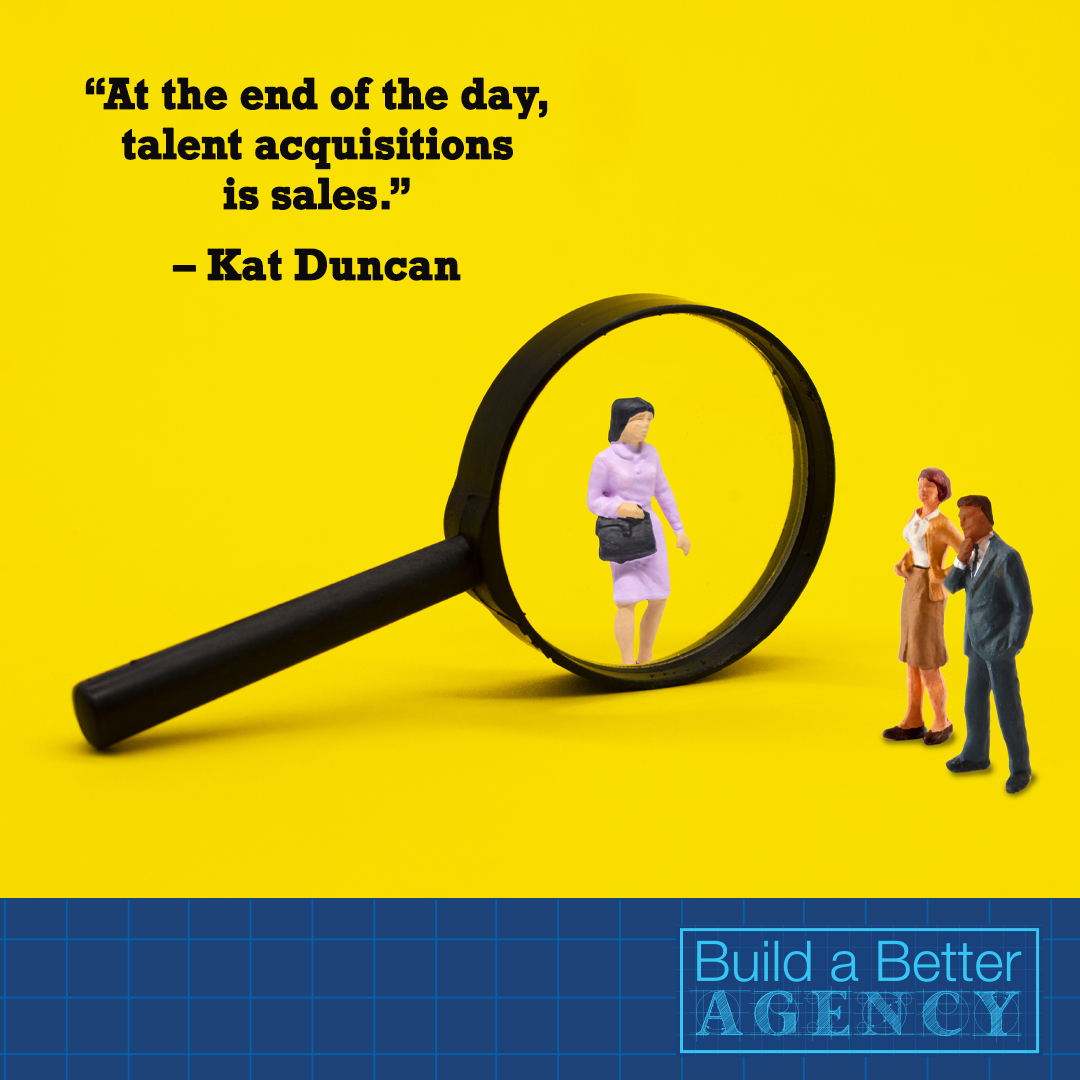
I think that talent acquisition at the end of the day is sales. You’ve got to be able to say, I’ve got a beautiful product here, and that is my agency. And you should want to come work here because we offer all of the fantastic and fabulous things that are going to help your career grow.
Drew McLellan [00:05:57]:
And let’s— it’s a different sales job.
Kat Duncan [00:06:00]:
Let’s do this together. It’s a very different kind of sales job, but you know, you’re selling organizations to human beings and you’re selling human beings to an organization. And I hate to drill it down to just sales, Drew, but it, it does somewhat come to that. Oftentimes I had to consider, you know, my product being a human being is emotional. My product is going to change its mind. My product has free will, right? Um, my product is going to be inconsistent because we’re human beings. And so I think it’s actually probably one of the more challenging and also maybe the best learning that you’ll ever get in sales.
Drew McLellan [00:06:46]:
So I want to put a pin in this product thing because I have a question about it, but I want to go back and finish sort of that. So, so you’re in account service in an agency. How did you move into HR and talent recruitment and all of that? How did that happen?
Kat Duncan [00:07:00]:
Yeah, I never moved into HR and I want to be clear about that. Human resources and talent acquisition are often put into the same bucket and many HR professionals practice talent acquisition. Very few talent acquisition professionals practice human resources. Okay. And we can talk more about that. But the, the way in for me was I, I was looking for something new. I was looking for a new business development role. I had had one with a direct marketing agency. I wanted to do something a little more creative. And in that process, I applied for a position through a recruiting company. And they said, that position might be good for you. We’re gonna, we’re gonna set that aside. But really what we want is for you to come recruit. And I looked at them and said, yeah, I don’t even know what that is. So let’s talk about that other job.
Drew McLellan [00:07:56]:
Yeah.
Kat Duncan [00:07:56]:
Right. And, and they kept coming back at me and asked me, you know, hey, here’s why we think you’d be good. Here’s why we like you for this. And I said, you know what, what the heck, I’ll do this job for a little while and I’ll place myself into my dream job. What I had recognized is I found it in, in recruiting and talent acquisition. I was over the moon that I was getting paid to connect with human beings and getting paid to learn about what they do best and what they love to do and making those connections and connecting people to opportunities and opportunities to the right people. Incredibly joyous for me. So that’s how I slipped and fell into it. I said no to the job a few times in a row, and I asked a professional mentor of mine many years ago, 20, 25 years ago, what do you think? I’m being recruited for this. And, and he looked at me and he said, oh, Catherine, he used my full name. Oh, Catherine, I wouldn’t wish recruitment on my worst enemy. You should do it though. I think you’d be good at it. And I thought, wow, I don’t know that this individual still likes or respects me, but they were right. They were right. I think it takes a very unique and special kind of salesperson to walk into the role of recruiting. And it was my niche, especially in my space, which was the industry of advertising, marketing, digital marketing, creative. If I could stay in that space, I knew I’d stay happy.
Drew McLellan [00:09:27]:
Right. So a minute ago when you were talking, you were talking about the recruit, the person who you’re trying to place into a job as sort of the product. And I’m curious because I would’ve thought that in some ways the product was the agency, right? So I’m talking to 5 people and I’m trying to help them see the agency as a great place to work. So for you, is the product both the recruit and the agency? And is it sort of the matching the yin and yang? Like, I, I know in most cases you are hired by the agency to find a specific person for a specific slot they have on their roster. So in theory, you’re kind of selling the agency, but you’re also selling the person to the agency. So talk a little bit about how you view your relationship with both sides of the equation.
Kat Duncan [00:10:23]:
Yeah, yeah. In the business, you know, they call it working both sides of the desk, which is, you know, working with your client, which is the agency that is tapped on me to help them find a very specific role that they just can’t find on their own. And on the flip side, it’s really my job to know all of the people that do that role and be able to convince somebody that it’s the right move for them to go to that agency. I’m not going to do that unless it’s the right move for them. So there’s a lot because that doesn’t, that doesn’t help either.
Drew McLellan [00:10:55]:
Like, and again, You’re evaluated on the matchmaking and the duration of that match, right? I mean, I think for most agencies, they think about recruitment and, you know, one of the reasons why they hang on to people too long is because finding the right person is so painful and takes so much time, especially if they’re doing it on their own and they don’t have someone like you. So for them, it’s a big investment of time and money So, boy, that’s got to pay off. And so I’m sure that’s where the pressure point is for you, right?
Kat Duncan [00:11:29]:
Very much so. I mean, I think that big investment of time and money is one that it’s hard to see for a lot of agencies when they’re doing it on their own. So what can happen often is, you know, well, we have a small agency, we don’t have an invested HR person or an invested like full-time or even a part-time recruiter that’s just for us. So what you often have are agency owners recruiting. Um, you often have the leaders within the organization trying to do the recruiting. They’re trying to do this while they’re doing their jobs, while they’re doing right, the job that they do very, very best for their clients. And that’s where it can get tricky and the investment in time and the money can become elusive. Suddenly you put a, a post out and everyone’s suffering cuz you gotta fill this role. But the reality is work got in the way. And so a month goes by, 2 months goes by, 3 months have gone by. Now you’re 90 days and your staff is burning out because you still haven’t filled this role, but no one’s got time to put into it. And then you look at a recruiter like myself and you think, wow, that’s expensive, right? That’s a lot of money. I mean, I charge 30% of the annual salary. That’s an average recruiting fee. And that’s a tough hit to the bottom line when you’re a small agency. Yeah. But if we take a look back at that 90 days, how can we monetize what you’ve lost? How can you monetize what you’ve lost in productivity, what you’ve lost in morale? Right. What you’ve lost in not having that seat filled. Burnout? Are you going to lose other people because you haven’t had that seat filled? Now what are we looking at? Now are we looking at losing potential client? There’s a lot you can lose by not investing that money. Yet at the same time, it’s hard to monetize. Yeah. So you had asked me though prior about the product being human and the product being an agency, and they are. It is. It’s like being a a real estate agent that is representing you for both the buy and the sell in the house, right? So a lot of people have encountered that analogy. I think we’re understanding that you’re working both sides. I have to do good by both sides. I— it’s an incredibly ethical job for what it is that I do. I need to be really upfront about what is the actual budget that the agency can spend and how can I make that match? What I’ve found over 25 years, especially when I’m working with smaller agencies that don’t have people dedicated to doing this kind of research and talent acquisition, is a lot of education. And I’m happy to do it. But it is about, you know, compensation. Yeah, it is about do you need this role to do this one thing? Or do you need this role to do 28 things? Are you looking for everything and the kitchen sink? Do you need a catch-all? How do we start defining this role and aligning this role with business objectives? And then we can make this process less painful.
Drew McLellan [00:14:51]:
Yeah. So when you— I’m sure a lot of times people come to you because they’ve tried to do it themselves and it hasn’t gone well. And you’ve been doing this for long enough. So if I’m doing this by myself as an agency owner, what am I doing wrong? Why do I get it wrong? And I’ve got somebody on staff for 30 or 60 days and it’s just not working.
Kat Duncan [00:15:14]:
It was the wrong hire. Well, I’m going to say right out of the gate that about 10 to 15%, Forrester stat, of all hires are the wrong hire, no matter how well vetted. Sure. So first and foremost, if you have a bad hire and you made a wrong decision, and you saw the red flags, but you kind of ignored them because they’re always there, right? There’s always something that made you go, every hire you make is a risk and every hire you make is going to have reward. So the first thing, maybe mistake I would say is, you know, trying to do it by yourself, being a talent acquisition professional when you’re a business owner and a creative and marketing strategist. I mean, what you do best is you take someone else’s service or product and you generate awareness, leads, and sales for that client. Oftentimes, if we could turn what we do in marketing around and use it in talent acquisition, we as agency owners could be smarter about it. So if we think about, okay, who’s our target market? We’re not just putting a post out into the ether, into the world to let anybody and everybody know that we’ve got a senior digital strategist that understands AI platforms to make recommendations to clients. Specific job. But we’re going to put that out into the world for every single human being to look at and get overwhelmed with people that have never done this job. What didn’t we do? We didn’t target, right? Which is what we do every single day for our clients, right? What didn’t we do? We didn’t design a strategy We didn’t think about a timeline. We didn’t put a project deadline on it. We didn’t put in milestones. Did we say this is how many candidates we’d like to see by this point? This is our interview process. Yeah, this is our feedback process. This is our offer process. This is how we’re going to approach, define, align, and close it. Instead, A lot of the mistakes I believe we make are just due to lack of time. We all know better. We’re all smarter about it. And nothing I’m saying is going to be a huge wake-up call. It’s gonna be an aha moment.
Drew McLellan [00:17:33]:
Like, well, it’s a reminder of what we know we should do, but we don’t do. Right.
Kat Duncan [00:17:37]:
And you know how to do. Right. But it’s hard to think about applying it for your own business.
Drew McLellan [00:17:43]:
It’s no different than business development or any of the other jobs that an agency owner has, knowing how to do it, making the time to do it, and doing it well and consistently. Those are 3 very different variables, right?
Kat Duncan [00:17:57]:
They are.
Drew McLellan [00:17:58]:
So, so one of the things you said when you just mapped that out was you talked about the feedback. So I think this is an area where many agencies don’t— when they map out their process, that is an area that they don’t really think about. So can you talk a little bit about When you are guide— if, if I’m the agency owner and you’re guiding me through looking for a specific person to join my team. Yeah. And you say to me, Drew, what are we gonna do around the feedback? Tell me what you’re talking about. What does that look like?
Kat Duncan [00:18:33]:
Sure. So one of the requests that I make of my clients is I need a 48-hour business day turnaround time on feedback. And if I’m not getting that, you’re going to hear from me 5 times a day until you pick up the phone or respond. I mean, it is, it is that important.
Drew McLellan [00:18:53]:
Is that feedback? That’s me saying to you, I just interviewed Babette. Yep. And no. And no. Or, or is it feedback that I’m sharing with you that you’re then going to share back to Babette? Do you know what I’m saying? Like, like, am I Yeah.
Kat Duncan [00:19:11]:
Okay.
Drew McLellan [00:19:11]:
It’s a little more about that.
Kat Duncan [00:19:13]:
Sure. I mean, let’s first, let’s just like wrap up on timing of feedback. Okay. Um, timing couldn’t be more important. Um, and that’s one of the things that small companies do poorly is, and big companies do poorly. All companies do poorly. I’ve yet to see anybody really get feedback done well. And part of the problem is when we’re working and we’re in the process of hiring, again, we have to remember all of the, the team members that are involved in that interview process, and we can talk about that as well. Um, they’re all doing other jobs. They took a half an hour to an hour out of their day to meet somebody, interview them, and then they went right back to their jobs because they’ve got a client deadline due and that’s their priority right now. And later on, maybe they will remember to send an email about the person they met at 2:00 PM this afternoon about that other thing that maybe they’ll hire somebody down the line. So what often happens is we forget, we put it on the back burner. It’s not a client deliverable, so it gets set aside. 2 days go by, 3 days go by, a weekend goes by, a week goes by. Now we’ve got 2 weeks. In your agency land, that 2 weeks was like maybe 4 hours. In the candidate’s mind, that 2 weeks, it’s a pass now. I’m not going to come back to you. You made me sit without any communication. After I sent my thank you follow-up, after I said, hey, what are our next steps? And you sat right now. That candidate went cold. They don’t feel good. They feel icky. They feel like you don’t like them. You ghosted them.
Drew McLellan [00:20:49]:
This is one of the things I think agency owners understand. They’re talking to 5 other agencies at the same time. They’re in process with multiple agencies. And so if you’re the one that’s not responding or treating them with respect, they’re moving on with somebody.
Kat Duncan [00:21:07]:
So a no is perfectly acceptable in my book. I think that there’s— every other recruiter I’ve talked to out there would tell you that feedback is critical. It’s important. You need to be able to provide feedback. Bullet points. Give me something. Let me know why. Help me get better as a recruiter to help find the right person. Your feedback on why this person I thought was going to be a great match for you isn’t. That’s only going to help me get better. But if you can’t put your finger on it, and that’s just real life, if you don’t know why it’s a pass or why it’s a no, but it’s just a pass, it’s got to be a no. I’m okay with that. And my communication back to my candidate is, hey, they’re going to pass. I don’t have any feedback as to why, but here’s the scoop. If they’re passing without feedback, you dodged a bullet. That means there’s no way You would have been happy at this agency. So we all just won. Even with a no, getting great feedback is rare. I let that expectation go 15 years ago. Really? I don’t expect as a recruiter to get wonderful feedback from my clients. I’ve begged for it for years to the point where I have just accepted that I’m not going to get it. So, my ask is, if I’m not going to get great feedback about the candidate, I need timely feedback. Even if it’s very minimal feedback, I need to know if we’re moving forward or not. Let’s let somebody off the hook. I’m not going to put a warm blanket over them and keep them warm for you unless you ask me to. So, it’s that feedback communication that is so rare. If you look at LinkedIn, every, every day somebody is posting about their bad job experience.
Drew McLellan [00:22:58]:
Yeah, that bad interview process, right?
Kat Duncan [00:23:01]:
99% of the time it’s because they’ve been interviewed 5, 6, 7 times. They have now met 13 people. None of those 13 people know who the decision maker actually is. None of those 13 people know who is supposed to be following up with that candidate. It’s an unorganized system and nobody follows up. That candidate has now met 13 people, 7 interviews, 7 to 15 hours of their time depending on how much work they prepped for, and they’ve been ghosted. So if you think about that in your personal life, take it out of the professional realm. How do you feel if you’ve invested that much time in someone and they simply don’t respond? Right. It’s a real human emotion. I’m done telling people to suck it up and don’t worry about it, and it’s not you, it’s them. It hurts, and I want to validate that. It’s a real emotion when you don’t respond to someone.
Drew McLellan [00:24:05]:
It feels disrespectful, for sure.
Kat Duncan [00:24:08]:
Yeah, your PR takes a hit. Yeah, there are agencies that over the years I’ve fired, and by I’ve fired, I’ve said I will no longer recruit for you. I will no longer recruit for you because I can’t in good conscience put a talented candidate up for a job within your organization because you can’t get your interview process and your offer process together.
Drew McLellan [00:24:29]:
Yeah. So in today’s world, what is an acceptable timeline for the entire process? Because I think, I think a lot of agency owners do exactly what you’re saying, is they get started, and then they get busy and they can’t schedule people’s stuff. And, and I will often say to agency owners, you can’t take— this cannot take 2 months to do. Like, you have to keep this— you have to have— you have to have room on your calendar to make this a priority if you’re really going to find a great candidate. So for you, when you’re advising us as, as your clients, when you’re advising us on the timeline that you think Like, what’s the ideal process? Like, from running the ad to making the offer?
Kat Duncan [00:25:14]:
Okay, so good question. And Drew, I work backwards. So today is— we’re looking at the end of January. Let’s just say it’s February 1st. You say, Kat, I need someone in the seat March 1st. That’s one month. So I’m going to work backwards from that date and I’m going to say, okay, That’s tight. So let’s think about it. Someone’s gonna, you’re gonna make an offer to someone and they’re gonna need minimally 2 weeks to put a notice in from where they’re currently working. 90% of the time you’re hiring somebody that’s currently working. And I hope you are because that means that you’re working with a passive candidate. You’re handpicking the best talent, not just the available talent. And that’s a huge difference as well. So let’s just bank on the fact that you are hiring someone that’s already working. So you’re already at making an offer now on February 15th, right? Yeah, right. That means you need to, in the next 2 weeks starting today, meet your candidates, interview your candidates, finish interviewing your candidates, and extend an offer to your candidates. Is that doable in your agency? Let’s give you 5 business days to find them, and let’s give you 5 business days to interview them and make a decision. No way, right? There’s absolutely no way. So when we say takes 2 months, it shouldn’t take 2 months, should it? But yeah, it’s gonna have to. 2 to 3 months is what you need to plan for when you need a new hire. It’s simply how long it’s going to take. You got to find your people. First round interviews, second round interviews, final interviews. Right. And that, that’s if you’re doing a tight system, that’s if you’ve got it buttoned up.
Drew McLellan [00:27:06]:
I was going to say, is that what you recommend is like about 3 rounds of interviews?
Kat Duncan [00:27:11]:
Yes. If your agency— I mean, you guys, we’re not talking about Fortune 500 here, right?
Drew McLellan [00:27:18]:
And nor are we hiring nuclear scientists.
Kat Duncan [00:27:22]:
Nor— yes, exactly. So we got to really sit down and think about, okay, how many people really need to make this decision? And actually, this is kind of a good step through, if you don’t mind, leading into your interview process, because if you have a buttoned-up interview process, the timing of getting your interviews done are going to be much easier. So for example, I know exactly who interviews for each role within my agency. And not only as the agency owner do I know who’s going to do those interviews, they know what their role is. And that’s critical, right? So if I’ve got a senior leader interviewing someone, they may be a decision maker. Are they the hiring manager? If I have somebody that is more of a peer role interviewing, they’re not a decision maker. Why are they in the room? Maybe for woo, maybe to talk about the agency extras, maybe to talk about day to day, to say, hey, you know what, we’re going to be teammates. Great. Do they have a say? What kind of feedback do you expect from that person? And if they don’t have any say and they don’t have a reason to be there, then why are they there? Right. Take them out of the room. Don’t let anybody interview a candidate unless they’ve been trained on how to interview a candidate. Let’s also talk about that. It’s not a week-long seminar on how to interview someone. It’s a 2-hour workshop. Bring me in for a lunch and learn, Drew. I could, you know what I mean? Buy everybody some sandwiches and we can talk about like the 3 primary roles of how to interview. Like, I’m here to make a decision. I’m here to gather technical knowledge. I’m here to bring the woo and talk about what’s great about working at this agency. I know my role. I know what my goal is in this interview, and I know what kind of feedback I’m supposed to provide so the decision maker can make that decision and so that they can turn that feedback around inside of 48 business hours.
Drew McLellan [00:29:25]:
I’m always surprised when agencies don’t— I’m not sure what the right word is, but systemize the feedback. So the way I always equate this with agencies is when I was helping our oldest daughter pick a college, we built like a matrix of the things we wanted to grade each college by so that we were really comparing apples to apples. And I, and, and I think agency folks, when they interview, haven’t decided in advance, what are the criteria I’m gonna— like, they’re like, yeah, I want to make sure they know how to do the job. I want to make sure they’re a good culture fit. But they haven’t defined how they’re going to know those things or how they’re going to compare candidate A, B, and C on those things so that they really are doing as best you can with human beings, an apples-to-apples comparison.
Kat Duncan [00:30:22]:
Yes, Drew, I’m just going to say yes.
Drew McLellan [00:30:24]:
I, and I’m assuming that that’s problematic.
Kat Duncan [00:30:29]:
It’s problematic. You can scoot along as a small agency for quite a while with a loosey-goosey hiring process when you’re only hiring 2 to 3 people a year. What happens when you scale? What happens if you scale, right? What happens when you need to hire 10 people this year? You want a big account, cart before the horse. Do we need the people to win the account or the account to win the people, right? But when you are at that precipice of scale. And right now it’s a very interesting time because people are hunkered down in their jobs. So there’s a lot of layoffs and there’s more tech layoffs coming. And that’s a huge indicator of what’s gonna happen to marketing and advertising. AI has taken over so much. We’ve seen a lot of, kind of a lot of layoffs within our organization, kind of within our community, Drew. Oh yeah. Yeah. But I’m starting to see that stabilize into less layoffs, not as much hiring, but not as much layoffs. That means people are hunkered down, they’re in their jobs and they’re not leaving their jobs. So when you do need to hire, which even in downtimes we need to hire, you’re looking at people who are already working. Yeah. You’re not putting an ad out into the world and thinking that you’re gonna attract a whole bunch of people that are sitting on the sidelines to come work at your agency. There aren’t that many people sitting on the sidelines. And if they’ve been sitting on the sidelines for a while, they’re probably not what you need because you as a small agency are looking for specialized skill sets. Yeah, right. So you want to look at the people that are currently working. And when you’re looking at people that are currently working and you’re wooing them and bringing them into your organization— yeah, that’s different kind of interview than grilling about your technical abilities and the size of budget you’ve worked with and who your blue-chip clients have been versus we’re gonna be a great space for you to come be. Yeah. And that’s another thing that I see in terms of there’s some systematic things that we fall down on. There’s some emotional things we fall down on. We want to say, well, We’re hiring you. Yeah.
Drew McLellan [00:32:48]:
So I’m going to stop you right there because I want to take a break. And then when we come back, let’s talk about the emotional side of the hiring process for both the candidate and the agency. So we’ll be right back. We’re going to take a break and then we’ll come back with Kat and we’ll talk about— I think a lot of you think about the technical side of the mechanics of interviewing and hiring, but I think there is a whole emotional side of that. And we’re going to talk about that when we come back. So we will be right back. As we take a quick pause from our conversation, I wanna talk about something that I see agencies struggle with. Hiring mistakes are expensive, especially when you’re expanding your team or thinking about hiring internationally. When agency owners ask me who helps them slow down, get clear, and avoid these mistakes, we often point them to JobRack. We trust Noel and JobRack and their approach. I’ve seen how he thinks about hiring and AMI agencies working with him have strong positive experiences. Because of that, we were happy to welcome Noel and JobRack as a paid sponsor of this show. If you want a smart place to start before your next hire, Noel’s hiring playbook is available at jobrack.com/ami. Again, that’s jobrack.com/ami. Okay, let’s get back to the conversation. Hey everybody. Thanks for listening today. Before I get back to the interview, I just wanna remind you that we are always offering some really amazing workshops, uh, and you can see the whole schedule at agencymanagementinstitute.com on the navigation, head to how we help, scroll down and you’ll see workshops and you can see the whole list there with descriptions of each workshop. They are all in Denver and we’ve got them throughout the year for agency owners, account execs, agency leaders, CFOs. We have a little something for everybody, no matter what it is that you’re struggling with— people, new business, money— all of those things we’ve got covered. So check them out and come join us. All right, let’s get back to the show. All right, we are back with Kat Duncan, and we are talking about the art and science, because I think it’s both, of recruiting and hiring the right people. And, you know, As all of you know, I am talking to agency owners 7 days a week, and there is no doubt the hot topics— and this has been true for as long as I’ve been doing this— are new business and people. And, you know, for all of you, most of you realize that unless you are a band of one with some contractors, most of you realize that the success of your agency, of your business, your ability to pay the mortgage, to put money aside for your retirement is very much dependent on the team that you build around you. And so this feels like such an important topic. So before the break, we started to go down the path of kind of the emotional side of the recruitment process, both from the agency’s point of view and probably from the candidate’s point of view. And I stopped Kat because I knew we needed to take a break. So we’re back. And so, Kat, let’s pick up right where we dropped off.
Kat Duncan [00:36:04]:
Sure. So in speaking of the emotional side, I think, you know, we touched on it a little bit earlier where the, you know, the agency itself gets busy and we forget that we interviewed someone 2 weeks ago and, oh shoot, we got to get back to them. At some point, somebody’s got to get back to them. And on the flip side, you have a candidate that went cold on your agency. And again, your hiring process can be your best and worst PR in that now you’ve got this person out in the world that said, yeah, Agency XYZ totally ghosted me and it feels icky. And what the candidate feels oftentimes is, you know, they feel rejected and then defensive, right?
Drew McLellan [00:36:43]:
And, and also in the dark, like they don’t really know why or what. And, you know, I mean, if you think about it, this is—
Kat Duncan [00:36:51]:
they’re gonna make up their own reasons as to why you didn’t hire them, and they’re gonna go down a dark path. You know, they’re going to be harder on themselves than you might have been on them. Yeah. Um, because that’s human nature, it’s what we do. And so now you’ve got this person out in the world that feels really awful about your agency because they don’t want to feel bad about themselves. They’re going to feel bad about you dead, right?
Drew McLellan [00:37:09]:
Um, that’s right.
Kat Duncan [00:37:10]:
Even the most, I would say, you know, emotionally, um, stable and responsible human being, it takes a lot to come back from being ignored. It’s a lot easier to come back from being told no, not right fit, not right now, than being ignored. It’s Just a basic human emotion. How do agencies feel when a candidate goes through their entire process and then says, no, I’m going to pass on this offer? The agency feels hurt. Like, it’s amazing how stunned and shocked sometimes my clients are that a candidate would come back and say, after I’ve gone through this whole process, I think I’m, I’m going to pass. I’m not feeling good about it. And I have so many clients that are bowled over but angry. They’re angry. They’re angry with me. They’re angry with the candidate. They’re angry at the process. And I think we just did that to 5 other people, right? So you just lost one. We’ll go get another one. It’s gonna be okay. We gotta pull it together. So there’s, um, There’s so much emotion when it comes to hiring because again, Drew, you, you nail on the head when you said, you know, our agency owners know, or they should know, and I believe they do, that, um, your number one asset is the human beings that work next to you. Yeah. The team that you’ve built around you and Drew, you said it. So if that’s your number one asset, then let’s treat them with every ounce of respect you can muster. Even if you don’t wanna hire them right now, this is an individual that could go on to be someone you want to hire. This is an individual that you never want to treat disrespectfully because whether you think you want to hire them or not, why would we ever treat a human being disrespectfully? That’s part of our industry, right? If you’re a good human being, this is just kindergarten. Be good, be nice, be respectful. Yeah. Have follow-up, have response time. Now, that’s not easy to do. It is easy to build. And when I say that, Drew, and I’m kind of going back to systems maybe a little bit, building those systems aren’t that tough. And that’s where a talent professional can come in and help at least get it built for you so that you have a repeatable process. So if it’s built up front and everybody knows what they’re supposed to do when they interview and everybody knows what their role is in an interview and everybody knows how to interview and everybody knows—
Drew McLellan [00:39:48]:
and they’re trained to do what they’re supposed to do, right?
Kat Duncan [00:39:51]:
And then everybody knows what the expectations are. And those expectations are enforced, then you’ve got to respect the hiring process without even thinking about it.
Drew McLellan [00:40:01]:
Yeah. Yeah. And I do think every agency— I find it a little fascinating. So when clients or prospects ghost us, we get super irritated and we’re frustrated and we feel disrespected. And so you would think we would want— and I do think this is true— that we would want our anyone who interacts with our agency to feel differently than that, to not feel dismissed or ignored. We know that intellectually. We just don’t bake the time in to do it well. And we feel bad when we ghost somebody or we don’t respond or whatever, which is not the same thing as just not doing those mean things. Right.
Kat Duncan [00:40:44]:
Yeah. I mean, nobody intends to be disrespectful. It’s not the intent. It is oftentimes the outcome, unfortunately.
Drew McLellan [00:40:51]:
Yeah, right. Okay, so I have a process. So let’s, let’s go back to— so for you, you believe 2 to 3 months is a reasonable length of time to go from I want to hire a fill-in-the-blank to actually having them walk in the door on day 1 of being an employee.
Kat Duncan [00:41:15]:
Yes.
Drew McLellan [00:41:16]:
Yes. And that’s because we know it’s going to take a while to screen the candidates, to do the interviews, for them to give notice. And depending on their role, 2 weeks might not even be enough. They might have to give longer notice depending on, you know, how senior they are or whatever that may be, or how long they’ve been with the agency. They may— or wherever they’re working, they may feel an obligation to give them more notice.
Kat Duncan [00:41:37]:
So although I will side note real quick, say that I will never ever recommend that a candidate give more than a 2-week notice. So that might be a whole other podcast.
Drew McLellan [00:41:48]:
No, no, talk about that for a minute. Yeah, yeah, let’s go there.
Kat Duncan [00:41:51]:
Yeah, the minute you put your 2-week notice in, you are— or your notice, let’s say it’s a 3, 4-week notice because you feel obligated to give them more time because you know what’s on your plate and you’ve got so much you need to wrap up before you walk out the door, but You’ve got one foot out the door and they are going to stop inviting you to all the meetings. Suddenly new work doesn’t come onto your desk. You’re taken off some Slack channels. You’re no longer getting all the emails. You’re not invited to this meeting, that meeting, this meeting, that meeting. You’re going to find yourself late into your second week going, I’m done, right? I’ve got it all done. I have one foot out the door. I am starting a new job. What I recommend is that most human beings take 3 weeks. So you’ve got 2 weeks that you’ve given to your employer, which is fair, and you’ve given yourself one week to rearrange whatever you need to rearrange, be that pet care or daycare or other life things, and then start your new job fresh. So oftentimes it is a 3-week notice, but I would never recommend giving a company more than 2 weeks, even if you’re feeling super loyal and good, because guess what? That third week you start to feel icky, and so do they, and it gets weird.
Drew McLellan [00:43:03]:
Yeah, yeah, you’re so right. I, and I can remember back in the day when I was an agency employee, man, if somebody gave notice, they were handed a box that day and they were out, right? They were— it was— there was no— even if they offered 2 weeks’ notice, the agency was like, uh, you are now, you are now the enemy and you need to get out of our camp. And I do think that’s changed a little. Do you?
Kat Duncan [00:43:31]:
That’s not as frequent. No, that’s not nearly as frequent. I mean, my recommendation and goal and what I’m seeing more of is when you have an employee put their notice in and say that I’m going away now, you need to say, I am so grateful that you flew with us while you did. Now take your wings and go fly higher. I mean, it is— it’s, it’s wish well. Wish them well. A boomerang employee is the best employee you’ll ever have, one that decides, you know what, the grass is greener where I was and I want to come home. And that happens, and especially in small agencies.
Drew McLellan [00:44:07]:
Yeah, yeah. And I think there’s just, you know, that our industry is relatively small, and today with social media and everything else, everybody’s connected. So, you know, you have to think about about what you started talking about in the very beginning of the conversation, which was kind of the PR aspect of what’s your reputation look like. Yeah, yeah, right. So other than the process itself, probably us being too optimistic about how quickly it can happen, and then, and then us not fulfilling what we probably promised the candidates we would do, like, oh, we’ll get right back to you and blah blah blah blah blah, Where else do agencies get it wrong when they’re— when they are evaluating candidates or, you know, they’re trying to figure out maybe between 3 or 4 candidates, where do we misstep?
Kat Duncan [00:45:00]:
You know, it’s agency to agency, but I do see a lot of— I hear this one, Drew. I didn’t see it on their resume. I can’t believe I still hear that. I’m shocked by it. I want our agencies to say, okay, this person has the technical abilities to be sitting down in front of me. If they’re already sitting down in front of you, then we want to look at, is this person bringing their potential to your agency? Yeah. And that’s what I wish we could have a better radar on, is potential versus been there, done that. We look for a lot of been there, done that. I want you to come in here and do exactly for us what you just did for that last agency, versus you didn’t do exactly all the things that maybe we think we need, but wow, this person has something that is a spark. It is special. It is going to, I think, move us forward. And kind of looking beyond the resume, looking beyond the skill set, trusting your, your gut reaction. To another human being. And then I also want agency owners to, and, and this is not my quote, this is someone else’s and I don’t even know where to attribute it exactly, but it’s not about culture fit, it’s about a culture add. Add to our culture, don’t fit into it. Mm-hmm. So fitting into it can create Stepford, and that’s where we have an agency of, yeah, we’ve all seen, you know, agency of Stepford wives and agency of Stepford husbands and I like thinking about bringing somebody to the table that maybe has a sim— similar skill set, but maybe not the big reputable agency background. I like— look at a lot of smaller agencies and they’re, they’re still looking for a big agency under the belt of a candidate.
Drew McLellan [00:46:59]:
Like, did you work— I’m gonna tell you, Kat, 9 times out of 10, those people don’t last. They know they’re big.
Kat Duncan [00:47:07]:
Yeah, they don’t know how to work in a small agency.
Drew McLellan [00:47:09]:
No, they don’t. And they’re so used to having a certain staff or assistants, they don’t know how to roll up their sleeves and do the work. And in a small agency, even if you’re at the director level, sometimes you have to make the pie, right? You can’t just tell somebody else how to make the pie. And so, you know, one of the things that we talk a lot about with agency owners is don’t get lured in by a big agency name and think, oh, especially in the creative department, because they’re going to be expensive and they’re not going to do well. And you don’t have Volkswagen as a client. So the fact that they did work for a, you know, a big brand with a multimillion dollar budget and you have regional B2B clients, that’s not the same skill set and it’s certainly not the same attitude. And sort of—
Kat Duncan [00:47:59]:
you’re not going to woo them in. If somebody that worked on Volkswagen is excited to come work on your B2B regional, yeah, there’s a reason. There’s a, there’s a big red X on their back for a reason. There’s a reason they’re not getting hired by 72 and Sunny and Wieden and Kennedy and, you know, BBD New York. There’s, there’s a reason. So exactly what Drew said. I agree with you wholeheartedly. I mean, let’s not be so drilled down on, I have an agriculture client, I must have agriculture in their background. Now, ag, don’t get me wrong, has a lot of landmines. You can step in a lot of landmines in, in the ag industry. And knowing the ag industry is helpful if you have an ag client. I get it, it’s helpful. It’s not the world, it’s not everything. You are a small agency. It’s going to be faster to bring someone really smart up to speed on your client than it is to wait for someone who’s mediocre that has that industry experience.
Drew McLellan [00:48:57]:
Yeah. Yeah. So true. I have, I have so much we’re going to— well, you’re going to have to come back and we’ll have to have a second conversation. But as we, as we wrap up the hour, I’m curious if you could, if you could have every agency owner or leader ask one question that it never occurs to them to ask. What should we ask?
Kat Duncan [00:49:19]:
Of a candidate? Uh-huh. Oh, see, now curveball, Drew. You didn’t prep me for that question.
Drew McLellan [00:49:25]:
I know, I know.
Kat Duncan [00:49:26]:
I know. You’re— you’re— are you going to get the best of me here? I don’t know.
Drew McLellan [00:49:30]:
Yes, I am. Because you’ve done this for a long time and you’re good at what you do.
Kat Duncan [00:49:35]:
Drew, thank you. If they could ask one question of candidates, I think it would be— I think the candidates need to articulate why they want to work at this particular agency.
Drew McLellan [00:49:46]:
Like, what, what is it about us that appeals to you?
Kat Duncan [00:49:50]:
Not the industry. What? Why us? Right. And if they can’t answer that, they don’t really want to work for you. They’re just applying for jobs.
Drew McLellan [00:50:00]:
Yeah, that’s so true. They haven’t done their homework. They haven’t. So it’s interesting. I have a niece who just got a new job and she had been, she had been recommended to 5 different companies, and she did some homework, and she was like, I was so excited to interview with this one company. And she listed several reasons why she thought they were just the right fit for them. And I thought, man, I bet you showed up in that interview on fire because she really wanted that job. And, and it was very specific, to your point, that she wanted a job at that place, not just a job, but there was, there were things about that place that really appealed to her. And, and I was just, I was just thinking, I was just with her over this last weekend and I, and I was just thinking, man, I bet she showed up so differently for that interview versus the other interviews.
Kat Duncan [00:50:57]:
And maybe even subconsciously. So, right. A little bit. There’s going to be a little spark there. Yeah. I’ve seen over my 25 years. In talent, the wrong person get hired again and again and again because the agency didn’t want to take a risk on the person that wanted it more.
Drew McLellan [00:51:15]:
Yeah.
Kat Duncan [00:51:16]:
Interesting.
Drew McLellan [00:51:16]:
So, so how much weight should how badly the person wants it be?
Kat Duncan [00:51:23]:
Oh, you know, I have a rule of thumb. Like, if they got to the table, they’re probably qualified to do the job, right? So If it’s down to two candidates and it’s one or the other, then I think that you should always lean on the one that wants it more. It shouldn’t necessarily bring someone to the next round or from first interview to second interview. You know, you still need someone that’s gonna be capable of coming in and doing the job at a high level, or someone that’s gonna come in and be capable of learning the job real fast. I’m a big proponent of somebody learning your systems really fast, taking it and running with it, basically hiring for that kind of grit.
Drew McLellan [00:52:06]:
Yeah.
Kat Duncan [00:52:07]:
Um, and drive, that drive. And that is what you’re going to find in the person that really wants to come work for you.
Drew McLellan [00:52:14]:
Yeah. Yeah, that’s, that’s a great way to end this part of our conversation. We’ll, we will have you back and have another one, but it’s a, it’s a really great reminder that again, it is It should be a mutual love affair, right? I mean, they should want very much to be with you, and you should be excited and want very much for them to be a part of your organization. And I think there is something magical that happens when it’s— when it goes beyond the technical skills, or to your point, the resume, and it really goes to sort of that connection and the desire that you have to be in each other’s world and to create together, whatever role that may be. And I— that’s an intangible. That I think sometimes we don’t give enough weight to.
Kat Duncan [00:52:56]:
It’s hard to trust your gut in some of those situations. That’s why when I have told people over the years, you don’t need to trust your gut, you need to trust mine. Right. If I say so.
Drew McLellan [00:53:10]:
Yeah. Well, I do think this is why agencies lean on good recruiters is because that independent point of view that unbiased, independent point of view is so valuable when, for us, this is such a risky decision. And I think a lot of times we’re afraid to make a bold decision when the bold decision may be exactly what we need or want. Or as you were saying, maybe the unconventional, like the resume doesn’t quite match the job or whatever it may be. You know, it’s good to have an outside perspective that, that knows us and, you know, can also kind of see the forest for the trees.
Kat Duncan [00:53:52]:
Yeah, I don’t disagree. Yeah, there’s still, there’s still some value to having a human recruiter working with you in talent acquisition. But, you know, there’s a lot of ease with AI platforms now in recruiting. It’s made it a lot easier to even drill down into some of those intangibles. But that’s another podcast along with, you know, career pathing and compensation structures.
Drew McLellan [00:54:17]:
Okay. All right. So when we’re done, you and I will find some time to have those conversations too. But this has been great. If people want to track you down, if they want to talk to you more about these things, what’s the best way for people to get in touch with you?
Kat Duncan [00:54:32]:
Yeah, you can just email me at [email protected].
Drew McLellan [00:54:39]:
Okay. Click is C-L-I-C-K. Yeah.
Kat Duncan [00:54:41]:
Yep. C-L-I-C-K. Because, you know, it’s got to click.
Drew McLellan [00:54:45]:
I like it.
Kat Duncan [00:54:46]:
You know, when it clicks. Yep. Yeah. And then talent, T-A-L-E-N-T. And I’m a dot net. That’s where people lose me sometimes. But that’s my website as well. So you can find me there too. And, you know, if you’re ever in the Stillwater area in Minnesota, right? Yeah. Come see my coffee shop as well because I own a coffee shop.
Drew McLellan [00:55:07]:
Love that. All right. So everybody, I will have all that stuff in the show notes as well so you can reach out to Kat. And pick her brain a little bit more. Kat, this has been great. Thank you very much for— thanks for being with us. So, homework this week is— here’s what I’m gonna tell you. I, in the world of AI, and one of the things that we’re tracking is trends. Agency size in terms of butts in seats is actually getting smaller, which means the importance of every butt in every seat in your agency just gets elevated because if you’re gonna be down a person or two, and by the way, this is not down because you’re losing business or whatever, it’s that you’re getting more efficient. Some of you are using AI in ways that you were manually doing things before. Some of you are making a shift to a, a different mix of employee versus contractor. But bottom line is we cannot do this work, and I don’t care how great you are at AI, we cannot do this work without the right people around us. And so when you’re an agency of 5 people or 10 people or 15 people. You know, when you’re an agency of 500 people, you know, you can have some B and C players and still be pretty good. When you’re an agency of 10 people, man, everybody better be an A or at their worst day a B+ because it shows in everything you do. And so as you think about your team and you think about the year ahead, and especially for those of you that are thinking about either making a, a player trade or adding a staff position or role, I do wanna remind you that this is mission-critical work. And a lot of times we kind of phone it in, we fit it in around client work and other stuff, and you can’t afford to bring the wrong person in. I could do a whole podcast on the dangers of bringing the wrong person in because you keep ’em for too long and they damage other relationships and it’s just a hot mess. So better to get it right off the get-go. And Kat gave you some great tips and tricks and tools to think about that as you go to your next hire. So homework is number one, look at your team. Are they really, are they really an A-team? And are they the people that you want to go to battle with every day that you want to go into battle with them? And are you proud to have them at your side? And do they do your clients justice every day? And if not, the good news is there’s folks out there looking for work and you can, you can level up. One of the smartest things an agency can do is level up the talent that they have on their team. And so listening to this podcast and doing it better than you’ve done it in the past would be a lovely way to kick off the year and think about sort of how successful you want to be in 2026. So that’s your homework. As you know, I want to of course say thank you to our friends at White Label IQ. I told you at the top of the hour, they are our presenting sponsor, have been with us for a super long time, super grateful to them. So check them out at whitelabeliq.com/ami. And I don’t get to do this if you don’t listen. So I miss out on all these great conversations. I miss out on all these opportunities to get smarter, and I miss out on hanging out with you. So I am super grateful that you keep listening and that you keep pinging me and letting me know the guests that add value for you. And when I see you at a workshop or at the Build a Better Agency Summit, you’ll stop me and say, oh, that interview you did with so-and-so, I love that so much. Or I went and bought the book, or I did the thing. That, that makes my day knowing that this show is valuable to you, that it is practical. It is something you can apply to your daily life. That’s great feedback for me, and I love doing this, so I’m super grateful that you love listening. All right. I’m coming back next week. I hope you do too. All right. See you next week. Have a good week.
Danyel McLellan [00:59:09]:
That’s all for this episode of AMI’s Build a Better Agency podcast. Be sure to visit agencymanagementinstitute.com to learn more about our workshops, online courses, and other ways we serve small to midsize agencies. Don’t forget to subscribe today so you don’t miss an episode.