
Episode 564

Welcome to another inspiring episode of Build a Better Agency! In this episode, Jeannie Walters breaks down the real distinction between customer experience and customer service, and why treating them as the same thing keeps agencies from measuring what actually drives retention and referrals.
You’ll learn how a concise CX mission statement becomes the judgment call every employee uses when things get messy, and why vague goals like “be the friendliest” never translate into real behavior change. If you’ve ever wondered why some brands earn fierce loyalty while others just get by, Walters explains the frameworks that separate the two.
Walters and Drew dig into the CX Strategic Success Blueprint and the CX Charter, two tools for turning customer experience from a poster on the wall into a cross-functional discipline with real accountability. They also unpack the difference between manufactured “wow” moments and genuinely reducing friction, using real examples from a utility company, a car dealership, and the pet brand Chewy to show what actually earns trust.
Whether you’re trying to sharpen your own agency’s client experience or help your clients think differently about theirs, this episode gives you a practical starting point. Tune in to learn how to turn customer experience into a real business strategy instead of just a nice sentiment!
A big thank you to our podcast’s presenting sponsor, White Label IQ. They’re an amazing resource for agencies who want to outsource their design, dev, or PPC work at wholesale prices. Check out their special offer (10 free hours!) for podcast listeners here.
What You Will Learn in This Episode:
- Learn the exact difference between customer experience and customer service, and why the distinction changes how agencies plan
- Discover why a concise CX mission statement matters more than a lengthy list of values nobody remembers
- Understand how to build a CX Strategic Success Blueprint that ties customer experience directly to revenue and expense goals
- Learn how a CX Charter creates cross functional accountability so customer experience isn’t treated as “a marketing thing”
- Discover why reducing friction matters more than manufactured “wow” moments, and how to tell the difference
- Learn how customer journey mapping uncovers friction points your team can’t see from inside the org chart
- Understand why agencies should weave customer experience into marketing and sales conversations, not just delivery
- Learn the two changes Walters recommends every agency make to their own client experience in the next 90 days
- Discover why tone matters as much as content in contracts, invoices, and other easy-to-overlook client touchpoints
Ways to contact Jeannie:
- LinkedIn: https://www.linkedin.com/in/jeanniewalters/
- Website: experienceinvestigators.com
Resources:
- Jeannie’s Book: Experience Is Everything: Making Every Moment Count in the Age of Customer Expectations
- BaBA Summit May 24-26, 2027: https://agencymanagementinstitute.com/babasummit/
- Drew’s Book: Sell With Authority
- AMI Facebook Group: https://www.facebook.com/agencymanagementinstitute
- AMI Preferred Partners: https://agencymanagementinstitute.com/ami-preferred-partners/
- Agency Edge Research Series: https://agencymanagementinstitute.com/agency-tools/agency-edge-research-series/
- Upcoming workshops: https://agencymanagementinstitute.com/advertising-agency-training/workshop-calendar/
- Weekly Newsletter: https://agencymanagementinstitute.com/newsletter-sign-up-form/
- Agency Coaching and Consulting: https://agencymanagementinstitute.com/advertising-agency-consulting/agency-coaching-consulting/
Danyel McLellan [00:00:01]:
Running an agency can be a lonely proposition, but it doesn’t have to be. We can learn how to be better faster if we learn together. Welcome to Agency Management Institute’s Build a Better Agency podcast presented by White Label iq. Tune in every week for insights on how small to mid sized agencies are surviving and thriving in today’s market. With 25 plus years of experience as both an agency owner and agency consultant, please welcome, welcome your host, Drew McLellan.
Drew McLellan [00:00:37]:
Hey everybody, Drew McLellan here with another episode of Build a Better Agency. Super excited to be with you again this week. Thanks for coming back if you’re a regular listener and thanks for joining us if this is your first time. For almost 600 episodes, we’ve been talking about all of the things that you should be thinking about in terms of growing a stronger, more stable, more sustainable, more scalable agency through good times and bad. That’s what we talk about every week, is sort of how you can continue to improve your agency so that it feels better every day to be there. You are confident that you can make not only payroll, but profit numbers and that you’re building something that someday, if you want to, you can turn around and sell. So with that in mind, we have a great guest today that is going to talk to you about an interesting topic that I think is important for you, your agency, but also something you could be talking to your clients about.
But before I tell you about her and we bring her onto the show, I want to give a huge shout out and thank you to our friends at White Label iq. As you know, they are the presenting sponsor of this podcast. So for several years now, they have made it possible for us to come back and hang out with you every week. And we are super grateful to them. We have. One of the things that I really like about White Label IQ is that they come from an agency or they are born from an agency. They’ve literally sat in your chair. They know what it’s like to have a client breathing down your neck and they’ve built their business because they live that same pain. So they were an agency that was looking for a web partner who could crank out a lot of websites at a price where they could make money. Couldn’t find that partner and so they built it. And White Label is the sister of one of the AMI agencies that we’ve known for 20 plus years. Today all they do is work with agencies. They help them with design, dev, paid media, AI implementation. So when you talk to them, you don’t have to explain your life as an agency owner or as an agency leader, they get it because they’ve been there. And that can make a huge difference in how they work with you, how they price their products, and how they serve your clients. So head over to whitelabeliq.comami to learn more about them and to thank them for supporting this show.
All right, so I’ve known our guest for many, many years now, and she has a depth of expertise in customer experience bigger and different than customer service in customer experience that goes on for decades. She’s taught at the university level, she’s written books, and she’s here today to talk about her new book and to help us understand that in this world of AI and automations and chatbots and all the things, how do we show up to be even more human and more transparent and more accessible to our clients? And how do we help our clients do that as well? So get ready to take a lot of notes because I promise you this is going to be chock full of good ideas. And if you will, please help me welcome Jeanne Walters to the show. Jeanne, welcome back to the podcast. Thanks for coming back.
Jeannie Walters [00:03:53]:
Thank you so much, Drew. I’m thrilled to be here with you.
Drew McLellan [00:03:56]:
So give everybody, if they’re not familiar with you, just a quick overview of sort of who you are and what you do. And then I want to dive right into the. Into the new book.
Jeannie Walters [00:04:06]:
Sure, yeah. I’m Jeanne Walters. I am the founder and CEO of a company called Experience Investigators. And what we essentially do is focus on a strategy around customer experience to get better business results and to make it a competitive advantage. I also do a lot of keynote speaking and training and writing, and just in general, kind of love the idea that if we really dive into customer experience and treat people well, everybody wins. So that’s who I am.
Drew McLellan [00:04:35]:
So the new book, which is titled Experiences Making Every Moment Count in the Age of Customer Expectations. First of all, fantastic book. Thank you. It feels like now is the time to write it. So what made you say this is the moment? Why? Why now Is experience everything?
Jeannie Walters [00:04:55]:
Yeah. It’s a funny question because I’ve been doing this work for so long, Right. That I feel like there was a part of me that was like, oh, I should have written a book 20 years ago, but I couldn’t have written this book 20 years ago because what I started realizing as we were working with these different leaders in very different industries, very different companies, organizations, there was this lack of connection between treating customer experience like any other part of the business and a lot of it was treated like, well, if we talk about it, if we say we’re customer centric, that’s how it works. Right. And there was nothing to back that up. And so I felt like right now we were seeing that in ways that there are a lot of tactics, there are a lot of actions taken. And now with AI and everything else, people are like, oh, just plug it in. Right. Just go. And what happens is you have this huge void of who are we really and what are the promises we’ve made and how do we know if we’re successful. And so I really felt like the tools that we use and the way we approach this, it’s different than a lot of what’s out there. And I saw the results and I felt like it was time to empower the leaders out there who really care about their customers. They just don’t quite know how to put it all together.
Drew McLellan [00:06:12]:
I think one of the takeaways for me from the book was. And it. When I, as I was connecting the dots, I was like, well, of course, Drew, but that customer service and customer experience is something we talk about like, it’s a soft thing, like, it’s a nice to have thing.
Jeannie Walters [00:06:30]:
Yeah.
Drew McLellan [00:06:31]:
As opposed to it’s just as important to our business in terms of client retention, in terms of client loyalty and referrals, and it should be treated. You know, the book sort of maps out. It’s not just a mindset, but it really is a strategy, a discipline and a business practice as important as any other business practice.
Jeannie Walters [00:06:55]:
Yeah. Yeah. And I think that when we think about it that way, you see the opportunities, you see how if we actually treated this like we treat sales or marketing or operations, we then have real goals that we want to achieve. So then we can make a plan to achieve those goals.
Drew McLellan [00:07:15]:
Right.
Jeannie Walters [00:07:16]:
We have success metrics that we can track that are way beyond customer feedback. Metrics that are tied to exactly those things you talked about. Retention, renewal, also things like the cost of service. We’re all trying to reduce expenses now by investing in customer experience. There is real ROI in that. I think that one of the things I see a lot is that people say, well, yeah, we can’t think about that right now because we have to focus on sales. Right. Like that is the only revenue driver.
Drew McLellan [00:07:50]:
Right, Right.
Jeannie Walters [00:07:51]:
And really, if we have the customers that we have and we invest in keeping them and engaging with them, you’re going to get more revenue, you’re going to have lower expenses, it’s going to be lower cost of acquisition for those new customers. And it’s just a win across the board. So it is kind of baffling. But we were not taught this as business people.
Drew McLellan [00:08:14]:
Right.
Jeannie Walters [00:08:15]:
And, you know, I always bring up the example of a traditional business plan. If you look at that, there’s so much emphasis on the marketing and the customer acquisition, and then you turn the page and it becomes completely internally focused about process and operations, and we kind of forget that the customers are still there.
Drew McLellan [00:08:36]:
Yeah, right. That they’re in the mix. Right.
Jeannie Walters [00:08:38]:
Yeah, exactly. So this is a new way of thinking. And I think part of that is because, you know, if you go back to kind of business education, when it started, a lot of businesses did not interact directly with customers. They had brokers or agents or distributors.
Drew McLellan [00:08:55]:
Yeah, that’s true. Yeah.
Jeannie Walters [00:08:56]:
And now we are all connected to the different brands because of social media and everything else. So it is a different model, and we have to just embrace that, especially looking forward to the future.
Drew McLellan [00:09:09]:
You know, one of the things that I found really interesting in the book was the distinction that you make between, like, when we say customer experience, I think a lot of people still think customer service.
Jeannie Walters [00:09:21]:
Yep.
Drew McLellan [00:09:22]:
So talk about how you make the distinction between those two and why that matters to us.
Jeannie Walters [00:09:29]:
Yeah. I think when we talk about customer service, really, I think a lot of us, the image that comes to mind is people answering phones, answering questions for customers, maybe frontline workers answering or helping customers in the moment. And all of that is important. All of that is critical. However, the customer experience starts before they even are aware of your brand to all the way when they leave you or renew and are loyal forever. And so we have to make sure we are understanding every single point of that journey and actually intentionally designing it to elicit how we want somebody to feel.
Drew McLellan [00:10:12]:
Right.
Jeannie Walters [00:10:13]:
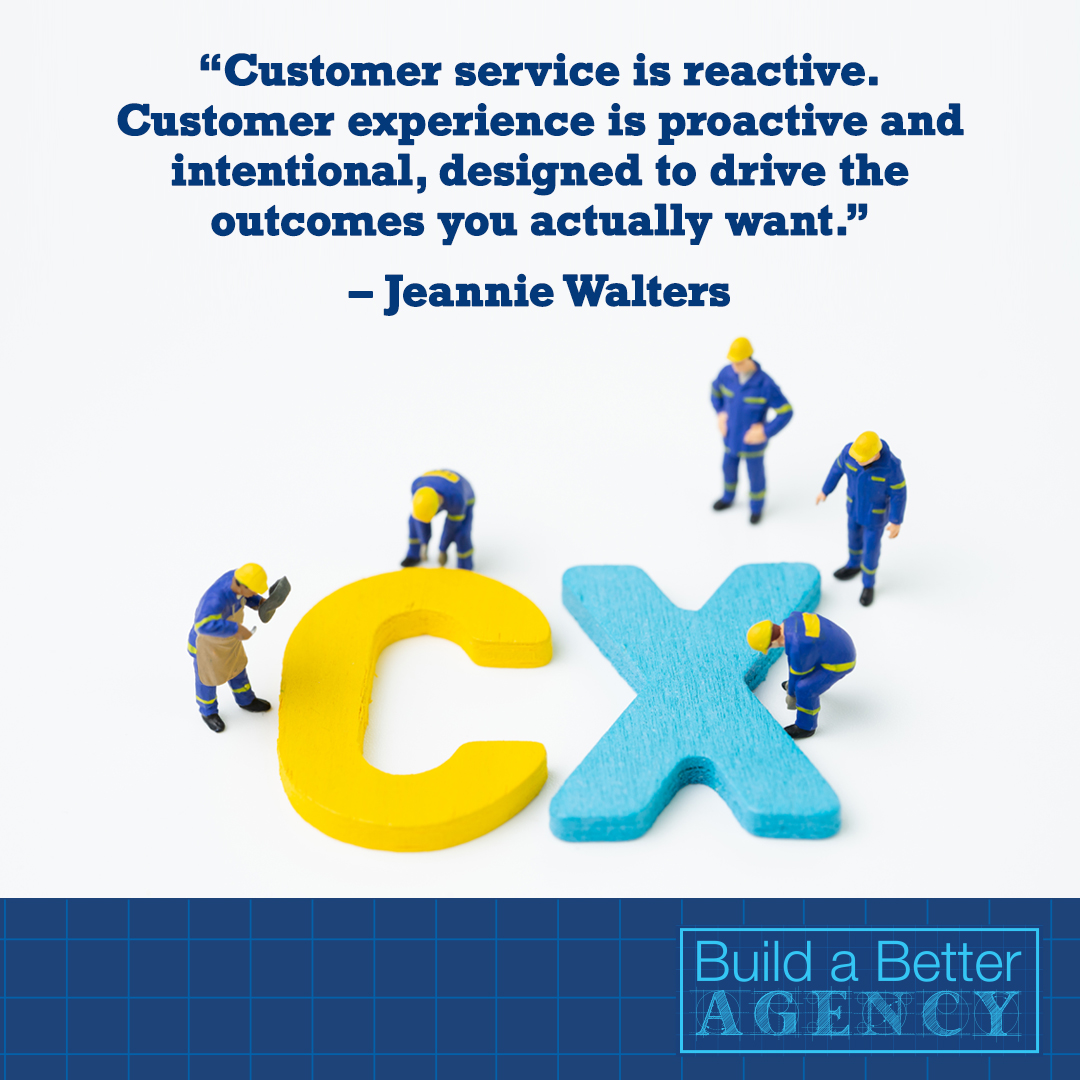
And the simple distinction I make is that customer experience is proactive and customer service is reactive. So it’s very important to react when customers have questions or need help. But we can proactively and intentionally design a better customer experience that actually drives conversion and renewals and all those things we want. And we can do it in a way that actually makes the employee experience better. We can put the data together so that customers don’t have to tell us a hundred times that something isn’t working. We start seeing that just by looking for those insights. So it really is about being thoughtful about the experience we want to deliver instead of just reacting to when things go wrong or when somebody has a question.
Drew McLellan [00:11:05]:
You know, you. You talk about sort of the design of it. And I. And I think part of what we have to remember, I like when I think of customer service. I don’t know why, but I always think of like a retail location and then someone’s being friendly to you at Target or, you know, at the service center desk or something like that. But the customer experience is literally how people feel seen and understood and are helped by through the entire, like getting to know you process first purchase process, the trial process and all of that. And one of the things that I thought was really interesting was that you sort of define how to purposefully map out the whole experience. So let’s talk about. And what you say in the book is you stress that the need that we need to define, which sounds simple, but I suspect is not, we need to define what success looks like before we start journey mapping or launching initiatives. So how do you help? Because I know you go into a lot of organizations and help them do this. How do you help a leadership team? Answer the question, what does customer experience success look like for us?
Jeannie Walters [00:12:23]:
Yeah, I think there are two sides to that coin. And you mentioned this when we talked about kind of the sections of the book and the approach we take, which is you start with the mindset that’s really important, but then you define the actual strategy for your business. So the way we do that, we use two different tools. One is called a customer experience mission statement. And the idea of that is to really understand how do we promise to show up for our customers no matter what. Because one of the things that breeds mistrust in this world is inconsistency. And we’ve all had that experience as customers where you go in one day and everybody’s great and you go in the next day and you’re like, what’s happening? You know, this is not what I thought it was. It starts eroding the trust we have with that brand. So we want to make sure that every single person in the organization understands that they play a role in this. It doesn’t have to be customer facing people, every single person. Because if I’m delivering inside the organization, and I think, oh, I can get that to you in four days, and you’re trying to get back to a customer in 24 hours, we’re immediately eroding that trust without even knowing. So we define that by figuring out what is the promise and that’s tied to our brand promise. So that’s really important too. You have to use the tools you already have. So if your organization already has a vision, statement, values, mission, great, use that and use your brand promise and figure out, what does that mean for us? What are those behaviors we want to see? And the most important question we ask in that process is how do we want our customers to feel?
Drew McLellan [00:13:59]:
Right?
Jeannie Walters [00:14:00]:
And the most important thing is to actually understand these are real emotions that matter because people actually make decisions based on emotions. You know, we love to rationalize, but we, we are emotional creatures. And so understanding. We want somebody to feel valued, we want them to feel light hearted, we want them to feel certain ways about the experience with us that can drive a lot of decisions. So that missions, the CX mission statement becomes your North Star for that. But then you translate that into what we call a CX Strategic Success Document. Success blueprint, sorry. And the success blueprint is literally starting with, okay, what are our organizational goals? So if you have a one year, three year, ten year plan, whatever it is at your organization, usually there are some very specific goals there that everybody is asked to help achieve.
Drew McLellan [00:14:54]:
Right?
Jeannie Walters [00:14:54]:
So we start there and we say, what are the levers in customer experience that could help us get there? So I joke that every organization in the world has two goals, more revenue and lower expenses. Like every, every version of a goal, you know, connects those in some ways. So if you are looking at customer experience goals and saying things that are kind of vague, like we aim to be the best in class or we are going to be the friendliest place in town, but you have no way to measure that. You have no behaviors, you’re asking people, you’re not training to it, all of those things, then it’s just words, right? So we turn that into that you’re
Drew McLellan [00:15:38]:
going to hit or miss depending on the day and the employee and the customer. Right.
Jeannie Walters [00:15:42]:
Well, and what does friendly mean? Right. Like we have to get into what does that actually mean. And it could mean different things. It means different things in New York versus Mobile, Alabama.
Drew McLellan [00:15:53]:
Right, Right.
Jeannie Walters [00:15:54]:
And so we have to really think about what is a realistic way that we can make this promise and live up to it. And so sometimes that’s very small behaviors, sometimes that’s more about what is the feedback that we hear from people. But it’s tied to, okay, if we do this, we think it will mean more renewals, more retention, more word of mouth, and then you start tracking those things as well, as well as the operation side of lower expenses around service or retribution and refunds and things like that. So there are ways to look at this with a lot of business acumen, but I think a lot of people just skip that step. So that’s how we really drive this definition of success because essentially we cannot deliver what is not defined. And I’ve seen a lot of organizations who say things like, you know, we, we’re customer centric now, good for us.
Drew McLellan [00:16:52]:
Right, right, right.
Jeannie Walters [00:16:53]:
And that’s about the extent of it. And we have to give people more, we have to give them tools, we have to give them definitions, we have to give them a way to track the progress in order to make this real for the organization.
Drew McLellan [00:17:06]:
Do you talk about a couple things? You talk in the book, you talk about a customer experience mission statement. And then just on LinkedIn recently, I think it was last week. No, it was about a month ago, maybe end of May, you’re talking about a customer experience charter. So talk about what those two are, and I assume they’re part of each other or intertwined. So tell. Define those for us.
Jeannie Walters [00:17:29]:
Yeah. So, you know, the book talks about the mindset strategy and then the discipline piece. And the discipline piece is really figuring out again, just like any other part of the business, what are the things we have to execute on daily, weekly, monthly, quarterly to make sure we’re getting there. And so we have all these tools in the toolkit. We have things like customer journey mapping, we have service blueprinting, we have things that help us with that. But one of the things I found is that customer experience absolutely has to be a cross functional initiative. We cannot do this on our own. And I see a lot of customer experience leaders who are essentially treated like the messenger. And then we all know what happens to the messenger when they have bad news. And so if we are not cross functionally, getting other leaders involved to say, you know what, we are trying to make sure that people are having an easy experience. And we’re hearing a lot about how hard this mobile app is. Right. We need to get that team involved. So if you’re cross functional like that, you need a certain rhythm to make sure that you are, you know, improving things, seeing the progress, et cetera. So the CX Charter is something I developed and I will freely admit that I, you know, stole this from my very good friends who are project managers, who, if you’re part of any big project and you have a great project manager, they start with a project charter and they say, this is what we’re trying to do, this is who does what. This is the goal. And so essentially the CX charter is taking the goal of that North Star, the CX mission statement, the strategic success blueprint, and saying, okay, this is where we’re trying to go. And then, okay, how Are we getting there and who’s doing what? So it really is about making sure that that cross functional team has a central source of truth and has a way to communicate about this. Because otherwise what I’ve seen happen is people will say, oh, you know, this is a marketing thing. Let’s get Sally from marketing. She’ll come to one meeting, she’ll be like, yeah, I’ll get to this. When I get to this, it’s on the side of her desk. Nobody’s really held accountable. And then again, customer experience is seen as like, well, I guess this isn’t really working. And so this is a way to have a real accountability, real governance, all of those things that we need to get things done.
Drew McLellan [00:19:55]:
So talk about that in comparison to the customer experience mission statement. And again, I’m assuming the customer service mission statement somehow plugs into, like you were saying, brand promise positioning statement. So how do all those intertwine?
Jeannie Walters [00:20:12]:
Yeah, the customer experience mission statement really does start with, okay, let’s talk about what we’ve said. We are, right, like our brand promise, our positioning. Some organizations have what they call a customer promise. So any of that sort of documentation, the first step of the customer experience mission statement is literally collect, like get all of that stuff. Because we want to make sure we’re very aligned with all of that.
Drew McLellan [00:20:38]:
Sure.
Jeannie Walters [00:20:38]:
And then the mission statement, what I love personally about what the mission statement does is, you know, I talk a little bit about how it has to be concise. It can’t be like 17 paragraphs and bunch of bullets. It’s gotta be something that people can internalize.
Drew McLellan [00:20:52]:
Right.
Jeannie Walters [00:20:53]:
Because if we tell people, for instance, be friendly and we don’t really get into, okay, what does that mean and how do we want people to feel? There are times we are going to have disappointing news for customers. There are times that we can’t deliver for them. But if we’ve said, you know what, we want people to feel valued no matter what, or we want people to feel a certain way, then that means that every single time we’re asking somebody or a process or anything to interact with a customer, we will use that as the judgment call. Because otherwise we’re asking every single individual to make a judgment call about what is good customer experience.
Drew McLellan [00:21:37]:
Right. And is friendly patting somebody on the back, Is it hugging somebody? Is it, you know, walking them to their car? Is it asking about their kids? It could be all those things.
Jeannie Walters [00:21:48]:
Right, right, right. And so the mission statement is really that central, like internalized mission that we have as an organization and Then we use that as when we build that success blueprint, we actually start, we always have the mission on top and then we build from there based on the organizational goals. And then the charter, let’s say we, we decide, you know, what we need to make sure that we have our store managers in the field coaching people a different way than they are now. Well, that’s a project, right? You can’t just wish that. So that becomes part of this cross functional leadership that we need. So the charter then would say, okay, we’re delivering on our mission in this way. These are the goals. This is how we know we’re successful. This is one of the things we’re going to do about it. And this is, you know, and then this is the plan. This is the plan of action. So I like to think about it as, you know, if you went to your head of operations and you said, what are your goals? A lot of them would be about efficiency. Right. But they have to execute on that through different processes, tools, technology, all of those things. All of that is under the charter too. Sometimes we have to improve technology, sometimes we have to decide, you know what, we need more information, let’s go interview customers, let’s go watch them, whatever. And so all of that is built into that charter as well, because it really is about deciding what are the priorities and how will we best influence the actual goals that we have as an organization and live up to that mission that we’ve defined.
Drew McLellan [00:23:30]:
Right. So I’m, I’m, I think about like brand promises and you know, my agency back in the day, we were a brand shop and you know, there were horrible brand promises and there were good ones. So I’m sure with customer experience, mission statements, it’s the same. So can you think of a couple that you think just sort of knocked it out of the park? They were, it was so good. I’m guessing it was so, you know, intrinsic to the organization. It was so specific. But what are a couple of your favorites? Like give us some examples that we can try and aspire to.
Jeannie Walters [00:24:04]:
Yeah, there are a couple in the book. And one of the ones that I thought was really just an interesting world to be in with this. I worked with a utility company, a gas company, large gas company. And one of the things that you know is interesting about customer experience that I think sometimes people don’t think of is as customers. We have customer experiences when we’re going to a Taylor Swift concert or when we’re paying a parking ticket. Right. Like those are both customer experiences when you’re paying a parking ticket. You can’t say, like, we’re going to have everybody feel joyful.
Drew McLellan [00:24:36]:
Right? That’s right.
Jeannie Walters [00:24:37]:
That doesn’t make any sense. But could we make it easy? So you really have to get into, like, what is it your customers really want? When we were talking about the customers that they have, we were like, you know what? They don’t want to think about this.
Drew McLellan [00:24:50]:
Right.
Jeannie Walters [00:24:50]:
The ideal customer experience. They never want to think about it, but they’re going to get invoiced, they’re going to have certain interactions, and what could we do about that? So we really crafted the mission statement to be about making sure that people were living their lives with ease and comfort. And by getting into. And this is another thing that I think we. We have to remember, this isn’t about the product or the service. This is about what our customers do with that.
Drew McLellan [00:25:21]:
Right.
Jeannie Walters [00:25:22]:
So I sometimes bring up, you know, I worked with a couple different financial services firms, and banks always want to say, like, our promise is a safe place to put your money. And I’m like, that is literally the definition of a bank. Right.
Drew McLellan [00:25:35]:
So it sure better be safe.
Jeannie Walters [00:25:37]:
Yeah, exactly.
Drew McLellan [00:25:38]:
That’s why you have that insurance.
Jeannie Walters [00:25:40]:
Right, Right, right. So you have to, you know, get into what is it you’re really trying to do. And so by crafting it around that idea, we were able to really look at things like their invoicing process and say, is this really delivering on that, on that ease and comfort? Well, what if somebody needed, you know, assistance with that? What could we do to make that easier and more comfortable for them? So it’s. It’s like a. I always think about it as, like, pulling a thread a little bit, where once you have that. That idea of who you want to be no matter what and what you’re trying to do for your customers, you start applying it to places that maybe are overlooked and neglected.
Drew McLellan [00:26:21]:
Right.
Jeannie Walters [00:26:22]:
And that’s really. The brands that people love, they do this. They show up this way no matter what. Apple famously created the unboxing experience.
Drew McLellan [00:26:35]:
Exactly.
Jeannie Walters [00:26:36]:
That wasn’t a thing before.
Drew McLellan [00:26:37]:
Right. And now people video it and share it.
Jeannie Walters [00:26:41]:
Exactly. Because they realize, like, that’s a moment with the customer. And so when you think about their ethos around, like, design and clean and all of that thing that applies to the unboxing. And so when you think about your own brand, and especially with professional services, I think sometimes it’s easy to think, well, we’ll wow them. But then we send an invoice or a contract that basically is like, here’s all the terrible things we’re going to do if you don’t pay this bill. Right. The tone of it is completely opposite of everything up until that moment. So those are the types of moments I really encourage people to look at once we have that mission. And because then you start realizing, like, whoa, we could do so much better, we could live up to this. And then you also start using it as a little bit of a yardstick. So you can say, wow, we didn’t live up to it this time, what could we do differently next time? What could we change? Why isn’t our process backing this up? And that’s what leads to those improvements that then we bring to the cross functional team and say, hey, if we do this, we think we’ll live up to the mission and if we actually deliver on it, that means we’re going to get more revenue and lower expenses and all the things that we want.
Drew McLellan [00:27:56]:
So for the utility company, what was the mission statement that they came up with that you thought was so out of the box?
Jeannie Walters [00:28:04]:
So I don’t have it right in front of me, but the idea was essentially that we’re going to create lives that are, you know, full of ease and comfort and make sure, like, you’re
Drew McLellan [00:28:16]:
not going to think about us, you don’t have to think about us.
Jeannie Walters [00:28:18]:
Yeah, exactly. And even when things go wrong, how can we deliver on that? Right. Like, how can we make sure.
Drew McLellan [00:28:26]:
And then, yeah, like there’s a power outage or whatever. Right, right. Yeah.
Jeannie Walters [00:28:30]:
And the other thing is, when you think about utilities, they don’t have to work for customers. Right. They just have customers.
Drew McLellan [00:28:37]:
Right.
Jeannie Walters [00:28:38]:
And so one of the things we identified was that customers felt like they were kind of tied in. They were. So if they needed help, they felt like they weren’t necessarily appreciated, valued. And so that was really what we were going for as well, was to help our customers feel valued every step of the way. So that it changed the kind of atmosphere, the ecosystem of how they communicated with customers, how they really made sure that they were serving people along the way. And then they had some projects that they realized were tied to customer experience. And one of them was billing assistance and realizing like, well, if we say that we want to make this full of ease and comfort for people, and yet we’re sending people to this other place when they ask for assistance in a way that is maybe not comfortable for them, what could we do about that? So they changed the technology and tools that they had. They really focused on a different way of thinking about it. And that’s the beauty of it. And they’re. I put a little template in the book, but what I found is the best ones actually, you know, turn that just 10% or whatever to make it fit with their organization, specifically their leadership, their. Their culture, all of those things. Those are the ones that really, I think, exceed expectations. Another one of my favorites. I don’t have it right in front of me as well, but working with an organization that was manufacturing and they built things that really. The only thing, the only things that go to space have some of their tools in there, like, that’s how amazing it is, and MRIs and some really cool things. So they build parts that go into these major things. And what they found was people were satisfied and happy with the quality of the manufacturing that was never in question. But the communication and the whole experience, they had some work to do. So what we realized was everything that went well was because they were thinking beyond. They were innovating, they were going beyond for the customer. And so we started. We had a mission statement that was focused on going beyond. And then we took that one step further and we created. There’s a tool called Mission Moments where I say, you know, use the mission as a tool and not just a poster. So you want to recognize people with it. You want to do all sorts of things. So they started a program where they created replicas of the little moon man from MTV Awards. And that’s what he looked like. It wasn’t exactly. And every month they had somebody who delivered above and beyond on the mission. And that was a recognition program that changed how people thought about it. And they recognized innovation around experience and all of those things. So it really is about whatever those core ideas are, kind of internalizing them. That’s what makes the difference with a mission.
Drew McLellan [00:31:40]:
One of the things you’ve been talking about that got me thinking is in both the book and in some of the interviews that you’ve done, you’ve talked about this idea of reducing friction. So I want to take a quick break, and then when we come back, I want to talk about the reducing friction, and I think you call it a customer effort score. So we want to chat about both of those things. But first, let’s take a quick break. You know, every agency is thinking about AI right now. The hard part is moving from we should do something with AI to here’s a real solution our clients will actually use. You know, client websites are messy, tech stacks are different, content is scattered. And no one wants an AI tool that takes months to launch or or creates more risk than value. Navu is built to fix that. Navu adds AI chat to business websites with a single line of code. It works with the site your clients already have and answers visitor questions using only the content that you select and manage from that website. That means you can bring clients an AI solution that’s easy to implement, tightly controlled, genuinely useful, and tied to real visitor insights. And for agencies, there’s a major bonus. Navu is completely free for your own website. No catch, no trial gimmick. Use it, learn it and prove that it works before you recommend it to your clients. If you want to see it in action, head over to the Agency Management Institute website. We installed it and literally it was exactly that one line of code. You can also learn more about it at Navu co Backslash agencies. All right, we are back and we are talking about how to create a customer experience that goes far beyond customer service. And right before the break, we were talking about how brands can obviously create amazing moments. And we’ll talk about that in a minute. But one of the things you were talking about is that for a lot of brands, it’s about making it easier. It’s about the level of effort that they have to go through to either interact with you or pay a bill or do whatever and that friction that sometimes happens. So talk a little bit about the importance of that in thinking about the customer experience as opposed to just like, oh, I can’t remember the name of the hotel chain but they always have the warm cookies at the front desk. Like that’s a different experience than I got to my room and, you know, the room was clean and I had the right pillows and all of that.
Jeannie Walters [00:34:17]:
Yep. Yeah. I think we had a moment in time where a lot of conversation around customer experiences were the surprise and delight. Right. Like we have to surprise people. And while that’s nice and there are places for that, if you don’t have the basics right, if you don’t have the consistent experience right, then that doesn’t really matter because people will overlook that. One example that somebody shared with me was they bought one of the higher end cars and they were really excited because they had heard the service was really exceptional. So they went in for their first oil change thinking this was going to be something magic. Yeah, exactly. And they said first of all, they didn’t expect me, even though she had an appointment. And then when she got there, she said they, like there was this really nice waiting room with like leather couches and stuff. And then she looked up. And she’s like, it was one of those crappy coffee machines.
Drew McLellan [00:35:16]:
Yeah.
Jeannie Walters [00:35:16]:
And I was like, so there. It’s like they were trying to get some of it right, but not all of it. And because she had to wait, she had to come back with the car, all of those things. She was like, they were sending me these beautiful, like embossed cards in the mail saying, thank you for buying your card here or car here and like doing all these other touches. And so she kept posting them on her social media saying, this is ridiculous that, you know, this is happening when I can’t even make an appointment and you guys can’t keep me there. So we have to make sure that the processes on the inside of the organization are working in the way that we think for the customer. And it’s really harder than that sounds sometimes because it can look like everything’s working because at the end of the day, did she get her car serviced? Yes. So on their side, they’re going to be like, yep, check, check. She got her first oil change.
Drew McLellan [00:36:13]:
We sent the card. All good.
Jeannie Walters [00:36:15]:
Exactly. But if we’re not paying attention to those moments that are creating that friction, then we’re missing opportunities to just again, earn that trust. Every time we deliver consistently, we’re either we’re earning trust and every time we don’t, that trust is eroding. And so we really have to be careful now as everybody’s introducing AI to everything, that’s another area where we have to make sure it’s working in the way we intend and it’s delivering on the same CX mission that we have for the rest of the organization. Because if it’s not, people will feel that and they will start questioning, is this really the brand that I thought it was?
Drew McLellan [00:36:57]:
So let’s talk a little bit about sort of the surprise and delight or the wow customer experiences. Talk about the difference between wow and gimmick. Like how, how can, how can we create? Because I, I do still believe there is a place to kind of knock your clients socks off and wow and surprise and delight them, but it can’t be schlocky. So how do we. How do you help? How do you help teams focus on what really matters to the customer so that that wow experience has a deeper meaning besides the, you know, the moment.
Jeannie Walters [00:37:33]:
Right, right. Well, I think for a while, especially when social media was kind of first wowing us all, there were all those famous stories about, you know, the stuffed animal left behind at the hotel, who the staff took all the pictures, or the guy who mentioned getting a. On a plane and they showed up and at bad baggage claim and gave them the stake. Those are really PR moments, I think.
Drew McLellan [00:37:58]:
Yeah.
Jeannie Walters [00:37:58]:
Because that’s very hard to scale.
Drew McLellan [00:38:00]:
Well. And you can’t. You can’t structure it. You can’t. You can’t manufacture it.
Jeannie Walters [00:38:07]:
Exactly.
Drew McLellan [00:38:07]:
Right. It is. It is somebody going above and beyond in a PR moment.
Jeannie Walters [00:38:11]:
Right?
Drew McLellan [00:38:12]:
Yeah.
Jeannie Walters [00:38:12]:
And sometimes that’s very appropriate. Right. Like, sometimes there are moments for that. But what we really look at is by using things like customer Journey mapping, by using things like service blueprinting, what we do is look at what is the real experience that a customer is having. And once you identify some of those moments that are frustrating or just highly emotional. Right. Like we are emotional. One of my favorite examples of this, Chewy, the pet brand, they do an exceptional job with this because what they do is they personalize those moments. So there are stories about people who, you know, their dog has a birthday and they get something in the mail and it’s a painting of their dog. If you call and cancel a subscription because you lost a pet, they’ll often send a card or even flowers or things like that because they understand the emotional moments. And that’s really the difference. Instead of saying, we’re going to wow people just for the sake of wowing them, we’re going to understand who our customers are, what those emotional moments are on the journey, and then we’re going to match that in a personal way, in a way that’s meaningful to them. Some hotels try this. They let you fill out preferences and things like that. That’s a moment where, if they get it right, it can be very meaningful. I’ve found personally as a traveler, that a lot of them don’t get it right. They ask you all that information and then they don’t use it.
Drew McLellan [00:39:42]:
And. And that actually makes you frustrating, right?
Jeannie Walters [00:39:45]:
Exactly. That’s like a detriment. So just don’t even ask me. Right. If you’re not going to use it. So those are the types of moments we have to look at. One of the things when we do Customer Journey Mapping, we look at literally what is actually happening in the customer’s life. Because sometimes we act like our processes, they’re just going to march through our process, no problem. Right. But when we are, you know, busy business owners and we’re getting kids to school and we’re doing all these things, that’s not just a moment in our life. We are, you know, trying to get help or whatever. There was a brand we worked with who the customers were complaining about the return options, and they couldn’t figure it out because on their end, it looked like everything was fine. What the customers were really saying was, if I order something online and I bring it to one of your stores, it’s a nightmare. And the reason it was a nightmare was because the inventory systems were different. So the poor manager had to call and get different numbers for every single thing. And I asked the manager, I said, what, you know, who have you told about this? He’s like, oh, my gosh, we’ve told so many people. But they keep telling me that they can’t do anything about it. And it was like, once we highlighted that the process that you have with these parallel inventory systems is creating a huge friction point, not just for the manager, but also for the customers. Because when the manager is doing that for a half hour, they’re not doing other things that managers need to do. Right? And they’re holding up the line and everything else. So there’s this trickle effect, too, that sometimes we don’t think of unless we’re really looking at the customer journey as it is for real customers. A lot of times we build our customer journeys as business people around our org chart. And the customers don’t want that. They don’t care about it. And so you’ll. You’ll hear it in the language we use even. Well, well, first they’re marketing, then they go to sales, then they, you know, and customers just want a consistent, easy experience.
Drew McLellan [00:41:56]:
I want the thing, I want to buy the thing, whatever the thing is.
Jeannie Walters [00:41:58]:
Yeah, yeah, exactly, exactly. So it can be very enlightening once you start kind of flipping the mirror around and looking at what’s really happening.
Drew McLellan [00:42:08]:
As I was reading the book, I was thinking, you know, from my lens and for my audience, book plays sort of a dual role because as I’m reading it, I’m thinking you can read this as an agency owner or leader and think about your own agency and how you can improve the customer experience. But we also have an opportunity to influence our clients and how they think about their customer experience. So a lot of agencies focus on kind of the front stage stuff, the branding, the storytelling, the acquisition of new customers. How do you suggest, for us, for. For the audience of this podcast, how do you suggest we weave in conversations around customer experience when we’re talking about marketing?
Jeannie Walters [00:42:54]:
Yeah, yeah, it’s a great question. And I think part of what we have to understand when we’re working on marketing or sales is that is the very start of the journey Right. With a customer. So if we are setting expectations that then aren’t lived up to later, we have culpability in that. And I’ve seen this a lot where marketing comes up with fantastic ideas. They deliver something really beautiful. And the people who are actually serving customers, they’re trying to say, like, wait, wait, that’s not going to work. Because of xyz, an example of this, we worked with a medical not quite product, I guess. And one of the things that they would do is they would deliver samples to pediatrician’s office. Yep, great. That was part of their marketing. They had people going out, delivering. They were sending them. Well, one of the things that marketing did was they said, oh, we’ve got this great idea. We’re going to put this beautiful box together with not just the product, but some tools and things like that. Fabulous. Looked beautiful. The problem was they hadn’t checked in with the people who were actually interacting with those pediatrician offices. And they all had these closets that they kept the samples in and the box was too big for the closet.
Drew McLellan [00:44:13]:
Oh my gosh. Right.
Jeannie Walters [00:44:15]:
So they would basically throw everything out, kind of look at it for two seconds and then just take the sample and put it in there again. So they were, they were spending all this money and they were frustrating the customer. And it was all because marketing’s intention was very good.
Drew McLellan [00:44:32]:
Right.
Jeannie Walters [00:44:33]:
And that’s the thing. We, we have a lot of good intentions. The trick with customer experience is having intentional leadership around it. And once you see the whole journey, then you can start asking questions in the right moment. So you’re not delivering something that actually is either setting the wrong expectations or is something that just won’t work for the customer once it actually is within the customer journey.
Drew McLellan [00:45:00]:
Yeah, it’s such a good point. As agencies are listening to this and they’re thinking they’re looking at their own. Their own business. So if you owned a small agency and you just finished the book, what are, what are two or three customer experience sort of focus changes or ideas or maybe checkpoints that you would do in the next like 90 days.
Jeannie Walters [00:45:24]:
So I’ll give you a strategic one and a tactical one.
Drew McLellan [00:45:26]:
Okay.
Jeannie Walters [00:45:27]:
Strategic, I would say write your CX mission. And the reason is because a lot of marketing branding folks, we love talking about our brands. We love figuring out the brand promise. Sometimes we haven’t taken that step to figure out what does that actually mean for the customer experience and how should we show up for that. So that would be where I would start is just defining that, figuring out what do you want people to feel? Satisfied is not an emotion, right?
Drew McLellan [00:45:54]:
Yeah. Good enough, right?
Jeannie Walters [00:45:56]:
Yeah, exactly. So think about really what is it? And if you want to be the light hearted one or the professional one or whatever, how does that actually translate to how we want people to feel? So that’s number one. The other one I’m going to say is really tactical, but I have seen this so many times where we woohoo people in the beginning we, we love bomb them, we give them all of the attention and then the minute they become a customer. Yeah, we don’t really have a standard of okay, how, what does this mean? How are we going to continue to show them that attention in the right way? Live up to the expectations that we created. And oftentimes this starts with the contract. The proposal is beautiful and flowery and all these things. And then we send them a contract that looks like it was written by lawyers and there’s none of the warmth in there, there’s none of the understanding. Or they send us one and we start negotiating in a totally different way. I think that we have to think about the fact that when we’re going through that process in the beginning, we are building trust and one of the things we want to do is keep and maintain that trust throughout the customer journey. So look at things like your contract language. Look at things like your invoice language. Sometimes the invoices are the only regular form of communication we have with customers. If that’s the case, I would say figure out another one. And also look at the language around it.
Drew McLellan [00:47:30]:
Right.
Jeannie Walters [00:47:30]:
Think, you know, simple things, but recognizing the work that you’ve done within that period of time, recognizing what they’ve done and partnered and contributed. There are different ways to do that, but I think it’s really important. I know I’ve worked with a lot of agencies who once they get the contract, they send these beautiful gift boxes, they do all this stuff, but then six months in, it’s like an old married couple. Right.
Drew McLellan [00:47:56]:
I’m not even giving you flowers on our anniversary anymore.
Jeannie Walters [00:47:59]:
Exactly, exactly. So I think there are so many opportunities because these relationships are so personal. Right. Like we have long term relationships as agencies and we want to make sure that they are turning to us for what they want. And one of the best ways we can do that is by, you know, continuing to innovate around experience and figuring out what are the ways that we can serve them better through experience. Not just, you know, the next, the next thing, last question then.
Drew McLellan [00:48:31]:
I know I need to let you go but let’s assume that we’ve done that. How do you. Well, do you recommend that we tell our clients or our customers that we’ve made an improvement, or we’ve been thinking about their customer experience and we’ve. We’ve recognized that our invoices were cold or whatever? Like, do we. Do you recommend that we reveal that. That we’re transparent about that, or do we just let them experience the new version?
Jeannie Walters [00:48:57]:
Yeah, I think it’s the latter, unless it’s something that they have been asking for. Okay, so if you have a client feedback program and they’re telling you, like, we want this, once you make that change, you want to close the loop, and you want to say, hey, we heard you. This is what we’re doing. But I think if you’re just generally improving things, you want them to experience that, you want them to feel it. And so that’s really the goal. And so the other question then is, how do you know you’re succeeding at that? And so that’s where we get into, like, how are we getting feedback? How are we tracking things? And once you have that kind of rhythm, it becomes a flywheel where you’re listening for those insights, you’re watching for those insights, you’re reacting to them. At the same time, you are proactively improving and innovating around your customer experience in an ongoing way as well.
Drew McLellan [00:49:47]:
Yeah. And your book goes into great detail about, like, creating different measurement tools and all of that, which we didn’t have a chance to get into today. But I think the idea of that flywheel, where we’re asking, we’re learning, we’re modifying, but we’re also measuring and then adjusting. I think that that infrastructure, that whole system is what then allows you to be able to point to, as we talked about in the very beginning of this conversation, the business outcomes that we’re trying to influence with customer experience. So now you can justify the extra effort, the extra budget, the extra whatever, because it is getting you better lifetime value, better retention, and all the other things that every business cares about.
Jeannie Walters [00:50:29]:
Right, Exactly. And I mean, can you imagine having an organization that just didn’t track sales? Right. Like, that would never happen. We. We track these things. So we might track things like retention or renewal rates right now, but we’re not tying those back to, okay, what’s influencing that?
Drew McLellan [00:50:48]:
Right.
Jeannie Walters [00:50:49]:
And sometimes we just say to the people, I’ve seen so many leaders do this. They put up a graph or something, and they go, hey, we’ve got to get this number up. Right. Like, go get that number up. And that’s all they say. And when we are looking at things like renewal rates, it’s such an opportunity because usually you can backtrack a little bit and see, okay, well, this one was handled in this way, and they renewed. This one was handled in this way, and they didn’t.
Drew McLellan [00:51:14]:
Right.
Jeannie Walters [00:51:14]:
So that gives you information that then you can turn into best practices, you can turn into behaviors, you can turn into all those things, but you have to pay attention just like any other part of the business.
Drew McLellan [00:51:25]:
Yeah, yeah. So true. This has been great. If people want to get a copy of the book, they want to learn more about your company and the work you do. Tell us all the ways that people can follow you, learn from you, and get in touch.
Jeannie Walters [00:51:39]:
Absolutely. So you can find the book wherever books are sold. But if you want some more information, it’s at experience is everything. Book.com you can find me either on the site experienceinvestigators.com or I’m very active on LinkedIn, so feel free to connect or follow there as well. And I’d love to hear from you.
Drew McLellan [00:51:57]:
This has been great. Thank you so much for coming back on the show and sharing your expertise. Congratulations on the book. It’s really, really great.
Jeannie Walters [00:52:05]:
Thank you so much, Drew.
Drew McLellan [00:52:06]:
You bet. All right, you guys, so you have homework looking at exactly how you’re serving your clients. So get that mission, get that customer experience mission written, and do some of the tactical things that Jeanne was talking about. Don’t let this be just something you think about or it’s philosophical. This is tangible, practical, bottom line behaviors that can impact for you both your own agency’s bottom line, but also this is a way for you to add even more value to your clients by talking to them about all of this. So really grab the book, Learn from Jeanne’s experience and all the stories she tells in the book. She’s got great frameworks and tools, and it’s. It’s. It’s kind of like a workbook and a book at the same time. So you can use it that way, too, and then apply it both to yourself and think about ways that you can bring this new sort of set of insights to your clients because they’re looking for strategic help from you, and this is a great way for you to lean into that in maybe a different direction than you have before. So that’s homework for you. I want to give a quick shout out and thanks to our friends at White Label iq. Do you know they’re the presenting sponsor of the podcast, so check them [email protected] backslash ami. And you know what? Like, I always like to end every episode. Thank you. Thank you for coming back. Thank you for hanging out with me for, gosh, over a decade. We’ve been doing this together. I don’t get to do this. I don’t get to have these great conversations if you don’t keep coming back. So I promise I’ll keep bringing back great guests, you keep coming back week after week, and we’ll keep learning together. Okay? All right. Have a great week and I’ll see you next week.
Danyel McLellan [00:53:49]:
That’s all for this episode of AMI’s Build a Better Agency podcast. Be sure to visit agencymanagementinstitute.com to learn more about our workshops, online courses, and other ways we serve small to mid size agencies. Don’t forget to subscribe today so you don’t miss an episode.