
Episode 566

Welcome to another insightful episode of Build a Better Agency! This week, host Drew McLellan is joined by Anthony Reeves, Vice President of Global Brand and Creative at Kohler and former Amazon internal agency leader, to explore the vital—but often neglected—topic of embracing discomfort and making tough decisions as an agency leader. Drawing on lessons from his book, “Eat the Donkey: Why Great Companies Embrace Discomfort,” Anthony Reeves reveals how formative experiences in the Australian Outback shaped his philosophy on leadership and organizational resilience.
Together, Drew McLellan and Anthony Reeves dig into the importance of organizational foundations, management principles, and company characteristics, offering a fresh perspective on why these matter more than the traditional mission, vision, and values statements. Anthony Reeves explains how agencies can distinguish themselves by being exceptional at one core thing, and how principles should function as decision-making tools at every level of the company, especially when leaders aren’t in the room.
You’ll also hear guidance on how agencies can strike a balance between being in an “explorer” mode versus a “static” mode, especially in today’s rapidly evolving marketplace where AI and remote work are upending old ways of doing business. The discussion goes beyond theory, with practical advice on making, communicating, and living with hard decisions, plus candid reflections on creating a sense of belonging and protecting one’s personal and professional foundation.
Whether you’re wrestling with your agency’s direction, building a culture of accountability, or looking for inspiration to navigate change, this episode is packed with wisdom and actionable strategies. By the end, you’ll be ready to rethink not just how your agency operates, but how you lead and the legacy you want to create.
A big thank you to our podcast’s presenting sponsor, White Label IQ. They’re an amazing resource for agencies who want to outsource their design, dev, or PPC work at wholesale prices. Check out their special offer (10 free hours!) for podcast listeners here.
What You Will Learn in This Episode:
- Embracing discomfort as a catalyst for agency growth
- Defining clear foundations, principles, and characteristics for your agency
- The value of making hard decisions rooted in your agency’s core foundation
- Why agencies should focus on being exceptional at one thing rather than doing everything
- Translating principles into daily behaviors and decision-making at every level
- Balancing exploration and optimization to stay relevant and innovative
- Reinvigorating culture, connection, and mentorship in a remote or hybrid workplace
Ways to contact Anthony:
- LinkedIn: https://www.linkedin.com/in/anthonyreeves/
- Website: https://anthonyreeves.co
Resources:
- Anthony’s Book: Eat the Donkey: Why Great Companies Embrace Discomfort
- BaBA Summit May 24-26, 2027: https://agencymanagementinstitute.com/babasummit/
- Drew’s Book: Sell With Authority
- AMI Facebook Group: https://www.facebook.com/agencymanagementinstitute
- AMI Preferred Partners: https://agencymanagementinstitute.com/ami-preferred-partners/
- Agency Edge Research Series: https://agencymanagementinstitute.com/agency-tools/agency-edge-research-series/
- Upcoming workshops: https://agencymanagementinstitute.com/advertising-agency-training/workshop-calendar/
- Weekly Newsletter: https://agencymanagementinstitute.com/newsletter-sign-up-form/
- Agency Coaching and Consulting: https://agencymanagementinstitute.com/advertising-agency-consulting/agency-coaching-consulting/
Danyel McLellan [00:00:01]:
Running an agency can be a lonely proposition, but it doesn’t have to be. We can learn how to be better, faster if we learn together. Welcome to Agency Management Institute’s Build a Better Agency podcast presented by White Label IQ. Tune in every week for insights on how small to midsize agencies are surviving and thriving in today’s market. With 25+ years of experience as both an agency owner and agency consultant, please welcome Please welcome your host, Drew McLellan.
Drew McLellan:
Hey everybody, Drew McLellan here with another episode of Build a Better Agency. Super glad you’re with us today. I’ve got a great guest and I think he’s going to get you thinking a little differently about the agency and how you think about the agency’s future and how you make plans and decisions. So that’ll be a great conversation. I think this is a moment when we’re making a lot of decisions about our agency, where we are all asking ourselves how AI is going to change what clients want, what they need.
You know, we’ve been talking about that a lot as we’ve been unpacking the Agency Edge and the Agency Core research in the newsletter and in this podcast. And so I think a lot of you are thinking about how do I make hard decisions and how do I make those around AI? And that’s actually one of the places where our presenting sponsor White Label can be super helpful. So among all of the other things they do in terms of design and dev and paid media, they are really leaning in hard with their agency partners on AI. So just like all of us, they’re trying to sort out how it fits for every agency that they serve, how it helps, what’s smoke and mirrors and what’s real, but they’re doing it alongside their clients. They’re doing it for themselves, of course, but because they serve agencies all over the world, They’re coming alongside their agency partners and helping them figure out how to experiment with, how to implement, and how to monetize AI inside those agencies. And so they’re thinking about AI from all of that context and helping their agencies stand up new products, new service lines, new experiments for internal operations, client-facing tools. So it’s really fascinating to watch how— what they’re developing and building with their agency partners. So these are the folks that you want in your corner right now. They can help you make sense of how AI can actually apply in your day-to-day because they’re right in the midst of it with lots of other agencies and of course for themselves. So if you want to learn more about how they could be a great AI implementation partner for you, head over to whitelabeliq.com/ami, and you can learn more about the work they’re doing. And there’s a special offer just there for you as a podcast listener.
Okay. All right. So let me tell you a little bit about our guest today. So Anthony Reeves is currently Vice President of Global Brand and Creative at Kohler, but he’s also led Amazon’s internal creative agency. He started his career at WPP, serving clients like Nike and Airbnb. But he just wrote a brand new book. The brand new book is called Eat the Donkey: Why Great Companies Embrace Discomfort. It just came out this spring. And the title comes from a story that I’m going to ask him to tell you about him growing up in the Outback and having to do some really hard things to survive and thrive in that environment. And His analogy is that each of us as leaders sometimes have to eat the donkey, do hard things, embrace discomfort. And so we’re gonna dig into sort of his past history and talk about how it applies to you and me today as we make hard decisions, as our agencies continue to evolve in this sort of AI-enabled world. Okay, so without further ado, please help me welcome Anthony to the show. Anthony, welcome to the podcast. Thanks for joining us.
Anthony Reeves [00:04:16]:
Drew, it’s great to be here. So, thank you very much.
Drew McLellan [00:04:19]:
Congratulations on the new book. I’m sure it’s an exciting moment for you with book tours and all of that sort of thing.
Anthony Reeves [00:04:26]:
Yeah. It’s interesting that you asked that question because when I sat down to write the book, I didn’t realize the tail-end effect of the book itself, like the marketing side of it and the tour side of it and talking about it side of it. And I feel like For any potential author, it’s just 40% is the book, 60% is the rest of the stuff.
Drew McLellan [00:04:48]:
Yeah, yeah. I think, I think unless you’re, you know, the, the John Grisham level where you’ve already written 3 or 4 bestsellers, a lot of that burden sits on the author for sure.
Anthony Reeves [00:04:59]:
Yeah. And I’m not paid, you know, half a million dollars just to do a book tour. That’s, that’s right.
Drew McLellan [00:05:05]:
That’s right. So So let’s talk, let’s go with sort of the obvious question. So the title of the book references an actual story in your life. So tell everybody a little bit about that story and how it came to be sort of such an important sort of milestone and philosophy in your professional life.
Anthony Reeves [00:05:28]:
Yeah, so the title of the book really only came out, I would say, probably in the last month of the book itself. we were working towards something a lot more corporate and a lot more basic to a certain extent. And then I’ve never truly had the opportunity to tell the story of how I grew up and where I grew up and the situation behind that. So clearly I have an accent.
Drew McLellan [00:05:53]:
Yeah.
Anthony Reeves [00:05:54]:
And I don’t think everyone in the world has an accent, but I have. I’m Australian. I grew up, I grew up in Australia, but I think most importantly, I grew up, generally speaking, in the Australian Outback, and there are really 2 Australian Outbacks. One is the towns like, like a Broken Hill or, or Tennant Creek, which— or Katherine, which is a town town, and you might get between like 3,000 or 5,000 people there. We were hours and days away from, from any town, and we traveled the Outback. You know, I say travel Australia, but a lot of time the Outback, because Australia does have mountains and we do have snow. And there was, we had to forage for food. That was part of the life is, you know, fishing or, and we did a little bit of hunting, but there were times, there was one time in particular where we couldn’t find food to eat because maybe there was a dry season or the animals were moving. So we, we rolled into a cattle station, which is like a, like a ranch, but like 20 times bigger. And the only meat that they had left was the meat that they, they fed their dogs and keep the dogs alive. And so we, we did, borrow some of that meat from them and cooked it. And the night after, the morning after, we were cleaning up around the camp and we realized that the meat had turned green. And the only reason the meat turns green is it was donkey. And so that night we had eaten donkey. And so where it really comes out in the book is there are times in your life when you have to sacrifice a bit of short-term pain for that longer-term success. And, you know, Jeff always spoke about it at Amazon. He’s like, I’m happy to sacrifice short-term revenue for long-term gain. And eating the donkey is like, we have forgotten as a society, but also as a business, to suffer the short term for that long-term success. So you gotta learn to sort of eat the donkey to survive for longer.
Drew McLellan [00:07:46]:
And that’s sort of the core message of the book is that Part of being a business leader is recognizing that there are hard things that need to be done. And sometimes you just have to tuck in and do it.
Anthony Reeves [00:07:58]:
Absolutely. There are hard things to be done and there are hard decisions that we just don’t want to make. And I’ll give you one example. It’s written in the book and everyone knows about it, is the Jaguar reed logo when they went to an electric vehicle. Now, Jaguar is a quintessential British sports car. They’re not known for winning things or reliability, but it’s kind of one of those things that, that’s where they’re at. In a sense, it’s a Mustang of, of the UK. They could have gone electric, kept the same logo, kept the same leaping cat, kept the same sound and the same robustness. but they decided to go all the way to electric. And 2 things really come out of that. One is, are you telling me not one person in the Jaguar C-suite ever said at one point or thought at one point, are we doing the right thing?
Drew McLellan [00:09:00]:
Right.
Anthony Reeves [00:09:01]:
Is this the right thing to do? And held up their hand and said, look, I struggle with this. The second thing comes out of it is, if their foundation is quintessential British racing green Jaguar sound, sort of roundness and everything like that for a sports car, and that’s their core foundation of who they are, it really doesn’t matter what engine you put into it or what system you put into it. You just gotta hold on to that base and that foundation. And they walked away from that, from that. And it really took them, I think it was from 1,600 US sales a year down to like 300. It just killed the business overnight, was that damn logo.
Drew McLellan [00:09:39]:
Yeah, it’s crazy. One decision and the impact of that decision. Yep.
Anthony Reeves [00:09:45]:
Yeah.
Drew McLellan [00:09:45]:
So, so in your book you talk about that every business needs to have foundations, principles, and characteristics. So define each of those for us because they’re a little different, I think, than mission, vision, values, and you have sort of a distinct way of thinking about them in contrast to those?
Anthony Reeves [00:10:05]:
Yeah. So I do get in trouble a bit. I don’t, I’m not a big fan of values. And the reason, Drew, is really simple is if you and I chatted today that we’re gonna start up a company, one of the values you and I would talk about is, I don’t know, earn trust, or one of the values would be is, you know, assume best intent. Isn’t that a core human thing? Isn’t that like a core—
Drew McLellan [00:10:31]:
It’s like that we’re gonna have integrity. It’s like, shouldn’t we all, right?
Anthony Reeves [00:10:36]:
Should we all have integrity? So, you know, I can talk about through like an Airbnb, Amazon, or even a Starbucks point of view is, is I, I wanted, let’s do it through Starbucks because, you know, everyone knows what Starbucks is and Amazon is kind of a bit of an anomaly like Nike and Apple and Airbnb. The foundation of Starbucks, of what it really is at the end of the day, they do not sell coffee. They’re a 3rd place in your life between home and work or a meeting place for friends. The foundation of that is always that coffee shop feel.
Drew McLellan [00:11:12]:
Right.
Anthony Reeves [00:11:13]:
And to do that, we have to sell coffee or food. Now, that’s their core foundation. If they came out and said, we’re a, we’re a purveyor of coffee, make the best coffee in the world, A, it’s not true, and B, I can’t afford that anymore. And so from, from a Starbucks point of view, they are that third place and that’s their foundation of what they should be and what they should exist. So from an Airbnb point of view, their foundation is about belonging and really sits on, on, on, on the belonging point of view. And Amazon is always about customer obsession and they do everything about customer obsession. It’s not about— Amazon is not a retailer. They’re not about— they’re not a tech company. They’re a customer-obsessed company and they stick to that. And on the other side, Kodak stuck to the foundations of being a film company where they should have been in the business of images and capturing memories, capturing memories and the tech just changes, right? So back to Starbucks, if their foundation is about that third place, all their principles should pull them back to that foundation. So the principle would be is every time someone walks through the door, the team have to greet them with a smile. I’m coming home.
Drew McLellan [00:12:32]:
Right.
Anthony Reeves [00:12:33]:
The principle would be is writing people’s names on a cup is a principle that pulls people back to that sense of familiarity. And they’re the principles that really hold true to who they are. So Amazon has, has 14 leadership principles and one’s customer obsession and One, one unfortunately is frugality, and I’m not a very frugal person, but that’s a frugality way of life. But when you look back at the Amazon principles and how Amazon grew, their principles have always driven customer obsession, and they’ve always pulled back to what they think of like, you know, disagree and commit. And the disagree means internally we disagree, like you and I disagreeing in a meeting over something. But before that meeting ends, we commit to a journey. So how many times have you walked out of a boardroom or a conference room out of a meeting and you walked out afterwards and you walk out and you’re walking down the hallway and you go, God, I can’t believe that Anthony guy. Like, what’s he talking about? So the disagree and commit forces you to commit to that journey without any backchat, without any hallway conversations. And that’s a principle that Amazon have. And so for Starbucks, if they have principles that pull them back to their foundation, that third place of that coffee shop point of view, that holds them true to their brand and what they’re going to do. And the characteristics could be like warm and welcoming, like bold and different, could be simple and refined. And they’re the basic characteristics that start to make up the brand. But the foundation of the company is so true. And even from an Airbnb point of view, their foundation is about belonging. You belong anywhere. And when I was working in the Airbnb business in early 2020 at the start of the Ukraine war, when I say the word smuggle, that’s— smuggle is a really big word.
Drew McLellan [00:14:34]:
Yeah, right.
Anthony Reeves [00:14:35]:
Airbnb didn’t have business in Poland. They didn’t have an operation or a facility. And but Brian Chesky was at— was determined to help refugees coming out of Poland. to give them a place of belonging when all hell was breaking loose back at home. And he, and I can’t remember the exact number, but Airbnb went and invested in tens of thousands of apartments and houses for refugees because he wanted to give people a sense of belonging, which is the foundation of the company. And when you have a really strong foundation is when you start to really do well. when that foundation cracks and you start to see a company wobble just a little bit, and that’s where I believe that companies really go wrong, is when they walk away from their core foundation of who they are. So Kodak, they were in the image capturing business, right? Which could have gone to the digital route, could have stuck with the film route, could have been mental imagery, but they, they, they messed that up because they didn’t know what business they were really in. And I would say the same, whereas, you know, Southwest Airlines, their principle— I don’t fly Southwest, but their principle is all about A to B and we’ll get you there cheaply with no frills. And I love that. It’s deliberately terrible, but they’re so great at everything else. But when you look at how they hire staff and the principles of that, they make flying fun. And that’s the principle of who they are is to enjoy that short distance or the principle is always lowest cost as possible. And it keeps pulling them back to who they are as a company.
Drew McLellan [00:16:17]:
So if you and I were starting an agency, yep, what would be— so if, if everybody’s listening and saying, well, my, my foundation is, you know, we help our clients achieve their goals, which would mean every agency’s foundation is the same, which obviously we’re going to talk about sameness in a minute, but what would be the mental exercise you would go through if you are the the owner of an agency and you recognize that your first answer to that foundation question is sameness. So how do you, how do you create that distinction?
Anthony Reeves [00:16:54]:
Yeah, so especially with founder-led agencies is why did you get in business in the first place? And you know, if I was to walk out and start an agency, and so I started my agency career in Australia through Uh, it was actually WPP Ogilvy, um, and, and, and Omnicom. I started truly on the, on the original direct response side of the business, and that— so then, then I moved into brand and all the, the— all hell broke loose after that. But if, if I— if for me, for example, I really loved that, that direct side of the business, I would stick to that core of my foundation and say that is generally speaking the only thing we do. If we’re here to help our businesses grow, great, but how we’re going to do that is through direct response media, and how we’re going to do that is by understanding every, every click or every purchase or every phone call. And that is, we will focus on that last mile of customer service or customer selling. or bottom of the funnel, and that I would focus that narrowly on the business itself. I get, you know, especially in holding groups when someone says, oh, we can do that. But if you say that to everything, if you say we can do everything, it also means you can’t do everything well.
Drew McLellan [00:18:18]:
Right.
Anthony Reeves [00:18:18]:
And that’s what worries me about the smaller agencies. And I know there’s a huge uprising. I love what, you know, the Indie Agency News is doing at the moment where they’re really pulling a network together. And it’s doing really well. And if they can build that trust, it’s going to be phenomenal. But I would, if I was starting an agency tomorrow, I’d work out what I want to be great at. What is that one thing I want to be great at? And then hire the team based on that one thing. I would not hire a team of inexperienced people or senior people. I would hire based upon what we want to excel at. And that’s a really big difference because It’s like I can do data and I’ve run massive media parts of the business. I can’t do data. I can say I can do data, but I can’t do it. It’s just not who I am. And I think the more you say no, the more you’re gonna say yes to other things.
Drew McLellan [00:19:13]:
One of the things I thought was interesting in the book is you talk about principles as how decisions get made when the agency owner is not in the room.
Anthony Reeves [00:19:23]:
Exactly right.
Drew McLellan [00:19:24]:
So, so talk a little bit more about that and give us an example of a principle that might live inside an agency that is super specific enough that it would actually direct a decision in the right way.
Anthony Reeves [00:19:39]:
Yeah. So I’m gonna let the brain ponder a little bit on that one.
Drew McLellan [00:19:43]:
Yep.
Anthony Reeves [00:19:44]:
So going back to principles help people make decisions when agency is not in the room, one of the hardest parts about being a growing and scaling business is what we’re going to call span of control. So, as a leader, what is that threshold where you’re no longer around to make a decision in the room? And span of control actually goes way back to the Sapien days where tribes, you know, the leader of the tribe could only have so many, so much size because he physically—
Drew McLellan [00:20:11]:
Right.
Anthony Reeves [00:20:12]:
Well, chances are it was a he, but physically could not hold anymore. So, from an agency point of view is A principle would be, and we’ll stick to direct response for a second, is a client rings up and says, we really want to run a TV spot in the Grammys. Can we do that? And one of the principles of the agency is, well, I’ll copy from Ogilvy, is like, we sell or else. Now, if the principle is we’re selling lower end of the funnel consistently. That’s our sweet spot. And someone says, hey, I want to give you, you know, $1.5 million for production. We want you to hire this big crew. We want you to run a couple spots in the Grammys. We want you to quad spot the Grammys and the pre-show and the after-show and all that sort of stuff. The principal would say that is not our sweet spot as a business because the principal says this is who we are as a, as an organization. And I believe another example would be if you are at that bottom end of the business, oh, not the bottom end, the bottom end of the selling funnel, every dollar counts. And if you think from a client point of view, if you’re buying a stock photograph through Getty Images or you’re paying for first-class mail instead of second-class mail in a direct response spot, for example, That principle of being frugal, I’m gonna say frugality, but smart with money because it’s the client’s money, should migrate to your business. And it’s the same all the way through. So your office is in New York, you got this great little shared service in SoHo or something like that, and you wanna move into the into the World Trade Center, building number 3 in the World Trade Center, that instead of paying $120 a square foot, you’re paying $180 a square foot. The principle would say every dollar counts, every cent counts. Should we move into this building? And the answer we know is gonna be no, but it’s decided by that principle. The great thing about these principles is it allows the most junior person in the room to have an argument discussion, argument with the most senior person in the room and have it with facts and data.
Drew McLellan [00:22:35]:
How have you seen companies translate the principles? So if everyone has a clear understanding of the foundation and now I’ve got these sort of management principles, how do you see companies that it’s not just in the handbook or I didn’t hear about it just when I go through orientation, Yeah. But how does a company keep those actually active and alive so that if I’m, if I’m a, if I’m a junior woodchuck and I’m making a decision and you, my boss, are not in the room, those are top of mind for me. So I know how to use those, those principles.
Anthony Reeves [00:23:15]:
Yeah, no, that’s a, that’s a phenomenal question. So there’s a couple of really important things to do it. So every time I do believe Amazon having 14 or 16 is way— is, is too many.
Drew McLellan [00:23:26]:
Too many.
Anthony Reeves [00:23:27]:
It’s too hard. There’s too, there’s way too many. However, when you’re, we’ll start, we’ll go right back to the beginning at the interview stage. When you’re interviewing for a job at a company, those principles should be interviewed against.
Drew McLellan [00:23:40]:
Yeah, right.
Anthony Reeves [00:23:41]:
And, and one of, one of Amazon’s principles is earns trust in something. I can’t think of the end something, but it’s, it’s a really big, it’s a big thing. So the interview question would be is like, Drew, tell me about a time, tell me about a time, I hate that statement. Tell me about a time, Drew, that you were prepping for a podcast and just, just before the start of the podcast, you realized that the information that you were about to talk about was factually incorrect and was not right. And you had the audience lined up and you were guaranteed to have airtime. What did you do? Yeah.
Drew McLellan [00:24:24]:
So situational questions that test against the principle.
Anthony Reeves [00:24:28]:
Exactly right. So from a, from an agency point of view, the question would be is like, tell me about a time when you were about to race into a client presentation. It was a brand new client and they were excited and the team was excited and, you know, you’re running at like an 18-point margin on this job and it was just gonna be a phenomenal piece of media or creative or whatever it was gonna be. And you’d all jumped into the Uber and you were racing across town to present the work to the client, and they had flown in especially for this meeting. And an hour, half an hour, 2 minutes before the presentation, the fundamental core of what you’re going to deliver was incorrect.
Drew McLellan [00:25:07]:
Yeah.
Anthony Reeves [00:25:07]:
What did you do? And as hard as it is, you, you ring the client up and you say, Dear Mrs. Senior Client, we apologize. We’re gonna pay for an extra hotel room for tonight. In 24 hours, we’re gonna come back and represent the work to you because we, we made this mistake here, here, here. And if you do that, 2 things are gonna happen. Well, 3 actually. They’re gonna be really pissed off, but people are human like they are.
Drew McLellan [00:25:38]:
Very still.
Anthony Reeves [00:25:39]:
The, the second thing is the client’s gonna really trust you.
Drew McLellan [00:25:43]:
Right.
Anthony Reeves [00:25:44]:
You’re taking care of their business. And the third, I’ve seen it before, is they’ll say, hey, let’s have a look at the work and let’s say try and fix it together. And you’ve won automatically that way. And so from an Amazon point of view, you really interview all the way through. And these principles are actually put into every document or every mechanism or document inside the company itself. And I can remember the first presentation I ever did to Jeff where I had to write the, you know, the Amazon docs.
Drew McLellan [00:26:13]:
Right.
Anthony Reeves [00:26:14]:
And I had written it on behalf of Amazon instead of on behalf of the customer.
Drew McLellan [00:26:22]:
Ah.
Anthony Reeves [00:26:23]:
And one of their principles is customer obsession. And I took it to a point that the idea we had was great. It’s going to help our revenue. It’s gonna be really creative. It’s gonna do different things. we needed a few new hires, etc. He, he was gracious about it, but it was a document that should have been written on behalf of the customer and not on behalf of Amazon and not talking about what we were gonna get out of it and what revenue we were gonna get out of it. Talk about what the customer’s gonna get out of it.
Drew McLellan [00:26:59]:
Right.
Anthony Reeves [00:27:00]:
And it actually changes your mind completely. And that’s one of their, one of their principles is really thinking about that customer obsession and I could go on forever about this. I was very fortunate then when we moved to Seattle, our neighbor across the road, like up a little bit higher on the hill than us, was employee number 5 at Amazon. And he became a mentor. He’s now a really, truly great friend. And the customer obsession part goes way back to when they were under 10 people and Jeff’s desk was a door taken off its hinges. And they used to look at every book that came in to make sure there’s no scratches or nothing was bent over. And if something was damaged on that book, they would automatically order a new book, send the damaged one to the customer with a letter of apology. And so the customer ended up with 2 books now. And you can, you can see that today.
Drew McLellan [00:27:57]:
Yeah.
Anthony Reeves [00:27:58]:
If you have a problem, I ordered a pair of sandal-type things recently and I put them on in front of our 12-year-old daughter. And she promptly, as any 12-year-old daughter does, told me that’s an ugly pair of sandals. And so I’m sending them back, but there was no question about it.
Drew McLellan [00:28:16]:
Right.
Anthony Reeves [00:28:17]:
You can feel that now. That’s phenomenal.
Drew McLellan [00:28:20]:
Okay. So I’m going to interview for it. It’s probably part of my orientation. So now let’s go. I’ve now been an employee for 3 years. Is the last time I heard about that principle that you’re expecting me to make decisions on at orientation? Like, where does it happen in the normal day-to-day so that it is always top of mind? And I totally agree with you, 16 or 14 is too many. Let’s call it 5, right? That’s a reasonable number for people to remember. How, how is that kept alive in normal— the normal course of an agency life?
Anthony Reeves [00:28:55]:
So every, every agency should be having MBRs and QBRs, so monthly business reviews and quarterly business reviews. We, we, weeklies, I kind of agree with to a certain extent, but there should be, you know, your monthly reviews. Those principles will be seen inside that document.
Drew McLellan [00:29:16]:
Okay.
Anthony Reeves [00:29:16]:
That would be your, your MBR would actually be written up hard against those principles. And are we aligning to those principles? Because, you know, you should be measuring your, your input goals as opposed to output goals. So your input goals are like, did we make enough sales calls? Or, you know, the customer satisfaction score, because they, they push your revenue out. So your, your principles should be in every piece of documentation that you have as an organization. So if you have your monthly business reviews, or, or with a client, you do, you know, quarterly planning or, or you know, H1, H2 planning, those principles should be written in that, and you write your documentation hard up against those principles. So they’re, they’re something that’s lived and breathed every single day.
Drew McLellan [00:30:02]:
Yeah, they’re woven into all of the work.
Anthony Reeves [00:30:05]:
Yeah, the problem with values is they’re, they’re written, they’re stuck onto the elevator wall or onto a toilet wall. They’re tucked low at the bottom of, of a website somewhere, where principles are ingrained into, into everyday life.
Drew McLellan [00:30:20]:
And business practices.
Anthony Reeves [00:30:21]:
Absolutely. So you think about, you know, I drove this morning to drop the dog off at daycare because I’m about to jump on a plane this afternoon. And the principles of driving are really there. How I drive, I have to drive on the right-hand side of the road. I have to stop at a red light. How do you create those for your company so that I stop at a red light whether police are there or not?
Drew McLellan [00:30:50]:
Right.
Anthony Reeves [00:30:50]:
How do you create those gates for your organization so the leader can focus on what they really want to do?
Drew McLellan [00:30:57]:
Yeah, yeah, it’s a great analogy, right? You stop at the stop sign whether there’s a cop nearby or not.
Anthony Reeves [00:31:06]:
Yeah. And those principles, like, I believe help team members interact and move faster. And I’m talking about the time of speed of the organization, not speed of the speed of the people, right? And you want to create systems and processes that speed everything up without killing the people and their time and their hours. Yeah. And when those systems and the mechanisms and the organization, the paperwork and what you report up against is working hard for you, your people get on to things that they really enjoy doing.
Drew McLellan [00:31:43]:
Well, and to the sort of overarching point of the book, If those are non-negotiable, it’s easier to do hard things because they’re non-negotiable.
Anthony Reeves [00:31:53]:
Non-negotiable.
Drew McLellan [00:31:55]:
Yeah. Yeah.
Anthony Reeves [00:31:56]:
Even like go back to the principles of, of, you know, we’re a fruit. We measure every dollar because we expect to measure every dollar for our customers because we’re at the, the, the ROAS or the ROI end of the business. If we’re doing that for our own business, you know, measuring every dollar and the return on every dollar, That’s really important. So, so we know that, that as a, as a small business, you know, costs including health insurance, everything like that, maybe $90, $85 per person that you have on your team and you expect a 3.5 to maybe 4.5% return, X return, sorry, 3.5, 4.5X return on, on the salaries you pay those people, give or take. Yeah. And that’s a really good way to measure the effectiveness of your company because if we’re working on the ROI of a client’s business, like every should-be-buy rights-managed image or a royalty-free image, that adds up. I would expect the same for us to measure our business that way.
Drew McLellan [00:33:00]:
Yeah. In the book, you talk about that organizations are either in an explorer or a static state. So I wanna Wanna dig into that idea, but first let’s take a quick break and then we’ll come back and, and have you explain that to us. I promise I’ll let you get right back to the show, but before I do, let’s be honest with each other. Most agencies lose deals not because they’re bad at the work, but because their proposals missed the mark. They weren’t client-centric enough. They weren’t specific enough. They weren’t strategic enough. That’s why we created the Getting It Right: Proposals That Win workshop. It is a live, in-person, hands-on workshop built specifically for agency owners who want to turn all the parts and pieces of written proposals, bios, case studies, your website, RFP responses, proposals themselves into real competitive advantages. This workshop is led by Robin and Steve Bowler from Mercer Island Group, and in the workshop you’re going to learn the art and the science of prospect-centric proposals. Uncovering true business issues, structuring a compelling story, and using the 5 elements that consistently lift win rates. You’re gonna see examples of good, the bad, and the ugly, so you can steal from them and improve the work that you do. So if you’re tired of pouring hours into proposals that go nowhere, you need to join us for this workshop and start submitting proposals that actually close business. The workshop is September 28th and 29th in Denver, and you can register at the Agency Management Institute website. All right. We are back with Anthony Reeves and we are talking about his brand new book and the principles behind it. And one of the parts of the book I found really interesting was this idea of explorer versus static. And it feels like we’re in a really interesting moment, certainly for agencies and I think for all businesses. We’re recording this in the summer of 2026. So depending on if people are listening to us real time or if they’re in 2028 looking back, talk a little bit about that concept of explorer or static and how we accurately recognize which one we’re in and where we should be.
Anthony Reeves [00:35:16]:
Yeah, so that’s an interesting question. And you have to exist in both worlds at different times or different phases. I was having a hallway conversation with a very smart strategist about a year ago and we’re talking about optimization. And I’m a very explorer-based person based on my background and where I grew up. I’m a very explorer-based person and I get twitchy if I haven’t gone out and been on a plane for a while or something like that.
Drew McLellan [00:35:49]:
Right.
Anthony Reeves [00:35:49]:
And I was talking to Casey and I said, you know, you just can’t optimize your way to growth. And he’s like, what? I said, you can’t grow through optimization. If you spend your life optimizing every cent out of it, like, the world is moving forward while you’re still sitting here optimizing. And so from that point of view, it’s like, how do you create a world where you create something and then you optimize it while something else is exploring or creating over here? And a company can spend too much time exploring and not truly optimizing what they’re doing and not making it really work, or they can be really static and spend all the time in that, in that minor little tweaks, right? Yeah, sucking the soul out of everything and optimizing it. And both worlds have to exist. The difference is, is how do you tell when you’re in that stage over that stage? And I find for agencies, I would say definitely for independent agencies, and they need to be the spark behind their clients and behind the engine that the clients can do. So they need to almost be in an explorer state for their clients.
Drew McLellan [00:37:05]:
From a strategic point of view, for sure, right? Clients are asking for that guidance.
Anthony Reeves [00:37:11]:
They are, and they’re asking, you know, I’ve worked on both sides of the fence, both from a client and a large agency point of view, and From an agency point of view, you go there and you’re that breath of fresh air. Like you go into Cleveland or you go into a town that’s CPGville and you gotta be that energy for them. You gotta help them explore and show them what’s out in the future. But at the same time, you gotta make sure your business has some stability and is very static and keeps optimizing. And I’m a huge fan of companies that that measure their inputs. And I’m not a big output person. Like, I love seeing the, the, the TV spot and, and the ads we create. But from a— to really be in that static state of optimizing what you’re actually doing, you need to measure your inputs and not your outputs. And from the explorer state point of view is you need to find a way to keep going and finding new and different ways to do what you’re really, really good at. Yeah, the view-based core, what we were talking about earlier in the show, is about the conversion end of the traditional funnel. It’s like, how do you explore new ways to do that conversion end of the funnel while still optimizing at the other side?
Drew McLellan [00:38:29]:
Yeah, so it sounds like what you’re saying is agencies have to be— there has to be a balance between the two. Like, we can’t afford to stay static.
Anthony Reeves [00:38:41]:
No.
Drew McLellan [00:38:43]:
So, you know, again, in this moment right now, agencies are really trying to figure out what— how are they going to evolve themselves to be of great value to a client when it is not as dependent on the agency to make the stuff? I mean, agencies for years got paid to make stuff, and now a lot of that is being done— it really has been a threat for our business for the last decade. It’s been, you You know, Upwork and freelancers and smaller agencies or whatever are, you know, can do it faster, better, cheaper, maybe faster, cheaper is right, maybe not better. So how do we, how do we provide value? So what you’re saying is that’s the explorer side is how do you continue to evolve the business, but you still have to deliver what you sold to the client at a quality level that keeps that client happy, healthy, and growing. inside your agency.
Anthony Reeves [00:39:36]:
Yeah, there’s a case example is that, you know, 2 or 3 years ago, there was a campaign we were working on and we needed 1,500 finished assets, I think, by memory. It was some massive number like that. And there was banks of people in scale design in Costa Rica or Mexico or, you know, Bangalore, across the globe. They’re the businesses that I worry about the most with AI at the moment. With, with companies like Rocketium or, or even with Adobe Express or Adobe Gen Studio, that heavy lifting work, and if you use those tools right, will get your campaigns launched faster, get them launched cheaper, and chances are the brand guidelines like, you know, the Adobe Gen Studio checks the brand guidelines and stuff.
Drew McLellan [00:40:29]:
Right.
Anthony Reeves [00:40:30]:
So you’re good, right? You use those tools. That is a beautiful thing for a smaller agency because you can focus on what you really be good at unless you wanna be good at, great at that scale. You want, you can focus on what you really wanna be great at and then get the scale to do it. And, you know, we partnered with a company called Rocketium and, and you buy credits and, and they, they build up their AI machine and, you know, the, the hold screen on CTV. So like a Disney, Hulu, Peacock, Netflix, etc. If you have to have a whole, you know, someone presses pause on the button, yeah, each one of those 5 or 6 or 10 different TV ads, they’re a different size, right?
Drew McLellan [00:41:12]:
Of course they are, right?
Anthony Reeves [00:41:13]:
And so with the campaign now, you can get all your assets pretty much launched at the same time. There’s no long tail end and it’s done cost-effectively.
Drew McLellan [00:41:23]:
Yeah.
Anthony Reeves [00:41:25]:
And the client can almost do that themselves, right? You, you provide the spark to drive that forward.
Drew McLellan [00:41:30]:
Yeah, that’s right. Yeah, we have, we have to be the strategy idea side of that, not the execution side, right?
Anthony Reeves [00:41:37]:
Yeah.
Drew McLellan [00:41:38]:
So I do think we are in a moment of time where a lot of agency owners are facing more hard decisions than perhaps they have in the past since COVID I mean, COVID brought a whole series of hard decisions to be made, but So let’s talk a little bit about sort of the anatomy of making a hard decision. I, I guarantee you everyone listening has a hard decision that they probably know they need to make that somehow they’ve been waffling on. So walk us through sort of how you identify the hard decision, how you prep to make that hard decision, how do you communicate that hard decision, and then how do you live with the consequences of that hard decision? So Identify, prep, communicate, and communicate slash execute, and then consequences.
Anthony Reeves [00:42:24]:
So the communication one is the one that I have always struggled with. So we’ll come to that. So identify and prep is if I identify what we want to be great at as a business and the foundation of the business, I guarantee the hard decision is going to be around, should we do this work or should we keep, should we expand people or contract people. But if you do it through the eyes of that foundation of your business, you’re taking away a lot of that emotional. You make it almost a very subjective, right? A non-subjective decision because you’ve got who you really want to be. You have the principles that align to that. And if those principles are inside of your company, you talk about them a lot, it makes it incredibly easy to do that. The Sad to say, as, as, as an ex-creative leader, I do believe in the metrics and the data a lot.
Drew McLellan [00:43:17]:
Right.
Anthony Reeves [00:43:18]:
And I had a really great CFO years ago that taught me a lot about, about EBITDA and, and margins and, and billable hours and what it really takes and what we should be focused on. And that was phenomenal. But, but if you have roughly 70% of the data to back it up, give or take, you’re in really good shape to make that decision. So once you’ve bedded that down and you’ve got a track to what to talk about is like, I personally have to set myself a date to do something. And if I don’t, I will procrastinate and I’ll waffle because chances are it’s gonna impact people in a positive way or a negative way, both clients and the business and the direction of what you’re doing. Right. I think the more you can take people on the journey, the better off you are. And if the journey is based on the foundation of the company and the principles of what you really stand for, they should already be there themselves. They understand what’s happening. And then it’s a matter of having that conversation and doing it. I’ve never been a fan of making hard decisions remotely. And I’ve, I have flown to Bangkok and to India and other parts of the world just to make those hard decisions face to face as opposed to do it remotely. Now, it’s a different business, but—
Drew McLellan [00:44:51]:
Well, and challenging today when you’ve got people scattered all over, even, even an agency of 10 or 12 people might have employees in 5 different cities today, right?
Anthony Reeves [00:45:02]:
Yeah, they might. Hey, I’m really curious. I wanna come back to that point for a second because I do wanna talk about in-office versus out of office.
Drew McLellan [00:45:09]:
Yeah.
Anthony Reeves [00:45:10]:
I wanna dig into that a little bit. So, but I’m a big fan of getting it onto a page. And the other thing I really do like, love to do, and I did steal this from Amazon, is there’s a document in Amazon called a working backward document. And it is an internal-only facing document. So no one sees it. But if you’re battling through a hard decision and this document takes months or weeks to build, if you and I were, you know, should we sell part of the agency? I’m making this up, by the way.
Drew McLellan [00:45:48]:
Yep.
Anthony Reeves [00:45:48]:
Should we sell part of the agency? Why? And it takes months to do that. You’ve got to find, you know, VC firms, etc. And If we wrote a press release for 12 months’ time and said, you know, the agency Drew and Anthony is now called Drew Anthony and Friends, right? And we’ve sold off to the friends part of it. And you, but you write a press release into the future. What it does is foreshadows a path forward. And directly after the press release is a lot of FAQs like, will we keep people or will we change our course of business or will we do that? And this working backwards document, there’s a really great book called Working Backwards, but it’s also called— the documentation is also called the PR FAQ. So press release and FAQ. And I would use that.
Drew McLellan [00:46:38]:
Yeah, that’s a great technique, right? What is the future state and how would you answer those questions then that help you decide the things you have to decide to get to that future state?
Anthony Reeves [00:46:49]:
And even for H1, H2 planning or for yearly planning with my leaders, I’ve used that document in the past and said, here’s where we want to go. And they will go away and write the document and craft the document. And so from an Amazon point of view, and this is where I got in trouble at Amazon with Jeff, was that press release has to be written from an Amazon point of view in behalf of the customer. Oh yeah, on behalf of the customers, it goes right back to the principles of who you are as a company. So our principles going back to this direct response agency that you and I have started is all about measuring every dollar that will be written into that press release because it goes almost as part of the justification for the decision you made. Yeah. Going back to the comment about people spread around the world and working at 10 different states, I understand that I am a white male. I understand that I have gray hair and that I grew up in an office and especially in Australia and New Zealand, it was guaranteed that you would be working one night a week till after midnight and guaranteed that once a month you’d you’d work all night, and it was guaranteed that it was a real shit when all those came together at once and you hadn’t had, you know, 3 hours sleep in like 4 days. When we talk about working from home versus working in the office is I believe we’ve done a really poor job of explaining the benefits of working in the office. And I’m a huge fan of exploring And development and growth of, of myself and people and keeping everything moving forward. Who I am. And I, I’d like that. And the way I think about in-office is I like people. Hopefully they’re like me, but generally speaking, I like people. When you’re around other people, you, you’re, you’re learning and you’re picking things up, and the osmosis of, of learning and development helps. If you’re sitting from home, it makes it hard. So if we, if we had 2 creative guys working on a creative project, there’s absolutely no way to say, hey, Drew, let’s, we’re gonna start concepting at 10 o’clock today. It’s like, well, we’re not, my brain’s not wired for a 10 o’clock concept session.
Drew McLellan [00:49:17]:
Right.
Anthony Reeves [00:49:18]:
I’ve just come out of 3 meetings and that’s where it’s really helped. So I’m a, I’m a huge fan of helping people grow. and for them to grow into the career and grow faster in office, unfortunately, is, is the fastest way to grow.
Drew McLellan [00:49:32]:
Yeah, you know, that, that our industry is struggling mightily with that right now. So I think there are a lot of agency owners who are in that, I would call it, 50-plus age group, and they grew in their career because they were a young pup in an office. They found a mentor, They observed, they were in meetings together. They, they talked in the hallway after the meeting. They, you know, sort of dissected the meeting afterwards. And agencies have not really figured out a great way to train young talent in a remote environment.
Anthony Reeves [00:50:13]:
They haven’t.
Drew McLellan [00:50:15]:
You know, they don’t— they, they have not invested in, you know, creating video learning tutorial. Like, they haven’t done that. And you also have on the other end of it, you have the older employees who are, you know, in their 40s or 50s. They’re hungry to help grow and groom young talent. Hard to do from a distance. So there, there’s the practical part of it, which is people have gotten used to being able to run upstairs and start the washing machine or take the kid to, you know, their dance recital or whatever. I believe agencies have always been good about giving their employees that flexibility to blend life, their life with work. But you’re right, there is, there is something that is very difficult to replicate about that hanging out in a conference room at 7 o’clock eating pizza and having a, you know, and working the whiteboard to try and get to something that you have to present in the next day or 2.
Anthony Reeves [00:51:15]:
And Yeah.
Drew McLellan [00:51:16]:
Agencies are struggling with it, and yet everyone’s afraid to make people come back to the office cuz they think they won’t do that. And on the flip side, one of the benefits is if I’m in Tupelo, Mississippi, mm-hmm, I can now hire talent anywhere and I have a bigger talent pool. And so I have more op—
Anthony Reeves [00:51:36]:
right?
Drew McLellan [00:51:36]:
So there’s the yin and yang of it is really challenging for our business for sure.
Anthony Reeves [00:51:42]:
It is. It’s a huge challenge. I was, as I was chatting, I was just, I was thinking about my career and my first step into a leadership role. And as a creative, I became like a, I think it was like either a senior creative or an ACD or something like that, or they used to call it group heads. And I struggled with taking authority and I used to think it used to mean you have to be really tough and you have to be like, Very strong and you spoke loudly. And I was in a meeting, I remember that really well. I was in a meeting with a more senior person than me, but they weren’t a creative director. And the way they handled the situation and seeing them interact and seeing them change the room made me think about how I behave and how I act. And I just, I don’t know how we get that back into that learning phase at the moment.
Drew McLellan [00:52:41]:
Yeah, it is a big challenge that, that one of the ways agencies are solving it is they are doing more. So if I have, if I have an agency of 15 or 20 people and I have people scattered in 3 different cities or 4 cities, I am, I am the money I’m saving on rent.
Anthony Reeves [00:53:01]:
Yeah.
Drew McLellan [00:53:01]:
I am bringing them together maybe once a quarter for a couple days to try and create not only that connection and commitment to each other, because that’s another aspect of it. Like, if you and I have never met in person and you need me to stay late and work on something, the, the psychology behind that is, is I’m not that invested in you like if I would be if we’d gone to lunch once a week together like people did kind of back in the, you know, the old days. Um, so they’re investing more money in bringing people together, but there’s— they are trying to struggle. They are trying to solve the problem. And as you have younger owners, you know, particularly younger owners who have school-aged kids, they want the flexibility of being able to work from home. And, and so it’s— I don’t know how it’s going to play out. I will tell you right now, we have more agencies bringing people back to the office more days a week. So It’s, it’s like the pendulum swung all the way to everybody working 5 days a week at home, and then slowly the pendulum has come back. And most agencies today are in office 3 days a week and remote twice. Yeah. But they do, they still have some employees who are never in office because they’re, you know, in, in another state.
Anthony Reeves [00:54:15]:
Sure. Yeah. That I understand.
Drew McLellan [00:54:17]:
Yeah.
Anthony Reeves [00:54:18]:
Yeah. And it used to be a one case for all where I, I do believe the right thing to do is Case by case. Yeah. You gotta trust people.
Drew McLellan [00:54:26]:
Yep. Yeah. You have to treat ’em like grownups. Yeah. Until they prove to you that you can’t treat ’em like a grownup.
Anthony Reeves [00:54:31]:
Exactly.
Drew McLellan [00:54:31]:
And then you have a hard decision back to the core of our conversation. Yeah. Right.
Anthony Reeves [00:54:35]:
Exactly right.
Drew McLellan [00:54:36]:
So one of the things that I thought was interesting is that your book is clearly a business book. It is focused on business and all of that, but a lot of people are sort of taking your advice to heart on the personal side too. Do you think there’s a distinction in sort of who and how we are in our personal life and who and how we are in our business life? Or should they take it as a personal, like a personal growth book as well?
Anthony Reeves [00:55:03]:
I, I, I do wanna talk about a certain chapter in the book in a second. It was never intended to be a, a personal growth book. And I’m absolutely delighted that people take it that way. I’m, I’m, I’m probably the least person to give personal advice out to somebody. I, I, Played golf last night with a great friend who’s going through, you know, a few bumps at work. And we didn’t talk about work at all for just over 4 hours.
Drew McLellan [00:55:39]:
Right.
Anthony Reeves [00:55:40]:
And, you know, so for me, giving him personal advice was giving him freedom just to let his mind wander and not have to think about stuff. But when you think about the foundation, the principles and the characteristics is one of the biggest mistakes I ever did was I gave up my foundation and it ended up breaking me as an individual. I talk very openly about the book where I was, I was in a job at Amazon where every, most Sunday nights I took a red eye. to anywhere in the world. And I love traveling, I love exploring, but I wasn’t being there for my family. I wasn’t being there for our daughter. We, you know, that event, we skied up in Seattle. I was gonna say the Alps, but the mountains outside of Seattle.
Drew McLellan [00:56:34]:
Yeah.
Anthony Reeves [00:56:34]:
And then, you know, tucked her into bed and picked up the bag that was always ready to go and disappeared and Basically, I sat down and cried. And I, I’m not saying I had PTSD, I just had like, I’ve had enough. I’m not being the human I want to be.
Drew McLellan [00:56:48]:
Right.
Anthony Reeves [00:56:49]:
And when you think about all the best religions, and there’s multiple religions in the world, like they all have that strong foundational area and, and the principles that pull you back to that. And it is amazing that I do believe that we have forgotten the value of, of humanity. And whether it’s a company or your personal self is like, what is it that keeps you alive? And for me, my personal foundation is always be in a state of exploration and always be in that state of learning and growing. And I’ll keep learning and growing until I’m 85 or 90, then to roll off and do what I have to do. But that’s part of who I am. And my principles is I’ve lost friends in my life because in one way or another they screwed me over and I just cut them out of my life. And they were good friends, but they did something that I disagree with on the human level. And if you can have like a loose set of principles of what you really want to do, I think you’re better off. And I’m honored that, you know, I’ve received some emails from people that talk openly about this business book gave them some really solid things to think about as a human. And it made me take stock of myself a little bit, but also at the same time, it’s like I was very touched by that inroads. And I do believe the foundation theory allows people to think about what they want to do, who they want to be. And I’m not saying write it down or write it on the mirror in your bathroom. I’m not saying any of that.
Drew McLellan [00:58:28]:
Right.
Anthony Reeves [00:58:28]:
It’s just what makes you be your best self and what is that? Yeah.
Drew McLellan [00:58:36]:
And how do you protect it?
Anthony Reeves [00:58:36]:
Yeah. And how do you protect it? Yeah. And, you know, sport has always been a huge part of my life. And if I’m flying every Sunday night and trying to be there for family doing a big job, I’m not exploring my mental side of high competition sport. And I lost all of that. And that’s probably the reason why I collapsed.
Drew McLellan [00:58:59]:
Yeah. If people remember one sentence or one concept from our conversation today, what do you want them to take away and kind of chew on this week as they, as they go through their week?
Anthony Reeves [00:59:15]:
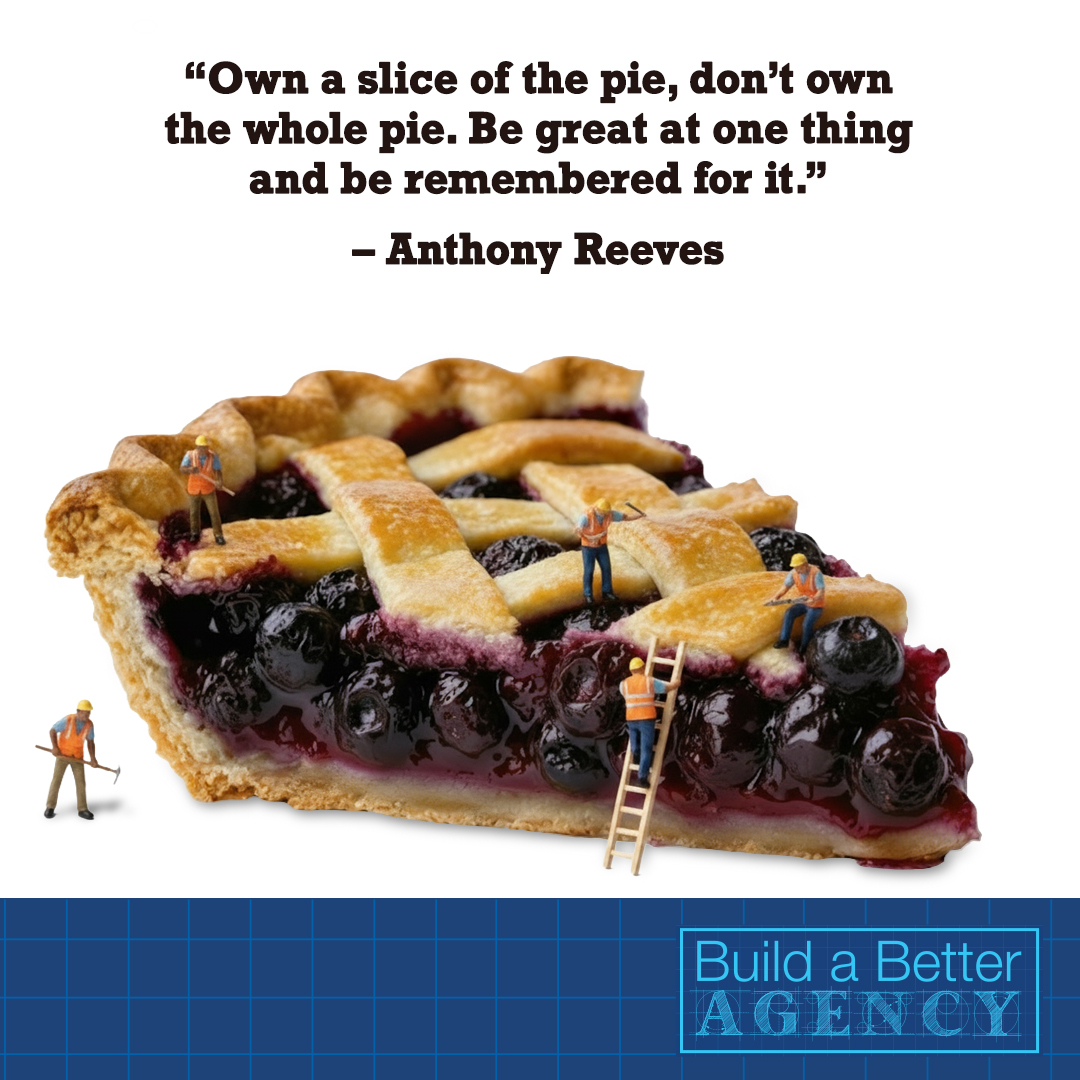
So from a— I’ll say, I’m gonna say 2 things, right? One is from an agency point of view. If you’re an agency owner or founder, it’s like, Own a slice of the pie, don’t own the whole pie, and be super great at that one thing. Be super great at that one thing and be remembered for that one thing. And if you can tell a client, we don’t do that, we only do this, the better off you’re gonna be. And they will trust you from, from that point of view. The, from an individual point of view, going back to what we chatted about before, and it goes back to the book, is like, Who do you want to be as a person? Who do you really want to be as a person that you can be proud of yourself at? And whether it’s from a work point of view or a personal point of view, it’s like, who do you want to— who do you want to be? And, you know, we have very fortunate— we have a phenomenal daughter. She’s not just one of those kids that is great. And my wife and I chat a lot about, like, how we can help support her. do the best that she can be. Um, when she’s, you know, learning and developing and growing in college and all that sort of stuff. And, and it’s interesting to think about, like, what is it that gets— going to keep her whole? And I’ve had to work on what’s going to keep me whole. And, you know, if I’ve— I fly a fair bit, and what keeps me whole is the ability to run through a city I’ve never been through. So every time I go to New York, I run through that. I ran through Oslo, downtown Oslo about 6 months ago and I thought I need to keep myself in good enough shape that I can trot, jog, run, whatever it is through a city and explore. And I love that and that is part of who I am. And so how do I, how do I make that part of my life so I can do that?
Drew McLellan [01:01:02]:
Yeah, good advice. This has been a great conversation. We probably could do it for another couple of hours, but I know you have to get on a plane. So If folks want to find the book, I believe it’s available everywhere in the world. Folks want to find the book, want to learn more about you, want to follow your thoughts. What’s the best way for them to kind of track all of that down?
Anthony Reeves [01:01:23]:
Yeah, thanks, Drew. So website is anthonyreeves.co. A smarter person than me stole anthonyreeves.com.
Drew McLellan [01:01:32]:
Yep.
Anthony Reeves [01:01:33]:
LinkedIn is, you know, just prolific on LinkedIn, maybe too prolific on LinkedIn. Um, it’s probably the 2 easiest ways. The, the book, uh, Eat the Donkey is available, generally speaking, on online only. So Barnes Noble, Amazon, Goodreads, etc. Um, I, I’d appreciate it if you, if anyone picks it up and writes, writes me directly or anything like that. I, it would be great. Love it or hate it.
Drew McLellan [01:01:59]:
This has been a great conversation. Thank you for, thanks for being on the show and sharing some of your life experiences because It isn’t, it isn’t just work experiences. It really is life experiences. And I think your book is a great example of we’re not 2 different people. We’re not somebody different at work than we are in the rest of our lives. And the more aligned those 2 halves of that whole are, I think the happier and more successful we can be. And so probably the eating the donkey doesn’t just happen in your professional life. It happens in your personal life too. And How you make all of that work is, you know, I think probably our lifelong journey as a work in progress. But the book gives some really great guidelines and examples. So, it was really fun to have you on the show, and I appreciate you sharing all your wisdom with us. So, thank you.
Anthony Reeves [01:02:50]:
Thank you, Drew. I really appreciate the time.
Drew McLellan [01:02:53]:
You bet. All right, guys. So, this wraps up another episode. So, here’s some homework for you. I want you to think about that idea of foundation and principles and characteristics. And, you know, if you’ve got mission, vision, values, looking at those and seeing, are, are they really foundations and characteristics and characteristics, or are they princip— you know, could you convert them to that? So, and, and here’s your real homework. I want, if you think I’ve got it down, the foundation, I know, I know what our core thing is at the agency.
Anthony Reeves [01:03:28]:
Mm-hmm.
Drew McLellan [01:03:28]:
I want you to either walk the halls if you’re in office, or as we were talking about, if you’re not, I want you to pop in your Slack or your Zoom or however you communicate. Hey everybody, give me our core foundation. What makes us different? What do we believe in that we are not willing to sacrifice? Tell me what it is and see how many people know what it is. And if everybody rattles it off to you verbatim, then you’ve nailed this. My guess is for most of you, either people are going to say, I don’t know, or you’re going to get a variety of answers. Danielle and I do this when we go into an agency. We walk the hall, we literally or figuratively walk the halls and ask people kind of those kind of questions about the company’s beliefs. And we get a lot of answers, but we don’t usually get the one answer. So if you get the one answer, bully on you. But for 99% of you, so you’re gonna find that you have some work to do. So then ask yourself, how do I actually bring this to life in our status meetings, in when we’re talking to a client, in our new business deck, in our interview and orientation of new employees? How do I weave this in in a way that no one can say they don’t know? Because that’s when they start actually leaning on it and using it. And when you do have to make a hard decision and you start with that, they all start nodding their head because they know that’s who and what you’re all about. So it helps you make better decisions. It helps your team make better decisions, and it helps you justify the hard decisions that if you’re really doing your job, that you’re going to have to make sometime, you know, probably through the rest of this year and the years ahead. So that’s your homework. All right, before I let you go again, just want to say another quick thanks to our friends at White Label IQ, the presenting sponsor of the podcast. So I told you at the top of the hour, they’ve been with us a super long time. Check them out at whitelabeliq.com/ami. And I always love to end the show reminding you that I only get to do this every week because you keep coming back and listening. And so I am very grateful that you choose to spend your time with me and with the great guests we have like Anthony. So Thanks for being here this week. Thanks for coming back next week. I promise I’ll have another great guest for you. All right, talk to you soon. Have a great week. That’s all for this episode of AMI’s Build a Better Agency podcast. Be sure to visit agencymanagementinstitute.com to learn more about our workshops, online courses, and other ways we serve small to midsize agencies. Don’t forget to subscribe. Subscribe today so you don’t miss an episode.