
Episode 567

Welcome to another insightful episode of Build a Better Agency! This week, host Drew McLellan welcomes Shawn Yeager, founder of Upshift, for a candid conversation about the seismic shifts AI is creating in the agency world. Together, they go beyond the hype and headlines, examining how agencies can genuinely commercialize AI—not just adopt new tools, but strategically redesign what they sell and how they deliver unique value in an AI-enabled marketplace.
In this episode, Shawn Yeager draws on more than 30 years at the intersection of technology and business, sharing a roadmap for agency leaders. He explains the three traps many agencies fall into when adopting new technology—becoming more efficient but less profitable, becoming educated without application, and buying into platforms without changing go-to-market strategy. Drew McLellan and Shawn Yeager also break down the difference between operational AI (streamlining internal processes) and commercial AI (transforming what you offer clients), and why the latter is critical for agency growth and survival.
Listeners will discover practical frameworks to evaluate service offerings, price on outcomes (even when clients aren’t sure how to measure them), and proactively use AI to become indispensable advisors—not just vendors. Shawn Yeager discusses the blend of efficiency and artistry required in the modern agency, how to avoid the risks of commoditization, and why focusing on judgment, relationships, and the “decision sandwich” will separate thriving agencies from those left behind.
If you’re looking for actionable steps to future-proof your agency, navigate staffing shifts, or reimagine your client relationships in light of AI’s rapid evolution, you won’t want to miss this episode. By the end, you’ll have new strategies and a fresh mindset for turning the AI revolution into your agency’s greatest opportunity.
A big thank you to our podcast’s presenting sponsor, White Label IQ. They’re an amazing resource for agencies who want to outsource their design, dev, or PPC work at wholesale prices. Check out their special offer (10 free hours!) for podcast listeners here.
What You Will Learn in This Episode:
- Moving beyond efficiency to true AI-driven business transformation
- Rethinking agency offerings for an AI-enabled marketplace
- Shifting from billable hours to outcome-based pricing models
- Harnessing judgment and expertise as differentiators alongside AI tools
- Blending scalable, repeatable processes with bespoke, high-touch service
- Preparing agency staffing models for a shrinking entry-level workforce
- Proactively evolving client value propositions to stay ahead of commoditization
Ways to contact Shawn:
- LinkedIn: https://www.linkedin.com/in/shawnyeager/
- Website: https://upshiftco.com
- Email: [email protected]
Resources:
- Free AI Commercialization Assessment (8-minute walkthrough): https://upshiftco.com/assessment
- BaBA Summit May 24-26, 2027: https://agencymanagementinstitute.com/babasummit/
- Drew’s Book: Sell With Authority
- AMI Facebook Group: https://www.facebook.com/agencymanagementinstitute
- AMI Preferred Partners: https://agencymanagementinstitute.com/ami-preferred-partners/
- Agency Edge Research Series: https://agencymanagementinstitute.com/agency-tools/agency-edge-research-series/
- Upcoming workshops: https://agencymanagementinstitute.com/advertising-agency-training/workshop-calendar/
- Weekly Newsletter: https://agencymanagementinstitute.com/newsletter-sign-up-form/
- Agency Coaching and Consulting: https://agencymanagementinstitute.com/advertising-agency-consulting/agency-coaching-consulting/
Danyel McLellan [00:00:01
It doesn’t matter what kind of agency you run— traditional, digital, media buying, web dev, PR, or brand whatever your focus, you still need to run a profitable business. The Build a Better Agency podcast presented by White Label IQ will expose you to the best practices that drive growth, client and employee retention, and profitability. Bringing his 25+ years of experience as both an agency owner and agency consultant, please welcome your host, Drew McLellan.
Drew McLellan [00:00:29]:
Hey everybody, Drew McLellan here from Agency Management Institute. You know what I feel like doing today? I feel like recording another episode of the Build a Better Agency podcast, and I am so glad that you are here for us to do it together. So thank you for joining us today, and thanks for letting me hang out with you for an hour. You’re gonna love this guest and you’re gonna love the topic. It’s gonna get you thinking. Which of course I think is a very good thing for us to do. Uh, before I tell you about our guest, I want to remind you and say thank you to our friends at White Label IQ. They are the presenting sponsor of this podcast. And you know what’s cool about White Label is they understand the agency business better than anybody because they were born from an agency. They were actually born from an AMI agency that back in the day was looking for a web dev partner that could really crank out, if I remember right, the initial project was like 10 websites in a very short period of time. They couldn’t find a web partner that they could partner with to get that done. And so White Label was born and then eventually split off from that agency and became its own entity. But they know agencies because again, that’s their roots. But one of the things they’ve done recently, you know, back in the day they did web dev and design and then they added paid media. And now over the last couple years, what they’ve added is AI. So they’re helping a lot of agencies think about how they can leverage AI to do their work better, deeper, faster, and more efficiently. And so that might be operationally what’s happening inside the organization, might be client-facing work, but either way, they’re partnering with their agency clients to not only think about what’s possible, but then they build it for them. So if you want to have that kind of a conversation with somebody who understands your world, head over to whitelabeliq.com/ami. You’ll learn a little bit more about them. You’ll see that they have a special deal for first-time clients, and it would tickle me pink if you would also send them a little note and just thank them for the sponsorship. They’ve been a huge supporter of AMI for a long time, and they really do make this podcast possible. So Even if you’re not ready to engage with them, just a little thank you would make me very happy. All right.
Drew McLellan [00:02:58]:
Okay. Let me tell you about today’s guest. So today’s guest is a gentleman named Shawn Yeager, and Shawn is the founder of a Nashville-based advisory called Upshift. And the purpose of Upshift, or the goal of Upshift, is to advise clients on how to commercialize AI for professional service firms just like yours. So really their work helps agencies decide what to sell, how to price it, and how to bring it to market. So it’s not about what tools to use or training you on the tools. It’s really the business strategy of what, with the help of AI and in an AI-enabled world, what are your clients really gonna want from you and what can you deliver with great quality, but also at a great profit. So Shawn comes by this work pretty naturally. So he has lived in technology his whole career. He did biz dev for Microsoft back when browsers were first coming into play. He has worked for other technology companies. He’s worked in the Bitcoin industry, and now he specializes in AI commercialization. And what’s interesting is what he believes is, and I think you’ll see this through his whole career, he believes that companies initially focus on how to adopt each new technology when it comes. But really what they’re missing is the bigger opportunity, which is how do I redesign what I sell because that technology exists? And so that’s really what we’re gonna talk about today, and we’re gonna talk about some of the tensions that live in the world right now. The reality is, how can we rethink and repackage and re-envision what we offer clients that’s valuable when many of the things that we have historically done can now be done by AI or AI and a human together? So it’s really about efficiency versus growth. How do we talk about outcomes versus hours? How do we not just adopt AI, but really commercialize it? How do we make sure that we have our judgment and expertise and taste and discretion and discernment in the work we do, even when we are using AI tools? And how do we find the balance between tool and people and all of that? So we’re going to dig into as much of that as the hour will allow. I’ve got a ton of questions for Shawn, and I’m hoping that I picked the ones that you would ask him as well. And if not, then we’ll just have him back on the show. But if you will, please help me welcome Shawn to the podcast. Shawn, welcome to the podcast.
Shawn Yeager [00:05:44]:
Thank you, Drew. I appreciate you having me. It’s a pleasure to be here.
Drew McLellan [00:05:47]:
You have an unusual background for our show, so give everybody a little bit of history of your background because I think it tees up everything we’re going to talk about today.
Shawn Yeager [00:05:57]:
You bet. So, I found myself in a situation where Having a computer science degree and being able to have a conversation with a few people got me pulled into the business side of technology very early in my career. The throughline has been 30-plus years of emerging technology, starting on Microsoft’s first browser team, going through the web, cloud, SaaS, mobile, streaming, most recently Bitcoin, digital payments, and now AI. The theme through all of that has been, for my work, has been, how do you take this interesting, new, compelling, disruptive, choose your adjective, technology and commercialize it? The first wave generally is, or rather, the first move is adoption. How do we squeeze out margin? How do we do things faster, better, more interesting? Once upon a time, a mobile phone was just a smaller screen.
Drew McLellan [00:06:48]:
Right.
Shawn Yeager [00:06:48]:
We would chuckle at that perspective on it now. It’s been transformational. And so time and time again, these waves occur. We adopt, we implement, we shave some cost, but ultimately what tends to separate those who thrive from those who do not is how they change ultimately what they sell, what they offer.
Drew McLellan [00:07:08]:
Yeah. So that’s, I think that’s an interesting shift because as you talk about this, you kind of talk about that there are 3 ways that we fall into a trap when we adopt a new technology. So, right. You talk about that we get more efficient. but we shrink, like we’re starting to invoice less, right?
Shawn Yeager [00:07:29]:
Yes.
Drew McLellan [00:07:29]:
You talk about the fact that we get, we educate ourselves, we educate the team, but we don’t make anything new with what we’ve learned. So that’s, uh, you call it educated, but it’s kind of stalled. And then the next one is that we buy into the platform, whatever that platform is, but it doesn’t actually, even if we play around with it, we run pilots, it doesn’t actually change how we go to market.
Shawn Yeager [00:07:55]:
Correct.
Drew McLellan [00:07:55]:
And so if I understand it right, your premise is that we have to go beyond all of those, that a lot of agencies are in one of those places right now.
Shawn Yeager [00:08:03]:
Yes.
Drew McLellan [00:08:04]:
And what we are not thinking about doing is how do we reinvent who we are and what we sell to take advantage of and also not be disadvantaged by the new technology, right?
Shawn Yeager [00:08:18]:
I’m stealing that quote. That’s absolutely it. And that’s why I think it is— there’s a continuum. Nobody gets this right overnight, nor would I assume You know, that that’s possible. But there is a continuum. There’s a process to move through from experimentation to defending initially against what’s compressing and what’s exposed. And we can sort of talk more about a framework for that. But I think much more hopeful is what now has emerged that we can do, deliver, go to market, sell, offer differently.
Drew McLellan [00:08:48]:
So let’s— I think a lot of agencies, actually, what I— where I think a lot of agencies, they’re waiting for the other shoe to drop. It’s still so new that in most cases, at least with the agencies of our audience’s size, so, you know, a couple people to a couple hundred people, privately held independent agencies, they’re not getting a lot of pressure from their clients to reduce because clients don’t understand AI well enough to go, hey, I can save some money because I know you’re using this tool or that tool. So we’re at the— we’re at the waiting for the shoe to drop. for a client to go, you know, I bet you’re using AI on this stuff. Where’s my price break? So talk to us about the continuum. If we’re right there right now, what’s coming next? And based on your experience with other technologies, how quickly is it coming?
Shawn Yeager [00:09:40]:
Well, I think— and I’m not one to sort of, you know, rattle the saber and say the sky is falling, mix my metaphors. But I think it is coming. It’s inevitable. We can see the arc. Right. And so as I’ve said a few times, AI has killed the billable hour. You know, billing by the hour will outlast most of us, but the billable hour as a unit of value, I think, is, is largely over. And so, you know, perhaps many of your audience have already emerged out of that, have already transitioned out of that.
Drew McLellan [00:10:08]:
Most of the agencies today are flat fee, right? So it’s gonna be, you want, you want a widget, that widget’s $5,000.
Shawn Yeager [00:10:16]:
Absolutely.
Drew McLellan [00:10:16]:
Now, on the back end, the way they’re getting to that $5,000 is still a billable fee, a billable hour. Right. They’re calculating how long it’s going to take, but the clients aren’t exposed to billable rates for the most part, billable hours anymore. That’s past.
Shawn Yeager [00:10:31]:
Absolutely. And so I raise that only to say that, for example, in law, in legal, 90%, as we read the statistics, would say that 90% of legal billables are still by the hour. And so I think we can look at that field, look at that sector as a canary. But back to your question, I think there are— well, I look at it as 3 sort of ladders that I call it pricing, delivery, and productization. To my knowledge, no one sort of climbs them all at once and gets to the top, but I think there are 3 ways or 3 elements of looking at how we go to market differently. More practically speaking, there is an arms race on where your competitor can acquire most, if not all, of the same tools, budget permitting, right?
Drew McLellan [00:11:14]:
Right.
Shawn Yeager [00:11:15]:
They’ve got Claude Design. You’ve got Claude Design. They’ve got HyperFrame. You’ve got HyperFrame. nerd out about the tools, so the technology ends up being net neutral, right, as the adoption occurs.
Drew McLellan [00:11:29]:
Right.
Shawn Yeager [00:11:30]:
I think what then happens is, for an agency to think about— easier said than done— but what are customers really, what are clients really paying for? I love this sort of idea of doing a postmortem on one deal, and that is to say, Here’s why I think you chose us. Here’s why I think we won this deal, but please tell me, why did you actually buy? That’s a tactic, but I think it informs. I do enough of those, right? It informs, do we have hidden assumptions about why they actually bought from us, and do we now know more about why they buy? The tech, the deliverables, the designs, the brand identity, all these things are crucial, but likely they’re still with you because they trust you, because there’s a relationship, and they look at you as a steward.
Drew McLellan [00:12:17]:
Yeah, right. So when you talk about pricing, you sort of talk about there’s a hierarchy or a ladder, and we talked about the first one, which was sort of retainer, or it starts without billable hours, right?
Shawn Yeager [00:12:30]:
Right.
Drew McLellan [00:12:30]:
And then that leads to retainers, which are often tied to a bucket of billable hours, right? And then project fees, which is kind of where I think most agencies are today. And then there’s outcomes. And one of the challenges with outcomes is, it is fascinating. And when I talk to agencies and we talk about billing, setting your pricing based on outcomes, for many of them, their clients don’t know how to measure the outcomes, right? Or they do measure them, but they don’t share them with the agency. So how do you envision with this technology push, how do you envision a different conversation with clients either to help them figure out how to measure the outcomes?
Shawn Yeager [00:13:12]:
Mm-hmm.
Drew McLellan [00:13:13]:
or for them to give you the data so that you actually can set pricing appropriately.
Shawn Yeager [00:13:19]:
Right, right. And that, and I think in the creative field, I say this just to anchor a bit, I’m a lifelong drummer, I’m in Nashville, my family, my friends, most of my dear circle are artists. And so I say that to say that I’m sensitive to the nature of putting a quantitative or other metric on creative. But I think, increasingly, it’s doable. What I’m seeing with the firms that I’m working with is they’re making some probably difficult decisions to narrow what they offer. What does that mean? That means, instead of this broad smorgasbord of services that fall into marketing, fall into creative, fall into branding and advertising, they look hard at what they’re really great at. They map that across How exposed are we to AI compressing that work and compressing the revenue? Out comes a narrow book of business or portfolio of services that the next phase then becomes, all right, can we actually get a beat on the inputs? Do we know the inputs that go in and, therefore, we can more predictably deliver the cost and then break that down into the unit of ultimate value, which is outcomes? Now, that’s a lot of words to say it’s hard. But I think in narrowing, in understanding why clients really buy, in narrowing the service lines, and in better understanding the inputs so that you can more predictably price, that’s a big move on the way to getting to outcome-based pricing. What does it mean to price, or rather, what does it mean to deliver brand stewardship? What does it mean to deliver competitive audits on an always-on basis? What does it mean that a client is expanding into a new market and they want sort of front-facing intelligence on that new market, not on a quarterly basis, but on a continuous basis?
Drew McLellan [00:15:17]:
Right.
Shawn Yeager [00:15:18]:
The outcome, in my view, doesn’t necessarily map to, here is this one thing, but it could be a state, right?
Drew McLellan [00:15:26]:
Right.
Shawn Yeager [00:15:26]:
I have the confidence in you as an agency that I know what’s going on in a market, I know what’s going on in my competitive field, and that is sort of an ongoing offer that I sell.
Drew McLellan [00:15:38]:
One of the things, as I was reading through some of the things that you’ve written in prepping for today, one of the things that struck me is you hold the belief that one of the ways agencies protect themselves is to be more prescriptive. To your example of client is getting ready to open a franchise in Nashville, they want to understand the Nashville market. So part of my product offering might be that competitive set, that competitive audit of whatever’s happening in Nashville. But unlike what happens today in many cases with an agency, rather than us waiting for the client to go to look at the audit data and go, you know what, I think we should do XYZ. I think what you’re prescribing is that part of our offering is now, hey client, we’re going to monitor Nashville and then we are every Friday going to make recommendations on what we should do next week to take advantage of whatever’s happening. Whatever happened this week in Nashville, we’re going to be prescribing to you or recommending to you things we should be doing, whether it’s paid advertising or SEO or GEO or whatever it may be.
Shawn Yeager [00:16:54]:
Yes. Yes.
Drew McLellan [00:16:55]:
To take advantage of that moment in time.
Shawn Yeager [00:16:58]:
Yes. I think there are 2 reasons for that. One is to beat the potential competitor to the first call. This is broadly applicable, of course. Good advice is to be proactive. But I think in making that first call, particularly if you’re not on retainer, if you’re project to project, then maybe they’re shopping in between projects. When you outreach like that, you’ve changed delivery models, I think.
Drew McLellan [00:17:27]:
Right.
Shawn Yeager [00:17:27]:
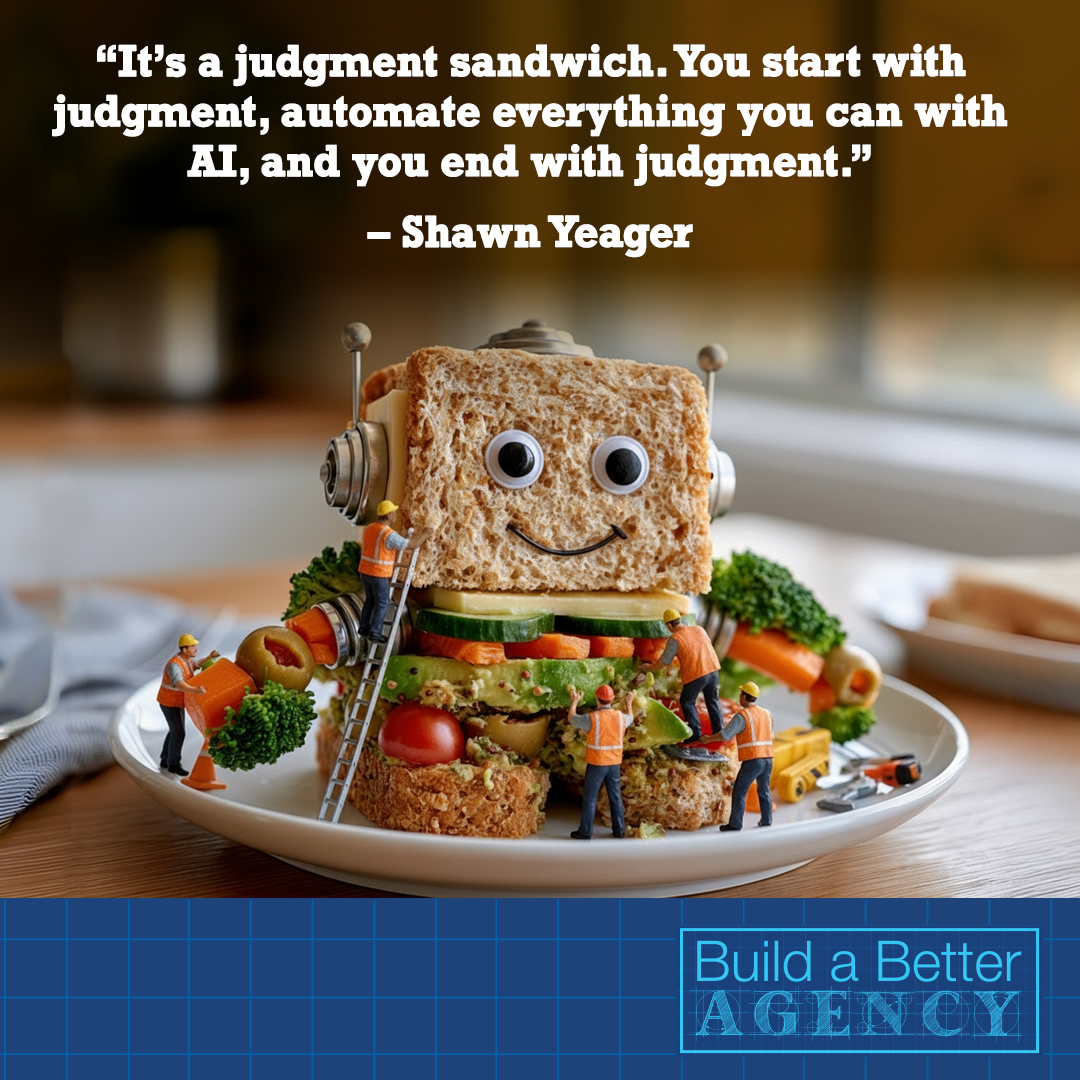
You’ve also, I think, really predicated sort of the value on your judgment. As someone said to me not too long ago, and this was again in the legal field, but I just think, as I say, as a canary, it’s a judgment sandwich. You start with the judgment, you automate everything you can with AI, and you end with judgment. Again, it sounds trite, I think it goes to your point, Drew, which is, if you’ve made that call and, or rather, if they know they’ve got that standing Friday meeting and on the agenda are the 3 things that matter because you’ve used all the tools to do all the competitive intelligence, you have scored it against a rubric that you’ve probably built over years, and ultimately someone senior has looked at it and said, based on my knowledge, my pattern recognition, those are the 3 steps to take. Those are what we lead with with the client.
Drew McLellan [00:18:17]:
So I think a lot of agencies right now are— the way I would, the way I would describe it is they’re kind of splashing around in the water with AI. So probably everyone in the agency has their own ChatGPT, Claude, Perplexity, whatever it is, account, and they’ve all built something, right? They’re all using it in some way. It’s certainly not well orchestrated in most agencies yet.
Shawn Yeager [00:18:42]:
Isolated.
Drew McLellan [00:18:42]:
Right. Very isolated. You know, when we talk to agency owners, I’ll say, well, tell me what’s happening with AI in your agency. and they’ll be like, oh, everybody’s using it, but I don’t know how. Like, I’m not sure what they’re all doing with it. I haven’t looked at the, what everyone has built out in Claude or whatever. Some of the agencies are certainly more sophisticated than that.
Shawn Yeager [00:19:02]:
Absolutely.
Drew McLellan [00:19:02]:
But paint us a picture, if you will, of kind of the, the theater inside an agency, the AI theater inside an agency. What’s happening in the shop that looks progressive but is not changing anything commercially? What do you, how do you invi— what do you think is happening right now inside shops?
Shawn Yeager [00:19:21]:
Yeah. Well, I think one read is to the degree that there’s a pricing page, it hasn’t changed. And so the external face of what the client buys is unchanged. And so it goes back to our prior conversation. There could be great margin gains. There could be cost recovery within the agency, but what the client sees hasn’t changed. And so in time, I do assert that that will become a request. That’ll become a question that clients ask.
Drew McLellan [00:19:49]:
Right.
Shawn Yeager [00:19:50]:
I think there is, without going too far in the weeds and you can pull me back, is there are these sort of 3 layers within those who are applying AI with great leverage. There’s the context layer, skills, and agents. Skills, most of us probably, if we’ve dabbled, if like me, you’re a real nerd, you’re in the command line and a terminal doing things. But even if you’re in Codex, ChatGPT Codex, you’re in Claude, Cowork, you may have learned that you can invoke these skills. And, you know, oh, by the way, those are basically for, you know, for, for those, uh, maybe in our age group that remember, uh, The Matrix, that’s Neo jacking in and knowing kung fu like that, right? You’re teaching the agent that skill. So there’s a great way to package or to bundle, you know, what you do in an executable fashion. And then agents really are, how do we just run that thing all the time? And so where I then go is back to that context layer. If you’ve got 5 people in an agency running ChatGPT, they are probably outpacing their peers. Maybe they’re delivering, they’re producing deliverables faster. Maybe they’re doing research dramatically quicker. But as an agency, are you seeing a compounding effect?
Drew McLellan [00:21:02]:
Right.
Shawn Yeager [00:21:03]:
If, for example, for a client, you’re maintaining these seemingly silly little markdown text files, design.md, productmarketing.md. These become the artifacts that the next time a junior needs to come in and produce a landing page or produce sort of a newsjacking effort to respond to a moment in time, they know they’re going to be on brand, on voice, and on time. That is all to say that I think that connective— some will call it the company brain, Mm-hmm. That becomes the compounding effect. Then, I think, people start to get a sense of, okay, wow, this is synthesized now through the agency. They begin to see how they can change the inputs, the outputs, the pricing, the delivery, the packaging. I think I’ll end on this. My background is in technology. I try to remember that not everything is a tech product, not everything is a SaaS product, not everybody wants 3 tiers of pricing on their website.
Drew McLellan [00:22:07]:
Right.
Shawn Yeager [00:22:08]:
But I do think we can learn a lot from that in the sense that there’s, there’s a, you know, decades of pricing psychology that go into it. And so, you know, beginning to think about how would you, if you needed to offer 2, 3, maybe 4 tiers of pricing and packaging, and then reverse that into, all right, how do we actually do that? How do we become— it’s a, it’s a word many will not like, but how do we become sort of a factory behind the scenes that again, at the end of the day, it’s the pattern recognition, the relationships, the judgment, the trust that put the premium on what you offer.
Drew McLellan [00:22:43]:
So it’s interesting that we have, we have 2 sort of extremes in agency world. So one is what we, what at AMI we call the Wonder Bread factory, right? So this is an agency that makes white bread, wheat bread, it’s sliced, you get it in a bag and there are no other options. You can’t ask for one slice, you can’t ask for rye bread. Like, they just do the same thing over and over and over again.
Shawn Yeager [00:23:07]:
Right.
Drew McLellan [00:23:08]:
So, to your factory language, right? On the other hand, we have the artisanal bakery, and that’s the agency where someone walks in and goes, I want a cake where it— you’ve combined the characters of Star Wars and Harry Potter, and they’re having a battle on the cake. And the, and the owner goes, We’ve never done exactly that before, but no problem, we can do that, right?
Shawn Yeager [00:23:33]:
Yeah.
Drew McLellan [00:23:34]:
So you’ve got the bespoke, everything is custom-built model, and you have the Wonder Bread factory. So when you’re— what you just said, do you— if you were predicting, are you saying that the bespoke agencies will have to move closer to a Wonder Bread factory To survive this, and will there be less work that is bespoke, or do we have to think about work differently? If so, there there are agency owners on both ends of the spectrum. There are some agency owners that love that Wonder Bread factory because that it is efficient and effective, and they deliver great work for their clients. But they do the same work for everybody in the same way, and there are other people and. this is very akin to your world in Nashville. There are other people that they don’t ever want to play one— the same song exactly the same way, right?
Shawn Yeager [00:24:29]:
I was at the show last night.
Drew McLellan [00:24:30]:
Yeah, they want to— they want to add a riff or something that’s different because that’s the artistry of it for them.
Shawn Yeager [00:24:35]:
Absolutely.
Drew McLellan [00:24:36]:
So talk about our world and how AI is going to change that spectrum, in your opinion.
Shawn Yeager [00:24:42]:
So I, I, I think what I’m— what I’m seeing in the conversations that I’m having are that the destination probably looks like a blend. And so by that, I mean, broadly, I think we can agree that even bespoke, and I love that word and I use it a lot, 80% is the same. It’s the Pareto rule, right? It’s that last 20% that puts the icing on the cake, to borrow your analogy. And so there again are these sort of 2 phases. One, how do we How do we have a factory approach to that which is predictable, repeatable, and, in fact, needs to run with precision?
Drew McLellan [00:25:23]:
Right.
Shawn Yeager [00:25:24]:
We have a certain way of producing strategy documents. We have a certain way of producing deliverables. We have a certain way of producing the LLMS.txt on the client’s website so that GEO is optimized, all those things, right? But at the end, It is that— I don’t mean to make light of it. It is that high-touch client engagement that makes them feel as much as see that this is bespoke, right? So I’m thinking of a particular agency who I lost as a client because they’re already so good at this. And I’m thinking about one of the founders and the conversation I had with her that because they have years ago moved to retainer pricing. They’ve moved to, you know, sort of package pricing. They’ve had some lead time. They have had sort of AI-native recent hires that can do the work with the tools that your competitor can buy, but they can do it so much better. And that’s a little, that’s a little nuanced and twisted to say that, you know, if you take a hammer and I take a hammer, undoubtedly, Drew, you’re probably better at it than I am because I’m not very handy, right? Same tool, different outcome.
Drew McLellan [00:26:33]:
We might want to add a third person to this conversation, but I understand the analogy. Right.
Shawn Yeager [00:26:38]:
So same tool, different outcome because there’s the craftsmanship. And so, you know, I would say that that craftsmanship is still there. It’s a new set of tools. The other thing that, you know, that she told me was that they have worked so hard to become an agency of record. Again, I get it. Easy said, harder to do.
Drew McLellan [00:26:57]:
Yeah.
Shawn Yeager [00:26:58]:
But they just set themselves up, right? And so versus to your, to your point, I think, Again, I try not to sort of throw dark clouds around, but if you’re that Wonder Bread factory, which I love, it’s going to get hard, right? Because I, as not a designer, can do remarkable things. And so then I go to the question of how many of your clients would see what they now can do themselves as good enough, right? And what’s that?
Drew McLellan [00:27:22]:
Well, that’s, that’s always been the challenge in agencies. Absolutely. So way before—
Shawn Yeager [00:27:26]:
now more accelerated.
Drew McLellan [00:27:28]:
Yeah, right. Well, and better. So, you know, I think you can watch local television if, if you have such a beast anymore. And you— and I think for somebody in our world, you know, I watch most of the commercials on local television, I think, good Lord, how did that ever get on the air?
Shawn Yeager [00:27:43]:
Absolutely.
Drew McLellan [00:27:44]:
But to your point, the client thought it was good enough, and it probably loved it if they were in it, right? But the client thought it was good enough. So that’s always been a challenge for us. But now they actually can make a lot of things that are actually good enough.
Shawn Yeager [00:28:00]:
Yes.
Drew McLellan [00:28:00]:
Right? So that, I think that’s the difference and faster.
Shawn Yeager [00:28:03]:
Yes. And, and, and I, you know, I’m not, I greatly dislike anthropomorphizing the technology. So I hesitate to use the word learn, but there are learning loops, you know, and I’ve built some of these tools myself because I, I own simply because, well, because I’ve got a startup and because I want to understand them. And so, The point is, it isn’t static. The tools and the technologies are not just static, right? The next model, Fable 5, whatever hits next month, but the way to apply them where a senior expert can look at it, grade it, and it gets better next time.
Drew McLellan [00:28:43]:
Right.
Shawn Yeager [00:28:44]:
Right? I think that 20% shrinks. But I will say this, and everybody says it, and it’s true. It’s about taste and judgment, right? Those are the 2 words that I always come back to, particularly in the field of marketing and creative.
Drew McLellan [00:29:00]:
So back to your client that did it so well that they didn’t need your services anymore. Yeah, they are. So what are they selling that can’t be commoditized, or how did they shift what they’re selling That cannot be commoditized by the tools.
Shawn Yeager [00:29:19]:
Right, right. So they are, you know, I think here again, it’s instructive to look into the world of tech startups and the products that are being marketed to them. And so I’m not endorsing any particular tools, but there’s one called Magistrar, and I can provide links so you can send them out to the audience. There’s another called Okara. And having tested both of them, I mean, it’s a marketing team in a box right now. That may be more an issue. You know, I’ll use another illustrative example for any of your clients, or rather any of your audience who use the tool ClickUp, the product ClickUp, which is sort of the latest greatest. They— I think it’s brilliant PR. We’ll see if it works. But they just posted an offer for a single individual as CMO, million-dollar salary, No staff. It’s one individual CMO and agents for a million a year. And again, I think it’s great PR. We’ll see if they can pull it off. But I think we’re going to see more of that. And so again, if we just sort of look for a moment for maybe your audience who don’t serve tech industry in particular, if you look at some of the tools that are being directed to these startups, they’re— I use a CRM product. And again, a little far afield, but it’s called Lightfield, lightfield.app. It has a built-in agent that does anything and everything I need to do with regard to sales. It doesn’t just organize my pipeline. It built a brief for me for today’s conversation, which was unbelievable, and it did it with my brand identity. I didn’t need that, but it did it, right?
Drew McLellan [00:30:51]:
Right.
Shawn Yeager [00:30:52]:
I think there are 2 points there. One is emphasizing the good enough element of our conversation, and the other is that, for a particular type of client, They are going to be able to choose from just an unbelievable array of tools, but ultimately, do they know how to wield them? I think engagements start to look like, or rather, they increasingly look like stewardship, fractional CMO, that just element of expertise and seniority that, no matter how good the tools are, you just don’t buy out of the box.
Drew McLellan [00:31:25]:
What do you think that means for staffing at an agency? Already, one of the things I’m seeing is that— and this actually was a pre- and post-COVID issue— a lot of agencies struggle to hire kids right out of school and then train them.
Shawn Yeager [00:31:42]:
Yes.
Drew McLellan [00:31:42]:
So back, back when we were all in an office, the way agencies trained a kid right out of school was they hung out with everybody else.
Shawn Yeager [00:31:50]:
Yes.
Drew McLellan [00:31:51]:
They observed, they watched, they learned through osmosis. Maybe they had some training, maybe they sent them to some training. But for the most part, you learned by being in the environment.
Shawn Yeager [00:32:02]:
Right.
Drew McLellan [00:32:03]:
So when everybody went home to work, all of a sudden it was harder to train the kids who you hired, and you hired them because they were low cost. Right? Right, right.
Shawn Yeager [00:32:13]:
The pyramid.
Drew McLellan [00:32:14]:
That’s right. And, and then you could grow and groom them in your likeness, which meant that they sort of adopted the whole agency’s attitude, strategies, all of that. All made perfect sense. COVID changed all that. Now AI is changing it because what a lot of agencies are saying is, you know what, there are tools that can do a lot of the things that the kids used to do. So I’m going to hire more senior people.
Shawn Yeager [00:32:39]:
Right.
Drew McLellan [00:32:40]:
To your point, have the discernment, the judgment, the taste, all of that, that they can govern what the tools and maybe some of the mid-level people are doing.
Shawn Yeager [00:32:49]:
And that’s a great word, specifically governance.
Drew McLellan [00:32:51]:
So, yeah, one of the things that I think is challenging is, great, that’s fine for today, but where do the mid-level and senior people come tomorrow if we haven’t groomed and grown them?
Shawn Yeager [00:33:04]:
Right.
Drew McLellan [00:33:05]:
And how do you— how are you seeing agencies or your clients shift their staffing because of AI? And what are the long-term and short-term implications of that?
Shawn Yeager [00:33:16]:
Absolutely. So I think the— and I see this across sectors, across industries— the, the bottom of the pyramid is being wiped out, either voluntarily, to your point, because, hey, you know, and this is not a— this is clearly not a commentary on the human impact, uh, of what this is doing and will do, but practically and commercially speaking, that gets that model— that pyramid model gets, you know, largely wiped out. I think that there are hiring decisions. I’m thinking of a recent conversation where instead of a junior, they hired a systems engineer, right, to build some of this fabric, you know, in the firm.
Drew McLellan [00:33:53]:
Right, right.
Shawn Yeager [00:33:54]:
I think I’m glass half full, genuinely, because I think what, what happens if I were an agency owner and, and I were out looking for my next 1 or 2 hires, I think the outlook is The junior who, as we used to say, internet native, is AI native, right? Someone who can truly— now, the question is, does that owner, does that managing director know enough to judge? So that’s a gap to close, right?
Drew McLellan [00:34:23]:
Right.
Shawn Yeager [00:34:23]:
And they’re probably coming to you for that. But assuming they can, speaking of discernment, assuming they can discern that 22-year-old who knows how to wield the tools, The same tutelage, the same apprenticeship is now going to pay 10x. That’s a lot of words to say. I think the same approach applies, but it applies with far fewer junior hires, with a different set of skills, knowing that that last— well, I don’t want to say the last 20% because the things that matter most might be 20% of the total bullet list, Of skills, but they’re the ones that matter most. So, in other words, the 22-year-old, you know, um, absolute rock star on the tools who’s got the right attitude, all the right cultural things that, that all of your audience would already know to hire for, now become that, that proverbial 10x employee.
Drew McLellan [00:35:17]:
And so, how do— and are you saying then that they learn the marketing, the discernment, the judgment, and all of that by being the technician and running the tools, and they’re surrounded by it. And so that’s how they learn how to then eventually step away from the tool and be the guide rather than the, the doer.
Shawn Yeager [00:35:41]:
You know, I, I, I wouldn’t— yes, in short, I don’t know that we’ll ever step away from the tools.
Drew McLellan [00:35:47]:
Well, but, but now they’ve got some junior woodchuck doing the stuff, right?
Shawn Yeager [00:35:51]:
Absolutely. Now, the thing I think is different, and again, it’s not to say that The point of this clearly is, is to, you know, from a career standpoint, is to move up the ranks and to become a partner and to not have to deal with the day-to-day. But a hypothesis I have to be proven or disproven is that this stuff moves so fast that you can, for the foreseeable future, you simply cannot leave it to someone else, right?
Drew McLellan [00:36:14]:
Yeah, interesting.
Shawn Yeager [00:36:15]:
It is a different language, you know, and yes, it’s been said about the internet and mobile and all these things, but I think you have to have a certain Competency, a certain literacy in them, and it changes every week.
Drew McLellan [00:36:25]:
Yeah.
Shawn Yeager [00:36:26]:
What does the velocity of that path up the pyramid look like? I don’t quite know, but the short answer to your question is yes.
Drew McLellan [00:36:35]:
Okay. All right. We need to take a break, but when we come back, you make a distinction between operational AI and commercial AI. I want to talk about that distinction. how we can recognize it in our own shop and be thinking about it differently. But let’s take a quick break first. You know, every agency is thinking about AI right now. The hard part is moving from we should do something with AI to here’s a real solution our clients will actually use. You know, client websites are messy, tech stacks are different, content is scattered, and no one wants an AI tool that takes months to launch or creates more risk than value. Navoo was built to fix that. Navoo adds AI chat to business websites with a single line of code. It works with the site your clients already have and answers visitor questions using only the content that you select and manage from that website. That means you can bring clients an AI solution that’s easy to implement Tightly controlled, genuinely useful, and tied to real visitor insights. And for agencies, there’s a major bonus. Navoo is completely free for your own website. No catch, no trial gimmick. Use it, learn it, and prove that it works before you recommend it to your clients. If you want to see it in action, head over to the Agency Management Institute website. We installed it and literally it was exactly that, one line of code. You can also learn more about it at navu.co/agencies. All right. We are back and we are delving into a topic that I know all of you are thinking about and talking about every single day, which is how is AI changing your business? So before the break, I said you, you will, you have differentiated AI, and you talk about operational AI and commercial AI. Talk about the distinction of those 2 phrases, and what does that look like inside an agency?
Shawn Yeager [00:38:41]:
Right. Well, and I think, and I think we can, we can take this hopefully to a valuable place, but it, it is, it is in essence a shorthand for saying adoption versus changing business model. Right? So, so the operational is how do we do things better, faster, cheaper, more predictably, The commercial is, how do we reinvestigate the business model? I’ll just put this out for reference. One of the reasons I chose to build Upshift and to move into this work is having done 12, 13 years of so-called business model transformation. There’s a great, brilliant mind, Alexander Osterwalder. He wrote a book called Business Model Generation. It is a canvas of 9 components. Anyone can sort of debate whether it’s perfect or not, but these are the 9 fundamental gears that move inside of any business. It gives you a framework for investigating everything from, I think, most centrally, what are our value propositions? Who are the customer segments that we serve? How do we reach them, get, keep, and grow? What are the revenue lines? What are the costs, the resources, the partnerships, cost line, all of this? The commercial side in the work that I do is really looking at, let’s take all your service lines, let’s map them against this quadrant, you know, again to say you’re exposed, it’s going to get bad fast, it’s compressing, it’s defensible, and it’s emerging, it’s newly possible. And so the work, you know, which is certainly challenging but necessary, is to say, great, we adopted the tools. Maybe we’ve even built the company brain. Maybe there is a definitive set of documents that say how we produce an outcome or a deliverable for a client. Then we’ve probably got the same thing for all of our clients. We know all their design tokens. We know all this from the minutiae up to the voice, competitors, ideal customer profiles, all these things. You’ve got that. Then the question is, all right, now that we can do this in a way that is faster, cheaper, better, and then we layer on that, as I say, the judgment sandwich, we’re adding that 20% of what is most valuable, it does go back to what we’ve talked about, which is, how do we change, perhaps, how do we expand the customers that we target? How do we reframe the fundamental value propositions? What is it that they’re going to value from us now? How do we go out and get, keep, grow clients? What does that look like? Do we have more recurring revenue than one-time revenue now? Do we need new partnerships? Do we need to go out and build relationships, not just buy a tool, not just purchase a copilot, which everybody else can do? Do we need to go license data? There are products, again, at the risk of getting in the weeds, with a background largely in sales, go-to-market, We go to something like Apollo.io, 140 million individuals in the U.S. that we have records on and we can enrich data and do all these tremendous things. Spoke with a company yesterday that’s doing something as seemingly simple as handwritten cards, but they’re doing it with enriched data. We have a client that needs to target high-net-worth individuals in Nashville, Tennessee, or in Denver, and we can now take this incredible amount of data. the automation that we’ve built, and this fantastic partnership that we have and deliver something new. Those are just a few examples, but again, it is the differentiation between plugging the tools in and really looking at the business model, which admittedly is the difficult, sometimes painful part.
Drew McLellan [00:42:18]:
Sure. Part of what you’re saying is, and in those 4 quadrants, part of what you’re saying is that we have to start asking ourselves, What can we sell now that we could not sell before? Right.
Shawn Yeager [00:42:30]:
That is, if I left you with a single question, that’s the one.
Drew McLellan [00:42:33]:
So let’s explore that for an independent agency. There’s there twenty people or so. So so you know a lot of agencies that look a lot like that. What are some of the answers to that question? What could they sell that they could not sell before because of this technology?
Shawn Yeager [00:42:51]:
There are, and the. The answer to that is obviously very, very specific to the agency, but there are, you know, we’ve touched on some of these. There are brand monitoring. There are, you know, on-demand sort of deliverables. We need landing pages, programmatic SEO, you know, to get into a particular example, right? What you can do now with programmatic SEO, and I have built it for, you know, for Upshift, is the ability to once a week go out, canvas the competitive landscape, you know, canvas, plug it into your Google Search Console. You know, all of that’s doable. All of your audience are probably, you know, maybe even rolling their eyes and saying, we do that, but it’s on autopilot now, right? And as someone smart who I need to look up said, you know, you just need to be one chapter ahead in the book.
Drew McLellan [00:43:41]:
Right.
Shawn Yeager [00:43:42]:
The client may have the same tools, you know, 6 months from now, but right now what you can deliver is continuous programmatic SEO, continuous brand monitoring. Newsjacking is incredible. You can buy these tools commercially, but I’ve built— and, again, this is not about me, but just to say that it’s doable— is a newsjacking capability that canvasses X. It canvasses particular websites, comes back, drafts the first tweet, drafts the LinkedIn post, drafts the angles, and then marries that against, and here we go, the relationships that you’ve cultivated over years with people in the press.
Drew McLellan [00:44:22]:
Yeah.
Shawn Yeager [00:44:23]:
And so you put those things together, you take that high-speed, low-lift automation, and you combine that with the partnerships and the relationships you have, and you’ve got this unparalleled newsjacking service where you’ve already got the client teed up for a conversation at 4:00 PM today, and They haven’t even had to think about it this morning before they even read the news that was relevant.
Drew McLellan [00:44:45]:
So as we think about— so walk us through the questions we should ask to identify these new opportunities. How do we, how do we begin to explore? You know, again, as I said, a lot of agency owners, leaders, senior folks, they’re still neophytes in AI too. So how, when, when you don’t know, it’s, it’s like me not being in the grocery store and I have to make up a recipe out in the parking lot and I’m not sure what’s on the shelves, right?
Shawn Yeager [00:45:19]:
Right.
Drew McLellan [00:45:19]:
So walk us through the thinking that agency owners and leaders could walk themselves and their team through today to begin to think about how to sort of surface up or identify What are some things that we could sell today that we could not do before?
Shawn Yeager [00:45:38]:
Yep. Well, so there’s, I will say, we’ll get this in the show notes, upshiftco.com/assessment. And so this is a, you know, free 8-minute sort of walkthrough to answer some of those very questions. And so to do that relative or specific rather to the particular agency, but I think the questions do start with the fundamentals of what do we repeat every day for every client, time after time? Where do we hand— effectively copy-paste the work? Where do we find ourselves having to unstick things that are repetitive processes? Where are our standard operating procedures maybe not where they should be? So that is the left side, the operational piece. And then on the right is, I think it’s incredibly valuable. I’ll go back again to go through an organized process of interviewing your clients. Why did they buy? Why are they still with you? These may feel like old questions, and many of your audience may already be doing it, but the point here is to really separate what you sold from what they bought. I think that’s fundamental.
Drew McLellan [00:46:42]:
Right.
Shawn Yeager [00:46:42]:
Then it is to canvass the field. A couple of the questions you’ll see in this assessment are, when was the last time you introduced a new offering? When was the last time a client questioned or challenged you on your price or your offer relative to AI? Have you noticed competitors that announced new offerings or announced new partnerships? You start to sort of triangulate these questions of what’s possible now, what does the competitive field look like, what do our clients actually value about what we’ve delivered to them, and you really start to hone in on, this is the crux of what we deliver. At value or for value. And now, how can we do that at a larger scale in a way that is more tailored? Somewhat surprisingly, the Wonder Bread factory can become the bespoke Wonder Bread factory because you could do things that would otherwise require hiring 10 more humans.
Drew McLellan [00:47:37]:
Right. Something I read that you wrote, you used the phrase, the tool gives you the draft, we give you a decision. Talk a little bit about that because I think What, as I was, as I was prepping for this conversation, I think a lot of agency owners are asking themselves, am I crazy to stay in this business? Is this, is AI gonna wipe out what I do? And I believe, and I’m curious what you think, I believe it’s actually a huge opportunity for agencies.
Shawn Yeager [00:48:07]:
Yes.
Drew McLellan [00:48:07]:
That retool themselves to have, be even more profitable and more successful than they’ve ever been before. And as I was thinking about that, and then I saw that line, the tool gives you the draft, we give you the decision, I’m wondering how those two— how that belief and that sentence fit together. Can you talk a little bit about that?
Shawn Yeager [00:48:27]:
Sure. I think, you know, it does go back to what do they value. And I think, I mean, I think those that are most vulnerable are those that are producing deliverables with no— call it this or call it something else— no advisory.
Drew McLellan [00:48:42]:
Yeah.
Shawn Yeager [00:48:43]:
If it is a content shop, I think things are going to have to change. I think, combine that, stop the slop, as goes the phrase, and there is so much slop. Though I am not an agency professional and not an artist, I do think I’ve got good taste. I say that only to indicate that, as I look at these tools and I look at what they produce, we are getting close to the so-called uncanny valley. I can now spin up tools to fully automate an entire Facebook ad campaign. I can run an unbelievable scale of A/B testing. In fact, I can do it across platforms, across channels. I can also look at most of it and see that 20-millisecond delay between the AI-generated— the AI user-generated content, AI UGC, is huge.
Drew McLellan [00:49:32]:
Right.
Shawn Yeager [00:49:32]:
Most of us can look at that and know it’s off. and your audience are going to look at that and tell their clients as a trusted advisor, don’t ship that, don’t do that.
Drew McLellan [00:49:42]:
Right.
Shawn Yeager [00:49:43]:
Because it doesn’t align, or maybe it does. Maybe you’re a dropship client who just needs market sharing and you’re out there to grab, and maybe your audience will tolerate an Instagram feed full of detectable slop. So I think that’s all to say that knowing what the client values, knowing the type of client you have, And adjusting the tools accordingly. I think where we end up is, as in so many of these waves, the trusted advisor, the confidant, the consigliere, the one who gives you the decision is the one who ends up on top.
Drew McLellan [00:50:18]:
So, you know, a lot of this we’ve talked about is sort of moving to outcomes. So when an agency doesn’t control the client’s product, their pricing, their sales team, their budget, the market, How do we do that effectively? How do we manage our risk in that? Is it appropriate? Do you think someday that we’re going to start telling clients, look, we’ll only work with you if we get to actually influence those other things? Like, where do you see this outcome-based model playing out?
Shawn Yeager [00:50:51]:
Yeah. And I think we can look into consulting to your excellent last point of If I, as the agency, cannot see that the value we’re delivering, the judgment, the decisions are not being integrated, that breaks the feedback loop, right? I can’t continue to offer— if we think of the— again, it’s a distasteful term, but the factory breaks down if our inputs degrade, right?
Drew McLellan [00:51:18]:
Yeah.
Shawn Yeager [00:51:18]:
Maybe it’s not so much I get to make a call, but I get to be part of the feedback loop. Right? So as an agency owner, I get to improve my high-touch but highly automated offers to you if we’re operating in that loop. So that’s to say, you know, there may be an important nuance between do you change based on what I provide to you versus do you at least tell me that you didn’t and/or the outcomes that you experienced. So, I think there’s a tighter integration there. And where there isn’t, I think that’s probably a client you have to fire because you won’t have the inputs back into that loop to deliver those decisions and outcomes.
Drew McLellan [00:52:01]:
Yeah. I think that’s one of the challenges because the first X number of months, anytime you have a new client, you’re overservicing to learn the client, to learn the business, to do all of that. And so, if in 3 months you find out that they’re not gonna be— they’re not gonna play well in the sandbox. You know, that’s a— that’s an expensive mistake. So I’m wondering, from your perspective, how do I test for that in the— in the sales process?
Shawn Yeager [00:52:29]:
Right.
Drew McLellan [00:52:30]:
To know if they actually are going to be a good client who is gonna keep me in the feedback loop, not only to give me data, but also to let me influence decisions.
Shawn Yeager [00:52:43]:
I think ultimately this, and this is again where I might look to consulting to borrow, and I sort of interrupted my own train of thought on the previous one, but, but, you know, it’s, it’s the discovery.
Drew McLellan [00:52:50]:
Yeah.
Shawn Yeager [00:52:50]:
And I think I’m a big fan of paid discovery, right? And it’ll take different names and different shapes in different industries. But, and again, obvious to some, perhaps anachronistic to others, is, you know, we don’t just sort of sell, sell, sell, get the retainer and go. We have a discrete engagement that allows us to get the lay of the land, to survey, Because I think when you’re operating in these tighter, faster loops driven by AI, it can compound either way, right? Good inputs can beget better, faster outputs, but it can also break the whole thing down. So, right, if, you know, if someone— if one in your audience, if someone in your audience doesn’t already, I think this paid assessment/discovery becomes critical.
Drew McLellan [00:53:33]:
So somebody’s listening to us and they are walking the dog and they’re listening and they Believe that their agency is efficient, but they can see that the shrinkage is coming. They can see that they’re going to start to get pressure, that maybe they are offering more of a commoditized product or service. What are the first three things? What are the first three things they need to do when they get to the office?
Shawn Yeager [00:53:59]:
What do they?
Drew McLellan [00:54:00]:
What do they? How do they need to think differently about their business right now to reverse that course? And to be one of the agencies that not only survives but thrives in the next 3, 5, 10 years?
Shawn Yeager [00:54:15]:
I would say shamelessly that they take the assessment. You know, whether or not, you know, we ever, we ever have a communication, I think it is valuable. And I think it is, again, just to map the landscape for them. But I think it is a partnership conversation, as is so often the case of do we have a shared view? Do we have the same or differing views as to the impact? I think often if it is, maybe it’s a 55-year-old partner owner who understandably wants to ride out the next 5 years and they just don’t want the hassle. That’s a different perspective than someone with another 20 years in the game who understands that this will be highly disruptive in the next phase of their career. I think that shared view among leadership, among the partners is critical. Then I think the question is to then say, what’s the time horizon? You know, do we have the names? Do we have 3 names in the title of the firm that commands such respect and such a premium that we think we’ve got a year, right? Because our clients won’t start to churn for 12 to 18 months because of those relationships and that—
Drew McLellan [00:55:22]:
Right.
Shawn Yeager [00:55:22]:
And that reputation versus a newer agency who may not enjoy that and probably has to move faster. So I think it is What is our view? What is our timeline? And what are we prepared to do? And I think that’s where the assessment— I’ve also got a calculator on there, which, you know, 2 minutes and you’re going to see sort of based on the billable model sort of what might hit the book this year.
Drew McLellan [00:55:45]:
Yeah. Okay. Boy, we could talk for— I have, you know, another 12 pages of questions, but—
Shawn Yeager [00:55:52]:
Absolutely. It’s been a pleasure.
Drew McLellan [00:55:53]:
We’ll have to have you come back. But this has been Super helpful. And I think your last answer is the homework, uh, for folks to really sort of look at their business and ask themselves not if it’s gonna change, but how is it going to change and how can they take advantage of those changes? So Shawn, if folks wanna find the assessment, if they wanna learn more about the work that you are doing, all of those things, what’s the best way for them to track you down?
Shawn Yeager [00:56:21]:
You bet. So the website is upshiftco.com, upshiftco.com. And as I lose my voice, perfect timing. Feel free to just hit me up at [email protected]. Would be delighted to. You know, I’m, I’m all about fellow travelers and so always happy to talk through the situation and, and give some, some perspective.
Drew McLellan [00:56:42]:
Love it. Thank you so much for being on the show and for sharing your expertise. Really appreciate it.
Shawn Yeager [00:56:47]:
Thank you, Drew. I appreciate the invitation.
Drew McLellan [00:56:49]:
You bet. All right, guys. So Shawn’s last answer gave you the homework for this week. Here’s what I will tell you. There is not— there really, and you know this, there is not an agency on the planet that is not already being impacted by AI and isn’t going to continue to be impacted by AI. And as the steward of that agency, it is your responsibility. It’s your job to figure this out and to figure out how you can shift how you work and perhaps what you deliver. In a way that gives even more value to your clients and your prospects. Here’s the deal, and I really do believe this. I said this at the on in my keynote at the summit. Shawn and I just said it. I believe this is one of the greatest opportunities that you as agency owners and leaders have ever had before you. You’re going to be able to do things that you have never been able to do before that add more value to clients than anything. You’ve done in the past if you figure it out and if you figure out how to package it and deliver it. And we have a window of opportunity right now to figure it out and to get better at it. And as you know, at AMI, I’m all about all boats rise. So we learn better and faster. As you know, one of our core beliefs, we learn better and faster when we learn together. So know that we’re going to be continuing to have these conversations. And as As you figure things out, sharing them inside your peer groups or inside the Facebook group or wherever that may be, the more we can figure this out together, cuz there’s plenty of opportunity out there, the more we can figure this out together and the more we can help each other get there faster, the quicker you’re gonna make better money. You’re gonna have better margin. You’re gonna have better confidence in the future. So that’s the opportunity for you is to figure this out now while we have time. It is not gonna be forever. So that’s your homework. Do the homework, figure it out for your agency and the clients that you serve, and then bring it back, share it inside the AMI community so everybody gets smarter and we all do this better together. That’s the homework. Okay? Before I let you go, 2 quick things. Wanna say thank you to our friends at White Label, the presenting sponsor of this podcast. I told you all about ’em at the beginning of the show, but head over to whitelabeliq.com/ami to learn more about them. And last but never least for me is I don’t get to have these cool conversations if you don’t listen. So if I have 3 people listening, Shawn does not come on this show. And so I am super grateful that you listen every week and you come back and you share it with your peers and you talk about it when you’re out and about, because that means I get to get smarter, which means we all get to get smarter. So thanks for listening. Thanks for carving out an hour of your crazy week to spend with me. And I will be back next week. And I’m counting on you to come back too. Okay. All right. See you next week. Come back next week for another episode designed to help you build a stronger, more stable, and sustainable agency. Check out our workshops, coaching and consulting packages, and other professional development opportunities at agencymanagementinstitute.com.