
Episode 572

Welcome to a thought-provoking episode of Build a Better Agency! This week, host Drew McLellan confronts a topic that every agency leader needs to address: operational inefficiency and the hidden costs it creates. Joined by operational efficiency expert Michael Greenberg, Drew explores why so many agencies find themselves drowning in disconnected tech stacks, tribal knowledge, and manual processes—and what it really takes to fix it.
Drawing from his extensive experience in agency operations and as the author of a book on digital maturation, Michael Greenberg breaks down his five-level framework for operational excellence. Listeners will discover how most agencies get stuck at “Level 2,” juggling a mess of cloud-based tools that don’t talk to each other, and why that bottleneck blocks the path to real AI adoption. Together, Drew and Michael pull back the curtain on “operational debt” and “operational drag”—those silent killers of growth and profit—and walk through real-world case studies, including agencies faced with integrating multiple acquired firms and their overlapping systems.
You’ll hear step-by-step strategies for moving your agency forward, from getting buy-in across your team to documenting processes and making smart technology choices. They discuss practical ways to quantify the cost of inefficiency, shortcuts for finding your biggest wins, and even how to gamify process improvement so change actually happens. Plus, Michael shares the single easiest place to start leveraging AI—no full tech overhaul required.
This episode is a must-listen if you’re feeling overwhelmed by tech bloat, turnover risk, or simply want your agency to be faster, more scalable, and ready for the future. Walk away with actionable tactics to build consistency, boost client confidence, and unlock the next level of profitability—no matter where you’re starting.
A big thank you to our podcast’s presenting sponsor, White Label IQ. They’re an amazing resource for agencies who want to outsource their design, dev, or PPC work at wholesale prices. Check out their special offer (10 free hours!) for podcast listeners here.
What You Will Learn in This Episode:
- Understand the five levels of operational maturity, from information silos to fully AI-powered operations, and where most agencies actually land
- Learn why “operational debt” and tribal knowledge quietly cost agencies six figures a year in lost time and inconsistent client delivery
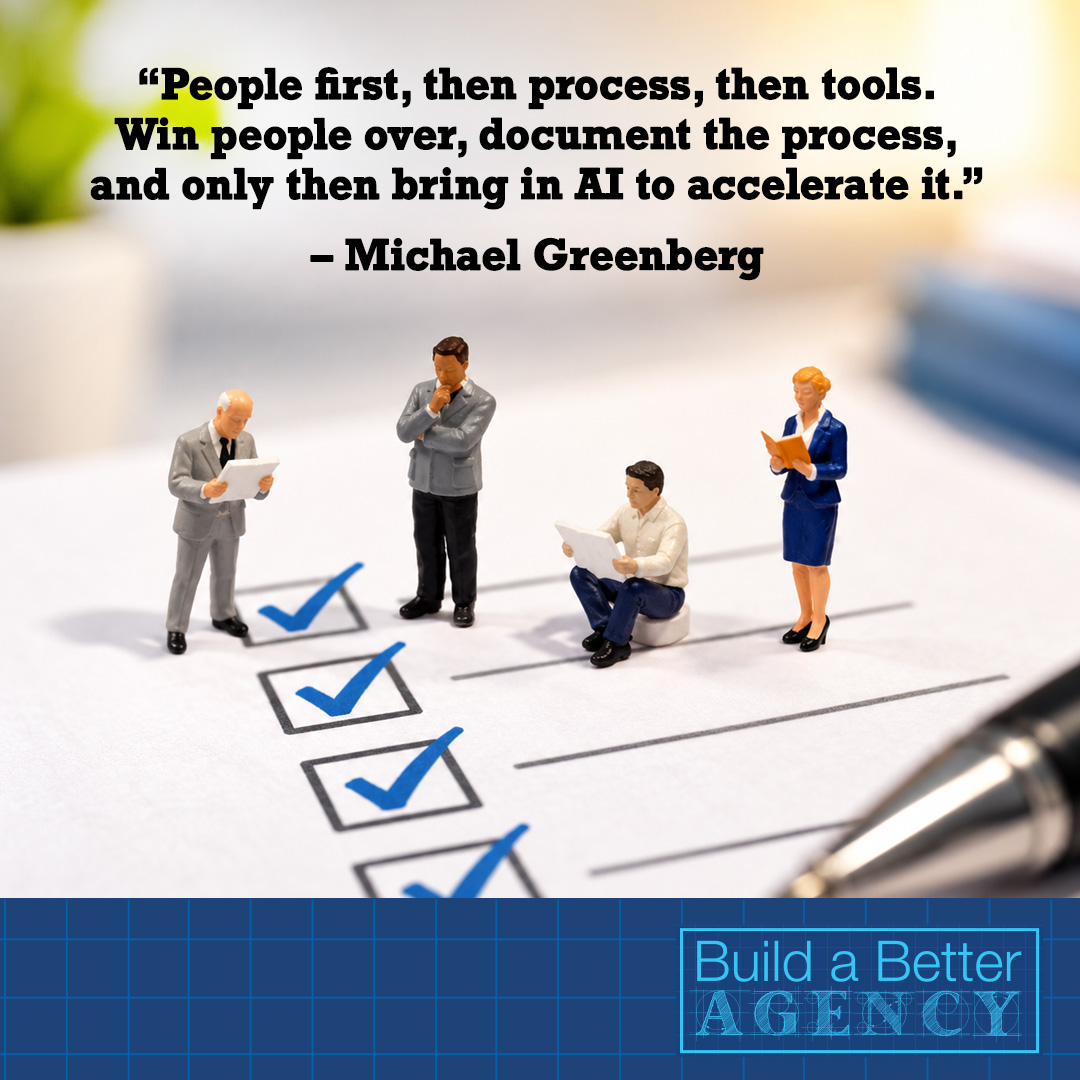
- Discover the exact order, people, process, then tools, that determines whether an AI rollout succeeds or stalls
- Hear a real case study of an agency that cut eight of thirteen overlapping software subscriptions and recovered $50,000
- Learn the “Rule Zero” habit (always be recording) that gives any agency an immediate, low-effort AI win
- Understand why client intake, onboarding, and weekly progress reporting are the highest-ROI processes to fix first
- Get Greenberg’s take on how to win team buy-in for new tools and processes, including two of his favorite incentive tricks
- Learn what kind of technical skill your team actually needs to start automating agency operations
- Discover Greenberg’s prediction for how fast agencies will need to mature over the next two years compared to other industries
Ways to contact Michael:
- LinkedIn: https://www.linkedin.com/in/gentoftech/
- Website: https://thirdbrain.co
Resources:
- Book (free EPUB/PDF): https://digitalopsplaybook.com
- Book (Amazon, hard copy): https://a.co/d/098qQczm
- BaBA Summit May 24-26, 2027: https://agencymanagementinstitute.com/babasummit/
- Drew’s Book: Sell With Authority
- AMI Facebook Group: https://www.facebook.com/agencymanagementinstitute
- AMI Preferred Partners: https://agencymanagementinstitute.com/ami-preferred-partners/
- Agency Edge Research Series: https://agencymanagementinstitute.com/agency-tools/agency-edge-research-series/
- Upcoming workshops: https://agencymanagementinstitute.com/advertising-agency-training/workshop-calendar/
- Weekly Newsletter: https://agencymanagementinstitute.com/newsletter-sign-up-form/
- Agency Coaching and Consulting: https://agencymanagementinstitute.com/advertising-agency-consulting/agency-coaching-consulting/
Danyel McLellan [00:00:01]:
It doesn’t matter what kind of agency you run— traditional, digital, media buying, web dev, PR, or brand— whatever your focus, you still need to run a profitable business. The Build a Better Agency podcast presented by White Label IQ will expose you to the best practices that drive growth, client and employee retention, and profitability. Bringing his 25+ years of experience as both an agency owner and agency consultant, please welcome your host, Drew McLellan.
Drew McLellan [00:00:31]:
Hey everybody, Drew McLellan here from Agency Management Institute, back with another episode of Build a Better Agency. Before I tell you about our guest, I want to of course say thanks to our friends at White Label IQ. They’re the presenting sponsor of the podcast, as you know. Super grateful to them. One of the things that’s cool about them is that they are built from an agency. That’s how— that was our origin story. And so they understand how agencies work. And what that means is they are willing to structure how you work with them to kind of fit what you need. So maybe you just have a couple little projects that your in-house web dev team or media team can’t get to, or PPC team, and they’re willing to roll up their sleeves and do that for you. Or maybe you want to outsource all of that work to somebody and you want a partner. And so that’s going to be how you want to work with them in a fixed fee kind of model where they’re helping you put together the estimate, working with the clients. Or it might be that you actually want somebody embedded in your organization, like a full-time equivalent that is on your roster. And so they’ve got FTE programs that’ll bring continuity and deeper integration if you want that. That’s the thing. They, they get your world. They know it’s not cookie cutter and they are willing to restructure in a way that serves you and your clients best. So if you are looking for a partner that does design, dev, or media, then maybe checking out White Label IQ would be the smartest thing you do this week. So head over to whitelabeliq.com/ami. To read more about them, to reach out to them, let them know that you appreciate the podcast. And also, if you’ve never worked with them before, they’ve got a deal there where you can get some free hours on your first project.
Michael Greenberg [00:02:27]:
Okay.
Drew McLellan [00:02:28]:
So this one is going to be uncomfortable. I think the episode is uncomfortable because it’s going to force us to think about places where our agency is inefficient. So it takes a new AE 6 weeks to onboard. We have information silos in places like Harvest for time tracking and tasks in Asana and budgets in an Excel spreadsheet and our accounting in QuickBooks. And all of those pieces don’t talk to each other. We have— we don’t have one place where scope and hours and all the margins line up and we can look at all of them at the same place. We often struggle to have a single source of truth. We have lots of data centers inside our agency, or worse, tribal knowledge. It’s not online at all. It’s in one of our team members’ heads or our heads. So, you know, your best account director is the only one who knows how to build out a QBR for a client or something else. This is the reality for many agencies that we have disparate systems that don’t work well together, don’t talk to each other, and we do a lot of cutting and pasting and moving information back and forth. All of which costs us time and money. And so if that sounds familiar, then I think you’re gonna love, uncomfortably love our guest today. Michael Greenberg wrote a great book on operational efficiency, and he talks about how we can audit what’s happening in our agency and then how we improve it. So he talks about 5 levels of sort of operational excellence and how we’re using our technology. And what he’s— one of his points is that if you really want to leverage AI, you’ve got to get some foundational stuff ready first. And so we have to sort of audit where we’re at foundationally before we can actually build out automated workflows and actually have AI run certain operations inside our agency, which I know many of you aspire to do. So Without further ado, let’s welcome Michael to the show and let’s dig into this topic together. Okay, Michael, welcome to the podcast. Thanks for joining us.
Michael Greenberg [00:04:42]:
Drew, thanks for having me.
Drew McLellan [00:04:44]:
You bet. Tell everybody a little bit about your background, how you came to write the book, and then I’ve got a ton of questions that we’re gonna dig into. But first, kind of introduce yourself to the audience.
Michael Greenberg [00:04:54]:
Yeah, definitely. So started out in venture-backed startups. Spent a little time there, realized I was going to make a whole lot more if I wasn’t playing the equity game and I started playing the cash flow game.
Drew McLellan [00:05:07]:
Yep.
Michael Greenberg [00:05:08]:
So moved into consulting for agencies first, mostly building little tools so that way they could get the tech-enabled multiple on exit, and then ended up working with a podcast network along the way. Was like, this is very interesting, and then spent the next 7, 8 years building and selling, uh, 2 podcasting agencies. Went to work for a guy much more successful than me, uh, named Jesse Pujji, who runs a venture studio called GatewayX here in St. Louis, Missouri. And he had built some big agencies. I was working with him and he said, you know, you should really go back out on your own. Uh, you know, you got the entrepreneurial bug, you’re not going to last here forever. So about 4 years ago now, I took what I enjoyed doing most working there, which was building out the operations inside of these businesses. And I started an operations consulting and automation business called Third Brain. ChatGPT came out about 3 months after I started the business. I’d done some AI projects for agency clients in the past. And fast forward 2 years, I had enough stuff to say, okay, I gotta write this book. Another year later, published it. And the whole purpose of the book is to take everything you need to get ready for AI, not necessarily start using it too much. Yeah, but build the foundation. And that was now a year ago that I published it, and we’re still going strong.
Drew McLellan [00:06:43]:
So in your book, you talk about sort of the maturation level Of an agency in terms of their, their digital maturation. So, and you have a framework or a model that sort of helps someone measure how sort of how mature their agency is. And to your point, like, how ready are they to take on the technology, whether it’s AI or whatever is coming around the corner? So talk us through that framework a little bit and help people, you know, as they’re on the treadmill this morning or driving to work or wherever they’re doing, walking the dog. How they can, how they can judge or value or grade their own shop.
Michael Greenberg [00:07:22]:
Absolutely. So generally, this sort of maturity cycle goes through 2 phases. The first one handles what we call levels 1 through 3, which is information silos, a connectable cloud, and then getting to a unified data layer, what we call level 3. And if you don’t have a unified data layer, at least inside of the workflow or the department you’re trying to apply AI or any sort of automation to, really, it’s not going to work very well because you’re not going to have the information you need to be able to do that work. But once you have that in place, then you can reach level 4, which is automated workflows, when we start using AI to assist inside of a Human-run workflow, and then level 5, which is AI-powered operations. And that’s when we’re able to deploy agents or other things like that more successfully and quickly across an organization.
Drew McLellan [00:08:23]:
So you walk into a, let’s say, a 30 to 40 person agency today. What level of maturation do you typically expect to find?
Michael Greenberg [00:08:36]:
2.
Drew McLellan [00:08:36]:
Okay.
Michael Greenberg [00:08:37]:
So most agencies have moved to the cloud. You know, we have the occasional client where it’s like, yeah, we do everything on our desktops and we don’t have anything shared. But I think these days most agencies pretty much do all their work in cloud tools. Most of those tools are generally accessible via API or MCP, so we can get to all the data.
Drew McLellan [00:09:03]:
Yeah.
Michael Greenberg [00:09:03]:
But they just haven’t put it together and they often are still copy-pasting things between tools, especially like, you know, CRM to project management. I don’t know how many projects we’ve done now where it’s, oh, well, we sell everything in HubSpot and then we copy all these details over and we go back over these 10 call recordings to fill out this intake form. And I’m like, you have all the information already. You just gotta automate getting it into that system.
Drew McLellan [00:09:28]:
Right. Why do you think agencies are where they’re at? Why do you think they’re either not further behind or further ahead? What, what is it that causes them to be a 2?
Michael Greenberg [00:09:43]:
Yeah, so most businesses are at a 2, especially if they’ve started in the past 10 or 20 years. We work with clients in more traditional industries, 40, 50 years old, they could still be doing stuff on carbon copies.
Drew McLellan [00:09:58]:
Right.
Michael Greenberg [00:09:59]:
Which, for those of you who don’t know what that is, that’s the little yellow piece of paper behind a normal piece of paper with special ink dots in it. So that way it automatically creates a copy when you write on it. It’s all paper. But agencies are fundamentally a people business. You know, you scale by hiring more people for most agencies. And so you can brute force your way through. You don’t necessarily have to build automations to connect everything if you can just hire one more person offshore, as an example.
Drew McLellan [00:10:29]:
Right.
Michael Greenberg [00:10:30]:
That being said, and this is sort of what we’re seeing across, across businesses, is that works in most businesses and you can get pretty big. You know, you can get to 8 figures, $10, $20, $30, $50 million without having to build much of these automations, without building this technology infrastructure. But you can’t use AI.
Drew McLellan [00:10:52]:
Right.
Michael Greenberg [00:10:53]:
And so that I think—
Drew McLellan [00:10:55]:
Or everybody’s using it on their own.
Michael Greenberg [00:10:56]:
Exactly.
Drew McLellan [00:10:58]:
Yeah.
Michael Greenberg [00:10:58]:
And then you don’t gain the same level of benefit. You know, if everyone raises by 10% productivity, that’s not going to make the same change as if you can move the entire business forward by 10% because their individual contributions are too different.
Drew McLellan [00:11:12]:
Yeah. So you use, you use the phrase, uh, operational debt. Talk a little bit about that and how, how getting more mature from a technology point of view shifts that.
Michael Greenberg [00:11:26]:
Yeah, definitely. So everyone who’s owned an agency has at some point been a small agency, right? And you probably have one person doing one key role and they have not written down how they do it, right? So When that person leaves, everything leaves with them, all that institutional knowledge. And that might be something as simple as an account manager leaving and not— you not knowing that they send an update email every week to their— every one of their clients. Or it could be as complex as like, oh, Joe does all of our AdWords setups and he knows exactly how to set up the keywords for our favorite type of client. And we can copy it out of one of his, but we don’t really know the secret sauce.
Drew McLellan [00:12:19]:
Right.
Michael Greenberg [00:12:20]:
And so these are tribal knowledge, which is one form of operational debt. And operational debt can take many forms, but generally it’s we’re working around something instead of documenting it and building an SOP so we can grow and hand it off to multiple people. Or it’s we Have set something up in such a way that it works, but it always breaks. Those tend to be the two most common examples.
Drew McLellan [00:12:49]:
I think the tribal knowledge thing—I think everybody listening has felt the pain of that or feels the pain of that today. Yeah, and and I don’t, and I and I think because agencies are moving at such a fast pace, they don’t they don’t feel the load of it, the cost of it until to your point that person leaves, and then it’s incredibly painful for a short period of. time, somebody new comes along, they either can’t figure out how Bob did it before he left and they recreate, and now that— now they’re doing it, you know, Babette’s way rather than Bob’s way. Or sometimes you’ll have a little bit of overlap so Bob can train Babette, but there’s a lot lost in the translation. But I don’t know that a lot of agencies calculate the cost of that. So when you come in and you are meeting with a client, how are you helping them recognize the exposure that they have when things are not well documented? And there’s one of the ways I talk is a lot of agencies, there’s, you know, let’s say you have 3 account people, you know, there’s a Bob, a Babette, and a Mary. All 3 of them are doing the same kind of work, but they all do it a little differently. And there’s not really the agency way of doing it. So what do you think that costs an agency?
Michael Greenberg [00:14:10]:
Well, I think, you know, we’ve got operational debt, and when everyone’s doing it a little different, that becomes operational drag. So your ability to grow and scale and to deliver the same results to every client is limited by your ability to do the same thing for every client.
Drew McLellan [00:14:32]:
Right.
Michael Greenberg [00:14:32]:
And the way I, I like to talk about it is we’ve got another— I’m a big frameworks guy and we, we’ve got a framework we talk about with clients in terms of sort of their North Star goals for what they’re trying to accomplish. And it’s pretty much always the same 3 things. First, you need consistency in your operations. When you are doing everything the same way for every client and you have the same instructions and the same SOPs and the same training, then you end up with fewer errors. All your data ends up looking the same. You’re able to put somebody new into a role without having that same, you know, 6-month training period.
Drew McLellan [00:15:13]:
Yeah.
Michael Greenberg [00:15:13]:
If they’ve done it before, it should only take them a month or 2 to learn how your agency does it a little different. And when that’s all in place, your data’s probably sitting in the right places so you can build clarity, which means visibility into your projects, into your dashboards if you’re operating on a project basis. Project costing, massive.
Drew McLellan [00:15:33]:
Right.
Michael Greenberg [00:15:34]:
I don’t know how many friends I’ve had build, oh yeah, I got to $1 million, $2 million, I’m making 5%.
Michael Greenberg [00:15:39]:
Right.
Michael Greenberg [00:15:41]:
And then finally, once you have consistency and clarity, you can start to build capacity. And so you can take on more per person, you can raise that revenue per headcount. And in doing so, you end up with the 2, what I call the bonuses. Which are cash flow and confidence. So you’re making more as an agency owner, as a business owner, and you have more confidence in your business because everyone is following that consistent process.
Drew McLellan [00:16:08]:
Yeah. So here’s my theory. Tell me if you, if you think I’m, if I’m right or wrong. I think agencies, I believe agencies are worse at this than like manufacturers. And I think it’s one of those things where we sell process discipline to our clients, but we don’t apply it to our own business.
Michael Greenberg [00:16:28]:
Fair. Absolutely fair. Yeah. And why not? That’s one exception to that. Okay. All right. The productized agency. Ah, okay.
Drew McLellan [00:16:39]:
So we call them the Wonder Bread factory, right? So they, they— it’s like, look, we make wheat bread and white bread. You get it sliced. That’s how it comes. Pick your, pick your flavor. But other than that, we don’t, we don’t do buns. We don’t do cupcakes. You know, we’re just a bread factory, right?
Michael Greenberg [00:16:56]:
Yep. And, you know, to your point, manufacturing requires that level of consistency. Whereas agencies, you know, when I was starting my first agency, I’d sell one guy, yeah, we’ll do B2B lead gen for content marketing. The next guy, yeah, we’ll do, you know, we’ll set you up your podcast, we’ll do whatever you want so long as you pay us and we think we can do it.
Drew McLellan [00:17:21]:
Right.
Michael Greenberg [00:17:22]:
And that’s— I think a lot of agency owners get their start that way, especially when— if you’re growing from like freelancer to agency. And we’re rewarded for that because you get more contracts, you get growth. A lot of times clients might choose another agency over you because they claim to have more capabilities.
Drew McLellan [00:17:40]:
Yeah.
Michael Greenberg [00:17:41]:
But at least what I learned along the way was you get better margins And you get an easier business if you’re only doing the 1 or 2 things you really do super well. And I think most agency owners by year 4, year 5, we sort of figure that out.
Drew McLellan [00:17:57]:
Some do, some don’t, right? I mean, a lot of— there’s still a lot of— we’re still a full-service integrated marketing agency. And to your point, we probably do 10 or 12 things every day. But if you come up with something outside of that 10 or 12, you bet we do that too.
Michael Greenberg [00:18:13]:
Yeah, but that, and that goes back to the selling, you know, to the people as the product. You’re selling hours in a lot of these cases, you know, maybe you use points or some other abstraction, but that allows you that flexibility, which in fact hurts your ability to scale because it prevents you from gaining the consistency. And the exception is, you know, the great agency salesman, the real rainmaker.
Michael Greenberg [00:18:37]:
Right.
Michael Greenberg [00:18:38]:
Who, yeah, they’ll sell anything to anyone and They’ll build this big old agency and maybe along the way they get a great operator who cleans things up in the background. But otherwise they end up at that $1-2 million making 5%.
Drew McLellan [00:18:52]:
Yeah. You know, your book talks about like remote-first companies are mostly stuck at a level 2, kind of juggling apps that don’t talk to one another. So have a lot of technology, have a, have a big tech stack, but they’re all sort of independently operating. So that describes nearly every agency I know. Why do you think we get stuck there?
Michael Greenberg [00:19:13]:
I could say because we’re tool obsessed. You know, we love the shiny new thing, right? But I think ultimately it goes back to that sort of tribal knowledge, the lack of consistency, and the growing on people where somebody new comes in, they add a new tool to the stack, or they see a shiny new tool and they’re like, I think we— this will make me 10% better. Let’s go buy it. And I can think of a few clients where, especially in agencies, this tends to be worse than in other businesses. You know, we’ll come in and we’ll look at their whole tech stack and be like, you know, you’ve got 2 or 3 tools that do the same thing.
Michael Greenberg [00:19:55]:
Right.
Michael Greenberg [00:19:55]:
Did you know that? Well, you know, yeah, but James uses this and Bob uses this and Joe uses this. And we can cut— I mean, I’ve seen there was one I’m thinking of. This was about a year and a half ago now. They were around $3 million a year, about 20-25 person agency. They mostly were doing like gym marketing, fitness marketing. They had, I think it was 13 separate tools they used as a business, and we cut 8 of them. And we were like, well, here’s $50,000 back.
Drew McLellan [00:20:37]:
Right. Yeah, just in subscription costs.
Michael Greenberg [00:20:40]:
Exactly. And, you know, did it change the way they work? Yes. But did it hurt the way they work? Not after they got over that initial adoption hump.
Drew McLellan [00:20:51]:
Yeah. One of the things I found interesting about your book, uh, and the way you sort of think about this is You tie dollars to all of this. So the example that you were talking about in the book, the agency that did the fitness marketing, you know, you talked about sort of figuring out how many hours a week they were burning by just moving campaign data between systems and what that really, what that really costs. And I don’t think, I don’t think a lot of agencies do that math. So for somebody listening who’s like, well, you know, yeah, you’re right, so-and-so loves teamwork and somebody else loves this and, you know, We have, you know, we, when, and we have to use a lot of different tools ’cause our clients use a lot of different tools. So we have to be in HubSpot and we have to be in, you know, Mailchimp and we have to be in blah, blah, blah, blah, blah. How do they quickly do the math to figure out what it’s costing them a year to be that inefficient?
Michael Greenberg [00:21:44]:
Yeah, so I think there’s sort of a couple, uh, couple shortcuts to this calculation ’cause You know, you, you can go and you can say, okay, everyone track your time for a week, see how much time you spend in every tool. That’s hard to get a bunch of people to do if they’re not already tracking hours. But what you can do is you can say, okay, show me every time you’re copy-pasting between 2 tools. Copy-pasting sounds like it takes a minute. Most of the time it takes 5 or 10.
Drew McLellan [00:22:15]:
Yeah.
Michael Greenberg [00:22:16]:
And most of the time you’re doing that several times a day. if not more. And so that’s sort of one. Number 2 is context switching. There, there’s been a lot of psychological studies around this where when people switch context, they’re losing 15 minutes, 20 minutes on each side.
Drew McLellan [00:22:33]:
Right.
Michael Greenberg [00:22:34]:
And so if, if somebody’s— if you’re like, oh, I noticed you have 5 tools open right now and you’re clicking between them back and forth, that means they’re looking at a new interface every time. They might be in the flow, or so they claim. But in reality, you watch them and they’re clicking, and then they— you watch them like stop for a sec, pause, reload, keep going. And then sort of at the, at the highest level, you can look at this and you can ask and look and say, okay, how many people do we have that are really masters of these different tools that we’re working with? Yeah. And that’s, that’s when it really gets interesting. Like very commonly you mentioned teamwork. We’ll see a company have teamwork and Monday or Monday and ClickUp or yeah, we use Airtable and ClickUp and Monday and Google Sheets and it all depends. And that, that’s a sign that the disorganization is there even if they don’t realize it. So I think at least for us, we really try to measure it because as we’re documenting a workflow so we can do this sort of automation or apply AI to it, we need to understand every step. And so we get to see how screwed up they become, right? But just at the highest level, you can sort of count the number of tools, be like, oh, this person is our email specialist. They’re in Mailchimp and HubSpot and, you know, Beehive, and they’re in all these tools every day. Well, that’s okay, so long as all they’re doing is copying and pasting what they’re writing into those tools. But 3 of these tools have APIs where we could be writing them all in one consistent format in Google Docs, and then it could auto-translate them in. And that would save us, you know, with some of those tools, it’s a real pain to set up those emails and that could end up saving you an hour or 2 a day.
Drew McLellan [00:24:33]:
Yeah, yeah, yeah. So in the book, you have the— you have an agency case study. So I’m talking about the agency roll-up. So, you know, 100 people, built by acquisition, and every acquired shop that they bought had their own tech stack. And so it just got more and more complicated. Walk everybody through that case study real quickly and just sort of tell them what you discovered, what you— what was broken in terms of, you know, how they were working and what did you do? How did you help them sort that out? Yeah, absolutely.
Michael Greenberg [00:25:08]:
So They, when they started with us, they were, I think, about 60 people and they had acquired one business so far. They got the funding for the roll-up and the original core business was about 50 of those 60 people. So they were acquiring much smaller agencies and just adding them on. They were using ClickUp. The previous agency they had just acquired was on Monday and every time they would go to buy an agency, they would just look and say, hey, does this add on a set of capabilities that is interesting to us? Or does this bring us a book of business that is going to be valuable? But they never considered the actual integration cost. So when we went in for that first one, it was— luckily it was early, so it was a little simpler.
Michael Greenberg [00:25:57]:
Hmm.
Michael Greenberg [00:25:58]:
You know, we could say, okay, let’s see how this small agency works. Let’s document it all. The big agency we had already been working with for a little while, we sort of understood the way they did their work and it became clear, okay, this new agency, they do nothing that you do right now. So we’re just going to take everything they do and we’re going to move it from Monday into ClickUp. Easy. The next few, not as easy, right? It was, oh, we’re acquiring a book of business, we’re acquiring talent. We have several overlapping processes. And so then it became sort of a multi-step workflow. First, we have to say, okay, how does this new acquisition line up against the existing business? Where’s the overlap? Where’s the new stuff? New stuff, we translate over, we move it into the new system. Stuff where there’s overlap, Well, do they do something better than you do right now?
Drew McLellan [00:26:58]:
Right.
Michael Greenberg [00:26:59]:
Good chance, no. Occasionally, yes. And then we can build that into the process. And across the whole thing then, as they continue to scale, when they start scaling like that, a lot of the agencies they acquired didn’t have sort of middle management. They didn’t have project managers or any of that. So, you know, capacity assignment infrastructure. And so we took the rules that they would use to do this work And very commonly for agencies, we end up building some sort of AI project management assistant or system. And so we bake that in so that way when a new client signed on, sales guy could check these are the services they’re using, and then it would automatically create the client lists and folders and set everything up. And when we do something like that, it allows us to do resource forecasting. And it allows us to build out the standards not only for the, for the original agency, but then apply those standards and make sure they’re applied across all of the new acquisitions along the way. And because we’re sort of building this, you know, or revising it across the board, we end up making SOPs for everything that we’re doing along the way, and that makes it easy then for us to say, okay, new agency, We’re keeping these 8 people from this acquired agency. This is how we do this thing at this company. It worked out.
Drew McLellan [00:28:25]:
All of that sounds great. It also sounds incredibly time-consuming and cumbersome. So yes, if somebody’s like, yeah, I want to do that, and we’re going to take a quick break, but when we come back, when they— if somebody’s like, yeah, I know that, I know that we’re inefficient, I know we have too many systems, No, our systems don’t all talk to each other. We certainly don’t have agents operating in the background, kind of operating the operations of our agency. And they’re like, this sounds great, but I don’t even know where to start. When we come back from break, let’s talk about kind of how do, how do you unpack this? How do you make this manageable in a, in a business where everybody’s running as fast as they can just to put out the client fires and do all the work? And now I’ve got to take time to stop and document how we do everything and move things from one system to another. I think a lot of agencies are stuck at a level 2 because that just sounds like it’s impossible to do. So let’s take a quick break and come back and have you answer that question. Hey everybody, just want to remind you before we get back to the show that we have a very engaged Facebook group. It’s a private group just for podcast listeners and agency owners that are in the AMI community. And to find it, if you’re not a member, head over to facebook.com/groups/babapodcast. So again, facebook.com/groups/babapodcast. All you have to do is answer a few questions to make sure that you are an actual agency owner or leader, and we will let you right in. And you can join over 1,700 other agency owners and leaders. And I’m telling you, there’s probably 10 or 15 conversations that are started every day that are going to be of value to you. So come join us. All right, we are back with Michael Greenberg and we’re talking about really operational efficiency inside an agency around technology. But it’s bigger than that. I mean, it’s certainly attitudinal and all of that as well. So before the break, I said to you, this all sounds great, but it also sounds, oh my God, like this would be so much work to do. Talk about how does somebody, how does somebody Start this. I know for you the framework is, or the sequence is people, process, tools, and you are, I would say, rather dogmatic about that order. So how do we get it backwards wrong and why is that the right order? Talk us through if somebody’s like, yep, I want this efficiency. I want, I want to get rid of some of the subscription costs, but more importantly, I really want to codify the way we work so that everybody kind of is doing the same thing in the same ways. There is an agency way of doing these things because that’s going to help me grow and scale and take better advantage of all the AI tools out there. How does somebody even start?
Michael Greenberg [00:31:17]:
Yeah. So first you start with your people. And the reason for this is very simple. You can’t get anything done if people aren’t on board with it. And in many cases, this might look like, oh, let’s make sure everyone’s using Claude or Codex in their day-to-day work.
Michael Greenberg [00:31:38]:
Right.
Michael Greenberg [00:31:38]:
And it might be, oh, you know, Joe, he’s been doing AdWords the same way forever. He clicks through everything. Let’s give him a tool that does the setup for him in the way he’s always done it and just automates all those clicks. The reason we do that is because in order to get people using these tools and in order to extract the knowledge about the process— when we talked about tribal knowledge earlier— in order to actually get that tribal knowledge out, you need them on board.
Drew McLellan [00:32:11]:
Right.
Michael Greenberg [00:32:12]:
And so when we do that, we win the people over so we can get the understanding of the process. And If we don’t understand the process, we can’t select or build the right tool to accelerate that process. And so first we get the people on board, then we document the processes and we optimize them where we can inside of the workflows. And then finally we accelerate them with AI. And that’s when we apply tools. And that’s when we can say, oh, you know, you don’t need these 3 project management tools. You really need one, though. Honestly, I can normally say that much earlier. We got to convince everyone that’s the right decision before we make a move on it.
Drew McLellan [00:32:57]:
Okay, so in most cases, I’m gonna guess— I know when we come into an agency, everybody is relatively attached to the tools that they have. So yeah, how do you help people get on board So that you can, because you talk about like that this transition or the implementation of your methodology is, you know, 20% technical and 80% cultural. So I think that, I think that because it’s mostly about the people, I think that’s where everybody gives up, right? You talk about it in a team meeting, sounds like a great idea, and then somebody’s like, well, I think it’s a great idea for all of you people, but I can’t possibly give up monday.com for, you know, because client blah, blah, blah. And, and then all of a sudden we’re done. Yeah. So how do you get everyone on the same page? How— what is there a process that you take people through? Is it just, you know, headbanging on a brick wall for a while? Like, what— when you come in and help an agency, first of all, I suspect when they hire you to come in, they’ve— they’re at some level of frustration, uh, that’s allowing them to make a financial commitment to bring someone in from the outside to help them figure this out. But How do you get everyone on the same page?
Michael Greenberg [00:34:16]:
Yeah, so we, we solve this in a few ways. One is the way we work with clients is fundamentally a little different than a lot of other groups. And then 2 is I’ve got a whole bag of tricks. So generally when we work with a client, especially with an agency, we tend to embed somebody inside of that organization. And so they’re there, you know, 20 or 40 hours a week. Working with the team, when somebody says, “Hey, I want a tool that does this,” they’re the person who goes and builds that. And somebody says, “Hey, can you help me use Claude or use ChatGPT to do this thing faster?” They’re the one who helps them. And so that lets us win support early on. And you’re right; it’s often we’re getting called in when oh, you know, we’re getting stuck because we can’t add enough writers to continue growing this arm or. These other pieces. So we’re often coming in with some sort of core project, but along the way we get to embed somebody who can help with a lot of the little stuff. That’s not always the case, but it tends to work very well because it lets them get comfortable, get familiar, and build trust, which is very important for getting people on board. The other side, as I mentioned, I have a whole bag of tricks. We probably don’t have time to go through all of them today, but I’ll give you my favorite 2. So one is people are super competitive. And I think in agencies, this is maybe more than average in terms of competitive spirit. And so we often recommend to clients, and we’ve seen many times it works super effectively, give out a weekly award or a monthly award for the most AI usage or the best process documentation. These sort of things where when somebody sees, you know, oh, Joe got the, you know, the special hat on his desk this week, right, because he did this thing, they want that, right? And, and that it could be a hat, it could be a trophy, it depends on the, the company. Uh, in some cases it’s been a very nice bottle of whiskey, but it changes depending. But fundamentally the, the idea is the same. You award people for doing this thing and you allow it to generate some competition around it. The second one is a little harder to pull off, especially in the hectic life of agencies.
Drew McLellan [00:36:43]:
Yeah.
Michael Greenberg [00:36:43]:
But I’ve seen enough agencies do it now that I know it’s possible in almost every case. And that’s setting aside a dedicated half day or a day, often during your offsite or around a quarterly transition time. And, you know, a lot of us have slow periods throughout our year, that sort of thing. To have everyone do sort of an AI hackathon. And you get together and everyone tries to build new things. I’ll tell you, you know, this works best in web dev agencies because they’re all already working with that sort of stuff. But we’ve seen it work in creative agencies. We’ve seen it work in design agencies. We’ve seen it across the board. And that lets everyone build things and it gives them the freedom to play around and stretch their creative muscles. And then they can come back together and show off. And very often we will do some sort of award or people’s choice at the end of that as well to accomplish the same thing.
Drew McLellan [00:37:40]:
Yeah, we are a competitive people for sure.
Michael Greenberg [00:37:42]:
Yeah, absolutely.
Drew McLellan [00:37:43]:
Okay, so who owns this? So, you know, in a typical 20-person agency, 30-person agency, they don’t have a director of digital operations. They don’t, you know, So I think, you know, this is— is it a COO if there is one? Is it an ops manager or a traffic manager? Is it the agency owner on nights and weekends? Like typically, who is going to drive this process, this evolution?
Michael Greenberg [00:38:12]:
Yeah, it’s generally whoever the functional head of operations is. Okay. So I’d say, you know, in that midsize to larger agency, that is a COO or a VP ops. In smaller businesses, it’s often going to be the CEO. So, you know, some of my biggest success stories over the years have been, oh yeah, we’re a 7-person agency. We decided to hire a COO. He brought us in, we operationalize, we get to deploy some of this AI much earlier on, and then they’re able to scale much more smoothly to the mid-millions. And in other cases inside of much larger agencies, so like some of the roll-ups we talked about, Once they get to 80, 100, 150, 200 people in headcount, it becomes possible to have a dedicated role or multiple dedicated roles just for this sort of work. And in some cases, that’s clients contracting with us to embed that team. In other cases, we sort of start the process and then we train them or leave behind team members who move on to the client’s payroll.
Drew McLellan [00:39:18]:
So one of the things that to me, all of this is like the precursor to really starting to use AI in a way that actually makes you money rather than costs you money, right? It’s really about operational efficiency and, you know, kind of getting more bang for your buck and all of that. And in the book, you talk about that AI is sort of the best intern that we’ll ever have. Super stupid, really not that bright, but if you tell it exactly what to do step by step, and I think this is This is where a lot of people are stuck. A lot of agencies are stuck using AI. They’re all, they’re all using it individually, first of all, and they’re all using it typically as a one-off, as a, as a research partner or to, to draft something that they’re gonna edit later or something like that.
Michael Greenberg [00:40:10]:
Yeah.
Drew McLellan [00:40:10]:
But they’re not really using it operationally to run to kind of in the background of running the business. So you talk about, Really great intern. In other words, you have to tell it exactly what to do. But when you do tell it exactly what to do, boy, it follows your instructions to the letter as long as they have that step-by-step instructions. So in a lot of ways, as I was, as I was going through the book and I was thinking about our conversation and every day as we’re talking to agencies about how they’re using AI, it’s really more of a— It’s more of a documentation problem than an AI adoption problem. Is that what you’re seeing as well?
Michael Greenberg [00:40:49]:
A little bit of column A, a little bit of column B. I think agencies that really want to use AI often have a documentation problem that prevents them from using it as well as they’d like. But especially with some of the more established agencies we’ve worked with, you know, I’m thinking of a particular case. Fairly recent client of ours, about 15 people in ads management, paid ads, you know, mostly media buying for social. They had simply not adopted AI because they didn’t need to. They, you know, they got good enough results. They were doing well. But what changed for them was we spent a day, well, half day, showed them how to do creative generation using AI to spin out new versions of their best performers. And then it was, oh, we can use AI everywhere.
Drew McLellan [00:41:49]:
Right.
Michael Greenberg [00:41:49]:
And it sort of changed overnight. That, I think, is absolutely the rarer case, especially because agencies, you know, tend to be competitive, as we mentioned. They’re fast-moving. You want to stay on the edge of the technology in the industry. And that means using AI. But in doing that, you know, you stay all the way at the edge. You don’t spend the time building that foundation. And so often what holds back the adoption, to your point, is absolutely the lack of documentation or the lack of like operational foundation.
Drew McLellan [00:42:23]:
So what’s the one place— so if somebody is listening to this and they’re going, still sounds overwhelming, what’s the one place that they can get a real AI win without fixing everything first? And then, and we’re gonna go back to, okay, the fix. But if they, if they want to get a big win with AI today, what’s, what’s the place you would direct them first?
Michael Greenberg [00:42:49]:
Yeah. So my first few businesses, as, as I mentioned at the beginning, podcasting agencies. Yeah. And we had, uh, what we called Rule Zero. Which was always be recording. So if you want just the simplest AI win you can have, record every one of your sales calls, record every client meeting. And then if you’re using a tool like Fireflies or Fathom, you can hook up your AI directly to that through what’s called MCP connections. And you can have your Codex or your Claude code then Go in and pull the transcripts. I keep all of my transcripts in a single file on my computer, and I have them broken out into every client and timestamped by date. And then you can have an entire record and you can say, hey, what have we been missing with this client? Or what’s the underlying piece? And just that alone is massive. If you’re doing ads management or stuff like that and you have your client work in similar data streams, Then you can pull it in and say, hey, does our client notice when we are delivering these great results? Are we sending them an update email every week based on this stuff? And that, in my opinion, that’s sort of the lowest hanging fruit of a win.
Drew McLellan [00:44:12]:
Okay. All right. So as we kind of round the bend on the hour, it’s Monday morning, coffee’s still hot. What is the one thing I, as an agency owner, how do I start?
Michael Greenberg [00:44:25]:
I mean, I guess you got to make sure to— this is one of those cases where luckily agencies, you know, account management ownership tends to be sort of the smallest piece of the organizational chart. So you sit everyone down and you say, okay, we want to record Every client interaction going forward.
Drew McLellan [00:44:50]:
And we’re all gonna use the same tool, right?
Michael Greenberg [00:44:52]:
Yep. I would buy Fireflies, fireflies.ai. They have a great API, and that makes it really easy to capture information. And then I would— your team is already using AI. I guarantee it. So take a show of hands, choose Codex, ChatGPT, or Claude, Claude Code. Pick one, buy a team subscription so that way you can get the data privacy you need, and hook up Fireflies to that AI tool. And then have each one of them connect their email in the same way. And you don’t want it to start writing and sending emails yet, but you do want it to be able to read all your back and forth with your clients. And if you use Slack for that or Teams, Integrate that in the same way, and then just stop there for a little while. Have everyone build up in— I assume you have a shared drive if you’re running an agency. Maybe you don’t, in which case go get a shared drive on Google or OneDrive. But assuming you do, then build those client folders with all of the interaction details inside of that shared drive. And I realize that’s more than a one-step process, right? But the one step you can do is just getting the recorder in place so that way everyone can start sharing that information easier.
Drew McLellan [00:46:22]:
Okay. All right. If somebody is going to fix one process this quarter, maybe 2 processes in this calendar, you, you’re in— you and I are recording this in late August of ’26. So if people are listening in real time and you’re staying up with the episode, You’re with us, but if somebody’s catching up later, so if I want to, if I want to fix two processes in the next you know five or six months, where would you start? Where’s the greatest ROI for an agency specifically? Do you believe in terms of fixing these processes?
Michael Greenberg [00:46:56]:
Client intake and onboarding, massive one. You know, I don’t know how many times I’ve seen an agency with a sixty-question onboarding form, and yeah, they need all those answers, but they’ve probably gotten half of them at least during. the earlier calls. And so just automating as much as possible inside of the client intake, you know, after they sign or making sure they’ve signed and then getting that information together and then progress reporting. I think this is something I see a lot of agencies, especially smaller agencies, sort of miss the boat on as they’re trying to scale is I have generally told people You want to be reporting to your client on what you did, even if you did nothing that week, every single week.
Michael Greenberg [00:47:43]:
Right.
Michael Greenberg [00:47:44]:
Because just having the visibility and the consistency of communication is 80% of what they’re paying you for. Maybe not 80% in every case, but certainly in many cases for those of us who are working in various outsourced roles. They want that higher level of communication. And so just automating that sort of reporting becomes very possible if everyone’s in the same project management system and you have those client communications documented. It becomes very easy for you to say, we did these 10 things for you this week. And oh, by the way, here’s the hours tracking on them if they’re buying hours. And these are the 10 things we’re going to do next week. And that just makes everyone’s lives easier.
Drew McLellan [00:48:31]:
Yeah. Yeah. As, as people are thinking about this and they’re thinking, oh gosh, I’ve gotta do this, or I have to figure out somebody on the team, how technically savvy today does someone have to be to do all of these things you said? I’ve, I’ve got Fireflies. I’m gonna, first of all, I’m gonna set everybody’s computer up so everything they do is recorded. Then it’s gonna all go somewhere and it’s gonna get put in the folders. Like, how skilled tech, from a technology point of view, does someone have to be to be able to do this? What level of person do I need?
Michael Greenberg [00:49:04]:
So like setting up Fireflies for everyone, depending on the specifics of your agency’s like IT tech setup.
Drew McLellan [00:49:12]:
Yeah.
Michael Greenberg [00:49:13]:
That is not a code thing. So, you know, we hire a lot of people we call AI operators. And they come from project management backgrounds. They come from, you know, like no-code Zapier building backgrounds. And then we educate them into a lot of these processes and the way we work. And they can do almost everything we’ve talked about today. So fair, I would not consider that deeply technical by any means. They’re not an engineer. You know, in the case of some of our larger like ads management clients where they’re doing lead tracking and performance marketing for enterprise companies or Fortune 500s, that sort of stuff, right? They need an engineer to set up a data warehouse, but the average agency just needs somebody who really loves technology and who is already adopting and using these tools. And then they need to sit with team members and show them how to use them effectively. Yeah, that—
Drew McLellan [00:50:12]:
I think that’s got to be a big part of it is the training and all of that. Like, getting— clicking on the buttons to make things work is one thing. Getting everybody to actually do it is a whole different thing, to your point. And there’s going to certainly be some, some training, but also some handholding and some accountability that has to be baked in. Otherwise, everybody’s going to go back to doing it the way they’ve always done it.
Michael Greenberg [00:50:35]:
Yeah. And that’s, you know, once you get up to a 10 or 15 person agency, that’s why you often need half a person to focus on this for 6 months or a year to get it all, get everyone up to speed and get it all documented. Yeah. And then things become much easier.
Drew McLellan [00:50:53]:
Yeah, I think that’s right. This has been fascinating, Michael, and I, I, we could talk for another 3 hours, I think. But if folks, if folks wanna get a copy of the book, they wanna read, uh, about some of the examples that we’ve been talking through on the show, or they wanna reach you, or they wanna follow up with you in some way, what’s the best way for them to track you down and to continue the conversation?
Michael Greenberg [00:51:14]:
Yeah, so First off, you can get a copy of the book on Amazon, or if you’re a digital guy and you don’t like the hard copies, you can go to digitalopsplaybook.com and get a— I’ve got the EPUB and the PDF just as a free download there. If you want to reach out to me, you can find me at thirdbrain.co. That’s number 3-R-D-B-R-A-I-N.co. And you can find me on social media @gentoftech.
Drew McLellan [00:51:45]:
Okay. And we’ll put all of that in the show notes for sure. This has been fascinating. So fast forward for me as we wrap. Where do you think— where do you think agencies will be in terms of all of this stuff in 12 months? How will we mature? Is it like you’re going to be left in the dust if you’re not on board doing this right now? Or is this sort of a slow burn situation, do you think?
Michael Greenberg [00:52:11]:
I think it’s a little faster in agencies than it is in the wider business ecosystem.
Michael Greenberg [00:52:18]:
Yeah.
Michael Greenberg [00:52:19]:
But, you know, much of what agencies do is specialist knowledge. It’s let me get access to the specialist who really deeply understands this thing. Many of the times that’s like understanding people, you know, writing copy, these sort of things where AI is not as good at it as at it yet, and it may never be good at it because they’re teaching all the AI to code and not to become great copywriters.
Drew McLellan [00:52:48]:
Right, right, right.
Michael Greenberg [00:52:48]:
So I think at least for agencies, we are going to see— and I think this is a trend we’ve been seeing for many years— more and more super specialized agencies come up.
Drew McLellan [00:53:00]:
Yeah.
Michael Greenberg [00:53:01]:
Where they are using AI to speed up their workflows and to increase the quality of delivery and consistency of delivery. while not adding as much headcount. And so we’re going to see sort of the integrated firms reduce in size once again, or move to more of a subcontracting general contractor system, agency of record, where we’ve— that we’ve seen in some of the bigger contracts in the past. And we’re going to see in some cases agencies simply not move forward. And in other cases, I think we’re going to see more roll-ups occur as like, oh, we have a great process for building websites now. We are going to go acquire 30 other books of business of web design agencies, and we’re going to be this big web design and development management roll-up. And I think we’re just going to see really acceleration of the existing trends, I guess.
Drew McLellan [00:54:05]:
Yeah.
Michael Greenberg [00:54:05]:
I don’t necessarily see it totally changing anything, though I will say, like, in podcasting, we saw podcast show notes as an agency-specific and as a specialized group essentially dissolve with AI. And I think we will probably see a few more of those cases as AI delivers capabilities that just replace the need for a dedicated provider.
Drew McLellan [00:54:30]:
Yeah, yeah, it’s an interesting time to be in the business for sure. Michael, thank you so much for being on the show today. Thanks for sharing your expertise and hopefully for inspiring people that this is, this is doable and it’s manageable. And, and if they want to keep growing, it’s probably somewhat necessary. So we do have to, we have to find our, our way to the path, I think.
Michael Greenberg [00:54:51]:
Yeah, uh, you know, if I could leave them with one last note of confidence Yeah, I think in the wider business ecosystem, this is going to take— we’re maybe hitting our plateau next year in 2027, 2028, and it’s going to be another 5 to 10 years to get everyone up to speed. Agencies might be 2 years faster. So this is not something you need to do tomorrow, but it is something that you need on your annual planning.
Drew McLellan [00:55:18]:
Yeah, yeah, yeah. I think you’re right. I think, I think we have the capacity to do it. We just have to make the room for it. And then, you know, we can be, as we always are, a leading, a leading indicator of what’s coming for other businesses for sure.
Michael Greenberg [00:55:34]:
Yeah. And yeah, the returns are there. Yeah, I’ve seen them enough to know, you know, you set aside $50,000 for a year, you can get most of this done.
Drew McLellan [00:55:44]:
Yeah. Yeah. Thank you very much, Michael, for being on the show. This wraps up, everybody, another episode of Build a Better Agency. Homework is real clear. It is figuring out how do you begin to get efficient in terms of using the tools about your operational efficiencies moving. Probably for most of us are at a level 2. How do we move to that level 3? And, and Michael gave you the game plan. It’s, it really is as simple as starting by capturing everything you do, whether it’s internal meetings, external meetings, whatever it is, and then automating that gathering of that data. So that you have it in a folder online that everyone can access and that you can start to query that folder, right? And start to then build from that folder. So that’s homework for you this week. So everybody pull your team together, talk about how to do this, gamify it if you need to. So everybody’s on board because we all love the competition and we love a prize. I don’t care if it’s a Starbucks gift card or it’s a goofy trophy on your desk, whatever it may be. Everybody loves that, but this is not the time for us to, to stay still. This is an opportunity for us to get more efficient. All of you are thinking about your realized billable hour. This is a way for you to get more done with less people and to get all of your people being more efficient, both for your agency and for your clients. And so this is a great opportunity, bottom line, for you to make more money. Without spending more money. So painful for the short run, probably, but huge gains. So that’s your homework. Before I let you go, 2 quick things. Of course, thanks to our friends at White Label IQ. They’re the presenting sponsor of the podcast. Super grateful to them. So whitelabeliq.com/ami. I talked about them at the top of the hour. And as always, just a reminder, I know I don’t get to do this if you don’t keep coming back and listening. So Thank you so much for carving out a little bit of time to hang out with me this week and to meet Michael and to hear from him. I’ll be back next week and I hope you will too. Okay. All right. See you next week.
Danyel McLellan [00:57:54]:
Come back next week for another episode designed to help you build a stronger, more stable, and sustainable agency. Check out our workshops, coaching and consulting packages, and other professional development opportunities at agencyManagementinstitute.com.