
Episode 540

Welcome to a powerful solo episode of Build a Better Agency! In this installment, host Drew McLellan takes a deep dive into one of the most urgent and consequential topics facing agencies today: the vital importance of ongoing professional development. Drawing from decades of experience and the latest industry data, Drew McLellan lays out a compelling case for why investing in your team’s growth is no longer a “nice to have”—it’s a must-have for agency survival in the coming years.
Throughout the episode, Drew McLellan connects the dots between employee retention, profitability, and developing future-ready skills, emphasizing how the talent landscape is shifting faster than ever before. With alarming stats showing that over 90% of employees would stay longer with employers who invest in their career development, he argues that the biggest threat to agencies isn’t just AI or industry consolidation—it’s failing to keep your people learning, engaged, and prepared for new demands.
Listeners will walk away with concrete strategies for building a culture of learning within their agencies. Drew McLellan shares actionable steps: from creating a realistic professional development budget, conducting a skills gap assessment, and designing meaningful learning experiences, to the critical role of leadership in modeling a learning mindset. He also addresses common objections, like the fear that trained employees might leave, and flips the paradigm—demonstrating that investing in growth is actually the best insurance against turnover and burnout.
If you want to protect your margins, retain your best talent, and lead a team that can outpace industry change, this episode is essential listening. Tune in for data-backed advice, tough truths, and a practical roadmap to becoming an agency where people join—and stay—because they know their growth matters.
A big thank you to our podcast’s presenting sponsor, White Label IQ. They’re an amazing resource for agencies who want to outsource their design, dev, or PPC work at wholesale prices. Check out their special offer (10 free hours!) for podcast listeners here.
What You Will Learn in This Episode:
-
- The critical role of professional development in agency growth
- Why investing in employee learning boosts retention and profitability
- The ROI of upskilling versus the true cost of turnover
- How to build a culture of continuous learning and accountability
- Prioritizing skills for the future: AI fluency, data literacy, and business acumen
- Combatting burnout with smarter, not just harder, work
- Simple steps to launch an impactful development program today
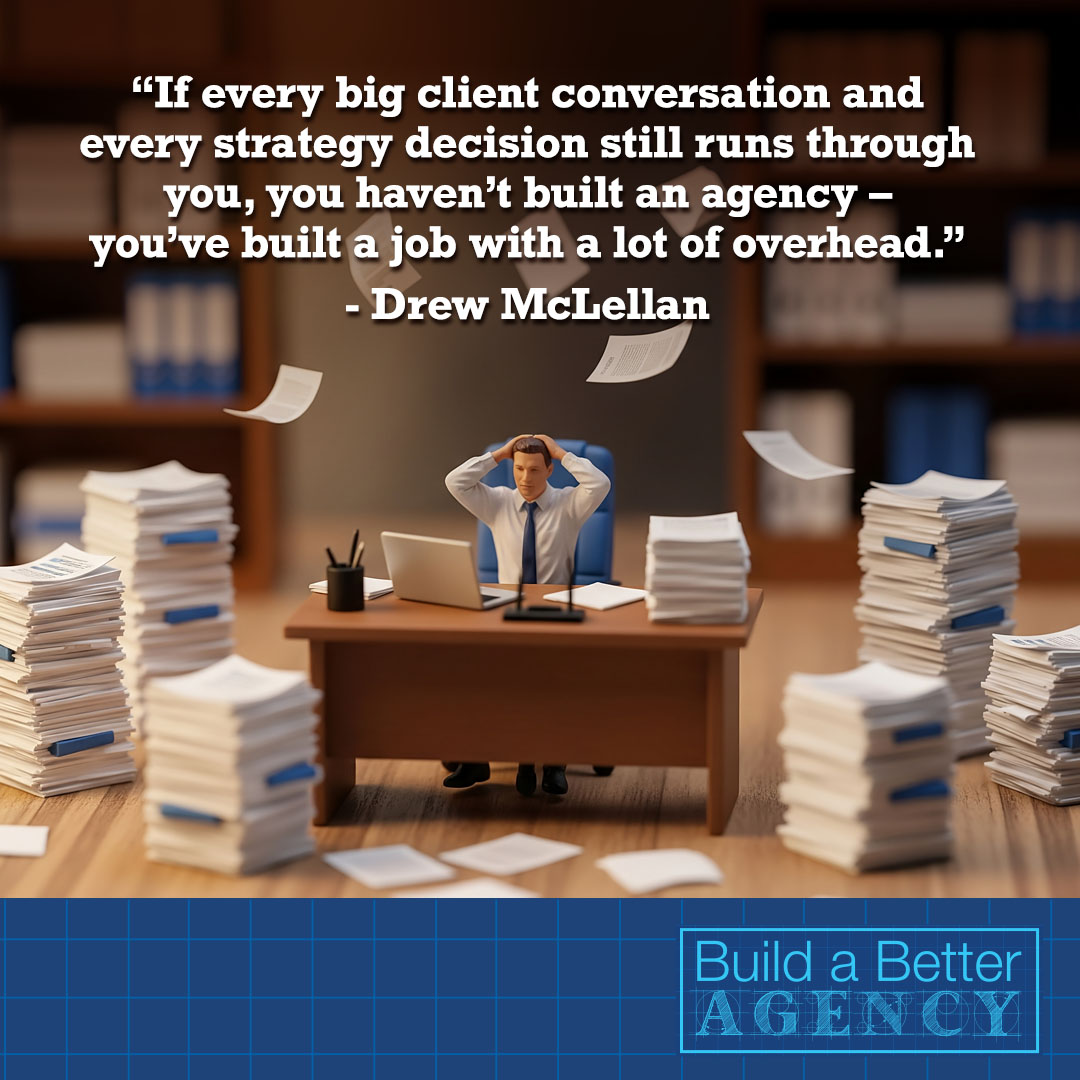
“If every big client conversation and every strategy decision still runs through you, you haven’t built an agency —you’ve built a job with a lot of overhead.” - Drew McLellan Share on X
Training isn’t a nice-to-have anymore. Drew McLellan reveals how teaching new skills helps keep clients happy and employees around. Share on X
Agencies with robust training see up to a 370% return on investment. Drew McLellan breaks down where most leaders go wrong—and how to avoid falling behind. Share on X
Drew McLellan argues that the true threat to agencies isn’t AI or clients—it’s ignoring the development needs of your team. Find out what you should do, starting today. Share on X
The war for talent isn’t coming—it’s here, and Drew McLellan explains how ongoing learning is the only way agencies will stay relevant. Share on X
Ways to contact Drew:
- Email: [email protected]
- LinkedIn: www.linkedin.com/in/drewmclellan
- Website: https://agencymanagementinstitute.com/
Resources:
- BaBA Summit May 18-20, 2026: https://agencymanagementinstitute.com/babasummit/
- Book: Sell With Authority
- AMI Facebook Group: https://www.facebook.com/agencymanagementinstitute
- AMI Preferred Partners: https://agencymanagementinstitute.com/ami-preferred-partners/
- Agency Edge Research Series: https://agencymanagementinstitute.com/agency-tools/agency-edge-research-series/
- Upcoming workshops: https://agencymanagementinstitute.com/advertising-agency-training/workshop-calendar/
- Weekly Newsletter: https://agencymanagementinstitute.com/newsletter-sign-up-form/
- Agency Coaching and Consulting: https://agencymanagementinstitute.com/advertising-agency-consulting/agency-coaching-consulting/
Danyel McLellan [00:00:01]:
Running an agency can be a lonely proposition. But it doesn’t have to be. We can learn how to be better faster if we learn together. Welcome to Agency Management Institute’s Build a Better Agency podcast presented by White Label iq. Tune in every week for insights on how small to mid sized agencies are surviving and thriving in today’s market. With 25 plus years of experience as both an agency owner and agency consultant, please welcome, welcome your host, Drew McClellan.
Drew McLellan [00:00:37]:
Hey everybody, Drew McLellan here from Agency Management Institute, back again with another episode of Build a Better Agency. Super excited to be with you. Thanks for spending some time with me this week.
This is one of our solo cast episodes. So for those of you that are familiar, or maybe those of you that are new to the podcast, just a reminder that every fifth episode I don’t have a guest. It’s just you and me talking about something that I want to make sure you’re thinking about or something maybe I’ve been talking to a lot of agency owners about lately and I am guessing or wondering if it’s on your mind too. And this week’s episode is no exception to that rule. So we’re going to have a good conversation and I’m excited to kind of dig into what I think is going to be one of the most critical issues for 2026 for your agency.
But before we do that, a couple things. Number one, you know, one of the things that we do for every solo cast is that we give out a free workshop or seat to the Build a Better Agency summit. So here’s the way it works. Wherever you download podcasts, go and leave a rating and a review. So that might be Apple podcasts, it might be iheartradio, it might be Google, where it might be Spotify. Wherever you download this show, just leave a rating and review and then take a screenshot of that rating and review and email it to [email protected] or go to the contact us page of the website and you can send it through there as well. But the reason I ask you to do that is yes, we read every, every rating, every review we read and we are super grateful for them.
So thank you for that. But more importantly, most of your usernames are not ones that I can figure out who you are, what agency you work at, and I certainly can’t figure out how to get a hold of you. So I need that screenshot of your review tied to your email so I can put you in the drawing for a free workshop seat or A free ticket to the Build a Better Agency Summit. No obligation. Other than that, you just have to get to Denver, and then you are welcome to attend either that workshop or the conference on our dime. So that prize is a minimum of a couple grand. So it’s going to take you five minutes to leave a rating or a review. Seems like a small price to pay for maybe winning a $2,000 prize. And as you might imagine, it’s not like the entire world is leaving us rating our reviews and sending them to us. So your odds of winning are good. Your name stays in the drawing until you win. So sooner or later, I’m going to guess you’re going to win. So don’t dilly nor dally. Just go leave a rating and review. Take a screenshot and send it to me.
So Josh Linman from Common Good Creative did that back in 2025. And Josh, congratulations. Your name got drawn. So I’m going to shoot you an email with some instructions on how to take advantage of your free workshop or summit seat. And we are looking forward to seeing you in Denver soon. So congratulations, Josh. That was easy. Josh just spent five minutes on it, so why don’t you do that, too so that you can win a free ticket and you can come join us for some learning and some fun. Okay. All right.
The other thing I want to do before I dig into the topic today is, of course, I want to thank our friends at White Label iq. They are the presenting sponsor of this podcast, and without their support, it would be very hard for us to do this every week. So we. We are very, very grateful that they believe in what we’re doing. They believe in educating agency owners and leaders, and they believe in the AMI way.
So one of the things that I really like about them is their dedication to an ongoing relationship that they are not. They’re just not a transactional kind of business. And so they don’t treat their partnerships or their client relationships as quick hits or just transactions when they work with an agency, because that’s all they do is they support agencies with design, dev and paid media. Every client of theirs gets a dedicated account manager and a dedicated project manager. And that’s not because they think you need to be babysat, but they know how busy you are. Why? Because they were born out of an agency. So they get it. It’s because they know that the more collaboration and the more support they give you, that that’s an investment that they need to make in the relationship and that they want to make sure they deliver your project on time and on budget, and they believe those two roles are critical to doing that. So they want to know how you want to work, and then they’re going to come alongside you and figure out how to do that, and you’re going to really enjoy their people and those interactions. It’s not really about just good business.
It’s also just about being a good human being and treating people the way they want to be treated. And, and they believe in sort of that platinum rule of showing up the way you need them to show up. And I’ve seen for years and years and years, I’ve seen them really live that out. So if you want to learn more about them, head over to white labeliq.com ami if you’ve never worked with them before, they’ve got some free hours for you off your first project. So go check that out.
Okay, let’s talk about the topic at hand today. And I’ve been having a lot of conversations with agency owners about this. And this, this is one of the reasons why I want to talk about this. I’m also in our live peer groups. I put together a trend deck that we walk through all the trends that are impacting agencies. And if you’re a regular listener, you know that I walk through those trends for you in the summer of every year after the live peer groups have already consumed that content. And one of the big trends that I’m seeing is all around employees and professional development.
And, and I think professional development for many agencies is a nice to have, not a must have. And I’m going to tell you, I think that is a huge attitude shift and a huge potential mistake you’re making as we go into 2026. I don’t believe your agency can afford to wait to educate their people.
So here’s the thing, and I really want you to hear me on this. Over the next three to five years, I think most of you are worried that your agencies are going to get crushed by AI or agency consolidation or fickle clients. I don’t think that’s actually what’s going to give agencies a run for their money. I believe agencies are going to get quietly squeezed by the people, trends that we’re not identifying and we’re not reacting to quickly enough. So that’s what this solo cast is all about. I want to talk about some trends around your people, particularly around professional development and what I think you need to be thinking about and doing today.
And I get it, you’re super busy. You’re firefighting, you’ve got Clients breathing down your neck, everybody’s asking for a raise, you’re worried about your margins. So the last thing you want me to tell you is that you have to spend more money, that you need to carve out budget and time for employee professional development. But let’s be really honest about what’s happening this year, 2026, and what I think is just going to escalate as the next couple years go on.
So there was a stat in the Edelman Trust barometer that I think should stop every agency owner in their tracks. More than 50% of employees believe that their employer is obligated, not encouraged, but obligated to provide both well paid positions and, and skills for the future. So in other words, yes, you’re going to pay me well for what I do, but it is your job, employer, to help me stay skilled for the future.
Now, we can have a big discussion all day long about how professional development is a shared responsibility, which I firmly believe, and we preach all the time to your employees. But the reality is that the way employees are thinking about it is it’s not a perk in their mind, it’s a moral obligation. Bottom line, your employees don’t see their job as just exchanging hours for dollars anymore. They see it as exchanging hours for dollars plus a future. And if you are not willing to provide them the preparation they need for that future, they are already thinking about their exit. This isn’t about entitlement. It’s a survival instinct.
In a world where 70% of workplace skills will change by 2030, that’s four years away. Where 39% of current worker skills will be reshaped or become outdated by 2030, and where AI is literally rewriting job descriptions in real time. Your people know that their shelf life depends on continuous learning. Should they be investing in it? Absolutely. Should you be encouraging them to invest in it for themselves? Absolutely. But it from their perspective, if you, the employer is not helping them stay relevant, someone else will.
And here’s what the Data tells us. 94% of employees would stay at a company longer if that company invested in their career development. It’s not 54%. It’s not 64%. That is 94%. Think about what that means for your agency. The people you’re most worried about losing. The ones who are better than average, the one who have lots of options, the ones who are getting job offers on LinkedIn every day, they’re making their stay or go decision in some ways based on whether or not you are investing in their growth.
You Know for the reality is in most small to mid sized agencies, your team is the business model. The people that you have, whether they’re full time people, part time people, contractors you use every day, occasional contractors, that is the business model. Those are the people that shape your clients business outcomes and the shape the way people think about your business. Every trend that I’m watching right now when it comes to employees is either strengthening that model, that business model we have of our employees, or it erodes it. So some of the trends are who can you attract and who can you afford. Whether your best people will stay or bail, how effectively can you as an agency leverage AI without burning people out? And ultimately whether you as the owner are finally able to get out of the day to day work and let the company work on your behalf without you having to be in the fray of it all day, every day.
You can have the best positioning, the tightest financials, the most impressive client roster. But if you can’t build and keep a team that evolves as fast as the market does, you’re done. And yet, when I look at most agency budgets, professional development is either non existent or, or it’s one of the first things that we cut when revenues dip. Now that is a fear based decision. And fear based decisions kill agencies.
Really the ROI of professional development is don’t think about it as the cost, think about it as the insurance. So I want to get into in this solo cast, I want to talk a little bit more about how we do professional development. But let’s be brutally clear on why. With some real data points, every dollar invested in professional development returns anywhere from $2.84 to $4.70 depending on what study you look at. That’s 184% to a 370% ROI. Companies investing in employee training see an 11 to 21% increase in profitability. And organizations with comprehensive retention strategies achieve 87% higher employee retention rates and 67% lower recruitment costs. Those are real numbers and real dollars tied to those numbers. That’s what professional development does for your people. It makes the hard work of staying relevant, valuable and employable a little easier. And when you do that, they value that. They don’t just stay, they bring their hosts, their whole selves to work. That’s a huge advantage to us as small businesses.
And here’s where it gets really interesting. As all of you know how expensive it is to replace an employee, but the cost of replacing an employee on average is half to twice their annual salary. So let’s say you’ve got a $60,000 employee that’s anywhere from 30 grand to $120,000 in replacement costs. When you factor in recruitment, lost productivity during the vacancy, all of the time that you’re onboarding them, when they’re not really fully deployable, what it does to your team when they’re carrying the weight, when somebody is gone and you haven’t replaced them yet, that tribal knowledge loss that happens when someone walks out the door, and what it does to the client relationships. So do the math. If you’re running a $2 million agency and you lose, let’s say two mid level people a year in one single year because you didn’t invest in their development, you just ate anywhere from $60,000 to $240,000 in replacement costs, that’s 3 to 12% of your revenue gone. When you think about it that way, spending 3 to 5% of your revenue on development isn’t a cost really, like insurance against a much larger expense. It’s the difference between running a 12% margin agency that constantly churns people and a 20% margin agency that builds bench strength and doesn’t rely so much on you to do all the heavy lifting.
And here’s another angle Most agency owners miss.65% of companies globally have lost their chosen applicants due to delayed hiring processes. We’ve talked in this podcast before about how quickly you need to move through the hiring process. But when you’re investing in your internal current team now, you don’t have to hire as often. So even if you don’t have your hiring act together, the good news is you’re promoting from within. You’re developing leaders internally and you’re moving faster on behalf of clients, on behalf of the agency because you’re not constantly backfilling positions.
Organizations that prioritize professional development and skill development programs see a over a 5% over 5 times. So it’s I think the number is 5.1 times higher retention impact. That’s not incremental for most agencies. That is transformational. We know that the more consistent our team stays, especially when we can keep those rock stars and superstars. Clients are happy. Clients breathe deeper because they know the team, they know they’re reliable, they know they’ve been around. You can breathe a little easier because you know the team is consistent and has worked together for a while. So it matters to you, it matters to your clients, and it matters to the team.
So I know at this point, me rattling all these numbers and you’re like, totally get it. But I’ve been burned so many times. I’ve trained someone, I’ve sent them to a conference, I’ve invested in them, and then they leave. I hear this objection constantly, Drew, what happens when we train them and they leave? And of course you guys have all heard that old sort of, yeah. What’s worse is when you don’t train them and they stay, right? So now I’ve got a mediocre employee that’s not growing. I have helped many of you wrestle down this issue of I’ve got an employee. They’re super loyal, but they haven’t grown in years and years, not on their own. And frankly, I haven’t forced them to grow, I haven’t encouraged them to grow. I haven’t sent them to training, I haven’t told them, as part of their job requirement, to grow. And now what I have is a stale employee. I don’t know what to do about it.
So think about that for a second. Incompetent, resentful employees who feel stuck and undervalued cost way more than turnover. They impact team morale. You’ve all had employees where your best employees are frustrated that they’re carrying the weight of somebody who has not improved their skills or sharpen their own saw in many years. They deliver mediocre work, they create client problems, and they whisper toxicity into your culture until your best people, the ones that have options, the ones that you are hoping stay a long time, they decide to leave to. It’s really a rampant problem in small agencies.
And when I say small, by the way, I’m talking 300 people or less. So that’s you, right? The data shows us that trained employees are more likely to stay, not less, especially when the training is paired with clear career paths. So those of you that are members, you know that we have created it’s almost 40 job descriptions baked in with career paths. So you can sit down with every employee you have and talk to them about their future, about where they could take their career, and also the skills, both soft and hard, that they need to develop to keep advancing. Remember, 94% of employees would said they would stay at a company longer if it invested in their career development. So critical. 83% of HR managers actively use learning and development programs, if they have one, as a retention tool. The ones that you lose after you train them.
You know what? This is the reality. Some people, not everybody is going to be a lifer in your agency. And honestly, you don’t want everybody to be a lifer. You are going to have some People who take the training and sooner or later leave. That’s the cost of doing business with talented people. But those people become your alumni network, your referral sources, and sometimes your boomerang hires. The ones who stay become your leadership bench the people who can run your agency so that you don’t have to always be in the weeds.
When you invest in someone’s growth, you’re telling them that they matter. You’re saying that their future matters, that you are invested in their future. And that creates loyalty that money alone, that salary alone cannot buy. You know, the truth of the matter is that there’s a talent war happening right now. And we have always been on the side of that equation where we struggle a little bit. We don’t pay as well as clients, we have weirder hours than clients do sometimes. We don’t have our HR ducks in a row in terms of career pathing the way clients or other, other entities do.
So let’s talk about what’s happening.
The war for talent isn’t coming. It’s here. And actually for most of us, it’s been here for a while. And if you think you can win it with, you know, ping pong tables and free snacks, I hate to tell you, but you’re bringing a knife to a gunfight. One in ten job postings in advanced economies now require at least one new skill. Professional, technical and managerial roles are seeing the most demand for new skills, particularly in it, which accounts for more than half of this demand. Healthcare is seeing a surge and even in our world, advertising and marketing, we’re seeing increased demands around expertise in social media, AI tools and data analytics. Business acumen. These are things that back when I was in school for advertising, we didn’t talk about that stuff. But today they’re table stakes.
So now think about from a talent perspective. Your competitors, other agencies, the consultancies, the in house teams, they are all investing in training their people right now. They’re building AI fluency, they’re teaching data literacy, they’re developing strategic thinking skills. And when your best people look around and realize that they’re falling behind, they’re going to leave for places that invest in keeping them current. That’s our competition right now for employees.
So here’s what high retention organizations look like. They maintain 91% retention rates for high performers. They have 87% internal promotion rates for leadership roles. In other words, they are constantly grooming their people for a future that gives them growth and opportunity. And their employees are satisfied. They’re hitting about an 8 out of 10 on employee engagement scores. Their voluntary turnover rate is under 11%. Those are not lucky agencies. Those are agencies that have made professional development a strategic priority, not an afterthought.
You know, we’re hearing in the news constantly how basically we’re all going to be replaced by AI. I don’t actually think that’s the case. I don’t think AI is about replacing people, but it is exposing the underprepared. So AI fluency isn’t a nice to have anymore. It’s table stakes. We are, we saw that in 2025. Agencies that did not wrap their arms around AI are falling further and further behind.
Your competitors are training their teams on prompt engineering, AI tool evaluation, ethical AI use, and how to identify AI generated errors. If your people aren’t fluent, then again you are coming into that fight underprepared.
But here’s the trap. Most agencies are letting employees use AI tools in the shadows, without governance, without standards, without expectations, without training both on when to use and when not to use AI. So for many of you, that’s not innovation, that’s a liability.
Our good friend IP attorney Sharon Toerek will tell you that we have to have AI policies, both internal policies and policies that our client facing. But we have to understand that this is a whole new learning curve for us as agencies and we have to do it together. Recent research shows that 93% of people actively use generative AI, but primarily for text based tasks. But honestly, overall awareness and conceptual understanding, pretty uneven.
Still, there’s opportunity still for you to rise up and for you to be one of the leaders in this. And you saw from our 2025 agency EDGE Research that clients desperately want us to, to be their Sherpa, guiding them in the world of AI and how they can embrace it. So we have to understand that this is an area where we have to educate ourselves and our teams.
The agencies winning right now are the ones that are teaching their people how to use AI as a force multiplier, not a replacement. They’re investing time in AI literacy, governance training for every employee. They’re teaching data literacy so that their teams can read analytics dashboards, understand key marketing metrics and tell the data stories. That’s one of the biggest places where we have the opportunity to be above and beyond what our clients are hoping for and be somebody that is irreplaceable to those clients.
But they are also teaching business acumen so account managers can speak the language of ROI and connect marketing to business outcomes. This is not just teaching AI for AI sake. It’s really about just recognizing that it’s another set of tools. All of these skills I’m talking about don’t just make your team better at their current jobs. They make your agency more valuable to clients, which means you can charge more, win bigger accounts and build better and longer relationships.
And for your employees, finding or keeping a job will be increasingly depend on their ability to update skills or learn new ones. If you want them to not go looking for a job, let that happen inside your shop. You know, we’re going to, we’re already seeing educational systems be kind of redesigned and rethought for this AI driven economy that we are just in the, in the sort of opening throws to today’s Students today are going to have to have a whole new set of cognitive, creative and technical skills that complement and leverage AI and help them use it rather than compete against it. So if the entire education system is scrambling to figure this out, you can bet that your employers are worried about it and you can bet that we need to be worried about it too.
The good news is we can be the answer to that worry. One of the other things that AI is doing is it is changing the way clients look at agencies. And this is a trend that I’ve been talking about for a couple years, way before everyone was talking about ChatGPT or had an account. But it’s just escalating that clients don’t want account managers anymore, they want strategic advisors. They now know that we have tools that will do many of the sort of data crunching, many of the tasks that we used to have account people do. So they don’t want order takers who execute their ideas. They really want business partners who will challenge their thinking, bring market intelligence and drive measurable outcomes. Problem is many agency people were not trained for that. They were trained to be responsive.
Just did employee or a client satisfaction survey for a client. And one of the things that the clients were talking about was these guys are so great, they’re so responsive and responsive and we love that. But it’s not enough. We need them to teach us their business and our business in a way that from as an outsider they can teach us that we can’t learn as an insider. We don’t want people who are just responsive, accommodating are tactically excellent. That’s not enough.
So now we agency people, we have to transform our account people from doers to advisors. And that’s going to take a whole level of professional development. You need to invest in consultative selling techniques, strategic planning frameworks negotiation and conflict resolution, project profitability management. That’s not the stuff people pick up by osmosis. And it requires structured development and training. Same goes for your creative team performance, creative optimization, AI assisted ideation, brand strategy development. Those are not just nice skills to have. They’re the difference between being seen as a commodity vendor and being seen as indispensable. And I think one of your goals for 2026 is for you to be indispensable to your clients that they cannot imagine doing what they do without you and figuring out what that means for every one of your clients and making sure that not only you can deliver it, but you’re sure they know you can deliver it. So this is not just on us for sure, but it is critical to our business.
So the World Economic Forum did some research and it showed that social and emotional skills, advanced communication, empathy, adaptability, the ability to learn continuously, are among the most in demand skills for the future of work. Why?
Because we are going to be advisors, we are going to be leaning in and creating deeper relationships with clients, relationships that require trust and the ability to have hard conversations together. These are critical. And a lot of your younger people don’t know how to do those things. So your people need training and executive presence, difficult conversations, written communications for different audiences, active listening and cross functional collaboration. These aren’t just soft skills, they’re the skills that will determine whether clients see your team as implementers or again, indispensable partners.
You know, I’m sure by now you’re like, oh my God, do I have so much to do already? And now I have to do this. I’m responsible for helping everybody be able to be employable for the future. What you’re trying to do is you’re trying to build a business that is going to weather all of the changes that has been true of our business ever since we started the business. But all of the changes that are here and all the changes that are coming and one of the ways for us as agency people is our people have to be ready. We are a very people forward business. We don’t have a lot of equipment, we don’t have a lot of really a lot of sophisticated technology. We are the product of our people. And so this is why developing our people, upskilling our people, is so critical.
But there’s another side of that and it’s really another elephant in the room that we need to talk about and that’s burnout. Your people, I guarantee you, are tired. Not I need a vacation tired, but really Tired. Ever since COVID we have seen an uptick in mental health issues. People struggling with balancing their life and their work. Some of that we create inside our organizations with unclear expectations, struggling with clients wanting more for less, and the relentless pace of client work are grinding people down.
And so here’s what I’ve learned in many decades of doing this work. Burnout. Sometimes every once in a while, it’s an individual problem. Someone’s having a really tough time at home or with a family situation, but for the most part, it’s a systems problem. When people burn out, it’s usually because they don’t have the skills, the tools, or the support to do their jobs effectively. They feel like they’re constantly working harder, not smarter, because no one has taught them any other way.
Professional development actually addresses this. When you train people on things like time management, prioritization, emotional intelligence, how to have difficult conversations inside the organization, setting boundaries with clients, you’re not just making them better employees, you’re. You’re making their jobs more sustainable and you’re helping them have a more balanced life.
Flexibility isn’t about letting people work from home a couple days a week anymore. Everybody’s doing that. Flexibility is about giving your people the skills to manage their workload, advocate for themselves, and design work that fits their life instead of consuming their life. And we have all had employees where the work has just been all consuming to them, and we’ve watched what it does to them as human beings. And none of us want to be that employer.
Organizations with wellness programs or the organizations that are very thoughtful about teaching those softer skills see retention, improvement, and higher engagement. Wellness isn’t just, you know, having a masseuse come in every so often or letting people do yoga at lunchtime. It’s really about giving people the competence and confidence to do their jobs without sacrificing their mental health. That’s the kind of employer you want to be. I know that about you.
So let’s talk about all. So I’ve, I’ve hopefully I’ve made the case that we can’t afford not to invest in professional development. It is more expensive not to do it than it is to do it. That every employee that we want to keep for a long time is looking at us and expecting us to do it. So I want to talk in the back half of this solo cast about how to do it. But first, let’s take a quick break.
Are you tired of juggling multiple tools to manage your agency? Meet Deltech workbook the all in one solution for marketing and communications agencies. Streamline your projects, resources and finances all in one place. With real time dashboards and reporting, you’ll have full project visibility. You can plan team capacity weeks ahead to avoid bottlenecks and keep your budgets on track to maximize profitability. It’s perfect for both agencies and in house marketing teams looking to work more efficiently. PCI is a certified Deltec Partner offering expert implementation and support to ensure your success. If you’re ready to transform your operations, visit PCI US Podcast for a free consultation today. Hey everybody, thanks for listening today.
Before I get back to the interview, I just want to remind you that we are always offering some really amazing workshops and you can see the whole [email protected] on the navigation head to how we help. Scroll down and you’ll see workshops and you can see the whole list there with descriptions of each workshop. They are all in Denver and we’ve got them throughout the year for agency owners, account Execs, agency leaders, CFOs. We have a little something for everybody. No matter what it is that you’re struggling with. People, new business, money, all of those things we’ve got covered. So check them out and come join us. All right, let’s get back to the show.
All right, we are back and I wanted to spend some time talking about. Hopefully I have Whether it’s inspired or scared you into thinking that you really do need to think about professional development as an ongoing investment in your people, in your agency, frankly, in yourself.
Do not think that I’m just talking about employees here. We as business owners also need professional development, but what does it look like? I think a lot of people have great intentions, but I think a lot of agencies fail at professional development not because they don’t want to do it, but because they don’t have a system.
Sure, you can send someone to a conference when the budget allows or you buy a course license that nobody uses. You might talk about development in your performance reviews, but you never follow through. And the truth of the matter is that’s not development, that’s theater.
So here’s what actually works.
First, you have to commit a budget. So again, as I said earlier in the solo cast, typically 3 to 5% of your gross revenue allocated annually tracked quarterly. So for a $2 million agency, that’s going to be $60,000 to $100,000. For a $5 million agency, $150,000 to $250,000.
Another way to think about this is it’s about somewhere between $2,500 and $5,000 per employee every year. So now break that into, into some buckets.
So one bucket is structural external training, like courses, workshops, conferences. 30% would be for internal training, like internal workshops, lunch and learns, mentoring time.
So keep in mind when I’m talking about this budget, it’s not all hard dollars. Some of it is people time, your own time, leaders time. Right. So we’ve got 40% for external training, courses, conferences, workshops, things like that. 30% internal training, lunch and learns, mentorship, 20% for some of your employees around technology and platforms like AI, and maybe 10% for professional memberships where your people can hang out with people who do what they do, peer groups that match their job description, other learning tools like books or courses that they can do on their own.
So that’s the, that’s sort of the breakdown of the buckets.
The next thing you need to do. So I’ve got a budget and now I need a champion. So this is someone inside the organization who’s going to really own the development strategy, who manages the budget and who coordinates programs. One of the things that I find fascinating, I was just with an agency on site with them doing our Agency Advantage program and they were saying that they have a, they have a budget for professional development, but historically they only spend about 50% because their employees don’t raise their hand and take advantage of it.
You have to understand that this is going to be for some of your employees. As soon as they know that they can go to a conference or a workshop, they’re going to raise their hand and do it. But for a lot of your employees, they aren’t going to do that. They’re going to think it is just more work to be done or they’re going to think it’s inappropriate for them to ask for the budget, whatever it may be. So you need a champion who’s working with the leaders and the managers inside your agency to encourage your people to think about how they’re going to spend their professional development dollars and time, not if how oftentimes this person, whoever sort of is leading the charge, doesn’t have to be an HR person. It can be a senior team member who really just values growth and has good follow through. Right.
But you have to give them time to manage this program. So it can’t just be one more thing. You bolt onto somebody’s full time job. Next thing I want you to do is I want you to do a skills gap assessment. What skills do you as an agency need to have in House. What skills are you constantly hiring for out of house? That would be handy to have in house? What skills do your people currently have?
And by the way, look for skills that are outside their job description. Sometimes an account person’s a great photographer or an art director might be a great speech writer, or they have skills that are outside the realm of their job. But figuring out what skills people have and then identifying where are the gaps, where does no one have a skill? And what skills do our clients need us to have in the next 12 to 24 months? Be very honest with yourself. Be very specific.
Now you can build a learning calendar. So map out maybe it’s quarterly themes, scheduling, monthly lunch and learns, blocking conference and external training windows, protecting learning time on the calendars. If development time is not on your people’s calendar, it will not happen. This remember I said earlier, professional development is a shared responsibility. Sometimes it should be on our time and our dime. Sometimes it should be on their time and their dime. And that’s the really one of the ways that you tell somebody who sees their job as a career versus a job if they just do it when it’s on your time and your dime. That’s pretty telling. You want employees and you want to find those people, encourage and nurture those people who are also learning and developing on their own. But you do have to give them time to in their day, in their workday, to keep learning and not only learn alone, but learn in groups, small groups again, lunch and learns, department meetings, bringing outside speakers in. Whatever it is, you’ve got to make sure that they know that it is important enough to you that you’re willing to carve out time to do it.
Then you’ve got to make all of this visible. So you want to share the budget and what it funds. You want to celebrate when somebody earns a certification or completes a workshop, you want them to do some sort of lunch and learn where they’re sharing their knowledge. Featuring learning wins in your team meetings. Make development part of your employer brand. When prospective hires ask what’s your development program? Or how do you grow team members? You want to have a real answer. And the more that you develop this program and the more that you invest in it and the more that you actually make it sort of a system and a process rather than a nice to have or when somebody has time to think about it, the more it’s going to be ingrained in the culture.
And then I want you to build it into performance reviews. So you know that we advocate for one on one meetings with direct reports every other week. So every two weeks I’m meeting with my boss and every quarter together my boss and I are setting a quarterly growth goal and we did a whole podcast on this. So. So now that means every employee has four growth goals for the year, right? So you want to be measuring that and how I am able to participate in bonus programs and other things should be tied to did I accomplish all four of my quarterly growth goals to be part of those performance reviews.
Every employee should have a development plan. Track it, celebrate it, tie it to advancement criteria, tie it to compensation criteria, and by the way, help your managers do a good job of this by making sure that they’re held accountable for how their whole team develops, not just what their department delivers. So it’s also about how are they growing their people.
High performing organizations that measure development, professional development. I see that 76% of retention investments show a positive ROI in 12 months. Every dollar you spend on making your people better and smarter and more skilled will give you remember, two to four dollars back. Organizations with a more comprehensive program achieve more than four and a half million dollars in annual retention program roi. So this is for us, a huge investment in our agency and a huge way to fortify our agency so that it’s stronger and better.
There are four skill areas that every single person on your team needs, regardless of role in today’s world. AI literacy and governance. How to use AI, when not to use AI. That is mandatory learning for everybody in our world.
Even though many of us got into the business to avoid doing math, by now you know that that is unavoidable. So data literacy, being able to read analytics, understanding marketing metrics, understanding basic data, storytelling, all of those sort of things. Mission critical for everyone side the organization.
No surprise, business acumen is also critical. How do our clients make money? How do I read financial statements? How do I understand my clients, way they measure ROI and their KPIs. I have to understand the industries that we serve. So those industry specific business models and really understanding how to connect marketing to business outcomes.
And last but certainly not least, our communication skills that should probably be have been the first one that I listed. So having a presence and being able to give presentations, being able to delve into difficult conversations, give good feedback, being a good writer in all the different ways we communicate today, being a great listener, asking better questions, all of those skills are things that can and should be taught.
These are not nice to haves. These are baseline competencies that separate strategic agencies from tactical vendors and I’m telling you, as I watch the finances of agencies, the more tactical the agency is, the more they are struggling to get anywhere near double digit profitability. And I don’t think that’s going to get any better.
Beyond these foundational skills, obviously you need role specific development. So you know that for every role you’ve got in your agency, there are certain skill sets that are tied to their job. Make sure that you are investing in not only the sort of tangible learning, but also those skill sets, those soft skills, particularly for your managers and high potentials. Investing in people, management fundamentals, performance management and coaching, strategic thinking, change management, which is a huge thing right now for all of us, helping them elevate their emotional intelligence, all of that mission critical for you and your agency.
But there’s one thing that I want you to understand, that if you don’t do, you can do everything else I’ve said so far in this solo cast, but if you don’t do what I’m about to talk about, it’s going to fall flat.
If you’re always the smartest person in the room, on every client call, in every conference room, you have to be the one that reviews every strategy document. If you are still the safety net for every tough client conversation, you haven’t really built an agency. You’ve built a job with a lot of overhead.
Professional development is how you build bench strength. It’s how you create a leadership team that can think strategically, make decisions independently, and represent the agency without you in the room. It’s also how your agency gets better.
But here’s the catch. You have to model it. If you’re not investing in your own development, if you’re not reading, if you’re not part of a peer group, if you’re not learning, if you’re not listening to podcasts, if you’re not sharing what you learn, then your team’s not going to think it’s that important. They’re going to see development is something you preach, but you don’t practice.
One of the things that I had to learn as a business leader is that my behavior shapes my team’s reality. When I protect learning time and share what I’ve learned, they protect learning time and share what they learn. When I celebrate that someone went to a conference or earned a certificate, then they pursue conferences and certificates. When I admit what I don’t know and I go figure it out or I go find someone to teach me something, they do the same.
You cannot delegate a learning culture. You have to live it and it’s the only way you get out of being the bottleneck of your agency. So understand that.
Professional development, if you’re thinking, yep, I’ve got to, we do have to invest more in professional development. You need to look in the mirror first because it starts with you. You’ve heard me say this a million times. What we measure matters and you can’t manage what you don’t measure. So you’re going to want to track your professional development. You’re going to want to track participation metrics. How many of what percentage of our employees are completing their quarterly growth goals? How many hours of learning are my people investing a year? What’s showing up on their timesheets around professional development? Are we using the budget that we’ve set aside? How engaged are my people when we do internal lunch and learns? And am I hearing and seeing them use what they’ve learned in their business interactions with each other and with clients? How do I reflect the importance of professional development on the impact that it has on the business? How does it, how does it impact promotions? How does it impact our retention? How does it impact when we hire someone new, the time to competency? How does it impact client satisfaction scores?
All of those things should see an uptick when we have a great professional development program. Also thinking about the skill set so that, remember you were going to do that gap analysis. So how quickly am I closing some of those gaps? Am I removing them from the database because they’re no longer a gap?
And again, what’s the ROI of this? So what are the benefits? What am I, how am I doing on turnover? Costs increase revenue per employee, reduced errors and rework, faster project delivery, and higher client and employee retention.
You know, one of the things that I haven’t talked about a lot, and I’m not going to get too deep into it, but mentorship programs matter. One of the things that we hear from agency employees all the time is one, how much they admire you and wish they could be more like you. But also two, that they want more time with the leaders of their organization, whether it’s you, the agency owner, or it’s other leaders. Companies with mentorship programs report incredibly high retention. It’s over 91% higher retention. And when you have that and you’re promoting from within, it makes a huge difference.
Companies with recognition programs also higher retention. Companies with development programs retain 81 plus percent of their employees. So the data is clear. When you measure development and hold yourself accountable to the outcomes, you will see real results that impact the bottom line.
So I have been going on for a while, and I know you’re like, oh, my God, Drew, this sounds great, but we’re too busy to train right now. That’s the trap. You’re busy because you’re inefficient. You’re busy because there are gaps. You’re busy because clients want more, faster. But you’re inefficient and you’re slower. And your processes and systems have bloat in them because you haven’t invested in the capability of your team.
And believe me, this cycle will continue until you break it. Start small, but start now. One monthly lunch and learn. Having quarterly growth goals for every employee and making those growth goals small. Maybe you protect one afternoon a month for people to invest in their own professional development, whether that’s taking an online class or reading a book or learning in a small group. Build the momentum. Track participation and measure your impact. And then just keep iterating.
You cannot wait for perfect conditions. Don’t wait until your margins improve or until we have extra budget. The agencies hitting 20% margins aren’t the agencies who are investing after they got to 20%. They’re the agencies that invested to get there.
So again, the World Economic Forum’s Future of Jobs report, which I highly recommend you read, it made it really clear the labor market is experiencing profound transformation. This is not news to us. We know it’s being driven by technological advancements, the demographic shifts, some of the things that are going on in the environment, and a lot of economic uncertainty, job creation and displacement, skill disruption and strategic responses are happening right now. Reskilling and policy interventions are essential to fostering an equitable and sustainable workforce as we go into the next few years, as we march into the future, into 2030. If you wait, you’re not just falling behind, but you’re very quickly becoming irrelevant.
This is about survival. This is not about, like, professional development as a perk. It’s not a perk anymore. It’s something. It’s not something that you offer the gen zers or to look good on Glassdoor. It is a strategic imperative that determines whether or not your agency survives the next five years.
I really believe that we have to keep upskilling ourselves and our team. And the agencies that invest in development are building teams that can think, adapt, and lead. You’re creating a culture where people want to stay, want to keep growing, will invest in their own time and own dime to get better, and they want to contribute. The agencies that are behaving in this way are attracting the kind of talent that has options. And their option they’re choosing is to work with you, to build a career with you. That is the future that we’re all trying to create.
The agencies that don’t invest, they’re becoming training ground for competitors. They’re watching their best people leave for companies, whether it’s agencies or client side that take development more seriously. And pretty soon, those agencies get stuck in a cycle of mediocrity, inefficiency, and declining profit margins. You get to choose which agency you’re building.
I’m guessing you got into the business because you have a love of learning. You just have to infuse that inside your organization. We get better by learning with and from each other. That’s not just one of AMI’s core values. It is the competitive advantage of the next decade. I believe that for our organization, and I believe it for your agency, too. The agencies that build learning cultures will outperform, out, retain, and outlast everybody else.
Running an agency is not easy. We do hard things not because they’re easy, but because they’re necessary. Investing in your people is not easy. It requires budget, time, discipline, and faith that the ROI will come. But it is necessary, not just for their growth, but for yours and your agencies. Your team is the business model. Everything else is just detail.
So here’s my challenge to you. As I wrap this up, I want you to consider committing to three things.
Number one, create a learning and development budget again, 3 to 5% of your revenue, or what you can carve out and protect it like you protect payroll. Number two, appoint someone to be the learning and development champion and conduct that skills gap assessment. And number three, schedule your first quarterly or monthly luncheon learner development program and put it on every team member’s calendar.
That’s it. Just do those three things. Just start small. Don’t overcomplicate it. Don’t wait for consensus. Just start. Because here’s the truth. The agencies that make it through the next five years won’t be the ones with the best website or the coolest office space or the most Instagram followers. They’ll be the agencies that have invested in their people when it was tough, when they would gladly not spend the money on it, or the time when margins were tight, when they felt like it, felt like it was a luxury that they couldn’t afford because they were smart enough to know it’s an investment they can’t afford not to make. They’re the ones that will be led with love, taught and added value, met their people right where they are and got better faster by learning with and from each other. That is the formula for the future. Those agencies that are going to be around in five years are the ones who understand that accountability is everything.
Many of you struggle to bake accountability into your agency, and it is mission critical. Everyone needs to be accountable to continue to grow. And we have to be accountable to our people’s futures because it’s our future too. That’s the work. And it starts today. Not tomorrow, not next quarter. Not when things calm down, not when you have more money in the bank today.
Start small. Maybe you don’t spend any money at all. Maybe it’s all internal learning and internal sharing and internal mentorship. I don’t care. But to not invest in your people, whether it’s time, money, or both, and to not champion learning and growing means that your agency has a limited shelf life. The war for talent isn’t coming. It’s here. And the only question that matters is are you building an agency people want to join or an agency that people are already planning to leave? That’s your move, that’s your decision. And honestly, that’s your future. All right, go forth. Teach, Learn, share. I love all of those things. They’re mission critical to being good agency people, but they’ve never been more critical than they are today.
All right, so again, a huge shout out and thank you to our friends at White Label. Don’t forget to do the rating and review so that we can give you a free workshop or come to the conference. Speaking of learning and of course, thank you for hanging out with me. I know that you’re busy. I know you have a lot of different ways to learn and I am grateful that we get to learn together. All right, I’ll see you next week.
Danyel McLellan [00:58:37]:
That’s all for this episode of AMI’s Build a Better Agency podcast. Be sure to visit agencymanagementinstitute.com to learn more about our workshops, online courses and other ways we serve small to mid sized agencies. Don’t forget to subscribe today so you don’t miss an episode.