
Episode 575

Welcome to another insightful episode of Build a Better Agency! In this solo cast, Drew McLellan continues his deep dive into the complexities of agency partnerships, offering a practical framework for agency owners considering bringing on a business partner. Picking up from last month’s episode—which focused on self-reflection, motivations, and evaluating if partnership is truly the right answer—Drew McLellan now guides listeners through an essential step-by-step process for vetting and integrating a potential partner.
Listeners can expect an in-depth discussion of a multi-phase framework designed to slow down the excitement of new partnerships and ensure critical conversations happen before any agreements are signed. Drew McLellan walks through topics such as personal and professional alignment, candid money talks, and even how to “test drive” the partnership with real-world collaboration. He emphasizes the importance of understanding each other’s financial habits, stress behavior, and life goals to avoid costly, painful mistakes down the road.
The episode doesn’t shy away from hard truths. Drew McLellan details red flags and yellow flags that should prompt caution or even a stop to the process, underscoring the gravity of a decision that can shape both business and personal futures. Rather than offering a one-size-fits-all answer, the episode provides pathways for owners who decide partnership isn’t right, including alternatives like strong #2s, peer groups, and advisory boards.
Whether you’re already in talks with a prospective partner or just beginning to consider it, this episode equips you with actionable tools and a clear-eyed perspective for one of the most significant decisions you’ll make as an agency owner. By the end, you’ll have a practical roadmap, a better understanding of your own needs, and the confidence to chart the best path forward for your agency’s future success.
A big thank you to our podcast’s presenting sponsor, White Label IQ. They’re an amazing resource for agencies who want to outsource their design, dev, or PPC work at wholesale prices. Check out their special offer (10 free hours!) for podcast listeners here.
What You Will Learn in This Episode:
-
- The critical importance of slow, thorough due diligence before entering a partnership
- Essential alignment conversations about personal goals, financial expectations, and decision-making processes
- The need for candid, sometimes uncomfortable discussions about money, risk, and stress
- Testing potential partnerships through real work scenarios and stress situations
- Recognizing and acting on red and yellow flags during the evaluation process
- Alternatives to partnerships, such as a strong number 2, peer groups, or advisory boards
- The value of honest self-reflection in determining whether a partner is truly needed
Ways to contact Drew:
- Email: [email protected]
- LinkedIn: www.linkedin.com/in/drewmclellan
- Website: https://agencymanagementinstitute.com/
Resources:
- Part 1, “Do I Want a Partner?” solocast (Episode 570)
- Partner Fit Scorecard Part One
- Partner Fit Scorecard Part Two
- The One-Page Pre-Deal Checklist
- 25 Partner Evaluation Questions
- BaBA Summit May 24-26, 2027: https://agencymanagementinstitute.com/babasummit/
- Drew’s Book: Sell With Authority
- AMI Facebook Group: https://www.facebook.com/agencymanagementinstitute
- AMI Preferred Partners: https://agencymanagementinstitute.com/ami-preferred-partners/
- Agency Edge Research Series: https://agencymanagementinstitute.com/agency-tools/agency-edge-research-series/
- Upcoming workshops: https://agencymanagementinstitute.com/advertising-agency-training/workshop-calendar/
- Weekly Newsletter: https://agencymanagementinstitute.com/newsletter-sign-up-form/
- Agency Coaching and Consulting: https://agencymanagementinstitute.com/advertising-agency-consulting/agency-coaching-consulting/
Danyel McLellan:
It doesn’t matter what kind of agency you run— traditional, digital, media buying, web dev, PR, or brand— whatever your focus, you still need to run a profitable business. The Build a Better Agency podcast presented by White Label IQ will expose you to the best practices that drive growth, client and employee retention, and profitability. Bringing his 25+ years of experience as both an agency owner and agency consultant, please welcome your host, Drew McLellan.
Drew McLellan:
Hey everybody, Drew McLellan here from Agency Management Institute with another episode of Build a Better Agency. This is one of my solo casts, and it’s actually a part 2 of my solo cast from last month. So last month I walked through some self-reflection that you need to go through when you are deciding whether or not you want to take on a business partner. And we talked about the different ways you could do that, whether it’s elevating an employee to a minority shareholder, whether you’re merging 2 agencies or you’re letting somebody buy in from the outside, regardless of how they come into your world, it’s important that you figure out if you even want a partner, why you want a partner. Is that the right reason to have a partner? And how this all sort of works? Are they the right partner for you?
And so we spent, gosh, about an hour and a half together last month. Kind of walking through that. And I promised I would walk you through a process, a framework to really test your assumptions. So I’m gonna assume this month that you’ve decided you did do the self-evaluation, you did evaluate the partner, and you really think that this partnership is a good idea for you. So we’re gonna assume that you’ve done all that introspection and you have decided this is right.
And so if you haven’t done that, go back and listen to the last solo cast. So go back 5 episodes and listen to that solo cast first. Do not let this be the first solo cast where you’re thinking about a partner. Okay? I want you to go back and make sure you’ve done that due diligence before you do what we’re gonna talk about today, which is this process that we go through to really bring partners together to make sure that something is great.
Before I walk you through that framework, a couple pieces of housekeeping that I want to do. First, speaking of partners, I want to thank our good friends at White Label IQ. As you all know, if you’re a regular listener of this podcast, they’ve been the supporting sponsor of this podcast for a really long time. They’ve been alongside us with the podcast. They’ve been alongside us with the summit. They really do believe in agencies because They were born from an agency and they still are an agency. They’re just an agency that partners with other agencies to do anything technical. So they do white label web dev, they do AI automations, they will build apps for you or backends to a website, databases, integrations. They also do design and PPC for agencies.
So they’re working with agencies all over the world who either need an extra set of hands for a single project Maybe your web department is just slammed right now and you need a partner, or maybe you don’t have a web department at all, or you don’t have a technical, that technical skillset on your team and you need a march through the swamp with me partner that will help you delight a client and be profitable. And that is White Label IQ. So if you’re curious about them or you just wanna thank them for being a sponsor of the podcast, head over to whitelabeliq.com/ami and you can learn more about them. They have a special deal there for you. and you can reach out to them and connect.
Okay.
Also, before we get going on every solo cast, we give away a free seat to either a workshop or the Build a Better Agency Summit. And here’s all you have to do to be in the drawing. You go to wherever you download this podcast and you leave a rating and a review. Then you take a screenshot of that rating and review and you send it to me at [email protected].
Why do I need you to do that? Because even though we read every rating and review and we are super grateful for them, in most cases you have some sort of a username that I can’t— I can’t interpret your real name from that username, and I sure as heck can’t get your email address from it. So the only way for you to be in the drawing is for you to take that screenshot, email it to me, and then you go in the drawing.
The cool thing is you stay in the drawing until you win. So sooner or later, for 5 minutes of activity, you’re going to win a $2,000+ free ticket to either one of our workshops or the Build a Better Agency Summit. Seems like a great deal to me. 5 minutes for 2 grand. I would do that all day long. So go ahead and do that. Send me your screenshot and then we’ll throw you in the drawing and you stay there till you win.
This month’s winner is Jeremy Hoders. It might be Hoders, H-O-D-E-R-S. So Jeremy, I’m gonna send you an email. Congratulations. You are welcome to join us. at either a workshop or the Build a Better Agency Summit in May. So watch for that email, but thank you for being a great listener. Thanks for the kind review, and we look forward to meeting you in person.
All right. Okay. So let’s get to the topic of today’s solo cast.
So Danielle and I do a ton of M&A work. We are helping agencies buy and sell each other. We are often helping agencies elevate an employee to either a minority owner or in some cases to buy out the owner. So we spend a lot of time in this space.
And one of the things that happens that we know is that you often get super excited about this and you want to go, go, go, go, go, and you don’t actually do the due diligence. So that’s why I did this 2-part podcast, because in last month’s, I really wanted you to be introspective and think about whether or not you really want to partner Or if there’s some other itch you’re trying to scratch and the partner just seems like the right solution, but maybe it’s not.
And in this podcast, I want to walk you through a process that slows you down, right? Because a lot of times people decide to be partners, they have a couple dinners and then, and they get along great. And so then they sign something.
And I will tell you, we have also, Danielle and I have also helped dissolve a lot of partnerships. And man, that’s painful. It is painful financially. It is painful emotionally. It is hard on the team. It’s hard on the clients. And so the best way to avoid that pain is to do it right in the first place.
All right. So I’m gonna assume you’ve gone through, and by the way, there are downloads, there are tools that we built for you tied to the last podcast to, again, not just listen to the podcast, but really walk yourself through that valuation. So I’m gonna assume that you’ve gone through what we called the gate and what we called the mirror and that you still want this partnership.
So now what do we do to evaluate the partnership and to slow roll that partnership? So this framework is 90 days minimum, ideally 180 days if you can go that slow. And the first few months are free. There’s nothing signed, there’s nothing announced. If you can’t get through a couple months without telling the team, that urgency is information. And what that information says is, Maybe I’m rushing this for the wrong reasons.
All right, so phase 1, so weeks 1 through 3, is really about alignment. There are alignment conversations and they’re in this order. A lot of agency owners get this order backwards. They talk about the deal first because it feels concrete. I want you to do that last.
First, what I want you to talk about is the future, not the company’s, but yours. What do you each want in your life? What do you want in the next 3 years, 5 years, 7 years? What does that look like? How many hours do you wanna work? How much do you wanna travel? How much money do you wanna make? What role do you wanna be playing in the agency? I don’t want you to talk about agency strategy at all. I want you to talk about what you as a human being want your life to look like in 3 years, 5 years, and 7 years.
Why? Because a partnership is a lifelong commitment. It is like adopting a puppy. You’re gonna have that puppy for a really long time. So you need to think about how that puppy fits into your world, and you need to think about how this partnership fits into your world. So no agency strategy allowed, just about you.
Then I want you to talk about what is enough. So enough is a broad term that I want you to think about it in several ways. So How much money is enough?
I can remember when I started my agency, I started it with a partner and we sat down and we both looked at what our mortgages were and we were kids, what our mortgage cost and what our other costs were. And we knew that we had to, if I remember right, we each had to take home $1,500 a month. That was like our bare minimum. We could, we could eat and live on $1,500 a month.
So I want you to do the same thing. Odds are yours is not $1,500, but I want you to talk about what is enough money. What can I survive on?
And one of the things you wanna look for is if your number’s $1,500 and your potential partner’s is $15,000, that is very important information to you because how you each run your life and how you each burden the agency with running your life is gonna be very important down the road. When things are great, doesn’t really matter. But when things are not great, when things are tight and you’re both saying, look, I gotta get a minimum outta the business every month I had to survive. If you are living very conservatively and they’re living high on the hog, you want to understand that right now because you want to make sure that they have enough reserves.
Having a business partner is as intimate as having a marital partner. You have to understand everything about them because all of a sudden you are in lockstep and you’re making decisions together. And if that partner comes to you and says, hey, look, I got to take 10 grand out of the business for whatever reason, You need to know how often that’s gonna happen.
So what is enough? What, how much income is enough? How big do I want the agency to be? What is enough in terms of number of people, in terms of AGI, in terms of profitability? What’s enough? What’s acceptable to both of you?
Would you sell it for the right offer? How much is the right offer? What’s enough on the table that would make both of you walk away?
And then third, what I want you to talk about is how do we decide? How do we decide everything?
Eventually, this is all gonna go into an operating agreement, which by the way, for a partnership is probably the most important document you are ever gonna have. Yeah, you’re gonna have a purchase agreement. Maybe there’s a loan document, but the operating agreement, that is the business equivalent of a prenuptial. It assumes every horrible thing that could happen to your business. And it defines while you’re still loving each other, while you’re still on your honeymoon, And how you’re gonna decide those things, how you’re gonna resolve those things.
And it is— Danielle and I have walked a lot of agency owners through this, and it really is in some ways an uncomfortable conversation because you’re saying things like, how do we decide what happens to the business if one of us gets injured in an accident and can’t talk anymore or can’t walk anymore or is in rehab for 6 months or a year? Or what, what do we do when, what, what happens to the business if one of us gets a DUI or accused of a crime, or one of our employees says that they were sexually harassed by one of the partners? These are things that you hope never happen, but you have to decide now, how do we make decisions when everything happens?
And so it’s everything down to a client is a jerk. or a client is unprofitable, like the easy decisions, all the way down to the really hard personal decisions.
What do we do if one of us gets divorced? Does all of a sudden, if you and I are business partners and you get divorced, all of a sudden does your wife or your husband become my business partner? How do we prevent that?
You have a million things to decide and you need to decide them before you go into partnership. And how you decide What those conversations look like, how they feel, should be a clear indicator to you whether or not this partnership is going to work.
If you can’t have those kind of candid conversations, it’s sort of the equivalent of— I can remember giving our daughters advice about when they were ready to be intimate with a partner. And my advice always was like, if you can’t talk about it with that person, Then you’re not ready to do it. You, you need to be able to talk about it first. And this is the same thing. If you can’t have these hard conversations with a partner, you’re not ready to be their partner.
So part of the deciding is what things do you each get to decide by yourselves? What things need to have both of you agree? And what do you do when you can’t agree? What’s the tiebreaker?
So even if the partnership is going to be off balance, one of you is— Right. 70% and one of you is 30%. If you’re the minority partner, you want to know that your voice still matters. You don’t want the majority partner just to always be able to, you know, say, well, my vote counts more, so therefore I win. You’ve got to have all of this worked out in advance because sooner or later, I don’t care who they are or how great they are, you are not going to agree on everything. And so you need to be able to resolve that question. You need a tiebreaker.
And then fourth, a fourth thing you need to talk about is you need to talk about the money. How much money do we want to leave in the business? How much retained earnings do we want to have? At what point do we trigger bonuses for ourselves or our team members? How do we fund the business when the business is upside down and it needs an infusion of cash? Do we each keep a certain amount of money outside of the business so that we can contribute loan into the business what it needs?
These are big, big conversations and you need You need to have them first. And if you can’t get through this set of conversations, stop, hard stop, because it means that you’re not ready to take on a partner.
All right. So let’s say you’ve had all those conversations, you’ve resolved all of those issues. Now you’re gonna move to phase 2 of the framework. And phase 2 of the framework ideally is gonna last from 2 weeks to ideally 8 weeks.
And you’re gonna try it by doing real work. You can’t really evaluate whether or not somebody’s gonna be a great partner just in conversations over cocktails. You need to be in the trenches together. You need to face good times and bad times. And typically in a 2-month period, so 8-week period, you’re gonna have a little bit of both, right?
You’re gonna have some challenges with employees. You’re gonna have some challenges with clients. You might have a new business opportunity. So you’re gonna really have some time to work together.
Now, this is different if the person is already inside your organization, right? So if they’re already an employee, you’ve already probably worked together, but now you have to work together in a way that they, the employee, get to help make a decision, which you may not have always done before.
And if they’re an outsider, then you wanna bring them in. Right? And you wanna start working together. You wanna start doing things. You need a shared history that in some cases you don’t already have. So you need to manufacture some.
And here’s what I want you to do. 3 assignments.
First, I want you to give them a mess, an unprofitable account, a broken process, an underperforming team member, not to fix, but to diagnose and propose. Do they gather facts or opinions? Do they blame people or the system? Do they bring a plan or do they bring complaints or concerns? That’s number one. So you want to see how they look at a mess and how they evaluate that mess and how they bring a solution to that mess.
Number 2, what I want you to do is I want you to ask them to deliver bad news to a client with you in the room. Now, again, if they’re an outside buyer, if it’s This is easy if they’re an employee. This is easy if they’re a partner agency that you’re doing work together and you’re thinking about merging. This is harder if they are just a third party who wants to buy into your agency. So you’re going to have to— you’re going to have to figure out how to do this, but you want to hear how they deliver bad news.
Watch whether or not they take responsibility on behalf of the agency, or do they quietly distance themselves? Whether they over-apologize or they give away money to resolve the discomfort, you wanna watch how they handle a client who is unhappy or a situation that is about to make a client unhappy.
Why? Because you’re gonna be doing a lot of that in the course of your partnership, and you wanna know how they show up. And if they don’t show up the way you show up, the two of you need to have a conversation about what is The agency’s policy of how we handle these situations, and how do we make sure that we’re on the same page before one or both of us go into that client meeting?
All right, then the next thing I want you to do is I want you to ask them to envision a future for your agency, to think down the road two years or three years. What is something that your agency should be exploring or chasing or developing?
And here, the end answer isn’t. Isn’t really the critical part of this exercise. The answer is how they got there. Did they do some homework? Did they interview other agency owners? Did they reach out to other people?
What evidence do they give you when they say, this is what we should do, this is a direction we should go? You wanna understand their thinking process because you’re gonna be doing a lot of this long-term planning together, and you wanna understand how they do it, not necessarily where they end up. That’s important, but not as important. You wanna understand how they got there.
All right. So the next phase, so this would be ideally on the short end, weeks 4 through 5, and ideally weeks like around 10 weeks, you’re gonna have money conversations.
So here’s the script, if you will. Hey, before we talk about price, I wanna talk about money because I’ve watched partnerships come apart over this. I’ll answer these first, and then I’m going to ask you the same questions. Then here you go.
So first question is, what do you take home today all in? In other words, what do you take home for W-2? What do you take home for dividend pay? What do you take home for contributions to the retirement plan? Do you have a defined benefits program? What do you take through in pass-throughs?
This is going to be a different conversation depending on where this person is coming from. If it’s an employee, you already know what they take home. But the other 2 cases, another agency owner or a third-party buyer, you need to understand that. What do, what do they feed their family with every day? How much do they take in?
And then what do you need minimum for your family to be fine? We started this conversation a few weeks ago and now we’re going to get really nitty-gritty about it, right?
The next question is, what’s the most financial stress you’ve ever been under And what did you do? This is a critical one.
If you’ve owned your agency for a day or a decade, you have, you know what financial stress feels like. You know that there are times when you don’t take a paycheck. You know, there are times when you’re sweating payroll. You know, there are times when you are back in the old days, you were running to the mailbox to see if there was a check in the mail. And today you’re checking your bank account to see if that ACH has arrived.
You understand that stress, particularly if this person has never been a business owner before. They have no idea what they’re getting into.
But even if they are a business owner, you wanna understand what kind of financial stress and pressures have they been under? And most importantly, how did they handle it? Do they have a nest egg so that their family is fine for a month or 2 months if the agency’s in trouble? Did they lend money back into the business? Did they have to borrow money from their parents?
Doesn’t really matter what the answer is. It matters that you get an answer.
And here’s a really uncomfortable question. How much debt are you carrying right now? So most of us have a mortgage. Some people might have credit cards. Some people might have a HELOC. Other people have borrowed money from a family member to put a down payment on a house.
You wanna understand what kind of financial shape this potential partner is in. Because like it or not, the more secure and stable their financial situation is, the better they’re going to make financial decisions. If they are on the brink of barely being able to survive every month and they owe a bunch of people a bunch of money, they’re going to make different decisions than you are. If you’re in a different place financially, you really do.
I know these questions are intimate and I know they’re personal and I know they’re uncomfortable. But you do not want to find the answers to these questions after you became their business partner. So how much debt are you carrying?
Next question. If we had $200,000 of profit next year, what should happen to it? What should we do with that $200,000?
You want to listen to, do they want to sock some away for a rainy day? Do they want to put it away? In a place where both of you have it liquid that you could lend into the business? Do they think you two should take it all? Do they wanna share it with your team? Do they wanna invest in new equipment or bringing the team together for a retreat? All of those are viable answers, and all of those answers will tell you a lot of the, about the lens that this person views the agency through and how they see the money and their right, if you will, to have the money.
Okay, another question: What do you expect to be paid as a partner, and how should we build partner comp? So what you’re looking for is: Do they understand that you’re going to get some money for your day job? I’m the president, I’m the COO, I’m the CFO, whatever that role is, right? And then what else are we going to take out of the business as a reward for the risk of owning the agency?
This last question is kind of a sleeper. In most agency partnerships, the fight is never about equity percentage; it’s about. About comp, because that’s the thing that some partners argue about every year.
So you want to have these really uncomfortable and in-depth money conversations. And by the way, if you aren’t willing to tell them the answers to all those questions I just listed, then you are not ready to be their partner. You have to be ready as well.
This is not a relationship where you can hide information. This is not a relationship where you get to go, well, you know what? That’s personal. I don’t have to talk about that with them. There’s, there’s nothing that’s off the table in a business partnership.
You have to really be very comfortable having intimate conversations about your personal life, about your finances, about your family, because we don’t ha— there’s not 2 versions of us. There’s not, Personal life Drew and work Drew. That is one person. And, and my work impacts my personal life and my personal life impacts my work.
And if you are going to entwine yourself financially with another person where you are literally saying, I am willing to risk my family’s financial future by partnering with this person, I think this person is gonna enhance my opportunities and help me take even better care of my family. And if you don’t feel that way after this money conversation, Then it’s time to bail. Even if you know you’re, you’re right for having a partner, this may not be the right partner.
Last month’s episode was, do I want a partner? Do I really need and want a partner? This episode is, is this person the right partner for me? Both halves of that equation are mission critical for you.
Okay. So phase 4, weeks 6 through 12.
Who else meets this person? So again, it’s gonna depend on where they’re coming from. If they are already a part of your leadership team or they’re on your staff, everybody already knows them, but they know them as their peer, which is a very interesting shift in relationship. And by the way, it’s very difficult as the person who was the peer to become a partner, to shift those relationships where now all of a sudden I’m your boss, right?
So. If they are not inside your agency, if they’re another agency owner, or again, they’re the third party, then how do I, how do I introduce them to the team? So now I’m, I’m week 6 on the short end, 12 on the Drew preferred, let’s go slow end, right? So you’re gonna want your leadership team to meet them, but you’re gonna wanna meet them separately. And then you’re gonna want each person to have a chance to meet that person.
And then afterwards, you’re going to be able to say to them, what did you notice? Not did you like them, but what did you notice?
You want your spouse or partner to meet them. And you want— and the reason why is because understand, this is a family decision. Your spouse is going to hear a lot about this business partner. You’re going to have a lot of dinners with this business partner and their partner and you and your partner. This becomes a business marriage and everybody in the marriage is involved, or everybody in the partnership is involved if you’re not married. So you want to hear from your partner what you think, what he or she thinks of this person. You want to let them have time together to ask questions and to get to know each other.
You want your CPA to meet them, right? So yes, your attorney as well, but that gets closer to we have the deal. You want your CPA to ask them financial questions.
And by the way, they have every right to ask you to meet their leadership team, to meet their partner or spouse, to meet their CPA. And if they don’t, that’s a red flag. If they’re not being careful about this, if you are driving all this due diligence and they are not responding with the same due diligence, you have to ask yourself why, why aren’t they being careful? Why aren’t they Why aren’t they being cautious about this? Maybe they need or want this partnership too much. You should be looking for that clue as well. All right.
So you want to— I know this sounds crazy, but check references. So you pick your own references. Don’t ask for a list. You call people who worked for them and beside them, not just people they worked for over time.
You want to reach out to people and say, you know what? I’m thinking about doing a business deal. You don’t have to say a partnership. You don’t have to get into it with so-and-so. Tell me about a time you saw them under real pressure.
And then be quiet for as long as it takes. Let them tell you the whole story because the pause before they answer is also data. It may be that they have to think for a long time because this person handles pressure so well. That they don’t show it very often, or they might have an answer immediately, like, oh boy. So you want to think, you want to pay attention to how quickly they have an answer and then what their answer is.
And then I want you to watch how this person behaves under stress. So you want to travel with them, right? You want to ideally maybe pitch some business together and see how they handle Both the pitch process, the prep process, if you win or lose and how you announce that, you know, you want to be with them and you want to talk to them about times when the financial numbers were bad.
And at the end of the day, what you’re really asking yourself at this point is, how does this person behave when they’re under stress or they’re afraid? Because whether we will admit it to ourselves or our employees or our spouse or not, It’s scary sometimes to own a business. It absolutely is. And you want to make sure that you know how they behave in every kind of situation.
Everybody’s delightful when we’re winning. Everybody’s lovely when we’re making a lot of money. But how people show up when they’re under pressure or they’re afraid or they’re worried is important for you to understand because you know how you show up. Good, bad, or ugly. And for most of us, it’s a combination of those 3. And you wanna see how your good, bad, and ugly matches up with their good, bad, and ugly.
Are you gonna escalate each other’s bad and ugly? Are one of you gonna calm the other one down? Are one of you gonna support the other one? These are questions that you wanna ask before you go into partnership.
Okay. All right. So this is all the due diligence and you notice we’re now in, you know, week 12 or so. Right? And we have not talked about the deal at all. 3 months in, not talked about the deal. In most cases, you start by talking about the deal, which is not what you need to start talking about first, but that’s where you go. So I want you to follow this framework so you can have these important questions before you start talking about the deal.
So we’re going to take a quick break and then we’ll come back and I will talk about the deal.
Hey everybody. Thanks for listening today. Before I get back to the interview, I just want to remind you that we are always offering some really amazing workshops, and you can see the whole schedule at agencymanagementinstitute.com. On the navigation, head to How We Help, scroll down, and you’ll see workshops, and you can see the whole list there with descriptions of each workshop. They are all in Denver, and we’ve got them throughout the year for agency owners, Account execs, agency leaders, CFOs. We have a little something for everybody, no matter what it is that you’re struggling with— people, new business, money— all of those things we’ve got covered. So check ’em out and come join us.
All right, let’s get back to the show.
All right, we’re back. We’ve gone through the money conversations, we’ve gone through the life conversations, we’ve gone through the how do you handle hard times conversations, and now it’s time to talk about the deal. So The 5th phase ideally doesn’t happen before week 10 on the fast end and doesn’t happen before week 18 on the Drew Preferred slow end. Now you’re going to settle the deal and the governance before emotion’s locked in. All right.
What I can tell you is there are certain conversations that must happen before you sign the purchase agreement or whatever legal document you have. There are 7 topics that are super important. And again, Daniel and I are in this all day, every day with agencies. And so I can tell you all 7 of these are mission critical.
Number 1, you’re going to both do evaluation. If you’re bringing 2 agencies together, you’re each going to do evaluation. If someone’s buying into your agency, either as an employee buying in or a third party buying in, you’re going to evaluate your agency and you’re going to get that done.
But then you also have to talk about in the future, When somebody wants to buy more shares or buy somebody out or something like that, how are we going to do the valuation then? And it might be that you’re going to go right back to the same company. You’re going to come back to AMI or whatever the CPA firm is that did your valuation. Or you might agree that you’re going to do something that’s more back-of-the-napkin math. It doesn’t really matter what you decide as long as you decide, not the number, but the methodology. of how it gets recalculated later.
So you’re going to have a formula in the shareholder agreement or the operating agreement. You’re going to have that locked in so that you can get to an answer.
So again, let’s say your business partner, you’ve decided to go into business together and your business partner is going through a divorce. They’re going to need a valuation of the business as part of their divorce proceedings. So you can have a formula in the shareholder agreement that’s sort of back-of-napkin math, which is going to be fast. You’re going to be able to do that. You could have an agreed-upon partner, again, CPA firm, AMI, somebody else who does it, and you’re just going to say, well, we agree that we’re going to hire this firm to do the valuation. Either way, but you have to have it documented in.
Okay? So that’s decision number 1.
Decision number 2, the buy-in structure. Someone is giving— there’s going to be money that exchanges hands somewhere. Odds are, if you’re the agency owner and you’re taking on a minority partner, or you’re merging with an agency, or a third party’s coming in, you are going to get some money.
So what does that look like? Is it cash? Is it a seller note that you’re going to hold? Is it phased tranches where they’re going to buy a certain amount? Is it an earn-in from profits? All of those are good options, some better than others, but that’s a different solo cast.
But you need to define how are they gonna buy in? Are they gonna write you a check that day? Are you funding their purchase and then they’re gonna make payments over time? All of those things are super important.
Be precise about what paying from profits means, if that’s what you’re gonna do, because mechanically it can mean 4 things with 4 different tax outcomes. All right?
So if the minority partner is going to pay from profits, number one option is vesting. So vesting is typically a 4-year, 1-year cliff pattern is sort of a startup convention. It’s not a law, but you can bring it into your agency as a choice that you should be able to defend, that they are basically earning shares over time they’re vesting in based on the profits that the business puts out together, right?
You could have— one of the things you have to think about is decision rights. So at certain shares or certain payment levels, does the decision rights change? So in the beginning, if you are seller financing to a minority partner, do you get to make all the decisions until they own a certain percentage? You have to have that discussion. What requires both of you to decide? And are there certain areas where you get to decide the financial things, but they get to decide the people things? So there’s lots of decisions around decisions, right?
Um, also some of the decisions you make are gonna impact you personally. So what do we do with extra profit? At what point, how deep in the red do we have to be before we each contribute into the business? These are decisions that are going to affect your family. So you need to talk through all of that.
Again, the whole deadlock thing that we talked about, when you are locked in, one of the worst things for an agency is for you to be stuck someplace and not be able to move forward or backwards in some cases. When you’re deadlocked and you are stuck in a decision, for most agencies, That’s dangerous.
So what happens when you genuinely can’t, when you cannot agree? Is there mediation? Do you have a named tiebreaker? Danielle and I are in several purchase agreements and operating agreements that we’re the tiebreaker over certain decisions. In some cases, it’s your CPA or your lawyer.
What do you need to have for a buy-sell trigger? Like, what does, what does the partner need to do? What behavior do you have to do to all of a sudden say that triggers the opportunity for that person to buy you out?
So again, we think of that as bad boy, bad girl behavior. What bad thing might you have done or might they have done that would make you go, I don’t want to be business partners with this person anymore. I, by our operating agreement, can buy you out. And if so, here’s how your shares are evaluated so that I know not only can I buy you out, but I know for how much. And in some cases, the person who did the bad behavior doesn’t get to vote. They have to sell you their shares. You got to have all this stuff Again, mapped out in advance.
The other thing you have to have are buy-sell triggers for, you know, what happens if one of you passes away? What happens if one of you gets disabled? Again, divorce, resignation.
In my case, I had to terminate my business partner, which is a long story for another day. But you have to have all of this defined in the documents, and you’ve gotta have price and terms and funding.
You know, in some cases agencies fund some of this with a company-owned life insurance policy, but there is tax implications for that. So the Supreme Court made a decision in 2024, it’s called the Connolly decision, and that changed how the proceeds get treated in estate tax valuations. So lots of money decisions, lots of deal decisions.
You also want to talk about the exit. Yeah.
So how does somebody get out with dignity if all of a sudden they want to do something different or something happens to them in their personal life and they have to get out? You know, we’ve had people who’ve had to leave their business partnership because they had to care for their parent full-time, or there’s just all kinds of things you can’t imagine happening, and hopefully none of them happen, but you have to cover all of this in the deal. Right? What happens to personal guarantees?
So there’s a one-page version of all 7 of these in the show notes that you’re going to want to get. All right?
Understand that the deal paperwork, this operating agreement, is in essence a love letter. It is a commitment letter. It is saying, we are going to take care of each other by talking about all these hard things Right now so that if any of these hard things happen, we can deal with kindness, with dignity, with forethought, and we’re not letting emotion get in the way of making hard decisions. These documents, this document, uh, operating agreement, partnership agreement, whatever you want to call it, are how 2 people who like and respect each other today Protect each other from all the versions of themselves that may show up down the road, versions of themselves and life consequences. This is how you protect each other.
And it, again, if you are not willing to have these hard conversations, you are not ready to be business partners. So if you cannot do this and you can’t do it with depth, with empathy, with kindness, with a little bit of humor, cuz it’s weird to talk about some of this stuff. If you can’t do that, do not enter into the partnership.
Okay. All right.
So I’ve walked you through the framework, but now I want to talk about some red flags and some yellow flags. All right.
So throughout this process, things are going to happen that may give you cause, right? So I’m talking about observable behaviors, not weird personality clichés. And I’m including the ones that agency owners talk themselves out of, right? I want you to think about, sometimes we get so invested in the idea of the partnership that we get blinded to sort of those warning signs that we get. I want you to be alert to them and pay attention, right?
So here are some red flags that mean stop the process.
Number 1, they’re vague about money. Or you are vague about money, not private, because sooner you’ll get through the private stuff. Somebody, it’s hard. We, we particularly as Americans, I don’t know about other cultures, but particularly about as Americans, we’re weird about talking about money and we’ve been raised to not talk about money. It feels kind of braggy or it’s embarrassing if we’re on the, on the rough side of things, like we have a lot of debt. We feel like it really reflects on us as human beings.
And so somebody who’s vague and won’t answer your questions, that is a Huge red flag. It means there is something in their personal financial situation that they don’t want to know about. You need to ask direct questions about debt or income, and if you get a story instead of a number, you keep pushing for the number. You know, you want clarity about their financial situation.
Another red flag is their explanation of why they left the last thing. So, If that story keeps kind of changing, why they left their last agency or why they started their agency or anything like that, if that story fluctuates, not the details, but the shape of it fluctuates, every past conflict has a villain. And if it’s never them, if they never own part of how they contributed to a situation, that’s a problem. Listen for patterns across 3 stories, not just the merits of any one story, but if they’re never If they never acknowledge how they contributed to a situation, it’s always someone else’s fault, then they have a victim mentality, which is going to bite you in the rear end later.
All right.
Another red flag is if they pressure the timeline, if they’re in a big hurry, that should give you pause. If they say anything like, hey, I’ve got another opportunity, or I’m trying to decide between 3 partners, or I need to know by a certain date. Right? That should be concerning for you.
Somebody who is going to be right for a 10-plus-year partnership can wait 60 days, can go through this process, and honestly, they want to go through the process because they’re taking as big a risk as you are. And in some cases, they’re taking a bigger risk.
If a— if an employee is buying into your agency, odds are they’re buying in as a minority partner. So they’re putting up their house or their home equity line of credit or their family money To buy into a business where they are not the majority partner. So they should want to walk through this process with you with just as much due diligence and concern and care and interest as you do.
Urgency is a sales tactic, and if somebody’s pushing you to hurry, hurry, hurry, you gotta figure that you are the one being sold and you need to ask yourself why.
All right.
Another red flag is if they don’t have any money to put in and they want to be your equal partner. So if they don’t have any money to put in, they should be willing to accept a smaller position inside the agency. Wanting a phased or funded buy-in is completely reasonable. Wanting ownership with zero exposure— where I, I will, I will argue this till the day I hang up my spurs.
Never, ever, ever give away a single share of stock in your company, ever. I don’t care how much you love the employee. I don’t care if the employee’s your kid. Do not give them shares.
You can sell them at a deep discount. You can seller finance them, but you want them to have skin in the game.
Number one, you want to know that they have money to put into the business, that they’re not so fragile financially that they don’t have a dime to put into the business. But number two, Anybody will take something for free. You wanna know that they want it badly enough that they’re willing to put money in, right? So make sure that they’re willing to write the check. Zero exposure is a bad plan.
Another red flag is how they talk about your people or your clients or their people and their clients. If they’re dismissive of those people and those people are still a part of their world, you have to ask yourself why. A good business owner, if somebody’s not right for your team, a good business owner kindly and gently helps them find a new opportunity, right? If a client is taking advantage of your team, is abusive, is not profitable, you figure out a way to exit them from the business. So if they’re talking dismissively about either your people, which is the worst because they don’t know them well yet, Or their own people or their own clients, you need to make sure you understand why and why they’re not doing something about it.
I think one of the most dangerous truths about businesses and business ownership is business owners who are afraid to do hard things. You wanna know that this person is capable of doing hard things, and if they’ve got a problem employee that they refuse to let go of, You wanna understand why? Because that’s a reflection of how it’s gonna be when the two of you have to make decisions about problem employees in the future. Maybe you don’t have any problem employees today, but you’ve had ’em in the past and you’re gonna have ’em in the future. And you wanna know that you and your business partner are in lockstep about how you’re gonna handle that.
Okay?
One of the other red flags, and this is gonna sound weird, but if they agree with you all of the time, right? That sounds great. Who doesn’t want a business partner that we are so on each, on the path with each other? We are so, we like, we just get each each other and we are always in sync.
You do want a business partner who pushes back, who asks questions, who has a different point of view. If they’re— if they always agree with you, they’re either managing you or they have no independent point of view. And both of those are dangerous for you as a business partner.
A business partner, just like a spouse, should be additive to your life. They should bring something to you That you don’t have by yourself. And one of the things is strong opinions, thoughts, ideas, right? You want a business partner who, yes, that on the big things you’re in alignment, but in terms of maybe how you get there or other things, you want there to be some debate, some discussion, some let me play devil’s advocate kind of conversations. Otherwise, really, they’re not bringing anything of value.
Okay. Those are the red flags.
Yellow flags. I want you to slow down and test some more, right? So one of the, one of the slow down and test some more.
One of the yellow flags is if they’re excellent at the thing that you’re worst at and you are relieved. If you remember from the last episode, I talked about that relief is a really bad emotion to have when you take on a partner, because in a lot of cases you’re taking on a partner not because you want a partner, but because you want to solve a specific problem. And if you remember back to the last episode, if you skip some of those gate items that I walked you through, it’s because you’re trying to get to relief. And that is not the ideal way to take on a partner. It’s great when they are good at something that you’re kind of each other’s yin and yang. But again, it should be additive, not just a relief.
The other thing that might be a yellow flag for you is if the timing is suspiciously convenient. Like they became available at exactly the right moment. And what I mean by that is, again, is it that you would’ve taken anybody cuz that moment was hard or uncomfortable, or you needed an infusion of cash, or you needed a new client to balance out a gorilla or whatever it is? You just need to ask yourself more questions if it’s like the perfect partner at the perfect time.
All right.
Another yellow flag is if they will not involve their partner or their spouse in any of the conversations. It’s sort of like when you get married, you don’t just marry your, your spouse, but you marry their whole family. Same thing. When you go into business with someone, you’re not just going into business with that person. You are absolutely going into business with their partner or spouse. That partner or spouse is going to have influence on how your business is run, and you want them to be involved in the conversations. You wanna have a good sense of them. You want to see if they’re excited about this or worried about this before you sign the papers.
Another yellow flag, and this happens almost always when the person works for you, is they want the title before they’ve done the work. Every great minority partner who eventually, in most cases, became the succession plan for their owner, and I cannot think of a single time this wasn’t true, they were doing the job before they got the title. They were acting like an owner before they were an owner. If they want the title or the ownership before they’ve earned it, before they’ve shown you they can do it, that should be a yellow flag, right? Watch for how— watch how much energy they put into what they’re going to be called versus what they’re willing to do or own or change or help with.
Another yellow flag is asking, what are you going to do differently? A prospective partner with no critique of your agency, if you say, what would you change about my agency? And they have no critique, they have no ideas, they are not— there’s nothing they can do that’s additive. They’re either not paying attention, they have a reason for buying that you don’t know yet, or they’re not being honest.
You want to be able to have those conversations. You run a great agency, I have no doubt about that, but there are probably some things that could be improved. You want a business partner, especially if they’re coming in from the outside, who’s bringing a different perspective and can see things that you can’t see. That’s the value of having a partner, right?
Another yellow flag. They’ve never lost money personally. They, it’s not really, it’s not a character flaw, but it just means that they’ve never gone through that before. And maybe it means they’re, uh, they’re risk-averse and they’ve never taken a chance on anything. Every one of us has made business decisions that didn’t pay out the way we wanted them to, that cost us something, money, time, whatever it may be. If they can’t point to some times where they failed, where they lost something, That should be concerning to you.
And then here’s the flag that owners rationalize away the most often. You already know the one thing that worries you, and you’ve known it since you started these conversations. It’s specific, and every time it surfaces, you produce the same counterargument, whatever it is. And every, for every one of you, it’s gonna be different.
I want you to say it out loud to someone who has no stake in the outcome, someone you trust, someone that knows your business. And then listen to what happens to your own voice as you start explaining it. This nagging thing in the back of your head, listen to how you explain it and ask them to reflect back to you what they’re hearing and seeing.
The one thing that you keep explaining away is the thing. All right? That’s the thing that you really have to pay attention to. It’s the one that you have not voiced maybe to your partner or spouse. So when maybe that you’re afraid to ask this potential business partner, but there’s something in the back of your head that’s concerning, find a trusted friend, business colleague, coach, and voice it out loud and work through it with them before you sign anything.
Okay. All right.
So let’s say you go through all of this and you land on no, this is not, this is not the right partner. Because no partner, it’s not a failure for this to happen. It’s actually a success. I would much rather have you decide no before you sign the paperwork than after you sign the paperwork, right?
I want to give you a path because no partner can mean a lot of different things. There’s 5 alternatives. Pick one based on what the partnership was actually supposed to try and resolve. Or solve.
If it was gonna solve capacity and exhaustion, then you need a strong number 2 with real authority and a real economic upside that there is something in it for them to behave almost like a partner and that they get rewarded, but they are not your business partner. Maybe it’s a profit share, a long-term incentive plan. Maybe it’s Class B shares like phantom equity appreciation rights. Talk to your CPA, talk to your attorney, talk to us. Figure out which one fits your entity, because you can do different things if you’re an S corp versus an LLC versus a C corp here in the United States.
And then actually give your number 2 the authority. Oftentimes we give them the responsibility, but we don’t give them the authority. We second-guess their decisions. We go up over them or around them or under them or whatever it is. And we, we belittle their authority rather than really give it to them. A number 2 without decision rights is just another exhausted person who has a better title and you’re paying more money.
If the partnership was gonna solve the loneliness of being a sole owner, join a peer group, not a networking group. Join a peer group like what we have at AMI, where agency owners come together in the same cohort for years, know each other’s business intimately, support each other. Help solve challenges, help answer questions. This is a small group of owners who see your financials. We require full financial disclosure and ask you hard questions every time they’re together. And also celebrate when you win, celebrate when you’ve landed a new client, celebrate you doing hard things, recognize that, encourage you, are the person that you can pick up the phone and call on a Sunday afternoon. When you’re dreading Monday, these peer groups are amazing, and that solves a lot of the loneliness.
If the loneliness runs deeper than professional isolation, then you have bigger questions to ask yourself. Maybe you and your partner need to spend more time together. Maybe a therapist would help, right? Whatever it is, loneliness should not be solved with a business partner.
If the partnership were gonna solve judgment and blind spots, Maybe you need an advisory board or a coach who’s gonna help you think through big decisions, who’s gonna see all the financials, all the implications, and give you that outside perspective because that’s their job, right? They have no stake in flattering you or agreeing with you. It’s their job to kind of be the ballast for you.
If you were thinking about a partnership because you are in a financial situation that maybe you need an infusion of cash, or maybe you don’t understand finances. You need to— you— there is no way you can successfully run your agency and not understand how to read your P&L and your balance sheet and all of that. It’s why we have the workshop Money Matters. We offer it twice a year to make sure that you understand how to run your business, right? If you don’t have a CPA or Uh, the bookkeeper inside your organization that can explain it to you in plain English, maybe it’s time to get a change in one of those people. You have a visibility problem and an understandable problem, which is I need to understand my numbers better.
Honestly, it is fixable in 90 days. It’s fixable at a 2-day workshop. It’s fixable with some coaching. It’s fixable with a new financial partner who answers your questions in plain English. And that is far less expensive than giving away a percentage of your company.
If you were thinking about a partnership because you were looking for a succession plan or an exit, then we need to put together a plan, right? Employee ownership is one path, right? Having a partner who’s younger than you is another path. Selling is another path. There are lots of paths. And the trick is getting your agency into a place that someone, whether again, it’s an employee, another agency owner, a third-party buyer, where someone’s gonna see the value in it and wanna buy it.
And there are things you need to do in advance. That’s a whole— I’ve done podcasts on it. I’ve got a workshop coming up, uh, if you’re listening to this in real time in December, talking about what you need to do to get your agency ready to sell so that it’s attractive to a buyer. Right? You need to do the things that make your agency attractive so that you can attract multiple suitors when you’re ready to leave. And you have lots of options for exit. You should keep all the paths open for as long as you can, right? It is— the great thing about it is doing all the things that make your agency more sellable also makes your agency more profitable while you own it. So there’s no good reason not to start that right now, even if you’re 15 years away. From wanting to exit.
All right. So if you’re trying to solve a problem with a partnership and the, you’ve gone through all the due diligence and this partner isn’t right, before you go looking for another partner, I want you to see if there’s a different way to solve the problem.
Now, for many of our agencies, we have lots of agencies in the AMI community that have amazing business partnerships and they can’t imagine doing it on their own. We also have people who have had partners and for one reason or another, the partner exited, exited, and that person is enjoying being a solo owner. So if you are, you know, it’s the grass is always greener. If you’re a solo owner, don’t assume that all problems will be solved with a partner, but also don’t assume that a partner is a bad idea. You really do need to go through the due diligence first, that self-reflection that we’ve talked about. And then evaluating the specific person to see if they are the right partner for you.
So a partner, if you’re, if you’re on the fence, honestly, then the cheap move is to do, to solve some of the problems I just listed and then decide if you still want a partner. The agency’s gonna be stronger and better. You’re gonna be in a better position to negotiate, and maybe you don’t need a partner anymore.
If the feeling goes away, then you didn’t need a partner. You just needed to solve those problems. If you solve those problems and you still feel like you want a partner, then odds are you probably do want a business partner. Nothing wrong with either decision, but for each of you, the decision is gonna be very personal.
Okay?
So here’s what I want you to do starting tomorrow. Day 1 through 30, go back, listen to the other episode, do the homework, ask yourself the questions, write ’em down in a journal, do whatever you have to do. To really be honest about yourself, right? Understand who you are, what you need, why you have this itch of maybe having a partner, and is it really gonna be solved with a partner?
Then let’s say you get to the point where, yep, in many cases it’s a partner versus a really great number 2, right? Decide which one of those makes sense. All right.
Then if it is a partner, Or even if it’s a great number 2, the next phase is define the job, write that partner job description, what you’d actually want a partner to be able to do to add the most value to your agency and to your life. And what would you want the number 2 to do to add the most value to your life? Then talk to an advisor, talk this through with somebody, whether it’s us, whether it’s your CPA, your attorney, whoever it is, have them reflect back to you. On what they think the job description says, right? Decide at that point which way I’m gonna go, partner or number 2, right?
Then you start looking through candidates, start finding, thinking about, do I wanna merge with another agency? Is there someone in my agency that I think would be a great minority partner that would be potentially my succession plan? And then go through everything that we have done together. Mm-hmm. That is gonna help you evaluate.
So again, you’ve got the partner fit scorecard, you got the 25 evaluation questions, you’ve got the pre-deal checklist, all of those. Print ’em out, write on ’em, work yourself through it all. Go slow. This is one of the biggest decisions that you’re gonna make in your life, and I want you to make it well.
I know the version of you that’s listening in the car. Probably wanted me to say, absolutely, yes, you should have a business partner. You wanted permission and a framework that mostly confirmed what you’re already leaning towards. And I didn’t give you that. I actually gave you a bunch of red flags, yellow flags, hard conversations. I want this to be hard for you because the consequences are so big.
Here’s what I believe. The best partnerships that I have seen in this business Weren’t built by lucky people who found their other half. They were built by 2 people who did the hard, uncomfortable, unglamorous work of getting very specific about money, about decisions, about what happens if this goes sideways. Back when they still liked each other well enough to do it well, because there were no emotions involved, they took their time. to have all the uncomfortable conversations. And then they still got to the decision that they would be good business partners.
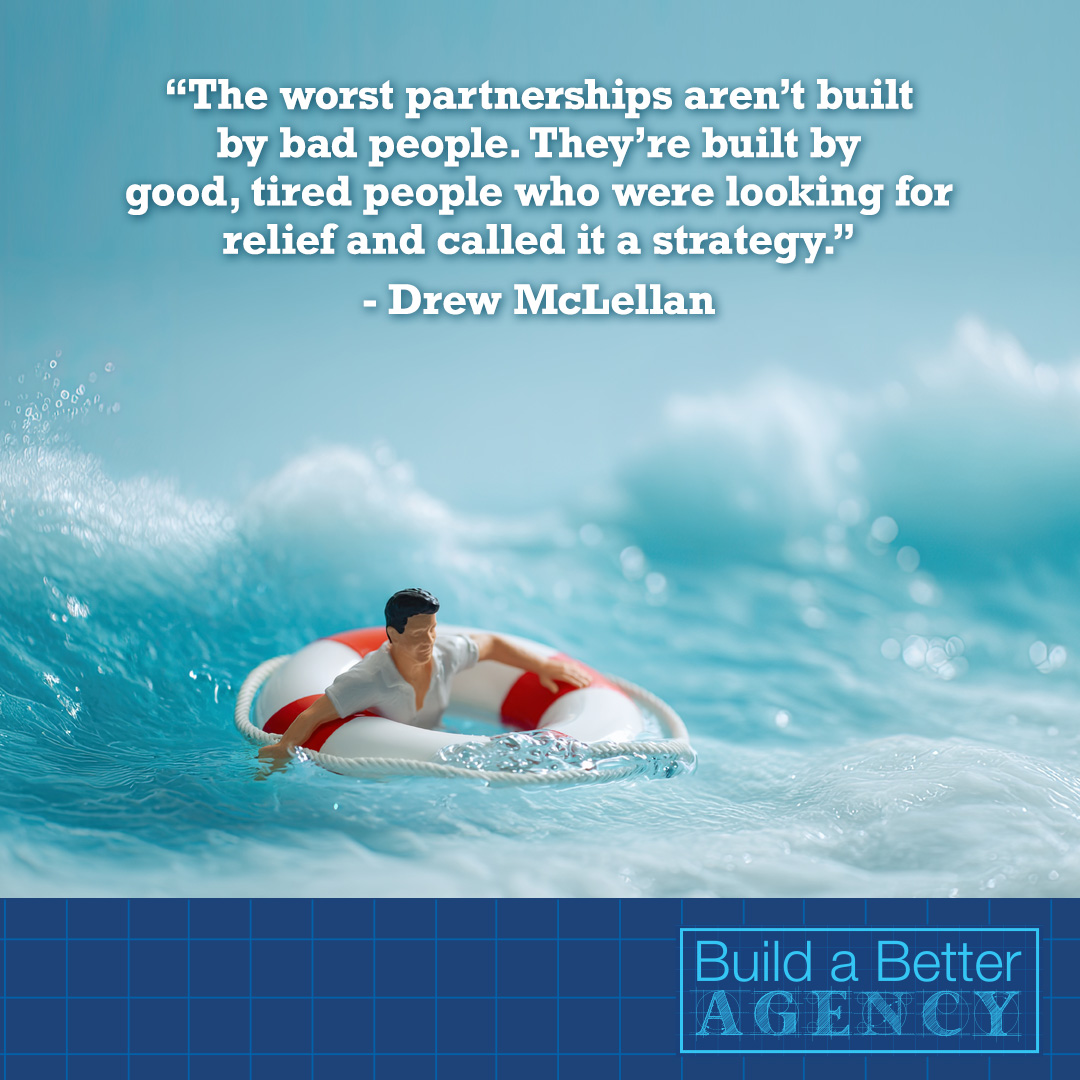
And the worst business partnerships, and I’ve seen many of those, they’re not built by bad people, but they were built by good, tired people who were looking for relief and called it a strategy, or got partnered up with their college roommate because they’re personal friends and didn’t think they had to go through all the homework. Of asking the hard questions.
You have carried your agency for a long time, and wanting a partner or help doesn’t mean that you’re not still capable of carrying it all yourself. It means that you’re paying attention. It means that you are looking to go to the next level.
So take the next 90 days, do the honest work of looking in the mirror first from the last episode, and then go find out whether or not You want a business partner, a number 2, or something different, whether you need a peer group, whether you need an advisor, or you just need to go away for 2 weeks somewhere with no cell service and recuperate. All of those are right answers. One of them is the right answer for you. And either way, you’ll know, you’ll know the right thing and you will make the right decision.
Because understand, every decision we’ve talked about in these last 2 episodes has a lifetime commitment and consequence, and they’re either gonna be good or not so good. So go slow, be thoughtful, be really honest with yourself, and get help where and when you need it.
Okay? All right.
That’s what I have for you this week. Thank you so much for being with me again.
Our thanks to our friends at White Label IQ, the presenting sponsor of the podcast, whitelabeliq.com/am. I.
And as always, I am so grateful. I really am so grateful that you listen every week, and that I get to do this with you and that you allow me to come alongside you and give you a different perspective to be as helpful as I can be. It’s a privilege, and I don’t take it for granted. So thanks for listening. I hope you come back next week. I’ll be here. See you then. Come back next week
Danyel McLellan:
Thanks for joining us for another episode designed to help you build a stronger, more stable, and sustainable agency. Check out our workshops, coaching and consulting packages, and other professional development opportunities at agencymanagementinstitute.com.