
Episode 549

Welcome to another episode of Build a Better Agency! Host Drew McLellan sits down with Emily Thompson, marketing manager at CoSchedule, to unpack the just-released AI Impact 2026 research study. With 900 respondents spanning every industry, company size, and marketing level, this is one of the most comprehensive looks at how marketers are actually using AI today and what they plan to prioritize in the year ahead.
Despite reporting declining ROI across every major channel in 2025, a striking 79% of marketers say AI positively impacted their performance, and yet only 3% consider themselves AI experts. Emily and Drew dig into what that gap means for agencies, why owned channels like organic search and email are taking the biggest hits, and why the oversaturation of AI-generated AI research content is actually one of the strongest arguments for what agencies do best. The data is full of contradictions that agencies are uniquely positioned to help clients untangle.
From the surprising stat that 53% of marketers now use AI tools (not Google) as their primary source of information discovery, to the finding that AI research shows humans still own strategy, this episode is a masterclass in reading the room on behalf of your clients. If you want to know where the real agency opportunity lives in 2026, this conversation is where to start.
A big thank you to our podcast’s presenting sponsor, White Label IQ. They’re an amazing resource for agencies who want to outsource their design, dev, or PPC work at wholesale prices. Check out their special offer (10 free hours!) for podcast listeners here.
What You Will Learn
- Why 79% of marketers feel positively about AI even as ROI declines across every channel
- What the AI research data reveals about how marketers are actually using AI in 2026 vs. 2025
- Why only 3% of marketers consider themselves AI experts and what that means for agency opportunity
- Which channels are declining most and why owned media is taking the biggest hit
- Why lead generation is the top 2026 priority and why marketers channel choices do not yet match that goal
- How 53% of marketers now rely on AI tools over Google for information discovery
- Why differentiation (not AI adoption alone) will determine agency success in a saturated market
- What it means to be your clients AI Sherpa and how to position that as a core offering
Ways to Contact Emily:
- Website: coschedule.com
- LinkedIn: https://www.linkedin.com/in/emily-thompson-68468084/
Resources:
- CoSchedule 2026 AI Report: https://coschedule.com/ai-marketing-statistics-2026
- BaBA Summit May 18-20, 2026: https://agencymanagementinstitute.com/babasummit/
- Drew’s Book: Sell With Authority
- AMI Facebook Group: https://www.facebook.com/agencymanagementinstitute
- AMI Preferred Partners: https://agencymanagementinstitute.com/ami-preferred-partners/
- Agency Edge Research Series: https://agencymanagementinstitute.com/agency-tools/agency-edge-research-series/
- Upcoming workshops: https://agencymanagementinstitute.com/advertising-agency-training/workshop-calendar/
- Weekly Newsletter: https://agencymanagementinstitute.com/newsletter-sign-up-form/
- Agency Coaching and Consulting: https://agencymanagementinstitute.com/advertising-agency-consulting/agency-coaching-consulting/
Danyel McLellan [00:00:01]:
Running an agency can be a lonely proposition, but it doesn’t have to be. We can learn how to be better faster if we learn together. Welcome to Agency Management Institute’s Build a Better Agency podcast presented by White Label iq. Tune in every week for insights on how small to mid sized agencies are surviving and thriving in today’s market. With 25 plus years of experience as both an agency owner and agency consultant, please welcome welcome your host, Drew McClellan.
Drew McLellan [00:00:37]:
Hey there everybody. Drew McLellan here from agency Management Institute, back with another episode of Build a Better Agency. Very excited about this. We’re going to dig into some research that I think you’re going to find fascinating was research done by a company called Co Schedule, which many of you are probably familiar with, talking to both clients and agencies marketers all across the board about a wide variety of topics that I think you’re going to want to sort of lean into and take some notes. But before we do that, I want to give a shout out and my genuine thanks to our friends at White Label iq, the presenting sponsor of the podcast. They go out of their way to stay current, to learn new things, to have the technology at their disposal to help agencies. And one of the places where they’re investing a lot of time and energy, as you might imagine, as many of you are, is they’re leaning hard into AI. So just like all of us, they’re trying to sort out where it fits, how it helps, what’s smoke and what’s real. And they’re experimenting with that every day with real clients that look just like you and their agencies all over the world that they’re working with. But they are not just reading about this, they’re experimenting, they are learning, they are developing an expertise and they’re putting some serious time and money into figuring it all out so that they can be helpful to us. Because they work with agencies and only agencies across design, dev and paid media. They’re thinking about AI in the same context that you are. And so they’re bringing expertise and knowledge and experience into every conversation they’re having with agencies as they, like all of us, are figuring it out. So these are the folks that you want in your corner when it comes to AI or honestly any sort of technology around web dev, design or paid media. They can help you make sense out of all of the hype and figure out what your clients really need and how to best leverage that for both your clients and for your agency. So head over to white label iq.com/ami to learn a little more about them and to reach out to them to find out exactly what they’re doing on the AI front and how that could be beneficial to you and your team. Okay. All right. So one of the things that White Label is doing and that I think CoSchedule is doing is that the reality is if we’re not lifelong learners in our business, we fall behind. And so what CoSchedule does is every year they go out and they do research. And so this is a continuation of their research. Their new data for 2025, early 2026 just came out. And we’ve got the person who headed up that research project, Emily Thompson, with us today to talk about what they learned, what surprised them, and what they think we all as agencies need to be paying attention to and leaning into. So without further ado, let’s welcome Emily to the show. Emily, welcome to the podcast. Thanks for joining us.
Emily Thompson [00:03:50]:
Hey Drew, thanks for having me. Great to be here.
Drew McLellan [00:03:53]:
Tell everybody a little bit about you, your background and the study.
Emily Thompson [00:03:57]:
Absolutely. I’m Emily Thompson. I’m the marketing manager at a software as a service company called CoSchedule based in North Dakota. And we are a marketing management software specifically to help marketers manage their basically everything, their campaigns, their task management, social media, kind of a one stop software for the project management arm of agencies, which is of course is a behemoth in agency life, that’s for sure. I like to describe us as imagine your project management software, varying your social media software. That’s kind of our our world. So I joined the company a year ago from an agency. I was working as a content strategist, copywriter. My lane is everything related to what needs to be said and how do you say it? And was just watching what AI was doing to the industry as we all lived through in 2025 and starting to feel a little shaky in my role, which I had felt like I had great job security as a copywriter in all other years of marketing. 2025 was a wild one and so I started to look around and was really excited to find a company in my own backyard that was committed to helping make life easier for marketers because I myself was just knee deep in project management at that point. So I joined CO Schedule a year ago and every year co schedule does a major industry survey on some hot topic. We have a giant database of marketers having been in the business for 12 years. And last year we looked at how are marketers using AI? Are they using it? How do they feel it’s helping their job? How Are they using it now? A year later? We wanted to look at. Okay, we’re a year into AI being mainstream in marketing workflows. How’s it going?
Drew McLellan [00:06:01]:
Right, right.
Emily Thompson [00:06:02]:
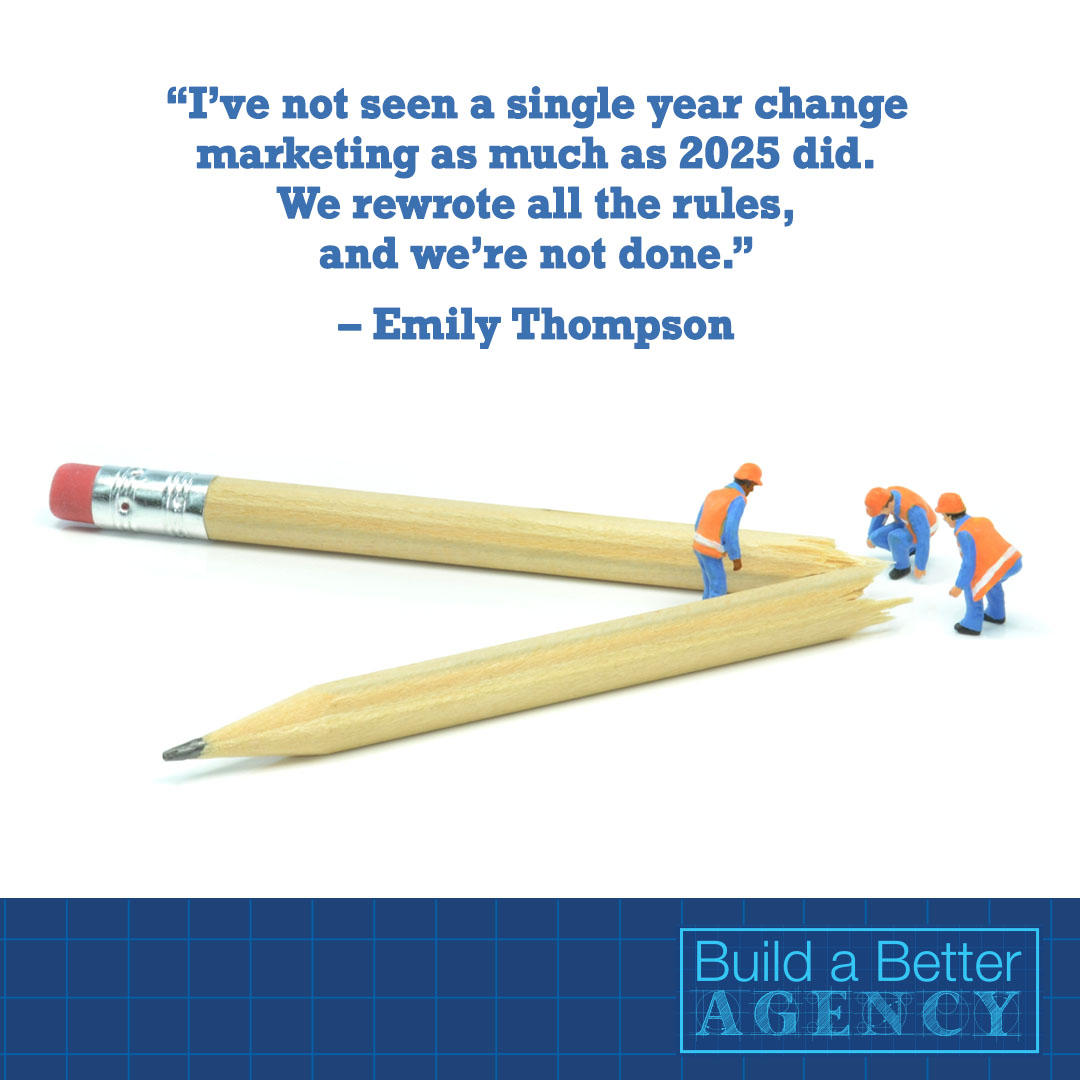
I don’t know about you. In my career, I’ve not seen a single year change marketing as much as 2025 did. For me, it was a watershed year where the industry changed rapidly. It’s not to say we haven’t seen major changes in the industry, but never as fast as 2025. And so I really wanted to have a conversation with marketers. 2025 changed marketing. What now? What’s still working? What’s not working? How are you doing? What are you prioritizing in 2026 and how are you as a marketer doing? What’s your sentiment towards what’s happening in the industry? And so we did a major research in December 2025 and just released the findings and would love to chat about them with you.
Drew McLellan [00:06:53]:
Yeah, it’s great. So everybody will put a link in the show notes so you can download the study, but we’re going to dig into it. So the respondents were brand side agencies or both.
Emily Thompson [00:07:07]:
All across the board we talked to, we got 900 responses. And they are everything from solopreneurs to working at companies with 20,000 employees. Every level of marketer, entry level on up to cmo, not specific to the US globally and every industry as well. Every sector and industry. So giant swath of marketers.
Drew McLellan [00:07:37]:
Okay, okay. So what surprised you the most when you, when you started digging through the research, what was the biggest surprise to you?
Emily Thompson [00:07:44]:
Lots of surprises. Probably the single biggest one was how optimistic marketers are about AI. In spite of indicating declining ROI across every channel in 2025, there’s. I would have expected a much more negative attitude because of how much more competitive things are. And the survey did not show that. We asked just a general how was your performance impacted by AI in the last year? And 79% said positively. And I take that to mean they personally feel that AI improved how they do their role on the subsequent questions they indicated. But I’m seeing declines across every channel and things have gotten tighter. Things are more competitive. I’m concerned about the oversaturation of content. There’s lots of concerns, but yet there doesn’t seem to be an indication that they are correlating that with any negative feelings towards AI. Sentiment towards AI is very, very positive in the result.
Drew McLellan [00:09:05]:
But if I read the question and the response is right, you didn’t correlate ROI to AI. You just said, how how is your marketing working? And they said it’s not working as well as it had. So that’s one thought. Right. Completely separate from AI. And then the next thought was that a separate question was, how are you feeling about AI? And they’re saying we’re bullish on AI. We think, we think it’s going to change. We think it’s going to change the way we work. But interestingly, only 3% of the respondents thought that they were AI experts.
Emily Thompson [00:09:45]:
Yes. Yeah. Key opportunity for agencies in the year still to help our clients feel more confident in AI. We knew that was an opportunity a year ago. Still an opportunity. When we asked, we asked a question in this year’s survey that we also asked last year, which is, how are you using AI? And you know, are you using it for content generation? Are you using it for personalization? Are you using it for predictive analytics? And the percentages of what they were using AI for were identical in 2026 as they were in 2025, sort of indicating no change, not a lot of growth like we’ve. We’re all using it, but we’re staying in safe lanes. And so key opportunity for agencies there to continue growing and educating clients.
Drew McLellan [00:10:44]:
So how did they tell you they were using it? What Was true in 25 and apparently now true in 26?
Emily Thompson [00:10:52]:
Highest percentage was content creation and generative images. Really content creation was the lane and not a lot of the more advanced uses of AI that you hear a lot about. It’s very trending to talk about personalization and I hear that push in conversations everywhere. Reality. Not only about 10% said they’re using personalization and do not intend to prioritize that this year. So the highest usage, 73% say they’re using it for content creation. 45% are using generative AI tools, 40% are using chatbots, the rest, predictive analytics, personalized engines. Really small percentage.
Drew McLellan [00:11:46]:
Did you ask why? One of the things we’re seeing on our end, and it may not have been something you asked, is that a lot of times, especially if they’re client side, they’re not allowed to use it for a lot of things that legal departments or whoever are really pretty restrictive in what they are allowed to do. So that’s where the. Well, you can use it to write blog posts or content, but you can’t use it. You can’t put certain data in or things like that because the corporate lawyers are concerned about, you know, the risk of exposure of information leaking and all of the other things that we’ve Heard, you know, everybody’s afraid of.
Emily Thompson [00:12:25]:
Yeah, we did not ask that this year. We asked it in last year’s survey and if I remember right, it was only 1 to 3% indicated they were at companies where they were not allowed to use it, which is why we didn’t ask it again this year.
Drew McLellan [00:12:41]:
Right. Interesting.
Emily Thompson [00:12:42]:
Fascinating. Right? It’s a, it’s a good reminder that sometimes the headlines are louder than marketers reality.
Drew McLellan [00:12:51]:
Sure.
Emily Thompson [00:12:52]:
One of my favorite things about doing the survey is just kind of grounding ourselves in some data. When the headlines can lead you to believe other things, it’s helpful.
Drew McLellan [00:13:06]:
So one of the data points out of the study was when you asked them kind of again stepping away from AI for a minute and just asking about what their priorities were. And it was pretty clear that marketers in 2026 are feeling a lot of pressure to generate leads.
Emily Thompson [00:13:25]:
Yes. Yep. The question was what will be your top marketing priorities in 2026? And almost 50% of marketers said lead generation, not AI and automation was very low percentage. The smallest percentage that really surprised me was thought leadership is almost non existent statistically. I think. Yes. What the results show is that 2026 will be about revenue stability and less about those more long term branding and marketing efforts that are equally important but lose, lose out to the more short term dependable returns. I think we’re regaining confidence in the fundamentals in 2026 rather than branching out into new channels and new types of marketing is what the research shows.
Drew McLellan [00:14:29]:
Well, the other sort of related one that surprised me when you were asking them about ROI for specific tools is your data would suggest, and the results were pretty clear that the owned channels were actually declining more than paid channels. So, so that would tie to that thought leadership. Right. Like I am creating thought leadership and I’m putting it on, you know, social media, but I’m putting it on our website and other things that we own and control. And if the ROI isn’t really, if they, if they can’t measure. Oftentimes the ROI may be there, but they can’t measure it. If they can’t measure the roi, then it makes sense that they would kind of lower the priority of like thought leadership content.
Emily Thompson [00:15:14]:
Which hurts my heart as a content strategist.
Drew McLellan [00:15:17]:
Yeah.
Emily Thompson [00:15:17]:
Share that. I, I love branding and I still wholeheartedly believe in, in that, in the value and it, of course it still matters. Marketers are just saying top priority will be the short term gains over long term. Yeah. We asked where have you seen the greatest declines in your marketing performance? And really every channel. The marketer said every channel. But the three biggest losses were we’re seeing it in organic search, no surprise there. Email marketing and website traffic. So you do see this idea of the channels that we control the most as marketers are taking the biggest hits over paid social, for example.
Drew McLellan [00:16:07]:
Part of it may be the ability to measure because one of the channels that got the lowest response in terms of decline was brand awareness. So you would think oh, thought leadership own channels. Our brand awareness is doing well based on their response. But I just wonder if that’s something they can’t or don’t measure.
Emily Thompson [00:16:27]:
Incredibly difficult to measure.
Drew McLellan [00:16:30]:
Right.
Emily Thompson [00:16:30]:
And harder to defend to the right the long term marketing initiatives. And on the flip side of that we asked what channels are doing the best for you and kind of the same result of there’s no knockout winner. There’s no longer. Gone are the days of marketing where we could pick that one channel and confidently step into it. That’s what 2025 did for us. Reintroduce, rewrote all the rules for what moves the needle. Really no knockout channel. Slight number of people said email is delivering the best ROI for us. But really what you see is we have to work towards incremental wins across every every channel. It’s getting harder.
Drew McLellan [00:17:24]:
That was the takeaway for me was basically they’re all getting harder to have success with.
Emily Thompson [00:17:31]:
Yes. Yep. And that certainly showed up in the research of what is your top concern? We asked, we asked them both in a select select your top concern but also open ended so that we could hear their answers in their own words and weren’t controlling the answers with what we thought they were going to say. And across the board the top concern is the over saturation of AI content and how it’s just harder to stand out and make a difference in today’s noisy market. That came up again and again and again which I think is another. That’s actually good news for agency owners because if differentiation is the.
Drew McLellan [00:18:22]:
Yeah, it’s the savior of it for sure.
Emily Thompson [00:18:25]:
Savior of it.
Drew McLellan [00:18:26]:
Yeah.
Emily Thompson [00:18:26]:
Agencies do that better than anyone. We need agency strategic expertise for that. But yeah, it’s definitely. We’re stepping into a new market rewriting rules fast here.
Drew McLellan [00:18:42]:
Yeah. You know one of the things that was interesting is so the response of sort of where are you losing? Where are you declining in roi? The number one answer was organic search. But later the one of the questions is which marketing channel delivers the highest ROI for your organization? And organic search was number two.
Emily Thompson [00:19:05]:
It still matters. Yeah.
Drew McLellan [00:19:07]:
Right.
Emily Thompson [00:19:07]:
I can say for our own organization. Yes, we took hits in 2025, and yes, it’s still important. Yeah, yeah, yeah, it’s. I don’t think there’s anything we are throwing out completely. And yet the stakes of how to make it perform are changing quickly. Interestingly, in the world of traffic, what was surprising is how few people indicated that they saw drastic declines in 2025. Only. Really only a small percentage, I think it was 6% said they saw declines in traffic, which is one of those stats that you look at and you say, did they read the question wrong? Like, is that really reality? So that’s a lot. That’s one of the takeaways from the survey that I really ponder and don’t even have a definitive takeaway. I can’t hardly believe it. I would have expected 100% of participants to say traffic took a hit and that that wasn’t what they. They said. And so there’s indication that SEO is still really important and that things are maybe not as bleak as we would read.
Drew McLellan [00:20:26]:
And when you asked about SEO, did you differentiate search from search engines versus all of the AI search that everyone is now focusing on, or did you just leave it as search?
Emily Thompson [00:20:43]:
We asked them, will your emphasis on SEO decline or increase in 2026 and have you started optimizing for AI? We asked those separately, and I believe 93% said we are continuing our SEO efforts. No change, no decline. And 89% said we are either already optimizing for AI or we will in 2026. So I guess while marketers are not indicating giant traffic declines, they’re preparing for them, is what I conclude from that.
Drew McLellan [00:21:23]:
Yeah, it’s fascinating. So, all right, let’s. Let’s take a quick break, and when we come back, we’ll keep digging into this data. And I, and I want to think about how you, when we come back, I, I would love to hear how you would assimilate this data as an agency owner and what, if anything, you might change about how you go to market to get clients based on the data. So let’s take a quick break, and then we’ll have you sort of put yourself in the role of agency owner. And what would this tell you you need to be thinking about for your business in 2026. So we’ll be right back. One of the things that’s really important to us at AMI is that we know our sponsors, and we are actually genuinely happy to recommend them. And so over the past couple of years, I’ve seen more and more AMI agencies successfully build long term remote teams with the help of Noel at jobrack, I consistently hear good things from agencies working with him and his team, and I’m comfortable introducing him to agency owners because he understands how agencies actually operate. That’s why we are proud to partner with Noel and jobrack as a sponsor of this podcast. If hiring is on your radar at all, Noel has put together a hiring playbook that is well worth reading. You can find it at jobrack.comami again jobrac.comami to get some good words of advice from our friends at Job Rack There’s a thief loose in your agency. They don’t wear a mask or sneak in at night. They’re stealing from you in broad daylight. A missing hour here, an unlogged revision there and poof, 15 to 30% of your profits have disappeared without a trace. It’s time to call in the detectives at Toggles Agency profit heist. They’ll investigate your workflows and expose where the money is leaking out and hand you a 90 day plan to recover what is rightfully yours. The clues are [email protected] backslash ami that’s T O G G L.com ami use code ami10 so that’s ami and the number 10 at checkout for 10% off annual plans or just mention this podcast during your demo. Case closed. All right, we are back with Emily Thompson and we are talking about the research that just came out. And again you can Download the almost 50 page research study report. There’ll be a link in the show notes for you to be able to do that. Really fascinating data. But before we break broke, I said, all right, put yourself in the role of agency owner and as you’re going through this data, what game plan changes might you make?
Emily Thompson [00:24:16]:
Yeah, I’ll start with a hot take. We always are as marketers talking about having a niche, standing out and having one lane that you specialize in. I think one of the takeaways of the data is if you are an agency owner and you’ve sort of specialized in say email marketing, but your clients are asking for social or you know, if you’ve sort of picked a lane and you’ve wondered, should we have more than one lane? I think the data says yes in
Drew McLellan [00:24:52]:
terms of channels and deliverables.
Emily Thompson [00:24:55]:
Yeah, yeah. Yes. Yes. Yeah. Thank you for clarifying that. I think that the days of leaning into one channel alone are gone and we need to be smart and seek wins. Be them ever so small, perhaps where we can and so the ability to help Your clients grow in across channels will be important. You can absolutely disagree with me. That’s the beauty of a hot take.
Drew McLellan [00:25:32]:
Well, you know, we are huge proponents of niching, but it’s really more about who you serve.
Emily Thompson [00:25:39]:
Yes.
Drew McLellan [00:25:39]:
And, and we’ve always said that if you’re going to, you know, what we believe is you can niche in one of three ways. You can serve a certain industry or a. A specialty market. You can niche in terms of an audience like, boy, we know millennial moms better than anybody else, or you can niche in a. You know, we do one thing and only one thing, pr, SEO, whatever it is, but that it is difficult to maintain your subject matter expertise, status when you specialize in a channel because sooner or later everybody else does the same channel. So we had a bunch of agencies back in the day, remember when there were social media agencies and that was all they did. And we don’t see those anymore because everybody does social media. And then there was Amazon Marketplace agencies, and now we don’t see a lot of those because everybody does it. And right now the hot new thing to be is an AI Forward agency. Well, you know what, every agency in three years is going to be AI Forward or they’re not going to exist anymore. And so to your point, the idea of specializing in a deliverable is a tenuous position.
Emily Thompson [00:26:49]:
Yeah, yeah. I’m glad you, you clarified what I meant. That’s absolutely what I meant. In a single channel. Risky in this environment. We touched on it a little bit earlier. I think the fact that only 3% of marketers feel they are AI experts, yet 80% indicate it will be a major part of their work this year is a key opportunity if you marketers feel equipped to turn AI into a sustained competitive advantage. Yeah, there’s your key opportunity. Agency owner. I’m surprised that because I know we were talking about this a year ago. I know you. I listened to an episode where you talked about this. Yeah, I’m surprised we’re still saying that a year later, but it’s still true. If we are not growing in our use cases of AI. And we on the client side. Yes. Yeah, the client. Yes. I say we because I was the client. Right?
Drew McLellan [00:27:53]:
Yep, yep.
Emily Thompson [00:27:54]:
So as clients, we need direction, we need places to feel confident because we have rewritten all the rules and everything’s changing rapidly. And I think agencies can provide that training and that confidence. I think there’s still a lot of opportunity. There is one takeaway, I would say for sure.
Drew McLellan [00:28:18]:
I think it’s critical for agency owners Absolutely. What else as an agency owner would you be? Would you lean into and go, oh, I know what to do with that data?
Emily Thompson [00:28:27]:
Well, if 89% of us say we are optimizing for AI or plan to this year, also a key opportunity because very few of us actually know what we’re doing. That’s brand new.
Drew McLellan [00:28:44]:
Yeah.
Emily Thompson [00:28:45]:
Lots of, lots of very, very different voices in the market right now telling us how to go about optimizing for AI. And so key opportunity for agencies to provide education or the service itself, that I think that’s a key takeaway in the results. And even, you know, again, I’m surprised I’m saying this a year later, but I think it’s still true. Agencies are better than anyone at helping clients create the sort of brand guides and templates to coach AI to deliver a better result.
Drew McLellan [00:29:32]:
Yeah.
Emily Thompson [00:29:33]:
And there’s an opportunity there too, that, you know, people turn to agencies to give them that type of language and to create those sort of brand guidelines and the style guides that create a better output. So I think there’s opportunity there in the AI optimization world. And then I think it sounds so basic. But in 2025, we talked about how authenticity will stand out. I would slightly change authenticity to say I think differentiation will be. Will be what wins the day. And It’s. That’s marketing 101. But it’s that ability to do that is harder than it has ever been. Yeah. And it’s a skill set that agencies do in their expertise that general marketers do not do. I think the day of the general marketer is quickly dissolving. And so those are the types of things where I would look at the data and be encouraged.
Drew McLellan [00:30:57]:
Right. There’s still opportunity for sure.
Emily Thompson [00:31:00]:
Yeah. Even though it is certainly discouraging to see how much tighter the market has gotten and how the playing field has. The stakes have gotten higher. I think there’s. There’s always opportunities because of agencies excellence within that one.
Drew McLellan [00:31:18]:
One of the data points was when you were sort of asking about, you know, is AI harming the industry, helping the industry? Where. What is it replacing? One of the things I took heart in, which is something I’ve been sort of preaching all year, is the respondents do believe that was like 34% of respondents believe that AI helps, but do not believe that I can replace the humans when it comes to great strategy. And so, you know, I think for agencies who’ve always been strategy forward and leading the way and helping clients sort of think through all of that, I think that was really encouraging.
Emily Thompson [00:31:56]:
Yeah. The concern for AI slop is hot, is high.
Drew McLellan [00:32:02]:
Yeah.
Emily Thompson [00:32:03]:
And agencies don’t produce that. So I agree wholeheartedly that the day of top tier marketing has arrived. There’s no longer a place for the malaise. The malaise is everywhere. The stakes are higher. And so key opportunity.
Drew McLellan [00:32:22]:
Well, in that response, that question came to it like your question was, which of these statements best describes your current sentiments towards AI and marketing? And that actually was the highest scoring response. And AI helps, but is not replacing strategy. So I was like, okay, I feel good about that. Yes. It can help crank out some copy or smooth out a first draft or give you some ideas that you can then actually write to those ideas. So you’re adding the human element, but clients are not thinking that the ability to think creatively and connect the dots is something that AI can do at the level that humans can do it.
Emily Thompson [00:33:05]:
Yeah. And one of the related findings that we just didn’t draw a lot of attention to because we had a similar takeaway last year. Where we did draw attention to it is really no one is indicating changes to the size of their team. A very small percentage.
Drew McLellan [00:33:25]:
I thought that was interesting. Yeah.
Emily Thompson [00:33:26]:
That they had lost their, you know, that their team had downsized because of AI, or that their role was changing because they, you know, they were eliminated and needed to do this role. Basically, we’re all sort of expected to bring it into our current. The vast majority of us are bringing it into our current role, but without a size change to our team.
Drew McLellan [00:33:57]:
Yeah. Or really like a big change in roles in the team even. It was sort of like we’re just holding steady. One of the things that surprised me was you asked the question, have you started experimenting with optimizing for LLM platforms? And I would have expected pretty much everybody to go, yes. And really less. Less than 45% said actively, 32% said testing little. And then everybody else was either not yet, we’re going to, or no, we’re not doing it at all. Which surprised me. Did it surprise you?
Emily Thompson [00:34:33]:
Yeah. What’s so fun about having been at an agency and now working for a company on the client side is being able to bridge some of those things that we just see things differently because of being in different spots.
Drew McLellan [00:34:52]:
Sure.
Emily Thompson [00:34:53]:
I think agencies are probably very far on the front end of that because of needing to deliver results.
Drew McLellan [00:35:01]:
Yeah, great. I think that’s right.
Emily Thompson [00:35:03]:
I think the average client is probably behind and why we’re needing to look to agencies to help push us forward in those. Those things. And so, yeah, again, Great opportunity because a lot of people are probably at step one not knowing how to do this, whereas agencies have seen it coming and are prioritizing it.
Drew McLellan [00:35:29]:
And what was fascinating was then you asked them where do they hey marketer, where do you go to get your information? And 53% of them said they rely most on AI tools for information discovery, which far surpass Google search of 35%. So in other words, as users they get the importance of being findable on AI tools, but as marketers, they haven’t yet wrapped their head around they need to be findable on those tools.
Emily Thompson [00:36:00]:
Yeah. Interesting takeaway. That was my favorite stat in the whole research project. It wasn’t the most surprising, it was just the most fun. 53% of marketers say that they start for their own information discovery.
Drew McLellan [00:36:16]:
Right.
Emily Thompson [00:36:17]:
AI tools, not Google. 35% use Google first. So they themselves think about that.
Drew McLellan [00:36:25]:
Two years ago nobody would have said that. Think about how quickly that change has come.
Emily Thompson [00:36:30]:
Yeah. And it’s fascinating to think about. Well, I don’t want to go down a bunny trail. We’ll, I’ll come back to that. Fascinating to me that yes. That 53% of marketers are no longer even use Google.
Drew McLellan [00:36:47]:
Yeah.
Emily Thompson [00:36:48]:
But maybe are not yet optimizing for the place that they’re using as their primary place of information. And so what’s fascinating to me is to think about how drastically search has changed from. I know this because my Google home did not change over to Gemini AI answers until a couple months ago. And I would ask it nuanced questions because I was used to AI answers that nuance me and they know me and they give me a multifaceted answer. And it would constantly say I don’t have the ability to do that. I can’t answer that. And it was this lifetime reminder in my own house of how much search has. We expect so much more from search now that yeah, it Google’s going to frustrate us. We want our multifaceted answers. That answer according to us and know us. That’s fascinating to think how far we’ve come in as you said, two years that we expect our answers to just to not have to dig in and evaluate multiple answers to just have the answer right before us, which there’s a whole conversation there with concern if marketers aren’t digging deeper and taking what they’re getting at face value in AI.
Drew McLellan [00:38:25]:
Yeah, for sure. One of the things that I thought was sort of an interesting, I guess juxtaposition is the vast majority of respondents said lead gen was their number one priority. But then when you ask them what they thought was the best investment, how they were going to spend their focus, their content focus, 55% said social media was going to be what they were going to spend their focus on. And you know, then 43% said website content and 34% said short form video. But I would have expected more direct lead gen tools to kind of be ranked higher than social media and I
Emily Thompson [00:39:11]:
would, I would interpret that as another opportunity for agencies too. If we’re, we need help doing lead gen. Right, right. If we’re saying both of those at the same time and if we’re thinking social media is the lead gen tool, there’s some strategy assistant there, assistant opportunities there for sure.
Drew McLellan [00:39:33]:
Yeah. Because email was so, social media was 55 some percent and email was like not even 21%. So. But email they think is the strongest lead gen tool they have. So I was like, I was like, I don’t, I’m struggling to connect those dots in a logical way.
Emily Thompson [00:39:53]:
Yeah, yeah. Similar takeaways where I think opportunity for agencies. We have some incongruence in our behaviors as marketers and need some expertise.
Drew McLellan [00:40:05]:
Yeah.
Emily Thompson [00:40:06]:
Key opportunity.
Drew McLellan [00:40:07]:
Yeah. No surprise when it comes to social Media, they thought LinkedIn was the strongest platform and interestingly that Twitter is delivering the worst ROI amongst all the channels. I don’t know that I find, I find either of those particularly surprising. But what was your take on sort of how they viewed the social media channels?
Emily Thompson [00:40:29]:
Yeah, I Love, I love LinkedIn, so it’s, of course, I love seeing that result that they believe LinkedIn delivers the best ROI. I think it makes a lot of sense. Sure. If lead gen has is our priority, it makes sense to me that LinkedIn would be the channel where we would lean in opposed to more standard social media channels that don’t have as. As deep of a business tie as, as LinkedIn does. I don’t have any real takeaways from them saying that Twitter is delivering the least roi. But I do think it’s encouraging as a content strategist to see that they’re making more selective bets about where they’re publishing as opposed to setting a standard of having to publish across everywhere every channel, which is just not effective marketing. And I’m a big fan of lean into the places that are working and don’t be afraid to walk away from the places that aren’t, even if everyone else around you in your industry is. So it’s good to see that we’re, you know, assessing and making more selective Bets with our, our social posting.
Drew McLellan [00:41:46]:
I agree. As we are approaching the top of the hour, I’m curious, after seeing all of this, what’s the one question you wish you had asked that you didn’t ask?
Emily Thompson [00:41:59]:
I am so glad that you asked that question because when you’re creating a survey, you do absolutely everything you can to keep it neutral and make sure you’re putting in every answer and you don’t want to make any guesses how people are going to answer or manipulate a certain way. Yeah, right.
Drew McLellan [00:42:19]:
Yeah.
Emily Thompson [00:42:20]:
And so I realized that I made a guess how people were going to answer. They did not answer how I thought. And so I did not ask a follow up question. When we asked, how do you feel that AI impacted your performance in the last year? I did not expect that it would be so overwhelmingly positive. And if I had, if I could have seen that, I would have asked, tell me why.
Drew McLellan [00:42:52]:
Yeah, right.
Emily Thompson [00:42:53]:
Why?
Drew McLellan [00:42:54]:
Give me some detail about that. Yeah.
Emily Thompson [00:42:56]:
Especially because the very next question, they said, we’re seeing declines across every channel and the stakes are high and we need more lean lead gen, we need more revenue. Tell me why you answered so positively about AI.
Drew McLellan [00:43:11]:
Yeah. Where are you feeling the benefit or the lift? Yeah. If it’s not in the results, where is it? Yeah.
Emily Thompson [00:43:18]:
But what I hope for all marketers in 2026 is I hope the conversation, the AI wars, which are cheap, just, I mean, my whole news feed is just constant AI bashing. I hope we can move beyond that because I think the, the research is not negative and I, I, I really hope we can start having more intelligent conversations about it and stop the battles. And it’s here to stay.
Drew McLellan [00:43:47]:
No doubt about that. Right.
Emily Thompson [00:43:49]:
I think only 1% of the people we talked to said that they think AI has reached its peak.
Drew McLellan [00:43:56]:
Yeah. It’s a fact.
Emily Thompson [00:43:57]:
And it’s going to wane.
Drew McLellan [00:43:58]:
Yeah. Right.
Emily Thompson [00:43:59]:
But I tell you, more than 1% of my newsfeed is talking like, no doubt, no doubt.
Drew McLellan [00:44:05]:
Well, sometimes I think that’s just wishful thinking. Don’t you think?
Emily Thompson [00:44:08]:
Yeah, yeah, yeah, yeah. It’s to our advantage if we’ve watched it change our industry to think, okay, that’s done now. Right. It’s not. The research shows it’s not. So yeah, I hope that we move into deeper, deeper growth and opportunity this year. I thought we would do that more in 2025, but the research shows we really haven’t. And so a lot of opportunities for agencies to guide their clients into that in 2026 as well.
Drew McLellan [00:44:39]:
Yeah, we, you know, we did we did our agency Edge research back in May, and, and our. One of our big takeaways from that is that clients really want their agency. The word we’ve been using is to kind of be their AI Sherpa. Right. So I want you to take me. I see that the, the mountain is cloud covered. I can’t navigate it. But I know you know the path. I know you’ve been on the path before, and I want you to load up the right equipment, tell me what to pack, tell me what to do, and really show me the way to get to the top of that mountain. And I do think that is a huge opportunity for us as agencies if we’re willing to lean into that and develop that expertise. And those offerings. Those are some different offerings than perhaps we’ve had before. But I think you’re right. I think it’s a big opportunity for us.
Emily Thompson [00:45:26]:
Yeah, that’s a great final thought. That’s what I hope agencies will take away from the research.
Drew McLellan [00:45:33]:
Yeah, me too. So, Emily, if folks want to get a hold of you, if they want to learn more about the research that you guys do or all the content and ways you help agencies throughout the year, what’s the best way for them to initiate that kind of conversation?
Emily Thompson [00:45:48]:
Yeah, you can find us on coschedule.com if you want to connect directly with me. I’m Emily Thompson. You can look me up on LinkedIn. Common name, so maybe hard to find. But the research is called AI Impact 2026. So if you search CoSchedule in that, I’m sure you’ll find your way to all of our data. But Drew, you said it’s 50 pages. That’s pretty intimidating.
Drew McLellan [00:46:14]:
No, it’s great. There’s lots of pictures. Not, it’s not, it’s not dense. It’s a lot of charts and graphs. But the data is fascinating and we have to understand how our clients and prospects are thinking about all of this and their experience with it. And so the study is a really great way for agencies to get some insight into what it’s like on the other side of the fence. And we have to have it. So it is not intimidating at all. It’s a lot of great data that is visually presented, so it’s not overwhelming. So in the show notes, we’ll for sure have a link to the company website to where you download the research. We will find Emily on LinkedIn and make sure we link to the right Emily there so you can find her. Emily, thanks for being with us and giving us your Insight. This was a really great conversation, and I’m sure it’s got everybody thinking in some interesting ways.
Emily Thompson [00:47:09]:
Thanks, Drew. Thanks for engaging the survey. And we’re, of course, very excited and knee deep in all of it, and it’s fun to get to talk about it with other people.
Drew McLellan [00:47:18]:
Yeah, it’s. It’s awesome.
Emily Thompson [00:47:19]:
Thank you.
Drew McLellan [00:47:20]:
All right, guys, so here’s the homework. I really do want you to download the study and I want you to look at it. So your clients, depending on who you serve and the kind of work you do, they may be feeling really differently about it. It would be a great thing to do to share with your clients and then say, hey, is this true to your experience? Is this what you’re feeling and seeing and thinking? What a great way to initiate a conversation with your clients about what’s working and what’s not working, both. And the study is not all about AI. It’s about marketing tactics and results and ROI and things that we’ve always been talking about with clients. So I. Not, yes, look at the study for yourself. Yes, share it with your team, but also share it with your clients. I think it’s a great way to start a really deep conversation that is going to show them that you want to understand what’s going on in their world and you want to help them sort of exceed whatever’s going on so that they can have a great 20, 26. So I would use it as a tool to trigger a great conversation. So that’s homework for all of you from this episode. You know, I want to say thank you one more time to our friends at White Label iq, the presenting sponsor. And last but not least, I want to thank you. So I know you’re busy and I know that you know I’m taking up an hour of your week every week, and I am super grateful that you grant me the privilege of us getting to hang out every week. And I love getting to introduce you to folks like Emily every week. So thank you for listening. Thanks for coming back every week week. And I will be back next week, so I’m hoping that you will too. So I’ll see you then.
Drew McLellan [00:48:57]:
That’s all for this episode of AMI’s Build a Better Agency podcast. Be sure to visit agencymanagementinstitute.com to learn more about our workshops, online courses, and other ways we serve small to mid size agencies. Don’t forget to subscribe today so you don’t miss an episode mode.