
Episode 536

Welcome to another insightful episode of Build a Better Agency! This week, host Drew McLellan tackles the critical—yet often underestimated—legal side of agency mergers and acquisitions. Joined by agency law specialist Sharon Toerek, Drew explores all the ways agencies can better prepare for buying or selling a business and avoid the legal pitfalls that can delay deals, drive up costs, or even kill transactions entirely.
Sharon Toerek shares from her first-hand experience helping agencies on both the buy and sell side, breaking down the foundational legal elements every agency owner needs—whether or not they plan to sell someday. Together, they dig into everything from the importance of robust client and employee contracts, to protecting intellectual property, to the necessity of having proper corporate governance documents in place. Sharon explains how missing or incomplete contracts can erode agency valuations, scare buyers, and create costly last-minute headaches.
The conversation also covers the nuances of deal documentation, the significance of a well-prepared due diligence process, and the real-world “war stories” that illustrate why legal readiness matters so much. Drew McLellan and Sharon Toerek offer listeners practical, actionable steps to start shoring up their agreements, documents, and internal processes now—not just in anticipation of a sale, but as fundamental best practices for running a sustainable, valuable agency.
Don’t miss this episode if you want to eliminate unnecessary risks, maximize the value of your agency, and ensure a smoother M&A journey whenever the time comes. By the end, you’ll have a to-do list that can strengthen your agency’s foundation today and set you up for a more profitable, stress-free exit tomorrow.
A big thank you to our podcast’s presenting sponsor, White Label IQ. They’re an amazing resource for agencies who want to outsource their design, dev, or PPC work at wholesale prices. Check out their special offer (10 free hours!) for podcast listeners here.
What You Will Learn in This Episode:
-
- The critical role of client contracts and why agencies need to centralize and consistently document them
- The importance of up-to-date employee agreements and talent documentation to protect agency value
- Intellectual property as a major driver of agency valuation (and how to properly identify and secure IP assets)
- The need for clear, accessible corporate governance and owner agreements to prevent deal slowdowns
- Why preparing legal foundations early smooths M&A transactions and safeguards potential deal value
- How lack of organization or missing documents can delay, diminish, or even derail agency sales
- Proactive legal preparation as both a best practice and a profit generator for agencies
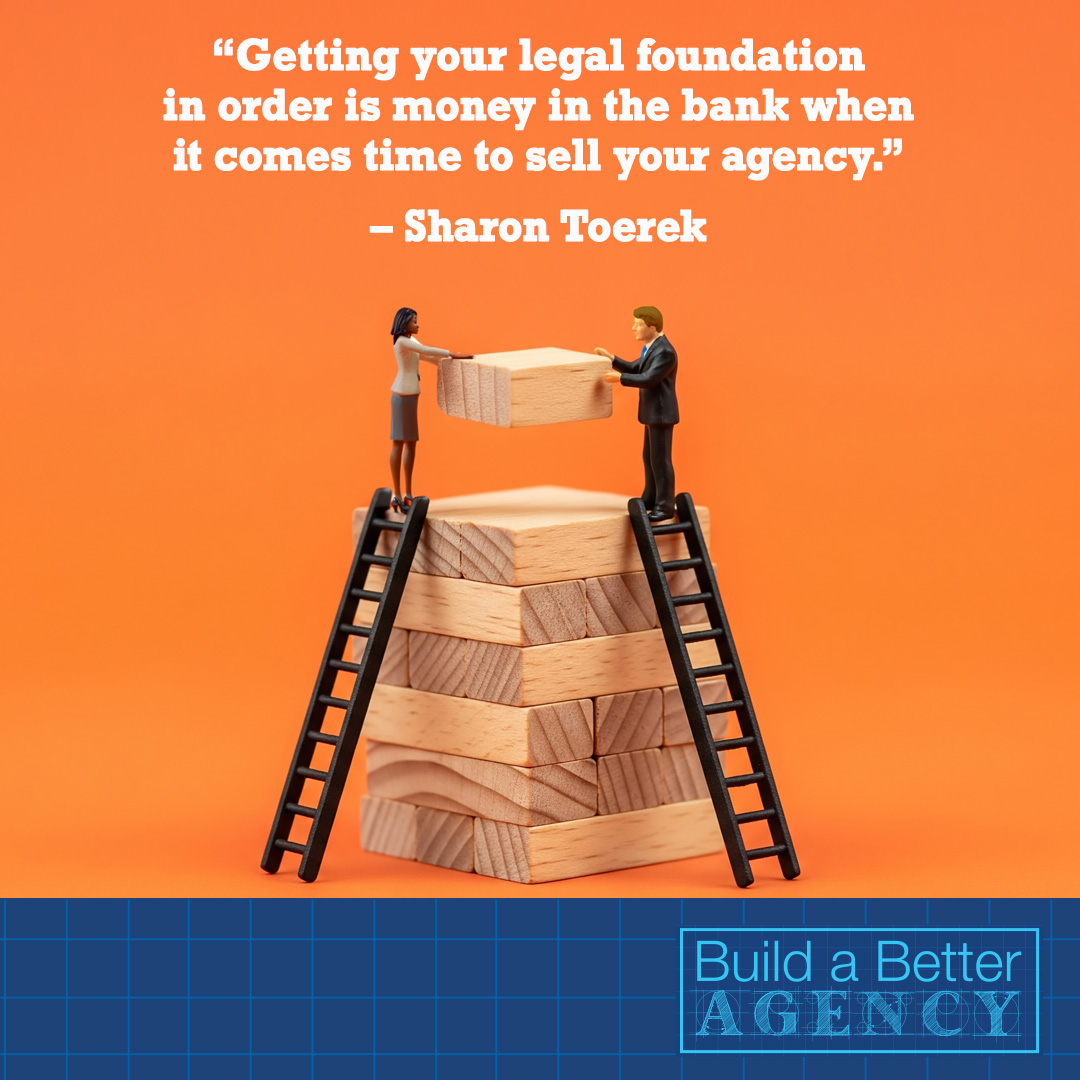
“Getting your legal foundation in order is money in the bank when it comes time to sell your agency.” - Sharon Toerek Share on X
Most agency owners underestimate the impact of legal prep on M&A success. Sharon Toerek explains why getting your contracts in order can make or break your agency sale. Share on X
Buying or selling your agency? Sharon Toerek reveals the legal pitfalls that can derail your deal—and how to keep the process smooth and profitable. Share on X
Handshakes aren’t enough. Sharon Toerek explains why formalizing client and employee agreements is essential whether or not you plan to sell. Share on X
“If you don’t know where your contracts are, you don’t really own your agency.” Sharon Toerek breaks down the critical documents every agency needs before an M&A deal. Share on X
Ways to contact Sharon:
- Email: [email protected]
- Website: Legalandcreative.com
- LinkedIn: https://www.linkedin.com/in/sharontoerek/
Resources:
- Sharon’s AI Toolkit
- BaBA Summit May 18-20, 2026: https://agencymanagementinstitute.com/babasummit/
- Drew’s Book: Sell With Authority
- AMI Facebook Group: https://www.facebook.com/agencymanagementinstitute
- AMI Preferred Partners: https://agencymanagementinstitute.com/ami-preferred-partners/
- Agency Edge Research Series: https://agencymanagementinstitute.com/agency-tools/agency-edge-research-series/
- Upcoming workshops: https://agencymanagementinstitute.com/advertising-agency-training/workshop-calendar/
- Weekly Newsletter: https://agencymanagementinstitute.com/newsletter-sign-up-form/
- Agency Coaching and Consulting: https://agencymanagementinstitute.com/advertising-agency-consulting/agency-coaching-consulting/
Danyel McLellan [00:00:01]:
Welcome to the Agency Management Institute community where you’ll learn how to grow and scale your business, attract and retain the best talent, make more money, and keep more of the money you make. The Build a Better Agency podcast presented by White Label iq is packed with insights on how small to mid sized agencies are getting things done. Bringing his 25 years of experience as both an agency owner and agency consultant, please welcome your host, Drew McLellan.
Welcome everybody to another episode of Build a Better Agency. This is your genial host, Drew McLellan. Looking forward to the conversation today? This is a hot topic for me, so I’m, I’m looking forward to digging into it.
Before I do that, of course I want to thank our friends at White Label iq. They are the presenting sponsor of the podcast and one of the things that I love about White Label is yes, they are absolutely your White Label team to do dev and design and paid media. But they don’t just crank out code. They actually can take ideas that you have and turn them into something real. Ideally turn them into something that is has IP value for you that you may be able to license to clients or you may be able to spin off as a separate business or you it may just be IP that really locks a client into you for a long time. And so don’t be hesitant if they’re your partner already or you’re looking for a partner to sit down with them and describe this idea that you have and ask them to help you think about how to make it come to life. Remember, they do that every day for agencies all over the world, whether it’s design, dev or paid media, or in this case, helping you take an idea off the whiteboard and turning it into something really tangible, real and has great value. So check them [email protected] AMI and have that conversation with them.
Actually, that’s sort of related to our guest and the topic today. So many of you are familiar with Sharon Toerek. Sharon is an attorney who specializes in serving agencies and one of the areas where she helps agencies every day is helping them think through and protect their ip. So White Label can build it for you. Sharon can help you make sure that you own it and protect it. But today what I want to talk to Sharon about is we often work with Sharon side by side through the M and A process, whether we’re representing the buyer, the seller, or both. And oftentimes Sharon is along on that journey with us and she and I were having a conversation about all the sort of legal faux pas and the places where legally things get complicated in agency purchase or sale. And we decided it was a deep enough topic and a topic that is near and dear to both of our hearts because we know it’s important to get through that process as cost effectively and quickly as possible. That was worthy of a conversation here on the show. So without any further ado, let’s welcome Sharon back to the show. Sharon, welcome back to the podcast. It’s good to have you back.
Sharon Toerek [00:03:15]:
It’s wonderful to be back with you, my friend. I’m looking forward to it.
Drew McLellan [00:03:19]:
Me too. So today where I really want to kind of lean into is, you know, everybody who’s listening knows that, you know, you, you and your law firm serve agencies in a variety of ways all around IP and AI today and contracts and all of the things. But one of the things that we’ve actually never talked about on the podcast before is the work you do in, in the M and A space. And I know that you’re helping a lot of agencies on both the buy and the sell side sort of get the deal done. And so you and I were having a conversation offline and talking about some of the things that make us hit our head against a brick wall in terms of how this gets harder than it needs to be. And it just seems like it would be a good conversation that sort of legally, what are some of the hurdles and some of the places where agencies just make it harder than they need to. So let’s talk a little bit about that. So kind of tee up from, just from a perspective and maybe we have to flip back and forth, buyer and seller, but in general, what are some of the sort of top level things that agencies need as, as they’re thinking about prepping themselves for a sale or they’re thinking about growing through acquisition? What are some of the legal hurdles that perhaps doesn’t occur to them that they need to be mindful of?
Sharon Toerek [00:04:43]:
Yeah, I very much like your focus on when you talk about M and A in general and the agency space drew about using the Runway that you have to plan or the softest possible landing for buyer or seller. And so many of these things, you know, can be sort of, the Runway can be smoother if you think about putting certain legal foundational bricks in place. And it turns out they’re the same foundational bricks to put in place for your agency whether you sell it or not in the future, if you’re a.
Drew McLellan [00:05:18]:
Seller, you know, it’s, it’s interesting. So we just taught, you know, we teach that one day virtual workshop Sell your agency without regrets. And that’s I give that exact speech, which is whether you want to, whether you decide to sell or not, everything we’re going to talk about today to get your agency ready to sell and be of more value is actually just good practice as a business owner and an agency owner anyway. So I’m glad to hear that that’s true on the legal side as well.
Sharon Toerek [00:05:44]:
A hundred percent. And it’s funny that, you know, we didn’t start or we didn’t build the agency. Focused practice really to focus on M and A transactions for agencies. It’s just that as activity has heated up in the industry over the last 24 months or so, as you know, more and more transactions keep popping up and we kept seeing the same patterns. And so a few things that can, I think, make what should be a simple deal more complicated, more costly, take longer, or that can impact the amount of money you realize from selling your business, fall into some of these categories.
Drew McLellan [00:06:31]:
And in some cases squirrel the deal altogether. So we’ve also seen and been involved where the legal complications make one side or the other just go, you know what, this either can’t be done or it’s not worth it, or fill in the blank. So it really can actually derail the deal altogether.
Sharon Toerek [00:06:51]:
And we have seen that, unfortunately. And you would think that the deals that had the, the highest price point on them would be the longest, most complicated. And that’s not always the case when the parties have their acts together in terms of their foundations. So the first thing that we see and notice and that every agency owner listening should be thinking about whether they’re buying or they’re selling is, you know, when you’re buying an agency, you’re buying a couple of things. You’re buying a book of business. So it’s the clients and the contracts obviously that come along. It’s the intellectual property that the agency has created, whether that is their brand, you know, that prominent brand, their client industry, or whether they actually have proprietary content, systems, technology, whatever it is, and in many cases is also the team of talent that you might be able to bring over and plug into the acquiring agency. So thing one, what do your client contracts actually say?
Drew McLellan [00:07:57]:
Right. Do you have the right to sell them?
Sharon Toerek [00:08:00]:
Yes, that’s the first thing is what does the agreement do about addressing assignability or transferability of that client account to an acquiring agency? What kind of approval would the client have to be expected to give to that sort of transaction if the contract is assignable? And how are you going to Handle that. And that is, and that is really an outcome of first of all. But until you get to the communication, you’ve got to know what the agreements say and be sort of war gaming it, if you will, out a few steps ahead. Does the agreement allow it? If it does, how are we going to have, you know, under, under what conditions and how are we going to have that conversation with the club without spooking them?
Drew McLellan [00:08:49]:
Well, and even like what’s the timeline? And you know, like in some contracts they have to be notified within a certain period of time and you know, can be a, it can absolutely complicate the deal from the get go. Right.
Sharon Toerek [00:09:03]:
Because if the acquiring agency doesn’t have the sense of security that they’re going to be able to continue the revenue stream that the valuation relies upon.
Drew McLellan [00:09:12]:
Right.
Sharon Toerek [00:09:13]:
It’s going to make the selling agency, the optics at least of it appear less valuable. And so that’s something that secondarily to that and you would be, maybe you wouldn’t be given the number and hundreds of agencies you talked to Drew. But some of the listeners might be surprised at how many of their peers who have particularly longstanding relationships with their clients have done so on a really shaky foundation, contractually handshake relationship that, you know, I took the agency over from a parent and the parent had the original handshake with the client. And we’ve never wanted to get into, you know, formality.
Drew McLellan [00:09:54]:
We didn’t want to open that can of worms.
Sharon Toerek [00:09:57]:
So there’s no contract and there’s no assurance that the buying party is going to be able to reap the benefits of that book of business. You know, that, that part of the book of business. And so it’s, it’s having poor provisions in your agreements about transferability or, or it’s have, it’s the absence of contracts entirely. That is, that is really. And I say I put the highest priority on that as thing one, if you will, because it is the first thing we look at when we’re doing legal due diligence is let’s see, the client contracts. Well, first of all, does a seller even know where they are? I mean, I was just going to.
Drew McLellan [00:10:33]:
Say I, I’m, I’m always astonished when we ask that question. And the seller’s like, I’m pretty sure we have them. I’m not sure where they are. And I’m like, holy crap. Like, yeah.
Sharon Toerek [00:10:47]:
So yeah, I mean the practice tip here and this is implementable no matter what size your agency is. It’s actually probably easier the smaller you are, but you need a centralized process for contracting with your clients, and that includes consistent documentation, you know, contract templates, the whole nine yards. But you need centralization. It needs to be. You need to know where the agreements are. You need to know basically what they say, and you need to be able to get your hands on them quickly. You need to be able to track when they expire. You know, one of the, One of the success stories of AI implementation is agents and agencies now on the back end is I’m sure there’s an AI tool that can help you summarize the.
Drew McLellan [00:11:32]:
That’s right.
Sharon Toerek [00:11:33]:
Really quickly so that you could turn over that summary and due diligence really easily. But going through that process of doing an audit internally of your agreements to make sure, first of all, you have them. And second of all, you know, what they say happens if your agency is sold. It will save you time, it will save you money in professional fees, and it’s probably going to positively impact the return you get on in terms of purchase price. It’s certainly not going to hurt it. So it’s definitely something you need to be ready with. Do your consultants, your accountants, your legal counsel a favor and get a head start on that. That’s. That that is thing one that we see.
Drew McLellan [00:12:14]:
And again, whether you’re going to sell or not seems pretty smart. Right. That you have A, that you have contracts and B, that you know where they are and see that you know when they need to be renewed. You mean that. That doesn’t seem like rocket science, but. But I think it’s one of those things that it’s just a detail that especially if the agency has been around for a really long time, kind of gets just lost in the shuffle.
Sharon Toerek [00:12:37]:
Yeah. I mean, it’s not sexy. Right. You always like to say you’ve said, ever since I’ve known you that you. One of your fundamental premises for your business is that a lot of agency owners are accidental. Agency owners. Well, similarly, no agency owner went into business because they love dealing with, you know, the legal compliance end of things.
Drew McLellan [00:12:59]:
Right.
Sharon Toerek [00:13:00]:
So I get it. But when you think about the actual impact it can have on your checkbook in an M and A transaction, it’s worth spending some time to put the process in place that will have your act together when it comes to your client relationships and contracts.
Drew McLellan [00:13:17]:
Yeah. So you know, clearly, as you said, when somebody’s buying an agency, whether it’s another agency or it’s a third party or whatever it may be, obviously they care deeply about the book of business, but they also care about the people that service the book of business. And I, and I’m equally surprised at when, when we’re in the middle of a deal and, and the buyer is saying well, where are the employee contracts? Where are the confidentiality agreements, where are the non solicitation agreements? That sort of the same thing. It’s like well we did one five years ago and it’s in a file cabinet somewhere which is now probably in a storage unit, you know, because the agency doesn’t have a physical space. So talk about on the employee side, sort of the risk of all of that too.
Sharon Toerek [00:14:01]:
Yeah, absolutely. That’s thing too for sure it is the documentation of your employee and talent relationships. First of all, any buyer is going to want to understand a couple of things. They’re going to want to know how vulnerable would we be if we didn’t bring the talent over. Are the people who we don’t hire from the selling agency going to be in a position to lobby those clients to work directly with them? They’re looking for security in terms of the potential revenue transportability, if you will. So what do the employee agreements say about fair competition covenants? What do the employee agreements say about, you know, are they clear on intellectual property ownership of the work product that’s been created? Are they clear on what the obligations are in terms of a term? I mean, is the selling agency in a term relationship with the employee, meaning that they’ve committed to a specific period of time? You don’t see this as much these days, but most relationships tend to be at will. But if you have a, if you’ve brought a key employee over to your agency, you may have been more likely to have incentivized them with some initial term. Are they entitled to any part of the deal proceeds? You know, agency owner have any sort of appreciation rights or phantom stock arrangement in place with any of these folks or profit sharing arrangement that’ll need to be satisfied out of the proceeds? You know, what are the expectations you’ve given your team around pto, around employee benefits and is the buying agency going to be willing to sort of create a similar scenario for them? So you don’t, you can’t get to answers to any of these questions if you don’t have the documentation in the first place. So consistency in employee onboarding documentation, consistency in employee contracts and again centralization so that you can get your hands on all of these things when you’re in the middle of the due diligence process in an M and A transaction and there’s not a single agency that my firm has worked with. And I’m guessing that your organization has in its fold that doesn’t use 1099 contracted talent.
Drew McLellan [00:16:25]:
Right.
Sharon Toerek [00:16:25]:
So if any of those folks are considered critical to your organization because of a client relationship or a particular skill set, how firmly do you have them engaged? What does the paper look like? They’re free agents legally. So. And you’ve, you have created that construct intentionally, at least I hope intentionally.
Drew McLellan [00:16:45]:
Right.
Sharon Toerek [00:16:46]:
Do you have a contract in place with them? And what is it going to look like to transfer that relationship from seller to buyer?
Drew McLellan [00:16:54]:
You know, another side of that is a lot of times the buyer, there are certain key employees that the buyer wants to know that are not going to walk out the door. And so we’ve also had times where we’ve wanted the seller to negotiate. They didn’t have a contract, let’s say, with a key employee, and we wanted them to negotiate an employment contract. And typically they’re usually on a leadership team so they know about the transaction before it’s done. They’ve been part of some of the early conversations, but want to lock them into an employment contract with some sort of a stay bonus so that the buyer is confident that the, that key employee who owns the biggest relationship of the, of the agency they’re buying isn’t going anywhere.
Sharon Toerek [00:17:38]:
Right.
Drew McLellan [00:17:39]:
And again, you got to know what you already have in place. And then you also have to be ready to execute some, some of those additional documents sometimes to kind of get them get the deal done.
Sharon Toerek [00:17:49]:
Yeah. I mean, and this is a perfect example where, you know, having a lot of Runway before between your readiness to sell and you actual need to sell is your friend. And this is your margin of time and space to assess, you know, what you have in place and where your inconsistencies might be. And I’m not suggesting that every agreement you have with talent in your organization needs to be identical because there are going to be certain, as you’re to your point, there are going to be certain people who are going to be more critical to your organization perhaps than others. And so it’s not that their agreements need to all be the same or look alike. It’s that you need to have an intentionality. And then that needs to be reflected in writing in your relationships with these people. Likewise, not only your contracts, but your employee policies and procedures. This is a great margin of time for you to, if you don’t have written policies and procedures, think about putting them in place. First of all, it sets you up to look like you have your act together like nobody should when you’re putting yourself out there and marketing yourself for sale. And second of all, if you’re a buyer, if you’re an agent, if you’re looking to acquire an agency, it gives you just a heightened level of security about the way that talent has been treated, the way that you’ve been thoughtful and intentional around growing and acquiring talent. And the optics of the value of your agency are greater as well. I’ve seen it in a number of.
Drew McLellan [00:19:21]:
Cases, and again, it’s just a good practice. Right. I mean, whether. Whether you’re thinking you’re going to sell or not. You know, having an employee handbook and having things documented and having, you know, on your calendar that January 3rd of every year is when everybody resigns. The confidentiality agreement and the no solicitation agreement or whatever agreement you have, just kind of having your ducks in a row around all of that just protects your business, whether you’re going to sell it someday or not.
Sharon Toerek [00:19:50]:
Yeah. The only difference between the conversation you and I are having right now, between the points we’ve made, this could just as easily fit into an agency legal one on one session, right?
Drew McLellan [00:20:00]:
Yeah.
Sharon Toerek [00:20:01]:
But we’re talking about it in this context because I have actually literally seen each of these things we’re going to be discussing and have discussed impact a deal, whether the deal didn’t work out or whether that there was a significant shift in compensation for the deal, or whether the professional structure.
Drew McLellan [00:20:23]:
Right. More. Less guaranteed money, more earn out money. So you’re now you’re putting. You’re putting some of the sales price at risk because you don’t have your ducks in a row.
Sharon Toerek [00:20:32]:
Yeah, yeah, yeah. I mean, these are actual war stories, right, that we’ve seen of transactions that happened or didn’t happen and where these things were a factor.
Drew McLellan [00:20:41]:
Yeah. All right, so client contracts, employee contracts. What’s the next thing we have to think about?
Sharon Toerek [00:20:48]:
So I want to talk about intellectual property. And you know, this is us. Anybody who knows me knows this is a soapbox for me. But I want to talk about it because, first of all, every agency has some.
Drew McLellan [00:21:01]:
Yeah.
Sharon Toerek [00:21:02]:
And in my experience, most agencies are discounting it or undervaluing it. And I have definitely seen it make a difference in the consideration exchanged in an M and a transaction. And so, you know, when we triage intellectual property for an agency, we’re looking in three. We’re looking at three points of the triangle. We’re looking at your brands, and that can either be the brand of your Agency or it can be the brand of your sub products like your technology or your productized package services. Whatever it is, the brands that your agency goes to market with and has become known for, those have value. They comprise a significant part of the value of your agency. Then you move to your content and that could be your proprietary methodologies, it could be software, it could be research, proprietary research. It’s the content that you could be.
Drew McLellan [00:22:00]:
A methodology by which you do something.
Sharon Toerek [00:22:03]:
100% and it is, it’s a reflection of your expertise as applied to specific business problems or a specific client industry. And it is ownable and it is protectable and it has value. And it is a consideration point when you’re assessing the value of your agency overall or whether you’re looking at the assessment of agency that you’re looking to acquire. So there we’ve got brand, we’ve got content. Third point of the triangle, transactions. What do I mean by that? It’s a type of contractual relationship actually that governs who owns the IP or who can use the ip. The best examples of that are you license out your proprietary stuff to clients and don’t present it to them as a work for hire that the client ends up owning. So do you have contracts in place or contract language in place to, that protects the agency and its ownership position and then intellectual property as to the rest of the world who buys it. And then there’s transactions into the agency, which is sort of a subset of the talent agreement thing we just talked about, which is if you’ve hired third parties like vendors or freelancers or contractors to help you create the IP that you go out to market with, do you have something in writing that says that you actually own it? Right, because if you don’t, then you don’t and therefore it’s going to be hard to capture the value of it in a sale. So it’s really, it’s, it is a three part analysis that you should be doing on a regular basis. You know, I mean, we’re kicking this horse again, but in this context it actually has a dollar and cents significance to it. And also your costs of protecting your IP are much lower and more manageable if you are doing it as you’re creating it and going to market with it, rather than trying to play catch up, you know, in, in advance of putting your agency out for market.
Drew McLellan [00:24:08]:
Well, I was just, as you were talking, I was thinking, okay, so I worked with a third party to build out something that I is, I think is my ip, but we don’t have an agreement on that and if I go during a transaction to negotiate with them, that I get to own it. Well, what I’ve pretty much said to them is this is really valuable to me and you kind of have me over a barrel now. So go ahead and stick it to me because it’s part of my deal and I’m in a bad position to negotiate. So to your point, having it in place prior makes a whole lot more sense.
Sharon Toerek [00:24:44]:
Yeah, I mean, or potentially that. And if I’m representing acquiring agency and we’re in due diligence and it comes time to look at the ip, great, you’ve got this proprietary software you’ve created. For example, did you use a third party developer? Oh, you did? Okay. Where’s the agreement you have in place with them? It’s a total red flag. First of all, I’ve got to spend time, you know, reviewing it. And second of all, which is okay, but if, if you don’t have anything in place and there’s no chain of ownership, then okay, that’s automatically made me sort of discount the value of it because if you don’t own it, then you can’t sell it to me legally. And so your agency is probably still valuable, but maybe a little bit less so than I thought it was yesterday. So.
Drew McLellan [00:25:31]:
Or now I have the hassle of now I’ve got to go negotiate with that third party.
Sharon Toerek [00:25:36]:
Yeah.
Drew McLellan [00:25:37]:
After I buy the agency. Or again, you’re going to have to go do it now and you’re in a compromised position to do it. Right?
Sharon Toerek [00:25:43]:
Yeah, yeah, 100%. And I think it’s easy to overlook this, just as it’s easy to overlook the place that the IP plays in the overall valuation of the agency, which is more significant than I think most agency owners think about on a day to day basis because again, they routinely undervalue the IP that they’re creating every single day just in the process of serving their clients. Or there’s a default assumption that, well, we’re only creating IP that clients can own. We’re not creating, you know, IP that has its own independent value to us as a business. And that’s just not the case. You, you know, you absolutely are creating value. So, you know, we’ve talked about client relationships, we’ve talked about talent relationships, we’ve talked about your intellectual property, item four that we have seen. Can I’m not seeing this scotch a deal, but I have seen it hold a deal up. And this is. What do your corporate governance documents look like? First of all, do you have them?
Drew McLellan [00:26:50]:
Do you have any right?
Sharon Toerek [00:26:52]:
Do you have any, can you find them? And what is the relationship or the understanding that the agency owners have with one another, if there’s more than one of them, about decision making? And what hitches do we need to be looking for as a buyer if the owners are not agreeing or if one wants to sell and the other doesn’t, or they have different ideas about terms and things like that. So corporate bylaws, corporate shareholder agreements, corporate co owner agreements, if you don’t have these. Now, these are fundamental legal, foundational things for any kind of business, but a business that is in sell mode or buy mode, these are, these are critical things because can you rewrite them or can you write them on the fly? Technically you can, but it’s going to cost you money and time and you’re already putting out a lot of those things to just deal with the transaction realities as well. So what tends to cost in these situations is the drag on the time and the professional fee investment. So I don’t think of this as critical to the valuation question or the desirability question when it comes to the transaction, but it’s a hitch that costs time and money, which is something usually in short supply when you’re in the middle of a transaction like this.
Drew McLellan [00:28:18]:
Well, and again, if you don’t have them in place and you and your partner are at odds, it’s going to be a lot. So they’re, you know, it’s like, they’re like prenup agreements, right? You want to do those when you’re still madly in love and you can’t imagine having conflict. You don’t want to do it in the middle of a conflict because then everybody digs their heels in. And if nothing else, it’s going to do your point, going to take more time to resolve it and it’s going to take more mediation to get to where you are finding some sort of middle ground. Yeah, yeah, yeah. All right, I have lots more questions, but let’s take a quick break and then we’ll come back and pick this up right where we’re at.
Are you tired of juggling multiple tools to manage your agency? Meet Deltech workbook the all in one solution for marketing and communications agencies. Streamline your projects, resources and finances all in one place. With real time dashboards and reporting, you’ll have full project visibility. You can plan team capacity weeks ahead to avoid bottlenecks and keep your budgets on track to maximize profitability. It’s perfect for both agencies and in house marketing teams looking to work more efficiently. PCI is a certified Deltec partner offering expert implementation and support to ensure your success. If you’re ready to transform your operations, visit PCI US/podcast for a free consultation today.
Hey everybody, thanks for listening today. Before I get back to the interview, I just want to remind you that we are always offering some really amazing workshops and you can see the whole [email protected] on the navigation head to how we help. Scroll down and you’ll see workshops and you can see the whole list there with descriptions of each workshop. They are all in Denver and we’ve got them throughout the year for agency owners, account Execs, agency leaders, CFOs. We have a little something for everybody no matter what it is that you’re struggling with. People, new business, money, all of those things we’ve got covered. So check them out and come join us. All right, let’s get back to the show.
All right, we are back with Sharon Tork and we’re talking about some of the legal things that can either scotch a deal altogether in the M and A space or at the very least slow it down or diminish the value of the sale or on the buyer side make you decide that maybe this is not worth, you know, the juice is not worth the squeeze. So, so we’ve talked about client contracts, we’ve talked about employee contracts, we’ve talked about sort of the operating agreements between partners so that everybody kind of you’ve already decided how you’re going to make decisions. We’ve talked about protecting your ip. Where else do you see in the even maybe in the negotiation of the purchase agreement or the actual documents tied to the purchase. Where do we get sort of jammed up?
Sharon Toerek [00:31:17]:
Yeah, I think it’s good to sort of give a preview to what the traditional set of documents that look like that parties can expect to review or have their advisors on board to review. And usually we’re starting with the letter of intent. I have done transactions where we’ve kind of blown past the letter of intent because the parties just start speaking informally and you go straight to a purchase agreement. I’m sure you’ve seen that too in your practice. So the letter of intent is the informal and non binding sort of sketch out in mostly non legalese. Some are more formal than others. But the main terms of your understanding so money, timing, structure, any particular conditions that the parties know are critical or material, like client A, B and C are going to be, you know, transferring over or employee A, B and C people, those sorts of things. So that, that’s the sketch out. And it will usually put an aspirational timeline on the table for the parties by which they, you know, when they want to do due diligence, when they’d like to close. So then you go to go through your due diligence, which is when all these holes that you and I have been punching in a potential transaction in our conversation up until now, get reviewed, vetted, information identified, questions asked. Right, exactly. Then you move to the purchase agreement and this is usually where. So if things have not slowed down in due diligence, the drafting and exchanging of drafts of the purchase agreement is typically where you see your first signs of potential drag. Either because there’s a fleshing out of a term that maybe wasn’t thought through all the way by both parties, or there was a disconnect between them on some material or significant term like the participation of the owner after the closing of the selling agency in the buyer’s business, what sort of trans, what sort of transition services is the selling owner going to be expected to provide?
Drew McLellan [00:33:33]:
How you’re going to handle financing is another one that often gets, is problematic.
Sharon Toerek [00:33:39]:
How are you going to handle financing which is sort of a cousin to the purchase price issue? Right. Well, I’m willing to pay you 3 million if we, if you are going to loan me some of that money as a selling. Right. But if you want cash, then I’m, I am only willing to pay you two and a half million or two.
Drew McLellan [00:34:00]:
Million dollars, for example, or I’m willing to pay it, go to the SBA and get a loan. Therefore all this is contingent on somebody giving me the money because I don’t have two and a half million.
Sharon Toerek [00:34:12]:
Right, yeah, exactly. Or the employees who we don’t bring over are going to have to, everybody’s going to have to be subject to some fair competition covenants that don’t match up with. And we just actually had this situation where the buyer wanted a much longer non solicit, non disturbance covenant than was actually already in the agreements that seller had with their team members, which, you know, the seller was in no position to compel the employees to agree to extend them and the buying agency owner wasn’t going to be bringing them over. So, you know, nobody had any leverage to change the situation. So this were these sorts of material things that either were unknowns or where there was a disconnect perhaps, and usually it’s because the parties didn’t dig deep enough in their LOI discussions or somebody saw Something they weren’t expecting during due diligence that made it a drafting point for the purchase agreement when it hadn’t been for the loi. So this is where, you know, having all your documents and ducks in a row even before you sign the LOI can help, you know, avoid some of this head trash and also deal drag in terms of timing. So that is the, you know, the sort of the first juncture which is the negotiation of the purchase agreement, whether it’s an asset or whether it’s an equity purchase agreement. There are a lot of side documents and agreements that tend to go along with this. And the one I think most agency owners are familiar with is sort of this transition services or this consulting arrangement that they’re going to be expected to enter into. Because just about everybody, every buying agency party wants slash needs some assistance or participation from the seller’s owner in transitioning the business over for a period of time. Yeah, yeah, they either need your assistance with integrating the operations or they need your assistance, you know, handholding key clients so that they’re assured that they’re still going to be taken care of by the new agency, whatever it might be. And you know, we see these last anywhere from, anywhere from three months to two years. And it, it’s, it’s a cocktail of the selling owner feeling like hell no, I want out of here tomorrow. That’s why I’m selling right to a buying agency saying no, we, we really think you’re a valuable part of the package here and we would like to keep you involved as long as possible. And they work it out whether that means the owner, you know, participates on a very part time basis after an initial period where they’re, you know, more involved and spending more time there. But that’s a side agreement that usually the negotiation of which goes hand in hand with the purchase agreement. Next is the financing documents.
Drew McLellan [00:37:18]:
Yeah.
Sharon Toerek [00:37:19]:
What can we expect in terms of the money part of the transaction and how does that interplay with the legal document review? If you’re a selling owner and you are going to finance any part of the deal, whether it’s via a promissory note or whether it’s via an earnout understanding, usually both these are key critical documents for you because you want to know how you’re being paid, when you’re being paid and what conditions could adversely impact your ability to get paid. And so these are crucial documents to understand and it’s, it’s important to figure out how they fit into the deal as a whole in terms of valuation Total compensation, you know, and there’s usually many components of how a selling owner will get paid by the buyer. So you need all these side documents working together with the purchase agreement to make sure your total consideration makes sense for you.
Drew McLellan [00:38:17]:
Well, and usually at this stage, everybody is kind of cat on hot tin roof anxious. Right. So how do you help clients anticipate A, that this is going to take longer than you think, and B, how are some way. What are some things that they can do if they’re the seller? Make critical documents go faster and smoother.
Sharon Toerek [00:38:42]:
The first thing in my experience that slows this down is that the parties are not all at the table at the same time having the conversation. And so the transactions that move the most quickly and the most, I don’t want to say sensibly, but the concerns get expressed in real time and in plain English in ways that can be reacted too quickly. It’s when everybody is having communication as a team. And by that I mean you are all getting on the call that you’re not having a bunch of sidebar meetings with, you know, the brokers and then the agency owners and then the agency’s teams. It’s there. There’s times and places for all those side conversations because you don’t need to be paying every advisor to be involved in every conversation necessarily. But the lack of a team approach costs everybody money and it costs everybody time. So that is the first thing. And by the way, this is a universal truth. Whether you’re negotiating an M and a deal or whether you’re an agency who’s negotiating a client agreement with, like an enterprise where they’ve got a lot of different constituencies and nobody on the client side’s talking to each other. So get together as a group and do it early and have a firm idea about how you’re going to plan out the communications and also how you’re going to assign and divvy up the labor and what the timelines are going to be. That has proven on more than one occasion to speed up. Either either speed up the deal or speed up getting to know which is just as important. If this isn’t going to work, then knowing that, you know, early in due diligence, after all you’ve done so far is have an ally get signed and maybe had a couple of conversations and document reviews, you’d rather know it then. And when you’re trying to negotiate purchase agreements and loan agreements and that kind of thing.
Drew McLellan [00:40:42]:
Yeah, because you’ve already spent a lot of money. That’s what I say. To our clients all the time. My job is to get you to as fast a no as possible. If there’s going to be a no, that’s, that’s my job. Right.
Sharon Toerek [00:40:52]:
100%. So I, I have, I have found that to be a truism. The other, the other thing that I’ve found to be true is that the thing that you think is critical isn’t always the thing that is going to impact the deal. And the thing that you’ve sort of brushed under the rug and sometimes really pop up and smack you in the face when you’re mid transaction. And the best example I can give you of that is that is client relationships that ended up just not, not having it when it came to the transition. And it completely came out of left field. Yeah, the seller. And you don’t want to be in that position as a buyer or a seller. Right. If you’re, if you’re making an offer to buy an agency, it’s because you’re excited about, you know, the clients are, that the seller’s working with are the revenue stream that they represent. So nobody wants to be disappointed in that way. So. And nobody expected it. And you know, and other times it’s silly things like, well, it’s going to take us, you know, an extra two weeks to get some sort of government certificate of good standing or evidence of trademark registration that nobody thought to look for before, you know, so it’s not impacting the money of the deal, but it’s impacting our timing and our ability to get it close. So either, either we have to agree we’re not going to do it before we get closed and we’ll clean it up later or we’re going to delay the closing of the deal, which nobody ever wants to hear. So I think that is the first truism is getting everybody together and getting communication harmonized. The second truism is it’s almost always never the thing you think it’s going to be that can slow these things down. But I have seen consistently that taking the steps you and I have been talking about in preparation for having M and A conversations severely reduces the likelihood of being surprised later.
Drew McLellan [00:42:55]:
Yeah. And I mean, I think that. And as we sort of get to the top of the hour, I mean, I think that’s, I think that’s the message is you want to eliminate as many potential surprises as possible, which should be your goal as an agency owner whether you’re going to go sell or not. But in particular, when the stakes get high and there’s A lot of pressure. And honestly, by then, especially if you’re the seller, you kind of want this to be done. And so you and I have both seen where we’ve gotten very close to the finish line and something has derailed it and the owner is right back in it. And a lot of times they’re already halfway out the door. They’ve planned the vacation, they bought the fancy car, they’ve scheduled the grandma time with the grandkids. Whatever is their next chapter, they’re ready to go to that next chapter. And so it can be really devastating for things to fall apart. You know, this isn’t a legal thing, but I think, I think in general, having the right conversations early on. So, for example, if you think you’re going to sell it to an employee, you have to have those conversations with some specificity far earlier than you think you’re going to. Otherwise you get to 12, 18 months and you’re like, great. They’ve said for three years they want to buy the agency, but I’ve never said a number to them. And I put the number in front of them and all of a sudden they don’t want it and I got to start over. So in general, this is not a wait to the last minute sort of deal. This is get your ducks in a row, have the right conversations. And Sharon, I think meeting with your legal team and saying, you know, here’s a list of things that I heard on the podcast that I have to have tied up before I go to market would be a good for the business anyway. But B, I think eliminates a lot of the sort of headaches and war stories that, that we have walked through with agencies who were not as well prepared as they needed to be.
Sharon Toerek [00:44:55]:
I agree. And it’s our, you know, our agencies love the spontaneity of the creative process and agency owners are used to building cultures around innovation. Spontaneity, ideas flowing back and forth. Look, I’m here to tell you that I’m the first person that understands that this is not the sexy part of running your agencies. For most of you, some of you are more about the business side of things than others. But in general, after having done this for agencies as long as I have, I get it. It’s why you. But I also want to leave you sort of thinking about this. Getting your foundation in order is actual money in the bank for you?
Drew McLellan [00:45:47]:
Yep.
Sharon Toerek [00:45:48]:
It’s value in the form. So think of this as a profit making tool or generating tool rather than something designed to put obstructions in your pathway and, and your process will go more smoothly and you’ll probably end up realizing more financially out of the transaction.
Drew McLellan [00:46:06]:
Absolutely. Absolutely. This has been great. Thanks for. Thanks for coming back on the show and sort of reminding us again, gotta emphasize these are best practices, folks. Whether you’re getting ready to buy or sell, these are best practices for just running your business well. And so whether that, and sooner or later, these are also best practices. Even if you’re going to just shut the agency down someday, you still need to have all these documents in place so that you can do that legally and gracefully. So sooner or later, you sort of have to tend to these things. And I think the message Sharon and I are trying to deliver to you is today is a good day to start rather than waiting until you’re sort of, you know, in a race to get to a finish line.
Sharon Toerek [00:46:50]:
That’s really important to you 100%. Yeah. Sooner is cheaper also.
Drew McLellan [00:46:54]:
That’s right. That’s right. Sharon, if folks want to get a hold of you, if they want to follow your content, if they want to learn more about the work you do with agencies, what’s the best way for them to track you down?
Sharon Toerek [00:47:05]:
Well, first of all, thank you for having me back again. I always love it. Talk with you about agency legal. Legalandcreative.com is the firm’s website. I’m very active on LinkedIn. That’s T O E R e K. And come see me on the Innovative Agency podcast. Drew’s been a guest a number of times and we talk about nothing legal. If that’s a selling point for any of you listening, it is about innovation in the agency space. And so happy to have you visit us there. And feel free to reach out by email directly. I read all my emails, Sharon. Legalandcreative.com Beautiful.
Drew McLellan [00:47:46]:
Thanks for being with us again.
Sharon Toerek [00:47:48]:
My pleasure. Thanks for having me.
Drew McLellan [00:47:50]:
You bet. All right. There was plenty of homework in this episode, so a few things I want you to think about. Number one, track down your contracts and legal documents and know where they are. Put them in some sort of central storage space. Know when they need to be renewed. If you have not reviewed them in five years, I suspect some things have changed. Maybe it’s time for you to have your attorney take a look at them. But in general, the theme of this episode, I think, is get your ducks in a row early. So whether it’s with employees, whether it’s with your clients, whether it’s around your IP thinking about what you need to do to make sure that you are in the best position possible to be acquired for the largest amount of money in the quickest amount of time. I mean, that’s. That’s the equation. I want to make more money. I want it to be easier and faster. And that requires preparation. And so I think Sharon gave you a lovely laundry list of things to make sure that you have in place and that you know where they are and that you’re sort of tending to them appropriately, whether it’s around renewals or storage or negotiations, but making sure that you are protecting your business, whether you’re going to sell this year or in 10 years. This is just good best practice. And there is no better time to start this than today. All right, so before I let you go, a couple of things. Thank you to our friends at White Label. As you know, they’re the presenting sponsor of the podcast. As I told you at the top of the hour, check them out at White LabelIQ.com AMI for that deal that I mentioned. And I never, ever want to end a show without me reminding you that I love to do this. I love having these conversations, and I don’t get to do it if you don’t keep listening. And so I do not take your listenership and your time for granted. I know how busy you are, and for you to carve out 45 minutes or an hour to hang out with me every week is really a privilege. So thank you for listening. I’ll be back next week, and I am counting on you coming back as well. All right, see you next week.
Danyel McLellan:
That’s a wrap for this week’s episode of Build better agency. Visit agencymanagementinstitute.com to check out our workshops, coaching and consulting packages and all the other ways we serve agencies just like yours. Thanks for listening.