
Episode 571

Welcome to another insightful episode of Build a Better Agency! This week, host Drew McLellan sits down with Lucy Stratton, CEO and longtime team member of AgencyEA, to explore her remarkable journey from entry-level sales assistant to sitting at the helm. If you’ve ever considered succession planning, agency leadership, or simply wondered what it takes to thrive within one organization for decades, this episode is tailor-made for you.
Lucy Stratton shares her unique story, beginning with her move to Chicago and initial freelance work at AgencyEA, to ultimately steering the agency through an ESOP transition as CEO. Along the way, she discusses the value of deep institutional knowledge, the benefits and challenges of working with a tightly knit team, and why staying attuned to external perspectives helps avoid insularity as your agency evolves. Her first-hand account offers an authentic look at how agency culture, consistent growth, and intentional talent development contribute to long-term success.
Together, Drew McLellan and Lucy Stratton unpack the practical realities of succession, including the importance of financial rigor, the surprises and challenges of moving from a specialized role into broad leadership, and how CEOs can balance the ever-present tension between creative vision and business responsibility. They explore how success metrics change for leaders, why leadership fulfillment needs to come from team development rather than individual wins, and strategies for staying innovative as an agency.
Don’t miss this candid conversation if you’re navigating your own leadership path, pondering agency ownership, or looking for ways to foster both stability and creativity within your organization. By the end of this episode, you’ll walk away with actionable insights on preparing for the top job, building great teams, and leading agencies into new, exciting chapters.
A big thank you to our podcast’s presenting sponsor, White Label IQ. They’re an amazing resource for agencies who want to outsource their design, dev, or PPC work at wholesale prices. Check out their special offer (10 free hours!) for podcast listeners here.
What You Will Learn in This Episode:
- Navigating the unique journey from entry-level to agency CEO
- The value—and challenges—of growing within a single agency
- Retaining culture while avoiding insularity through fresh perspectives
- The evolving role and impact of experiential marketing
- Preparing for leadership transitions and the importance of open conversations
- Bridging gaps in financial rigor during ownership changes
- Finding new sources of fulfillment as CEO beyond individual achievement
Ways to contact Lucy:
- Email: [email protected]
- LinkedIn (Personal): https://www.linkedin.com/in/lucyrstratton/
- Website: https://agencyea.com/
Resources:
- BaBA Summit May 24-26, 2027: https://agencymanagementinstitute.com/babasummit/
- Drew’s Book: Sell With Authority
- AMI Facebook Group: https://www.facebook.com/agencymanagementinstitute
- AMI Preferred Partners: https://agencymanagementinstitute.com/ami-preferred-partners/
- Agency Edge Research Series: https://agencymanagementinstitute.com/agency-tools/agency-edge-research-series/
- Upcoming workshops: https://agencymanagementinstitute.com/advertising-agency-training/workshop-calendar/
- Weekly Newsletter: https://agencymanagementinstitute.com/newsletter-sign-up-form/
- Agency Coaching and Consulting: https://agencymanagementinstitute.com/advertising-agency-consulting/agency-coaching-consulting/
Danyel McLellan [00:00:01]:
Running an agency can be a lonely proposition, but it doesn’t have to be. We can learn how to be better, faster if we learn together. Welcome to Agency Management Institute’s Build a Better Agency podcast presented by White Label IQ. Tune in every week for insights on how small to midsize agencies are surviving and thriving in today’s market.
Drew McLellan [00:00:25]:
With 25+ years of experience as both an agency owner and agency consultant, please welcome Hey everybody, Drew McClellan here from Agency Management Institute, back with another episode of Build a Better Agency. We are gonna talk to one of our own today, someone who today is an owner and a leader, CEO of an agency, and we’re gonna talk about her path to get there, uh, which is a little unusual, and I’ll tell you a little bit more about that in a minute. But, uh, first, let’s get to know Drew. Yeah, so, uh, But first, I wanna remind you of a couple things. Number one, I wanna remind you that we have some really great workshops this fall, live workshops and virtual workshops. The live workshops, we have the AE Bootcamp and the Advanced AE Bootcamp. We have Money Matters, which is probably our most popular workshop. And then we have 2 killer workshops with Mercer Island Group in September. They are going to dissect and they are gonna show us best in class and worst in class. of all the written elements that come with new business. So pitch letters, intro letters, cover letters, bios, uh, case studies, what your website needs to say for the prospects that visit it, RFP responses, how you present pricing, all the elements of the written parts of your new business effort. Then in October, they’re gonna do a strategic insights workshop where they teach you a methodology of how to develop a strategy that either your prospect or your current client is going to love, that it, it really drills down much deeper than most strategies, and it sets the tone and the course for all the work you’re going to present. So both of those workshops, we’ve taught them for years. People often come to the workshop and then win their biggest piece of business. So if new business has been a little soft for you, either of these workshops is going to help you cross the finish line of 2026 stronger, better, and more profitable as you go into ’27. So check out our website. It’s, uh, go to Agency Management Institute and under the How We Help tab, scroll down and you’ll see workshops. So you’ll see all the workshops I just described. And we’ve got a new experiment going on. We’re doing 4 one-day virtual workshops. So we have one in September, one in October, one in November, and one in December. So September is all about growing your existing clients. October is all about grooming and growing a leadership team that actually leads your agency. November is about building a sales machine, and December is about getting your agency ready to sell. So check out all of those on the website, and we would love to have you participate in any or all of them. The last thing before I tell you a little bit more about our guest is I wanna say thank you to our friends at White Label IQ. They are the presenting sponsor of this podcast, and what that means is that they support us in ways that allow us to keep putting on the show. We’ve been doing this for almost 600 episodes, and for many years that is thanks to White Label IQ. If you are not familiar with them, they come alongside agencies. They only work with agencies. They come alongside agencies all over the world and they do design, dev, paid media, PPC work, and AI augmentation and building out automations. Uh, they do all kinds of work, both for you and as the agency, but also for your clients. And so check them out at whitelabeliq.com/ami to learn a little bit more about them and how they work with agencies just like yours. Okay. So let me tell you a little bit about our guests. So for most of us in the agency business, we have worked at several agencies, or maybe we worked on the client side and then the agency side or back and forth. But Lucy Stratton took a very unusual path to her current role as one of the owners and the CEO of the agency that she’s at. And the path she took was she started there right outta college. And so I wanna talk to her today kind of about her trajectory. And now that she’s sitting in the CEO seat, how does she look at the leaders? So basically looking back in the mirror of who she used to be.
Lucy Stratton [00:04:45]:
Yeah.
Drew McLellan [00:04:45]:
the young leaders that are growing up in the agency, how does she look for good leaders that she can surround herself with? And what did she learn from her own journey of growing up in this agency? So I think you’re going to find her story and her life lessons fascinating. And so without further ado, let’s welcome her to the show. Lucy, welcome to the podcast. Thanks for joining us.
Lucy Stratton [00:05:07]:
Thanks, Drew. Happy to join today.
Drew McLellan [00:05:09]:
So give everybody a little bit of background on your career and where you’re at today.
Lucy Stratton [00:05:17]:
Yeah, happy to. I, well, I’m going, I’m coming up on 2 decades with AgencyEA, which is the company I am now leading in the CEO role. But if we go back to the beginning, 2007, I moved to Chicago. I went to school in New York and then ended up out here in Chicago and was looking for a job. And I think it At the time, there was a whole, the whole persona around agencies and Chicago was sort of the heart of all these big agencies.
Drew McLellan [00:05:54]:
Yeah.
Lucy Stratton [00:05:55]:
And so I thought that’s where I was looking at all the usual suspects and sort of foresaw this future for myself in ad sales. Who knows? I don’t even know what I was thinking at the time, but I ended up finding this company called Event Architects. Online and they were hiring for a senior role, but it caught my attention. I hadn’t really heard of experiential marketing and I’m not even sure if that was the word at the time. I think it was more event. It was really more event planning at that time. And I thought that looked interesting. So I came, I rode the L down to the office and dropped off my resume with the, with the guy at the front desk who ended up calling me and having me work. A little bit of freelance work around the office, which was a great opportunity to get to know a couple people. And then a role opened up as a sales assistant, a full-time role, which I took. And it’s kind of nuts looking back, but over the years I grew through, you know, I wore a couple different hats working in sales, business development, account management. Then I started to focus exclusively on the business development side of things as the agency grew. I think when I joined, it was 25 people, and then was able to build out a business development function. I ended up overseeing marketing as well. And that’s really what I was doing prior to the CEO appointment, which was due to our founders exiting 3 years ago. And in doing so, you know, of course, backfilling that position. So, since that transaction, I’ve been in the CEO Positions are, you know, at the helm leading the agency. So that’s a quick overview of how we are here today.
Drew McLellan [00:07:40]:
So really you’ve only worked at this one agency.
Lucy Stratton [00:07:43]:
That’s true. Yeah. Yeah.
Drew McLellan [00:07:45]:
Which is unheard of. Yeah. Yeah.
Lucy Stratton [00:07:47]:
Yeah.
Drew McLellan [00:07:48]:
Although it’s becoming more common in our, you know, it used to be everybody worked at an agency for 2 or 3 years and then they started to kind of shop hop, you know, to get raises and, and promotions, but I think the job market has been so different, certainly since COVID that people have been, uh, have settled in more, I think.
Lucy Stratton [00:08:07]:
Yeah. And I think there’s value in that, particularly if you’re on a rocket ship that is growing. It’s very cool to be able to see it through those different phases. I think that you can gain a lot of experience seeing, you know, those inflection points where the agency then moved to a new plateau and living Living that experience.
Drew McLellan [00:08:30]:
Yeah.
Lucy Stratton [00:08:31]:
And knowing it so deeply, having worked in, you know, I didn’t, I didn’t work every single role at the company, but worked alongside those individuals. So having an understanding of what everyone does, I think gives me a lot of advantage in the CEO role because I can relate to everyone’s position. I sort of sat in that role at that agency. So.
Drew McLellan [00:08:53]:
Right.
Lucy Stratton [00:08:54]:
I have a ton of context. I think it’s really, really valuable, but also being really eyes wide open about not being too insular.
Drew McLellan [00:09:00]:
Right.
Lucy Stratton [00:09:01]:
I think if there’s a good company, good culture, we’ve done an excellent job at retaining talent. But a lot of those folks have the same story as me. They started right out of school. So we have a group who’s worked together a really long time. We know each other really well.
Drew McLellan [00:09:18]:
And that has both advantages and disadvantages, right?
Lucy Stratton [00:09:21]:
Exactly.
Drew McLellan [00:09:22]:
Yeah.
Lucy Stratton [00:09:22]:
Exactly. Yes. So always trying to make sure we’re kind of still staying at the cutting edge of things, thinking about things differently, leaning on our new hires to bring in that outside perspective to say, hey, are we doing— is there another way to do this? Or is there some sort of thing we’re doing that you would say this is ridiculous? Like this is an antiquated process. We should definitely fix that. So I think there’s ways to mitigate that insularity. sort of sounds negative, but I think it’s a positive mostly.
Drew McLellan [00:09:53]:
And just for folks, we’re not talking a 500-person agency.
Lucy Stratton [00:10:00]:
We’re talking, you know, 15 people, right? Yes. Let me, I can give you a little bit more context about Agency EA. So Agency EA is 25 years old and grew through, originally was founded by husband and wife partnership and they had a ton of background in, in event planning and logistics. Like they came from the catering world, which is interesting.
Drew McLellan [00:10:24]:
Mm-hmm.
Lucy Stratton [00:10:25]:
But it does relate in so many ways. There’s like the hospitality piece of it, the client service, the, and then the event logistics side of things. So I think when we were in those earlier stages known as this agency who could do really, really logistically complex events, but over time we layered in a massive creative department, which is our, you our second biggest team after production. So we do full service and we have all of the various creative roles in-house. So the agency very much evolved to be full service. We rebranded at some point. I said the company was called Event Architects at the time. We rebranded to Agency EA. That’s what the EA stands for. And now we’re 100 full-time employees. And then we grow our team through a network of independent contractors to scale up because our business is, you know, it’s a little seasonal, it’s a little cyclical. So we wanna make sure that we have the flexibility to handle all of that, but not over-index on full-time employees.
Drew McLellan [00:11:28]:
So I, I think the era of experiential marketing is coming back with a, with a vengeance right now. I think, you know, everyone is so tired of living online and, and not speaking to other real humans that they know are humans. That we’re really seeing an interesting trend of, of consumers really hungry to be among other humans. So talk a little bit about, you said, you know, it used to be, it was just sort of events, but now when you think about experiential, what’s the depth and breadth of that work? Mm-hmm.
Lucy Stratton [00:12:02]:
We focus, we do both. And in experiential, we sort of see it as B2B and B2C. And actually a third category of, we call it B2E. So like an employee base and internal events.
Drew McLellan [00:12:15]:
Yeah, sure.
Lucy Stratton [00:12:15]:
So we do all of that, but I will say we are more focused on the B2B side. So as it relates to experiential marketing, that is, it is all, it’s, you’re absolutely right. Identifying a trend here that it’s just popping off right now. It is. And I’m, I’m curious if it has to do with both You know, coming out of COVID people realizing that they want to be together, they want to gather. And then I think the AI, most recently AI has created even more noise in the digital space of being able to, you know, like what is real is that I think as it relates to business-to-consumer events, those are really important for brands to connect with people and get people together and deliver some sort of incredible experience. Same. exact principles apply in the B2B space.
Drew McLellan [00:13:05]:
Yeah.
Lucy Stratton [00:13:06]:
And very important because I think the, you know, hearing directly from a CEO’s mouth on a stage and hearing directly from these experts in person, you can tease through whether that’s legitimate information or content versus whatever you’re being served online. It’s just gotten so full of garbage that I think those in-person experiences have become way more valuable because they are the opportunity to know that you’re getting like real information and then talking to other peers is so critical. That remains a huge core tenet of all of the work we’re doing is, and it’s kind of, you know, what your podcast is doing too, but giving those opportunities to connect with peers and talk about the business, talk about what they’re doing. A lot of times we work with a variety of different clients, but Hilton, and then we also work a ton in tech. You can think about like an Intuit, a Salesforce, Google. A lot of these people coming to these events are really looking for ways to propel their businesses or what they’re doing at their organization. I think it’s really important to make space for those organic conversations and that facilitated networking and all the different things that go into that. So anyways, this is a long answer to yes, experiential I think is, is really powerful and very, very valuable and is going to be, continue to be a huge pillar in, in marketing and maybe even more so than it was before.
Drew McLellan [00:14:43]:
Yeah, I think so too. For you guys, what, when you think about experiential, the, I mean, are you doing product activations? Are you doing trade shows? Are you doing mostly big events? I know that you oversaw the Obama Presidential Center opening. So obviously that was a huge event. So, like, what is that? What is your work? What does the deliverables look like for you guys?
Lucy Stratton [00:15:09]:
Yeah, it always changes, but there’s always similarities. I think the Obama Library, the Obama presidential opening that we just wrapped up, was very unique.
Drew McLellan [00:15:21]:
Yeah, right.
Lucy Stratton [00:15:22]:
It pulled together a lot of the specific skills that we have, sort of like the agency superpowers. Like I mentioned, we can handle really logistically complex events, and that one was certain— fell in that category. We had—
Drew McLellan [00:15:38]:
I can’t even imagine.
Lucy Stratton [00:15:39]:
Oh my gosh.
Drew McLellan [00:15:40]:
Yeah. I mean, the security alone on top of everything.
Lucy Stratton [00:15:44]:
Oh my goodness.
Drew McLellan [00:15:45]:
And everybody there was like a, you know, VIP times 12, right?
Lucy Stratton [00:15:50]:
Exactly.
Drew McLellan [00:15:51]:
I know.
Lucy Stratton [00:15:52]:
So we’re handling all of that. And I would say, yeah, the audience members alone, the people on the stage, you know, we had a lot of talent and performers. We had massive partnership with Secret Service to secure the area, to have what they required for an outdoor event. We were using a venue that’s not, it’s not like an amphitheater. It’s a plaza. It’s not at all built to be a venue. And This building had never been used before. It was just opening.
Drew McLellan [00:16:21]:
Right.
Lucy Stratton [00:16:21]:
So we were fielding everything from power, is this power going to be installed? Is it going to work? Is it the right— is it what we need? Bringing in generators, all the things. We built out an entire back-of-house kind of camp across the street that we had all of our radios and everything over there. But anyways, that was a huge endeavor. However, I think it leaned into the logistics and Ultimately, the goals of that event are to, very similar to a lot of our events, it’s like certainly to inspire, educate, you know, make a broader audience. There was a huge livestream component to it, aware of everything that not only from President Obama’s history, but, you know, what is the foundation doing now?
Drew McLellan [00:17:09]:
Right.
Lucy Stratton [00:17:10]:
And bringing that educating people on what, what it is, and then also encouraging people to come visit the center itself. So while that was a very unique event, it has a lot of parallels to what a lot of our work is around, which even when we’re talking like a user conference for HubSpot, very similar. We want to inspire, we want to educate, we want people to connect, and it’s just in a different environment. So I would say that is So you’ve been at—
Drew McLellan [00:17:44]:
you have been at the agency since you got out of school, and you’ve worked a lot of the jobs. And at some point in time, the CEO at the time identified you as, I’m sure in the beginning, a potential candidate, and then the candidate to take over the CEO role. So, tell me about that. Talk a little bit about like, what was that first conversation like? When did you first know? And the reason I’m asking this, where I want to kind of go in our conversation today, is I think a lot of times agencies don’t really know how— agency owners don’t really know how and when to start those conversations with the team members that they’ve identified might be their heir apparent, regardless of the structure of the agency. So talk a little bit about like, what was that first conversation like? Do you remember it?
Lucy Stratton [00:18:37]:
Yes, I had been close on, I guess, planning for their exit, which was— we actually looked at a variety of different ways to do that, you know, strategic buyers, private equity, etc. So that was going on a few years. So I think that I had a very good— it was not a surprise. It wasn’t all of a sudden like, okay, we’re gonna, we’re gonna do this and that’ll be, you know, our time wrapped up here. So I had a lot of foresight that this was coming. So no surprise there. I think once they allowed—
Drew McLellan [00:19:10]:
You had foresight in that the founder was gonna leave or that you were the heir apparent?
Lucy Stratton [00:19:15]:
No, that we were gonna go into a new chapter. Sure. Right.
Drew McLellan [00:19:18]:
Okay.
Lucy Stratton [00:19:19]:
Yeah. Right.
Drew McLellan [00:19:19]:
Right.
Lucy Stratton [00:19:19]:
I think that the founder was gonna, you know, they were getting to a point when they, they wanted to make that change.
Drew McLellan [00:19:24]:
Yeah.
Lucy Stratton [00:19:24]:
But in terms of my involv— so, so I was involved at, in that phase, which I think was another valuable moment, like opportunity to learn a lot about how those processes work and just understand what an external, you know, party, how they view the business, what they’re looking for. So that was good and helped me get another layer of exposure to the agency and like, you know, what did— what do EBITDA trends look like? What are the client, you know, some of the questions they would ask.
Drew McLellan [00:19:58]:
Sure.
Lucy Stratton [00:19:58]:
Were really enlightening and helped you focus too on, on things you might need to look at internally at the business. So it went through that process, but then when they ultimately decided, and I think they were open to different paths. So if we had gone to a strategic buyer, I would have moved over to that new company as fulfilling probably the business development role. It probably would have been more status quo with a new group. But when we went the ESOP route, obviously they did need—
Drew McLellan [00:20:28]:
A leader, right?
Lucy Stratton [00:20:29]:
Exactly. And so, you know, I should ask them this, and I don’t think I have in terms of how we got there specifically. But I think a couple months into looking at the ESOP structure, we had a discussion about, you know, what my role would be in going forward and taking over that CEO position. I was lucky to have and still am lucky to have a group of senior leaders that I work really closely with who, like I mentioned, we know each other really, really well.
Drew McLellan [00:21:00]:
Right.
Lucy Stratton [00:21:01]:
So I felt really comfortable with that. And it felt like an exciting new chapter for me too, you know, to have an opportunity to do some things and really have, you know, way more control. I think in the business development role, obviously, you’re driving agency growth, which I think is really valuable for the CEO as well. Like operations, great to have, but I think having firsthand exposure to the agency growth side of things was, was good to have as well. But I’m not sure what, to be honest, I’m not sure what their thought process was in terms of having this discussion, but we talked for months. before and, you know, put plans in place before the ultimate transaction.
Drew McLellan [00:21:52]:
Of course. Yeah, of course.
Lucy Stratton [00:21:54]:
Yeah. Yeah. Sorry, I feel like I don’t have the right— it’s a good question. I should find out a little bit more about.
Drew McLellan [00:21:59]:
From your perspective, what did that feel like? The idea that, you know, clearly you were one of the leaders in the organization, you were driving biz dev, but that’s very different than being responsible for the whole thing.
Lucy Stratton [00:22:14]:
Yep.
Drew McLellan [00:22:14]:
So, so what was your thought process when, when this was, when this was presented to you as an option? Did it occur to you to say no?
Lucy Stratton [00:22:22]:
No, it didn’t. I was excited. I was excited about it and felt like that’s something I can sink my, sink my teeth into, and I’m prepared, and I know this company, and I, I think I can figure out the parts that I don’t know about the CEO role, but I think that looking back, there’s definitely things I would have done differently right out of the gate.
Drew McLellan [00:22:47]:
Like what?
Lucy Stratton [00:22:47]:
With an ESOP transaction, with any transaction, I think that you, maybe you know, but like maybe people would be surprised at the financial rigor and expertise that sits within an agency. Agencies can grow and do all these things. My husband works in finance, so he always was like, what’s going on over there? Because they have so much financial rigor in their business.
Drew McLellan [00:23:15]:
Right.
Lucy Stratton [00:23:16]:
And I think looking back, I would have liked to have— we didn’t have— we have excellent individuals on our accounting team. But I would have loved to have sort of a senior financial strategic point of view that could have assisted me because that’s not my core That’s not my area of expertise. And that just would’ve helped me kind of pave the way through those early days of the transaction, which can be pretty complex. And I will say, I wasn’t as involved in the writing of the deal.
Drew McLellan [00:23:52]:
Right.
Lucy Stratton [00:23:53]:
So, there was a lot of information that I needed to absorb quickly. And particularly with ESOPs, they’re complicated. So, Going back, if anyone is going through a transaction like this and is in the position where they’re going to be taking over as CEO, I think take a real honest look at what you have and go get maybe a fractional CFO or somebody to come in and help support you because there’s just going to be things you miss that a CFO, I think, would be ahead of and it’s only going to save you time and headache and—
Drew McLellan [00:24:26]:
It’s interesting because you You articulate what a lot of agency owners experience, which is I kind of went into marketing to avoid math.
Lucy Stratton [00:24:36]:
Yeah.
Drew McLellan [00:24:37]:
And then all of a sudden my job is a lot of math.
Lucy Stratton [00:24:40]:
A lot of math. It’s a lot of spreadsheets.
Drew McLellan [00:24:43]:
Yeah. Right.
Lucy Stratton [00:24:44]:
Yeah.
Drew McLellan [00:24:45]:
How did you, well, actually I wanna talk about how you prepared to take on the role. What did you sort of identify you needed to learn more about or do? Let’s take a quick break and then we’ll come back and we’ll just talk about the prep. How long it was and kind of where you felt like you had to shore up your expertise. So we’ll be right back and we’ll talk a little bit more about that. You know, every agency is thinking about AI right now. The hard part is moving from we should do something with AI to here’s a real solution our clients will actually use. You know, client websites are messy, tech stacks are different, content is scattered, and no one wants an AI tool that takes months to launch or creates more risk than value. Navoo was built to fix that. Navoo adds AI chat to business websites with a single line of code. It works with the site your clients already have and answers visitor questions using only the content that you select and manage from that website. That means you can bring clients an AI solution that’s easy to implement, Tightly controlled, genuinely useful, and tied to real visitor insights. And for agencies, there’s a major bonus. Navoo is completely free for your own website. No catch, no trial gimmick. Use it, learn it, and prove that it works before you recommend it to your clients. If you want to see it in action, head over to the Agency Management Institute website. We installed it and literally it was exactly that, one line of code. You can also learn more about it at navu.co/agencies. All right. We are back with Lucy Stratton and we’re talking about her ascension into the role of, uh, agency CEO. So for many of you listening, you are, uh, inside in a leadership role inside your agency. And you may or may not have thought about whether or not when your founder is ready to sell or retire, that if you would be interested in buying the agency or whatever that structure looks like, that the structure is sort of to me this the side part of the conversation. It’s really about how do you evolve as a professional to be ready to you know when you when you were in your role with new business, you had a very focused. and very narrow lane of responsibility, which was, you know, very defined by— and your, even your success was very clearly defined. And now you’ve stepped into this role where the whole thing is your responsibility, all the people, all the money, all the KPIs, all the deliverables. So as you started to consider stepping into the CEO role, what, what, what, what did prep look like for you? Where did you feel like you had to shore up your expertise?
Lucy Stratton [00:27:40]:
Yeah, I think I wish I could say this was carefully mapped out and that we spent lots of time onboarding and it was very, very methodical, but it happened much more organically. Our founders were really, they were ready to close that chapter. So they exited the business and, and sort of were like, here you go. Luckily, while we didn’t have any sort of methodical handoff procedure at the time, because I had so much context and had been involved in so much decision-making to that point.
Drew McLellan [00:28:22]:
Yeah.
Lucy Stratton [00:28:22]:
It wasn’t like jumping off a cliff. I think what I mentioned to you just before just before we took the break is, is that financial rigor. That, that was my gap. And I did identify it fairly quickly. And we’ve since hired a CFO because I think the reporting and in any, like I was saying, in any transaction, if you have a loan, if you have anything, you’re going to be doing quite a bit of financial reporting.
Drew McLellan [00:28:49]:
Yeah, somebody’s asking you hard questions.
Lucy Stratton [00:28:51]:
Yeah. Yeah. And they, they need to be right. It’s an exact science.
Drew McLellan [00:28:55]:
Yeah.
Lucy Stratton [00:28:55]:
So you really don’t want to be caught with— just me personally, like, I wanted to have full confidence in all these numbers and everything we were presenting. So I do think, again, like, I had a gap there and was able to fill it through someone else. I’m not going to go, you know, I’m not going to go get my CPA or what have you.
Drew McLellan [00:29:18]:
Right.
Lucy Stratton [00:29:18]:
That’s not my strength. That’s not where I’m going to lean in. But again, just We were able to bring in some external financial support to kind of get us through some of those tricky post-deal things that crop up, those different things that can happen. So that I just was like not— I was not aware of that. I thought it was going to kind of be business as usual running the company. But this was a massive shift. This was like a massive change in organization and all the different things, the administrative pieces that go alongside it, and then having We never had debt on the company. And then all of a sudden, we have multiple debt holders that, like I said, all require a much higher level of financial rigor than I think we were doing in the past on a monthly or quarterly basis. So, that was certainly one of my gaps. I think then I also had to backfill my role, which amazingly found an incredible person who had boomeranged from our agency who’s now overseeing business development. And that just worked out. But I think to prepare better for this, I would have— I think turning back the clock, I would have liked to be more involved in the writing of the deal so that I was stepping into something that I had a very deep understanding of versus, you know, reading the deal after the fact. But it’s just a lot to get up to Yeah.
Drew McLellan [00:30:47]:
And I think, I think that speaks to sort of the different deal structures. You know, if you had been, if you or you and a couple other of the employees had been independently buying out the founder, then obviously you would’ve been at the heart of the deal structure.
Lucy Stratton [00:31:02]:
Exactly.
Drew McLellan [00:31:02]:
But with the way, but with the way your agency transitioned with an ESOP, it really is a, it’s a legal transaction that actually doesn’t involve the employees hardly at all until they’re handed the company. In some ways. Yeah.
Lucy Stratton [00:31:16]:
Yes. No, you’re absolutely right. It’s between, yeah, whoever’s selling and there’s this trustee. There’s a whole legal piece there. Yeah.
Drew McLellan [00:31:23]:
Yeah.
Lucy Stratton [00:31:23]:
Yeah. Yeah.
Drew McLellan [00:31:23]:
It’s a complicated thing.
Lucy Stratton [00:31:25]:
Yep.
Drew McLellan [00:31:26]:
So you’ve been CEO for how long now?
Lucy Stratton [00:31:28]:
Coming up on 3 years.
Drew McLellan [00:31:30]:
Okay. So looking back, what surprised you the most about the role? What, what about the role weren’t you expecting, good or bad?
Lucy Stratton [00:31:42]:
Mm-hmm.
Drew McLellan [00:31:42]:
That now that you’ve been doing it for 3 years, you’re like, oh yeah, that, that was, that was a surprise.
Lucy Stratton [00:31:48]:
Ooh. Yeah. I would say you were sort of alluding to this in business development. The, the wins are so visceral. They’re so right in front of your face and they’re so quick to get. I mean, they’re not that great. They’re not that quick to get, but you know, but you know when you got one. Exactly. You’re like pitching, you win, you close the business, there’s a number associated with it. That is really so in front of your face. And I think the biggest, the biggest thing for me as a CEO is that I guess I found that a lot of the work is invisible and you have, you still have the, the metrics because it—
Drew McLellan [00:32:30]:
Mm-hmm.
Lucy Stratton [00:32:31]:
Then it goes into the the end of your EBITDA? Like, how are you trending on EBITDA? And I think that that isn’t as quick of a win, or it doesn’t have the same, like, dopamine hit maybe.
Drew McLellan [00:32:43]:
Right, right.
Lucy Stratton [00:32:43]:
That you get from the new business. So it’s more of like pushing the boulder up the hill and solving different problems, or really like my, what I try to do is get the right, we, I’ve— this was something that our old founders also, I think, emphasized, but try to get the right people in the right roles and just let them rip. So if you can do— like, a lot of my work is spent doing that, like identifying, okay, this person should be doing this, or could we try this person here? We have a gap here. I don’t see anyone internally. Do we go get someone externally to fill this? So a lot of it, I don’t know if you call that like talent nurturing or talent spotting or whatever. I guess it could be. I think that’s a lot of my work. Again, kind of invisible, but again, it’s all to drive agency performance, but it’s not as visceral as that new business pitching. So I found that that’s a difference. And then I also think, you know, we got into this business. I think a lot of people got into agencies, agency work because it is more interesting and it’s creative and you get to do a lot of that. And the CEO role unfortunately has very little creativity associated with it. Right.
Drew McLellan [00:33:57]:
Right. In fact, you can go to jail if you’re too creative.
Lucy Stratton [00:33:59]:
Right. You’re supposed to be taking these like calculated, you know, whatever risks. But that, I think I miss the high of the tangible business result in the moment, but still get it through the agency growth. But I will say it’s just not as exciting. And we’re on a, we’re doing great. We’re like one of the Fastest 50 growing companies. Like, we’re doing really well, um, so that’s awesome. But I think that I ultimately get a lot out of also that, like, imagination and creative side of the business. So I think— I wonder if that’s a conflict for agency owners in general versus other lines of business, because you’ve got these people who’ve probably come up through the creative ranks to some degree, and then they’re like, oh, wait a second, this is business. Right.
Drew McLellan [00:34:51]:
Well, and I think the other part of that is, which you identified, is as you, as you grow in the ranks and you, and you move through the organization and you go from being kind of a junior woodchuck to a woodchuck to a senior woodchuck in whatever your skill set is, it’s a very personal and individual achievement. Yes, our work is super collaborative, But there are lots of highs that you created for you and your team, whatever team you’re on inside the agency. And when you step into that owner role or that CEO role, really now your job is to help all of them become superstars, right? So instead of you being the superstar, and to your point, Yeah. getting that dopamine hit because you knocked it outta the park in a client meeting or with, with a new logo or, you know, landing a new piece of business, whatever your contribution is in the agency as an individual, it’s celebrated. And now as the CEO, you’re mostly celebrating other people’s accomplishments and high points. And, and for a lot of agency owners, I think that is super challenging to make that shift.
Lucy Stratton [00:36:03]:
I agree. I definitely feel that. Yeah, I was thinking about like how we have— it’s not so much about your— it’s not about your personal anything.
Drew McLellan [00:36:13]:
Right.
Lucy Stratton [00:36:14]:
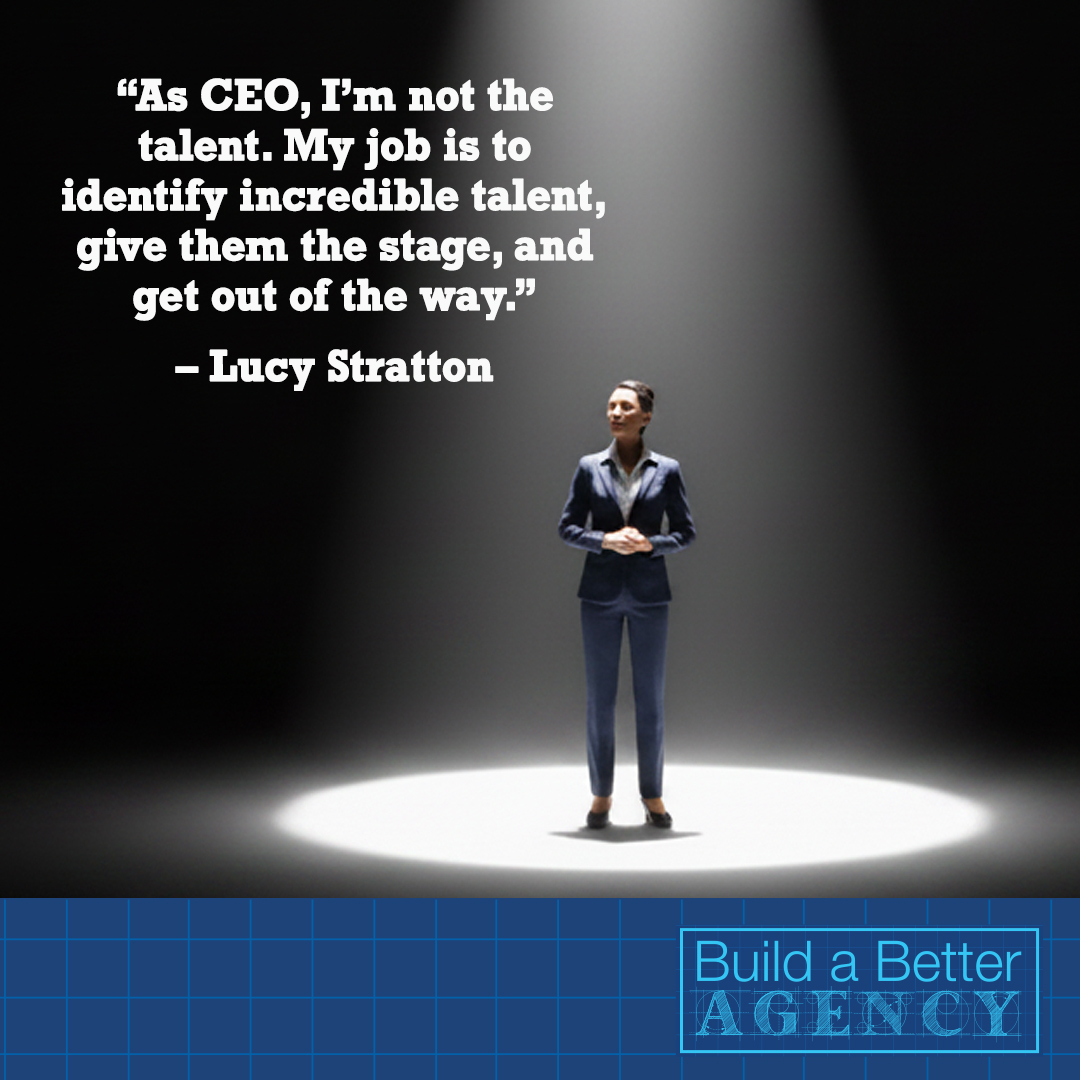
You know, maybe you can have a little bit of a vision as a CEO. But I think it’s more about like, how much room are you going to give your top talent? And how are you going to make it a place for them where they can do their absolute best? How can they run fastest without necessarily asking you for permission. Like, you don’t want to be that CEO who is delegating and giving them exact direction. It’s like you want them to be owning their role and coming up with business-changing initiatives and moving that forward and rethinking process and all of the different things. So yeah, you’re absolutely not the star performer anymore. I was thinking about exactly what you’re saying the other day where we were on site and somebody had asked me like, oh, what was that what was that like? And I was like, well, you know, for me, it’s actually— my job is to— I like liken it to a circus ringmaster. I’m like, I’m not the talent, I’m getting the talent in.
Drew McLellan [00:37:12]:
Right.
Lucy Stratton [00:37:13]:
Like, we— my job is to make sure that we have the stars in all the different spots. I certainly am like not the most skilled producer when it comes to, you know, very intense event. And, you know, I can, I can do a little bit of creative, but again, I don’t have those technical skills. Like, I’m in no way trying to master all of that. I think it’s like, identify that incredible talent, get them, you know, in the ring, make sure they’ve got the stage, and then get out of the way. So it’s— you’re in no way the star. You’re just trying to like raise, raise them up. So—
Drew McLellan [00:37:51]:
Yeah.
Lucy Stratton [00:37:51]:
I see that I see that a lot, which is very cool to see people really thriving and shining. But I would say compared to my old role, I did love, and I bet a lot of CEOs love, being in the trenches. And it’s a constant battle. And I’m always trying to personally find fulfillment between— I love being on, I love working with the team and doing a project and what have you. But oftentimes that dynamic shifts in a big way as CEO. It’s like, why is the CEO now involved in my work? Like, right, right. It totally changes the stakes.
Drew McLellan [00:38:28]:
This is, this is a challenge for everybody because you’re right, it’s not you, just you. This is one of the hardest parts of owning the agency or being in that CEO or president seat is you got into the business cuz you liked to do the work.
Lucy Stratton [00:38:44]:
Yes.
Drew McLellan [00:38:44]:
And now you don’t get to do the work. You get to celebrate and support and mentor and groom and grow the people doing the work. And so, you do have to find a different way to measure accomplishment and fulfillment. And where do you get your dopamine now if it’s not landing the big new client? What is satisfying to you? Because otherwise, what happens is And I’ve seen this a lot. Agency owners allow themselves to be pulled back into the work because A, they’re really good at it, and B, it does feel good. I mean, they like again, that’s a that’s a real visceral success and win, which is different than sitting in that president or CEO seat. So today, you’ve been doing it now for three years. Where where do you derive? the satisfaction in your work differently than when you were running biz dev?
Lucy Stratton [00:39:45]:
Mm-hmm. I— something that— and this is, this is sort of a new idea. I was just chatting with our president about it. But because we’re doing so well, because we have so many, you know, we’re firing on all cylinders, we have an incredible team. I, I think we could— like, a lot of the leaders are like, what is that next thing we can do? Like, what is something tangible we can build? We have the agency singing, and that’s wonderful. We’ve done a great job there. But I think to not just sit and run that and optimize that, which we will be doing, like, that’s important work that we need to keep doing.
Drew McLellan [00:40:24]:
Of course.
Lucy Stratton [00:40:25]:
But I think my next, the next thing on my list is like, what is something wild and out there? Like, what’s something we can launch It’s not looking for a new client logo. It’s like, what is something creative and out there that is going to inspire the team that’s going to still utilize our agency superpowers? That’s something I definitely want to focus on now. So I think on the, on the small level, like maybe it’s a new business line. And I don’t, I don’t know what this is, but like, we’re—
Drew McLellan [00:40:56]:
Right.
Lucy Stratton [00:40:56]:
You know, but let’s dream up something that we can sink our teeth into. We’re a creative agency. How do we you know, how are we constantly evolving? How are we making something new and exciting? So I don’t know.
Drew McLellan [00:41:09]:
It is evolving, right?
Lucy Stratton [00:41:10]:
Yeah, yeah. It’s like, do we start our own proprietary event or festival? Do we— we have a lot of hospitality background. Like, do we launch some sort of awesome hospitality experience? Or we have a ton of design experience. We have folks who come from, you know, that world of do we launch a product that would be a little bit outside of our core, but whatever it is, like, I’m excited about that. I think, and then I think combined with our amazing business that we already have, like, that’s only more growth engine fuel.
Drew McLellan [00:41:41]:
For sure.
Lucy Stratton [00:41:42]:
And I think that keeps the energy high. And I think that gives sort of that creative playground and there’s no guidelines there. So I think like, that’s what we’re really good at. Like how, like, I don’t know, it’s like, how might we create a cultural moment from scratch? could be the brainstorm prompt for this. This is like, I don’t know what it is yet. But I think there’s a lot of agency optimizing, process optimizing work that happens, like solving for bottlenecks. So we’re constantly doing that.
Drew McLellan [00:42:13]:
But— Right.
Lucy Stratton [00:42:13]:
Let’s do that. Let’s like refine our procedures. Let’s be perfect. But like, let’s also go build something fun. Because I think that you want to have that energy at all times. So It’s only going to be additive to what we’re doing, you know, which is we obviously, we also stay really busy. So it’s like, what can we do on top of this is to be determined. But that’s what I’m excited about. So I think that’s where, like, I find balance and, you know, not only running the business, making sure that we’re doing really well from a growth point of view, but then, you know, where else can we go? What is that new, cool, creative thing that is going to be just, you know, take us to the next level.
Drew McLellan [00:42:52]:
I think that’s actually a really great way to frame up the shift in working at an agency versus running an agency, which is when you work at an agency, like when you were the head of business development, you knew, you knew what the job was and you know what, you knew what success looked like. You might not know which logo you were chasing, but you knew, you knew what the ask of you was. And I think one of the interesting challenges about CEOs or presidents or owners, whoever’s in that sort of head of helm seat is, it’s your job to lead the agency into the unknown.
Lucy Stratton [00:43:27]:
Mm-hmm.
Drew McLellan [00:43:27]:
And you have to be brave enough and visionary enough to explore and to be open to possibilities and to guide the entire agency into the what-ifs, because that’s really what you’re talking about. You know, there’s, there’s a, there’s a finite number of what-ifs if you’re rank and file in an agency. But I think that’s the biggest shift is that you go from the known to the unknown, and now you’re responsible for opening up the doors to the unknown and seeing what is possible and which, which of the unknowns makes the most sense to pursue to the ultimate benefit of the agency, the clients you serve, the team you serve, all of that. And so that’s, I think that’s where the juice comes from over time is getting comfortable leading in, in like opening up a door in the dark and walking into it.
Lucy Stratton [00:44:25]:
Yeah. And maybe it works and maybe it makes a ton of money. Maybe it, maybe it’s additive revenue. We don’t know. We’ll see. Yeah. I think we’re always split. Creatives are always split on, I wanna do really cool, interesting work. And then as a business leader, And I, I, that’s me. Like, I’m a— I have that duality. I’m like, I want to do really cool shit, but I’m also very responsible for running this company and making sure that we grow and that we have, you know, that we have amazing success. And like, right, with the ESOP, that goes into everybody’s pockets too. So it’s, it’s like, and I’m like, oh, I know, I know that this would make us a lot of money, but I was like, I don’t think this is what everyone wants to do. Let’s Fine, let’s do that, but let’s also do something wild over here, you know, so that we can kind of serve all of those purposes.
Drew McLellan [00:45:14]:
Yeah, right. Yeah, it, it’s, it’s an interesting new transition for you for sure.
Lucy Stratton [00:45:20]:
Yes, absolutely.
Drew McLellan [00:45:22]:
This has been fascinating. Thanks for sort of— I, I, my goal with this episode was to get people just thinking about what does that transition look like. We don’t talk to a lot of people Mm-hmm. Who are new in the role of running the joint and the transition of that. And so I think it’s really valuable for people to hear what that felt like and looked like for you as they consider their own career path. You know, there are a lot of people sitting in leadership roles in agencies that are wondering if they should step into an ownership role, either start their own agency or buy their founder out or whatever that may be. And it is, it is a journey that should be carefully thought about. And so this has been a great conversation around that. I’m grateful that you were willing to come on the show and, and talk about it a little bit.
Lucy Stratton [00:46:11]:
Yeah, of course. Of course. Yeah. I think it is a very sort of niche topic, but will be important for a lot of people, a lot of listeners.
Drew McLellan [00:46:20]:
Yeah. Yeah. So if folks wanna learn more about your agency or get in touch with you, what’s the best way for them to do that?
Lucy Stratton [00:46:27]:
Yeah, I, I would check out our website. It’s agencyea.com. And then I’ve got my profile on there. I’m, I’m happy to, yeah, get in contact or on LinkedIn as well. I’m very active. So send me a message. I’d be happy to connect.
Drew McLellan [00:46:40]:
Great. This has been fun. Thank you very much for, for joining us today.
Lucy Stratton [00:46:45]:
Great. Thanks a lot for having me, Drew.
Drew McLellan [00:46:47]:
You bet. Okay guys, so here’s some homework. I want you to, regardless of where your role is in the agency, If you are the owner or the leader or the president or the CEO, I want you to ask yourself, because you may not have thought about it, but where does the juice come from for you? Again, it used to be when you were a producer, you knew exactly what success looked like and you knew how to sort of get your dopamine hit from that. But as Lucy was talking about, it, it shifts. So I think it’s important for us because the work is hard. It’s good to know. where you get that energy from so you make sure that you feed that energy, that you get enough of it. So that’s your homework. If you are a leader in the organization, I want you to think about what that transition would look like for you. There’s nothing wrong with deciding you’re perfectly content to be a department head and sit on the leadership team and not step into that mantle of command. Or if you are, if that does interest you, then it’s perfectly appropriate for you to sort of go, you know what, I need to start initiating conversations. One of the things that I find is often true is that owners and leaders do not have that conversation with enough candor early enough in, in the process. So, if you’re a, if you’re a leader in an organization and you think, boy, someday I would like to own this agency, have the courage to say, to talk to your owner about that. And if you’re an owner and you’ve identified someone who is your Lucy, who is your successor, a lot of times you wait too long to talk to them and they think you’re not thinking that way about them. And there’s just a lot of miscommunication from the lack of communication. So I encourage you, if you’re on either end of that fence, to reach over and, and initiate that first conversation. It doesn’t have to be tied to a timetable. It doesn’t have to have a price tag to it. It’s just about that you’re interested in it. And that you would like to learn more and that you would like to grow towards, or that, that this is the person you’ve identified and you would like to start mentoring them in a different way. Really important conversations to have at an agency today. All right. Before I let you go, of course, you know, I want to say thanks to our friends at White Label IQ. They’re the presenting sponsor of the podcast. So super grateful to them. Talked about them at the top of the hour. So whitelabeliq.com. And last but not least, thank you for listening. I don’t get to do this if you don’t keep coming back. So I am very grateful that you listen week after week and that we’ve been doing this together for, gosh, over a decade now. I’m coming back next week and I hope you will too. All right, I’ll see you next week.
Drew McLellan [00:49:28]:
That’s all for this episode of AMI’s Build a Better Agency podcast. Be sure to visit us at amibuildsabetteragency.com. Visit agencymanagementinstitute.com to learn more about our workshops, online courses, and other ways we serve small to midsize agencies. Don’t forget to subscribe today so you don’t miss an episode.