
Episode 515

Welcome to another episode of Build a Better Agency! In this special solo cast, host Drew McLellan tackles one of the perennial challenges and hottest conversations among agency leaders: how to strategically shape your agency team for lasting success. Drawing on decades of experience and access to the financial workings of hundreds of agencies, Drew provides listeners with a timely and insightful look at evolving team structures as agencies gear up for 2026.
Drew shares fascinating trends shaping today’s agency workforce, including the rise of smaller in-house teams, increased reliance on part-time employees, contractors, and global talent, as well as the impact of AI on traditional roles. He explores why the most profitable agencies typically have teams between 12 and 40 people, and details how agencies are leveraging a blend of strategic full-timers and specialized contractors to maximize expertise while remaining nimble. Throughout the episode, Drew challenges listeners to move beyond old paradigms of in-house staffing, instead embracing flexible models that respond to both economic realities and shifting client needs.
Listeners will gain practical advice for preparing their own agencies for the future. Drew urges owners to focus on cultivating “Sherpa-like” team members—those who act as strategic guides and teachers for clients, rather than simply executing deliverables. He highlights the growing importance of nurturing a culture of continuous learning and adaptability, as well as prioritizing skills and problem-solving ability over traditional credentials in new hires.
If you’re ready to future-proof your agency, enhance your strategic value to clients, and reimagine what a modern, high-performing agency team should look like, this episode is packed with actionable insights and food for thought. Whether you’re planning for next quarter or looking ahead to 2026, Drew’s thoughtful analysis and forward-thinking advice will help you start important conversations about the future of your agency.
A big thank you to our podcast’s presenting sponsor, White Label IQ. They’re an amazing resource for agencies who want to outsource their design, dev, or PPC work at wholesale prices. Check out their special offer (10 free hours!) for podcast listeners here.
What You Will Learn in This Episode:
-
- Shifting agency team structures for maximum profitability
- The growing blend of full-time, part-time, and contract talent
- Leveraging global talent for specialized and technical roles
- The impact of AI on team composition and the “hollowing out” of the agency pyramid
- Evolving client needs: strategic partners and “Sherpa”-style leadership
- Rethinking hiring for skills and adaptability over formal education
- Building a learning organization to stay ahead in a rapidly changing landscape
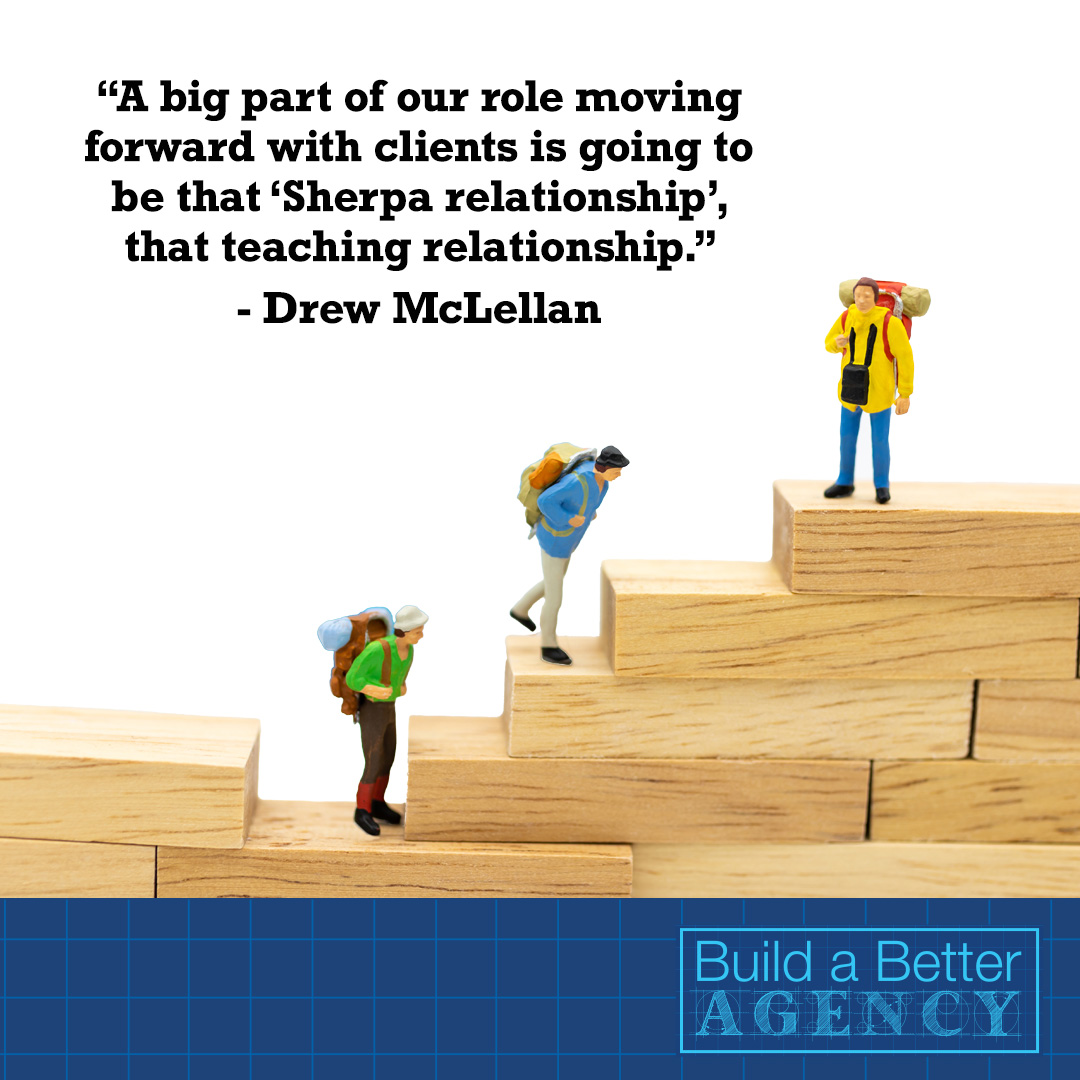
“A big part of our role moving forward with clients is going to be that ‘Sherpa relationship’, that teaching relationship.” - Drew McLellan Share on X
“Bigger isn’t always better—most profitable agencies have between 12 and 40 employeess.” - Drew McLellan Share on X
“Today’s most successful agencies are smaller, more specialized, and built on a mix of full-time staff, part-timers, contractors, and global talent.” - Drew McLellan Share on X
“AI is hollowing out the agency pyramid—replacing or augmenting task-based roles while increasing demand for strategic thinkers.” - Drew McLellan Share on X
“The one thing clients will always need is a strategic partner who can find the business problem beneath the business problem and help solve it.’” - Drew McLellan Share on X
Ways to contact Drew:
- Email: [email protected]
- LinkedIn: www.linkedin.com/in/drewmclellan
- Website: https://agencymanagementinstitute.com/
Resources:
- BaBA Summit May 18-20, 2026: https://agencymanagementinstitute.com/babasummit/
- Book: Sell With Authority
- AMI Facebook Group: https://www.facebook.com/agencymanagementinstitute
- AMI Preferred Partners: https://agencymanagementinstitute.com/ami-preferred-partners/
- Agency Edge Research Series: https://agencymanagementinstitute.com/agency-tools/agency-edge-research-series/
- Upcoming workshops: https://agencymanagementinstitute.com/advertising-agency-training/workshop-calendar/
- Weekly Newsletter: https://agencymanagementinstitute.com/newsletter-sign-up-form/
- Agency Coaching and Consulting: https://agencymanagementinstitute.com/advertising-agency-consulting/agency-coaching-consulting/
Hey everybody. Drew McLellan here from Agency Management Institute, back with another episode of Build a Better Agency. Super excited to be with you today. This is one of my solo casts. So if you are new to the podcast, this is an episode where I don’t have a guest, where it’s just you and me chatting about something that I think you need to be thinking about or I’ve been talking to a lot of agency owners about and I just want to make sure you’re thinking about it as well.
So before I tell you what we’re going to talk about today, the other thing we do on every solo cast is we give away a free workshop seat. So the way this works is super simple. To get into the drawing for a free workshop seat, you just leave a rating and review on any site where you download the podcast. So it might be Apple Podcasts or Iheart or Spotify or wherever you get your podcast. You can leave a rating and a review for this podcast, take a screenshot of it and then email it to me at [email protected] as soon as you do that, you get put in the drawing and you don’t get taken out of the drawing until you win. So the universe of agency owners is not that great. And the universe of people who will take the three minutes to do this to win a $2,000 workshop seat are even smaller. So your odds are pretty good. So it’s definitely worth making the effort, taking the time and sending me that screenshot.
So back in 24, Laura Williams from Insync Media did that, wrote a lovely review about the podcast and Laura, congratulations. You are this month’s winner. I’ll reach out to you. So Laura, now all she has to do is get to Denver and the workshop itself, which retails for non members at about $2,000, is free to Laura to attend to, grow to learn, to bring back to her agency. So again, not a bad return on your three minute investment. So if you have not left us a ratings and review, please go do that and then send it to me [email protected] so that I can put you in the drawing. Laura, I will reach out to you and give you the details, but congratulations.
All right, so here’s what I want to talk about today. We’ve been talking a lot. First of all, this is a perennial favorite topic. So this is not a new, this is not a new hot topic. I think for as long as I’ve been an agency owner, long before I owned ami, the truth is that there were two things that you could always count on agency owners talking about when they got together. One was new business and that it was challenging and what you were doing to get, you know, break in the door. And two was our employees. So I want to talk a little bit about team makeup and some of the trends that we’re seeing. Some of the things I want you to be thinking about as we, as we march our way into the fall of 2025. If you’re listening to this real time, you know, this is a good time for you to be thinking about your 26 plan. We’ll talk in the next solo cast about what you should be doing to plan for 26. We’ll have a bigger conversation about that planning. But I want to, I want to see that conversation with this topic around the team.
So agencies typically, back in the day, back, you know, when I was early in my career, agencies were measured based on the number of employees you had and the more employees you had, the more successful you were. Well, the truth of the matter is that’s not always the case. You know, we see the full financials of, I don’t know, about 350 or 400 agencies across the land. And I will tell you that the agencies that are most profitable range between about 12 employees to about 40 employees. That’s where they are the highest double digit profitability. So bigger is not always better. I’m not saying you can’t make a lot of money by being a larger agency. I’m just saying that the percentages would suggest that there is a sweet spot for maximum profitability, which is 12 to 40 people. So, and I can, I can talk in a minute about all of that, why I think that is. But the truth of the matter is one of the things that we’ve been seeing, one of the trends we’ve been seeing, and this is pre Covid, is that agencies have been getting smaller. And I think there are a couple of reasons for that.
So first of all, I think that to be an agency Smaller than 12 people is challenging because everybody’s gotta have Multiple skills, everyone’s wearing multiple hats. Odds are you don’t have really robust systems and processes built out. And so you’re doing a lot of it sort of on tribal knowledge, as opposed to having a project management system or a project manager running that project management system. It’s just harder when you don’t have more people on the bench to help. It’s hard to cover maternity and paternity leaves. It’s hard to even cover vacations because you’re so small. So that’s the challenge. Once you get to 10, 12 people now you can have people that are sort of in a lane, and they are specialists in something that they do. And that just gets easier and easier, obviously, as you get bigger. So that idea of specialization is both to our advantage, but today it’s also to our disadvantage.
So back in the Mad Men days, you know, you had account people, you might have had a salesperson, and then you had writers and artists, and that was pretty much it. Maybe you had a production manager who oversaw the making of the things, but that was it. The swim lanes were few and far between because the work we did was much simpler than it is today. Today, an agency needs so many different specialties, so many different areas of expertise the work do, especially if we’re producing end results, if we’re producing deliverables, as opposed to just strategy. But the work we do is so much more complicated and nuanced, and you need to have specialists.
So for a long time, agency owners believed that they needed to have everybody in house, that there was this idea that we had to have all of those specialists in our shop 40 hours a week who could help us accomplish what we wanted to accomplish. Leading up to Covid, already we were starting to see that shift. Agencies who had sworn they would never have contract labor, they would never have an outside resource helping their clients, started to lean into that for really specialty skill sets. And it started with some obvious things like, oh, you know what I can remember when I started my agency, I was at a very large agency, Y and R, and we had everything in it.
So we had a full production department, we had a whole research department. But as agencies got smaller and as I moved into smaller agencies, agencies couldn’t afford to have a video director, a camera guy, a gopher, an editor, a producer. You couldn’t afford to have all of that. You couldn’t have an entire research team. So there were some ancillary. Ancillary services that agencies started to farm out. And so that started with things like video and audio Production back in the day, it started with illustrations. Maybe you didn’t have an art director who, who was good at illustrations. Started with things like research. So those began to be farmed out either to a freelancer or to oftentimes a partner company. So it would be a production house or a research firm or something like that. So that was agencies first foray into outsourcing. And then agencies got to the point where there were some skill sets that they needed certain kinds of web design work or coding or things like that that they just could not justify keeping on staff full time. And so they started outsourcing that.
Leading up to Covid, we were seeing that pretty much every agency had started to become a bit of a hybrid in terms of we have our full time employees and we have a small team of trusted contractors that do work for us that we just don’t sell enough of to justify a full time hire that was sort of going into Covid. And then Covid really shook things up for all of us in a couple ways.
Number one, we by, by demand, by force, had to learn how to work in a remote fashion. So many of you prior to Covid, owned your building, rented a space and were very committed to being in person. You saw the value of it. And I’m not diminishing the value of this, by the way. A lot of agencies are going back into more office time or more collaborative work time where they’re coming back together, but you saw the value in being together and you did not want to have a dispersed team with the exception sometimes of your contractors. Obviously part of here in the United States, part of the IRS rules are that you can’t make contractors work in your office. So that was the one exception to the rule at some point in time for many agency owners was that. So we come into Covid and we come as we’re coming out of COVID two things happen.
Number one, we realized that for some agencies it worked pretty well to be remote or hybrid or have a dispersed team that was not all in the same geography. And number two, we walked right into the Great Resignation where a lot of people for a lot of reasons decided they didn’t want to go back to work, or they didn’t want to go back to full time, or they didn’t want to go back to the office. And so agency owners had to rethink the way they viewed how they staffed.
So that trend has continued that many agencies now have this mix of a remote workers, full time workers, or hybrid workers. But also there’s A better mix, not meaning that it’s preferred. I just mean a greater mix. That would be a better word. A greater mix of full time employees and contractors. So you come out of the great resignation and Covid and you know, Covid was challenging because back then everybody was hiring anybody that could walk upright and breathe because the, it was so challenging to find talent. So as we, as we rejiggered our team out of necessity really with COVID and then the great resignation, some interesting trends emerged.
So now today, so again 2025, if you’re listening to this in real time today, now a handful of years outside of COVID we see agency teams looking very different. And I want to tell you what we see now and then I want to ask you some questions to think about for yourself as you think about 2026 and beyond. So here’s what we’re seeing now. We are seeing smaller full time teams. So most agencies have fewer full time employees than, than they did a couple years ago. And for many of you that is a mix of economic realities, right?
So new business has been challenging, but also, and more important, you have different needs and skill sets and it’s harder to have all of those people in house full time. And today’s workforce has a different attitude about work. And so what we’re finding is more and more employees are open to, to a different arrangement than the traditional five days a week, 40 hour work week. So what we’re finding is agencies have fewer full time employees, they have more part time employees. So people working three, four days a week for an appropriate salary. We find people job sharing. So two people may share the same job and one works a couple days and the other one works three days if you need that job full time. We’re seeing more people leaning into contract labor, which again, this is a trend that’s been going on for really probably a decade now or more. But more of you are working with contractors and the contractors are either individual freelancers or in many cases you’re partnering with an agency or another company that has a specialty that you don’t have in house.
So you know, the sponsor of our podcast, White Label IQ is a great example. So for a lot of agencies that don’t want to have a web dev team in house, they’re partnering with a company like White Label who becomes their, basically their department for web dev, design and PPC work because they can just plug them in and they’re able to take care of their clients without having that on their payroll. So we’re seeing more of that, whether again it’s an individual contractor or, or it’s a partner, we’re also seeing a shift. And this happened, I would say over the last five or six years, but it’s really ramped up in the last couple of years. So many of you have used Global Talent for virtual assistants and sort of administrative work.
But what’s happened over the last probably five or six years is that agencies are starting to hire Global Talent for highly technical or highly skilled jobs. So recognizing that you could get a great account service person, or a great backend web developer, or a great art director who happens to live in another country, who is willing to work your office hours, is going to participate is full time to you. That’s the other shift.
When we’re doing VAs, when we’re doing global VAs, you would buy them for 10, 15, 20 hours a week. But now these, these new hires, these new global hires are more critical to the team and the work that you do. And so typically you’re hiring them full time and they are on board just like any other employee. They just happen to live in another country and in many cases they match their work hours with your work hours. So they participate in team meetings, they participate in retreats, they participate in everything that your employees do. They just happen to live in another country.
So now we have this interesting mix of smaller full time teams, more part time employees, and again, this has nothing to do with whether you come into into an office or not. That’s a whole different discussion. But fewer full time employees, more part time employees, more people job sharing, deeper relationships with outside partners, whether they’re contractors or partner companies. Like a white label. And we are seeing more global talent full time. So that mix is very different and it allows you to have more areas of specialty under your roof because they’re not all there full time. And as the demands of our clients shift, agencies are shifting with it. So what we’re seeing is again the smaller full time team.
But here’s who’s staying in full time. It’s your more technical people and it is your account service people. So basically your thinkers, your relationship owners are full time to you and are typically in the country of your origin. So they are able to meet with clients, to travel to clients with ease, things like that. And we’re seeing fewer pure creatives, we’re seeing fewer junior team members. So this is an interesting impact that AI is starting to have on our teams is it’s called hollowing out the pyramid. So one of the things that AI is doing is that it is recognizing that it can’t replace the strategic thinkers at the top of the pyramid, but it can replace a lot of the doers, the worker bees. Some of the task oriented roles that we have in our agency can either replace them or it can augment them. So you need fewer of them because it’s helping the people that you do have do their work more efficiently, more effectively and faster.
The other thing we’re seeing is we’re seeing a shift in how you hire. So one of the things that used to be that if you didn’t have a marketing degree or some sort of advertising degree, it was challenging to break into the agency space. But now what we’re seeing is degree based hiring. So even expecting someone to have a degree at all is very different. We’re seeing more agencies hiring for skills and the adaptability sort of the able to be nimble to keep learning, to have that sort of. I did the skill this way today, but by tomorrow I need to learn a new way to do the skill. That sort of, that mindset of constant learning and experimentation are more in demand. And so for the first time ever, we’re seeing a lot of people get hired at agencies that may not have the formal education that you and I had when we broke into the business. And we certainly are seeing more full time international team members.
So that’s kind of the makeup today is it is sort of this melting pot of, of employees and partners that are coming together with a wider set of skills, a deeper set of skills to meet the demands of today’s client. What hasn’t changed, and honestly what I think will never change, is those people who own the strategy, who can have the deeper conversations with the client, who can really suss out the business issue and, and then help them figure out how we’re going to tackle or solve that business issue, the demand for that and keeping that in house, keeping that really close to your vest because that is what the client values most. That’s not changing, that’s staying in house.
And in fact we are. I’m excited. We’re partnering with Marcus Sheridan this fall to offer a new course to teach everybody in your agency how to be more strategic. And so watch for that as we talk about it in the newsletter and other places later this fall. But that idea of being strategic, particularly as our tools around us get more sophisticated, as clients believe right or wrong, that they can kind of leverage some of those tools themselves to make do the basic blocking and tackling that we do to sort of make the most simple of deliverables.
The one thing that they always will need is, is somebody who has that outside perspective, that strategic mindset that asks better questions, that can lean into a business problem and find the business problem underneath the business problem and then help solve it. And so for all of you, that you’re not outsourcing, that you are hungry to keep growing and grooming inside your agency. And so that’s what shops are looking like today.
So let’s talk about what I think is coming down the road and what I want you to start thinking about as you gear up for 2026. I know it sounds weird to say that when it’s still summertime, but boy, as we know, that’ll be right. It’ll be here, right around the corner. So if that is true, if you have a smaller full time team and you have more of your technical and strategic people on the full time team and then you’ve got a mix of part timers, contract partners and global talent, which again, some of your global talent could be that technical expertise that you have on full time when your team is structured like that and you start thinking about what clients are going to need from you.
You know, one of the, one of the big takeaways from our 2025 agency Edge Research was clients are hungry for and are in desperate need of strategic partners. They want thinking partners and even more so even when it comes to AI, they want teachers, they want Sherpas. And I want you to start thinking about your agency as though you are a Sherpa. So a Sherpa is somebody who, when I think of a Sherpa, I always think of somebody who’s leading like on a, a mountain climb, a mountain trek expedition. So a Sherpa is the expert who has gone up and down that mountain a million times and they know exactly what equipment you need. They have it all packed for you. They’ve got the donkeys all loaded up with the tents and the food and all of the tools that you’re going to need. And there’s going to be some Sherpas on the front end and they’re going to be some Sherpas on the back end and they are going to guide you up the mountain.
And not only are they going to physically guide you up the mountain by knowing what path to take, by watching the weather conditions, by knowing when it’s time to stop and take a break or stop for the night, but they’re also watching. I have a lot of friends. I have not done this. I have A lot of friends who have done a lot of mountain climbing with Sherpas, you know, I’ve gone up like Kilimanjaro and that sort of thing.
One of the things they talk about is that the most valuable thing about the Sherpa is the emotional support, the mental support, the hang in there, we can solve this problem. The when you want to sit down and stop and start to cry, they help you. They let you cry for a minute, but then they get you back up and they get you back on the path. And I think that that’s a critical part of what we do too. I don’t think it’s just your technical expertise, your ability to navigate the mountain, but I also think that it is your ability to support your clients, to cheer them on, to help them stay focused and energized and all of that. So that’s, I believe, where agencies are going more and more. Sherpa esque, teacher, esque guide esque, and less and less of the actual doing of the things.
Will we always make some sort of marketing materials? Probably, but we’re already seeing. Most of you are already seeing that clients are more willing to do some of that work on their own. They believe they can do it faster. They believe they can do it more cost effectively. And in some cases, that’s true. So we’ve got to be. If we. If we are going to be valuable. And this is why niching is so important, because niching is that you’re a subject matter expert. So a Sherpa can’t go to any mountain and lead a team up that mountain with the same prowess that they can their mountain. Right. They know that mountain. They know the paths on that mountain. They know the weather patterns in that region of the world. Could they go up any mountain? Probably. But do they do it as well and as quickly and as efficiently and as safely? No.
And that’s what your clients want too. They want someone who knows their mountain and they want someone who can, who has done the climb up their mountain a million times. That’s what gives them confidence. Every client wants to feel safe. Every client wants to know that they are in some in good hands and that they are able to sort of navigate up that mountain with their agency.
So as you think about 2026, I want you to keep this idea of the Sherpa in your head. And I want you to start thinking about what does your agency need to have all the Sherpas in house? Right. And then what do you. What do the Sherpas need to Support them. So what stores do they need to go to, if you will, to stay with the analogy, to load up the donkeys with the right equipment? Who do they need to talk to about a particular weather condition that’s coming in, a storm that’s coming in. But who are the Sherpas on your team? And how do you keep your Sherpas sharp? This, I think, is going to be one of the most critical questions we ask ourselves. How do we, even more than we ever have before, how do we create a learning organization filled with people who are hungry to keep getting better, who are hungry to not only keep getting better, but are great teachers?
Great teachers internally and, and great teachers externally? Because I believe that a big part of our role moving forward with clients is going to be that Sherpa relationship, that teaching relationship, you know, Again, the agency Edge research from this year said loud and clear, what clients want is, when it comes to AI, is they want us to be their Sherpas, they want us to be their teachers, they want us to assess what kind of AI tools and policies and rules they need to have inside their organization, not just in marketing, but in general, and then to teach them how to use AI more effectively in their organization. They want teachers, they want thinking partners, they want strategy. And so as you lean into that for your clients, the question is, who do you need to have on your team to deliver that? That’s what I want you to be thinking about as we round the bend into fall of 25. Who do I need on my team and then how do I keep helping them get smarter and smarter? I think Those are the two critical questions to ask yourself for 2026.
And by the way, you’re not exempt from that. How do I keep getting smarter? How do I keep adding more value in whatever role you play in the agency? Hopefully it’s about new business. Hopefully it’s around growing and mentoring your team. And you’re following sort of our methodology for what agency owners should do. But you too have to keep growing because otherwise you’re not going to be able to have the conversations on the sales side that you need to have to demonstrate to your clients that you know your stuff. So that’s it for today. That’s what I want you to think about. I want you to think about the makeup of your team and how you want to carefully shape, mold and support your team going into 2026 and what do you want that to look like. And if you don’t have that right mix of people that full time, part time, the contractor partners, the global talent. If you don’t have that, how could you retool your team to better be prepared to guide your client up that mountain? Those are worthy questions to ask.
And so I’m going to leave you with that. I want to for sure stop and say to our friends at White Label who I mentioned earlier, thank you. They are the presenting sponsor of this podcast. They actually did this. They really figured out they were born of an agency and the agency needed a depth of expertise that they couldn’t find in house. They couldn’t hire it fast enough. So they actually built a sister company that all they do is support agencies to do web design and builds ppc. They do apps and other things, other digital builds, databases, things like that. And so it’s design, dev and PPC. So check them [email protected] AMI if nothing else, please send them a note and thank them for sponsoring the podcast. That would make me very happy to hear that they were flooded with thank you notes from folks who are grateful for them.
I will be back next week with a guest, but in the meantime, this has been a great conversation. I know it felt like a monologue on my end, but I’m hoping you’re talking back to me and you’re asking questions of yourself and you’re thinking about what I’m saying. I think this is critical. The one thing that makes us different from everybody else is the mountains we know how to climb and the team that we take up that mountain with us. And so these are really critical questions for you to ask yourself as you go into next year and as we go into the future. And as AI is rapidly rewriting the future, we have to rapidly rewrite our future as well. And I think it starts with the team. So give this some thought. Have some conversations with your leadership team or if you’re in an agency, if you’re in an AMI peer group. This is a great conversation to have with your peer group members. But what is that team going to look like in the future? And how are you going to make sure that you can scale that mountain for your clients? All right, okay. See you next week.
That’s a wrap for this week’s episode of Build a better agency. Visit agencymanagementinstitute.com to check out our workshops, coaching and consulting packages and all the other ways we serve agencies just like yours. Thanks for listening.