
Episode 578

Welcome to another thought-provoking episode of Build a Better Agency! This week, host Drew McLellan sits down with category design expert Kevin Maney for a conversation that will have you rethinking what truly sets your agency apart. Drawing from decades of experience as a tech journalist and co-author of landmark books like Play Bigger and The Category Creation Formula, Kevin Maney unpacks the pitfalls of simply striving to be “better” and instead shares actionable strategies for helping agencies carve out and own their own unique category.
Together, Drew McLellan and Kevin Maney dig deep into the concept of category design—why being “better” than the competition is a recipe for constant comparison, and how agencies can escape this cycle by identifying what’s actually missing in their market. Kevin Maney introduces listeners to his simple yet powerful formula: context + missing + innovation = new category. You’ll hear how this approach can help your agency move beyond incremental improvements and create truly meaningful differentiation that resonates with both clients and prospects.
Listeners are provided with real-world examples, including a behind-the-scenes look at Kevin Maney’s work with LinkedIn and how discovering new context and unmet needs revitalized their Sales Navigator division. The episode also offers practical advice on running the category creation exercise with your own team, crafting a compelling point of view (POV) document, and ensuring your messaging is centered around your clients’ challenges and aspirations rather than your agency’s credentials.
Whether you’re struggling to stand out in a crowded market, or you’re looking for a framework to help your clients do the same, this episode is filled with actionable inspiration. Listen in to discover how reframing your strategy can help you own a unique space, align your team, and tell irresistible stories that engage prospects and clients alike.
A big thank you to our podcast’s presenting sponsor, White Label IQ. They’re an amazing resource for agencies who want to outsource their design, dev, or PPC work at wholesale prices. Check out their special offer (10 free hours!) for podcast listeners here.
What You Will Learn in This Episode:
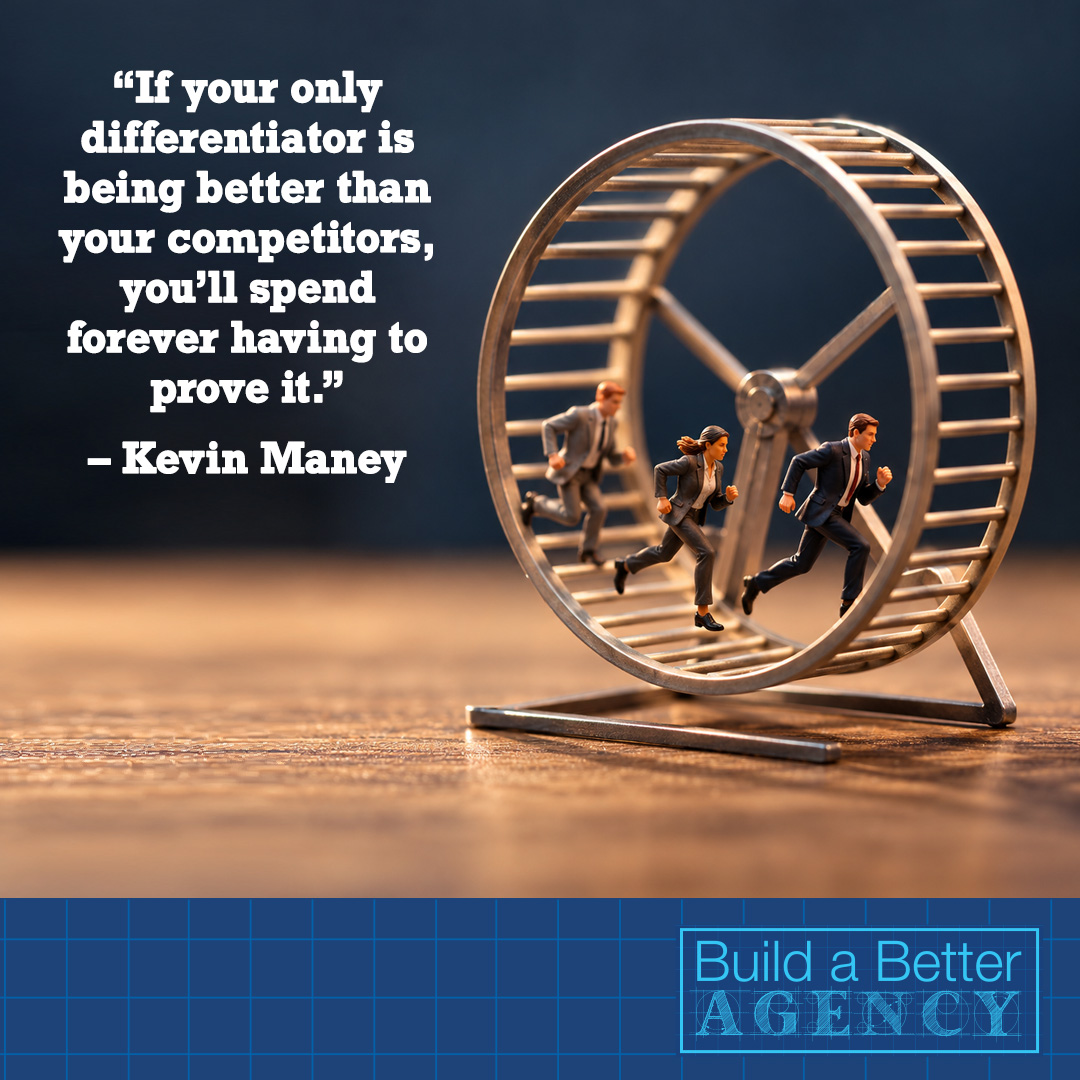
- Why positioning your agency as “better” forces you to re-argue your value every time a key staffer leaves
- How to apply the context plus missing plus innovation formula to uncover a category your agency can own
- Why you shouldn’t ask your customers what’s missing, and who you should gather in the room instead
- How LinkedIn Sales Navigator used the “deep sales” concept to go from slowest to fastest growing division in two years
- How to use the adjacent possible to keep your positioning from landing too safe or too far out
- How to structure a point of view document, from describing the problem to the brief case for why you’re the one to solve it
- Why a point of view should replace your About Us content in RFPs, websites, sales decks, and job descriptions
Ways to contact Kevin:
- LinkedIn: https://www.linkedin.com/in/kevinmaney/
- Website: https://categorydesignadvisors.com
- Website (Personal): https://kevinmaney.com
Resources:
- The Category Creation Formula (February 2026): https://a.co/d/0aVLOMdm
- Category Design Advisors Office Hours (free 30-minute sessions): https://categorydesignadvisors.com
- BaBA Summit May 24-26, 2027: https://agencymanagementinstitute.com/babasummit/
- Drew’s Book: Sell With Authority
- AMI Facebook Group: https://www.facebook.com/agencymanagementinstitute
- AMI Preferred Partners: https://agencymanagementinstitute.com/ami-preferred-partners/
- Agency Edge Research Series: https://agencymanagementinstitute.com/agency-tools/agency-edge-research-series/
- Upcoming workshops: https://agencymanagementinstitute.com/advertising-agency-training/workshop-calendar/
- Weekly Newsletter: https://agencymanagementinstitute.com/newsletter-sign-up-form/
- Agency Coaching and Consulting: https://agencymanagementinstitute.com/advertising-agency-consulting/agency-coaching-consulting/
Danyel McLellan [00:00:01]:
Running an agency can be a lonely proposition, but it doesn’t have to be. We can learn how to be better, faster if we learn together. Welcome to Agency Management Institute’s Build a Better Agency podcast presented by White Label IQ. Tune in every week for insights on how small to midsize agencies are surviving and thriving in today’s market. With 25+ years of experience as both an agency owner and agency consultant, please welcome your host, Drew McLellan.
Drew McLellan [00:00:34]:
Hey everybody, Drew McLellan here from Agency Management Institute, back with you with another episode of Build a Better Agency. And you are gonna love this one. This is a, a great conversation. I know, uh, we’re gonna learn a lot. I know that we are going to walk away with a lot of things to think about, and I know I’m gonna have some homework for you at the end. But before I tell you more about our guest, I just wanna remind you that this would not be possible if it were out for our friends at White Label IQ. They are the presenting sponsor of this podcast and incredibly generous to AMI and to AMI members. And if you’re not familiar with them, White Label IQ is a group that was formed from an agency. So one of the things I love about the folks at White Label IQ is that they only work with agencies. That’s it. That’s their whole business model. And here’s where that comes from. Brian Gerstner, who runs it, was running an agency and he tells it like this, that he was hiring freelancers, he was hiring internally, nobody was good at everything, and his internal people would bottleneck. So he’d sell a couple projects and then everyone would freak out. You know what that feels like, right? So how in the world can we get that work done? We’ve got to hire somebody. And so what Brian did was he went to India, he set up shop there, He actually partnered with and then purchased an agency there and started taking the overflow from his agency to that group of very talented people. And now today he does the same thing for all their clients. That overflow that he was helping his agency friends with back in the day, that became White Label IQ. So you never have to explain agency life to these folks because they get it. They have lived it and they do white label design, dev, PPC, AI implementation, anything technical, they’re your people. If you’ve got a client with an old, old, like a Joomla site that you haven’t touched Joomla in years, White Label IQ has somebody who’s an expert. So check them out at whitelabeliq.com/ami. All right. Okay. Let me tell you a little bit about our guest today. So really interesting guy that I, that I’m excited to introduce you to. So Kevin Maney has spent 22 years as USA Today’s technology columnist, which means he had a front row seat while the internet, the smartphone, and now AI rewired just about everything. About 10 years ago, he co-wrote a book called Play Bigger, and that book gave the business world the idea of category design. And you’ve heard us talk about that on other episodes before. Since then, he and his partner have run category projects with about 50 companies through their firm, Category Design Advisors, and they’ve boiled down what actually works into a simple formula in their brand new book, The Category Creation Formula. He’s also co-written another book called The Human Machine Company, which is all about why you can’t just bolt AI onto a business that you already have. So really cool. Helped a lot of businesses sort of identify how do they niche down, how do they talk about themselves differently and the value of that. And he, I’m gonna get him to walk us through that formula so we can gut check not only our own distinction, but you guys can do it for your clients as well. All right. All right. Let’s welcome Kevin to the show. Kevin, welcome to the podcast. Thanks for joining us.
Kevin Maney [00:04:10]:
Thanks, Drew. you having me on.
Drew McLellan [00:04:13]:
Give everybody a little sense of your background. I sort of teed it up for them during the intro, but give them an idea of sort of how you’ve been spending your time lately.
Kevin Maney [00:04:22]:
Well, background is kind of long and varied. I was a journalist and author in this tech arena since the late ’80s and have covered everything and interviewed everybody and written books that range from a biography of Thomas Watson, who built IBM, to big idea books such as Play Bigger, which came out in 2016 and really changed my life because after that started, you know, Play Bigger introduced this concept of category design, the book, most successful book I’ve ever been a part of. And it became part of the conversation in, especially in the, you know, tech startup circles, but more widely. than that too, and led to me starting a consulting business called Category Design Advisors that I’ve been doing for 10, 11 years now and helping companies do this thing we called category design.
Drew McLellan [00:05:18]:
Yeah. And, uh, at AMI, when we talk to agencies, we talk a lot about having to differentiate yourself and all of that. And so one of the, one of the kind of learnings that is woven through a lot of your writing is this idea of when a, when a company wants to be better, that, that’s sort of a trap that they fall into. Can you talk a little bit about how better isn’t enough and what the trap is? And what does that look like from the outside if someone’s looking at a better company, uh, and, and what we, what we’re missing in that pursuit?
Kevin Maney [00:05:53]:
Well, yeah, it’s a good question because, you know, so many companies pitch themselves as, you know, we’re better, right? We’re either lower price or we’ve got a few more features. And if you’re an agency, we can have some better writers or whatever, right? Yeah. But the reason it’s a trap is because it’s an argument you have to constantly have, right? You’re not implanting yourself in people’s minds as like, this is the go-to. They’re comparing you to other agencies and saying, okay, well, you know, and you have to constantly make that argument. And look, I mean, there are thousands, millions probably of companies out there that ride on that better argument and make a perfectly good business and living, but you’re not going to be a breakout, like enduring success by constantly making that argument.
Drew McLellan [00:06:44]:
Well, and in our space, better really implies I have smarter, better people because we don’t have a lot of other things that we have frameworks, we have beliefs, but it really is based on our people. So, To me, every time when you say better, every time you have a staff change, you have to reprove better. Right. Because Bob left or Mary left or whatever it is. So I think that’s, it’s, I think it’s super challenging, particularly in this world of AI. So I’m curious, as everybody has access to these same amazing tools, how has that changed or has it changed kind of the way you look at category design? For businesses in general, but in our case, in our conversation today for agencies?
Kevin Maney [00:07:27]:
Well, and first of all, I would say that we can get to the topic of AI and all of that. I don’t think it’s changed the way we look at the market or the way we look at strategy. And so what I would tell your audience is that the way to be enduring and different is to start with the market and look inwards from there. Instead of starting with you and trying to pitch yourself to a market. And so the last book that we had out, the title of the book is The Category Creation Formula. And it’s because over the years of doing this work with companies, we found a lot of thinking tools that are really helpful. And a lot of them are in the book. And we’ve tried to codify all these things that we’ve done over the past 10 years. But the title is that because the single most powerful thing that we’ve come across is this very simple way of thinking about a strategy and the market you want to address. So this, we have this formula and the formula is context plus missing plus innovation equals a, like a new category that you can create. And so to explain that, and I would tell your audience, like, go through this exercise because it actually can identify a way for you to be something different rather than just better. And so context is, what is happening and what is changing around your target audience? And that includes everything from, and this is where AI comes into play, that includes everything from technology shifts like AI or whatever comes along. But it also includes, you know, depending on the audience you want to address, maybe geopolitics comes into play. Does it change things like supply chains or the economics of the space that people are in? And honestly, very few companies, agencies, anybody start with that conversation, right? They start with a conversation about who we are, what we’re gonna do, right? How do we plug into this thing? Start with a conversation about people that you want to address and truly understand what’s changing for them. And through that conversation, start to understand what is missing now. What’s the new missing in this new context? And by missing, I mean, is there Does the context create a problem that never existed before that needs to be solved? Or for that matter, does the new context, like things like technologies like AI, does it create new ways to solve problems that have been around for a long time and are not well solved? And if you can understand the context shift around your target and what’s now the new missing thing in this new context, you’ve probably identified something that is different and doesn’t exist yet and needs to exist. And it’s probably important. And that leads to that third piece, which is the innovation. So if you don’t understand the context, you understand the missing, then you can very pretty clearly see what is that innovative thing. And if you’re an agency, right, what is that innovative approach or a design of an agency or whatever it ends up being? that now addresses fixing that missing in this new context. And if you put all those pieces together and can describe them well, then your audience will understand why they need you. Because if you pitch that back to the audience and say, I understand how things are changing for you, and I understand that that has created something that is really frustrating for you now, and nobody’s addressing that. And here’s what we’re going to now do to address that in this new context. And that is different from anything that anybody else is doing. Now you’ve got their attention in a way you’ve never had if you’re just going in and saying, we can do this a little bit better, a little bit cheaper.
Drew McLellan [00:11:13]:
So you’ve, you’ve walked a lot of clients in your consulting business through this formula,
Kevin Maney [00:11:21]:
right?
Drew McLellan [00:11:22]:
Can you, can you share with us an example of like sort of how it played out so people can sort of see the sort of the output of the context, what’s missing, and innovation parts so they see how they fit together?
Kevin Maney [00:11:36]:
Yeah, sure. And I know this gets outside of the agency area, but actually kind of close to it in a sense. So one of the more successful projects that we did was with LinkedIn as a division called Sales Solutions, LinkedIn Navigator, Sales Navigator, a lot of your Clients will be very familiar with that, right? So at the time that they tapped us in, it was, that division was 10 years old and its growth had slowed greatly. It was now the slowest growing division within LinkedIn. And the problem was that over those 10 years, 2 things had happened. One was that what was going on for sales professionals had changed dramatically. They were flooded with all these tech tools that they had, you know, they started to become, feel like, you know, data entry people instead of actually salespeople.
Drew McLellan [00:12:30]:
Right.
Kevin Maney [00:12:31]:
And nobody was answering, you know, their cell phones anymore. They were ignoring emails. So they were doing more outreach and getting less results. So there’s a lot of frustrations building up in the sales profession. And at the same time, there were a lot of other little, these other companies like ZoomInfo and such that were dipping at, pieces of what LinkedIn had. But they also knew that they, you know, they had especially data, right? That nobody else had.
Drew McLellan [00:12:56]:
For sure. Yeah.
Kevin Maney [00:12:57]:
And so the process when we got together with them, so we got the leadership team in a room, had this day-long discussion focused on what’s happened to the sales profession. Why are they unhappy now? Why are they not being able to sell the way they used to? That conversation led to this concept that salespeople were, like I was saying, like they become data administrators or doing more, getting less results, all this. And the, what was the only thing kind of selling that was really working were ones that were based on deep relationships over time.
Drew McLellan [00:13:30]:
Right.
Kevin Maney [00:13:31]:
And nobody was really addressing the ability to do that. And LinkedIn was the only company that would’ve had the ability to address that. And so, That all led us to this concept that we called deep sales, you know, kind of contrasting that to shallow selling, which is what, you know, everybody ever did before. Right. And by identifying this, identifying the problem, identifying the context and the missing and what this deep sales should be and kind of describing what it should be, it actually led LinkedIn to go back and rebuild its Sales Navigator product. So it was, it was, It was bringing this deep sales concept to life. And then they went out and pitched this. You can go back and you can find all sorts of stuff online about deep sales and it reenergized the division. And they went within 2 years from being the slowest growing division to the fastest growing division in LinkedIn. And so, you know, it not only helped them identify the product to build, but then how to tell the world about it. And, and it really had a, you know, resonating effect.
Drew McLellan [00:14:38]:
So as I’m listening to you, I’m thinking, so if an agency knows they want, and maybe already has, maybe they already have a niche and they serve a certain industry or group of businesses, what kind of questions would you, if they’re gonna gather a focus group, a research project, a chat over dinner, whatever it may be, if they’re gonna gather a bunch of their prospects or even their own customers together, What kind of questions did you ask the LinkedIn salespeople that our agency people could ask their target audience to figure out what the context is and what’s missing?
Kevin Maney [00:15:18]:
So this is an interesting path to go down because one of the things we would say is don’t go ask your customers.
Drew McLellan [00:15:25]:
Okay.
Kevin Maney [00:15:26]:
‘Cause your customers are going to, they only know what they already know. And what they’re really going to ask for is, I want something a little bit better. You know, there’s this apocryphal quote, right, to Henry Ford that if I asked my customers what they wanted, they would’ve said a faster horse.
Drew McLellan [00:15:42]:
Right.
Kevin Maney [00:15:42]:
And that’s what your customers are gonna tell you. I would hope that if your, your, you know, agencies are good at what they do, that they know already what’s going on in the context of their customers, um, or their target audience. Because what you want to end up being led to, like with deep sales or with, you know, let’s go back to, you know, somebody like, you know, great category creators of our time, like somebody like Steve Jobs who gave us the iPhone because it was something we didn’t know. We never, you know, we never saw a phone with a full screen and a keyboard on the screen and it had an app store behind it and everything. Right. You have to have the guts to be able to say, I understand what’s going on and my target audience wouldn’t even imagine what this possible solution could be, but we can see it. And once we see it, we can build it. And then when we, and this is exactly what Steve Jobs did when he introduced any product, was he went to the audience and said, first, I’m going to describe to you what’s changing in your life and why there’s, why what you’re using is inadequate. And now I’m gonna introduce you to this new concept that we believe could solve that problem. And so what I would tell your agency folks is don’t go ask those questions of your target group, ’cause you probably know most of those answers anyway. Sit down with your colleagues, get 5 or 6 or 10 of you in a room. And for that matter, you could put that formula on the wall, you know?
Drew McLellan [00:17:19]:
Right.
Kevin Maney [00:17:19]:
Context, missing innovation. Let’s talk about each one of those and spend some time talking about it. And it’s not necessarily a particular question. It really is like, what’s changing and what does that mean? And what are the problems that are there? And if we see all those things, what can we do to solve that problem in a way that’s never been done before?
Drew McLellan [00:17:39]:
Yeah, that takes a lot of courage.
Kevin Maney [00:17:42]:
Yeah. And again, you know, look, I mean, again, it’s so much easier to describe yourself as something that already exists and we’re better than that. It is way easier to market yourself that way, but you’ll never get— you’ll never be that standalone, that thing that embeds yourself in people’s minds that says, oh, if I want that, that’s the only people to go to.
Drew McLellan [00:18:07]:
Yeah. In one of your writings, you talk about a session, I think it was with a pre-IPO company that had been around for a long time, 15, 20 years. And, and this, and the veteran executive who had been in the session made the comment after they had gone through this exercise that he was embarrassed because the, uh, the answer seemed so obvious.
Kevin Maney [00:18:30]:
Right. Yeah.
Drew McLellan [00:18:31]:
Right. So in your experience, how do people not push past the obvious? You know, I think sometimes we’re looking for an answer that’s harder. You know, the answer we’re really looking for is easier to find than we think it is. So we, we zip right by the obvious answer. or the easier answer to try and find something that’s really gnarly and hard. How, when you’re working with people, how do you help them identify what’s the right answer, even if it is an obvious answer?
Kevin Maney [00:19:01]:
Well, I would, I would tweak that just a little bit because, uh, what, um, in that story, uh, about this company called Ernex that we worked with, what he was actually saying was, uh, that we knew the answer, but could not articulate it.
Drew McLellan [00:19:16]:
Yeah.
Kevin Maney [00:19:17]:
And that tends to be more of what we have here. So one of the reasons that companies hire us is because we’re outsiders. Right.
Drew McLellan [00:19:28]:
Which is true for agencies too, right? I mean, that’s why we get hired is because we are that outsider with some inside perspective.
Kevin Maney [00:19:35]:
That’s right. Exactly. Yeah, exactly. And there’s a lot of value in that because if you are like, If you are in a company, you’re in an agency, you’ve been there for a while, it’s 10 years old or whatever more, you have your own perspective on the world and on what you are and how you can do it. And it can be really difficult to break out of that.
Drew McLellan [00:19:57]:
Right.
Kevin Maney [00:19:57]:
And having an outsider in the room that says, but wait, you know, okay, I hear things you’re saying, but maybe that adds up to something different than you guys are thinking. And,
Drew McLellan [00:20:08]:
you
Kevin Maney [00:20:09]:
know, kind of brings a different way of looking at things to the room. So with this particular company, and again, we go into most of our assignments believing that the company really does know the answer, but they just either are, they either can’t quite articulate it or perhaps there’s, if you get 10 executives around the room, they have 10 different opinions of what that thing is.
Drew McLellan [00:20:33]:
Right.
Kevin Maney [00:20:34]:
And you have to bring that together. Or, or they just, um, you know, they, they kind of know it, but they can’t get their arms around it. And then our job becomes like, how do we, how do we narrow that down so that everybody’s starting to see the same thing? And then, you know, okay, so my background, long journalism, author background, I know how to write.
Drew McLellan [00:20:56]:
Right.
Kevin Maney [00:20:57]:
I, I, I’m able to take their, what they’re saying and put it into words, into a story. That then when I put it back in front of them, they say, okay, now I get where we can go. And a lot of times we’ll put that story back in front of them and that will lead to a whole other conversation. But it does start to push down a path of here’s what we could be. Here’s who we are. Here’s, here’s, we can all agree we see this thing together. And that becomes like the new strategy, right? The new position.
Drew McLellan [00:21:30]:
Yeah, you liken it to— and I think, I think it’s right that it’s really about hearing it, kind of repackaging it, handing it back. You liken it to it’s hard to be your own psychologist, that sometimes you can’t see yourself as clearly, but when someone puts it in front of you, you’re like, oh yeah, okay. So
Kevin Maney [00:21:50]:
exactly.
Drew McLellan [00:21:50]:
For, for agencies. So this is interesting because Agencies can do this for clients, which is one conversation, and obviously they need to do it for themselves, which is another. So is there a, is there a framework that you take into those conversations to start to peel back that onion that agencies might be able to adapt either with their own clients or even if they can’t afford an outside facilitator to kind of get that outside lens on for the, for themselves?
Kevin Maney [00:22:22]:
Yeah. Well, you know, like, so over the years we’ve developed these bunch, handful of different thinking tools that can help do that. And we, and I believe that they do help. I mean, we had a Zoom call with, because we’ll, we just enjoy and make available some time on our calendars for people who just want to talk to us about their efforts to do category design. Sure. So literally just yesterday, there was this young guy, solo entrepreneur who read this latest book, used those tools by himself and sent us a POV, a category story that was really well done. And he built it by using these. So like that category formula is one very powerful one, right? I mean,
Drew McLellan [00:23:14]:
yep.
Kevin Maney [00:23:14]:
you could use that as a conversation starter. Another one that really is helpful and, you know, maybe more geared towards tech companies, but actually potentially, I mean, agencies or anybody would be able to use this. And so it’s a concept called the adjacent possible. And this actually came out of, it was originally a biology concept and then turned into a tech concept that’s Steven Johnson wrote about it in his book called Where Good Ideas Come From. And it’s this idea that new things catch on when they’re in this very narrow space between what already exists, what’s possible, and what’s not yet possible. So if you think of like this space on one side where, you know, the technology works, right? We all understand how to use it. We’re using Zoom or laptops, whatever. Those are all in the possible. And the technology exists and works, and we as people understand how to use it and use it in our lives. Those are kind of categories that are done, right? They exist.
Drew McLellan [00:24:18]:
Yep.
Kevin Maney [00:24:19]:
There’s this other space called the not yet possible, and that’s the technology isn’t quite there yet, or we don’t quite really know how to use that thing. You know, maybe something like nuclear fusion is way out in the Not yet possible. So, but when things are, there’s this narrow band between those 2 things called the adjacent possible, which actually pushes the, you know, maybe the technology or the concepts or the thinking a little past where everybody’s used to. And makes us feel a little uncomfortable, but also it’s not so much that it seems like it’s, we don’t know what it is or how do you, how that would fit into our lives.
Drew McLellan [00:24:58]:
Right.
Kevin Maney [00:24:59]:
And so we’ll put that up and have a conversation. Okay, well, what you’re talking about doing, where does it land? If truthfully you realize it lands in this possible zone, and those are the agencies that are going to be always making that conversation that we’re better or cheaper, then how do you push past that and get out to this adjacent possible zone where it really is a new way of thinking, a new way of doing things? You know, yet people will get it and understand it. On the other hand, you know, if you’re running an agency and you’re saying, oh, we could do humanoid AI robots that, you know, uh, uh, that, that, you know, take care of all your PR needs or whatever, maybe that’s too far out of the not yet possible, right?
Drew McLellan [00:25:44]:
Right.
Kevin Maney [00:25:44]:
But, but you, but you might know that like maybe 10 years from now that becomes possible. But if we stay out there, and don’t do anything but force that, we’re going to run out of time and money before that happens.
Drew McLellan [00:25:57]:
I was going to say, right? We’re going to be gone before it gets here, right?
Kevin Maney [00:26:00]:
Before it gets there.
Drew McLellan [00:26:01]:
Yeah.
Kevin Maney [00:26:01]:
So then the conversation is, okay, let’s keep that as a vision because maybe that’s something that’s really going to happen and maybe that’s something we could take work towards. But how do we peel that back and land in the adjacent possible today? And then let our audience know we’re going to take them on a journey to that. That new vision so that as it happens, you’re on top of it and you’re doing the latest, greatest thing. So that’s like, for instance, that is another tool that becomes really helpful in having a conversation, trying to get yourself out of your own space and thinking about the world at large.
Drew McLellan [00:26:35]:
Yeah. And so much is almost possible today, and so much is, especially with technology and agencies today. Is this harder to do as service industry rather than product? Or is it, or is it for you, is your observation that it’s the same?
Kevin Maney [00:26:51]:
I mean, honestly, we’ve worked with so many companies across every spectrum, from consumer products to service industry stuff to software to just like everything. And it really does apply and work no matter what you’re talking about. We, um, I, I did a, I did a brief project with, uh, uh, uh, the, the, uh, Skunk Works inside of Corning Glass. And they had developed a, uh, a new kind of paint that was, you know, had a, had glass substances in it, uh, that would kill viruses on contact. And so it was, it was really interesting, especially in the COVID kind of era. But like here we’re talking about paint, like how do you, but it’s a new idea about paint and how do you frame that and, and understand what the, you know, help the market understand why it needs it and all that. So, you know, you could, this could apply to almost anything.
Drew McLellan [00:27:51]:
One of the concepts that you teach and talk about a lot is, is having a point of view. So I wanna take a quick break and then when we come back, I wanna talk a little bit about sort of framing up what you mean by that and how agencies can embrace that idea. Absolutely. So we’ll be right back. Hey everybody, just want to remind you before we get back to the show that we have a very engaged Facebook group. It’s a private group just for podcast listeners and agency owners that are in the AMI community. And to find it, if you’re not a member, head over to facebook.com/groups/babapodcast. So again, facebook.com/groups/babapodcast. B-A-B podcast. All you have to do is answer a few questions to make sure that you are an actual agency owner or leader, and we will let you right in. And you can join over 1,700 other agency owners and leaders. And I’m telling you, there’s probably 10 or 15 conversations that are started every day that are going to be of value to you. So come join us. All right, we are back and we are talking about category design and how to differentiate yourself in a sea of sameness, which, you know, this has been an agency problem from the beginning of time, and it just gets more exponential. It used to be back, you know, back in the day, you know, if you were a smaller agency, you know, you might be one of 3 in your local market. Nobody knew anybody outside of your market and couldn’t even imagine working with somebody. And now, obviously, with the internet and AI and all the other things, people can find agencies anywhere. But you write, you talk You talk a lot about this idea of having a point of view and that, that, that’s a strategy that then becomes some artifacts. So first of all, define from our perspective what our point of view might look like.
Kevin Maney [00:29:41]:
Sure. Um, well, let’s just start with that for starters, is, um, when we, we write a point of view for For a client, it is a, it’s a story. And maybe it’s 800, 1,000 words long, takes 5 to 7 minutes to read. And it’s a very structured story, very purposeful. And that the first, maybe, you know, almost half of it is strictly about describing the problem to be solved, the problem that your customers, your clients have.
Drew McLellan [00:30:14]:
So back to, back to the context, right?
Kevin Maney [00:30:17]:
Back to the context of missing, right?
Drew McLellan [00:30:18]:
Right.
Kevin Maney [00:30:19]:
And really making them feel like if you were to read this to your target customers, they should really feel like, oh, you get it. Like you get my, the frustration of my life. And then the second, most of the second half of that is not about your product or your marketing campaign or whatever your brand. It’s really about, okay, if that’s the problem, let’s describe the solution that is absolutely true that should exist. That if your agency or company disappeared tomorrow, somebody else has to build this because now we see it and can’t unsee that possibility. And then at the very last, I mean, maybe the last 10% or less of these, of the POV should be just a bit about why you are the ones that are qualified to bring this solution to the world. You know, our history or our technology or our capabilities, we, you know, we know this whatever, those kinds of things. And that, it’s so important to write that down because, you know, if we talk about all these thinking tools and you have a conversation inside your agency about all this, and then you stop there and just, okay, it’s in your heads. There’s a reason that they wrote down the Declaration of Independence. You know, there’s a reason you write down these things.
Drew McLellan [00:31:38]:
Right.
Kevin Maney [00:31:39]:
Because it solidifies it. It makes everybody in the room say, okay, we’re taking ownership of that. You want people of the leadership of that agency or everybody in it to be willing to say, I’m going to sign my name to the bottom of that.
Drew McLellan [00:31:53]:
Right. Make a commitment.
Kevin Maney [00:31:54]:
Print it out, make a commitment. Say, this is who we are and this is what our mission is going to be. And it also creates language that everybody can share. You name that you know, that category, you name what that problem is, you have, you know, sentences in there that a marketing or branding team could lift from and use and gets everybody talking about things in the same way. So the sales deck looks exactly like the marketing campaign. And so that would be a huge thing that I would say to your audience is not only have that conversation, But then have, and by the way, it can’t be just the leader writing it down and then dumping it on everybody and saying, here you go, here’s what it is.
Drew McLellan [00:32:41]:
Here’s our point of view. Right.
Kevin Maney [00:32:43]:
It’s got to be a collaborative process, right? One person has to write it because, you know, writing by committee never works very
Drew McLellan [00:32:50]:
well.
Kevin Maney [00:32:50]:
Like Thomas Jefferson had to sit down and write the Declaration of Independence, but then multiple people contributed to the editing or conversation around what this should be. There are many drafts. Eventually you get to one that everybody says, we all agree on this. And because everybody had a part, played a role in what that document says, everybody feels like they have some alignment and ownership around it. And honestly, I think there are very, very few companies of any kind that do that.
Drew McLellan [00:33:24]:
I’m trying to remember, are there samples in the book? Are there samples somebody could— do you have samples somewhere either on your website or somewhere that someone could look at and say, oh, I understand, for example, what a POV document looks like versus an About Us page or something else?
Kevin Maney [00:33:42]:
Yes. Well, just out of respect for our clients, there’s no actual client ones in the book.
Drew McLellan [00:33:49]:
Sure.
Kevin Maney [00:33:49]:
But what we did instead was we wrote what if in the 1980s Chrysler was going to write a POV about the minivan market that didn’t yet exist. And so what we do in the book is we actually wrote like if I was, you know, Lee Iacocca in 1980 looking at this market possibility. So we wrote the POV. And then added comments and notes within it that says, here’s what you should do in this place and how you should think about this particular part of this POV, et cetera. So that is in the book.
Drew McLellan [00:34:27]:
Okay. You’ve written a lot of books. I just want to be clear for the listeners, which book are we— is it in?
Kevin Maney [00:34:31]:
This is the most recent one, The Category Creation Formula.
Drew McLellan [00:34:35]:
That came out in February of 2026.
Kevin Maney [00:34:37]:
February 5th, 2026. Exactly.
Drew McLellan [00:34:38]:
Yeah. So if you’re listening to this in real time, it came out earlier this year. If you’re catching up with us 2 years from now, uh, search for the title on Amazon and look for February 2026 publication date.
Kevin Maney [00:34:49]:
Yes. And all of these things we’ve talked about— the formula, the adjacent possible, the POV— all of it is in that, in that book.
Drew McLellan [00:34:57]:
And I think I have in my head, but talk about the perspective difference between a POV and an about us. You know, every agency has to put an about us part of Like in an RFP or response or something like that. And I keep thinking about as you’re talking that this replacing the all about us stuff that everybody shares would really get their audience’s attention because it’s about them, right?
Kevin Maney [00:35:26]:
That’s exactly what I was gonna say is,
Drew McLellan [00:35:28]:
yeah,
Kevin Maney [00:35:29]:
that’s exactly the right framing is that about us is about us. I mean, about the POV is about you.
Drew McLellan [00:35:36]:
Yeah. And our perspective of you and how we can help you, right? Yep.
Kevin Maney [00:35:42]:
Right, exactly. Yeah. Much more powerful way. And look, I mean, if you went on probably 90+% websites of companies and especially in the tech industry, the first thing you see is here’s our product or here’s what we do or whatever. And that doesn’t help me understand why I need you. So help me understand why I need you.
Drew McLellan [00:36:04]:
And as I, as I’m listening to this, I’m thinking about all the different sort of roles inside an agency. So the business development person, uh, the new hire onboarding, the content of an agency’s website, or all of that, all of that could and should be pulling from the POV because now I’m constantly talking about who we serve and why we, why we understand them better than anybody else and how we help, right?
Kevin Maney [00:36:35]:
Absolutely. Absolutely. Yeah. And as you said, like, one of the things we would say is like, use that POV language in your job descriptions when you’re hiring because you want people to join because they believe in that same thing.
Drew McLellan [00:36:48]:
Yeah. Or even in your want, even in your whatever, whatever today’s version of want ads are as you’re interviewing and making sure you’re matching up, it’s almost like your core values. Same thing, right? This is who we are and this is who we serve and what they need from us. If you buy both of those, then you’re probably a pretty good fit to join the team.
Kevin Maney [00:37:08]:
Another, like, so, you know, product demos or stump speeches, or you get a chance to speak in front of a conference. So we use this example, right? Like of, again, going back to Steve Jobs, who we all admire how he did things, right? And we tell the story actually in the book about 2011, and Apple was going to introduce the iPad. And the way he does it, and he did this for every product that Apple introduced under him. So he goes up on stage. First thing he says is not like, here’s our iPad and here’s what it does. Right?
Drew McLellan [00:37:42]:
Right.
Kevin Maney [00:37:42]:
First thing he says is, look, the media marketplace, the media market is changing dramatically. We’re all now going to be consuming media digitally. everything is going to, you know, whether it’s watching sports or watching movies, reading books, listening to music, every kind of media is going digital. And so at first he starts out like creating this, I, you know, think getting us to think about something we maybe haven’t thought much about before.
Drew McLellan [00:38:08]:
Right.
Kevin Maney [00:38:09]:
And then he says like, okay, but that’s happening and it’s going to happen. But right now you don’t have a very good device for consuming all of that media. Because right now, okay, I know you’ve got an iPhone and you love your iPhone, but look, it’s got a really small screen and watching a movie or a football game on that screen is not going to be a great experience.
Drew McLellan [00:38:29]:
Right.
Kevin Maney [00:38:30]:
You’ve also got this tremendous MacBook and it’s got this great big screen and maybe it’s really, it’s probably really good for watching a movie, but what are you going to do if you want to read a book on the beach or listen to music while you’re walking around. This doesn’t work very well. So he’s setting up this idea that, again, there’s a context shift and he’s getting in our heads and making us think something we probably never thought before, which is, oh, I don’t have the right thing.
Drew McLellan [00:39:00]:
Right.
Kevin Maney [00:39:00]:
You know, I’ve got this, I’ve got that, but okay.
Drew McLellan [00:39:02]:
And I want to be able to do those things that you’re reminding me I cannot do.
Kevin Maney [00:39:07]:
Right. So he’s setting all of that up before ever telling us what he’s going to introduce. And then he puts up a, you know, he’s got an image of an iPhone and an image of a laptop on the screen back behind him. And then he puts up an image of the iPad in between.
Drew McLellan [00:39:21]:
Yeah.
Kevin Maney [00:39:21]:
And says, and so today we’re introducing, he literally said, this new category of device. Ours is called an iPad. It’s built for digital media, you know, and starts to, and then he starts to describe the features. But by then you’re hooked, like, okay, I want that thing because now I realize I need it.
Drew McLellan [00:39:40]:
Right.
Kevin Maney [00:39:40]:
Nobody does that. And, uh, and, you know, I would tell, you know, your, your agency people, if you got— you have a chance to go speak in front of a conference, talk to your audience that way.
Drew McLellan [00:39:53]:
Yeah, yeah. Tell the story and make them hungry for the solution.
Kevin Maney [00:39:57]:
Yep.
Drew McLellan [00:39:58]:
And, and there should not be a category of business better at doing that than agencies. I mean, in theory, We are storytellers at our core. And so we, with the right framework, we should be able to tell that story in a really compelling way.
Kevin Maney [00:40:14]:
Yep. Yeah, pretty much.
Drew McLellan [00:40:17]:
Yeah.
Kevin Maney [00:40:17]:
And by the way, the other thing about that too is, um, that we’ll always encourage is, you know, in a lot of the best companies, agencies, or whatever, there’s, there’s a personal passion behind it, right?
Drew McLellan [00:40:28]:
For sure.
Kevin Maney [00:40:29]:
There’s a sense of, of I’m, I’m doing this because I believe this thing needs to exist. And adding some of that personal story to it can be very powerful. You know, I’ve been advising this company that’s building a way for hopefully help musicians, music artists make more money in the streaming era when they make very little from streaming. And it’s being started by a young music artist who has gotten millions of downloads and millions of views and all billions of clicks and can’t make a living on it. And so he feels this personal story. And my, you know, when he’s going and talking to say investors or to possible partners, I’m encouraging him to start with that story and say, you know, I’ve experienced this problem in this context shift. Right. That’s happening. It’s not just about you, but it’s about me too. And I set out to find a way to solve this.
Drew McLellan [00:41:33]:
Yeah, right. Great, great storytelling for sure. This has been a great conversation, Kevin. If agencies are listening to this and they’re like, yes, I— our about us is all about us. And I do see that the industry or niche that we serve, like every business today, Is going through a lot of challenges, and I don’t wanna just say I’m better. If they, if they wanna start this week and they wanna take themselves— no consultant, don’t really have a budget— but I wanna take my leadership team through an exercise to begin thinking about this, what would you recommend they start with? Would you have them start with the context framework, or what, what, where would you have them start?
Kevin Maney [00:42:19]:
Oh, I’d absolutely have them start with the Context-Missing Innovation Framework.
Drew McLellan [00:42:23]:
Okay.
Kevin Maney [00:42:23]:
Even if you don’t do anything else, do that. It will lead you to some conclusions that are probably really valuable. And then some of the other, you know, there’s other tools in the book that, you know, you can turn to for some other perspectives, but I think that’s the most valuable. Even if you just spent 2 hours with your team doing that and then commit to that writing process, writing a POV down. You’d get farther ahead than you probably are now.
Drew McLellan [00:42:50]:
So if they start that and they find that they are sort of stuck in the what’s now part of the category and they’re struggling to see either, you know, what could be adjacent or what is, what’s coming down the pike or whatever, how do you kind of unlock, when you are leading one of these, how do you unlock their, I don’t know, their mind to go to possibilities or things that are a little outside of kind of the tried and true, boy, we’ve served this industry for 20 years and we know them like the back of our hand, kind of stuck in that kind of rut?
Kevin Maney [00:43:27]:
Yeah, you know, it’s— I mean, it’s— I guess we— it’s kind of trite to say, but you keep pushing, keep pushing. Like, so that’s where the adjacent possible thing comes in handy, because you kind of say, okay, but look, Could you, could you right now tell me that there’s not 10 other agencies that are able to say the exact same thing?
Drew McLellan [00:43:47]:
Right.
Kevin Maney [00:43:48]:
So if they are, let’s keep pushing. The more the context changes, the more opportunity there is to create something different. And we’re in a moment right now where context is changing so fast and so much. AI is driving so much context shift. The politics of the world are driving so much context shift. You know, social situations and the economics are changing. All of that is creating opportunities to do something different. So keep pressing on that and saying, what does the world really need us to do now that nobody else is doing? That’s really where you want to get to.
Drew McLellan [00:44:25]:
Yeah. It’s kind of a, I think it’s an amazing and exciting time to be in business. I know a lot of people are anxious about You know, a lot of agencies are worried about AI, you know, kind of eating their lunch and all of that. But I think it’s a time for humans to be more innovative than they’ve ever been before. And, and I just, I just think it’s a time that we can really be significant to our clients in, in ways that we haven’t been able to before. So it’s exciting to, exciting to talk through these frameworks and think about how agencies can apply them to be the best in that category that only they can own in a way that is really truly theirs. So, this has been a great conversation. Thank you very much, Kevin, for joining us.
Kevin Maney [00:45:08]:
Well, you’re welcome. It was fun. I’m glad we got to talk about all these things.
Drew McLellan [00:45:12]:
Me too. If folks want to follow your thinking, learn more about you, get more information about all the books or your consulting, what’s the best way for them to track you down?
Kevin Maney [00:45:24]:
Our firm, Category Design Advisors, the website is literally categorydesignadvisors.com. If you want to find out more about me personally, I have a website, kevinmaney.com, where I have all sorts of stuff about my other past books and things. So both of those are probably good resources. And by the way, I would tell your audience too that if you go on categorydesignadvisors.com, there is a button there for what we call office hours. Which are these 30-minute slots we keep free on our calendar and anybody can sign up for them and have a conversation with us. So if somebody’s going down this path and feels frustrated or wants a sounding board, go in there and sign up. We’ll be happy to talk to you.
Drew McLellan [00:46:05]:
Yeah. Who would want to do that? Yeah. I love that. I may come do that.
Kevin Maney [00:46:09]:
I love it. Okay. Happy to talk to you.
Drew McLellan [00:46:11]:
Yeah. This has been awesome. Thank you. Thanks so much for joining us.
Kevin Maney [00:46:14]:
You’re welcome. Thanks, Drew.
Drew McLellan [00:46:16]:
Yeah, you bet. All right guys, so this wraps up the episode, but not your homework. You know, I like, I like episodes that you take away something meaty to do, and Kevin gave you several frameworks that— and for you, it’s dual bonus, right? You should be doing it for your agency, but you can also take them and do them for your clients. And so practice on yourself, get good at it, get some great results, feel good about that. You have comfort with the frameworks, Grab the book if you want to, you know, really dig into the frameworks, ’cause they go into greater detail obviously in the book than Kevin and I can do in an hour. But do it for yourself. Create that point of view document, put that on your website, put it in your RFP responses, share it with the world, and then help your clients do the same thing. So this is both good for you and running your business wisely and well, but it also could be a new product or service that you offer clients. that again helps them differentiate themselves in, you know, a world where everybody sort of seems to be doing the same things or selling the same products. You can help them understand that they really truly can differentiate themselves. So that’s your homework. Do it for yourself first. I would love to see your POV. If you write one, send it to me. I would love to see it. And in the meantime, also be thinking about how you can help clients do this better. So lots of good homework from this episode. So Go forth and get that done. Before I let you go, 2 quick things. Huge shout out and thank you to our friends at White Label IQ, the presenting sponsor. Talked about them at the front of the show, uh, whitelabeliq.com/ami if you want to read more about them. And of course, I never like to end an episode without reminding myself and you that I am super grateful that you listen every week and that we’ve been doing this for, gosh, almost 600 episodes now. And I’m going to keep coming back if you keep coming back. So, thank you for sharing an hour of your week with me, and I will talk to you next week. All right. Thanks for listening.
Danyel McLellan [00:48:16]:
That’s all for this episode of AMI’s Build a Better Agency podcast. Be sure to visit agencymanagementinstitute.com to learn more about our workshops, online courses, and other ways we serve small to midsize agencies. Don’t forget to subscribe today so you don’t miss an episode.