
Episode 530

Welcome to a transformative solo episode of Build a Better Agency! This week, host Drew McLellan invites listeners to reframe how they view uncertainty, chaos, and change in the agency world. Drawing from both scientific research and personal stories—including a gripping childhood encounter with real fear—Drew McLellan explores why agencies feel paralyzed by unpredictability, and more importantly, how leaders can move beyond fear to thrive in today’s rapidly shifting landscape.
Listeners will discover why uncertainty is baked into agency life, why our brains crave control, and why periods of upheaval—from economic turmoil and technological breakthroughs to social unrest—can actually be seen as fertile ground for growth and innovation. Drew McLellan champions the concept of a “perpetual renaissance,” encouraging agency leaders to harness rather than resist continual change and to build their businesses on adaptability, creativity, and community.
Throughout the episode, Drew McLellan underscores the power of belonging and reciprocal support, likening the AMI community to a network of redwoods—each agency strengthened by connection with others. He shares actionable advice on showing up as both a teacher and a student in industry salons, generously exchanging knowledge and resources so everyone thrives amid uncertainty. Insights from neuroscience, evolutionary biology, and agency research come together with practical wisdom to reveal how leading through chaos isn’t about control, but about learning to ride the storm—together.
Don’t miss this deeply encouraging and practical episode, especially if you’re looking for ways to put fear aside and become the agency clients seek out for guidance and innovation. By embracing the value of community and the inevitability of change, you’ll gain a new perspective on how to master—and even enjoy—the wild ride ahead. Join the conversation, connect with the AMI salon, and help shape the future of your agency in 2026 and beyond.
A big thank you to our podcast’s presenting sponsor, White Label IQ. They’re an amazing resource for agencies who want to outsource their design, dev, or PPC work at wholesale prices. Check out their special offer (10 free hours!) for podcast listeners here.
What You Will Learn in This Episode:
-
- Embracing uncertainty as a constant in agency life
- Reframing fear of change into excitement for opportunity
- The power of community and collaboration for agency leaders
- Leveraging perpetual innovation and renaissance as a competitive edge
- The necessity of group learning and support to overcome decision paralysis
- Leading clients confidently through chaos and continual change
- Adopting a “giver’s gain” mindset to strengthen agency networks and growth
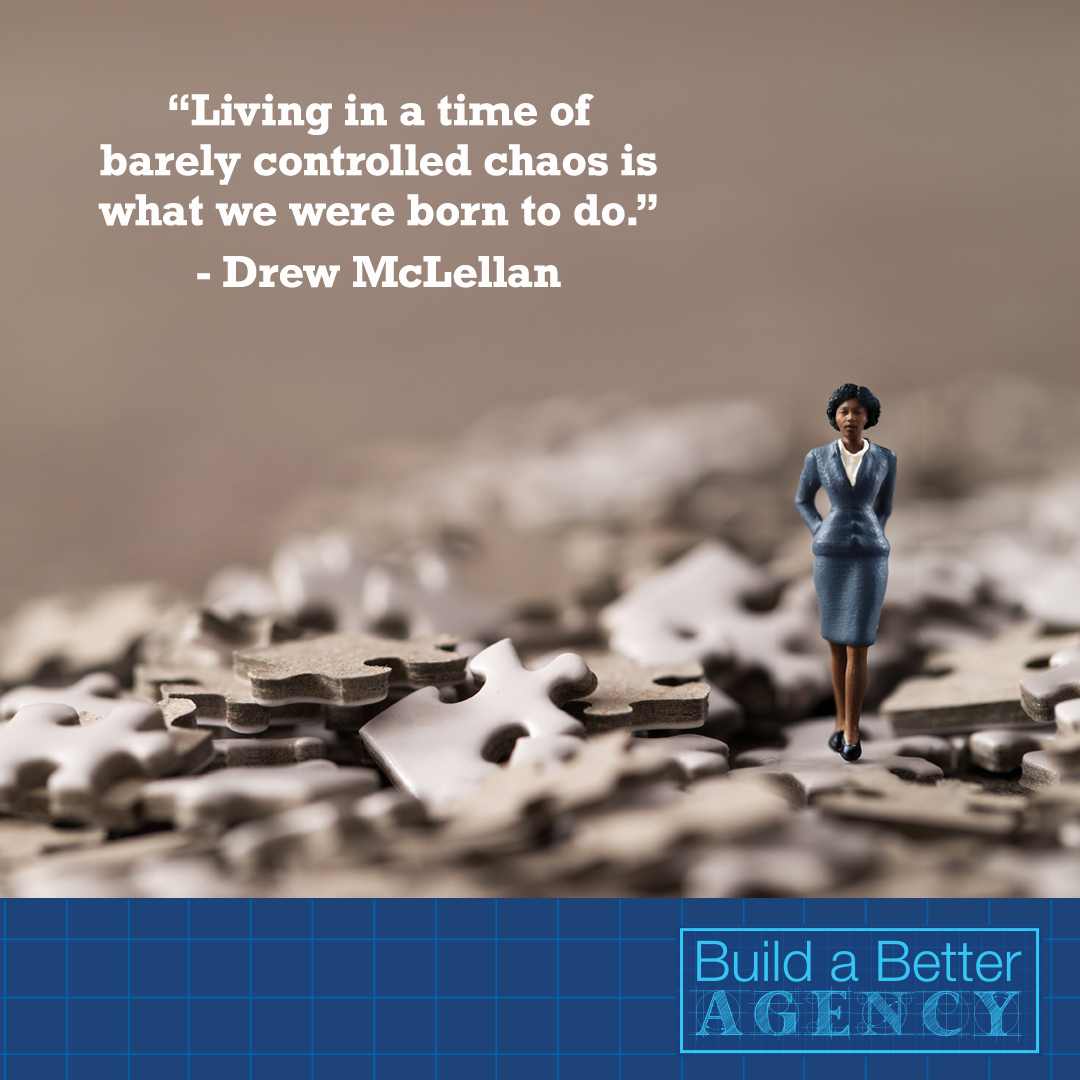
“Living in a time of barely controlled chaos is what we were born to do.” - Drew McLellan Share on X
Uncertainty is the new normal. Drew McLellan explains why embracing change—not resisting it—is the key to agency growth in 2026 and beyond. Share on X
“Living in perpetual renaissance.” Drew McLellan reframes constant change as opportunity, urging agencies to run toward uncertainty and lead clients forward. Share on X
Agency leaders are feeling stuck—but it’s not just you. Drew McLellan reveals how fear and indecision paralyze owners, and what to do about it. Share on X
It’s not about chasing certainty anymore. Drew McLellan shows why thriving agencies accept chaos—and build community to weather each storm. Share on X
Ways to contact Drew:
- Email: [email protected]
- LinkedIn: www.linkedin.com/in/drewmclellan
- Website: https://agencymanagementinstitute.com/
Resources:
- BaBA Summit May 18-20, 2026: https://agencymanagementinstitute.com/babasummit/
- Book: Sell With Authority
- AMI Facebook Group: https://www.facebook.com/agencymanagementinstitute
- AMI Preferred Partners: https://agencymanagementinstitute.com/ami-preferred-partners/
- Agency Edge Research Series: https://agencymanagementinstitute.com/agency-tools/agency-edge-research-series/
- Upcoming workshops: https://agencymanagementinstitute.com/advertising-agency-training/workshop-calendar/
- Weekly Newsletter: https://agencymanagementinstitute.com/newsletter-sign-up-form/
- Agency Coaching and Consulting: https://agencymanagementinstitute.com/advertising-agency-consulting/agency-coaching-consulting/
Danyel McLellan:
Welcome to the Agency Management Institute community where you’ll learn how to grow and scale your business, attract and retain the best talent, make more money, and keep more of the money you make. The Build a Better Agency podcast, presented by White Label iq, is packed with insights on how small to mid sized agencies are getting things done. Bringing his 25 years of experience as both an agency owner and agency consultant, please welcome your host, Drew McLellan.
Drew McLellan:
Hey everybody. Drew McLellan here from Agency Management Institute, back again with another episode of Build a Better Agency. So glad to spend some time with you this week. Thanks for joining me. This is one of my solo casts. So this is you and me hanging out together, talking about something that’s on my mind that I know is on your mind has been coming up in conversations with agency owners as we’ve been sort of progressing through the month since my last solo cast that I’ve just sort of been collecting up and want to talk with you about. So no guests today, just. Just you and me.
Before I get into that, I want to make sure that we announce our winner as if you are a regular listener. You know, we give away one free seat to a workshop or the summit to a listener at every solo cast. So every five weeks we give away one of these seats. So we’re talking minimum value, couple grand. And all you have to do to get in the drawing is go to wherever you download this podcast and leave a rating and a review. When you do that, make sure you take a screenshot of it and that you send it to me. Send it to Drew agencymanagementinstitute.com and that will allow me to know that it’s you. Because usually on the review sites it’s your username, not your full name and it certainly does not have your email address. So I don’t have any way to get a hold of you if and when you win.
So as you might imagine, we have a pretty small universe. So the odds are good that sooner or later, because your name stays in the drawing forever. So sooner or later, the odds are very good that you are going to win. That’s what happened to Netta from Blue Seedling. She left a review, gosh, about a year and a half ago. And it’s her lucky turn. She got drawn out of the hat. And so Neta, I will reach out to you and give you the instructions on how you turn in this free opportunity. So congratulations and we look forward to seeing you live at an event soon.
All right, one last thing I want to do before I Jump into our topic is I want to say thanks to our friends at White Label. As you know, they are the presenting sponsor of the podcast and so we’re super grateful to them that they allow us to do this every week. They make it possible for us to attract great guests and to host this podcast. And gosh, we’ve been doing it for almost a decade, I guess, actually over a decade now, and they have been by our side for a very long time. So if you are familiar with the podcast, you know that White Label IQ is a team of people who come alongside agencies. All they do is work with agencies to help them with web design, dev, regular design, PPC and ad placements. And they are amazing at either. Boy, you’ve got a team on, on your agency’s side that maybe needs some extra help, or you don’t have anybody in house and you’ve got a client that’s got a big need. They want to build an app, they want to build some sort of database. They want to build something that requires a technical skill you don’t have. In either case, whether it’s an on occasion need or it’s a regular need, you want them to be an extension of your team. Folks at White Label IQ are dialed in to working with agencies, understanding how you need to serve your clients, how they need to help you communicate with those clients, what you need to do to still make money, and make sure that you’re delivering an excellent product along the way. So these are good, good folks. I’ve known them for 20 plus years and they’ve been a part of the AMI community for a very long time. So if you find that you are in need of any of those services, head over to white labeliq.com ami and learn about the offer that they have for you. And if you are not in need right now, but you like this podcast, it’d be awesome if you popped over there and just sent them a note and said, thank you. Thanks for sponsoring the podcast. I get something out of it and I’m grateful that you make it possible. That would be lovely. That would make my day.
So, all right, with all of our work done, let’s get into the topic of the day.
So, you know, it’s been a. It’s been a year, hasn’t it? 2025 has been a year for the record books in our world. So regardless of where in the world you live or what your politics are, things have been a little chaotic. And chaos triggers all kinds of emotions.
So no one likes it when their world Seems unsure. It actually makes us pretty anxious and angry. And when the world is angry, we feel it. And we can feel that right now. You can feel that people are short tempered and agitated.
But it’s really more than that. The anger is just sort of the surface. Psychological research consistently identifies anger actually as a secondary emotion, Meaning it often shows up in response to a more vulnerable primary emotion like fear or uncertainty or being hurt. They often talk about the anger iceberg, that the anger is kind of at the surface, but underneath that surface lies the root or the deeper feelings.
So they’ve done MRI studies and doctors can actually demonstrate that fear or the discomfort of uncertainty triggers anger. So that’s the base emotion that makes us angry. It’s just how we express those deeper held emotions. And when those emotions are induced, brain regions associated with aggression and anger show up increased activity and activation, and participants report feeling more angry.
We know that people frequently shift into anger mode to avoid feeling vulnerable, afraid, or out of control, because anger provides us with a sense of power or control compared to the discomfort and helplessness of the more root emotions.
The truth is, as human beings, we crave control and certainty. And let’s be honest, there’s probably hardly a person listening to me right now who, who isn’t a bit of a control freak. Agencies attract that.
Neuroscientists have found that our brains crave certainty using the same neural circuits as those for food, sex, and other primary rewards. When we experience certainty, our bodies release dopamine, Creating a sensation of reward and contentment. Which is why we as humans love activities that provide clear answers like puzzles or games or shows where the bad guy always gets caught in the end.
In fact, the primary function of the brain’s neural cortex is prediction. Our brains are constantly gathering data from the environment to predict what will happen next, Minimizing uncertainty and maximizing a sense of safety and control. The feeling of certainty is an involuntary mental sensation, Not a logical conclusion.
And as human beings, we are hardwired to seek certainty even when it may not exist in reality. Which is why the world feels so off right now. It’s why clients are pulling back budgets. It’s why prospects won’t commit. It’s why your team members are more reactionary, taking more mental health days, and just feel a little less connected.
What’s happening out there is widely out of our control. There’s financial unrest with the on again, off again tariff talks. The US government shut down, ran for 43 days, and all of the chaos that that caused, and the global economy is experiencing slowing growth, persistent inflation, and has many high risks facing it.
And as if that weren’t enough, there’s social unrest as we watch the conflicts here in the States and abroad. All of that adds up to a ton of uncertainty. Uncertainty that you and I have very little control over. And we’re seeing it unfolding and influencing our agencies every single day.
Now, I promise we’re about to take this conversation in a more hopeful place. So hang with me. It’s not going to be all doom and gloom.
Research consistently finds that uncertainty is predominantly associated with negative emotions, especially fear and anxiety. Uncertainty not only increases the intensity of those emotions, but but also decreases positive feelings, making people feel more likely to experience genuine distress. That anxiety increases exponentially over time the longer the uncertainty exists.
Uncertainty creates this feeling of hanging over a cliff and not knowing if or when we will fall. The longer we hang there, the worse our fear gets.
So why am I sharing all of this nerdy science stuff with you? Because I think we have to understand it. Because we are caught in an uncertainty maelstrom that does not feel like it’s going away anytime soon. And we, as business owners and leaders have to find a way to not only survive it, but we need to thrive in it, and we need to help our clients thrive in it.
And by the way, we are not crazy for craving certainty. Uncertainty is the primary driver of psychological stress. And prolonged uncertainty creates a need for constant alertness. When we are always on edge, tense, and waiting for the next shoe to drop, we lose our ability to concentrate. We fall into exhaustion and even depression.
The part of the brain that controls our fear response is more activated by uncertainty than any other known stimulus. Hear that again. The part of the brain that controls our fear response is more activated by uncertainty than any other known stimulus.
So the world isn’t just angry. The world is reacting to all of the uncertainty around us, and it just scares the crap out of us. And that’s what I want to talk about today is what do we do if that’s our reality? What do we do with that reality? To take as much control of it as we can and to realize that we can actually thrive despite all of that.
So how, given the world around us and the uncertainty that is not our imagination, but instead is our reality, how do we find the path forward out of that paralyzing fear? And if we can do it, we can help our clients do it, too.
So I actually learned about the power of uncertainty and fear in a really visceral way when I was just a boy. I was about five and a half, so we have to go back a few years, so I’m five and a half.
My parents had gone out to dinner with friends, which meant that my Italian grandma was babysitting me and my baby sister. Now, when Granny babysat, I could count on three things. Homemade pizza for dinner, pizzales for dessert. And at least once, she would somehow combine my name and God’s name in a way that took both names in vain because I had gotten under her skin.
She was the best. And then the best part of it was she always slept over at our house, which meant I could count on a full Italian breakfast the next morning. So I loved it when my parents went out for dinner because my grandma was going to be there and I knew it was going to be a great time.
So I went to sleep that night with a full belly, a bemused smile on my face because I had egged on my grandma and anticipating an equally good next day.
But that is not how it played out. Several hours after going to bed in the middle of the night, the light in my bedroom suddenly blazed on and woke me up. Through sort of half squinted eyes, I saw a young man standing in my doorway. I didn’t recognize him. He was dressed in dirty jeans and a flannel shirt and he was pointing a gun at me.
Without saying a word, he grabbed my wrist and he yanked me out of bed. Remember those cartoons where the kid would drag his teddy bear down the stairs and the bear hit every step as they went? Well, that’s how I got downstairs to the main floor of the house.
He pulled me around the corner and into the kitchen. At the kitchen table sat my grandma in her nightgown and robe. My mom, she was still in the dress that she had worn out that night. She was holding my six month old sister and my dad was pressing a towel to his head with blood seeping through his fingers.
That was the night that I learned the effects that uncertainty and fear can have on our body and our mind.
Now, the science of uncertainty and its byproduct, fear, is kind of fascinating when we look at it in the abstract. Not from 5 year old Drew’s eyes. But remember, we haven’t evolved all that much in centuries. Our brains are still hardwired to monitor for any danger and react in an instant. All to protect us from the woolly mammoth or whatever threat is in front of us.
This is all about neural pathways in different parts of our brains, analyzing the threat, deciding how legitimate it is, and then designing a response. The More ambiguous or uncertain the threat, the more severely our brains react to it. Our brains fill in the gaps because it can’t know with certainty how severe the threat is. So it assumes the worst and exaggerates our reactions in an effort to keep us safe.
So as I was dragged into the kitchen, the man shoved me towards my mom and I fell against her lap. She started to say something to me and she was quickly silenced when we were told to be quiet and that if anyone spoke again, they would kill us.
I know this all sounds like a crazy Dateline movie, but as I have experienced, life is often stranger than fiction. So I’m five and a half. I know something bad is happening, but I really have no idea what. I don’t know who these men are, why they’re in our house, or what is about to happen.
My grandma and my parents faces are frozen in fear. My mom tries to make eye contact and I’m sure she’s trying to reassure me with that look. But the signal was not really coming through. Even though we were all in the same room, we were not together. We could not talk, we could not communicate. We were each alone in our own cocktail of fear and our neurotransmitters were firing like blasters.
What I didn’t know at the time was that there were four other men in the house emptying everything we owned into a van.
Now, when we experience an intense situation of uncertainty or fear, legit or not, for an elongated period of time, our brain chemicals begin to inflate those emotions and our responses.
So back then we had a schnauzer, a miniature schnauzer named Teufeld, which means little devil in German and explains why she had to sleep in the laundry room. Schnauzers are yappy dogs if you’re not familiar with the breed. And Teufel was no exception.
Now the laundry room was right down the hallway from the kitchen. So in my five year old brain, I began to believe that when Teufel heard people moving around the house, she would start to bark. And one of those men was going to shoot my dog. Just saying that sentence out loud to this day still makes my heart race.
Now Teufel is long gone, those men are long gone. And I am here with you, safe and sound. And yet that fear was so chemically burned into me that night that it still fires off when I think about it.
That’s how powerful uncertainty and the fear it creates can be.
Uncertainty and its byproduct, fear, are costly, not just to us, emotionally and mentally. But in very tangible terms, fearful leaders waste 10 to 15 hours a week on micromanagement and indecision. 10 to 15 hours a week.
So I’m wondering if you’ve been feeling a little less decisive lately, that you have been pulled in a lot of directions, that you have felt a little paralyzed. If so, you’re not alone. And imagine that it was costing you 10 to 15 hours a week.
The prefrontal cortex responsible for decision making becomes preoccupied with risk and loss, and it often leads to risk aversion and decision paralysis. It’s so busy worrying about what might happen that it doesn’t do anything about the situation.
In fact, fear paralyzes one in three business owners, keeping them from launching new initiatives or taking any risks. Individuals who are caught up in their own sense of uncertainty will often opt for decisions that feel safer and come with a guarantee of some kind, even if the rewards are minimal.
As leaders, when we’re afraid, we get caught up in this analysis paralysis, where we get so stuck that we miss opportunities. We also prioritize things that just don’t matter so we can make ourselves feel better that we are making some decisions even though they’re inconsequential.
Worse yet, fear is contagious. It spreads through social observation. Our team members can smell our fear, especially if we don’t talk about it together. It transfers to them. And now we are all afraid and stuck.
So that night back in my house, I got caught up in that escalation of fear. The night of the robbery, in our forced silence, my family’s fears just kept elevating. I looked at my leaders and all I could read was terror. We couldn’t talk about it, so I just let their fears escalate mine. And like any five year old boy, that led me to the worst thing I could imagine. Something happening to my dog.
After being held in that kitchen for hours, they were finally done taking everything out of the house that they wanted. They led us to the upstairs bathroom and they closed us in. As one of the men shut the door, he warned us that he was going to wait on the other side and if we opened the door, he’d shoot us.
We sat in silence in that bathroom for an eternity. Once the door was closed and the threat was literally out of my eyesight, my body took over and I started to shake. I eventually got sick. It’s odd what you remember, but everyone else was still afraid to speak. My dad stood silently, his ear pressed to the door, until finally he thought they were gone and he was willing to Risk opening the door.
At some point in time, we all have to risk opening the door and stepping out.
Now, back in my 2022 keynote at the Build a Better Agency Summit, I talked about how Covid had paralyzed us and that we needed to push past the uncertainty and fear and and get back to work. That we could not stay in the safe harbor if we actually hoped to get anywhere.
And then last year, my keynote talked about the Kubler Ross Change Curve, which was all about how we as humans navigate any significant change and how much harder it is to move through that ecosystem when the changes are thrust upon you. Whether it’s Covid, the shift to hybrid work, a recession, or or a world horribly divided, these truths are largely out of our control.
Now, the rosy retrospective principle says that we remember the past with a much softer and more positive lens than it really was. So maybe, maybe uncertainty is more common than we recall.
Now, for those of you who have owned your agency for 20 some years, here’s what you’ve endured. You’ve endured the dot com burst 9 11, the Great Recession, the housing and subprime market collapse, technological advancements that brought disruptive business models like Uber Covid remote work, the Great Resignation, rising interest rates and labor market instability, persistent inflation and rising costs, the influx of AI and now tariffs, rapid fire policy changes and economic chaos in the global market.
You’re a warrior. You have survived all of that. You have gotten your company through all of that.
So listening to that list reminds us that every few years something pretty big knocks us off whatever feels normal in the moment and hands us a brand new normal. Sometimes that new normal is relatively permanent and in other cases it’s a season. But we never go back to the original normal. There are always shifts that stick.
So maybe the certainty we long for has always been an illusion after all.
In the past, I’ve remind you that the plague in the 1300s actually made way for the Renaissance period, and that I believe Covid did the same for us and that we were embarking as an industry on a new renaissance where we could and would completely revamp how we did our work and what it would mean to our clients.
But as I’ve been reflecting on the past few years and watching 2025 unfold, I’ve come to believe and realize that I didn’t actually go quite far enough in the past. I spoke as if that were a moment in time, a temporary season of chaos and evolution. But I don’t think that’s accurate. Not anymore.
It used to be back in the 13th, 14th or 15th century that life altering change happens about once every hundred years or so. No one, no one lived through multiple Renaissance periods. But we’ve already lived through several. And they’re coming faster and faster.
The industrial revolution changed everything. The automotive age created individualized mobility. And by the 1950s, we were flying to destinations we could have never imagined visiting. The scientific and technological renaissance came after that. It brought us radio and television, and we suddenly saw the world in a very different way. The medical advances that we have seen in our lifetime are the likes of science fiction.
And then the digital renaissance brought us computers, the Internet and cell phones. And today we have AI and cars that drive themselves. Who the heck knows what’s around the corner?
Here’s the problem. Well, actually the problem is that we think of it as a problem. I think we need to think of it as an opportunity.
Until the 1900s, people experienced and had to adapt to maybe one season of life changing shifts, one renaissance, one huge tidal wave of change and innovation in their lifetime.
But not us. We’re on the accelerated program. Yay.
For us, the definition of a renaissance is a fervent period of cultural, artistic, political and economic rebirth. Add technological to that list and it becomes very evident that we now live in a perpetual Renaissance period. And if anything, it’s just moving faster.
What if we’re in a moment of time where we have to recognize that the one thing where there is no uncertainty for us as business owners and leaders is that there is going to be uncertainty?
What if the one thing where there is no uncertainty for us as business owners and leaders is that there is going to be uncertainty?
What if it’s just the given that it will come in the form of we don’t do it that way anymore, or at the very least, we won’t do it this way for long.
We are living in an era of continual renaissance. The pace of innovation and change is not going to slow down anytime soon. Maybe we need to stop being surprised by it. Maybe we need to stop fearing it and instead figure out how to build our agencies on that truth.
Okay, I’m going to take a quick break because I need to wet my whistle and then I’ll be right back.
Are you tired of juggling multiple tools to manage your agency? Meet Deltech workbook the all in one solution for marketing and communications agencies. Streamline your projects, resources and finances all in one place. With real time dashboards and reporting, you’ll have full project visibility. You can plan team capacity weeks ahead to avoid bottlenecks and keep your budgets on track to maximize profitability. It’s perfect for both agencies and in house marketing teams looking to work more efficiently. PCI is a certified Deltech Partner offering expert implementation and support to ensure your success. If you’re ready to transform your operations, visit PCI US Podcast for a free consultation today.
Hey everybody, thanks for listening today. Before I get back to the interview, I just want to remind you that we are always offering some really amazing workshops and you can see the whole [email protected] on the navigation head to how we help. Scroll down and you’ll see workshops and you can see the whole list there with descriptions of each workshop. They are all in Denver and we’ve got them throughout the year for agency owners, account Execs, agency leaders, CFOs. We have a little something for everybody. No matter what it is that you’re struggling with. People, new business, money, all of those things we’ve got covered. So check them out and come join us.
All right, let’s get back to the show.
All right, I’m hoping during that break you were just sort of soaking in this idea that uncertainty is the norm. There will always be uncertainty. Uncertainty catches us off guard. We didn’t know it was coming and we didn’t and we don’t know when it’s going to end. That triggers the fear and all the after effects from that fear, that inability to focus, the difficulty with decision making, the desire to just get off the merry go round.
But what if we did? And honestly, we do know it’s coming and we just settled into the idea that the pace of change was going to keep bringing us new challenges and opportunities and we just developed an SOP for dealing with them. What if the uncertainty just became part of our normal routine?
Most of us got into the business because we are creators at Art for a creator. What could be more glorious than living in a time of constant creation and newness? We also love deadlines, the pressure to come up with something innovative, and the fact that no two days are ever alike. That’s agency life.
The truth is we have chosen a career that does its best work in, if we’re being honest with ourselves, in barely controlled chaos every single day. Maybe it’s time we reframe all of this for ourselves, our clients and our team. Living in a perpetual renaissance period where creativity, innovation, evolution and leading the way earns us a seat at the C Suite table. Because that sounds pretty good.
What if all of this uncertainty shouldn’t be something we fear, but instead what if we ran to it knowing that it’s our competitive advantage? If we can always anticipate and participate in the shifts and master them, we will be the agency that clients need.
We know from our own experience with almost 15 years of agency edge research that clients really do want us to guide them. Yes, there’s a good portion of them that will continue to either bring the commodity work in house or find a less expensive vendor. But they don’t want us to be a vendor. That’s never been our value.
Our value is finding the sweet spot of truth that intersects their brand and offering what their consumers need and want and the world around them. We have the unique ability to see those connections with our insiders outside perspective. And even more important, we have the creativity and knowledge to help them tell their story in a way that cannot be ignored.
If you look at the history of our industry, we’ve always evolved as new tools and technology gave us fresh opportunities to tell stories, connect and convince the world that our clients had something important to say. The amazing truth of our world today is that we’re simply being offered new tools and technology faster than ever before. And the agency that stays ahead of that and is the expert to their clients benefit is the agency that will be highly valued and paid accordingly.
We’re already seeing that those of you that have figured out how to bring AI and other technology to your clients, to your internal operations, are being rewarded handsomely for that. But to do that, first we have to shift our natural, biological, hardwired reaction to the uncertainty from fear to excitement. Living in a time of barely controlled chaos is what we were born to do. By our career choice. We have said we are born to do this.
There’s a great line in a recent MIT Sloan Review article. It said, leading through chaos isn’t about control. It’s about learning how to ride the storm. And no one rides out a storm alone. Facing continual change and the need to always be learning and reinventing your business sounds scary when you have to do it all by yourself.
So many of you have said to me, how in the world do I keep up? There’s so much to learn. Underneath that statement is a fear of falling behind or becoming irrelevant. But what if we tackle that fear together? Remember, when we are gripped with fear, real or perceived, our brain assumes the worst.
One of the biggest magnifiers of fear is when we face fear alone. We escalate in our own heads to get to that worst case scenario that our brain chemicals need to make decisions. Studies have shown that an individual’s response to a threatening situation is significantly higher in terms of the level of fear. And that overcompensation for that fear when that person is by themselves, because our survival instinct goes on to high alert.
So remember that five year old boy that I’ve been telling you about? Even though we were all in the same kitchen, was all alone that night and I was convinced the gunman was going to shoot my dog. There was no evidence to that whatsoever, but I was convinced that that was what was going to happen because my brain escalated to that. Now, had I been able to process that thought with my parents, I’m guessing they would have convinced me that the last thing the bad men wanted to do was deal with the dog. Far better to leave her contained in the laundry room. But my brain by itself did not go there.
But when a group of people deal with a perceived danger or threat, the presence of others significantly reduces the subjective fear. Experiments have demonstrated time and time again that even a single companion lowers our fear responses. And this effect grows as the group size increases in a phenomenon known as risk delusion.
This is rooted in our nature. Animals rely on group living to minimize environmental dangers. This phenomenon is called social buffering, and it’s well documented. The presence of other animals of the same species reduces psychological and behavioral stress responses, increasing the animal’s ability to tolerate risk and accelerates its ability to recover from a frightening or anxiety producing experience. All which increases the animal’s chance of survival.
In humans, this effect is profound. Studies show that being part of a group significantly reduces fear in times of uncertainty. The larger the group, the greater the reduction in perceived risk and the stronger the sense of safety. Animals of all shapes and sizes, including us humans, instinctively seek affiliation and connection, preferring to confront uncertainty together rather than alone.
In other words, we can and we should do this together. We will move from discomfort into a much better place, faster and easier. And if we don’t go it alone, that’s really why AMI exists.
Fortunately, we are wired to connect as humans. Everything about us as human beings is built to form relationships, connections and community. Maslov’s hierarchy of needs tells us, other than food, water, shelter and basic safety. Again, other than food, water, shelter and basic safety. The most important element of being a healthy human being is belongingness and love.
Human beings are meant to belong. Not only are we meant to belong, it turns out it’s a survival strategy. Remember that uncertainty creates this feeling of hanging over a cliff and not knowing if or when we will fall. The longer we hang there, the worse our Fear gets Traumatic experiences can lead to lasting changes in how the brain processes fear and safety, often resulting in persistent anxiety, intrusive memories, nightmares, fear of occurrence, and a lot of bad decisions.
There are still some agency owners today who have serious PTSD from COVID and are stuck in a fear loop that keeps them from making good decisions or making any decisions at all. But it turns out that being part of a group or having social support against again, that social buffering principle significantly reduces persistent fear reactions even long after the original danger has passed, and eventually can help you vanquish them altogether and create a new viewpoint.
That’s what we need to do. Create a new viewpoint. Uncertainty is certain, it’s a given, and it’s actually to our advantage. Going it alone is not only harder, it’s also so easy for us to get stuck. Without some support, our brain spirals into worst case scenarios and our most basic instincts kick in.
So again, back to five year old Drew. As you can imagine, long after the police were called, the reports were filed, the alarm system was installed, there was still a lot of fear for us to process as a family. After the robbery, my mom got into a therapy group with other women who were victims of violent crime. I could not fall asleep unless my bedroom light was on and I had a crazy fear of the dark. I did some individual play therapy and some group counseling with other kids who had some big fears as well.
But my dad. My dad was not a big believer in talking things out. He wanted to pretend that it never happened. He wanted to stay in his own head. And he didn’t want to share in the burden of his fear until bedtime. And then my dad would go down to the living room and he would sleep all night in the recliner facing the front door. And he would sleep with a loaded handgun on his chest.
That is not coping with your fear. Eighteen months later, we moved across the country. Left to his own devices, an escalating sense of fear, moving across the country was my dad’s only way. His brain could not solve the panic he felt in any other way about keeping his family safe, other than to literally uproot us and move us across the country.
No one rides out a storm alone. Or at least no one should have to. It often leads to less than optimal results.
Why does community have such a powerful effect on our ability to manage uncertainty? Well, it turns out we don’t really have a choice. The answer is baked in us both from a psychology and a biology perspective. We’ve already talked about social buffering. The Presence of supportive peers dampens this physiological and psychological stress response, lowers our cortisol and our other stress hormones.
But being part of a community also has the opposite effect. On the good side, they call it emotional contagion. The positive emotions and calm behaviors spread through groups, helping members regulate their own anxiety and see alternative viewpoints. We give each other neurochemical rewards. Our social affiliation activates reward pathways in our brains, making us feel safer and more motivated to act. We can eliminate that paralysis that happens in too many leaders when we’re unsure or worried.
And that’s really what I hope that you, as part of the AMI community, experience every week when you and I are together on the podcast or in the Facebook group, when you attend one of our workshops or the summit. Cognitive diversity groups bring together varied experiences and viewpoints, which improves our ability to solve problems creatively, and it reduces our natural cognitive biases that distort our perspective.
We make each other better, safer, stronger. We are each other’s protection. We are each other’s support. We are each other’s teacher. But only when we understand how we must show up.
On the surface. Communities are just about that first layer of connection. We’re all here together listening to this podcast as a professional community because we all do the same thing for a living. We come together to learn how to be better at our craft.
But that doesn’t really sound like a need. If that alone were a need, then I would have 20 million people listening to this podcast. We’d have a bunch of people knocking on the door at the summit after we sell out to be let in. The Facebook group would have tens of thousands of people. That’s not quite a need.
That we share a religious faith or grew up in the same neighborhood or even our siblings doesn’t actually turn a group of people into a community. We do have something in common, our professional connection. What turns us into a community is actually the root system is what happens underneath the surface. And that’s the magic I think of ami.
Redwoods are the tallest trees on the planet. They are also among the strongest. They grow as tall as a 35 story building, and yet they can survive on just the moisture they extract from fog. From fog. Now, the fog’s mist condenses against the trunk, and that creates what is called fog drips. So these fog drips roll down the grooves of the tree’s bark down to the root structure.
But the real secret to the redwood survival is that root structure. Now, I don’t know about you, and I’m no architect but my instincts are that if I’m building something that is over 300ft tall, I would want that foundation to be buried deep underground. But that is not how redwoods do it.
Redwood roots are actually very shallow, maybe five or six feet deep, but they are wide. In fact, a redwood’s roots can reach over 100ft away from the trunk of the tree, and they intertwine with other trees root systems and actually fused together. Now you have the strength of many as the foundation.
This is why redwoods can withstand high winds and raging floods. But it’s more than just strength. It’s also how they nurture each other. When the fog drips reach the root structure, it doesn’t just serve the one tree. It serves the entire network or community. Community of trees through their shared root system.
One of the coolest things about nature is the entire ecosystem is created on an assumption of shared goodwill. We will help each other. That assumptive understanding that we are here not just to meet our own needs, but to help one another is how a community builds a strong root foundation and how we ultimately get our needs met, too.
When I think about the AMI community, that’s how I visualize it. You are all so interwoven, some closer than others. But on any given day, you contribute to the whole. You might encourage a peer group member. If you’re in a peer group, you answer someone’s question. In the Facebook group, you share an experience you’ve had when you attend a workshop.
And on any given day, you get something you need from the community. Someone shares a resource or makes an introduction. And in many cases, if we stay with the redwood analogy, you’re in very distant parts of the same forest. You might not even know each other, but yet you are still connected through that root system, the strength of the whole.
Now, if you haven’t dipped your toe into any of the AMI community gatherings, digitally or in person, I invite you to do so because you are missing out on some amazing support and learning opportunities to ride the storms of perpetual renaissance together, we have to embrace the idea of reciprocal altruism.
So, in evolutionary biology, reciprocal altruism is a behavior whereby an organism acts in a manner that temporarily reduces its own fitness while increasing another organism fitness with the expectation of that the other organism will act in a similar factor at a later time. In today’s world, that’s sort of an extraordinary concept, giving of yourself with confidence that you’ll be taken care of by someone in the community too.
Now, we see this in nature over and over again. Vampire Bats share food with bats. They don’t know and are not related to expecting the favor to be returned, which ensures the entire group’s survival. Meerkats give alarm calls to warn others of predators, a behavior that strengthens group unity and collective defensive. More evolved animals like dolphins extend this idea beyond their own species.
We’ve all seen the stories and videos of dolphins forming a protective circle around another animal or human in the water to keep sharks at bay, or guiding stranded animals to safety. If they can do it, we can do it too. It’s biologically baked in us. Human beings are meant to belong. More succinctly, we need to belong for our survival in this constant renaissance.
And by the way, this isn’t just about our survival as humans. It is absolutely about our survival as business owners and leaders. Danielle and I think about this concept all of the time as we pour into the AMI community and and we imagine how it can serve all of you even better. How can we bake even more of that spirit and access into what we do?
Back in the Renaissance period, the creators that gathered together in what they called a salon. Salons were a central way for artists, writers, musicians and thinkers to meet, exchange ideas, especially from the renaissance through the 19th century. In later centuries, especially in Paris, salons became regular invitation only events where guests mingled, discuss philosophy, literature and art, listened to music and attended readings or performances.
Salons mixed people across all social classes and genders, forcing and fostering a vibrant intellectual and artistic community. Throughout history, artists have gathered, form groups, guilds and associations to support each other, share techniques and develop new styles. In ancient Rome, workshop associations brought artists and craftsmen together, often for mutual benefit in learning.
We are a modern day salon. We come together physically and digitally to share ideas, best practices, support, to cheer each other on and to lean on one another when we hit a rough patch. We do this because we understand we can tame and harness the chaotic storm of change better Together. Again, we do this because we understand we can tame and harness the chaotic storm of change better together.
Our community is able to do that and be that for one another because we give first without expectation of something in return. There’s a philosophy called Giver’s Gain that’s rooted in the principle of reciprocity. By helping others succeed, you ultimately create opportunities for your own success. Rather than focusing on what you can extract from your network or community. Giver’s Gain encourages you to proactively support others.
Whether it’s through referrals, sharing knowledge, offering resources, all with the understanding that that generosity will be returned, often in unexpected and multiplied ways. Sound familiar? I think the world in this perpetual renaissance that we are in needs more giver’s gain more now than ever before. We need to go out of our way to look for opportunities to give first with no expectations, so that more and more people do the same for us.
We can tackle this together. We can not only harness change, we can embrace change. We can take advantage of change for ourselves and our clients. We should be aggressively teaching with our thought leadership, giving away our smarts. We should be showing up with a basket full of giver’s gain for clients. Most of you are already doing this with your team, and I’m telling you it’s the best example of compound interest that I know at ami.
One of our core beliefs, as you probably know, is we all learn better and faster when we learn together. At any AMI gathering, be it digital or in person, we ask that you show up as both a teacher and a student. The more you teach and give, the more you learn and gain. It really is that simple.
And if we are living in a perpetual renaissance period, which I believe we are, we are not going to see a slowdown anytime soon of change. Our salon needs to be as active and full as possible so that we are the industry leaders. We’re the agencies that clients seek out for guidance. We are out in front showing everyone else how it’s done because we’re learning it faster, because we’re learning it together.
One of the more interesting aspects of givers gain is that people will often surprise you. We often have first time summit attendees admit that the level of friendliness and lack of competitive airs kind of shock them in their local market and other agency associations. It’s just not that way.
But in the right environment, anyone can surprise you. And that’s kind of the perfect way to close the loop on five year old Drew’s story.
So I’m taking you back. We’re in the kitchen. We’d been there a couple hours. The different men were in and out as they looted the house. And at one point, one of the men was alone in the kitchen with us. Kept kind of looking over his shoulder. And then he got very close to my mom and he handed her something. He whispered, put this in your pocket and shut up and stepped away from her.
Hours later, when we were alone, my mom put her hand in her pocket and discovered that what he had given her were two sets of wedding rings. My mom’s and my grandma’s.
So if that can happen, imagine what good humans with good intentions can do together. I believe we should infect our agencies, our teams, our clients and if you want to the world with givers gain. And I believe that we should pour into our shared salon and we should teach each other as much as we can. We should share as generously as we possibly can, all with the intention of the salon, helping every agency within it to get stronger and better.
And because we’ve recognized this truth, we get to reframe the story. We get to rewire our brains to see the bigger picture. Change, uncertainty and something new around every corner is not something to fear. It’s something to master and benefit from.
Never before have we had so many resources at our fingertips. We can do bigger and better things for our clients. We can add more value and be more valuable. We can learn together because there’s too much to learn on our own. Rather than wishing for a past that can’t come back, we are going to help each other step into the future.
Our whole professional lives have trained us for this moment. In fact, we’ve been training for this ever since we accepted our first agency job. We were drawn to this industry because it is chaotic. We get energy from having to be brilliant on command and hit a deadline. There has not been a single day in our professional lives that look like any other day and didn’t have a twist or turn in it. And that is part of what we love.
The answer is actually rather simple. We eliminate the fear brought on by continual uncertainty by expecting it. It’s not uncertain anymore. Being certain that it’s coming when we’re not surprised by it or taken aback by it, we can quickly move to mastering it for our clients and our benefit.
Now, instead of being a threat to our agencies, it becomes a strategic edge because we’ve anticipated it and we’re taking full advantage of it. We’re going to have more financial unrest. We’re going to have more technological wonders. There will be new tools that we need to adopt and teach. Social issues are going to change the landscape of ours and our clients worlds. And rather than being surprised by it now, we’re going to be ready.
So what if we get in line together and simply buy a ticket, knowing full well that the ride is going to be a wild one and that we were built to love the ride and help others learn to love it too. We’re the kid who sits in the front of the roller coaster, arms in the air, ready to relish every dip, drop and curve.
We were made for this. We are Renaissance people and we’re going to embrace this continuous renaissance to create the future for ourselves and our clients. We’re not going to just accept the speed of change. We’re going to anticipate it, we’re going to drive it, we’re going to own it and we’re going to use it to build agencies that cannot be ignored. And we’re going to do it together in our modern day salon.
That is the exciting part. We can do this together and we can do it better together. And that’s how I want to leave you with this solo cast. As you go into the final month of the year thinking about 2026, I want you to think of it with enthusiasm, with a contagious hunger to learn and to learn together.
That’s how we master this as we do it together. And we have lots of opportunities for you to do that. So please, please, please become a part of the salon. Jump into the Facebook group, attend the free webinars. You don’t have to spend a dime to be a part of the salon. Yes, we have things that you can have deeper connections or more activity or more individual attention that you can pay for. Absolutely. But there’s a ton of things at AMI that don’t cost you a dime and could help you attack and embrace this renaissance in a way that you just cannot do it by yourself.
So don’t turn your back on that opportunity. Join us. Come into the salon. Come as both a teacher and a student. And let’s tackle 2026 together because it’s going to be a wild ride.
All right, that’s what I’ve got you for you this week. I’ll see you soon. Thanks for listening.
Danyel McLellan:
That’s a wrap for this week’s episode of Build a better agency. Visit agencymanagementinstitute.com to check out our workshops, coaching and consulting packages and all the other ways we serve agencies just like yours. Thanks for listening.