
Episode 539

Welcome to the latest episode of Build a Better Agency! Host Drew McLellan is joined by talent strategy expert John Arnold to tackle one of the most critical and timely challenges facing agency owners today: hiring, retaining, and managing the right people in the ever-evolving agency landscape. As AI and technology shift agency workflows, Drew McLellan sets the stage for a refreshing conversation about why the human element is more important now than ever.
John Arnold, co-owner of Celarity—a firm that was itself born from agency roots—brings decades of experience in staffing, executive search, and talent advising. Together, they explore the seismic changes agencies have faced in team structure, from the rise of remote work and fractional contracts to the increasing responsibility placed on each team member. John Arnold shares actionable strategies for navigating this new reality, including how tools like Predictive Index and other personality assessments are transforming agency hiring decisions. You’ll learn why understanding your own leadership style is just as important as knowing what you’re looking for in a new hire.
This episode digs into practical frameworks for the ideal interview process, tips for avoiding common hiring pitfalls, and ways to structure assessments and team interviews to ensure long-term fit. John Arnold also reveals the personality traits and behaviors that signal an exceptional agency employee, while offering candid advice for managing generational divides and work-life balance in today’s workforce. The conversation doesn’t shy away from tough topics: Drew McLellan and John Arnold discuss red flags, deal-breakers, and why agency leaders must be upfront with candidates from the very start.
If you’re ready to strengthen your agency’s team, enhance your understanding of talent, and embrace data-driven hiring, this episode delivers the insights you need. By the end, you’ll have the tools—and the confidence—to build a stronger, more resilient agency culture. Don’t miss this invaluable deep dive into what it takes to recruit, retain, and inspire top talent in today’s dynamic agency world!
A big thank you to our podcast’s presenting sponsor, White Label IQ. They’re an amazing resource for agencies who want to outsource their design, dev, or PPC work at wholesale prices. Check out their special offer (10 free hours!) for podcast listeners here.
What You Will Learn in This Episode:
-
- The critical role of data in modern agency hiring
- Balancing gut instinct with science for better hiring outcomes
- Structuring a successful multi-step interview process
- Why curiosity and accountability matter in agency talent
- Navigating generational shifts in work/life balance expectations
- The evolving landscape of remote and hybrid work in agencies
- Preparing for the future: leveraging AI and assessments to predict job fit
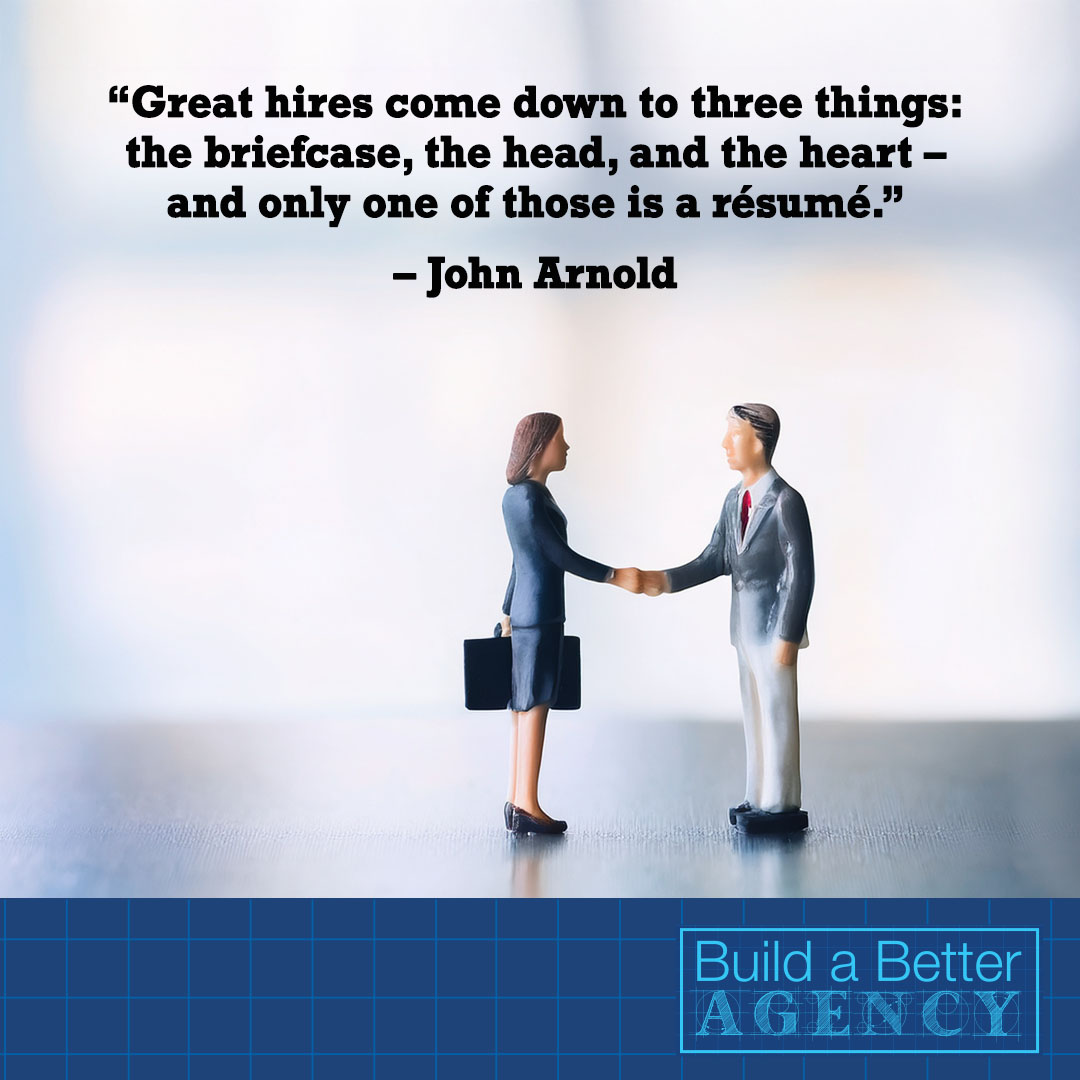
“Great hires come down to three things: the briefcase, the head, and the heart—and only one of those is a resume.” - John Arnold Share on X
John Arnold explains why every agency should assess their current team—not just new hires—to maximize collaboration and performance. Share on X
Gut feeling isn’t enough anymore. John Arnold explains how data-driven hiring means better fits and stronger teams that last. Share on X
Hiring gets harder as agencies get smaller. John Arnold joins Drew McLellan to explore why the stakes have never been higher—and how the right talent can transform your agency. Share on X
Curiosity is a must for agency life. John Arnold shares his go-to interview questions for spotting someone who’s always hungry to learn and grow. Share on X
Ways to contact John:
- Email: [email protected]
- LinkedIn: https://www.linkedin.com/in/johnearnold/
- Company Website: https://www.celarity.com/
Resources:
- https://www.16personalities.com/
- BaBA Summit May 18-20, 2026: https://agencymanagementinstitute.com/babasummit/
- Drew’s Book: Sell With Authority
- AMI Facebook Group: https://www.facebook.com/agencymanagementinstitute
- AMI Preferred Partners: https://agencymanagementinstitute.com/ami-preferred-partners/
- Agency Edge Research Series: https://agencymanagementinstitute.com/agency-tools/agency-edge-research-series/
- Upcoming workshops: https://agencymanagementinstitute.com/advertising-agency-training/workshop-calendar/
- Weekly Newsletter: https://agencymanagementinstitute.com/newsletter-sign-up-form/
- Agency Coaching and Consulting: https://agencymanagementinstitute.com/advertising-agency-consulting/agency-coaching-consulting/
Danyel McLellan [00:00:01]:
Welcome to the Agency Management Institute community where you’ll learn how to grow and scale your business, attract and retain the best talent, make more money, and keep more of the money you make. The Build a Better Agency podcast, presented by White Label iq, is packed with insights on how small to mid sized agencies are getting things done. Bringing his 25 years of experience as both an agency owner and agency consultant, please welcome your host, Drew McLellan.
Drew McLellan:
Hey everybody, Drew McLellan here from Agency Management Institute, back with another episode of Build a Better Agency. And this is an important one. You know, as we talk about AI and how it’s changing the way we work and it’s eliminating jobs and fill in the blank, fill in the blank, fill in the blank. I think one of the conversations we’re not having as often as we need to is the more AI infiltrates our world and becomes part of the tool set that we use, the more important the people we have on our team will be. I think the human element becomes even more critical the more reliant we are on technology and tools. And I’m not saying any of that’s a bad thing. I think it’s all a really great thing. But I think it is going to be mission critical that you have the right team members on your team to sort of navigate all of that, both in terms of internal relationships, relationships with clients. And so if ever there was a time to have the right team around you and surrounding your clients, I believe it is now. I think it’s going to be so mission critical that we have strong, strong performers on our team. Yes, many agencies actually are getting smaller in terms of the size of the number of people that they have. And the way we staff is different today than the way we used to. But what that means is you’re putting more responsibility, more pressure, and you’re relying more on each individual as you have roles that are critical to your agency’s success. And so I think hiring and retaining the right people and understanding the people that you have on your team is going to be even more important today than ever before. And so that’s why I think our next guest is so important. But before I tell you about them, one of the things I love about our next guest is they are born from an agency. And so, as John, our guest, will tell you, their business has evolved, but they started out as like an agency, just like you. And all of, all of you listening are today. So I love it when partners understand our world because they came from our world. And that’s true of our Presenting sponsor, our friends at White Label iq as well as. You know, one of the things I really love about White Label IQ is that they come out of an agency so they have sat in your chair. They know what it’s like to have pressures from a client. They know how important it is that you go above and beyond for your clients. And they built, they built White Label to solve a problem that their agency had because they lived in all of that pain and they couldn’t find a good solution, and so they built it. So if there’s one thing that’s true about agency folks, is we are very creative. And when, when we cannot find something that we need, we figure out a way to create it from scratch. And that’s what White Label was. It was an agency that needed a partner that could build websites and other digital tools at speed and at scale. Couldn’t find the right partner, and so they created it. And today, now all they do is work with agencies, helping them with design, dev and paid media, because they know that you need that at a wholesale price, at scale and at speed, because they needed it too. So when you talk to them, what’s great about it is you don’t really have to explain your world, your pressures, your life, because that’s where they came from and that makes a huge difference. So check them [email protected] ami and as I often ask you to do, even if you don’t need them right now, just drop them a note and say thanks for sponsoring the podcast and let them know that you appreciate it. Okay? All right, so our guest today, also born from an agency. So John Arnold is one of the owners of a company called Celarity and they are out of the twin cities, the Minneapolis St. Paul area. Born out of an agency and, and then they made an interesting pivot. And so I’m going to let John tell you all about that. So let’s welcome him to the show. Hey, John, welcome to the podcast. Thanks for joining us.
john Arnold [00:04:49]:
Thanks for having me, Drew. Always a pleasure talking to you. You too.
Drew McLellan [00:04:52]:
Hey, tell everybody a little bit about you and your background and the company and then I have a ton of questions to ask.
john Arnold [00:04:59]:
Absolutely. So Celarity actually we’re a family owned business. My mom actually started it way back in the early 90s and actually started out as a agency ourselves. So she would do like production overflow work for think like General Mills cereal box designs or three unpackaging. So they would do that kind of stuff, you know, over time. She kept ask, getting asked for the same people to come work on projects. And she actually liked the business side more than she liked the project size. And she actually figured out a different business model of sending out people to do the work on site versus taking the work in. Little did she know way back in the day that was actually staffing. So after a few years of doing it, she loved it and actually shut the project side of the business down and just fully went all in on staffing creatives. So since then, you know, the company’s added quite a few different, you know, different services. You know, we do executive search, firm recruiting now. We also do talent advising with kind of what we’ll talk a little bit about is predictive index, which is what we’re a certified partner of. But there’s a lot of great tools out there to use, but me specifically, I’ve been doing this for 17 years. So me and my brother actually purchased the company about seven, eight years ago. So we’ve been running it with just me and him. We’re about a 10 person shop. We do a lot of work in Minnesota, but we also do a lot of work across the country as well. And we primarily work with agencies, private equity firms for a lot of our perm and talent advisory services. But then we also actually do a ton of Fortune 500 staffing within marketing, creative and digital.
Drew McLellan [00:06:32]:
So are you still placing people temporarily in companies when somebody needs someone for a short period of time, or are you now really just recruiting and helping people retain their good people?
john Arnold [00:06:44]:
Yeah, we do both. So we kind of like to think of ourselves as like a one stop talent shop. So if you need someone for a few hours, we can do that. If you need fractional help, we can do that. We need freelancers, we can do that. You need, you know, longer term maternity leave, fill in, we can do that. You need a firm executive, we can do that. You need help assessing your current team and you know who’s in the right seat. Right, but right seat. We do a lot of, you know, EOS traction as well. We can also help figure that out.
Drew McLellan [00:07:11]:
Yeah, interesting. So, you know, it just feels like today the way agency staff has changed so much. I was on another podcast earlier this week and we were talking about, you know, that it used to be everybody was full time and everybody was under the roof. And today, you know, it’s a mix of full time and part time employees. It’s a mix of locally, meaning inside your country contractors. It’s offshore contractors. Some of those are perma hires. Sometimes that’s you Know, it’s sort of side hustle work. And so all of that said though, for an agency of any size, but certainly for the audience of our podcast, there probably is no more important decision than that hiring decision that, that bringing somebody into the fold, exposing them to your client, giving them the opportunity to either delight your client or not. So I’m curious for you, how you, over the landscape of the last 17 years, how have agency employees changed?
john Arnold [00:08:14]:
That’s a great question. I think, you know, there’s been more change in the last five years than the total 17 years. That’s been no doubt. And as you, you mentioned, there’s been so many trends that have been kind of interesting, you know, with remote work obviously really taken off five years ago that kind of just blew the doors open for, like you were saying, overseas stuff, a lot of fractional, a lot of know, temporary freelance stuff, helping out, you know, everything kind of goes in cycles. I’ve noticed as well. You know, usually perm hires are the way to go because you get better margins on it, but you need certainty and there has been anything but certainty the last few years. So a lot of people have been opting for more flexible work models, you know, so a lot of people are, you know, retaining key strategists, key client facing people internally and then a lot of the like doing work they’re either automating or offshoring. It’s just one of the biggest trends that we’ve been seeing. But you know, the, the biggest thing too, I think when companies are trying, or agencies specifically are trying to scale and hire. It’s, it’s those first few hires that are usually the toughest and kind of like, you know, with a lot of the agency owners we see, you know, you go off a lot of gut feel. A lot of entrepreneurs go off a lot of gut feel when they’re hiring. So that’s kind of the biggest thing, you know, I’ve noticed working with all these, these owners over the years.
Drew McLellan [00:09:29]:
So when you are, when you’re doing a perm hire on behalf of an agency, I know you use the predictive index, talk a little bit about sort of how you’re, you’re absolutely right. So I think a lot of people, they got higher and it’s who they like and it’s often who’s like me, right?
john Arnold [00:09:48]:
Yep.
Drew McLellan [00:09:48]:
Like there’s something about them that, you know, is, oh, they’re a younger version of me kind of thing, which I think is both, you know, a good idea and a bad idea, probably both. But you know, when you are hiring on behalf of somebody, talk a little bit about the science and the data that you use to figure out how to match somebody with an agency that is likely to be a long term productive hire on both sides.
john Arnold [00:10:17]:
Yeah, yeah. It’s a great, great question. And I’ll kind of start with, you know, the, the number one thing anybody can do in any business even before you hire is really get to know yourself.
Drew McLellan [00:10:27]:
Right.
john Arnold [00:10:27]:
If you don’t know yourself, you don’t know your strengths and weaknesses. It gets really hard to hire for a complimentary person to come on board. Because like you said, I think the biggest trap people fall in is they hire people that, that are like them because we like people that are like us.
Drew McLellan [00:10:41]:
Right.
john Arnold [00:10:42]:
And then also the common trap too, from you know, personality standpoint is people who interview really well. I mean, when the standard interview is set up for extroverted people oriented.
Drew McLellan [00:10:51]:
Yeah.
john Arnold [00:10:52]:
Sellers, persuaders, which may not always be what you need, especially a lot of people on your podcast might be EOS traction people.
Drew McLellan [00:10:59]:
Yeah.
john Arnold [00:11:00]:
So maybe the integrator wouldn’t interview as well. Wouldn’t interview as well as a visionary. They’re just very different personality types. And if that’s what you’re looking for, then, you know, you just gotta, gotta think through that and you know, to kind of go back to the, you know, the data side of it. So we are a predictive index shop and we’re certified for that and we sell on behalf of them for our clients and we use it for a lot of researches. But I’m kind of agnostic on that stuff, so I don’t want to come off as like I’m a pushing predictive index, but it’s just what, you know, what we do. So I’m probably going to focus mostly on that. But there’s so many other good tools out there, whether it’s disc or culture index or the hogan dust fence. My favorite one is the big five as far as like gold standard of personality. The problem with the big five is it’s not really work oriented. It’s kind of just more of a personality test.
Drew McLellan [00:11:47]:
Right.
john Arnold [00:11:47]:
And I’m a little weird about this stuff, so even my wife, when I first met her the first few months of dating, I actually had her.
Drew McLellan [00:11:53]:
Did you give her, you gave her a test?
john Arnold [00:11:55]:
Yeah, the big fight. And it wasn’t because.
Drew McLellan [00:11:58]:
And she married you anyway. Like, hey, I bring a number two pencil to dinner because I have a, I have a fun activity for us to do together.
john Arnold [00:12:06]:
Yeah, yeah, you know, you know it wasn’t that structured. It wasn’t like I went into dating her thinking like, oh, I can’t wait to give this assessment and figure out what she’s about. Wasn’t like that. I was just, at the time, I was going through it myself and I thought it was very interesting.
Drew McLellan [00:12:18]:
Did you just leave questions through dinner?
john Arnold [00:12:20]:
Like, yes.
Drew McLellan [00:12:21]:
Hey, an interesting question.
john Arnold [00:12:23]:
Yes.
Drew McLellan [00:12:23]:
A, B or c?
john Arnold [00:12:26]:
I got 80 questions here. I think we got a lot of good. Let’s just go one by one.
Drew McLellan [00:12:30]:
Oh, my gosh.
john Arnold [00:12:31]:
But it’s been very spot on and it was kind of a fun way to get to know each other. And we bring it up as a joke all the time. And, and jokes mostly on me for, for having her take an assessment. But. But I strongly believe in it. I mean, it’s been very accurate. So, yeah, there’s a lot of good data points out there and a lot of the ones I just mentioned are personality. There’s also a lot of cognitive ones out there too. I know Predictive has a cognitive assessment. There’s a Wonderlic. There’s a bunch of those out there too. So, you know, to take a few steps back. When I’m working with clients and trying to figure out the right data to collect, it always starts with, does that person know themselves well enough? And do they know what they’re trying to hire? And then kind of figure out, well, what are we going to measure? That’s kind of the biggest thing to start with.
Drew McLellan [00:13:12]:
And in terms of measuring, when you’re doing sort of, when you’re looking for data, are you identifying that based on role? Are you identifying that based on. So if I hire you to hire a key role for our agency, then is what you’re going to look for different with me than it would be with somebody else who’s hiring the same role, or is it more role oriented?
john Arnold [00:13:37]:
Yeah, it’s much more role oriented. So what you’re describing more like culture, fit stuff. So there’s. There’s really like three things to look for when you’re hiring. And this is kind of a predictive index thing, but also just common sense, I guess, from doing this for so long. There’s the head and the heart and the briefcase you look for. So briefcase is just experiences. The head is kind of where that’s that workplace behavior stuff that’s all measurable. The heart, that’s just your values and that’s stuff that is a lot harder to probably use assessments for. Although there are ones for that as well. But usually those are just interview Questions and really getting to know someone about what they value and how they interact with other people. But the head, you know, the assessments, that’s probably the biggest data points you can go off of and that’s really more job specific fit.
Drew McLellan [00:14:23]:
So give me an example of how you use tests, regardless of what the test is. So like you said, whether it’s predictive index or disk or whatever, how do you use that data to frame interview questions and conversations?
john Arnold [00:14:39]:
Yeah, that’s one of the things I love about predictive actually kind of does a lot of the work for you. So we actually have our clients take the first part of the assessment on predictive index to, to really hone in on what they’re looking for and then it can actually average out the answers for multiple people taking it. You can actually have, you know, your best employees take it. You can also have someone that you don’t want to model it after take it. So there’s a lot of different data points you can gather as well as us also putting in our input. And then you can average them out, you can remove some of them and figure out what the ideal profile is. There’s also different profile types for specific jobs as well. There’s a whole directory for it. But the cool thing about it is once you set that job target, you can give it to every single candidate that comes in the door. And also what I love about predictive, and again, I don’t want to sound like I’m just showing predictive the whole time, but you can send out as many assessments as you want. It’s not a per assessment fee, so you can send out a thousand of them if you want. But the cool thing is that it matches it to the job target.
Drew McLellan [00:15:39]:
Right.
john Arnold [00:15:40]:
And from there it actually gives you questions to ask about why they would be a good fit and what are some, you know, potential caution areas with this person. So it actually does a lot of the work for you with giving you questions to really dive deeper and get to know people.
Drew McLellan [00:15:55]:
Where do we get interviewing wrong? Where do we. Where do you see agency owners and leaders sort of stray down a path that is not productive for them? When it comes to hiring especially I think key roles, sort of leader level roles, mid level roles that are going to have a lot of influence. Not over clients, not just over clients, but probably over other team members.
john Arnold [00:16:17]:
Yeah, there’s two things really I see a lot of. One is like probably less common but like more of an interrogative interview style where it’s just kind of rapid fire and it’s all about figuring out, like, how they’re handling pressure in the conversations. You don’t get a true sense of someone when you do that. You know, they’re going to be in defensive mode. They’re going to be trying to put their best face on. And then the other thing I see is just not having a structured approach as well. So with the first thing, if you really want to get to know someone, it’s really just kind of creating an environment where they can show up and kind of show up as their true self and you really get a sense for them kind of disarming them more or less. The interview style that I personally really like is called top grading. I don’t do it to a T. It’s very, very long process and in depth. It even asks questions going back to their high school days. Wow. You know, we. We alter that a little bit internally, but you really do, like, by the time you get through it. Everyone has always told me that when they interview with us internally, it’s. It was a completely different experience. They felt like they could relax, talk through everything, like, and really get to know both sides. And I’ve never had a hire where I didn’t see some potential issues or strengths come through. It’s never been a surprise when we’ve gone through that process.
Drew McLellan [00:17:33]:
I’m not familiar with that. So describe for us what that looks like different than a typical interview.
john Arnold [00:17:40]:
Yeah, so it’s a structured approach where you ask the same questions over and over again, more or less of different scenarios. So I may ask in high school, like, what was your biggest achievement and what do you attribute that to? Like, what was your biggest mistake or. Or mess up? What do you attribute that to? What was your favorite class, why and why not? And then you kind of take that same questions and also, like, where you grew up. What’d you like about it? What didn’t you like about it? What were the highlights? You know, what was a success? What do you attribute that to? What do you not attribute that to? You ask these same questions at every major stage of someone’s life, and you kind of keep going through it, and you look for patterns. So one thing that I always like to look for when I’m asking these things, especially from an attribution thing of like, hey, what was your biggest accomplishment? What do you attribute that to? And then what was, you know, biggest mistake or failure and what do you attribute that to? I always look for, like, where do they put that? Like, you know, control of the situation. Right. So if their Biggest success. I want to, if I’m always looking for people who are very collaborative and humble. So I always want to hear somebody say, like, you know, like, my biggest achievement is, you know, I, I had a D going in a class, but I, you know, through working with some teachers and I worked really hard and I had a lot of help and support from my parents, I was able to turn that into an A. Well, that’s great. They’re like giving a lot of credit to other people, but they also worked. You know, they’re showing that they did something too. Right, right. The biggest failures is an interesting one because you can find out pretty quickly whether they blame other people or if they take accountability. And I always like people who take accountability even when it’s 100% not their fault.
Drew McLellan [00:19:11]:
Right.
john Arnold [00:19:12]:
Because I just enjoy working with those kind of people that always want to do everything they can in their power to change something. But you can notice that right away, you know, if they talk about, like, ah, you know, I got a D in that class because the teacher was really bad, or, or my parents are traveling a lot, I didn’t get any help.
Drew McLellan [00:19:27]:
Right.
john Arnold [00:19:28]:
Like it’s, you know, you could see that when you start looking for those patterns and when you ask it over and over again for multiple stages, it becomes very clear it’s a very lengthy interview process. So sometimes people don’t have that luxury meeting with someone three, four times for hours at a time. And sometimes you need to move quickly. So it’s not appropriate for every situation. But for, I’d say upper level hires. Yeah, I think it’s a great, great tool and style.
Drew McLellan [00:19:50]:
So it’s interesting because one of the things that, you know, is sort of that common understanding now is that agencies take too long to hire, that their hiring process is really drawn out and the candidates are interviewing with five other people. And by the time you pick a candidate, odds are they’re already entertaining other offers because, you know, you were sort of a little slow on the draw. So talk a little bit about how you think we should structure. So let’s say I want to hire somebody at a, at a director level. What should that process look like? Like, how long should it take? How many interviews should it be? Should they meet with the team? Like, how would you, if you were coaching me on hiring a director of account service, let’s say, what would that process look like ideally, in your opinion?
john Arnold [00:20:39]:
Yeah, it’s, you know, every situation is different, but as a whole, I would just say, you know, move, move slow till you can Move fast. And what I mean by that is, you know, try to get as many options as possible at first. Try to talk to as many people as possible. And once you start zeroing in on a few options, you’re really excited about. I would. I would move quick for all the reasons you just gave, but also just to keep the excitement going. You know, if you kind of wait for weeks of time in between interviews, you A, forget what the conversation was about.
Drew McLellan [00:21:09]:
Right.
john Arnold [00:21:09]:
Or B, the person loses the momentum and, you know, excitement about accepting an offer. So I know there’s, you know, a lot of our clients, especially these days, with the unpredictable uncertainty out there, they do like to drag things out. And, you know, I’ve had, you know, previously on average, usually searches from first interview to close go 30 days, you know, from that first interview point, you know, throw on another two weeks for sourcing and, you know, phone screening. So a month and a half. Right. Nowadays, just because of how slow the clients are moving from an uncertainty standpoint, it’s been three months. Three, four months. Right. Yeah. Which, you know, it is what it is out there. It’s not like you can force people to make decisions they’re uncomfortable with on both sides.
Drew McLellan [00:21:54]:
Right.
john Arnold [00:21:54]:
But it’s just the environment we’re in. But, yeah, I would say once you’ve identified someone, you had an initial conversation, you’re excited about them. I would try to move as quickly as possible to get everyone involved, you know, over a few weeks, get those hours and hours in with them. And then as soon as, you know, you hit something that doesn’t seem right, you can slow down. You don’t need to keep going fast. But I would just say as long as you’re getting, you know, the green flags and uncovering everything you can, I would say move quick. And then when you don’t, you know, when there’s a caution flag, it’s okay to slow down.
Drew McLellan [00:22:25]:
All right, I want to take a break. And when we come back, I want you to say that I. Here’s what I want you to help us with. So hiring a director of account service who has the initial interview. How many interviews are there? Are there team interviews, group interviews? Is it all one on one? Like, how would you structure that? But first, let’s take a quick break, and then we’ll. Then we’ll have you give us the recipe for success. We’ll be right back. Are you tired of juggling multiple tools to manage your agency? Meet Deltec workbook the all in one solution for marketing and communications agencies. Streamline Your projects, resources and finances all in one place. With real time dashboards and reporting, you’ll have full project visibility. You can plan team capacity weeks ahead to avoid bottlenecks and keep your budgets on track to maximize profitability. It’s perfect for both agencies and in house marketing teams looking to work more efficiently. PCI is a certified Dell Tech Partner offering expert implementation and support to ensure your success. If you’re ready to transform your operations, visit PCI US Podcast for a free consultation today. Hey everybody. Just want to remind you before we get back to the show that we have a very engaged Facebook group. It’s a private group just for podcast listeners and agency owners that are in the AMI community. And to find it, if you’re not a member, head over to facebook.comgroups/b a b a podcast. So again, facebook.comgroups/bab podcast. All you have to do is answer a few questions to make sure that you are an actual agency owner or leader and we will let you right in. And you can join over 1700 other agency owners and leaders. And I’m telling you, there’s probably 10 or 15 conversations that are started every day that are going to be of value to you. So come join us. All right, we are back with John Arnold and we’re talking about the critical role of hiring team members. So again, whether it’s for a full time position or part time position, whether they’re here in your country of origin or they’re somewhere else across the world, there really is not a more critical decision that we make as agency owners and leaders than who we’re going to put on the team, who are going to put in front of clients, who’s going to help us with the rest of the team? I just, you know, the work we do is so collaborative and so, you know, intellectually demanding, whether that’s strategic or creative or whatever it may be, depending on the role. And most of us, you know, we, we don’t have a lot of room for error because we’re, we’re not talking about having a team of 400 people. We’re talking about having a team of 40 people or four people. And so everybody you put on that team is really mission critical to the success of your agency. So before the break, I was saying to John, what’s the recipe like if I’m going to hire a director of account service, how do I structure that in terms of what are those, who do they talk to and when do they talk to those people and how do I move them through our Process. So, John, what’s in your opinion, what’s the ideal structure or the cadence of interviews? And where do you do the testing? Do you do the testing right up front? Like, if they don’t pass the test, whatever test you choose, do you not even bother or do you do that later in the process? So just kind of walk us through what you think best practices for that, for that hiring cadence.
john Arnold [00:25:51]:
Yeah, it’s a great, great question. So I’m just going to take it from the point of view as you’re hiring alone, you’re not using an outside agency. Like. Okay, yeah, okay, I’ll take the question like that. So. And also with predictive index in mind.
Drew McLellan [00:26:03]:
Okay.
john Arnold [00:26:04]:
Since you don’t pay per assessment, I would actually send that out as like a first step. It takes less than five minutes for somebody to fill out. And usually these days, especially if it’s a remote posting, you’ll get flooded with applicants. Way too many applicants. So I think you do need to have, you know, I’ve had some interesting conversations.
Drew McLellan [00:26:21]:
Screening tool.
john Arnold [00:26:22]:
Yes. Yeah. And I’ve had some interesting conversations these last few days that with AI tools and LinkedIn, easy apply. The cost, like from an economic standpoint, the cost of applying for people is so low that they’re just everything.
Drew McLellan [00:26:35]:
Right.
john Arnold [00:26:35]:
So that’s why we’re seeing a lot.
Drew McLellan [00:26:36]:
Of, especially in the job market right now. There’s not a lot of good jobs out there. So I’m sure they’re scrambling. Right? Yeah.
john Arnold [00:26:42]:
Yep. So I’ve heard a lot of people get tons, tons of applicants in. So where do you start? Right. Training with. With assessments. So I would send that out to everybody. I would kind of take a cutoff point, maybe a 70%, 75% fit, and start from there and start looking through profiles from there. I usually start with phone screens just to kind of get a feel. And I don’t try to share too much about the role. At first, my questions usually would center around what are you interested in doing? What are you not interested in doing? Kind of get a feel for what their comp needs are. So really just kind of finding out about them and what. Where they’re at. And then after that taking those conversations, you’d probably whittle down to an easily 10 or so after that, you know, from there I’d have them meet with the actual hiring manager first and just kind of get an assessment of the role and fit, kind of get to know each other. Then after that I would do another round of probably a group. And I always like having Two people, three people, no more than that. You don’t want to feel ganged up on. Right. And if you do have more than that, I would just split the groups into different times. If they pass all of that and that’s kind of.
Drew McLellan [00:27:50]:
And the group, is that who they would be working with? Is that.
john Arnold [00:27:53]:
Yeah.
Drew McLellan [00:27:54]:
Okay.
john Arnold [00:27:54]:
Or if it’s cross functional, obviously pulling in other people from different teams, I wouldn’t have it all just be account team. Right, right, right. If they’re interfacing a lot with project management or creatives or you know, xyz, I would have a multiple stakeholders involved in that. And that’s more for culture alignment fit. Right?
Drew McLellan [00:28:10]:
Yeah.
john Arnold [00:28:11]:
From there, you know, I’m. I’m a fan of doing projects, presentations in an account role. See how they present, how they talk about things. I would recommend doing something like that. And then after that final step, maybe like right after it, just have that kind of final confirmation conversation, you know, have that list of questions that maybe have popped up throughout the process of hey, why this might not be a fit, double check things and close. So I think total, it’s about three rounds. I think three is pretty appropriate.
Drew McLellan [00:28:42]:
Yeah. I’m a big fan of the testing too. I think agencies for every role should have some sort of a practical test where somebody has to demonstrate that they can actually do the work. And, and I love the projects where they also have to present their work. I mean, when you think about agency roles, being able to talk about your ideas, present your ideas, explain your ideas, answer questions off the cuff about your ideas, like we do that every day. And so to not test that, especially on the account service side, but really I think for every role, you know, to not sort of know that they are capable of, of sort of holding their own in a room is pretty mission critical.
john Arnold [00:29:26]:
Yep. Yeah, I would just. And this stuff doesn’t have to be overly complicated. Right. I would just think about the role in the situation. If they are doing a lot of presentations for clients. Absolutely. Have them do a presentation to the leadership team.
Drew McLellan [00:29:38]:
Right.
john Arnold [00:29:39]:
If they’re doing a lot of communication through, you know, email and phone calls, I would try to have the process set up that way. Like, hey, follow up with me next week and let me know what you heard and why you think you’re a fit. You know, I would just have them, you know, whatever the main part of the role in Day to Day is, I would just try to model an activity after that.
Drew McLellan [00:29:56]:
Are there, are there things that you watch for that are sort of red flags that are sort of universal in terms of like, if I see one of these four things, I think either this person isn’t right for agency life or isn’t right for a role. What are the red flags that you sort of universally keep an eye out for?
john Arnold [00:30:18]:
Yeah, I mean there’s the obvious stuff that I won’t spend time talking about. Right? Yeah. But the, the stuff that I find interesting, especially in the agency world, is somebody’s just gotta be curious, right? Yeah, they just have to have that. It’s just a must. And one way I suss that out, my favorite question I always ask is I just ask people, what are you passionate about? Could be work, could be life, you know, friends, family, hobbies, which, what are you passionate about?
Drew McLellan [00:30:41]:
Right.
john Arnold [00:30:42]:
And I just listen for their response and then I just start asking questions about it and I try to get a feel for like, hey, is this actually something you’re passionate about? Like, do you spend time on this? Like, you know things about this, like, and just keep hammering them. So I’m going to tell me they like to read. Oh, what are you reading? What are your favorite authors? What kind of genre do you like? Like just, boom. I just keep going, right. You can get a really good feel for somebody like how, how much they’re actually passionate, interested in something.
Drew McLellan [00:31:06]:
Yeah. Versus they have their standard interview answer.
john Arnold [00:31:10]:
Right? Yeah. Right. And I actually noticed that most people light up when you ask them this stuff because like, who doesn’t like talking about things they’re passionate about? But you know, without fail, I’ve noticed that people kind of give like pretty surface level answers, don’t have a lot of like, interesting things after that to follow up with. They are the ones who do not, you know, dive in, learn constantly trying to figure things out. They’re just not, not interested in life, not interested in things. No. I would say that’s one of my favorite questions to ask. Outside of the obvious red flags that everyone picks up on showing up late, inappropriate things they’ll say or anything like that.
Drew McLellan [00:31:48]:
For you, is there a deal breaker? Like, boy, if this comes up or if this. Again, knowing that you’re hiring for agencies, other than the curiosity thing, is there anything that you’re like, if this either isn’t present or this is present, then I know that they’re not, they’re not made for agency life.
john Arnold [00:32:08]:
Yeah. I mean the curiosity thing I think is the biggest thing. Right. I think people go through different phases of their lives as well when it comes to just work life balance. So I mean there’s you know, agencies are used to, you know, working long hours when a client says jump. Yeah. You know, jump as high as you can. So that’s stuff that, you know, also to look for. That stuff never changes in the business.
Drew McLellan [00:32:30]:
Right.
john Arnold [00:32:30]:
But people kind of go through their life cycles with that. Right. So I would kind of look, look for that stuff. But outside of that, I’m a strong believer in just job fit and how people, you know, are just good fits for the roles or not. And even like, if you’re not hiring, but things change at your agency, being really thoughtful about, like how people’s roles are changing and if someone’s performance starts to drop, like really trying to ask questions about, you know, is, you know, people have a lot going on in their home life. But also when roles change, that could also drain them and stress them out too. And it’s not like, you know, an a performer all of a sudden is just a C performer. Like there’s always something going on there.
Drew McLellan [00:33:09]:
Right.
john Arnold [00:33:09]:
So, yeah, I’m a big believer in job fit over just like general red flags or green flags.
Drew McLellan [00:33:15]:
So I want to take a couple quick jogs. So first, you know, a lot of agency owners are frustrated by, in their quotes, today’s employees and sort of, you know, you mentioned long hours and all of that. And I’m sure some of the listeners were like, not my employees. It’s five o’ clock and they’re done. Talk a little bit about how you see that shift in terms of sort of how employees, agency employees specifically, sort of look at their work responsibilities and sort of that life, work balance. How are, how are you seeing the shift around that, both from an applicant’s point of view and I know you also work with agencies and help them with current employees. So talk a little bit about how that shift. Is that a perception? Is it true? And how do you counsel agency owners who probably are north of 40 did work the 60, 70 hour work weeks. Don’t really understand somebody yabba dabba doing out at 5 o’.
john Arnold [00:34:13]:
Clock.
Drew McLellan [00:34:14]:
So talk a little bit about that disparity and how you help agencies manage that.
john Arnold [00:34:19]:
Wow, that’s a great question. I’d actually love your insight too as well, because you obviously see a lot of. Yeah. In these agencies and generational divides has always been a thing. You know, even 20 years ago, when I was first getting into the workforce, you know, people had strong opinions of my, I’m on the cusp of Millennial Xer, so I feel like I can go either way. But, you know, we have biases towards how we work. And you know, we need passion in our work, we need purpose. And the Xers of the world and above are, hey, work is work and you got to get stuff done and you know, figure it out. And you know, we have our current thoughts for, you know, the, the latest generation entering the workforce, how they’re just not ready for professional setting and you know, quote unquote lazy, you know, whatever, whatever terms you want to use. So I do find that really interesting these days. And work is changing too, especially with, you know, AI tools and people becoming more efficient. You know, I don’t, it’s, it’s tough to suss that out other than just being super honest and upfront with people and if they are looking for a work life balance, just letting them know if you are one of those shops that you need to work, you know, long hours and this is like always to be on. I have clients like that within private equity fast growth space as well. It’s a very common thing. I think the more upfront you can be with people, the better. I think people are pretty honest about it unless they’re desperate for a role and then they’ll come out later, unfortunately. But you can always, you know, test for that. You can always have interviews after hours, like if you’re just too busy, a 6 o’ clock interview, 7 o’ clock interview, go get dinner together for an interview. There’s things you can kind of do to suss out like whether people are that comfortable or not. You could do quick interviews like, hey, tomorrow at 8:00am let’s, let’s meet or 6:30. I actually one of my first jobs reminds me I had somebody say, hey, you know, first interview we’re doing, we’re doing breakfast, 6am Perkins down the road. And that was. I showed up.
Drew McLellan [00:36:18]:
Sure.
john Arnold [00:36:18]:
But that was, that was definitely, you know, a screening tool. Yeah, I was gonna say you talk.
Drew McLellan [00:36:23]:
About a test, right?
john Arnold [00:36:24]:
Yeah, yeah. And I didn’t even know 6am existed back then when I was 20, 21.
Drew McLellan [00:36:29]:
Right.
john Arnold [00:36:30]:
But yeah, so there’s a lot of things you could do. I mean, I’m curious to get your thoughts too. I mean, how often are you seeing. I’m guessing this is maybe one of the largest frustrations some of these agency owners bring to you and your groups. Right. Is just like the work ethic maybe or the engagement. Is that.
Drew McLellan [00:36:44]:
Yeah, yeah, it is. But it’s interesting, you know, I think people assign it to certain generational issues. But what my observation is, is, is there are good hard workers at every Generation level.
john Arnold [00:36:58]:
Right.
Drew McLellan [00:36:58]:
So, so it’s not as easy as saying, oh, millennials are this, or exes are this, or whatever. I do think it’s about the person and sort of their attitude about their professional development, their work, the pride they take in the work that they do. And I also think it’s about being realistic about what we’re asking people to do. Right. I mean, I think, you know, if you’ve got an employee that’s got three kids under the age of four, you know, they have some life requirements that, you know, just are what they are. And you know, you have to be mindful when you put them in a role that, you know, you, you can’t change the fact that you have to feed those children every day. Right. Like, that’s just part of the, part of, you know, keeping your children alive. And so they’re gonna have to do that. And so they may not be as available for, you know, travel or, you know, client dinners or, you know, or they need more advanced notice because they have to prepare differently. So I think it’s, I think it’s attitudinal more than it is anything else. And I think you can, I think you can interview for it. And I, and I fully agree with you that you have to be really upfront about like, you know, look, this is, this is not working like a bank teller. You know, you don’t punch in at 8:30 and punch out at 5. You know, we try and make sure that everybody has flexibility and can manage their life and their work together. But, you know, it is demanding and sometimes it’s demanding in the off hours and you know, you have to be okay with that and ask questions about that for sure.
john Arnold [00:38:29]:
Yep. And I always like bringing up in those conversations. It’s a two way street. I mean, we’re going to be asking a lot out of you, but you’re going to get a lot out of this situation. You’re going to learn a lot of skills that are very valuable in the workplace because I can tell you from a corporate setting, they all want agency people. That’s like the thing that they want. There’s the people that know that they grind and work hard and it’s a very valuable skill set and experience to have. And then the private equity growth front, like that’s a good payoff at the end of the road. Like you invest for five years in this and you get this 10x, you’re going to have a good payday at the end of it. So I think it’s just Figuring out what that two way street is. And you can’t just, you know, say, hey, you’re going to come here, you work 60 hours a week and you’re going to do what I tell you and you’re going to do what the client tells you and you’re going to like it. Like.
Drew McLellan [00:39:12]:
Right, okay, right.
john Arnold [00:39:14]:
What’s in it for me?
Drew McLellan [00:39:15]:
Right, right.
john Arnold [00:39:16]:
So.
Drew McLellan [00:39:17]:
Well, and I think agencies have always been pretty good about that flexibility and you know, yes, yes, you can leave at 10 o’ clock to go see your kids dance recital or what. I think agencies have always been very humane about they treat their employees. Actually, I think, I believe the problem is agency owners are not upfront and candid about it during the interview process and they don’t address it the first time somebody’s unavailable and go, you know, look, we had a, we had an understanding what happened? Like, that’s you, you being unavailable when we have a big pitch on Monday and you’re not available all weekend to help us finish the deck up or whatever. Like, yeah, I, I get that you have weekend plans. We, I did too. But there are some times when we have to put that stuff aside. You let the team down. Like, I, I don’t think we’re good at having those conversations.
john Arnold [00:40:09]:
Yeah.
Drew McLellan [00:40:09]:
And then, then the employee thinks that it’s okay and so then the behavior just gets more exasperated.
john Arnold [00:40:17]:
And that’s a common thing. People are just scared to have those upfront conversations. Yeah, I mean, I’ve seen that in so many different settings and contexts. Whether it’s family business, like not being open about the structure of the business and what’s working, what’s not working, versus what you’re saying. Like, I think people are afraid to have the conversations because they’re afraid to hear the answer or someone just saying like, nope, I’m not gonna work weekends. And then, then you have a problem on your hands. Like, I don’t want to know that problem. I gotta fire this person now.
Drew McLellan [00:40:41]:
Right.
john Arnold [00:40:42]:
So they’re like afraid to face the music more or less about having honest conversations. Or if they like this candidate so much, I don’t want to scare them off. I don’t want them to.
Drew McLellan [00:40:49]:
Right.
john Arnold [00:40:50]:
You know, but at the same time it’s like, well, you also don’t want to have to let someone go or have them quit after three to six.
Drew McLellan [00:40:55]:
Months or have them let some, somebody down or you know, let someone down.
john Arnold [00:40:58]:
Yeah.
Drew McLellan [00:40:59]:
Screw up a great client relationship or whatever. So again, that the candor is important. The other thing I was going to ask you about is where do you see the like remote employee? What are you seeing in terms of. So one of the things we’ve been tracking is the data, which is more agencies are going back into an office more days a week. Right. So whether they own the building, rent a building, have a we work space or whatever, but they have some gathering space for the agency. And we’re seeing more people requiring the team to come back together more often per week than right after Covid or whatever. So we’re seeing a shift away from remote work. And even hybrid work is more in office than out of office. And I’m curious what you’re seeing as you are looking for candidates and you’re placing folks. What are you seeing?
john Arnold [00:41:51]:
Yeah, absolutely. That’s the biggest trend that’s happening. You know the interesting thing, I think that surprises a lot of people when I tell them that it’s not who you think wants to be in the office. It’s actually the younger Gen Z that want to be in the office as much as possible. It’s the millennial Xers with kids that don’t want to be in the office.
Drew McLellan [00:42:10]:
Yeah.
john Arnold [00:42:11]:
For maximal flexibility. They’re far enough in their career, they’re not looking to make new connections or network or mentor. So that, that’s like the shocking thing to me is it’s actually driven a lot by the younger generation craving it and then the older generation knowing how important it. The boomers or whoever’s owning the Xers are the owners now these days, I guess, but them just like putting the importance on it. But yeah, I’ve seen most common two, three days plus a week in person. But like you said, I think agencies have always been on the cutting edge of work life balance and kind of trying out new ways of working. And I’ve seen very flexible. You know, the common thing is core hours. Like, hey, you got to be here for these core hours. Outside of that, I don’t care if you have a dentist appointment at 8 or 9am, like go do that or you got kids, you know, you know, sports at 3, 4 o’, clock, great. Just log back in when you get back and clean up things. Yeah, so I mean it’s pretty common. The fully remote stuff is becoming a lot less common. It’s also becoming a lot harder to, you know, like I mentioned, screen all the candidates and also just there’s a lot of fake candidates making things up. So it’s also a little bit riskier these days as well. Yeah, I’ve heard, you know, some horror stories on that front, but I’m a strong believer in a hybrid approach. And yeah, usually Tuesday through Thursdays or hours. That’s kind of what I’m seeing.
Drew McLellan [00:43:33]:
Yeah. What we’re seeing is it’s kind of donuts. So it’s the young people that want to be in the office, and then it’s the, the empty nesters, the ones whose kids are off to college. Right. So they, they crave that social connection. They crave. They want to be a mentor to somebody, and they love the socialization of being in the office and that collaborative creativity. So you’re right.
john Arnold [00:43:57]:
It’s.
Drew McLellan [00:43:58]:
It really is that middle, that middle chunk, the donut hole. You know, it’s. I’ve got kids K through 12, and their life is crazy, therefore my life is crazy. So it’s easier for me to be more, more remote than in an office.
john Arnold [00:44:12]:
Yeah. And I would put a caveat on that too. And this is probably a strong biase coming from me. Having a young daughter, I didn’t know how efficient I could be during the day until I had a kid. You know, I would work long hours, I’d work weekends. I work less hours now than I did previous.
Drew McLellan [00:44:30]:
Yeah.
john Arnold [00:44:30]:
But I feel like I am getting so much more done because I know I got to go pick my daughter up by five. Like that is my deadline, like every day. And so I know I have to make the most of every hour. So it’s an interesting. You know, I wouldn’t discount the entire young family group just because they’re, you know.
Drew McLellan [00:44:47]:
Right.
john Arnold [00:44:48]:
I just think in the office.
Drew McLellan [00:44:50]:
Yeah. I just think you have to understand kind of where they’re coming from.
john Arnold [00:44:52]:
Flexibility. Yeah, yeah, yeah. That’s for sure. I agree with that. The Gen Z’s and the, the older empty nesters are braving that in person culture for sure.
Drew McLellan [00:45:02]:
Yep. All right, last question. What is the hiring trend you think that we are not. That’s not on people’s radar screens. That needs to be on our radar screen.
john Arnold [00:45:14]:
Yeah. Kind of what sparked the thought of doing this, this podcast and having these kind of conversations around data. I’m a strong believer that going forward, the best way to hire is going to be just all these data points and sifting through it, especially with these AI tools being able to suss out, you know, right. Fits for job types and, and predictiveness of, of assessments and everything. And again, that could be predictive index, it could be multitude of other assessments. But you know, sports, which has major investments, has been doing this for a long time now. Everyone Knows Moneyball. Right. I think that there’s going to be a strong movement towards that of getting as many data points as possible about candidates and being able to predict outcomes better.
Drew McLellan [00:45:57]:
Yeah.
john Arnold [00:45:57]:
So I just, I’m a big believer that that trend is really going to pick up the next five to 10 years. There may not be as many hiring. Right. Like, people might be able to do a lot more with less with the tools available. But I do think that those hires are going to become more and more important, which means you just got to get them right. And the only way to get them right is by doing everything you can to find out all the information you can.
Drew McLellan [00:46:18]:
Yeah. And to cut out some of your personal biases, like I. Right. I mean, the data helps you balance the oh, she was funny or oh, she was, you know, whatever. That, that as humans we tend to default to, which often is to our own detriment, I think. So your. Your point’s a really valid one.
john Arnold [00:46:39]:
It’s. The most common biases I see is from a predictive index profile standpoint is candidates getting super excited about a people oriented collaborator, persuader, even though they might need actually like a driver in the sales seat, like more of a maverick captain. So it’s. It’s by far the most common bias mistake in hiring that I see.
Drew McLellan [00:46:57]:
Yeah.
john Arnold [00:46:58]:
Yeah.
Drew McLellan [00:46:59]:
This has been great. John, if folks want to learn more about you and all the different ways that you help agencies find the right talent, what’s the best way for them to track you down?
john Arnold [00:47:08]:
Yeah, you can just reach out to me on LinkedIn, my email. Sure. To share that information. It’s just johan.com you can check out our website. But you know, the best way to kind of find out more is just reach out to me. I talk to and respond to everybody, so feel free to just have a conversation.
Drew McLellan [00:47:26]:
Awesome. We’ll include all of that in the show notes for sure. So thank you, my friend, for your time. Appreciate it very much. This is such a critical part of agency life is getting, getting that team right. That this conversation, I’m sure has everybody thinking a little differently, which is certainly our goal. So thanks for being with us today.
john Arnold [00:47:45]:
I hope so. Thank you, Drew. Appreciate the time.
Drew McLellan [00:47:48]:
You bet. All right, everybody, so hopefully this was helpful. I will tell you one of the things that I think is really a great activity is whether you’re hiring or not, pick the tool, predictive index, whatever it may be, but assess either your leadership team or your entire team. I think you can learn a lot about the people that you already have on your team and how to manage them, how to help them collaborate with one another. So that’s homework off this episode is pick a tool and do some testing. One of our favorites is a tool called 16 Personalities. It’s a fascinating one that really assesses different personality types and how they interact with one another, which I think is the important part of sort of these assessments. But go do that testing and learn a little bit about yourself. Learn a little bit about your team, particularly like a leadership team. It’s a great discussion to have around, sort of how, how do we all show up and how do we all like to be communicated with? How do we like to collaborate and where can everybody sort of lean into their greatest strengths? So I think that’s a big takeaway from, from the conversation with John today is there’s a lot of data out there for you to gather and learn from. So don’t be, don’t be shy about doing that. All right?
john Arnold [00:49:04]:
Yeah. It’s also great team building, great engagement, especially this time of year. Yeah. Right.
Drew McLellan [00:49:09]:
For strategic planning or your retreat, for sure.
john Arnold [00:49:12]:
Yep, yep.
Drew McLellan [00:49:12]:
I agree. All right, guys, this wraps up this episode. Thanks for listening. Again, huge shout out to our friends at White Label iq, the presenting sponsor of the podcast. So again, I told you at the top of the hour, but check them [email protected] ami for the offer that they have for you. And I’ll be back next week with another guest. I hope you will join me. Thanks for listening. That’s a wrap for this week’s episode of Build a better agency. Visit agencymanagementinstitute.com to check out our workshops, coaching and consulting packages and all the other ways we serve agencies just like yours. Thanks for listening.