
Episode 569

Welcome to another insightful episode of Build a Better Agency! This week, host Drew McLellan is joined by industry veteran Laurence Metrick, founder of Trailer Works and author of the new book Your Audience Has a Heart, Not Just a Profile. Together, they tackle the timely and complex intersection of AI, agency life, and the enduring value of genuine human connection.
Drawing on over three decades of agency experience, Laurence Metrick shares stories and lessons from both his career journey and his latest book. They examine how the increasing reliance on AI for pattern recognition, speed, and even emotional insights is reshaping both client expectations and agency roles. Laurence Metrick makes a compelling case for why care—not just creativity—is the new currency for agencies that want to serve and retain their most valuable clients in an AI-rich marketplace.
The conversation dives deep into practical strategies for infusing more humanity into agency work, including unique staff training approaches, the importance of storytelling, and staying curious about real human experiences. Drew McLellan and Laurence Metrick discuss observational research techniques—like the “cocktail party focus group”—and why true insight into client audiences can never be fully automated. Real-world anecdotes, from tennis club revelations to sleep clinic advertising, illustrate how nuanced understanding, empathy, and direct observation lead to greater effectiveness than mere technological efficiency ever could.
If you’re asking yourself how to future-proof your agency in the age of automation—or simply seeking inspiration to reconnect with the heart of your work—this episode is a must-listen. You’ll walk away with actionable ideas for cultivating deeper team and client relationships, leveraging technology wisely, and ensuring your agency’s unique value shines brighter than ever.
A big thank you to our podcast’s presenting sponsor, White Label IQ. They’re an amazing resource for agencies who want to outsource their design, dev, or PPC work at wholesale prices. Check out their special offer (10 free hours!) for podcast listeners here.
What You Will Learn in This Episode:
- The enduring value of human insight in an AI-driven world
- Care as the new creativity: strengthening client and customer connections
- Why efficiency doesn’t always lead to effectiveness in marketing
- The evolving role of agencies as creative conductors and curators
- Teaching the next generation to observe and understand real human behavior
- Reviving fieldwork and in-person experiences for deeper audience insights
- Adapting agency structures for a future of storytelling and nimble teams
Ways to contact Laurence:
- Email: [email protected]
- LinkedIn (Personal): https://www.linkedin.com/in/laurence-metrick/
Resources:
- Laurence’s book: Your Audience Has a Heart, Not Just a Profile: https://www.laurencemetrick.com/your-audience-has-a-heart-not-just-a-profile
- BaBA Summit May 24-26, 2027: https://agencymanagementinstitute.com/babasummit/
- Drew’s Book: Sell With Authority
- AMI Facebook Group: https://www.facebook.com/agencymanagementinstitute
- AMI Preferred Partners: https://agencymanagementinstitute.com/ami-preferred-partners/
- Agency Edge Research Series: https://agencymanagementinstitute.com/agency-tools/agency-edge-research-series/
- Upcoming workshops: https://agencymanagementinstitute.com/advertising-agency-training/workshop-calendar/
- Weekly Newsletter: https://agencymanagementinstitute.com/newsletter-sign-up-form/
- Agency Coaching and Consulting: https://agencymanagementinstitute.com/advertising-agency-consulting/agency-coaching-consulting/
Danyel McLellan [00:00:01]:
Welcome to the Agency Management Institute community, where you’ll learn how to grow and scale your business, attract and retain the best talent, make more money, and keep more of the money you make. The Build a Better Agency podcast presented by White Label IQ is packed with insights on how small to midsize agencies are getting things done. Bringing his 25 years of experience as both an agency owner and agency consultant, please welcome your host, Drew McLellan.
Drew McLellan:
Hey there, this is Drew McLellan, and I know this is not going to surprise you in the least, but I am back with another episode of Build a Better Agency as we march towards episode 600, which is crazy to think about that we have been together for that long, listening and talking and meeting amazing people and learning from them. Super excited to be with you again this week. Thanks for listening. Before I tell you about our guest, I want to of course say thanks to our friends at White Label IQ. They are the presenting sponsor of this show and have been for a very long time. They also support us by being the presenting sponsor at the Build a Better Agency Summit every year. So many thanks to them. And one of the things I really love about White Label is that they have a lot of subject matter experts that you can talk to.
So For many of you, you get thrown a technological curve, whether it’s a CRM or it’s a web platform or something like that. Many of you have like legacy clients that have old technology that you’ve got to fix because they don’t want to start over, or maybe they do want to start over and they want to know what tool to use. And what White Label does is they’ve got subject matter experts who you can actually talk to. So they’re not they’re just to show up if you’ve hired them or you have a project, but they’re actually genuinely invested as partners. They come alongside agencies every day all over the world and help them with design, dev, paid media, and AI integrations and implementation. And so they are— they have technology experts on all the things. Like, I can’t think of a web platform that you could name that they don’t have someone on staff that could talk to you about the mechanics of that, the value of it, or whether or not it needs to be ditched for something else. So they’re always open to have those conversations. Don’t be shy about reaching out to them and asking them to have a conversation about what you should do for a client. They are happy to help you sort of sort that out, whether you are a client or not. So if you’re looking to have that kind of conversation, head over to whitelabeliq.com. And you’ll get their contact information there. And I would think of them as a resource, as a technological resource that can help you guide your clients better in this world where all we’re doing is talking about technology.
All right. So, you know, speaking of technology, that tees me up perfectly for the guest that we are gonna welcome to the show today. You know, for the last couple years, every conversation we’ve had on the show about AI has oftentimes landed in the same place. How do we use it? How do we sell it? How do we not get flattened by it? All good and valid questions and all questions that our guests have really stepped up to and, and led great conversations. But I wanna talk about it from a different perspective today. So based on our guest, so Laurence Metric has been running an agency in Toronto since back in 1991, real work, real clients. And he has a really interesting book. It’s, uh, the book just came out. It’s called Your Audience Has a Heart, Not Just a Profile. And he has a really, it’s, he’s a, he’s a great storyteller and you’ll, you’ll feel some of that. Uh, I’m gonna get him to tell some of the stories outta the book. But the reality is he has a very interesting take on how we have to show up in the world of AI to still be of value to our clients and to make sure that our work actually does its job. And so the book, as, as by the title, as you might imagine, is really about the humanity of our work and how to make sure that we bake that humanity into the advice that we give our clients and the guidance that we offer. And so I think you’re really going to enjoy this conversation, and I think you would enjoy the book. So let’s welcome Laurence to the show. Laurence, welcome to the podcast. Thanks for joining us.
Laurence Metrick [00:04:45]:
Ah, Drew, thank you for having me.
Drew McLellan [00:04:46]:
So tell everybody a little bit about your career path and how it all culminated in the new book.
Laurence Metrick [00:04:53]:
I guess if I had to start and say, you know, how did my career start? I once got fired publicly in front of a client and peers, and determined not to be humiliated again, I hung up my own shingle. That was like 30 years ago. And since then I’ve been doing like what everybody else does. I’ve been begging for work, you know? And I’ve never stopped. That’s the interesting part of it. We were lucky enough to be ranked the 2nd coolest corporate headquarters in the world by Wall Street Journal and MSNBC.
Drew McLellan [00:05:29]:
Wow.
Laurence Metrick [00:05:30]:
Which gave us a ton of recognition, which was kind of fun. At least it was getting to the point where People were saying, oh yeah, you, you have those trailers, right?
Drew McLellan [00:05:42]:
Yeah.
Laurence Metrick [00:05:42]:
So our offices, we have 3 Airstream trailers inside and a golf cart, and it’s built like a movie lot. So one’s a commissary, one’s a recording studio, and one is my office, which you can see behind me.
Drew McLellan [00:05:55]:
And are you, are you all still working in the office today, or did COVID change that?
Laurence Metrick [00:06:00]:
COVID changed it.
Drew McLellan [00:06:02]:
I—
Laurence Metrick [00:06:03]:
we can’t get our staff back.
Drew McLellan [00:06:05]:
Yeah, it is a challenge for everybody listening.
Laurence Metrick [00:06:07]:
Yeah, we have half. I mean, look, I understand it. Your office is now 10 feet from your bed.
Drew McLellan [00:06:14]:
Right.
Laurence Metrick [00:06:14]:
Yet it’s amazing that people are still late for meetings.
Drew McLellan [00:06:19]:
Or they look disheveled.
Laurence Metrick [00:06:23]:
They’re pretty good. I mean, all that’s happened from COVID is the quality of the work has remained the same. The difficulty is that it takes longer to produce.
Drew McLellan [00:06:33]:
Yeah, and the culture is different, I think.
Laurence Metrick [00:06:35]:
Yeah, very. We’ve kept all of our staff, at least the core group, although a number of people have moved out of Toronto.
Drew McLellan [00:06:42]:
Expensive to live there.
Laurence Metrick [00:06:43]:
Yeah, Toronto’s a frightfully expensive place to live, so people have moved out to buy houses, you know, just normal stuff. Also, it’s kind of like, uh, I liken it to— for those of the audience that are members of Soho, You know, when they joined when they were 25, 26, it was cheap. Now, 10 years later, SoHo is filled with kids.
Drew McLellan [00:07:06]:
Right.
Laurence Metrick [00:07:06]:
Things change.
Drew McLellan [00:07:08]:
Right. Yeah, yeah, the world evolves for sure.
Laurence Metrick [00:07:11]:
Yeah. How did I end up writing the book? I didn’t answer that part of it. Our clients started to use AI extensively to the point where they were making decisions based on an LLM. And regardless of what we were trying to tell them, it was kind of, hey guys, look, it’s great for pattern recognition. It’s great for speed. It’s great for even the odd emotional insight if you’re lucky enough to have enough electricity to your question that day.
Drew McLellan [00:07:40]:
Right, right.
Laurence Metrick [00:07:41]:
However, our clients were making decisions from it and we were trying to do it. So I wrote a couple of podcasts and I guess I just kept going.
Drew McLellan [00:07:51]:
Yeah, yeah, it’s a great book. I, I would like you to tell the— what I think of as the sort of the open of the book. So I think of it as the data betrayal story. I think it’s one of the best book opens for a nonfiction book, honestly, that I have ever read. So I think it— it’s that— I think it tees up our whole conversation. So tell that story, if you will. I— you’re gonna have to remind me what it is because it’s about the woman who was worth $2,000 a year and her mom had just died.
Laurence Metrick [00:08:18]:
So the pattern recognition would be, let’s say, for an AI to come up with a woman who normally gave you $300 a year, and you would continue to farm that $300 a year from this person. Her mom dies. Okay? All of a sudden, everything changes in that relationship because she’s only been profiled.
Drew McLellan [00:08:43]:
Right.
Laurence Metrick [00:08:43]:
There’s no connection whatsoever with her. And if someone just makes that one connection, she becomes your best friend for life. And it’s not necessarily the recognition of her mother dying, it’s the recognition of her as a person.
Drew McLellan [00:08:57]:
Right.
Laurence Metrick [00:08:57]:
And that’s kind of the best parts about AI can be pattern recognition to do all the research you don’t want to do. However, if you want to cultivate someone from a $300 client to a $2,000 client, You’re going to have to start looking at the person and what is it that makes them up, the why behind what they’re doing, not just the what. And sadly, a lot of us are doing what.
Drew McLellan [00:09:23]:
Yeah, we’re just going to the LLM and asking the questions, right?
Laurence Metrick [00:09:28]:
Yeah. And by the way, full disclosure, we’ve built a brand advisor AI, and we started that 18 months ago when I started to write the book. And we’ve been trying to teach the AI, and the AI, by the way, is pretty good strategically.
Drew McLellan [00:09:43]:
Yeah.
Laurence Metrick [00:09:44]:
Okay. But LLMs are pretty good strategically, but they may not be right. But ours is just segmented on everything we’ve ever done in terms of creative work. So every ad, every video, everything we ever did, every case study was shoved into the AI and given guidelines. So it doesn’t take from other LLMs. So it’s pretty good in terms of just the advertising speak and the way it works. But we can’t teach it. It’s pretty good. It’s not great. We’ve been trying for 18 months to teach insights. We’re not there yet.
Drew McLellan [00:10:19]:
Yeah. Thank goodness. Right? I mean, otherwise we wouldn’t have jobs.
Laurence Metrick [00:10:23]:
Yeah. And the other reason why I wrote it was mostly because I wanted something to send to our clients to say, hey guys, look, there’s a place for AI in what you’re doing. However, it’s not everything.
Drew McLellan [00:10:38]:
Right.
Laurence Metrick [00:10:38]:
And as clients are firing their agencies, or at least eliminating marketing people within their offices, like in-house guys, and they’re starting to strip them down, I wanted to show them, hey guys, you gotta remember that you kind of need agencies. And the reason you need them is because of that insight.
Drew McLellan [00:10:55]:
Right.
Laurence Metrick [00:10:56]:
So that was the purpose of the book.
Drew McLellan [00:10:57]:
Yeah. So, uh, your book, the prem— one of the premises in your book is the idea that care is the new creativity. Talk a little bit about that.
Laurence Metrick [00:11:07]:
If we don’t— well, let’s look at your clients for a second. You know, like, you get 80% of your revenue from 20% of your clients, right?
Drew McLellan [00:11:16]:
Yep.
Laurence Metrick [00:11:17]:
So those guys count, okay? And that in turn works for any other retailer that’s there. And so consequently, you got to kind of look at your clients and say, okay, this is whom I’ve got, and how do I make it more palatable? And the only way you can is by caring of— care. You have to care about them, right? You know, and so many of us— listen, some agencies are great at it, other agencies are okay at it, some are very poor at it. But it’s the insight behind the person, because it’s not about you, right?
Drew McLellan [00:11:50]:
Yeah.
Laurence Metrick [00:11:50]:
Everything we tell this about to our clients all the time— it’s not about you. I get you worked hard and all the things that you’ve done. However, in the end It’s a client on the other end.
Drew McLellan [00:12:01]:
Right. Yeah, it’s the customer, right? Yeah.
Laurence Metrick [00:12:05]:
And they’ve got to, you know, they’re buying something. And the more you get closer to them, the better it is. Now, some people do brilliant jobs online, you know, no question. I mean, if you want to buy clothing, Ralph Lauren is probably like the best clothing website I think I’ve ever seen in terms of segmenting their audience and making you feel good about it. And then they, you know, they pass it up with, you know, 300 emails a day, which is a little annoying, but it works for them, right? By the way, when I was promoting the book, I was looking for a publisher. I sent out an e-blast every day about the book to the point where I was doing it more than National Geographic.
Drew McLellan [00:12:50]:
Crazy.
Laurence Metrick [00:12:52]:
And my daughter called me and said, you gotta stop. You know?
Drew McLellan [00:12:55]:
Right, right. Yeah.
Laurence Metrick [00:12:57]:
So we forget, you know, that, that we forget our tool is a little bit, uh, more, it’s a tool. Okay. But let’s not overuse the tool.
Drew McLellan [00:13:05]:
Yeah. Right. That’s right. Because then it, then it becomes an annoyance and it, and again, to your point, when you understand the audience and you actually care about their experience. So in our world, caring about our clients and what they need in their experience, but also teaching and helping them. care about their audience and teaching and helping them. That I, I do believe that you are right in that, that’s, that’s something that is very human, thank goodness. And it’s something that we can bring to the party. But you also in the book talk about the fact that agent— there’s, and I don’t think anybody listening would disagree with you, agencies’ roles are changing because of the influence of AI. And you talk about The creative conductor. Talk about your vision of how our role changes in today’s technology world.
Laurence Metrick [00:13:59]:
We talk about it in the office all the time about what we’re going to do and how we’re going to do it and what the agency will look like. And it used to be like 5 years ahead. Now it’s kind of like 5 months ahead.
Drew McLellan [00:14:10]:
Yeah, right.
Laurence Metrick [00:14:11]:
You know, in terms of what we’re doing—
Drew McLellan [00:14:13]:
On a good day, it’s, it’s, it’s more than 5 minutes ahead.
Laurence Metrick [00:14:17]:
It’s And we’re all gonna have to make hard choices.
Drew McLellan [00:14:22]:
Right.
Laurence Metrick [00:14:23]:
We’re gonna have to decide where we’re going to succeed. So our hope is that Trailer Works will succeed in storytelling. So because we frame all of our work in terms of a storytelling structure, it’s going to be, I imagine, in time, less better people. And there’ll be some things that we’ll have to give up. I mean, we have a very large design department, and I’m kind of wondering why, because our clients are using whatever to do their design. And the designs are okay.
Drew McLellan [00:14:52]:
Right.
Laurence Metrick [00:14:53]:
You know, the difficulty is, you know, you need a sort of a gatekeeper to make sure that it all kind of looks the same and it comes from the same place. However, I do believe that the younger group that’s coming in, so 25, so a couple years out of school, have a very different view of advertising than we have it. So It used to be, not all that long ago, that you would commission music.
Drew McLellan [00:15:18]:
Right?
Laurence Metrick [00:15:19]:
Right? When did that die?
Drew McLellan [00:15:23]:
Yeah.
Laurence Metrick [00:15:23]:
And it turned in from, you know, someone giving you a brief in person to someone sending you their brief from their phone. And we’re going to have to recognize that the people that are going to be buying our stuff are going to be 25 to 30, and they believe in a phone.
Drew McLellan [00:15:42]:
Right.
Laurence Metrick [00:15:42]:
And they think it’s the— they think it’s everything, you know. So, and it’s kind of interesting because I don’t know, whenever we hire someone who’s really young, it takes us a long time to teach them, hey, there’s a person on the end of what you’re doing.
Drew McLellan [00:15:56]:
Right.
Laurence Metrick [00:15:57]:
It’s not just, have you done a search to find out what they care about? I use the example of your phone is an accelerometer, a spectrometer, a colorimeter, a microscope, a telescope. But the insight is, this is a physics lab that everyone could have. But AI won’t do that. And then we’re finding that everybody who comes into our office for interviews, they’re very much like, what are the features as opposed to what’s the end result, which is what’s the insight behind it that makes people buy?
Drew McLellan [00:16:32]:
So the idea of the conductor, you talk about that What we still bring to the party is that we’re curating, right? It’s judgment, it’s discernment, it’s taste, it’s calibration, it’s things like that. How, how do you envision, given that we’re hiring 25-year-olds, how, how do you envision raising the next generation of agency employees? to, to have all of those things?
Laurence Metrick [00:17:07]:
It’s a tremendous question, Drew. I don’t know if I have the right answer. We’re becoming a little bit old school here in terms of what we’re doing. So, for example, we do a lot of charity work, and some of the charity work are for institutions like the Hebrew University of Jerusalem. Okay. In order for our clients, for our staff to understand who our clients are, we take them all to a Jewish delicatessen and have them order something just so they get an idea of what the culture is.
Drew McLellan [00:17:44]:
Right.
Laurence Metrick [00:17:44]:
And it’s kind of like we want everyone to spend less time on their phones and more time in life. And I think that’s part of it because we’re dealing with a group of kids that have grown up with these, with a phone. Okay.
Drew McLellan [00:17:57]:
Yeah. With all the devices, right?
Laurence Metrick [00:17:58]:
Everything. I mean, depending upon the age of your clientele. I mean, most of my staff have never been to a bank. Yeah.
Drew McLellan [00:18:05]:
That’s crazy when you think about it, right? Yeah.
Laurence Metrick [00:18:07]:
All of them were born when the Titanic was found, yet the rest of us, you know, if you’re just under 40, the Titanic was lost our whole lives.
Drew McLellan [00:18:16]:
Right.
Laurence Metrick [00:18:17]:
Do you know what I mean? And so the understanding— so we’re trying to get everybody out more and experience more stuff rather than spending it like Doing an LLM, a Gemini search, trying to find out information. We want them to know more about clients, and the more they know, the better it is. And it’s— this isn’t genius, and this isn’t anything that everyone listening hasn’t thought of, but go out and buy a coffee. The amazing part, if you could take Starbucks for example, is, you know, there’s a barista sitting there going, you know, I’m serving you coffee, but I’m saving the world at the same time. I don’t get the mentality at all, but that holier-than-thou attitude.
Drew McLellan [00:18:59]:
Yeah.
Laurence Metrick [00:19:00]:
And what’s great about that is you get to see, you tell people you’re getting your coffee, you don’t want the crap that goes with it. So I find it that if we can get them out more, that they become better at their jobs.
Drew McLellan [00:19:14]:
It’s interesting. There’s a lot of data talking about sort of the backlash And that people are hungrier for in-person experiences than they have been for a long time, and that brands are starting to lean into that. And we’re seeing a lot more, you know, product activations and in-person events. And Starbucks— speaking of Starbucks, Starbucks is closing a lot of their mobile-only stores and kind of reopening that third place, the sit-in-the-coffee-shop-and-chat-all-day kind of locations. So I do think your point is a valid one. And I can think about, like, in my own career, one of the things I loved was what I called field trips, like grabbing my whole staff and going to see a new animated movie or go to an art museum or just do something that stimulated your brain, allowed you to observe people, led to interesting conversations. And I, I do think we’re going to see more of that. And I think as agency owners and leaders, we have to remember that even if our people are remote, maybe we’re not gonna do it all together like we used to, but we could say, okay, everybody buy a ticket for the 4:00 PM, anywhere between 3:00 and 5:00 PM version of the movie and go see the movie. And then even if we have to gather online afterwards to talk about it, let’s have an inhuman experience and then reflect on it. And notice what we notice. Because I, I do think that ability to observe humans in their real environment and, and to feel what they feel, like your delicatessen example, is part of how we connect to our work and our clients and ultimately to their ultimate customers.
Laurence Metrick [00:21:03]:
I just came back. Um, I spoke just a couple of days ago. I give a lecture series at in Jerusalem at the Hebrew University. And here’s a country that is in conflict, is in war, and I got there and you would never know.
Drew McLellan [00:21:22]:
Hmm.
Laurence Metrick [00:21:23]:
People are out in the street having a great time. They’ve progressed with their lives. It’s amazing. Not everyone is on their phone. You know, uh, here when we go out, I see everybody on their phone.
Drew McLellan [00:21:36]:
Yeah.
Laurence Metrick [00:21:37]:
And I don’t know if it’s cultural. I don’t know exactly what happens, but it was nice to see people experiencing life.
Drew McLellan [00:21:44]:
Yeah. As creators, we have to do more of that, right?
Laurence Metrick [00:21:48]:
Yeah. I mean, look, people are going to concerts. People are, uh, I speak at a ton of events. What’s interesting is the events are getting smaller because they wanna sell out.
Drew McLellan [00:21:59]:
Right.
Laurence Metrick [00:21:59]:
Not because they couldn’t sell more tickets.
Drew McLellan [00:22:02]:
That’s interesting. Yeah.
Laurence Metrick [00:22:03]:
And they want to keep it more intimate because it’s about the discussion. I remember a bunch of years ago, I met the guy, his name’s Richard Saul Wurmer, who invented TED Talks. And we’re having breakfast one morning and he said to me, I said to him, how’d you come up with the format? And he goes, well, there’s a couple of things. 20 minutes, because no one gets bored. Even if you hate it, you know, you can sit through the 20 minutes. Then you get a 20-minute break and then you come back for another speaker. And he goes, the break was more important than the speakers. And he had a rule about how far the washrooms could be from the stage because he said he didn’t want people to go to the washroom and then start to gravitate because it’s too far away and they don’t come back and stuff like that. But he had defined rules and he said he just went through it and said, I’ve listened to hundreds and hundreds of conferences. And he goes, I always wanted to have a good one. And that’s where he came up with the format. And I thought, that’s great, because his suggestion was the networking was far more important than the speech.
Drew McLellan [00:23:05]:
Yeah. You know, that’s really interesting. We hold a conference every year called the Build a Better Agency Summit. And one of the feedbacks we got early on was that the breaks were, the networking breaks were too short, that they wanted, so, you know, we wanna make sure we pack it with content and all of that. And what we heard was, I’m in a room with 400 other agency owners. I want more time with them in between the content to digest and discuss the content or just to say, hey, what is your agency doing? Or, you know, and so we changed the format to, to exactly your point, which was we give them more time to just hang out and talk, which is we get rave reviews about that aspect of the conference that it didn’t feel like they were running from room to room to room. speaker to speaker to speaker. They just got to hang out, which we don’t do probably enough, to your point.
Laurence Metrick [00:24:00]:
Yeah. And all of this is about care, care for the person that, right, in the end, you’re just caring about the person that’s listening to your stuff. I mean, look, as ad agencies, we don’t have the right to ch— to waste people’s time, right? Billboard, whatever it may be, you know, Insta, whatever. You don’t have the right to waste anyone’s time. And we’re all pretty good at knowing that. You know what I mean? So there is the care. It’s just that you have to take the care one step further.
Drew McLellan [00:24:30]:
Yeah. So we need to take a break, but when we come back, one of the more intriguing things about your book that my brain kept kind of banging around was you take a bit of a contrarian view about AI in terms of efficiency and effectiveness. So when we come back, I want to talk a little bit about That view and have you sort of explain to the audience sort of your thinking about that. But let’s take a quick break and then we’ll be right back. Here’s the deal. If you don’t really understand your agency’s money, you are guessing your way through the hardest part of agency ownership. Money Matters is our 2-day workshop for agency owners, GMs, and finance leads who want simple, practical agency math they can actually use. You’ll learn a handful of financial benchmarks that matter, how to read the right reports, how to turn AGI up, how to increase utilization and turn staffing ratios into clear decisions about pricing, hiring, and profit. If you are ready to stop feeling blind around the numbers and start running a more profitable shop, grab your seat for Money Matters. We’re gonna get together on October 15th and 16th in Denver, and you can register at the Agency Management Institute website. All right, we are back and we are chatting about, uh, Laurence’s new book and we’re— and some of the concepts in it. So in your book, you talk a little bit about AI and that, that whole concept of efficiency that we’re all very obsessed with about how AI is giving us all this efficiency. You make the point that efficiency does not equal effectiveness. Talk a little bit about that.
Laurence Metrick [00:26:16]:
Look, AI can spit out an entire email campaign for you before you finish your latte.
Drew McLellan [00:26:23]:
Yeah.
Laurence Metrick [00:26:24]:
So it’s incredibly efficient in that way, but is it effective? Not necessarily. Remember also, depending upon which one you use, and, you know, ChatGPT, Claude, doesn’t really matter. My favorite one now is Genspark. Because GenSpark’s the amalgamation of 5 LLMs. And it also shows you where the research came from, which kind of makes me feel a little bit better than—
Drew McLellan [00:26:46]:
Right.
Laurence Metrick [00:26:47]:
Whatever it is. But however, you’re still dealing with billions of bits of information that have been fed in there that has nothing to do with your business. It may be a like something that you want to do, but it’s not there. And also, we all have this feeling about AI that there’s some guy in the back reading this before you get it. You know, there’s some nerd is reading the thing going, yeah, this is pretty good. You know, we’ll send that.
Drew McLellan [00:27:14]:
Right.
Laurence Metrick [00:27:15]:
Yes. And it couldn’t be further from the truth. I mean, we’re talking about pattern recognition is the first 4 characters of a word. It’s not even the whole word. And it’s putting the next one in logical order next to it. And it’s obviously pre-programmed to be whatever the program is, which would be what was the next word that was put next to this one? And that gives you your answer.
Drew McLellan [00:27:40]:
Yeah.
Laurence Metrick [00:27:41]:
So it’s incredibly efficient at giving you something that’s damn close, but it’s not effective. You’re doing advertising for, I don’t know, cars, and there’s a good chance that the San Francisco Cadillac Bar and Grill stuff might come in because Cadillac is the same in both.
Drew McLellan [00:28:02]:
Right.
Laurence Metrick [00:28:02]:
It’s interesting how it works. Do you know what I mean?
Drew McLellan [00:28:04]:
Yeah.
Laurence Metrick [00:28:05]:
So can we trust it? No, but it’s pretty good for saying, okay, uh, if you put your sales information in, it’s pretty good at telling you, okay, who your customers are. But you remember the profiles, and I’ve always hated, um, when clients briefed us, I’ve always hated, okay, it’s a woman, 35 to 45 with 2.2 kids who lives in, you know, an upper middle income. I’ve always hated that kind of brief because it never really connected with the person. It connected with a group of people.
Drew McLellan [00:28:38]:
Right, right.
Laurence Metrick [00:28:39]:
And we all used to use, oh yeah, soccer moms.
Drew McLellan [00:28:42]:
Right.
Laurence Metrick [00:28:43]:
Okay? But the insight was, how horrible is the life for a soccer mom?
Drew McLellan [00:28:50]:
You know what I mean?
Laurence Metrick [00:28:50]:
What do you do? Like, there’s not— but the efficiency of the stuff, the efficiency that comes out of an AI or an LLM, doesn’t talk about her life. It talks about what she— what they— the profile is what she’s like.
Drew McLellan [00:29:07]:
Right.
Laurence Metrick [00:29:08]:
So incredibly efficient for handling everything you don’t have time to do. But just from my experience, although I think it’s getting closer, but not enough in 18 months to say, yes, there’s insights here. And hell, we update our stuff. Probably every day, but it’s still not there. Yeah, it’s not there.
Drew McLellan [00:29:32]:
Well, and again, I mean, thank goodness it demands human discernment. Otherwise we would all be out of jobs, right? So, so one of the, one of the stories in your book that I loved was that, that before you started your agency, you ran tennis programs and you stole what I call the cocktail party focus group. So talk a little bit about that and how, again, that— because I think one of the things that’s interesting about your book is that it suggests new ways for us to go to market given the world that we live in today. And to me, that was an interesting idea. So tell that story and frame it up for us.
Laurence Metrick [00:30:16]:
So there was a guy by the name of Kurt Busemann who had a Tennis club in Westchester County, New York, and a really bright guy in the tennis and fitness industry. There weren’t many of them, but he was one of the bright lights. And he wanted to get the bitching out of the locker rooms. Didn’t know how to do it, so he decided to have focus groups where it wasn’t a focus group behind a closed mirror. He invited 15 members or 20 members.
Drew McLellan [00:30:46]:
Yeah.
Laurence Metrick [00:30:46]:
to have great wine and hors d’oeuvres, and he just asked questions. He wrote down what everyone said, but never ever answered about the club was doing it or the club wasn’t going to do it and stuff like that. But he wrote down everything everyone said, and what happened was it empowered people to talk more because when they wrote something, he— when they said something, he would write it down.
Drew McLellan [00:31:09]:
Yeah, they were— he was paying attention.
Laurence Metrick [00:31:12]:
And then he was finding out, so he had a tennis club, you know, and so in the middle of winter, Wednesdays at 6:00 PM, it was a difficult time to get. And one member would say, you know, I can never get to play Wednesdays at 6:00 PM. And then another, rather, he wouldn’t answer. Another member would say, well, just get up 24 hours before and make the phone call. You know, what happened was the members started to answer his problem.
Drew McLellan [00:31:39]:
Yeah. To solve, right.
Laurence Metrick [00:31:41]:
Which I thought was amazing. So we copied it and we did it for our club. And now we do it for all of our— we don’t use traditional focus groups. We use, try and bring in 15 people and let ’em talk.
Drew McLellan [00:31:55]:
Yeah.
Laurence Metrick [00:31:56]:
And the insights are great. We can probably get 3 tremendous insights about what people talk about. So for the tennis club, what happened was, We got all the research and we were researching how to get more people into the club, how to make more revenue, that sort of thing. And what we found out was that people just wanted to be called by their name. That’s all they cared about. They wanted recognition when they walked in the club, which is, who am I? That was it.
Drew McLellan [00:32:27]:
Right. Am I an important member that you know? My name is Drew. Right.
Laurence Metrick [00:32:32]:
And at the Telescope, we ended up taking pictures of all the members. and putting their names underneath so people could flip over. But everybody’s young, they learn pretty quickly. But the demeanor changed when somebody walked in and it was like, hey, Drew. Nothing more than that. It was just, hey, Drew. And there’s a lot to be learned from that interaction in terms of how we should be dealing with our client’s customer.
Drew McLellan [00:33:00]:
Yeah.
Laurence Metrick [00:33:02]:
There was other stuff that we do. We just did this 2 weeks ago, which was we had a retailer telling us who their clientele was, and it didn’t make sense to us. So we hired somebody to stand— well, to sit outside of their store and take pictures of everybody who walked out with and without bags. And then we divided into bags and the no bags.
Drew McLellan [00:33:25]:
Right.
Laurence Metrick [00:33:25]:
Okay? It was unbelievably inspirational in terms of showing to a client, your client, is all— you think your client is all the guys without bags, and they discover that their clientele’s 15 years older. Interestingly enough, more disposable income, you know, all that kind of stuff that goes with it.
Drew McLellan [00:33:43]:
Mm-hmm.
Laurence Metrick [00:33:43]:
But, but it was just teach— showing them there’s ways of being able to connect with people so you can understand who your client is and then who you should be working on. Hence that 20% that’s gonna give you most of the money you’re gonna get.
Drew McLellan [00:33:57]:
And I honestly think that’s the part of the business that drew most of us into the business in the first place. You know, we’re all, a lot of us are armchair psychologists. We love to think about how people think and what makes them act in a certain way. So your sleep disorder clinic story makes me think about that. So that was just a great way to sort of look at humans and have an insight that changed The way you brought a solution to a client. So talk a little bit about that story.
Laurence Metrick [00:34:28]:
If I remember correctly, I don’t have it handy, should I? But I should play for you one of the funniest commercials we’ve ever made. And it wasn’t because the commercial was meant to be funny, the radio spot was meant to be funny. It was that people who suffer from sleep apnea snore, right? And consequently, we thought they were the sufferers. And we wanted to talk to them. In fact, we found out after we interviewed a couple, okay, like his wife came along and it’s mostly men. And I think typically it’s most people develop sleep apnea if you have a neck greater than 17.5 inches. So think of every NFL football player kind of thing.
Drew McLellan [00:35:13]:
Right.
Laurence Metrick [00:35:13]:
And so the guy’s spouse Looks at us and goes, what the hell are you talking about? I’m the one who’s not sleeping.
Drew McLellan [00:35:21]:
Right.
Laurence Metrick [00:35:22]:
And so we changed it. Now, the reason I brought up the commercial being so funny, because the first time we did it, we had snoring in it. Snoring, regardless of how you do it, is funny. Yeah. So we had, we had to, we had to scrap it. But it was, uh, it was an interesting start. But she was the one who was suffering.
Drew McLellan [00:35:42]:
But again, that’s the insight that you wouldn’t have had had you not gone out into the world to interact with humans.
Laurence Metrick [00:35:51]:
Yeah. And look, we all want to be recognized, right? I mean, our goal in life is to be, you know, like in the Entourage crew. You know, wherever you go, someone knows who you are. It’s always very important, stuff like that. We have to do that for all of our Clients, customers. We gotta figure out a way for them to be kind of recognized. And it doesn’t have to be all of them, it’s just the 20%.
Drew McLellan [00:36:18]:
Yeah. Well, and, and to your point that that’s what gets them to lean in and pay attention to whatever the marketing is because they feel seen.
Laurence Metrick [00:36:27]:
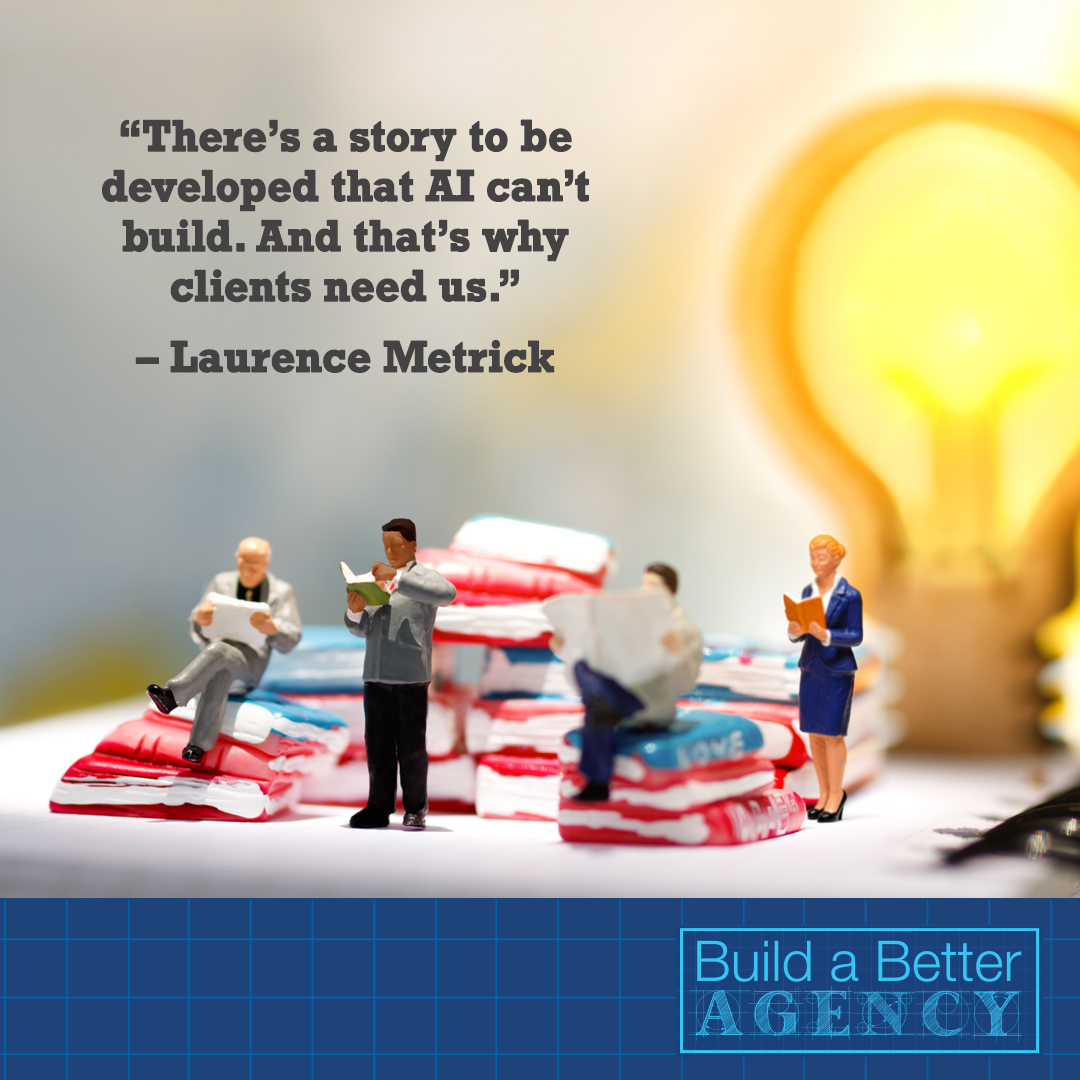
One of the things I would advise the agencies that are listening is try and get your clients as quickly as possible and tell them, hey, There’s a story to be developed that AI can’t build.
Drew McLellan [00:36:41]:
Right.
Laurence Metrick [00:36:41]:
And that’s why you need us.
Drew McLellan [00:36:43]:
Right.
Laurence Metrick [00:36:43]:
And maybe not all of them will do it, but in advertising, there’s always that ebb and flow with in-house and using AORs, right? It’s every sort of 5 years, it kind of changes where all of a sudden everyone goes—
Drew McLellan [00:36:57]:
Yeah, the pendulum swings one way or the other. Yep.
Laurence Metrick [00:36:59]:
I want to be AI. I want to be in-house. Well, this is very much the same kind of thing. In other words, everyone’s now running towards AI as being the savior, and they’re able to save money. at the bottom line. And business generally sucks. You know, if you look across the board, it’s not great. I can tell you that most of our clients are suffering.
Drew McLellan [00:37:18]:
Yeah.
Laurence Metrick [00:37:18]:
And what’s interesting is Toronto’s a bit of a bubble, and there isn’t a single— there, in my daily life, there isn’t a tariff that’s affected me, you know, from the US, right? Because I don’t sell cars or aluminum. The new recent one is on hockey sticks. I find that laughable. So there’s a 50% tariff on hockey sticks from Canada. Really? But what’s kind of cool, what’s interesting about this is that business is not great in Toronto across the board because people perceive it not to be great.
Drew McLellan [00:37:58]:
Right.
Laurence Metrick [00:37:58]:
And the perception is, and our jobs is to have to go back to our clients and say, hey guys, it could be Great. And this is how you can make it great. Would I love everyone listening to buy the book? Only if you’re giving it away to your clients. You know what I mean? And if you can get them to read it, because that’s the next part, which is more difficult. Yeah, that’s right. It’s easy to write a book, by the way. It’s hard to get someone to read it. Yeah.
Drew McLellan [00:38:27]:
So true. So I’m curious, as we wrap up, what do you think your agency will look like 2 years from now? What will be the value you bring to clients and how will you, how will that value manifest? What, how do you think, how do you think you will continue to evolve? ‘Cause I think this is the question every agency owner is asking themselves right now. What are we gonna look like 6 months from now, a year from now, 2 years from now?
Laurence Metrick [00:38:53]:
I would probably want to have the best writing staff on the planet. That would be first and foremost.
Drew McLellan [00:38:59]:
Yeah.
Laurence Metrick [00:39:00]:
We’re lucky we have one. I would love to have a second who’s equally as good. It’s kind of finding great writers is very, very difficult.
Drew McLellan [00:39:08]:
Yeah.
Laurence Metrick [00:39:08]:
Plus great writers that will stay with you because, you know, they get bored.
Drew McLellan [00:39:12]:
Yeah.
Laurence Metrick [00:39:13]:
And they want to go, they want to go around, they want to go other places. But it would be writing first, then strategy. But our strategy will probably become our AI, which is called Brand Advisor AI, because it does a really great job. And I can see that Giving that to our clients would be a tremendous move in terms of it would give them their AI need. At least we know that the guardrails are for marketing and advertising with the way we want it. But I think it would be a huge tool that they would use, okay? That we would just give them. And then one phenomenal designer and a brilliant strategist. And that would be one team. And that one team would only look after 2 people.
Drew McLellan [00:39:59]:
Yeah. The, the 80%, right? 80% of your revenue. Yeah.
Laurence Metrick [00:40:03]:
Yeah. And then when you grow, you add another team exactly the same way.
Drew McLellan [00:40:07]:
Yeah.
Laurence Metrick [00:40:08]:
Because this way it’s compartmentalized. It’s not as agency owners now trying to find space. Someone’s got some time and you throw a thing at them. You know, it’s funny, my kid, my kid was, when he was in high school, came to me and said that You should build the agency the same way you’d build a fantasy hockey team in terms of looking at the depth of what they are. Not everybody scores, that kind of thing.
Drew McLellan [00:40:36]:
Right.
Laurence Metrick [00:40:36]:
In other words, you need someone on defense. And I looked at it and I said, this makes a ton of sense. And we started to model it over how we would build a fantasy hockey team in terms of what it was. And by the way, I don’t know how many of you— this kid had Ken Dryden Who’s— as a professor when he was at McGill.
Drew McLellan [00:40:57]:
Yeah.
Laurence Metrick [00:40:57]:
And the way Ken Dryden introduced himself— this has nothing to do with what we’re talking about today, but he introduced himself as, hi, my name is Ken Dryden. I used to play a little hockey in Montreal.
Drew McLellan [00:41:07]:
That’s crazy. Such an interesting time for us to be in the business we’re in. What excites you about the future of— Agency life?
Laurence Metrick [00:41:21]:
Oh, I think we’ll end up with better work. I mean, I can’t say that the work has been great for 10 years. You know, it’s been fine with some glimmers of hope. I think when we focus on the storytelling side or the creative side in terms of the writing and the insights, um, I think we’re gonna start to see much better work.
Drew McLellan [00:41:41]:
Yeah.
Laurence Metrick [00:41:42]:
You know, the— I don’t know how many guys have tried to do an AV video. We took our video production team and gave them 2 weeks to come up with AV video. It was horrible just finding stuff. It just, it was— however, what’s probably gonna happen is it’s gonna be radio commercials with some sort of visual on top of them.
Drew McLellan [00:42:06]:
Yeah, it’s crazy. You know what I mean?
Laurence Metrick [00:42:07]:
In terms of the creative stuff.
Drew McLellan [00:42:08]:
Yeah.
Laurence Metrick [00:42:08]:
Until it gets good enough, but highly unsuccessful at trying to put it together. And in fact, it took a lot more time to put together a video that was AV generated I mean, that was AI-generated versus just doing it on our own.
Drew McLellan [00:42:23]:
Yeah.
Laurence Metrick [00:42:24]:
So that’s got a very long way to go. But I’m kind of excited because I think we’re going to get better work. There may be less people in the industry. We’re all becoming pretty nimble at doing the work faster.
Drew McLellan [00:42:40]:
Yeah.
Laurence Metrick [00:42:41]:
Although I have to tell you, it does— I think I said before, it takes longer for us to do great work.
Drew McLellan [00:42:47]:
Well, but to your point, we have tools to, to make stuff faster. It doesn’t mean we’re making the right stuff. And it does take that human interaction to make sure that we’re making the right stuff. And that’s slow, manual, thoughtful work.
Laurence Metrick [00:43:04]:
I think there’s a tremendous future in this. Yeah. But I think it’ll be for a fewer number of people.
Drew McLellan [00:43:09]:
Yeah. You very well may be right. We’ll see. Uh, this has been a great conversation. I, I, it, it’s just such an interesting time for us to be in the business and for us to reinvent our agencies and sort of think about the future. If folks wanna learn more about the book or your work or come tour your, your studio, tell me, tell them how to reach you.
Laurence Metrick [00:43:31]:
The easiest way is [email protected]. Uh, Laurence is L-A-U-R-E-N-C-E. And just tell me what you’re looking for. And there’s enough people here to help.
Drew McLellan [00:43:42]:
Yeah.
Laurence Metrick [00:43:43]:
So I will follow up. Drew, this has been fabulous for me. I can’t tell you, your questions are insightful.
Drew McLellan [00:43:49]:
Thank you.
Laurence Metrick [00:43:50]:
I hope my answers matched your questions because I thought, I think what you’ve done today is amazing. And I don’t know how many people know how difficult it is to do well, but you do it extremely well.
Drew McLellan [00:44:01]:
Thank you. It is fun work. I enjoy these conversations very much and I know our listeners enjoy them too. So I’m grateful that you took time to be on the show. Thank you.
Laurence Metrick [00:44:12]:
And what’s your dog’s name?
Drew McLellan [00:44:13]:
Uh, that’s Jax behind me. It could have been one of any— any 3 could wander in and out of my office at any time. We’re, we’re terrible foster family. We end up keeping them, uh, which is exactly what the foster rescue program wants you to do, of course, uh, and we fall right into their trap on a regular basis.
Laurence Metrick [00:44:31]:
So tremendous. Good for you.
Drew McLellan [00:44:33]:
Yeah, it was— this was great. Thank you.
Laurence Metrick [00:44:35]:
It was a pleasure. Thank you.
Drew McLellan [00:44:37]:
Yep. All right, listeners, here’s homework. I want you to plan a field trip. I want you to create a human experience, a human interaction that helps your team better understand your client’s customers. Again, it could be sitting outside the store, as Laurence was saying, and taking pictures of who walks in and out of the store. It could be interacting with them in their natural environment. It could be watching how they consume a product. But create the tactile human experience of actually interacting with those people and learning who they are, and watch how it changes your work. Book is really great. It’s got a lot of great ideas, but the core message underneath it is to use AI effectively, we have to be even more human. We have to be able to connect to people at a deeper level. To bring the quality of work and the quality of the storytelling that we all went into the business to begin with. This is our opportunity, and I think it is what will help us not only survive this next sort of 3 to 5 years of crazy innovation, but it’ll help us thrive in it, and it’ll help us become so indispensable to our clients, which I know is what all of you wanna do. So that’s your homework. Make a field trip. I would love to hear what you do. What you learn, uh, and what you’re gonna do next. ‘Cause I think once you do it, it’s kind of infectious. You’re gonna start doing it even more and more. All right. That’s your homework. Before I let you go, 2 quick things. Big shout out and thank you to our friends at White Label IQ, the presenting sponsor of the podcast. So whitelabeliq.com/ami. And as I always like to end the show, I don’t get to have these conversations. I would not have met Laurence if I did not have the show. So I am super grateful that in the crazy world that you live in, you carve out an hour to hang out with me every week. So I do not take that for granted. We have been doing this for a long time together, over 10 years now, and I look forward to it just like I did in the beginning. So I hope you do too, and I’ll be back next week and I hope to see you there. All right, I’ll talk to you next week. That’s a wrap for this week’s episode of Build better agency, visit agencymanagementinstitute.com to check out our workshops, coaching and consulting packages, and all the other ways we serve agencies just like yours. Thanks for listening.