
Episode 576

Welcome to another inspiring episode of Build a Better Agency! This week, host Drew McLellan sits down with longtime agency owner Stacy Jones to discuss the hard-earned lessons and deep insights behind her new business parable, “Dragons and Doors.” If you’ve ever felt the pressure of forging your own path, facing daunting challenges, or wondering how to truly move your agency forward, this conversation is a must-listen.
Stacy Jones opens up about her winding journey through the world of agency ownership—sharing both the victories and the setbacks that shaped her over nearly two decades in the business. Together, she and Drew McLellan explore the central metaphor of her book: the “doors” (opportunities) and “dragons” (challenges) we all encounter, and the resilience required to move through uncertainty. Listeners will get candid insights into why setbacks matter, how failure becomes a teacher, and the universal truths that every agency owner should recognize as they grow their business and lead their teams.
The episode also dives into the human side of leadership, from understanding personal and team core values, to learning how to avoid over-rescuing employees, to finding balance between relentless drive and necessary rest. Stacy Jones shares her own moments of overwork, vulnerability, and growth, revealing how introspection—and even failure—can pave the way for greater agency success and personal fulfillment.
Tune in for practical wisdom on decision-making, fostering a strong work culture, and building agency resilience in the face of unexpected turns. Whether you’re navigating a tough moment or celebrating a big win, you’ll walk away from this episode with renewed motivation to embrace your journey—dragons, doors, and all.
A big thank you to our podcast’s presenting sponsor, White Label IQ. They’re an amazing resource for agencies who want to outsource their design, dev, or PPC work at wholesale prices. Check out their special offer (10 free hours!) for podcast listeners here.
What You Will Learn in This Episode:
- Embracing failure and resilience as central to agency growth
- Recognizing and navigating doors (opportunities) and dragons (challenges) in agency ownership
- The evolution of instincts and decision-making through experience
- The impact of core values on agency culture and leadership
- Balancing self-sacrifice with personal well-being and growth
- Developing teams by allowing space for mistakes and learning
- Finding purpose and having faith in your journey as an agency leader
Ways to contact Stacy:
- LinkedIn: https://www.linkedin.com/in/stacyjones/
- Website: https://hollywoodbranded.com
Resources:
- Stacy’s Book: Dragons and Doors: The Path Creating You by Stacy Jones: https://a.co/d/00eBz8XC
- BaBA Summit May 24-26, 2027: https://agencymanagementinstitute.com/babasummit/
- Drew’s Book: Sell With Authority
- AMI Facebook Group: https://www.facebook.com/agencymanagementinstitute
- AMI Preferred Partners: https://agencymanagementinstitute.com/ami-preferred-partners/
- Agency Edge Research Series: https://agencymanagementinstitute.com/agency-tools/agency-edge-research-series/
- Upcoming workshops: https://agencymanagementinstitute.com/advertising-agency-training/workshop-calendar/
- Weekly Newsletter: https://agencymanagementinstitute.com/newsletter-sign-up-form/
- Agency Coaching and Consulting: https://agencymanagementinstitute.com/advertising-agency-consulting/agency-coaching-consulting/
Danyel McLellan [00:00:01]:
It doesn’t matter what kind of agency you run— traditional, digital, media buying, web dev, PR, or brand— whatever your focus, you still need to run a profitable business. The Build a Better Agency podcast presented by White Label IQ will expose you to the best practices that drive growth, client and employee retention, and profitability. Bringing his 25+ years of experience as both an agency owner and agency consultant, please welcome your host, Drew McLellan.
Drew McLellan [00:00:31]:
Hey everybody, Drew McLellan here from Agency Management Institute. Welcome to another episode of Build a Better Agency. So if you are a regular, welcome back. If you are new to us, you’re just discovering the podcast, welcome. We are singular in our focus. We are focusing on what small to mid-sized agency owners and leaders need to know to make the agency more sustainable, more scalable, if you want to down the road, more sellable, and all along the way, making sure that it’s more profitable, that it serves you and your life and your family better by making better choices. And so, sometimes we’re looking at new business or operations or how people are using AI, and sometimes we’re looking at within, we’re looking at what kind of leaders we are and how do we get better. And that’s, that’s what this week’s episode is all about. Before I tell you a little bit more about our guest, Just a couple little housekeeping things. Number one, big, big housekeeping thing, actually. Huge shout out and thank you to our friends at White Label IQ. They’re the presenting sponsor of this podcast. What that means is without their support, I would have a hard time doing this. Putting together the effort and the team to put together this show for almost 600 episodes is a pretty heavy lift, and our friends at White Label make that possible for us to do week after week. So many thanks to them. If you’re not familiar with White Label, they are born from an agency, and what they do is they come alongside agencies. They only serve agencies. They come alongside agencies and they help them with web dev, design, PPC, AI automations, app development. They’ve got a team of engineers that can build just about anything. They also can come alongside if you have a legacy program. Maybe one of your clients is using an old piece of software that nobody in your world knows how to work. They know how to work it. They know how to fix it. They know how to repair it. They know how to tell you when it’s time to retire it and do something different. So if you need any of that kind of support, head over to whitelabeliq.com/ami. And if you see White Label folks out and about at conferences or things like that, or if you’re so inclined you want to shoot them a note, please, please, please thank them for supporting the show. If you get value out of this show, please let them know that you appreciate their support, okay? Also, just want to remind you that we are coming up on year end. We’re going to have some trends reports and other things for you to watch. If you are not a subscriber to our weekly newsletter, it’s easy to do. Go to the Agency Management Institute website, so agencymanagementinstitute.com, scroll down to the very bottom, and at the footer you’re going to see sign up for the newsletter and just give us your email address. and you will start hearing from us with really great content about how to make your agency even better. It’s not about selling you anything. It’s not about blowing smoke up your skirt. It really is thoughtful content to help you run your shop better, just like the show here today. Okay? All right. So, our guest today is an agency owner that Danielle and I have known for many, many years. Uh, she’s in one of our peer groups. We’ve done some coaching with her, and she wrote a brand new book called Dragons and Doors, and her name is Stacy Jones. And what Stacy did was very bravely look at the last 20 years of her life as an agency owner and really think through, through this business parable. So the business parable is all about doors you can walk through. So opportunities and the dragons, the challenges you meet along the way, and how do you make good decisions around both doors and dragons? It’s a great read, but more important than that, it’s a really great reminder to all of us that how we show up as leaders, how we make decisions, how we lead the team, how we build and support a team. All of those things are part of the fabric of how successful our agency’s gonna be. So I’m anxious to introduce her to you and have you learn from her very hard-earned mistakes, her very hard-earned lessons of abundance, and how you can apply those to your agency and your life. Okay? So without further ado, let’s welcome Stacy to the show. Stacy, welcome to the podcast. Thanks for being with us.
Stacy Jones [00:04:52]:
So happy to be here today, Drew.
Drew McLellan [00:04:54]:
I love that. So what prompted this conversation was your brand new book is out and it is a business fable that talks about sort of your journey as an agency owner. What, what prompted you to write the book?
Stacy Jones [00:05:09]:
You know, honestly, I set out to write something that was very, very different. It wasn’t a plan to write a parable, a fable. Like, this is not my style of writing. I do a lot of nonfiction business advice insight. So I had sat down, had this plan for years to write, had written all these different things along the way, started typing, and I don’t know what happened, but something did. And my lesson came out in more of a story format that was very fictionalized versus that nonfiction of Stacy’s life.
Drew McLellan [00:05:44]:
Yeah. So this was the book that was inside you, whether you knew it or not.
Stacy Jones [00:05:48]:
I don’t even know if it was inside me or if I channeled it somehow. Yeah. But I sat there typing and typing and it just happened. And my husband, was super, super sick, which actually gave me the time to actually do this. It was New Year’s break. It was his birthday. We had all these plans. He got the flu. We couldn’t go and see my mother because we couldn’t give her the flu. And I was able to DoorDash for everyone and just sit and type and type and came up. And when he actually came out of his stupor, he’s like, what did you write? I’m like, oh, you’re not going to believe this one.
Drew McLellan [00:06:20]:
Yeah. And he, and here we are. So, you know, as I was reading the book, it, it is, while it is your story, it is many agency owners’ stories. Yeah. And, and one of the, one of the overarching themes is things don’t go according to plan. Like that’s, I think that’s one of the things agency owners have to embrace early on is that whatever we think our agency is going to become or evolve to, or what the big client’s gonna do, it doesn’t always play out that way. And, and your story starts off with, you know, you kind of left a promised partnership that kind of kept moving further away. You started your own shop and then you had a legal, like a lawsuit that got in the way of you doing what you thought you were gonna do. So take us to the moment when you really realized that the original plan was not gonna work and what you did once that realization came to you. Mm-hmm. What did you do next?
Stacy Jones [00:07:18]:
Sure. So the whole book was— ended up being triggered by me actually doing a very introspective look at my life and, and what’s gotten to me here today. I’ve been in the entertainment marketing world now for 30 years. I’ve been an agency owner for 18, 19 years now,
Drew McLellan [00:07:33]:
right?
Stacy Jones [00:07:34]:
And really looking at the patterns that got me to the success and to my failures. And I’m a big advocate that you have to screw up in life. You have to have major, major mess-ups.
Drew McLellan [00:07:48]:
Yeah, you gotta take the risks, right?
Stacy Jones [00:07:50]:
You have to. You have to fail. Like, failing is actually— you fail forward. Every time you fail, you learn something, you get a little bit more resilience. And that is something I am just chock-full of, a lot of resilience from a very early age. And I work in an industry that is difficult. And, you know, Hollywood is one of the toughest industries I think that you could possibly work in. Because it’s a creative field that is backed by money, tremendous amounts of money.
Drew McLellan [00:08:17]:
Right.
Stacy Jones [00:08:17]:
And when you have that creative drive, but you also have that black and white fiscal impact, it causes a lot more than just emotion. And it, it, it, it tempers its behaviors that you’ve never necessarily even seen in business settings before sometimes.
Drew McLellan [00:08:34]:
Right.
Stacy Jones [00:08:34]:
And then you bring in the world that we do of bringing in brands who are also very black and white and who are on Wall Street and who have boards of directors and they have investors and they have all of these different people who believe in their brands. And it’s a very complex world to work within. Yeah. And so there’s a lot of mess-ups along the way, whether it’s my agency, someone else’s, or the brand. It’s not really driven by the individual. It’s by all the moving circles of everything that’s in life. And so from looking at those patterns, from looking at how I’ve actually been able to survive and actually thrive in this world, It helped me start looking at the opportunities that I took along the way. The, you know, the whole book, it’s, you know, Dragons and Doors. The doors are the opportunities that come to you, the choice to open that door, to step through. And as an agency owner, we have to step through all the time. And we don’t know what’s actually gonna be in that room, what dragon, what challenge, what fierceness is going to be there. And it’s not just with the agency owners in that path. We also have to figure out how to get our team members For sure. Actually be willing to open those doors also and not be risk-averse. Because as we’re not risk-averse as agency owners, usually, like, we’re just like, yeah, we’ll do it.
Drew McLellan [00:09:53]:
Right.
Stacy Jones [00:09:53]:
And then we’re like, what the hell did I get myself into? How am I gonna figure this thing out as it goes on? So that was the whole guide on this, on writing, so that I could try to share what are the universal truths that we all face. Every single solitary time that we’re walking through this path of life, path of agency ownership, path of being a team member, that we have to figure out, or we’re going to just keep on repeating the same pattern of facing that door and failing.
Drew McLellan [00:10:21]:
Yeah. And kind of being stuck in a room of mirrors, but never being able to find the path out, right?
Stacy Jones [00:10:28]:
Correct.
Drew McLellan [00:10:29]:
Yeah.
Stacy Jones [00:10:29]:
And you just repeat and you repeat, and you have to get very introspective, and you have to get to the point in life that you actually can look inward and see what you’re doing. And I think that’s what I really was trying to get across was how do you put into words experiences that we all have, no matter where they are, whether they’re in a work function, whether they’re in a personal function, where they apply to us in a recognizable way that we can name it, that we understand what that pattern is when it shows up. Because once you’re aware of it, you have a chance of actually doing something about it. Right. Otherwise,
Drew McLellan [00:11:03]:
you’re
Stacy Jones [00:11:03]:
just doomed to keep on going on that same rut and just same loop and doing exactly
Drew McLellan [00:11:10]:
So as you, as you were writing the book and you were looking back at your, at your, at all of the choices, because every day agency owners face doors, using your analogy, that we either open or don’t open, and we face dragons that we either fell or don’t fell. But how did, when you look back now, how did you tell the difference between a decision that had you adapting intelligently and a decision that was a mistake? Versus letting the crisis of the moment choose the door or the business decision for you?
Stacy Jones [00:11:42]:
I think that’s part of resilience. I think that you start making smarter decisions the more times you fall and fail, the more times you actually have the experience where you can listen to your gut and to your instinct and start recognizing again patterns and identification. That’s where that change Actually is going to happen. With all of this, I mean, it comes down to how can you actually recognize that not every single solitary thing out there is an opportunity? Because as agency owners, we also are like, look, it’s flashy. I’m going to go run over there now.
Drew McLellan [00:12:18]:
Right.
Stacy Jones [00:12:18]:
Hey, this thing’s flashy over there. Let me run over there now. And then, oh, now it’s getting hard. Do you double down? Do you keep on going forward? Or do you say, oh, I’m just going to lick my wounds. I’m going to retreat. I’ve already invested too much money in this. This was actually a loss or fail? Or do you step forward and say, I did actually see something here? My gut, my instinct that I’ve had as an agency owner, of all my experience, my feelings that are out there, I think there’s something here. It’s worth trying. It’s worth trying a different angle. It’s worth trying from a different viewpoint in some way. What do I need to do to suss this out to keep it actually happening so that you can, whether it’s felling the dragon or just learning how to control the dragon and or work within the dragon and the issues that are going to be there. Because there’s always going to be issues. I mean, it’s never about—
Drew McLellan [00:13:08]:
Right.
Stacy Jones [00:13:08]:
It’s never about full success. I don’t think any of us have ever been like, that was successful and this is successful and this is successful. And it’s always just like seamless and painless and we just keep on going forward.
Drew McLellan [00:13:20]:
Yeah.
Stacy Jones [00:13:20]:
I mean, it’s usually more about, okay, I got 60% of it right, and I’m only licking wounds for about 40% of it. Next time, I bet I could get this at 80%. Right. And how do you just keep on moving forward and improving until you actually feel that you’ve made enough headway that when you face that same challenge again, you’re not going to be back at basics? You’re actually going to be starting at a higher level so that you can continue your momentum and get actually to a higher level at your Outcome as well, cuz it’s never gonna be 100%.
Drew McLellan [00:13:53]:
Right. So as you were, again, there’s so much value in sort of looking backwards and sort of seeing things, kind of looking at it outside of yourself. The emotion’s gone, good or bad, and now I’m looking at it outside of myself. Did you def— did you decide or did you see that there was actually a framework, even if you weren’t aware of it at the time, that you use to evaluate the threat of the dragon or the opportunity of the door to know, do I fell the dragon? Do I tame the dragon? Do I learn how to ride the dragon? You know, is the dragon actually a door in disguise? Do I walk through the door? Was there a framework or was it all just trust your instincts?
Stacy Jones [00:14:38]:
I think that trust your instincts would be my, the phrase I would say, but the instinct is developed. from having the experience of having actually gone through prior experiences that are either similar or that are, have a feel to them that are the same. I, I don’t think that, you know, as agency owners where you’re at today, you know, the day one that you become an agency owner, very different than year 10, year 15.
Drew McLellan [00:15:07]:
Right.
Stacy Jones [00:15:08]:
Right. Like you’re evolving on this path. You would not recognize the opportunities on day one. You wouldn’t recognize the risks on day one. You wouldn’t recognize how far you could actually scale on that day one because you haven’t had the experience of doing those things, of walking those steps, seeing the reactions. And not just your reactions, but your team members. Because once you become that agency owner, it’s very different from— you were the usually awesome at whatever company you were at, right? You knew how to do your job.
Drew McLellan [00:15:42]:
You were the rock star, right?
Stacy Jones [00:15:44]:
Yeah. And you’re like, them? No one else knows how to do this as well as I. I can do it all,
Drew McLellan [00:15:49]:
right?
Stacy Jones [00:15:50]:
Do it. People who are my boss, down with them. I’m off to do my own thing. I can do it better. Or, oh, they set this up as this fantastic opportunity. I’m going to step into their agency and I’m now going to take it on as my own legacy. I mean, those are the ways that we become agency owners. We either Become an agency owner because we’ve hit a proverbial glass ceiling and we’re like, I’m not doing this anymore for someone else. I’m gonna do it myself. I can do it better. Or we say, oh, I don’t have a job. I’m going to start a company and I’m just gonna be a freelancer and I’m doing it. Oh wait, I could use some help. Now I have some employees. Wait, now I’m an agency owner.
Drew McLellan [00:16:25]:
That’s welcome to being an accidental agency owner, which is how most of you started, right?
Stacy Jones [00:16:30]:
Yeah. Or It’s, wow, I’ve worked at this agency for this many years and the founder is going to be leaving and I really like it. I think I could step in. I mean, I’m not sure if there’s really more than those types of opportunities that exist unless you’re like, I’m gonna buy someone’s agency. And you’re not usually, never an agency owner jumping in and being like, I’m gonna own an agency.
Drew McLellan [00:16:50]:
Right.
Stacy Jones [00:16:51]:
Without having some work there. So with all of that, like those experiences that we’ve had, I want to recognize most of the things that came my way, and they were developed through instinct, but instinct was developed through failure and through actually trying things and through years of opening doors and seeing what was good, what was bad behind them, where I needed to actually shore myself up, or where I needed to get someone to join me in whatever that battle was that would be
Drew McLellan [00:17:28]:
So are there, do you think there are some universal truths that you took out of this, that whether it’s my decision-making, your decision-making, brand new agency owners’ decision-making, are there some universal things that you’ve learned that help you shortcut to the instinct or the right decision now that you’ve done it for, you know, like you said, 18, 19 years as an
Stacy Jones [00:17:50]:
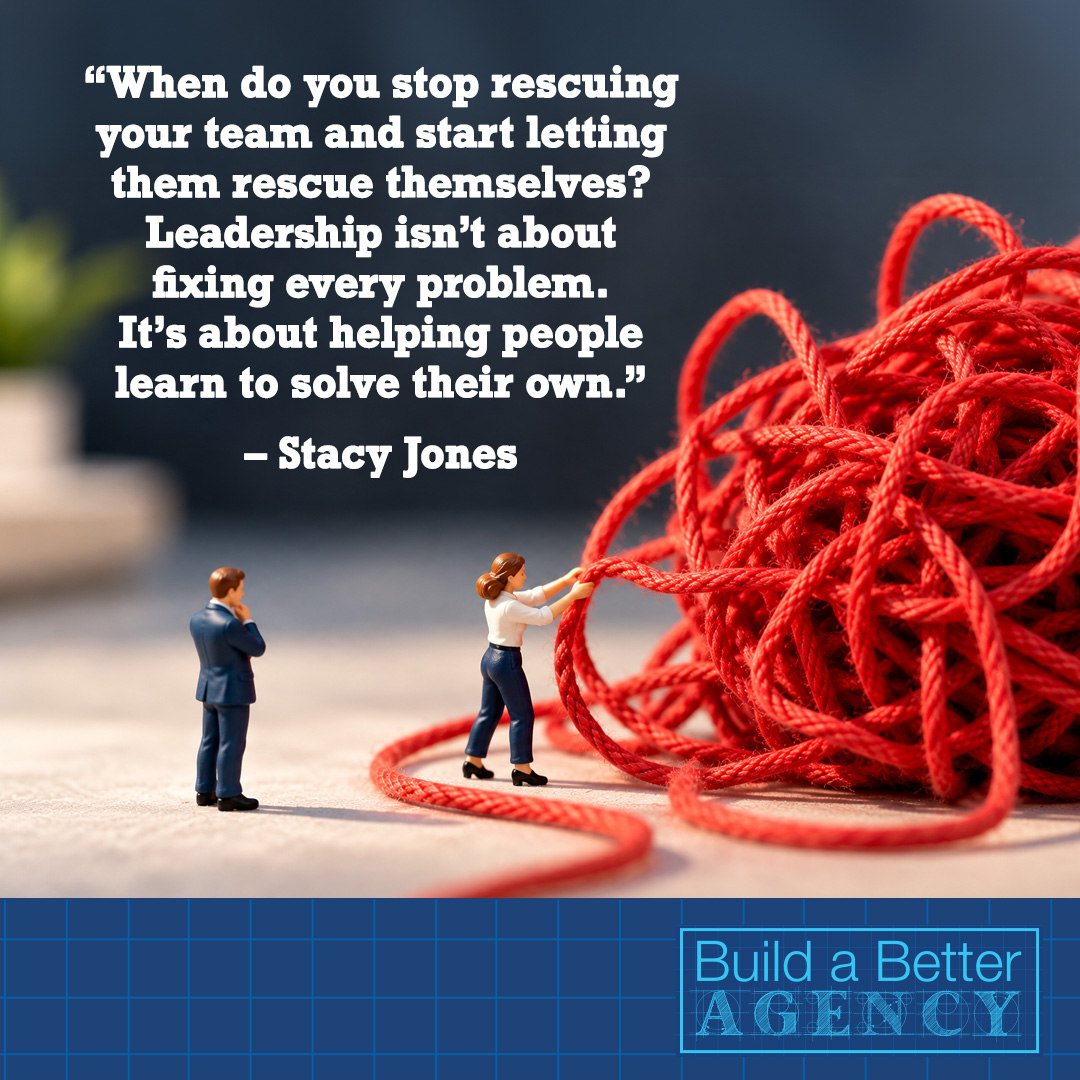
owner? Mm-hmm. Yeah, I, I absolutely think so. I think, you know, you look at certain things like how do you as an agency owner rescue your team too much? When do you actually let your team start rescuing themselves? How do you help them actually learn all the things that you learned earlier on? Right. That now as an agency owner, you have that horizon view. It’s fantastic cuz you can see where your team is going to screw up. Or you can see where they might potentially just as an individual not be fulfilling themselves. And it’s so hard because as agency owners, I think we’re fixers. I think that’s most things that we are.
Drew McLellan [00:18:29]:
We are problem solvers for sure. Yep.
Stacy Jones [00:18:32]:
So, and we’re really, we like doing that and we’ve made a career where we get paid to fix other people’s problems. Yeah.
Drew McLellan [00:18:39]:
It feels good to be the hero for sure.
Stacy Jones [00:18:41]:
Yeah. Yeah. And doesn’t mean that we’re always so good at fixing our own problems and looking internally at ourselves as well. So I think that’s really what the book is for me. It identifies what are your issues with perfectionism? How does that hold your business back? How do you actually delay things internally? How do you get stuck on something that needs to actually be done and it can’t be moved forward without your help? How do you actually instill your understanding, your values onto your team so that they can actually step forward and continue without you having to spoon-feed them everything along the way. It’s— those are the— all the issues that we all have with that. But there’s so many other universal truths that exist in life. You know, why would you have any challenges in life if they’re not actually caused by other challenges, other traumas, other everything that we’re all trying to work through. So everything that has plagued you throughout your life that’s held you back as an individual is going to show up in your business as well.
Drew McLellan [00:19:53]:
For sure. Yeah.
Stacy Jones [00:19:54]:
And you’re bringing your lens now to your team and all of your team members. They have their own traumas. They have their own issues from a very early day.
Drew McLellan [00:20:03]:
Right.
Stacy Jones [00:20:03]:
On day one, when they were born, they got instilled by all the things that their parents taught them. And all the things that their parents taught them, wrong or right, their parents were taught by their parents wrong things, right things, all the way back generationally through ancestors. So inside of an agency setting, you have this like boiling pot of all of these different broken things, trauma things, viewpoint things.
Drew McLellan [00:20:29]:
Culture things, good things, strengths. Absolutely. Right.
Stacy Jones [00:20:34]:
Yeah. And so how is that something that you can look at? And, and it doesn’t matter what that universal truth might be. How can your experience actually, you know, help you recognize those patterns? How can they help you prepare and make better systems for you? How can you understand, you know, the cost that’s actually applying to yourself and your business by working against your strengths versus actually figuring out what your strengths are. How do you actually figure out where you are, who you are as a person? How do you ensure that, you know, my core values— my core values are no ego, no drama. I work in a very heavy, heavy ego and drama field. You can have clients with drama and egos. I can have productions and creatives with egos and dramas. If it’s inside our agency also with egos and dramas, like, you can get it from all 3 legs. I mean, you’re gonna have your head cut off.
Drew McLellan [00:21:27]:
Right.
Stacy Jones [00:21:27]:
You know, I have a belief in that of mutual benefit. I founded my entire agency on mutual benefit. How do you actually ensure your team members have benefit? Our partnerships are beneficial, our clients have benefit, we receive benefit. You know, that’s how this world works. I mean, mutual benefit or money, it’s the same thing. There’s not really a differential about that.
Drew McLellan [00:21:50]:
Right.
Stacy Jones [00:21:51]:
You know, we have a strong foundation of learn, learn, do, teach, and we make sure that those are universal fundamental ingrained habits of the agency that everyone here has to have a mindset that you’re willing to learn, that you’re willing then to do, you’re willing to then teach someone else how to do the things that you learn so that you can now get to the next level of where you’re at so that you can challenge yourself, open a new door, have a new passion, try something different, take the agency in a new direction or grow it bigger as you grow yourself. You know, and it goes down to everything. It goes into your hiring, your accountability, you know, be accountable. Be invaluable, go above and beyond. Like, and how do you learn these things in life unless you actually look at how you’re showing up in life and how you’re helping other people show up and holding them to those expectations too?
Drew McLellan [00:22:43]:
Right. It’s hard to teach it if you don’t live it, for sure.
Stacy Jones [00:22:46]:
Yes.
Drew McLellan [00:22:47]:
Right. Yeah. Yeah. So I think one of the, one of the core lessons that is kind of woven through the book is, you know, you’re very candid about some of the challenges you had as an agency owner. And some of the losses and how that loss landed on you. And you talk about kind of what got you through it. But if somebody’s reading the book, they could hear or could see that if I care enough, I should sacrifice everything, which I know is not the message you want to project to the readers. In sharing some of your challenges and how hard they were on you personally, What’s the lesson you want the reader to get? What, what is the lesson that you now looking back on it from a different lens, what’s the lesson you got? How have you changed and what do you wanna make sure they hear? So it’s not a, I’m gonna take all of this on myself and put myself in physical health risks. I’m gonna put my, my relationships at risk cuz I’m just gonna sacrifice everything.
Stacy Jones [00:23:49]:
Well, I think what I’ve learned is that when you do that, cuz I’ve done all those things. Yep. I, I have been that, that would be me. But I’ve spent a lot of time trying to figure out how that has actually impacted my business, how that’s impacted the rescuing of team members when I’ve been trying to rescue the business. And it’s very hard as an agency owner, right? You’re like, okay, do I dive in and give it all? Because, you know, I, I’m in charge of these people. I’m in charge of this business. I have to keep all the wheels on the bus. I see the wheels are coming off. Mm-hmm. If I keep my finger on it at all points, if less wheels fall off the bus, then it’s going to be way easier on my life. So why should I not give up in order to have them? But you’re going to stunt your growth. And you’re also going to— all the things that you just said— really impinge on your relationships with your family. You’re going to have health issues. You’re going to wake up one day and be, you know, 15, 20 years into agency ownership and wonder what you actually did with your life. Was it actually worthwhile to give up all of those different experiences when— The experiences that you chose to say no to because you were running after this client or trying to save the day for that was actually something that would’ve shaped the day, opened you up to a new opportunity, and led you potentially to a new outcome or ability to see something, if nothing else, from a more rested place.
Drew McLellan [00:25:11]:
Right.
Stacy Jones [00:25:12]:
And that you’re less taxed.
Drew McLellan [00:25:13]:
Right. And it gets back to what you were talking about too, in terms of sometimes we over-rescue our own team. When all that burden comes on us and now our team not only isn’t doing what we need them to do and probably what we’re paying them to do, but they’re also not learning from that stumble or that challenge in a way because we almost made it too easy for them.
Stacy Jones [00:25:38]:
Right. And, and it’s hard. And I will say that the making it too easy from them, you know, I think anyone who is at least in their 40s, I’m in my early 50s. Uh, we had a different way of growing up. We weren’t in the frying pan. We were sizzled all the time. You know, this is before all the movements that have come out. We all dealt with those on a day-to-day basis, and our asses were handed to us in no uncertain terms by those who led or who worked above us, or we were not treated fairly.
Drew McLellan [00:26:11]:
Yeah, we were working 60 hours a week and all, all of the things that Agency owners talk about, look, to your point, over 40, talk about like paying their dues and it’s a whole different world today.
Stacy Jones [00:26:24]:
And without those dues being paid, I mean, and fairly I will say, I am not sure that the younger generation is experiencing the pressures that we had that actually forged the current day agency owners into being resilient enough to be able to fall flat on their face when something happened that was out of their control. goal because people are very sensitive now and it’s a different world. And quite frankly, I think that a lot of parents, my generation, my age, have shortchanged their kids in a lot of the ways that we have rescued, a lot of helicopter parenting, a lot of safety nets. Yeah. And a lot of it’s also not really driven by the parents. It’s driven by the social media that’s changed everything so much. of where it is. And it’s— people are working just as agency owners now are trying to figure out what to do with these newly graduated kids who have come out who are so different. The parents who are raising them had to raise them in a world that was so different than what they knew as well. So we have this mixing pot that’s difficult to figure out of how you’re going to have that next generation Um, where—
Drew McLellan [00:27:45]:
yeah, how do they get— how do they get their bumps and bruises to learn without being broken, right? To learn how to stand up stronger and be able to face bigger challenges,
Stacy Jones [00:27:55]:
right? And they don’t learn from seeing you as an agency owner,
Drew McLellan [00:27:59]:
right?
Stacy Jones [00:28:00]:
Like, they don’t feel it. They see it and they, they take that perception, because everything in life is perception, right? That’s really what I do. I control and work in perception in Hollywood. Like, whatever I’m doing. And so how, as an agency owner, are you helping people actually have enough of the experience where they’re not getting broken because they are more sensitive and it is a different climate and you have to wrap your head around how not to serve up the same thing in the same way that you were served up because it doesn’t work anymore and your team will leave and they will break and it’s a different world. Mental health is a true conversation point now.
Drew McLellan [00:28:36]:
For sure.
Stacy Jones [00:28:36]:
That we have within offices. For sure. And protecting it and safety.
Drew McLellan [00:28:40]:
So we’ve been talking a lot about sort of the burden and the challenges. I wanna take a quick break. Yeah. And I wanna come back because I think equally threatening to us is when things are going great. So when we come back from our break, I wanna pick up from there how that too can help us get stuck. So let’s take a quick break and then we’ll be right back. Hey everybody, just want to remind you before we get back to the show that we have a very engaged Facebook group. It’s a private group just for podcast listeners and agency owners that are in the AMI community. And to find it, if you’re not a member, head over to facebook.com/groups/babapodcast. So again, facebook.com/groups/babapodcast. All you have to do is answer a few questions to make sure that you are an actual agency owner or leader. And we will let you right in and you can join over 1,700 other agency owners and leaders. And I’m telling you, there’s probably 10 or 15 conversations that are started every day that are gonna be of value to you. So come join us. All right. We are back with Stacy Jones and we are talking about her life experience as an agency owner for over 20 years and kind of how it manifests itself in her brand new book, which is a really great business parable and, uh, Easy to read, easy to digest, but some really tough lessons underneath the story part of it. And, you know, early on in the story, the comfort, things going well, kept the main character, the knight, kind of stuck. And then later, what we’ve been talking about so far is that sometimes you can overburden yourself and you need, you need to rest, you need to recover, you need to recuperate. Is a necessity, not a reward. So how do you, how do you, Stacy, sort of figure out the balance between comfort and that keeping you stuck and the need to stay still for a moment to catch your breath? So, you know, when does hibernating, if you will, or slowing down, when is it a deliberate choice? And When is it that you’re just so exhausted you have no choice?
Stacy Jones [00:30:54]:
So I operated myself for most of my life on the do more, do more, do more. It’s a constant race. You are on the hamster wheel. You’re not getting off. There’s another disaster around the corner. As soon as you have a success, you know, great, jump off. There’s gonna be another thing that you have to fix around the corner. And, and It depleted me beyond belief. I ended up 60 pounds overweight, massive health issues, you know, so much stress, incredible stress across my life. And I had to come up with a realization. And I think the biggest pattern, and this is really what happened before, just before I started writing this book, is really looking introspectively at the fact that I’ve been doing the same thing. I, as the agency owner, I, as a human, I, as me, Stacy Jones, I’ve been operating the same way since I was a child through all the things that I have learned. And I’ve had disaster after disaster. And I’ve had, if you look at it, unbelievable amounts of success, crazy amounts of success. I have the highest highs and the highest unbelievable experiences.
Drew McLellan [00:32:04]:
Right.
Stacy Jones [00:32:05]:
And the one thing I’ve gotten actually throughout all that time is I’m very good at celebrating in the moment. Because that’s something that I think we forget as an agency owner. For sure.
Drew McLellan [00:32:17]:
Most people aren’t good at it.
Stacy Jones [00:32:18]:
Yeah. And so I am good. And now I’m not good at doing it for long, and I could certainly do it for much longer than I do it. But I know that the win that you have today may be taken away by some stupid decision a producer or director makes on stage to like edit something out that was the big win before. Right. So you never know what’s coming. You never know what could happen. And you know that bad is out there, but good’s out there too.
Drew McLellan [00:32:46]:
Right. So you have to try. And if you, and if you don’t step through the door, I think one of the more points of your book is you can’t get to the good if you stay where you are. You can’t, you can’t open up that door and get to that good cuz it’s on the other side.
Stacy Jones [00:32:58]:
It’s on the other side. And, and the, the biggest pattern I realized with all of this as I did this, and I think agency owners will relate to this, is You know, we’re still alive. We’re still like thriving. We still are finding wins. We might have bad years. We might have bad times. We might have bad moments. But if you can actually step back, we typically lead more interesting lives as an agency owner than a lot of other people. We meet really interesting people. We get to help clients in ways that solve a lot of our own traumas that we have as fixers. And a lot of times, you know, Most of us, I think, are working on codependency issues very frequently also.
Drew McLellan [00:33:40]:
That’s true. Right.
Stacy Jones [00:33:41]:
We’re really good at codependency. But there’s wins. There’s big wins. And there, there’s moments where, like, you’re employing team members, you’re feeding people, you’re enabling other people to learn and make money and have their families actually prosper. And you as that agency owner, No matter the shit you go through, no matter the awesomeness you go through, like, you’re impacting lives in ways that a lot of times are not appreciated by those who work for you, possibly, or the clients that you’re working with. You know, you’re driving money for brands when you are sitting there and you’re helping a company make money through your marketing and media and advertising services, or however you’re creatively helping them. Now they’re employing more people. Now they’re feeding more people. And if you can take a step back and you actually look at that line of the people you have impacted and how you’ve changed lives and all the things that you’ve done in this world because you decided your light needed to shine a little brighter than being just a worker bee, that you were going to take that on, that you had that resilience, that you had that strength in you, that you had that gumption to take the risk.
Drew McLellan [00:34:56]:
Right.
Stacy Jones [00:34:57]:
That’s pretty powerful. I mean, as a human being, you’re a unique individual and not everyone’s cut out like you at all.
Drew McLellan [00:35:05]:
Right. You know, I often will say to an agency owner that’s having a hard time, let’s take it, let’s just take a look at your life. So in your worst year, you bring home X, $150,000, whatever the number is. You have the freedom to leave at 3 o’clock ’cause your kid’s got a dance recital. You are able to choose the people you work for and the people that work around you. Like, there are just so— there’s so much wealth in being an agency owner that sometimes I think we take it for granted, right? Yeah. And we think, and we forget that we live a life, even in the worst year of your agency’s history, we live a life that most people would kill to live. And we, yes, we pay the price for that. We have the bumps, the bruises, we’ve fallen, we’ve scraped our knees, we fought a lot of dragons. Sometimes we’ve been burned by the dragons, but overall, the work that we do and the choices and risks we’ve taken have created a pretty good outcome for us.
Stacy Jones [00:36:09]:
They have. And that’s the positives. I, I, I think that if you’re an agency owner and you get to the point where that negatives are always outweighing the positives, it’s time for some reflection. Right on that, either individually or at the practice of what you’re doing. Or maybe there’s some changes that need to happen. Yeah. Hopefully at least it’s 50/50, at least maybe 40% good and 60% bad. Like, and it still outweighs on the good, it still goes up. But I wouldn’t give up in my worst of times. And I’ve had a lot of, lot of crap happen to me. I’ve had millions of dollars I’ve had to sue for because someone’s left me on the ringer for that, that I’ve still had to pay out for the biggest names in Hollywood. I’ve had employee lawsuits. I have had things I’ve screwed up. I’ve had, you know, out of my control, writer strikes, actor strikes. You lose all your clients, like,
Drew McLellan [00:36:58]:
right?
Stacy Jones [00:36:59]:
And not just once. This has happened 3 times. We all had COVID. We all had to rebuild. Some agency owners figured it out and they flourished during that time. Others of us languished and we just had to figure it out and keep going. Yeah.
Drew McLellan [00:37:11]:
Just had to hang on long enough to get through it. Yeah.
Stacy Jones [00:37:14]:
Yeah. And all of this though, and, you know, it, it, it can, it can negatively impact your relationships. It can positively impact your relationships. I’m a, a rare breed where my husband ended up joining my agency and is now a partner with me. And who knew that that was going to open up and work in my life? And it worked brilliantly for us. Not work for other people in such the same way. Right. Definitely doesn’t for many, but like, that’s allowed us as agency owners to have unbelievable opportunities, experiences, travel, people we get to meet, and people we get to impact. And we get to do that together, and we get to actually have that life purpose. And really, that’s what you have as an agency owner. You have purpose. And, and I think that’s the big thing that people are missing in general in life. And that’s what the book’s about. It’s about discovering what is your own Purpose. What is your purpose in life that’s fueling you? How are you driving yourself? Because that’s always it. We’re only, we can only drive ourselves. We can, we can shine our lights on other people and encourage them along, but we can only drive ourselves. We can only elevate ourselves. And if you are someone who’s an agency owner, you’re probably on a path that you’ve been opening a lot of doors along the way and facing a lot of dragons and, and figuring out how to keep on, like any good video game, leveling up to that next level. Because that’s what life’s about.
Drew McLellan [00:38:41]:
Yeah. You know, it’s, and every decision stacks on another decision and every dragon felled opens up a pathway that you didn’t have before. It’s, it is all the micro decisions that you’ve made through the course of your career. Mm-hmm. Before you were an owner and then you’re after you’re an owner gets you to where it is. And I think part of what I thought was really interesting about your book was that The better you understand how you make those decisions and what are the things that you call instinct but really are well-honed realities that give you better odds to make the right decisions, all of that sort of ends— wherever you’re at today is the path of a million other decisions. Yeah. One thing I wanted to ask you before we get too far close to the end of the conversation is one of the things that you talk about in the book. And I know because I know your story, you don’t always have to walk through these doors or fight these dragons alone. Mm-hmm. So talk about sort of what was your reflection or your insight around surrounding yourself with other people, uh, on your team, adjacent to your team, to help you fight the dragons or pick which door. Like, how do you know who the right companion is for the journey? And, and do they change over time?
Stacy Jones [00:40:10]:
Yeah, I think that you’re constantly having your companions change in life because they might be walking in a similar path that you’re on at a moment, and then their path may diverge. It may be time to like split. That happens. But I think for me, it’s recognizing people who share my core values. I think instilling core values, talking about the core values. We have core values posted all over our agency. We, we do training on our core values.
Drew McLellan [00:40:36]:
Right.
Stacy Jones [00:40:37]:
And the reality is, when I was doing this core values, what are our 5 core values that are now like 9 core values? We went, we went big. You know, I was trying to figure them all out, and I had this wake-up moment. And, and it sounds stupid, Probably to many people, but all of a sudden, like, and I spent weeks working on this. It was like a project, like figuring out our core values. I did Traction. I was doing all of this stuff. What are they? I woke up and I’m like, those are me. Right.
Drew McLellan [00:41:04]:
My core values. My core values.
Stacy Jones [00:41:06]:
The agency. Those are me. That’s what wires me. And then I had to say, well, why and how did I develop these core values from my experience? And why to me are these important core values? And I think every time that I’ve found a mismatch in my life, it’s because my core values haven’t actually aligned and we’re so far off that it’s not going to be something that we can align. Because at the end of the day, it’s my core values that are actually driving the agency. It’s my core belief systems that are putting the smell and the flavor into the agency of who we are and who the brand is. And when you start having people who join your brand, because remember, everyone’s a brand. Your company’s a brand, your agency’s a brand, your employees are a brand, you as an agency owner is a brand. So when someone else has a different brand, now we can look at that and be like, you know, Coca-Cola and Pepsi are different brands. They have different fan bases. Right. You need to be that authentic you so that your people match your brand and your partners do too. And I think the other thing is, as an agency owner, is recognizing that not everyone is going to be you. Not everyone can be at the same level as you. I think my biggest wake-up call on this always has been my husband. I love him. We are soulmates. He is fantastic. He does really awesome things in his world. I do really awesome things in my world. They tend not to be the same awesome things.
Drew McLellan [00:42:44]:
Right.
Stacy Jones [00:42:44]:
And he cannot typically do the things I do at any near level of what I do. And I had to carve out and figure out what I was willing to give up, let him own, and not micromanage, and have faith that he had enough tools. And it took a little while to make sure. We had some flubs along the way, as anyone with any employee.
Drew McLellan [00:43:04]:
Right.
Stacy Jones [00:43:05]:
But I share that because I also know that there’s no one in this world that’s more invested in our agency and more so in me than him.
Drew McLellan [00:43:13]:
Right.
Stacy Jones [00:43:13]:
And I saw him stumble and I saw him stumble here and I saw him stumble there. And it allowed me to change my perspective about how I see my employees stumble. Because here I have someone who’s so invested in me, married me, and he’s so invested in my agency because now he’s an agency owner and he never planned on that in his life.
Drew McLellan [00:43:33]:
Right.
Stacy Jones [00:43:33]:
And this is where he can show up. And if I can understand that not everyone’s 100% there and to allow people to live within percentages that are not exactly the same, it allowed me to calm down. It allowed me not to feel like everything always had to be at this crazy level because it doesn’t have to be. And it allowed me to see which employees and other team members are also like him. Operating in all the best intentions, all the ways, but they’re wired differently than me. They’re not going to have the same viewpoints as me. They’re not going to be of the same brain as me, but they’re complementary because they’re better at X, Y, and Z than me because they have these things that I don’t even have.
Drew McLellan [00:44:16]:
Right.
Stacy Jones [00:44:17]:
And it’s real. It’s understanding that and it’s coming up with the empathy and the compassion. Yes, for your employees and team members, but also yourself.
Drew McLellan [00:44:26]:
Yeah.
Stacy Jones [00:44:26]:
But the patience in yourself also of understanding that it all doesn’t have to be perfect. It really doesn’t all the time, and it won’t be.
Drew McLellan [00:44:34]:
You know, I, at the end of the day, our— this is why I think core values should not be a community or a committee project. It really, it really does boil down to this, this agency is a reflection of me, and I’m gonna drive my spirit and soul all the way through it. And therefore it does have to, it has to align with my core values. And I think when that happens, that’s when you can, when you’ve got that true north, that’s when you can begin to tolerate, and that sounds more harsh than I mean it to, but people who aren’t you, right? They, that they are, they align with you on the things that matter most, but in other ways they are very different from you, which brings different challenges. but also different skill sets and different opportunities. But once you know that you align on what for you is most important, these, this is like, these are the rules that we do not break, right? Then I think you can give them that space to sort of step into their own and to do the things maybe you’re not as good at or that you don’t have time to do because you are connected at the core.
Stacy Jones [00:45:42]:
Mm-hmm. Or maybe even just the things that you don’t want to do, or the things that if you keep doing, you’re never going to be able to keep on opening doors and trying new things and you’re gonna get stuck in your own rut.
Drew McLellan [00:45:53]:
Right.
Stacy Jones [00:45:53]:
And I think, you know, you said that, you know, you don’t wanna be harsh, but it, it, it’s true. Like, what can you tolerate as a business owner? And, and what are you willing to tolerate within your organization? And then on the flip side of that, what are you willing to step back and look at and appreciate?
Drew McLellan [00:46:11]:
Right, right. When somebody puts down the book, uh, which I don’t actually think we’ve said the name of it, but it’s Dragons and Doors: The Path Creating You. When someone puts down the book, what do you— what do you want them to feel?
Stacy Jones [00:46:25]:
I want them to feel that they have faith, that they can actually have faith. And it’s not about religion. It can be. It can be that you have a big universal faith or a belief in us. But it comes down to faith that you’re going to be okay, that you’ve figured it out. You’ve gotten yourself so far along here. Like, your parents, if you were lucky, were there day one helping you perform and move forward for your first crawl, for your first walk, for your first words. And you were being given encouragement and you were being told how good you were all along those ways. As agency owners, there’s no one there who’s saying, good girl. Good boy.
Drew McLellan [00:47:11]:
Right, right.
Stacy Jones [00:47:12]:
Keep on going. You have to have developed the resilience in life, whether you’re an agency owner, whether you’re a team member, wherever you are on your path. You have to have faith in yourself. You can ascribe it to a higher belief, you can ascribe it to something else, but it comes down to, you know, that you have managed to get yourself this far today. No one else in the entire world is inside your head and responsible for helping you move forward. Every word of encouragement that you might need to hear from someone else, you need to figure out how to hear from it yourself first and be able to actually give that back to yourself because you have been there all your life helping propel yourself forward. You are the only one who’s going to be there for yourself for the rest of your life propelling yourself forward. Mm-hmm. And you’ve done a damn good job so far. So have faith. Keep on trying to go through challenges. You are going to fall flat on your face. That’s okay.
Drew McLellan [00:48:10]:
You’ve done it before.
Stacy Jones [00:48:11]:
Done it before. And if you fall flat on your face from 10 feet, well, when you’re at 100 feet falling flat on your face, you figure out how to put your arms out and bounce a little bit better. Right. So, you know, the, the falling on, the obstacles get bigger, the challenges get bigger, and they’re supposed to. Your world is supposed to get bigger. We’re here to grow is my belief. We’re here to, you know, learn and do more things and not be stuck in a daily rut. And as agency owners, we recognize that we did not want to get stuck in the daily rut of being a worker bee. We wanted to do more. So if you’re there and you’re doing more already, you have an unlimited path ahead of you. You just need to have faith on those bad days and It always works out. Something always works out.
Drew McLellan [00:49:00]:
Yep. Yeah, you’re right. This has been a great conversation. If folks wanna learn where to get the book, if they wanna follow your agency and all of the thought leadership you have around all of this, what’s the best way for them to keep track of you, Stace?
Stacy Jones [00:49:14]:
Sure. So if you wanna learn more about the book, it’s available on Amazon. It’s free on Kindle if you happen to have that membership, or you can get the paperback. Um, it’s also Dragons and Doors, tells you lots more about it and will give you some insights. And then if you are interested in Hollywood Branded, how you wanna change, you know, your brand’s clients’ perception by leveraging some of the biggest voices and platforms and hands-on opportunities and movies and TV shows or with celebrities, that’s hollywoodbranded.com.
Drew McLellan [00:49:45]:
Awesome. Thank you so much for being with us. Thanks for having the courage to write the book. I am sure That putting it all out there like you did, I’m sure there were moments when you were like, hmm, is this good for inner reflection or do I really wanna share it with the world? But you’ve always been a bold and brave leader, so I’m not surprised that you published the book, but I’m, I’m grateful that you did.
Stacy Jones [00:50:06]:
Well, thank you. I appreciate that. And yes, there is all a lot of my dirty little like, ooh, that happened to me type of scenarios and secrets, but I think that I was able to share them because those don’t define me as far as failures. And I’ve had a lot of failures. I’m telling you guys, I have failed so many times on different things. But they all made me stronger. They all made me learn something, and they don’t define me. And they’re things that happened, or maybe there were things I reacted to in the limited capacity of knowledge that I had at that time, that I wasn’t evolved enough or knowledgeable enough, or I hadn’t had enough experiences. To be able to see it from a different perspective always. And life’s a journey. We’re all growing, and that’s all we can do.
Drew McLellan [00:50:53]:
Yep, for sure. All right, guys, so here’s homework. I want you to identify— I want you to spend some time thinking about how you make decisions and what around your decision-making, what dragons you chase after to either tame or fell, what doors you open, And I want you to think about where you’re at right now this week. Are you at a place where you’re resting cuz things are going great? Are you at a place where you’re resting because you’re so exhausted you need to recuperate? Are you at a place where you’re pushing really hard and maybe you’re pushing too hard? Like just do it like a spot check on where you are in the decisions that you’re making. Many of you are making decisions around. AI and staffing and the clients you go after. You, many of you are in big pivot moments of your agency. And I think thinking about how you approach both your dragons and your doors and how you assess them and how you decide, is it foolhardy or brave to step into either a challenge or an opportunity? The more you understand that about yourself and the more you understand who you surround yourself with, To help you make those decisions and to fight those battles, the better you’re going to be as you move forward on your journey. Because Stacy’s right; it doesn’t get easier. It doesn’t get smaller. We wouldn’t want it to get smaller, but the more the smarter we can get and the more intuitive we can be in terms of the muscle memory of knowing how we call upon our past experiences, our colleagues, our circle of. Our peer groups, whatever it may be. However you are making those decisions, the more you intellectually understand how you do it, the more you can just let go and just lean into those decisions without second-guessing yourself. So that’s your homework for today is to think about that and kind of identify where you’re at and where you need to be. And if you need to move, are you making a move forward or backwards or sideways? Because all of those are viable choices. Okay. So that’s your homework before I let you go. Of course, I want to say one more time, thanks to our friends at White Label for being the presenting sponsor of the podcast. Check them out at whitelabeliq.com/ami. And you know, I always like to close, if you’re a regular listener, by acknowledging the fact that I don’t get to have these conversations. I don’t get to do this work if you don’t keep coming back and listening. And so I am super grateful that you find an hour to hang out with me. I don’t care if we’re gardening or we’re on the treadmill or we’re on the subway together. I’m all about multitasking. And so happy to be doing with whatever you’re doing right now. I’m happy to be doing it with you. And I’m grateful that you choose to hang out with me every week. So thanks for listening. I’ll be back next week and I hope you will too. Okay. See you then.
Danyel McLellan [00:53:42]:
Come back next week for another episode designed to help you build a stronger, more stable, and sustainable agency. Check out our workshops, coaching and consulting packages, and other professional development opportunities at agencymanagementinstitute.com.