
Episode 534

Welcome to another thought-provoking episode of Build a Better Agency! In this episode, host Drew McLellan welcomes Greg Star, founder of Driven Branding and former CEO of Carvertize, to explore how agency leaders can leverage LinkedIn to build stronger, more authentic personal brands. If you’ve ever wondered why your company’s LinkedIn page isn’t gaining traction or how you can make your own profile stand out in a sea of sameness, this conversation is packed with fresh perspectives and actionable strategies.
Drew McLellan and Greg Star dig deep into the “why” behind personal branding, revealing why executives and business owners should take the reins of their LinkedIn presence—rather than delegating to teams or relying on generic company posts. From sharing compelling origin stories to posting weekly updates and engaging thoughtfully with comments, Greg Star outlines what kind of content builds trust, authenticity, and ultimately, business opportunities. They discuss how true engagement emerges when you blend professional expertise with genuine connection—without veering into “cringe” territory or oversharing.
You’ll also get an inside look at Greg Star’s journey from manually creating buzz for his own business on LinkedIn to developing AI-powered tools that help introverted or time-strapped leaders tell their stories effectively. Hear practical tips for building consistency, making each post matter, and handling the inevitable engagement that follows. Plus, find out why starting now—no matter how long you’ve waited—is the key to momentum.
This episode is a must-listen for agency owners, executives, and anyone ready to move beyond passive lurking and intentional yet inauthentic posting. By the end, you’ll be inspired to up your LinkedIn game, share your unique “why,” and embrace consistency as the secret weapon to becoming a more visible and trusted leader in today’s crowded agency landscape.
A big thank you to our podcast’s presenting sponsor, White Label IQ. They’re an amazing resource for agencies who want to outsource their design, dev, or PPC work at wholesale prices. Check out their special offer (10 free hours!) for podcast listeners here.
What You Will Learn in This Episode:
-
- Leveraging LinkedIn for authentic personal branding
- Why agency owners’ voices outperform company pages on LinkedIn
- The power of consistency over perfection in building reputation
- Balancing professional storytelling with vulnerability (without getting “cringe”)
- Using origin stories and the “why” to foster connections
- How AI tools can assist—without replacing—the human touch
- Simple engagement tactics to grow trust and visibility
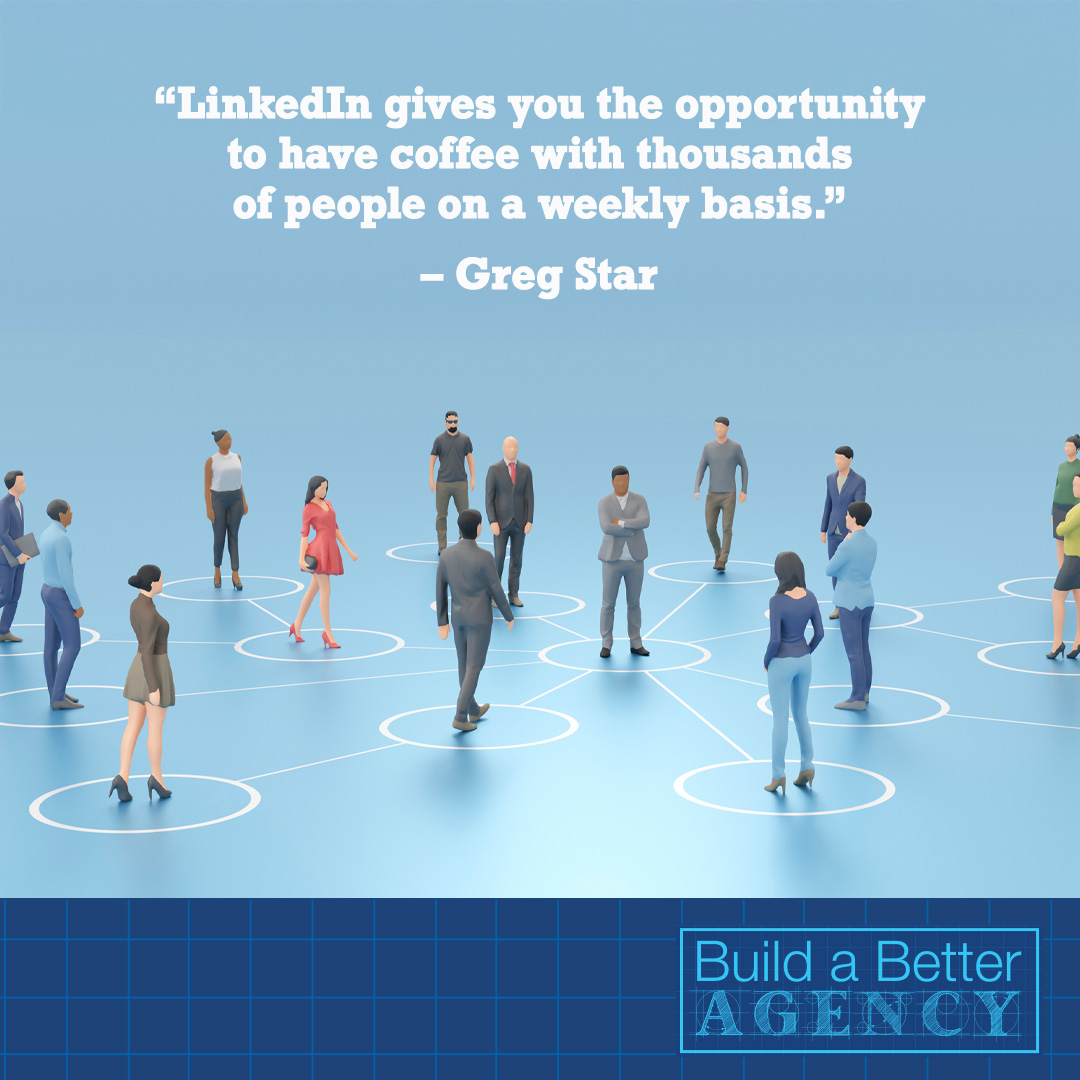
“LinkedIn gives you the opportunity to have coffee with thousands of people on a weekly basis.” - Greg Star Share on X
LinkedIn is a goldmine for agency leaders—if you use it right. Greg Star shares why telling your own story consistently is the key to building real connections. Share on X
Personal LinkedIn posts get eight times more engagement than company posts. Greg Star explains why authenticity beats algorithms every time. Share on X
Most agencies spend too much time on their company LinkedIn page. Greg Star and Drew McLellan unpack why your personal voice is what really grows the business. Share on X
Authenticity isn't optional anymore. Greg Star shares how leaders can leverage their real stories to drive business and attract talent. Share on X
Ways to contact Greg:
Resources:
- BaBA Summit May 18-20, 2026: https://agencymanagementinstitute.com/babasummit/
- Drew’s Book: Sell With Authority
- AMI Facebook Group: https://www.facebook.com/agencymanagementinstitute
- AMI Preferred Partners: https://agencymanagementinstitute.com/ami-preferred-partners/
- Agency Edge Research Series: https://agencymanagementinstitute.com/agency-tools/agency-edge-research-series/
- Upcoming workshops: https://agencymanagementinstitute.com/advertising-agency-training/workshop-calendar/
- Weekly Newsletter: https://agencymanagementinstitute.com/newsletter-sign-up-form/
- Agency Coaching and Consulting: https://agencymanagementinstitute.com/advertising-agency-consulting/agency-coaching-consulting/
Danyel McLellan [00:00:01]:
Running an agency can be a lonely proposition, but it doesn’t have to be. We can learn how to be better faster if we learn together. Welcome to Agency Management Institute’s Build a Better Agency podcast presented by White Label iq. Tune in every week for insights on how small to mid sized agencies are surviving and thriving in today’s market. With 25 plus years of experience as both an agency owner and agency consultant, please welcome, welcome your host, Drew McLellan.
Drew McLellan [00:00:37]:
Hey everybody, Drew McLellan here from agency Management Institute, back with another episode of Build a Better Agency. And we’re going to talk today an interesting sort of view of how AI and the sort of the human element are coming together to do some really interesting things, particularly around building our own brand as an agency and as agency owners and leaders. So I’m going to tell you a little bit more about our guest and where that conversation is going to go in a second. But first I want to do two things. Number one, I want to say thank you to our friends at White Label iq. As you know, they are the presenting sponsor of this podcast and one of the things that’s really interesting about watching how their business is evolving is how they’re leaning into AI. So like all of us, they’re trying to figure out sort of where it fits, how it helps, what’s smoke, what’s mirrors, what’s real. But what they’re not doing is that they’re not relying on the way they used to do things. They’re putting a lot of time and money into figuring it out so that they can be the partner that your agency needs. When you want to build something that is a combination of an idea that you have, an AI tool or an AI execution or an AI improvement or enhancement. Because they work with agencies of all sizes all over the world, across design, dev and paid media, they’re really thinking about AI in some ways in the same context that you are, but they’re also thinking about it from a very technical point of view, which odds are you as an agency may not have those people in house to do that. So these are the people that you want in your corner right now. They’re the ones who are willing to experiment with you to try beta tests. They can help you make sense about how these tools can serve your business day in and day out, can serve your clients business day in and day out, and what really makes sense in terms of how you bring that forward. So many thanks to our friends at White Label, not for just the work that they’re doing today, but how they’re thinking about how we’re all going to work in the future. So check them [email protected] ami and of course, let them know that you are grateful to them and you appreciate the fact that they are the presenting sponsor of this podcast. So my guest today is a gentleman named Greg Star, and he’s got a very interesting origin story, which I’ll let him tell you a little bit about. But Greg’s belief is, and he’s proven it through his own experience, is that when we use LinkedIn as business owners and leaders, when we use LinkedIn with more intentionality, with more consistency, we can create connections and opportunities that we’re just leaving on the table. And so I want to talk to Greg about how we do that. And what’s interesting about Greg is he sort of discovered the art of this in an analog way, doing all of it very manually. And now he’s building an AI tool that he’s got ready to release that is going to help him help business owners and leaders like you and me do this with that combination of AI and human ingenuity. So it’s going to be a really fascinating conversation, whether you decide to do it the old school way and do it yourself by hand, or you decide that a tool like Gregg’s might make sense for you. Either way, how we show up and how we show up as a personal brand, as a business leader and owner, pretty critical today. Even more critical, I think than ever before is everything else is being so sort of techno wizardry out. The human connection is still, at the end of the day, how and why people are going to buy us in our agency. And so we’ve got to create those connections. And, and I think Greg will help us do that. So let’s welcome him to the show. Greg, welcome to the podcast.
Greg Star [00:04:27]:
Thanks for having me.
Drew McLellan [00:04:29]:
So tell everybody a little bit about your background and how you have come to have this expertise.
Greg Star [00:04:34]:
So I started a company called carvertize back in 2012. It was, the concept was putting ads on Uber and Lyft cars, kind of like so started out in college, bootstrapped. And we grew the company to like $19 million. You know, we grew the company to, it was pretty big. And during that time of growing the company, I started to use my personal LinkedIn account. I would just kind of post twice a week, just like observations about what I was noticing, starting company, what clients were doing. And I created a sense of fomo, you know, about this new advertising concept, right. And it started working really well, like From a sales perspective, I started getting more business. And then as an executive, I started really being able to recruit talented people because I would talk about the values of the company. You know, stuff we did as a company together.
Drew McLellan [00:05:37]:
Sure.
Greg Star [00:05:38]:
Cultural stories. And then in 2023, just really a couple years ago, I was. I started to get weird headaches around my ears. I got this on my honeymoon. And, you know, I didn’t know what was wrong, but I went home, I started getting vertigo, and doctors were all like, oh, you have long Covid. And you, you know, you were carrying luggage on your honeymoon. That’s why your neck hurt. But it kept getting worse. And I later found out, you know, I was diagnosed with a rare form, brain cancer. So holy crap, right? That was a story. But I also wrote about that experience also. And, you know, it was definitely more personal, but it was. I wrote it while it was kind of uplifting, and I let people follow my journey. So I really thought, you know, I’m in a remission now, thankfully. But, you know, that was the whole story in itself. And I’m writing a book, actually. But I just saw the power of what being authentic really can do for you and the business, and that’s when I decided to start Driven. So that’s kind of my quick story.
Drew McLellan [00:06:56]:
So what’s your goal with Driven?
Greg Star [00:06:58]:
That’s a great question. I think one, it’s to help brilliant introverts tell their story. You know, I would have coffee meetings, like, thousands of coffee meetings, one on one. And most people, I’d be like, you, you’re pretty awesome, you know, but I’d only know you’re awesome if I had coffee with you. Right, right.
Drew McLellan [00:07:18]:
Yeah.
Greg Star [00:07:19]:
LinkedIn gives you the opportunity to have coffee with thousands of people, you know, on a daily, weekly basis.
Drew McLellan [00:07:26]:
Yeah.
Greg Star [00:07:26]:
So I want to help people tell their story. Right. That’s the first thing from the business mechanics of it. You know, I. I take over people’s personal LinkedIn accounts. So for people that don’t know how to tell their story, for people that are too busy, I think everyone probably listening here thinks, I know I have to do more on LinkedIn, I’m knee deep in client work and things like that. Right.
Drew McLellan [00:07:52]:
Or I don’t know what to do, or I don’t know what to say. And I have my team prepare what I should say.
Greg Star [00:07:59]:
Right.
Drew McLellan [00:07:59]:
I think there’s some of that, too.
Greg Star [00:08:00]:
Yeah. Yeah, there’s some of that. And I say it’s. It’s always. It’s always not as effective. Right. When you have your Team do it because it’s not as authentic. Right. I think that’s the key thing here. So the idea is I do ghostwriting for six months, three months, a year, whatever you want. But I’m building a software, right. And the software is very interesting because what it does, it we write together for the first few months. So I get your linguistic profile and your stories and then after we’re done, you can either keep ghost writing or I’m building a software that essentially takes all your posts that we’ve done together that are good. It attaches to your calendar so it kind of knows what you’re doing. And it just. The software, it’s once a month, it just asks you questions and for 15 minutes you just answer the questions. And then it produces good LinkedIn content for you that is reviewed by my team and gets sent back to you. And then it’s like your LinkedIn’s good for the next two months, you know.
Drew McLellan [00:09:04]:
That’s fascinating.
Greg Star [00:09:05]:
Yeah. So I guess the goal of the business is to have it be a very high touch. Co author, ghostwriting agency, and then that turns into a software.
Drew McLellan [00:09:15]:
Yeah, interesting. Okay, so you talk about the fact that it’s a lot less effective to have either your team write your personal LinkedIn posts or for your company to have LinkedIn posts. Talk a little bit about the truth of that, what you observed yourself and now what you’re doing with clients is that simply sort of an extension of a. In, in a very technology driven world, people still are hungry to know the other person and connect with another human being. Is it that the writing is different and more interesting? Like, what about it? What about my personal LinkedIn is different than my company LinkedIn, like in terms of how it’s viewed from the world?
Greg Star [00:10:04]:
Yeah. Well, there’s some key stats, right. And this is, you know, I wanted to start the company and then I researched. You get eight times more engagement from a personal post than from a company post. Right. Why? Because LinkedIn is the business platform and it’s business is done by people, it’s done by relationships.
Drew McLellan [00:10:26]:
Right.
Greg Star [00:10:26]:
You know, so people care less about driven and they care much more about what Greg Star has to say, you.
Drew McLellan [00:10:32]:
Know, and so is it that it’s Greg Star’s post on Greg Star’s account? But it’s not that Greg Star has to just talk about personal stuff.
Greg Star [00:10:45]:
Right?
Drew McLellan [00:10:45]:
It’s not. It’s agency owner on their personal. LinkedIn is still talking about the work they’re doing, the clients they’re serving, the way they do the Work, why they do the work, all of those sort of things. So it’s still work related. It’s just where it sits and whose voice it comes from. Right?
Greg Star [00:11:03]:
Yeah. I say, you know, you want your personal LinkedIn to be like a professional diary. Right. The keyword is professional.
Drew McLellan [00:11:11]:
Right. So you’re not talking about your dogs.
Greg Star [00:11:14]:
And yeah, I say the ideal LinkedIn profile, imagine a Venn diagram where it’s like company brand, personal brand, and where they intersect is where the magic happens.
Drew McLellan [00:11:29]:
Right? Right.
Greg Star [00:11:30]:
That’s what you aim to do. So I just found that there’s all this money and time being spent on the company LinkedIn page. Right. But that’s not what moves the needle. What moves the needle is having the executives of the company tell their story. That’s how you really get more business. That’s how you get more employees. That’s how you build culture. The company LinkedIn page, I look at it more as like a billboard. It’s just like it’s there. Keep it professional. You do. The personality comes from the people from the company because that’s, that’s what your business contacts like to see. That’s how they follow story. Right, Right. So I just felt, you know, one, okay, personal post are much more effective. Two, I think people are focused on the wrong thing, especially this audience. Agency owners. Right. For your clients. Right. You want to be pushing to your clients. The company LinkedIn page is not that important. The personal LinkedIn is very important. And we all know how important organic content is.
Drew McLellan [00:12:38]:
Right?
Greg Star [00:12:39]:
Right. It’s like the king. Right? So that was the thought behind it. The thought behind why having your team do it doesn’t really work. Is one, your team probably has never sold before. Right. There’s a big difference between someone who’s good at writing and someone who needs to sell.
Drew McLellan [00:13:03]:
Yeah, right, right.
Greg Star [00:13:05]:
And a lot of these people are like, okay, this, you know, put thought leadership, put some stats on some, like that’s not selling. Right. Selling is an art. Right. And it’s about not saying, call me if you need help with advertising. Right. It’s about being able to show your expertise without bragging. Right?
Drew McLellan [00:13:24]:
Yeah. Kind of telling your story or telling other people’s stories.
Greg Star [00:13:28]:
Yeah, yeah, yeah. So that’s what I see a lot of now where they’re like, I need to have a LinkedIn, we’ll have a team member, just do it. And it’s usually filled with AI and it’s like not that good.
Drew McLellan [00:13:39]:
Right.
Greg Star [00:13:39]:
It actually hurts your brand, I think more than, more than it helps the second Thing is, it doesn’t, it’s not authentic. Right. Like your LinkedIn should be like you’re having a cup of coffee with thousands of people. Right, Right. So that is an art in itself to be able to do. And that’s something that I found takes skill and takes really doing yourself, you know, like I wouldn’t trust anyone with my LinkedIn unless I’ve seen they’re good at LinkedIn themselves, you know, so given.
Drew McLellan [00:14:18]:
All of that, and then I want to get back to what we should be doing every day, but given all of that, how does your software solution avoid being filled with AI and not being authentically me? So how have you built it? So it avoids those pitfalls that you just identified are problems that we struggle with today.
Greg Star [00:14:43]:
Yeah. So how I work now is I do, I have them fill out a questionnaire. So I get their writing and then we do like a two hour interview, like a long interview.
Drew McLellan [00:14:55]:
Yeah.
Greg Star [00:14:55]:
And we get, we get their stories, we get their. And the questions I ask are really what I’ve learned From the past 12 years of being on LinkedIn and building a profile is what gets people interested. What’s your origin story? Right. Why did you start the company? Who was your first customer? Why did they put trust in you? How many years did it take before people really started taking you seriously? Right. What was a big breakthrough? Right. So questions like that and we get, we get the stories out of them. So like I say, I’m like, I don’t really do much, I get the stories out of you and then I put that into LinkedIn posts. Right?
Drew McLellan [00:15:37]:
Yeah.
Greg Star [00:15:37]:
Because it’s your words.
Drew McLellan [00:15:40]:
Yeah. Almost like being a biographer. Yeah, yeah, like, like you’re writing their autobiography, you know.
Greg Star [00:15:47]:
You know James Patterson is.
Drew McLellan [00:15:48]:
Yeah.
Greg Star [00:15:50]:
So he sold literally the most books out of everyone and he was inspiration for the company where he doesn’t write his own books. Right.
Drew McLellan [00:16:00]:
So hang on, just for the listeners, if you’re not familiar with James Patterson. James Patterson is a mystery, kind of thriller, kind of a writer. He was super prolific. He did used to write his own books. And then all of a sudden as he got to be sort of the name, like, like a John Grisham, like that level of name, he started pairing or partnering with other authors. So so now every James Patterson book is like James Patterson and Drew McClellan, you know, the pro, you know, Screamed at Midnight or whatever the title of the book is. So anyway, keep going now, Greg.
Greg Star [00:16:37]:
So his, his model is kind of how I look at things. Right, right, you. He outlines very aggressively Right. About what? The reader. Where’s the twist? What’s the theme? What’s the character development?
Drew McLellan [00:16:51]:
Right.
Greg Star [00:16:52]:
Someone else write it, like fill it in and then he edits aggressively. Right. That in itself, I call it the human sandwich. Right, right. That’s the way you do AI in general. Right. Outline aggressively.
Drew McLellan [00:17:09]:
Really aggressive prompting and outlining.
Greg Star [00:17:11]:
Yes, and editing aggressively.
Drew McLellan [00:17:13]:
Interesting.
Greg Star [00:17:14]:
So that’s how you ensure I call AI. There’s a race to mediocre middle. Yeah, there’s a, there’s a race to like, it sounds like AI and that is the last thing you want to do. Right. So that’s kind of my view on things. And you know, that’s what I do in the ghostwriting. Then we’re building the software where it’s the same principle where we have your voice, we have your posts. So we get your linguistic profile, we prompt aggressively, and then before you get the responses, it gets sent to my team of humans.
Drew McLellan [00:17:49]:
Right.
Greg Star [00:17:50]:
Review, edit.
Drew McLellan [00:17:52]:
Does it feel like this person? Does it sound like them?
Greg Star [00:17:54]:
Yeah, exactly.
Drew McLellan [00:17:56]:
Yeah.
Greg Star [00:17:56]:
So there’s got to be human at the starting point, at the finishing point. That’s, that’s the rule.
Drew McLellan [00:18:03]:
Okay, so for those of us that are self linked inning, what are we doing wrong if we, if we are posting on our personal LinkedIn, what. What could we do better in your observation?
Greg Star [00:18:15]:
Well, there’s, there’s two tracks. Right. There’s what I call the update track, where people who, who use LinkedIn, they might just take pictures when they go to conferences. They might take pictures of coffee, meetings.
Drew McLellan [00:18:29]:
Sure.
Greg Star [00:18:30]:
And I’d say it only. So posting once a week. This is interesting. Posting once a week puts you in the top 4% of content creators on LinkedIn. Huh?
Drew McLellan [00:18:41]:
Really?
Greg Star [00:18:41]:
It’s a very low bar.
Drew McLellan [00:18:43]:
Yeah, right, Right. Yeah.
Greg Star [00:18:45]:
Everyone is on LinkedIn, but they’re all what I call lurkers.
Drew McLellan [00:18:48]:
Yeah, right, right.
Greg Star [00:18:49]:
They’re lurking, they’re prospecting, whatever. So just by posting once a week, you’re already in the top 4%.
Drew McLellan [00:18:58]:
Do you think that’s all we should post?
Greg Star [00:19:01]:
No, no. So I think most people who do post are in that category of Updates. Right. Active LinkedIn, they’re posting. And that’s. That’s good. It shows you have agency, it shows you have a network. It shows your someone of influence. It shows you’re working. Right. Showing you working is very important.
Drew McLellan [00:19:21]:
Yep.
Greg Star [00:19:22]:
But there’s the other track, which is the why. Right. And people cling to your why more than they cling to your why. Right, sure.
Drew McLellan [00:19:32]:
Yeah.
Greg Star [00:19:33]:
And so if you’re doing your LinkedIn yourself. I really try to ask you, like, why are you doing this? Right. Why do you care?
Drew McLellan [00:19:43]:
Right.
Greg Star [00:19:44]:
I mean, that’s huge. Right? Why did you start the company? Right. Why do you like working with people that you work with? You know, so I have a whole list of questions that I give to every person who. Who wants to kind of do LinkedIn on their own and feels like they want to get to know it better, but it stems from the why and the how.
Drew McLellan [00:20:07]:
Right. So three times a week. How are. So if we’re doing our updates, and that’s. And I. And you’re right. I’m sure most people listening are not posting once a week or somebody’s posting for them once a week on some sort of a posting schedule.
Greg Star [00:20:24]:
What.
Drew McLellan [00:20:24]:
What do you find the ideal cadences?
Greg Star [00:20:27]:
I find the ideal cadences between one to three times a week. Okay.
Drew McLellan [00:20:33]:
And structurally, is there a length? Like 100 words to 500 words is. Don’t ever go over 200 words. What’s the. Or does it not matter if the content is compelling?
Greg Star [00:20:47]:
You know, I like three to eight senses. That’s kind of what I try to stick to. The reason is because people don’t read anymore. They scroll.
Drew McLellan [00:20:55]:
Yeah. Right.
Greg Star [00:20:57]:
And so you want to be succinct with your point. Right. But you can go a little longer if you have a story to tell. Right, right.
Drew McLellan [00:21:06]:
Right.
Greg Star [00:21:08]:
So that’s the. The kind of ideal post frequency. I like to say. It’s. You want to be visible, but you don’t want to be overwhelming.
Drew McLellan [00:21:17]:
Right, Right. It’s not an everyday thing.
Greg Star [00:21:20]:
Yeah. And there’s people who. Who have success posting, like, a deal. I post three times a day, and, like, they’re all in. And I’m just like, okay, that’s good for you. That’s not. That hasn’t been my style. That. And I’m basing my style on the fact that, like, this is what worked for me. Right. Or like anything good in life, though, it takes consistency to do it. Right, Right. So.
Drew McLellan [00:21:44]:
So consistent is more important than episodic frequency is what I say.
Greg Star [00:21:50]:
I think people treat LinkedIn like it’s a New Year’s resolution.
Drew McLellan [00:21:54]:
Yeah.
Greg Star [00:21:54]:
All right, I’m gonna start posting. I’m getting to it by February. Oh, I. I got busy for a week. Oh, right. Let me get back.
Drew McLellan [00:22:03]:
Right, right, right.
Greg Star [00:22:04]:
Like. And consistency beats out everything. Because even if, like, your posts aren’t that good, they could have been better if you are. If you are consistent with once or twice a week, you will be successful over the long run.
Drew McLellan [00:22:19]:
So on the kind of posts that you’re talking about. So the update posts I get, I’m. I went to, I spoke at a conference. I was in Paris for a meeting, whatever that is. For the, for the why posts, as you call them, visual or no visual.
Greg Star [00:22:36]:
Yeah. I think people, people really like a visual. Right. If it’s relevant to it. And it’s got to be a natural visual, it’s got to be a view out and about. What I say is, for the first post, I do this for all my clients. I do. It’s called the origin post. Right. And it’s kind of like, why do you start the company? How did you get here? Right. And for that post, I always say do that post and put a, A portrait picture of you.
Drew McLellan [00:23:04]:
Yeah.
Greg Star [00:23:04]:
And that always explodes on LinkedIn. Like we’ve gotten people that have like 30,000 views from that one post, you know? Right. That’s what I always start with. But it’s more about getting. Like I said, pictures can help. They’re not necessary. Right. It’s the biggest thing is consistency.
Drew McLellan [00:23:26]:
Right, Right.
Greg Star [00:23:27]:
If someone has great pictures but they post once a month. Like you’re not going to get the same out of it if you don’t really use pictures and you just use text. But you’re posting twice a week. Good content consistently. It’s great.
Drew McLellan [00:23:40]:
Yeah. Yeah. Okay. All right, we’re going to take a break. I have a bunch more questions, but let’s take a quick break and then we’ll come back and dig into this a little more. So we’ll be right back, everybody. Are you tired of juggling multiple tools to manage your agency? Meet Deltech workbook, the all in one solution for marketing and communications agencies. Streamline your projects, resources and finances all in one place. With real time dashboards and reporting, you’ll have full project visibility. You can plan team capacity weeks ahead to avoid bottlenecks and keep your budgets on track to maximize profitability. It’s perfect for both agencies and in house marketing teams looking to work more efficiently. PCI is a certified Deltec partner offering expert implementation and support to ensure your success. If you’re ready to transform your operations, visit PCI US/podcast for a free consultation today. Hey everybody. Thanks for listening today. Before I get back to the interview, I just want to remind you that we are always offering some really amazing workshops and you can see the whole [email protected] on the navigation. Head to how we help. Scroll down and you’ll see workshops and you can see the whole list there with descriptions of each workshop. They are all in Denver, and we’ve got them throughout the year for agency owners, account Execs, agency leaders, CFOs. We have a little something for everybody. No matter what it is that you’re struggling with, people, new business, money, all of those things we’ve got covered. So check them out and come join us. All right, let’s get back to the show. All right, we are back with Greg Star, and we are from Driven Branding, and we are talking about the power of LinkedIn and really using your personal LinkedIn account versus the company account. Again, as Greg mentioned earlier in the conversation, your. Your company LinkedIn is like the billboard. It’s fine. Keep at. Keep at it. But really telling stories and connecting with people and creating an authentic brand for you and your company happens more powerfully on your personal LinkedIn account. And so we’ve talked a little bit, as you know, because you’ve been with us, about sort of the hows of doing it, the frequency of that. So I’m curious, as we’re talking about this, what shouldn’t we Talk about on LinkedIn as business owners and leaders? Are there topics or things that we should stay away from?
Greg Star [00:26:17]:
I think you want to stay away from politics because you never know where your clients might stand.
Drew McLellan [00:26:25]:
Right, Right. Particularly in a divisive world that, like, we’re in today.
Greg Star [00:26:31]:
Yes. And if that’s your image, where you want to be someone who’s politically charged one way or the other, because that’s like, that’s a personal decision. But I try to stay away from that. I also think there’s a difference between being authentic and being cringe. Right. You don’t want to be cringe. Like, I see.
Drew McLellan [00:26:51]:
So draw. Draw that line for us.
Greg Star [00:26:54]:
Yeah. That’s hard. That’s. The line I draw is like, that’s just cringy, like, talking about what your divorce taught you about sales.
Drew McLellan [00:27:02]:
Right. Okay. Yeah. Maybe a little too personal.
Greg Star [00:27:05]:
Maybe a little too personal and, like, kind of weird. Like.
Drew McLellan [00:27:08]:
Right.
Greg Star [00:27:09]:
You know, you can. I think what I always go back to is like, would this. Would I write this in my professional diary? Right.
Drew McLellan [00:27:17]:
Yeah.
Greg Star [00:27:17]:
Is this an interesting point or observation that I make that is maybe a little personal, but it’s my view of the business world.
Drew McLellan [00:27:26]:
Yeah.
Greg Star [00:27:27]:
Now, when I went through cancer, I kind of broke my own rules where I posted a. I posted about my cancer journey in a way that I talked about religion, I talked about acceptance, I talked about the unfairness that life can bring. Why Did I get brain cancer? A rare brain cancer. My cancer was only found in children. So my roommates were a three year old and a six year old chemo. So I saw a lot of. And I talked about that. Right, right. And that resonated with a lot of people.
Drew McLellan [00:28:06]:
It also just made you very human.
Greg Star [00:28:09]:
Yes, yes, it did. And also making you human. I say 60% of the sale, 70% of the sale. Do I like that person?
Drew McLellan [00:28:20]:
For sure.
Greg Star [00:28:21]:
Can I trust them? Like and trust the two biggest reasons. So if you think of your LinkedIn as how do I show trust? Why should people like me? Right, right. That moves the needle way more than a thought leadership piece on where AI is going to go. And I see that all the time. No one really cares.
Drew McLellan [00:28:49]:
Well, or I see it. And even if I care, even if it’s somebody that I know and like in respect, that’s the fifth post on that topic I’ve read today. As opposed to something that is more uniquely that only they could say or own.
Greg Star [00:29:07]:
And honestly, like you, I say like the first half of your LinkedIn, if you’re building it, is about you, the person.
Drew McLellan [00:29:14]:
Right.
Greg Star [00:29:15]:
And your observations. Only then can you really start getting into the thought leadership stuff. Because why would I care what you say if I don’t find you interesting.
Drew McLellan [00:29:26]:
You know, or authentic or credible or. Yeah, yeah, for sure.
Greg Star [00:29:31]:
I see the same thing with video people. Like, oh, I’m gonna invest into video. And people are, you know, I’ve got 10 interviews and I’m gonna post it on LinkedIn and I’m like, why would I watch two minutes of you talking like, I don’t really know you.
Drew McLellan [00:29:44]:
Right.
Greg Star [00:29:44]:
You know, so all that can come after you’ve built a brand and a reputation.
Drew McLellan [00:29:49]:
Yeah, no doubt. It does start with, you have to earn my confidence that at a very base level, I think that you’re a human being. I can relate to whatever that is. And then also that you have the expertise.
Greg Star [00:30:07]:
Yeah.
Drew McLellan [00:30:10]:
So for folks who are like, okay, I know I need to do this more, either my team does it, or were putting up generic sort of fact driven posts or updates like you’re saying, I’m going to commit to this, did you find, when you were, when you started, did you find that there was a cadence or a rhythm or a best practice of sort of how you didn’t treat it like a New Year’s resolution, so by February you had forgotten all about it, that you were consistent in your posting, that you were sort of double checking to make sure it was the kind of Post that you really wanted it to be like, what was your methodology back in the day before you created the tool and you were doing this manually? Did you have sort of a best practice in terms of how to get this done?
Greg Star [00:31:05]:
Yeah, and I still do it to this day.
Drew McLellan [00:31:07]:
Okay.
Greg Star [00:31:08]:
When you’re preparing for the week ahead, I always put, like, sales. Number one company doesn’t exist without sales. Then it’s taking care of the customers, any operational needs you have. And then I had a section called marketing, and that was maybe going to podcasts under the marketing section. I always had. What are my two LinkedIn posts for the week?
Drew McLellan [00:31:28]:
Got it.
Greg Star [00:31:29]:
What are they? Right. Could be just a picture. And it was easy when I was at Carbotise because it’s a very visual medium. Right, sure.
Drew McLellan [00:31:36]:
Right.
Greg Star [00:31:37]:
That’s also.
Drew McLellan [00:31:37]:
That’s also why here’s a vehicle with a new ad on it kind of thing. Yeah.
Greg Star [00:31:41]:
Look how cool. This is great. Okay. That’s it. But, you know, you guys are. You’re an advertising. You a lot of cool visual things. Yeah, Right. And it’s not like you’re an accountant showing a tax return. You know, it’s. Right, Right. Cool stuff. So I made that into my weekly motion of what am I posting for the week? And I did it, and I started seeing results. Like, I didn’t just do it because I did it because I was seeing things happening. And I say, like, you start to see. You guys are marketing. Right. So it’s like, okay, what are the results? And so what I tell people for the results that they see is there’s, you know, obviously impressions and engagement and audiences. That’s great. Right, Right, right, right. But then there’s the. What I call the soft metrics, where if you’re going to a conference and there’s these, like, circles. Right. At the. At the bar after the conference, you start to get invited into the circles.
Drew McLellan [00:32:43]:
Yeah. People recognize you. Right?
Greg Star [00:32:45]:
Yeah. And that makes it so much easier. Right. An outsider. People will start coming up to you, customers, you’re. You’re checking in. Oh, I didn’t know this about you. That was really interesting.
Drew McLellan [00:32:58]:
Right.
Greg Star [00:32:59]:
You start to have touch points with people you haven’t talked to in two years. But that’s valuable. Like when you meet someone at a conference and they’re a good connection, you have the ability to stay in touch with them on a weekly basis.
Drew McLellan [00:33:12]:
Right.
Greg Star [00:33:12]:
So they’re following you. And then when you see them, like, a year or two later, it’s like. It’s like you’re still, oh, I’D be keeping up what’s going on, but you actually haven’t seen them in two years. And that ability of being known and people following along is huge. Right. It’s huge for referrals. It’s huge for. So that’s what I say a presence gets you is these soft metrics that, you know, there’s no silver bullet in sales, especially in agency sales, you know, for sure.
Drew McLellan [00:33:43]:
Yeah. Right. It’s a, it’s a long tail sale. It takes a long time, It’s a considered purchase. All of those things. Yeah. And as you’ve said a couple times, you know, trust is so tandem out to being able to get a client or get a prospect to decide that they’re going to risk their job by choosing you to be their agency. Right.
Greg Star [00:34:01]:
Yeah.
Drew McLellan [00:34:02]:
Yeah.
Greg Star [00:34:02]:
And I think you, I mean, you’re starting this podcast, agencies. It’s so funny. They, they spent all their time and energy convincing their clients that they need to spend more money on marketing. Right. Like it’s important. And when it comes to themselves. Right. They, they need to start treating themselves like an agency.
Drew McLellan [00:34:26]:
Yeah. I do think that’s one of the great ironies in our business is that we, we profess that all of these things are super important and yet they’re not. We don’t behave like they’re important to our own business.
Greg Star [00:34:38]:
Yeah.
Drew McLellan [00:34:39]:
Yeah.
Greg Star [00:34:40]:
Just an observation.
Drew McLellan [00:34:42]:
Yeah, yeah. No, you’re, you’re not wrong about that. For sure. Yeah. So. So if I start posting more often. Yeah, I’m. I’m guessing. Ironically, one of the things people are thinking is if I start posting stuff, people are going to comment and then I have to answer their comments. So talk a little bit about the engagement after the post. Like, what is, what does that look like? And what did you find best practices in terms of cultivating relationships and ongoing conversations and those sort of things?
Greg Star [00:35:13]:
Yeah, I try to spend about 10 minutes a day. It’s like between meetings, I try to spend 10 minutes a day commenting other people’s posts. Not just like, I mean, I say, very cool, I’m great to hear, but like actual insights.
Drew McLellan [00:35:29]:
Yeah.
Greg Star [00:35:29]:
I’ve gotten some comments that have gotten me 5,000 impressions like crazy. And I feel like LinkedIn is a platform where the more you give, the more you get.
Drew McLellan [00:35:41]:
Sure.
Greg Star [00:35:41]:
Right. If you’re More active on LinkedIn and you’re liking more people’s posts, more people are going to reciprocate and like your post comment. So I think that’s very important too. It’s. Yeah, it’s very important. To engage with the people who are commenting on your post, you know? Right. Like start a conversation. Other people will see the conversation. So it’s another opportunity to showcase your thoughts on a subject.
Drew McLellan [00:36:08]:
Right.
Greg Star [00:36:08]:
And that’s more reputation building.
Drew McLellan [00:36:10]:
Right.
Greg Star [00:36:12]:
So, yeah, it’s very important to, I think, a common other people’s stuff and be. Comment on the people who. And again, it goes back to time, you know, do you want to invest in LinkedIn? Are you busy? You have to make that decision.
Drew McLellan [00:36:28]:
Right, right. Are there, are there things that you see people doing either in their own posts or in the comments of other posts that you think, oh, boy, you’re really stubbing. You’re stubbing your toe there. Like, that’s, that is not a. That’s not how you want to show up in this platform.
Greg Star [00:36:50]:
Yeah. I think it’s very important to know that you know, everything you say your clients will see it, maybe your boss will see it. Right, right. So professional. That’s what I try to say. You don’t want to. I always say you don’t want to say anything that’ll make people think less of you.
Drew McLellan [00:37:10]:
Right.
Greg Star [00:37:11]:
It’s. It’s okay to have a controversial opinion about your subject matter, but it’s, again, it’s not okay to talk about abortion.
Drew McLellan [00:37:22]:
Right. So, well, and, and even controversial opinions about your own profession or your expertise probably needs to be handled in a way that is, again, professional, respectful. Like, you know, you, you can take a strong stand, but how you respond to people responding to your stand or people who have a different opinion probably reflects on you as much as your original opinion did.
Greg Star [00:37:51]:
Yeah, totally.
Drew McLellan [00:37:53]:
So you’ve been doing this a long time. Have you run out of things to talk about?
Greg Star [00:37:58]:
Well, I started the company six months ago, so the company’s pretty new.
Drew McLellan [00:38:03]:
Right. But you’ve been posting on LinkedIn since 2012. Right. Like, you’ve been doing this twice a week, kind of origin story. More about me.
Greg Star [00:38:13]:
Once you get into the motion of posting, like, the inspiration comes from everywhere. So it’s a, it’s a. Just from this conversation, I’ve gotten like two or three posts that I can do that I think people find interesting.
Drew McLellan [00:38:27]:
Yeah, right. Yeah. It is interesting how your brain gets sort of wired to look for. It does like, oh, ping. That’s a. That, that’s a potential.
Greg Star [00:38:37]:
Yeah.
Drew McLellan [00:38:38]:
Yeah.
Greg Star [00:38:38]:
A good kind of thing for me is if I’m in a conversation and I find a point they’re making interesting.
Drew McLellan [00:38:44]:
Yeah.
Greg Star [00:38:45]:
Or I find that I’m talking about a topic for like five minutes with the other person, that’s a good post. Like, if they find it interesting or if I find it interesting.
Drew McLellan [00:38:54]:
Right.
Greg Star [00:38:54]:
The greater LinkedIn audience will also find that interesting. And you, you realize just being a business owner, you, like, there’s just so much, you know, there’s just so much like, oh, about sales, I learned this about culture. This is interesting. This was a really interesting story about recruitment. Right. Like, it just, it just comes to you.
Drew McLellan [00:39:16]:
Yeah. As you’re thinking about your business. It’s funny because, so way back in the day when blogging was brand new, I was writing a marketing blog and I was also writing a marketing column for a newspaper every week. And we, we would be out and about, my daughter and I, and something would happen, you know, like United, we. Our flight would be delayed or something would happen. And she would look at me and she’d go, you’re going to write about this.
Greg Star [00:39:41]:
Right?
Drew McLellan [00:39:41]:
And I’d be like, yeah, probably. Like, so even she noticed the pattern as a kid that as things happen to us in the world, you could sort of, if your brain was already sort of wired to look for opportunity for interesting topics, that you sort of just spotted them out in the wild and it was really just a matter of collecting them and then sort of reflecting on them in whatever medium of the day, you know, that you were, that you were creating content around.
Greg Star [00:40:12]:
I think a very easy hack for your audience would be probably everyone has a newsletter that they’re having and instead of just posting the newsletter, like, just talk about it in three or four sentences.
Drew McLellan [00:40:26]:
Yeah.
Greg Star [00:40:27]:
Like, that’s an easy LinkedIn post for you. I wrote about this subject because I was feeling X. The main takeaway, it’s this. Right. Post, you know?
Drew McLellan [00:40:40]:
Right.
Greg Star [00:40:41]:
Because how many people are really reading a newsletter every week?
Drew McLellan [00:40:44]:
I don’t know. Right.
Greg Star [00:40:45]:
I know. Again, again, the rule I have is, or I thought people don’t read anymore. They, they read books. If you’re going to buy a book online, they scroll. So you have to keep things short.
Drew McLellan [00:40:56]:
Yeah, yeah. So as people are sort of thinking, all right, I’m, I’m going to get back into this. If they’ve been in business for a long time, is it ever too late to start with, like, would you always recommend they start with their origin story? Is that always the place to sort of re. Engage with the platform?
Greg Star [00:41:19]:
Yeah. I say the best time, you know, the best time to plant a tree was 20 years ago. The second best time is today. Right. But Also great about LinkedIn is no one, like, no one remembers.
Drew McLellan [00:41:30]:
Right. Yeah. They have not archived your posts.
Greg Star [00:41:32]:
Yeah, yeah. Right. I remember talking to Guy. I’m like, dude, you should post about why you started. He’s like, I already did that, like, two years ago. I was like, okay. Right. It’s like it blew up. And I was like, so do it again. Right. You know, like, I myself, I look at. When I’m in a rut, I’m stuck. I’m looking at things I did six months ago, and I just post the same thing if I change a word or two, but great. It’s marketing. You have to say the same things over and over again.
Drew McLellan [00:42:01]:
Right.
Greg Star [00:42:02]:
So, yeah, I. I always say start with the origin story. Even if you did it. I tell my origin story, like, every six months or so. Yeah. Like, it’s good.
Drew McLellan [00:42:13]:
Interesting. And. And nobody comments, like, see, seen this already or whatever. They’re just. Yeah. Well, there’s. And there’s so much content. I. I mean, it would be lovely to think someone’s paying that much attention to you, but it’s just not really happening. Right.
Greg Star [00:42:29]:
Yeah. Even if you.
Drew McLellan [00:42:30]:
Yeah.
Greg Star [00:42:30]:
Even if you. Let’s say someone does comment that it’s an opportunity. Comment back. Yes. You have to be your biggest cheerleader. Right. Right. You have to tell your story. So I’ve told it a couple times and I’ll continue to tell it.
Drew McLellan [00:42:43]:
Right, Right.
Greg Star [00:42:44]:
You know? Yeah.
Drew McLellan [00:42:45]:
Because it matters.
Greg Star [00:42:46]:
Yeah.
Drew McLellan [00:42:47]:
Yeah. If this has been. This has been. Hopefully this has gotten a lot of people going. Okay. I really have to get back at this. I have to. I have to find a way to build my personal brand, which will also build the agency’s brand. If folks want to learn more about the software you’re building or the ghost writing that you’re doing, what’s the best way for people to track you down, to ask more questions?
Greg Star [00:43:14]:
LinkedIn. Greg Star, right?
Drew McLellan [00:43:16]:
Yeah. Are there eight? Are you really just Greg Star? You’re not like Gregory, our star or anything like that? So you were an early adopter. So. So you got. You got the name first.
Greg Star [00:43:27]:
Yeah. I mean, not many. Yeah. I chose good parents. I got a good last name.
Drew McLellan [00:43:31]:
There you go. This has been fascinating. Thank you. Any last words of wisdom for folks as they recommit to their LinkedIn presence?
Greg Star [00:43:43]:
Yeah, the hardest part, and it’s like, you know, you all start a company, so, you know, the hardest part is just starting.
Drew McLellan [00:43:50]:
Yeah. Right.
Greg Star [00:43:51]:
It doesn’t have to be perfect. Just gotta start, get your shots up. You know, if you make a spelling error post. Isn’t that good. Doesn’t do that. Well, Move on.
Drew McLellan [00:44:02]:
Right.
Greg Star [00:44:03]:
I say it’s like getting your shot. I play back. Get. Get your shots up. Just get your shots up. Get in the motion.
Drew McLellan [00:44:08]:
Yeah.
Greg Star [00:44:08]:
And that.
Drew McLellan [00:44:09]:
Yeah. Create that muscle memory.
Greg Star [00:44:11]:
Yeah. That puts you in the top 4%. All right. You know.
Drew McLellan [00:44:16]:
Yeah. That’s crazy that the stats are that. So. So, right. As you said, the bar is low. So, so, so reach for it.
Greg Star [00:44:23]:
Yeah. Everyone’s on LinkedIn. Everyone’s on LinkedIn. You know.
Drew McLellan [00:44:27]:
Yeah. This has been great. Thank you for sharing your insights with us, Greg. Appreciate your time and kind of the kick in the boot, in the butt to get back out there and. And do it and do it better. So thank you.
Greg Star [00:44:39]:
Cool. It’s great to be on.
Drew McLellan [00:44:41]:
All right. All right, guys, this wraps up this episode, and there are some very clear takeaways here. So one thing I would suggest is if you are not already connected to Greg, follow him on LinkedIn because he’s the model. Like, he’s going to show you how to do it. You could just watch what he does and sort of mimic along. Number two, really commit to even one time a week for many of you would be a huge uptick in your activity level and maybe make a list of 20 or 30 different stories you could tell about the first couple years in the business. Or why you decided to leave. Most of us left an agency to start an agency. So what was that like? Like, why did you decide to leave the agency you were at and hang up your own shingle? Or what are the business lessons that still surprise you today that are core to the way you think about running a business? Or, you know, how do you think about, you know, working with partners? Or how do you feel about the new hybrid model of, you know, in office, working from home, remote employees, virtual employees.
Greg Star [00:45:52]:
Great thing, too. Yeah. Which I tell all the agency friends who do this. Talk about a client that’s been with you for a while and what you admire about them. Right. It’s great.
Drew McLellan [00:46:02]:
I was going to ask you, do you tag a lot of other people in your post?
Greg Star [00:46:06]:
Yeah, I’ve been working with this person for a while. I love how she is innovative. She’s always going to try new things. A true partnership is back and forth. I can be honest, you know, like.
Drew McLellan [00:46:17]:
Yeah.
Greg Star [00:46:18]:
Talk about that.
Drew McLellan [00:46:20]:
Yeah, that there’s a ton of fodder when you sort of let your guard down and you get a little less formal and a little less formulaic and you just sort of talk from kind of the head and heart combination, which I think for most of you you know, is the right sort of cadence of your content. So do not let perfection get in the way. Make a commitment. Just like going to the gym, make a commitment that you’re going to do it at least once a week. See if you can elevate to a couple times a week and start to watch people lean in, engage, get to know you a little better, ask interesting questions and as Greg said, watch for some of those soft indicators that people are actually connecting to you as a human being and as a business leader and then let us know how it goes. I would love to hear how it’s working and I’ll be watching for you on LinkedIn as well.
Greg Star [00:47:12]:
So.
Drew McLellan [00:47:12]:
All right with that, I’ll be back next week with another guest. Go post something on LinkedIn right now. Write about this interview. Write about the fact that you’re going to get on LinkedIn and you’ve been inspired by Greg’s story to be more authentic and to share more of your origin story. But get started. Go, go do it now. Go do it this week. All right, all right. I’ll see you next week.
Danyel McLellan [00:47:34]:
That’s all for this episode of AMI’s Build a Better Agency podcast. Be sure to visit agencymanagementinstitute.com to learn more about our workshops, online courses and other ways we serve small to mid size agencies. Don’t forget to subscribe today so you don’t miss an episode though.