
Episode 580

Welcome to another can’t-miss episode of Build a Better Agency! This week, host Drew McLellan flies solo to tackle one of the most common patterns he sees in agencies of every size: the owner bottleneck. And he starts with a confession. AMI’s brand new website is designed, built, and tested, but it can’t launch because the copy is sitting on Drew’s desk. This isn’t a “you need to delegate more” lecture. It’s an honest look at why so many owners stay stuck in the middle, coming from someone who’s right there in the club with you.
In this episode, Drew breaks down the three hidden costs of the owner bottleneck: growth that stops at your personal capacity, talented people who stall out or walk out, and an agency that’s worth far less when it’s time to sell. You’ll hear two cautionary stories, one about an owner whose loyalty to a gorilla client cost the agency more than half its AGI, and one about a creative leader whose team only proved what it could do when she was forced out of the business for eight months. If you’ve ever wondered why your best people bring you the safe idea instead of their best thinking, this conversation has the answer.
Drew also unpacks the four payoffs that keep owners hooked on being needed, being in control, being the hero, and feeling safe, and why being the owner bottleneck is a business model problem rather than a time management one. He walks through how to test the “I don’t have the right person” excuse, the four paths (grow, hire, borrow, or ditch) when you truly have no one, and AMI’s simple spot, size, say, stay framework for handing off a real decision without the work falling apart.
Whether you’re a founder whose fingerprints are on every approval, an owner carrying your biggest client relationship on your own shoulders, or a leader who knows you should let go but can’t quite make yourself do it, this episode gives you a practical place to start. Tune in now, grab the free toolkit, and get one real decision off your desk before the month is out!
A big thank you to our podcast’s presenting sponsor, White Label IQ. They’re an amazing resource for agencies who want to outsource their design, dev, or PPC work at wholesale prices. Check out their special offer (10 free hours!) for podcast listeners here.
What You Will Learn in This Episode:
-
- Recognizing how agency owners often become their organization’s bottleneck
- Understanding the long-term costs of holding too tightly to control or hero roles
- Identifying the real reasons behind reluctance to delegate and letting go
- Practical strategies for giving away real decisions without disruption
- Steps to transition team members into greater ownership and responsibility
- The importance of building processes that allow the agency to thrive without owner dependence
- Using honest self-assessment and incremental handoffs to create sustainable agency growth
Ways to contact Drew:
- Email: [email protected]
- LinkedIn: www.linkedin.com/in/drewmclellan
- Website: https://agencymanagementinstitute.com/
Resources:
- Breaking the Bottleneck Toolkit (free episode companion)
- BaBA Summit May 24-26, 2027: https://agencymanagementinstitute.com/babasummit/
- Drew’s Book: Sell With Authority
- AMI Facebook Group: https://www.facebook.com/agencymanagementinstitute
- AMI Preferred Partners: https://agencymanagementinstitute.com/ami-preferred-partners/
- Agency Edge Research Series: https://agencymanagementinstitute.com/agency-tools/agency-edge-research-series/
- Upcoming workshops: https://agencymanagementinstitute.com/advertising-agency-training/workshop-calendar/
- Weekly Newsletter: https://agencymanagementinstitute.com/newsletter-sign-up-form/
- Agency Coaching and Consulting: https://agencymanagementinstitute.com/advertising-agency-consulting/agency-coaching-consulting/
Danyel McLellan [00:00:01]:
Welcome to the Agency Management Institute community, where you’ll learn how to grow and scale your business, attract and retain the best talent, make more money, and keep more of the money you make. The Build a Better Agency podcast presented by White Label IQ is packed with insights on how small to midsize agencies are getting things done. Bringing his 25 years of experience as both an agency owner and agency consultant, please welcome your host, Drew McLellan.
Drew McLellan [00:00:31]:
Hey everybody, this is Drew McLellan from Agency Management Institute. I am excited to hang out with you today on another episode of Build a Better Agency. This is one of my solo casts. So you, for your regulars, you know, every 5th episode is an episode where it’s just you and me talking about something that’s on my mind that I know is on your mind. that I just wanna get some clarity around, or I wanna do some coaching around, but no guest this time. And that is what we’re gonna do today.
But before we do that, I want to get a couple housekeeping things done. First and foremost, as you know, when we do a solo cast, we always give away a free seat at either one of our workshops or the Build a Better Agency Summit. So, we’re talking about something that’s, you know, depending on which you choose, a value between $2,000 and $3,000. All you have to do is get to Denver for the workshop or the summit, have a place to stay, and the rest of it’s on us. So, we will educate you, we will entertain you, we will feed you, all the things.
So, this month we have a winner, but let me tell you how this person became a winner, ’cause you can be a winner too. So, all you have to do is go wherever you download this podcast. So, Apple Podcasts, iHeart, wherever it is you go, and leave a rating and a review. And what I need you to do once you leave the rating and review is take a screenshot of it. And the reason I need you to do that is because in most of these platforms, you have a username that in some cases doesn’t even tell me who you are. If it’s CatFancy102, I don’t know who that is. And even more importantly, it doesn’t tell me how to get ahold of you. And so if you said, take a screenshot of your review, send it to me. Now I have your review, so I know you did it. I have your name. I have your email address, and when you win, I will be able to tell you about it. And when I say when, not if, it’s true because your name will stay in the hat, the proverbial hat, until you win. So for some of you, it might be a week. For some of you, it might be a couple years, but our universe isn’t that big. So for 5 minutes of effort, odds are sooner or later you’re gonna win a $2,000 to $3,000 free workshop for your agency.
Okay, so all of that said, this week’s, or sorry, this month’s winner is Evelyn Hooper. Evelyn comes from The Agency. And Evelyn, I will reach out to you and send you an email, but congratulations, you are this month’s winner.
Okay, the other thing I wanna do, and I do this with incredible gratitude, is I wanna thank our friends at White Label IQ. They are the presenting sponsor not only of this podcast, but also of the Build a Better Agency Summit. They are invested in agencies, are also a partner in Agency Core, which is a nonprofit that does research that helps agency owners learn more about their business. These are good human beings. Uh, White Label was born out of an agency, uh, so they understand your world. Uh, but they’re just good people who cert— do good work for agencies and they only work for agencies. And so that’s one of their, that’s one of their special sauces for sure.
But one of the other things that’s different about White Label IQ is how you work with them. In the agency space, you know, things are up, things are down. You’ve got one client, you have 10 clients. So they’ve built their business with no minimums and no retainers. They’re not looking for a wedding ring. If you’ve got a pile of little jobs, tap them in ad hoc. If you need a fixed price so you can protect a margin, they’ll quote it and they will stick to that quote. If you need someone embedded full-time in your shop for continuity, They actually do that too. And you can move between those needs as the work changes. They’ve built their agency that way on purpose to serve your agency.
So great folks, head over to whitelabeliq.com/ami to learn more about them and how you can help build your business by partnering with them. If nothing else, head over there and send them a note saying thank you for being the sponsor of the Build a Better Agency podcast. Okay, that would make me super happy to know that they’re being flooded from listeners who value the fact that they are supporting us.
Okay, that takes care of all of the housekeeping for today. So what do I want to talk about today? I’m going to start with a confession. We have finally built AMI a brand new website. Our old website was a little like having a 2-bedroom, 1-bathroom house and we just kept adding onto it. And so in our website, sometimes you have to walk through the kitchen to get to the bathroom, to get to the 3-season porch, cuz we’ve just Frankensteined it together over the years, like many of you have done with yours. So we knew we had to do it. We built a brand new website. It’s designed, it’s built, it’s tested. It is sitting there ready to go, and yet I can’t launch it. It’s not because of the developer. It’s not because of the budget. It’s not even because of my team. It can’t launch because the copy isn’t done. And the copy isn’t done because of me.
As you know, I am the voice of AMI. We’re a small team when it comes to how we talk about what we do. I’ve always been the one who writes it. I do the podcast, I do the newsletter. I wrote my— I write most of our educational content. So every page of that website is sitting in a queue waiting on the guy who is also coaching owners, recording this show. running workshops, facilitating peer groups, and answering hundreds of emails every day. Doesn’t sound awesome, does it?
And every week it sits there, it costs us something. The new site, the one that says what we do today, sits there unseen while the old one keeps doing the talking and in some cases keeps confusing people about what we do. And every time someone on my team asks, hey, any progress on the copy? I get that gnawing little knot in my stomach because I know It’s on me. You know that feeling. I suspect you’ve had it once or twice.
So you’re about to listen to an episode about owners who are the bottlenecks in their own organizations. And I want you to know upfront, I am not talking at you. I am talking with you. I am in the club. Shoot, I might be the club president this month, which means I either get a tiara or a gavel. I think I’m telling you, this is a challenge for me. It’s been a challenge for me my whole career. Because what happens is I tell myself a story about why the website is stuck, and it sounds perfectly reasonable. No one else can write in my voice. You’ve probably got your own version of that sentence. Hang onto it because we’re gonna come back to it and I’m gonna have an answer for you, and I’m gonna figure out an answer for me while we’re talking. Okay?
Today I wanna talk about one of the most common patterns that I see in agencies of every size, which is the owner is the bottleneck. Now, I’m not gonna do a, you need to delegate more lecture. You, you’ve heard it, you know it, you already know you should delegate. If knowing were enough, you would’ve already done it. None of you are thrilled that you’re the bottleneck. I am not thrilled that I am the bottleneck. I want this stuff done right, and I want it done well and right, and I want it done yesterday. And I’m the only reason why that’s not the case.
But what we’re gonna do instead is we’re gonna think about and talk about why this habit sticks. What it’s really costing you, what to do when you honestly don’t think you have anyone to hand anything to, and how to give away one real decision this week without the work falling apart. So we are gonna workshop this together in this solo cast. Okay? And I’m gonna take my own advice and we’re gonna check in on each other. And I’m gonna keep this grounded in the stuff that we actually live with— approvals, client escalations, creative reviews, new business that never quite makes it onto the calendar.
If you are listening in the car or we are walking on a treadmill, you don’t need to write anything down yet. I’m gonna actually give you a tool in the show notes that allow you to work through what we’re gonna talk about in the solo cast. Okay? So there’s a free companion to this episode. Uh, we’ve called it the Breaking the Bottleneck Toolkit, and it’s 5 short tools that are gonna walk you through everything we’re about to cover. The link is in the show notes, so you don’t need to do anything. But when you have time later this week, go grab that toolbox. Okay.
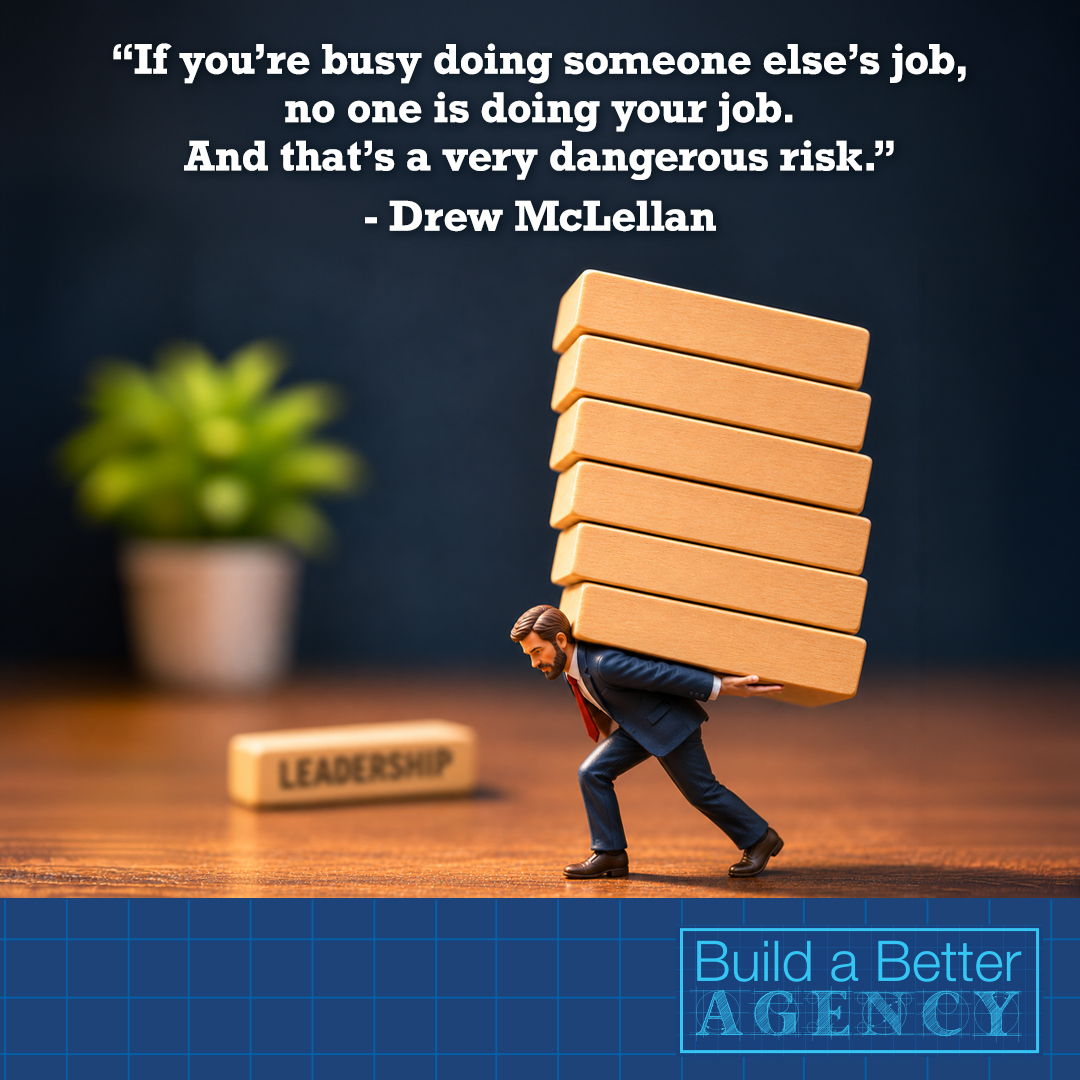
All right. I say this to agency owners all of the time, and I’m going to say it to myself today too. If you’re busy doing someone else’s job, then no one is doing your job. And that is a very dangerous risk. If we are doing something that someone else can do, The parts of your world that only an owner can do are not being done, or they’re being done lazily, or they’re being done sort of half-assed, or they’re being done at midnight. None of those are ideal.
You are the only one who can do your job. Your account director can run the client relationship. Your creative director can protect the work. Your project manager can keep things on schedule. Your bookkeeper can close the month, but no one else in your agency can set the vision. No one else can make the big calls about which clients you want and which ones you don’t. No one else can build a leadership team, guard the culture, and decide where the money goes. And in most cases, in an agency your size, no one else is gonna bring in the next big client the way you can.
So think about the last week that you had. How many hours did you spend on things that only you can do? I want you to really think about that. How much of your time was spent doing your own job? And how many hours did you spend doing work that is in someone else’s job description or their skillset? If you’re like most owners that we work with, the answers to those questions are not gonna be pretty. I know that my, I struggle with mine all the time. That is the owner’s job. And when you’re buried in approvals and client calls and rewriting headlines, that job does not get done. It doesn’t get done, or maybe it gets done, but it gets done badly. But in most cases, it does not get done at all.
So here’s what that looks like inside your shop. First, your growth stops at your personal capacity. Many agency owners will say to me, we are stuck at X million dollars and X number of people. And I can’t figure out why. And in many, many cases, the answer is it’s them. They’re the reason why. Your agency can only move as fast as the stack of things waiting on your desk. You can hire more people, but if every decision still routes through you, you’ve just made the line longer. More people waiting on the same desk. The pile just gets bigger.
Secondly, what happens is your best people stall and eventually they leave. Talented people absolutely want to own something. If every decision gets pulled back to your desk, they learn one of two things. Either I’m not trusted, or why bother? He or she is gonna just change it anyway. Neither of those is good for you. And the ones who stay often stop bringing you their best thinking because they’ve learned it doesn’t matter. They bring you the safe version, the one they think you’ll approve, and then they go away. That is a very quiet cost, but it’s a big one. You are paying senior salaries for people who have been trained to act junior. You have people on your payroll who are not— no, through, through no fault of their own, but they are not earning their keep because you won’t let them.
And third, it hits you in the wallet at the end. When I sit with owners who are thinking about selling, one of the first questions that I ask is some version of, what happens to this agency if you are not there anymore? And if the honest answer is the biggest client goes away or it falls apart, or the creative starts to lag, or, you know, 3 clients have to get a new account person, your agency is worth significantly less. Buyers aren’t paying for you. They’re paying for what keeps running after you walk out the door. No one sells their agency and wants to stay around for having a job. So the whole point of you selling is so you can get out of there, and you can’t get out of there if you’re critical to the business.
And here’s the thing about all 3 of those: you will not see them on your P&L this month. They show up slowly. Maybe it’s a year where the AGI stays flat, a great hire who leaves after 18 months, an offer that comes in lower than than you hoped when you go to sell.
This is not a time management problem. You can’t calendar block your way out of it. Am I a firm believer in calendar blocking? Absolutely. Have I told all of you a million times to take at least one half day every week and block it off and be unavailable so you can heads down, get your work done, make those new business calls, do whatever it is? Absolutely. And a better to-do app is not gonna save you in this case either. It’s a business model problem. Your agency was built for most of you with you in the middle of it. Most of us built our businesses from scratch, or you bought them and then you built them around your skillset and your passions. But now it needs to be rebuilt so it can run without you in the middle.
So let’s talk a little bit about what that looks like in real life, because I think these 2 stories that I want to tell you will feel a little uncomfortable and a little too Familiar. I’m gonna tell you about 2 owners, different agencies, different situations, same habit.
First owner had a gorilla client. You, many of you have this same problem. Client is so big that it dictates your calendar, your staffing, and sometimes your mood, right? They are demanding, and because they know they’re a big client, they know you’re gonna jump to when they snap. This gorilla in this story was about 70% of the agency’s AGI. Agency was doing about $3 million a year. So you can do that math. That client was the agency. When one client is that big, it shapes everything— who you hire, what you say yes to, and where your own week goes.
And the owner at this agency was the client’s person. Every big call, every tough conversation, every, hey, can you jump on, on a call or a Zoom with us for a minute? The owner was there because in the owner’s mind, they were the only one who really had the right answers for that client. And underneath was a fear. If someone else took over the relationship, maybe the client would notice, maybe the client would leave. Now, to be fair to this owner, that fear is not crazy. For many of you, that fear is not crazy. When one client is 70% of your AGI, Every wobble in that relationship feels like it could take the whole place down, and it could, right? Of course you wanna have your hands on it. Of course you wanna be the one on the phone. It feels like the responsible thing to do.
So like many of us have done in the past, the owner stayed in the middle. And honestly, there was a payoff. The owner got to be the hero. The client loved them. The team saw that owner save the day over and over again. It was aspirational for them. It was inspirational.
But here’s what wasn’t happening. No one was out finding the next client. Every one of you that has a gorilla knows that your number one job is to displace that gorilla and turn them into an orangutan or a monkey by bringing in enough business that they are not dwarfing your agency. But in this case, with this owner being at the beck and call of the client, No one was out there looking for that piece of business. No one was building a pipeline that could balance out that gorilla because new business is the owner’s job in most cases, and the owner was too busy doing the account director’s job.
And it wasn’t that the owner didn’t know they needed new business. Of course they knew. Every owner with a gorilla client knows they need to balance that gorilla out. You, you can feel the risk. But it’s just that new business is the kind of work that can always wait until next week. If you don’t have a new business system and a process, which is why we built the Sales Momentum Learning Lab, if you don’t have that and your whole team’s not involved in it, but the owner isn’t driving it, then it stalls. And unfortunately, when the client calls and says, hey, can you hop on Zoom in 5 minutes? And there’s 70% of your business. That can’t wait. And so next week becomes next quarter, and next quarter becomes next year. You all know where this story is going. You know it because you’ve either lived it or you’ve watched it happen.
So they lost the gorilla, and the agency went from about $3 million in AGI down to about $1.2 million. They ended up with 65% of the staff they had, and to make the numbers work, And to not lose as many bodies as possible, they had to let go a lot of their senior people. That was a brutal year for them.
If you’ve ever had to sit across the table, which most of us have, from good people who are doing good work and tell them that their job is gone, not because they did something wrong, but because you didn’t do your job, because you didn’t keep the new business pipeline full, because a big client walked out the door. There is no day that is worse for an agency owner than that day. And it’s even worse and it’s even harder when you know in your heart that it didn’t have to happen.
Think about that for a second. The very people who could have taken that client relationship off the owner’s plate were the ones who were escorted out the door. Being the hero felt to the owner Like he was protecting the agency, but it turned out that it was the biggest risk to the agency, and the worst-case scenario came true, which it always does. No agency keeps all their clients forever. You all know that. And the bigger the client you have, the bigger the gorilla, the more every other agency on the planet is knocking on their door trying to take them from you.
So let me ask you, if you’ve got a client that’s a big chunk of your AGI, who owns that relationship today? If the honest answer is you and only you, then you’ve got 2 risks stacked on top of each other. One, you have a client who can hurt you, and one, you have a person who’s too busy to fix it. And the fix isn’t to work harder on that client. The fix is to get someone else ready to own that relationship so you can do your job and go find the next gorilla or the next orangutan or the next monkey. That is the move that for many agency owners, they never get to make.
You know, the Sales Momentum Learning Lab asks for about 2 hours a week. Now remember, our best practice is 50% of your time should be spent on new business. So that’s 20 hours a week if you’re only working 40 hours. Yeah. Our program asks for 2 hours a week, and I cannot tell you how hard it was for many of the participants to carve out and find those 2 hours. 2 stinking hours. If that’s you, you have to know you are putting your agency at risk.
All right. So the second owner had a different flavor of the same habit. She held tight creative control, every concept, every execution. Every piece of work went through her, and if it wasn’t the way she would’ve done it, it wasn’t right. She’d send it back or she’d just fix it herself.
Now, her payoff was different. It wasn’t about being the hero. It was about control and her version of right. And I get that a lot of us started our agencies because we are really good at the work. Our taste, our discernment, our judgment. Our, our gut is part of why clients hire us in the first place. Letting go of the work can feel like letting go of the very thing that made the agency special to begin with.
But here’s what happened. Her best creatives started to leave. Not all at once, of course, one at a time, because good creative people want to make work they’re proud of, and they cannot do that if every idea Gets bent back into the owner’s idea. Eventually, she was left with junior order takers in the creative department, people who had learned that the job was just to guess what she wanted and execute it because it meant less changes for them.
And that made her even more sure that she had to stay in the middle. Look at this team, she would think. They can’t do it without me. But she created that team. She did it to herself, not on purpose, but she built it. Every time she rewrote the work, she taught people that their thinking didn’t count, that people were not capable on their own. So all the people that wanted to do their own thinking left, and the people who stayed learned to anticipate and wait for her answer, which also meant that the creative wasn’t as good.
And then life happened for her. She got sick. She got diagnosed with cancer and she was completely out of the business for 8 months. And here’s what was interesting. The team did great without her. That same team she didn’t think was ready, they stepped up, they made decisions, they kept clients happy, they did good work. Was it exactly the work she would’ve done? Probably not, but it didn’t matter because the agency was fine. Those order takers weren’t really order takers. They had just never been allowed to be anything else. When she wasn’t there to say no, they found out what they could do, and so did she. She came back and she learned her lesson, but she learned it in the most painful way that there is. And I’m telling you her story so you don’t have to learn it the way she did.
All right, before, uh, we move on, I wanna point out something that these 2 stories have in common. In both agencies, the owner was sure the team could not handle it. And in both agencies, the owner rarely, never found out until something forced the issue. For one owner, the forcing event cost them more than half of their AGI, which took them, by the way, more time than you can imagine to rebuild. Years and years and years. For the other, it was a health crisis. Neither of those is the way you wanna find out. 2 owners, one loved being a hero, the other loved being in control. Both thought they were protecting their agency and both were the bottleneck that was holding their agency back.
All right. I wanna talk about why we keep doing this to ourselves. What is it that we just, we know we’re doing it. We know we’re the bottleneck. We don’t even like being the bottleneck. But we keep doing it. Why? I want to talk about that next. But first, we’re going to take a quick break.
Hey, everybody. Just want to remind you before we get back to the show that we have a very engaged Facebook group. It’s a private group just for podcast listeners and agency owners that are in the AMI community. And to find it, if you’re not a member, head over to facebook.com/groups/babapodcast. So again, facebook.com/groups/babapodcast. B.A.B. podcast. All you have to do is answer a few questions to make sure that you are an actual agency owner or leader, and we will let you right in. And you can join over 1,700 other agency owners and leaders. And I’m telling you, there’s probably 10 or 15 conversations that are started every day that are going to be of value to you. So come join us.
All right. We are back and we’re talking about why we do this to ourselves. Why are we the bottleneck? Why can’t we let go? Why don’t we just stop? We are smart people. We see the pattern. The reason why the habit sticks is because being the bottleneck pays us something. And until each of us is honest with about what it pays us, we’re gonna keep paying for it.
So in my experience, in my observations, working with all of you for as long as we have, the payoff usually falls into one of 4 buckets. The first one is being needed. It feels really good when you’re the smart one, when everybody needs you, when people line up outside your door. It’s proof that you matter, that you’re smart, that you have the answers. For a lot of owners, being needed and being valuable got tangled up a long time ago. Honestly, for a long time, it was how we earned our keep in our agencies before we owned an agency, if that was our path. Being somebody who could walk in the room and know the answer and really Give a client confidence and trust us and get them to do what we ask them to do. That is heady stuff, no doubt about it. Right? But back when you were 3 people and maybe you had a dog in the office, you really were needed for everything. The agency grew and the habit didn’t change.
The second bucket is control. So this is the agency owner who got cancer. When everything goes through you, Nothing surprises you. You decide what good looks like. That was our creative owner.
The third bucket is being the hero. You get to swoop in and save the day. The client calls you, the team thanks you, and for a minute it all feels worth it. That was our guerrilla client owner.
And the fourth one is about feeling safe. If you are in the middle, nothing can go wrong without you knowing about it, or at least that’s the story we tell ourselves. It’s really a fear story. It’s not about safety at all. It’s about fear. If I let go, something bad might happen and it’ll be my fault. And here’s the irony. Being in the middle, being the bottleneck doesn’t actually make anything safer. It just means when something goes wrong, it went wrong on your desk.
Most of us have one of those that is the loudest, maybe two. If I’m honest and I think about the website, it’s a mix of control. And being needed. I like that the AMI voice is mine. I like that you are all familiar with my voice, both in your ear and sort of in your brain when you’re reading something we’ve written. And I’m a little afraid of what happens if it doesn’t sound like me.
So here’s what I want you to do. Pick one of the buckets, be honest with yourself, and then ask yourself a simple question. What is that payoff costing me this year? In new business that isn’t happening, in people I might lose, in weekends I am not getting back. So again, let’s review. It’s, I am needed, right? I am in control. I am the hero. And it feels safer, which means I’m afraid, right? So for each of us, what is it that is that?
If you wanna make this really concrete, put a rough number on it. What would one more good client be worth to your AGI this year? What would it cost you to replace your best senior person? That’s what your payoff is costing you. That’s what leaning into whichever bucket of need that is, that’s what it’s costing you. ‘Cause the payoff is real. It feels good. Absolutely. But man, is it expensive.
All right. I can hear you now. Somebody is saying, Drew, I would love to delegate this. I really would. I just don’t have the right person. All right, let’s talk about me again. Here’s the website. Nobody else can write in my voice. That’s my sentence I told you at the top of the hour. So let me test it again in the same way I’m gonna ask you to test yours.
When an agency owner says, I don’t have the right person, they usually mean one of 3 things. The first is I’ve really never handed it over. I’ve handed off tasks, But I’ve never handed off control, ownership, a decision. So I don’t actually know if they could do it, cuz I’ve really never let them try. That’s, that’s one option.
Option 2 is they won’t do it my way. They’re capable, they’ll just do it differently. That’s not a people problem, that’s a control problem. That was our creative director before she got sick.
And the 3rd reality is there really isn’t anyone, a true gap No one has the skill or no one has the time. In a small shop, that happens. If you’re a 10-person agency and everyone’s billing at full utilization, there may truly be no one with the room to take it on.
Notice that only one of those 3 is actually about the person. The other 2 are about us. It’s our need to control, our need to give it away and give authority along with the responsibility. Not an accusation. It’s the truth. And in some ways it’s good news because 2 of those that are about us are things we can fix this week if we want to, without hiring a soul.
So when I put myself through that litmus test about the website, really it is a combination of 1 and 2. I have not handed it over to someone else on my team who probably does have the skills to do it. I’ve never given anyone on my team the job of drafting it and letting them take a real swing. And even just saying, I’ll just be the editor. I’ve just told myself that nobody could do it. And that story let me off the hook. I also have said to myself, because it’s so important to me that it’s in my voice, who else could replicate that? Now, granted, there’s 20 years of my voice all over AMI that anybody who’s a decent writer could find a way to get into my head and into my voice. But that’s not what I’m telling myself. Honestly, it’s a little embarrassing to admit to you, but it’s the truth. And this is what we have to do, each of us, to figure this out.
Here’s what I’m going to do about it. Somebody on my team is going to take the first pass at that copy, and they’ve got more work to do on that, but they also have more content. They have more— they have a library of what AMI has been saying for years, because most of what’s going on the website is probably not brand new. It’s something we’ve already said. It’s years of podcast episodes, newsletters, and talks. My job, my new job is to react, to edit, not to write. They’re gonna recommend, but I’ll decide. And I’m putting a deadline on it. The new website will be live by the end of this calendar year. I don’t know what I’m gonna do to hold myself to that other than tell 15,000 people or how many ever are listening today. But that is my commitment to myself, to my team, and to you. And I promise I’ll let you know how it goes. And you’ll know, cuz believe me, when we launch the new website, we’re gonna do it with trumpets a-blazing.
Now, what if you test your sentence and it’s really number 3, that there really isn’t anyone and you, you have to really look at yourself and ask if that’s an excuse or it’s true. All right. So if you really do not have anyone, To delegate a particular task that should not be on your plate to, you have 4 choices. You can grow, you can hire, you can borrow, or you can ditch.
Grow means you pick the person who is closest to being able to do it, and you invest in them on purpose, knowing that building a leader can take 12 to 18 months. Building new skills take months of time. You give them the training, The coaching and the small decisions first. You tell them what you’re doing and why, so they know they’re being groomed for something important. This is one that most agency owners skip because it feels slow, but slow is still faster than never. And never is what happens when you keep waiting for someone to magically be ready.
Hire means you go find that person and you think about the cost differently. You’re not adding overhead. You’re buying back the hours you need to do your job. And if those hours turn into one good new client, that hire pays for itself. And it doesn’t have to be a full-time employee. It could be a contractor, it could be a part-time employee. It doesn’t have to be a permanent position, but you hire the skill.
Borrow means that you bring in maybe an outside partner for the work that doesn’t need a full-time seat. Fractional finance, a freelance copywriter, a contract project manager for a big launch. Maybe if you’re in a peer group, you literally borrow someone from one of your other peers who’s got someone who’s got some spare time on their hands, and you work out a deal to buy their time at cost. You get the skill without the full salary.
And ditch means you just give up. You stop doing it. You recognize that there’s something on your desk That shouldn’t be done by anybody. Kill it. The report no one reads, the meeting that used to matter, the approval step that you added after one bad week 3 years ago. Sometimes the fact that you don’t get to it means it doesn’t need to be done at all.
And here’s the part that most agency owners miss. You don’t have to wait for the perfect person. You can hand someone who’s 60 or 70% ready a smaller version Of whatever it is that’s not getting done, which brings us to how you actually do this.
All right, I’m gonna give you a simple way to give away a decision without blowing it up, without risking everything, without giving yourself heart palpitations that someone else is doing something you don’t think they can do. Very simple. 4 words: spot, size, say, stay. Spot, size, say, stay. These work whether you’re handing off one task or a whole client relationship like the one our gorilla owner was holding.
So number one is spot. First, you spot it. For the next 2 weeks, keep a running list of everything that waits on you. Every approval, every, hey, can you look at this? Every email that sits in your inbox cuz you’re the only one who can answer it. Write down what it is, who’s waiting, and how long it sat, right? Keep it somewhere where you’ll actually see it.
This is also the other thing I want you to write down are things you are doing that someone else on your team should do. Attending client meetings, writing client copy, reviewing code, all the things. Keep that list of all the things that either you’re not doing anything with or you’re doing and someone else could or should be doing. Keep the list right by you so you see it, because if it’s hard to get to, you’re going to stop doing it probably by day 3.
I think you’re going to be surprised. Most agency owners think they know where they’re the bottleneck, but the list almost always tells a different and bigger story. You think it’s the big creative reviews. It turns out that it’s 30 little things. Can we give this client a discount? Can I hire a freelancer for this project? Does this estimate look right? None of these take long on their own, but man, they whittle down your day and they whittle down your week. And pretty soon you have not touched your job. And in many cases, they keep either your team or a client or a vendor or a potential partner standing around waiting, thinking that what they’ve asked of you isn’t important To you, which is the last thing that you want them to feel.
Pay attention as you’re doing this list to how long things sit. If something waited 3 days for a 2-minute answer, that is not a 2-minute problem. That’s 3 days of someone else’s work being stuck because of you.
So, right, next one is size it. This is the part that solves the they’re not ready problem. Every decision does not have to be all or nothing. At AMI, we use 4 steps. Step 1, they watch you make a decision and bring you their recommendation. Step 2, you make it together and they do the talking. Step 3, they decide and you review before it goes out, so they’re not doing it without your approval. And step 4, they decide within guardrails that you’ve set and you hear about it afterwards. Someone who’s not ready for step 4 might be totally ready for step 1. Start there. Give them some reps, move them along on the steps as they earn it.
All right, let me make this super real for you. Let’s say scope changes on client projects always come to you. Step 1, your account lead sits in, and before you decide if you’re gonna client— you’re gonna charge a client for the scope change, or you’re just gonna do it. They tell you what they would charge and why. Step 2, you make the call together and they do the talking with the client. After a couple months of good calls, maybe they’re ready for step 3. They make the call on anything under a certain dollar amount, and you take a quick look before it goes to the client. And finally, maybe a year from now, it’s step 4. They handle it and you hear about it in your weekly one-on-one.
Same decision, 4 different steps, and the guardrails can change at every step. Maybe the dollar amount goes up as your trust goes up and the person grows into it instead of being thrown into the deep end. That’s how the person you have become— that’s how you became that person, right? So if you need someone to be able to do something you know how to do, they have to learn how to do it the same way you did, which was— You did learn it bit by bit. You weren’t as brilliant as you are now. You, your gut, your instinct, your intuition, your judgment wasn’t what it was, you know, what it is today. Back when you were 22 and just starting in the business, you have to give them reps.
All right. Step 3, say it. Now you’re gonna actually have the conversation. In our leadership work, we call this the keys conversation because you are handing someone The keys. It’s more than just, hey, you’re doing this now. You tell them what the decision is and why you pick them. You tell, you tell them which step they’re starting at. You name the guardrails like the budget or the client or anything that has to come back to you. You tell them what good and right looks like, and you make it very clear between the two of you when you’re gonna check in with each other.
So it might sound something like this. Hey, I want you to own creative approvals on the regional accounts. I picked you because your judgment on that work is really strong, and you know these clients better than I do at this point. For the first 90 days, you make the call and then give me a quick rundown in our weekly one-on-one. Anything that changes the strategy or the budget still has to come back to me. Good and right looks like the client approving it without me in the room.
Okay, so let’s dissect that. In, in that series of sentences, we had the decision. I pick— I’m picking you to do this. You’re telling them why them. You’re telling them what they can and cannot do. You are defining the guardrails and what good slash right looks like. And When you’re gonna check in with each other. It does not have to be a big formal meeting, but it does have to be clear. Most handoffs fail because the owner said, can you take care of this? Typically back in the old days when you were walking past each other in the hallway, now it’s probably in a Slack message, and both people walked away with a very different idea of what can you take care of this means.
And then you say the most important thing. You are going to do this in some ways that maybe I wouldn’t make. You’re gonna make some calls that I wouldn’t make, and that’s okay. I’m not taking this back the first time something goes sideways. You have to give them permission and the confidence that you are not gonna pull the rug out from under them when you give them this responsibility.
All right. The 4th step, stay. Which really means stay out of it. This is honestly where most of us fail. We hand it off on a Monday, maybe we hand it off sloppily, maybe we do it well, but by Thursday we’re back in the middle fixing something because whatever that bucket is— I need to be the hero, I need to be needed, I need to be in control, I’m afraid— kicks in. And by the way, we are hardwired for this. We’ve been behaving this way for a really long time, so you’re not going to be good This in the beginning. It doesn’t mean you should not keep trying.
So rather than stepping in to fix it, set your check-ins and keep them. If you need more often check-ins in the beginning, be— and by the way, this is on you, not them. But if you need more often check-ins to keep your fingers, your mitts out of it, then make the check-ins more often. Between check-ins, keep your hands off the work. If someone on the team comes around and brings the decision to you anyway, so let’s say they do an end run around who you’ve assigned it, you send them back to the person that you put in charge of whatever that project or decision or process is. Send them back kindly and say, hey, that’s your account lead’s call now. Go talk to them. The first few times you do that, it’s gonna feel strange and you’re gonna be nervous. But it’s also the moment that the team begins to believe that the handoff is real and that you’re not gonna take it back from them.
When they do something differently than you would, ask yourself one question: is it wrong or is it just not mine? If it’s just not yours, let it go. That’s the whole lesson from our creative owner who had to be out because of cancer. Different isn’t the same as wrong. Most of the time, the client or the team can’t even tell the difference. Sure, you can, because you are the one who would’ve done it your way, but the rest of the world isn’t seeing it as different. They’re just seeing it as the solution that it is.
Okay? And when there’s a real miss, don’t grab the keys back. The first miss is a coaching conversation. If it happens a second time, Figure out what’s missing. Is it training, information, or authority? If it becomes a pattern, adjust the step. Maybe they go from step 3 back to step 2 for a while, but you don’t take it all back because the minute you do, they learn it was really never theirs. And so does everybody else who’s watching. And believe me, your team is paying attention to how you handle this and how you handle the first miss. Handle it well, and you’ll find more people raising their hands for the next handoff.
Okay, so how do you put this into play today? I want you to start that list, not tomorrow, today. Grab a notepad, a note on your phone, put it on your computer. I don’t care what you do, however you’re actually gonna use it. Every time something waits on you for the next 2 weeks, write it down. Every time you’re doing a job that someone else on your team could do, Write it down. What is it? Who’s waiting and how long it sat? That’s it. Don’t try and fix anything yet. Just notice. Go and download the toolkit, right? This, this recording is tool number 2, the Waiting on Me log. It’s already all set up for you so you can see how it is and set it up however you want.
At the end of those 2 weeks, circle one thing, just one. Pick the item that costs you the most time. Or blocks the most people. Don’t pick the scariest one. Don’t pick the biggest one. Pick the one where getting it off your desk would make the biggest difference. You want an early win here for you and the person you’re handing it to.
And then run the test. Is the reason you’re holding it because I’ve never really handed it off, they won’t do it my way, or there really isn’t anyone? And be honest with yourself. If it’s number 1 or number 2, the fix is you, and you can start that right away. If it’s number 3, pick your path. Grow, hire, borrow, or ditch.
And then size it. Pick the step, even if it’s just step 1. Write down the guardrails, what has to come back to you and what doesn’t. And then book your keys conversation on your calendar within a week. Put it on the calendar. Not, I’ll get to it. I’ll do it when I talk to the person next. Put it on the calendar. And then set your first check-in with that person before you leave the keys conversation. So you’re not tempted to hover in between. Tool 5 in the toolkit walks you through that conversation, literally line by line.
And when it gets uncomfortable, and it will, remember why you’re doing this. You’re not getting rid of the work. You’re making room for you to do your job. I’m doing the same thing with the website. I promise. Let’s both have one real decision off our desks before the end of the month. If I can do it with my own voice on the line, you can do it with whatever is on your list.
I wanna leave you with this. Being the bottleneck does not make you a bad owner. Almost every owner I know got there because they cared a lot. They were good at the work. And for a long time, being in the middle of everything is what kept the agency alive and thriving. That absolutely made sense. Once. It just doesn’t scale, and it definitely does not give your agency or your life what you want. This is why you started the business, so you didn’t have to be locked into everything, so you could have a life outside of the agency, so you could build wealth, so you could scale and grow your team and make them even more successful.
Your agency needs you to do your job. No one else can do it. Your team needs room to grow and they need your confidence and trust to grow. They cannot do that while you’re standing in the doorway, no matter how good your intentions are.
When you start handing things off, don’t hand all of it to the one person who always says yes. All of you have that person in your agency. That’s how you just trade one bottleneck for another, and it’s how you burn out one of your best people. So that’s what we’re gonna talk about then in the next solo cast, who’s been quietly on your team. Holding your agency together and what is it costing them? Until then, grab the Breaking the Bottle toolkit from the show notes and go start on that list. I can’t wait to hear what you hand off.
Before I let you go, 2 quick things. Again, thank you to our friends at White Label IQ for being the presenting sponsor, and I am so glad that we get to hang out. Thank you for coming back. Thank you for your trust in me and for this opportunity for us to learn together. That’s one of the best things I love about the podcast. You’re learning, but honestly, I’m learning right alongside you, as was clearly evidenced in this episode. So thank you for helping me be better by hanging out with me. All right, I’ll see you next week.
Danyel McLellan [00:49:31]:
That’s a wrap for this week’s episode of Build a Better Agency. Visit agencymanagementinstitute.com to check out our workshops, coaching and consulting packages, and all the other ways we serve of agencies just like yours. Thanks for listening.