
Episode 551

Welcome to a fresh episode of Build a Better Agency! This week, Drew McLellan invites Yoni Kozminski, CEO and co-founder of Escala, for a candid and transparent discussion that takes you behind the scenes of agency operations, scalability, and owner independence. Drew opens up about AMI’s own journey towards better systems and processes, and together, they explore what it really takes to future-proof an agency so it can thrive through to 2030 and beyond.
In this episode, you’ll hear Yoni Kozminski break down why most agency owners unintentionally become the biggest bottleneck in their own business. He shares his perspective as a “recovering agency guy” and reveals Escala’s proven framework for assessing agency maturity and organizational health. Drew and Yoni walk listeners through the critical stages Escala uses to help agencies transform: assessment, design, and implementation, all aimed at making your agency less dependent on you—and more profitable.
The pair dig deep into the practical realities of creating lasting change, from tackling tribal knowledge and heroics to putting real systems in place that reduce owner burnout. They’ll discuss concrete strategies for documenting processes, measuring owner involvement, and empowering team members at every level. Plus, Drew shares firsthand what it’s like to face a “ruthless assessment” of your agency’s internal operations—and how that clarity is a gamechanger for growth.
If you’re ready to move past hustle and improvisation toward an agency that runs smoothly without you, this episode is your roadmap. Don’t miss the honest conversation and actionable takeaways, along with special resources designed to help you start your own agency self-diagnosis. Dive in and start building a business that lets you make a bigger impact—without being trapped in the day-to-day.
What You Will Learn
- How to assess your agency’s true dependence on you using the 1-5 maturity scale
- Why the Build-Manage-Execute index reveals where owners get stuck in the wrong activities
- The top-down methodology for creating systems that actually scale your operations
- How to identify and eliminate tribal knowledge that creates operational bottlenecks
- Why validation sessions with cross-functional teams reveal hidden process breakdowns
- The framework for transitioning from heroic execution to strategic visioning
- How to build offshore capabilities that multiply your onshore team’s effectiveness
- Why agencies must shift from owner-centric to metrics-driven decision making
- The assessment process that reveals exactly where your scaling gaps exist
Ways to Contact Yoni:
- LinkedIn: https://www.linkedin.com/in/yonkoz/
- Website: https://www.multiplymii.com/
- Website (Personal): yonikozminski.com
- Email: [email protected]
Resources:
- BaBA Summit May 18-20, 2026: https://agencymanagementinstitute.com/babasummit/
- Drew’s Book: Sell With Authority
- AMI Facebook Group: https://www.facebook.com/agencymanagementinstitute
- AMI Preferred Partners: https://agencymanagementinstitute.com/ami-preferred-partners/
- Agency Edge Research Series: https://agencymanagementinstitute.com/agency-tools/agency-edge-research-series/
- Upcoming workshops: https://agencymanagementinstitute.com/advertising-agency-training/workshop-calendar/
- Weekly Newsletter: https://agencymanagementinstitute.com/newsletter-sign-up-form/
- Agency Coaching and Consulting: https://agencymanagementinstitute.com/advertising-agency-consulting/agency-coaching-consulting/
Danyel McLellan [00:00:01]:
Welcome to the Agency Management Institute community where you’ll learn how to grow and scale your business, attract and retain the best talent, make more money and keep more of the money you make. The Build a Better Agency podcast, presented by White Label iq, is packed with insights on how small to mid sized agencies are getting things done. Bringing his 25 years of experience as both an agency owner and agency consultant, please welcome your host, Drew McLellan.
Drew McLellan:
Hey everybody. Drew McLellan here from agency Management Institute. Super excited about today’s content. Going to kind of let you take a little peek behind the curtain at ami because I think it’s going to be really relevant to the work that you’re doing as well. So before we do that, a couple things I want to tell you about. Number one, the Build a Better Agency Summit is right around the Corner. It is May 19th and 20th. Member Day. If you’re a member is May 18th. Tons of content. The theme, the focus. The only thing we’re going to be talking about is future proofing your agency. What do you need to be thinking about now? What do you need to be doing right now to move your agency successfully into 2030 and beyond? We have killer keynote speakers, of course. We’re going to be talking about AI, but we’re also going to be talking about how to train your account service people to level up so they can upsell your clients and be a strategic advisor. We, which our research is showing loud and clear is what clients want. We’re going to be unveiling the new agency Edge research where we specifically said to clients, what are you going to be buying from agencies in the future? And their answer is going to surprise you, but it’s also going to give you some direction about where you need to head and all kinds of other content.
So most conferences you sort of have to decide which session is most relevant to your business. At the Build a Better Agency Summit, we have Build it on purpose for you small to mid sized agencies. And and honestly the challenge is all of the content is relevant so you’re going to be having a hard time deciding which content to go to because you don’t want to miss any of it, which is why a lot of people bring more than one person. But whether it’s you or a team that comes, we really want to get you there. It is so important that you have this content. And so by becoming an Associate member, you can become a Summit Associate member. It comes with a free ticket to the Summit and all the benefits of membership. You can also just buy a Ticket if you’re not ready to be a member, but do not delay, grab your ticket, head over to agencymanagementinstitute.com and in the upper left corner it’s going to say Baba Summit. Click there. You can read more about the summit, you can read more about the speakers, you can look at the agenda, and you can grab your ticket and register before we sell out. So don’t delay on that.
All right, One of the folks who’s going to be there is our presenting sponsor of both this podcast and the summit, our friends at White Label. And you know, one of the things that I think people misunderstand about White Label is they think that they are just a web dev shop or just a WordPress shop, but it’s easy to overlook that they’re not just that. Yes, WordPress is part of what they do, but they’re doing a ton of work in AI, AI automations. They’ve got the depth of bench to jump in on all kinds of legacy platforms. So if you’ve got a client who’s on some old platform, they can help you with that. So whether they need to go backward in time or forward in time with AI, they’re able to help you with the system that you’re working on or a system that you haven’t even built out yet. But what I love about them is that they’ve built teams with real specialization. So when you bump into either some gnarly out of date system or you’ve got a challenge that you want to solve with an AI automation or an AI solution, you have the right expert on tap, so you don’t have to scramble to find some unicorn freelancer. They’ve already got the muscle for it. And because they focus only on design, dev and paid media for agencies, they’re always looking at these problems through the same lens that you are. So honestly, when it comes down to it, what it means is you don’t have to walk away from opportunities and you can leverage the efficiencies that AI gives you with White Label as your partner. They give you the ability to say yes with confidence, whether it’s to a project you want to do internally or to something that a client or a prospect brings you, even when the technical ask is not in your sweet spot. So if you want to learn more about all of that, head over to white labeliq.com/ ami and reach out to them and ask if they can help you, because odds are, they can.
Okay, all right, so let’s talk a little bit about this episode. So if you’ve listened for a while, you know that we spend a lot of time talking about how we want to make and how we help you make your agency more scalable, more profitable and less dependent on you, the agency owner. What we haven’t done very often is turn that spotlight on ami. And in a lot of ways, AMI is very much like a traditional agency in the services we deliver and the strategy and all of that. The truth is, we’ve had our own shoemaker kids issues and, you know, I hate that cobbler’s children analogy, but honestly, we suffer from it too. We’ve grown super quickly and we do a lot of things really well. But behind the scenes, just like you, we’ve also been guilty, guilty of running on tribal knowledge, kind of running to the fire, heroics, and a fair amount of it’s in Drew’s head, just ask him, sort of decision making, which, as you know, is not scalable and it is not as healthy as I want AMI to be. So we decided it was time to practice what we preach. So over the course of the next several months, we’re going to do a four part series and this is the first of the four parts. So we have partnered with a company called Escala. And so you’re going to learn who they are and what they do, but I’m going to bring you into AMI’s work with this firm. And what they do is they specialize in helping agencies align people, process and technology so you can actually scale without strangling the owner or burning out the team. And so far, we’ve gone through the assessment phase, and that’s what we’re going to kind of walk you through today is sort of what that looked like and what, what were some of the AHAs. So Escala came in, they did a really, honestly, a ruthless assessment, which I will tell you, when I heard about the assessment, I thought, there’s no way I’m going to have time to do that. There’s no way my team’s going to have time to do it. They made it so easy for us. But we’re going to walk you through a little bit of that assessment, kind of where we landed. And the findings were both affirming. Frankly, there weren’t a lot of surprises in the findings. There was a lot of, like that head nodding. Yep, yep, yep, that’s us. And it was a little uncomfortable. There was, you know, they exposed some of our warts to us. Again, not that we didn’t know that they were there, but it’s hard to hear somebody else sort of point it out for you, which is exactly what I want for you and your shop too. So today, in part one of this four part series, I’m going to introduce you to the CEO and one of the founders of Escala. We’re going to talk a little bit about who they are and why they exist. We, we’re going to talk about their sort of philosophy of how businesses scale and what gets in the way of that. And then we’re going to talk a little bit about what they found about AMI and how we’re going to move forward with them. And my goal with all of this transparency is so that you can kind of do this work even for yourself alongside us as we work to make AMI even better for all of you and frankly for us internally as well. So with all of that to be said, I want to introduce you to the CEO and one of the co founders of Escala, Jani Kozminski . Jani, welcome to the podcast. Thanks for joining us, Drew.
Yoni Kozminski [00:08:10]:
Very excited to be here. Thanks for having me.
Drew McLellan [00:08:13]:
If you met an agency owner at a conference and they said, oh, tell me what your company does and why it matters to me. Tell, tell me what you would say to them.
Yoni Kozminski [00:08:24]:
Well, I’d ask them the candid question. If you walked away from your business and tried to take a two week holiday, what would happen? Would it continue to run as designed or would you get called in? That’s what we do. We look to support businesses to get out of their own way, work on their business, not in it, and build systems that scale so that they can build profitability and not get stuck in building these businesses around them and their brilliance.
Drew McLellan [00:08:52]:
You know, you said something earlier which I think sort of encapsulates it, which is nobody starts an agency to be the agency that their goal is obviously for the business to be independent of them and that obviously that they have influence over the business, but that it’s not so dependent on them that they can’t take a day off or two weeks off or a month off without having impact on the business. And so the kind of work that you do, which is so we talk, we just talked about it in the abstract, talk about it in the practicality of how does an agency look different before and after they work with you and your team.
Yoni Kozminski [00:09:35]:
So I’m going to dive into that in one second. One thing that I find funny, when you think about agency owners generally, I feel like most follow a somewhat similar track and I’m guilty of the same, you know, no one obviously here knows who I am, but I like to define myself as a recovering agency guy. I spent 10 years in creative advertising and started my own agency. And three months in, I was actually doing about 30, $40,000 in monthly recurring revenue. And I hated my life six months into that journey and sort of re thought everything. And so when you think about contextually, you know, you start the agency because you are very good at what you do and you love it. And inevitably at some point, unless you find out how to systemize and scale, you start to sort of hate the brilliant work you do in part in my positioning here. But making idiots rich, so to speak, is what often ends up happening right when you’re, when you’re an agency line. So from a practical sense, what are we actually doing to help make those people rich? But doing it in a way that is not dependent on you is the first thing we’re doing is we’re taking a stock take of what’s actually happening in a business. So, you know, we all get so busy in our own operations and so close to the source that just having an external piece of counsel asking the operational questions and looking through it is key. We actually have in our methodology that we’ve evolved over the last five, six years. We call it our maturity analysis framework, which is just management consulting jargon that stipulates we have a grading of 1 to 5. And you know, I don’t know if it comes out in our conversation today on where you graded. I can share anecdotally where I was graded when we did the first ever project six years ago. But you know, we grade it simply from one to five. One is if you left your business for a week, two weeks, everything falls apart. And a five, which is optimized, one being initial, five being optimized. And obviously there’s gradings throughout is you’re working toward metrics. Every person in your company, whether it’s two people or 200, are working to a defined performance metric that’s aligned with the company goals. And you can switch off for as long as you work want to because you are just additive, not a dependent in the business. And so that’s, I’d say at the highest level, that’s what we’re trying to do is assess where you sit and help build the framework of how do we get you to a reality where you’re looking at performance metrics and business metrics and making incremental inputs not driving the entire thing.
Drew McLellan [00:12:20]:
Well, I think obviously that’s, that’s what most agency owners aspire to get to is that they don’t want to be so essential to the business that they are in essence, the bottleneck. That’s the language that we always end up using. And certainly when you and I first started talking, that’s what I was saying to you was, look, I. The business is too reliant on me, that people can’t make decisions, can’t move forward. Even though most people who have worked for me and with me have worked with me for years, they can’t always anticipate because I’m always doing some end run or coming up with something new or clients depend on me more than that they should. And so, and I think most agencies, most agency owners find themselves in a position where they want to be less integral to the business. And we know at AMI that if they are ever going to sell their agency, one of the critical components in terms of evaluation is how irrelevant is the agency owner to the business. So even if that doesn’t feel good, even if you don’t want to be irrelevant to the business, because that doesn’t sound awesome from why I built this thing and I want to sell it someday because I want to retire, it’s critical to the biz, the agency’s evolution, that the owner get less and less relevant. Maybe they don’t have to be completely irrelevant, but certainly want to be less and less relevant in the day to day work as the business matures, for sure. And we will get into specifically kind of where AMI was because that’s, that’s ultimately, I think the purpose of this episode, as I told everybody in the introduction, we’re going to do a series of episodes kind of walking them through our experience and our learning so that they could kind of, you know, through osmosis, kind of bring some of that back.
Yoni Kozminski [00:14:12]:
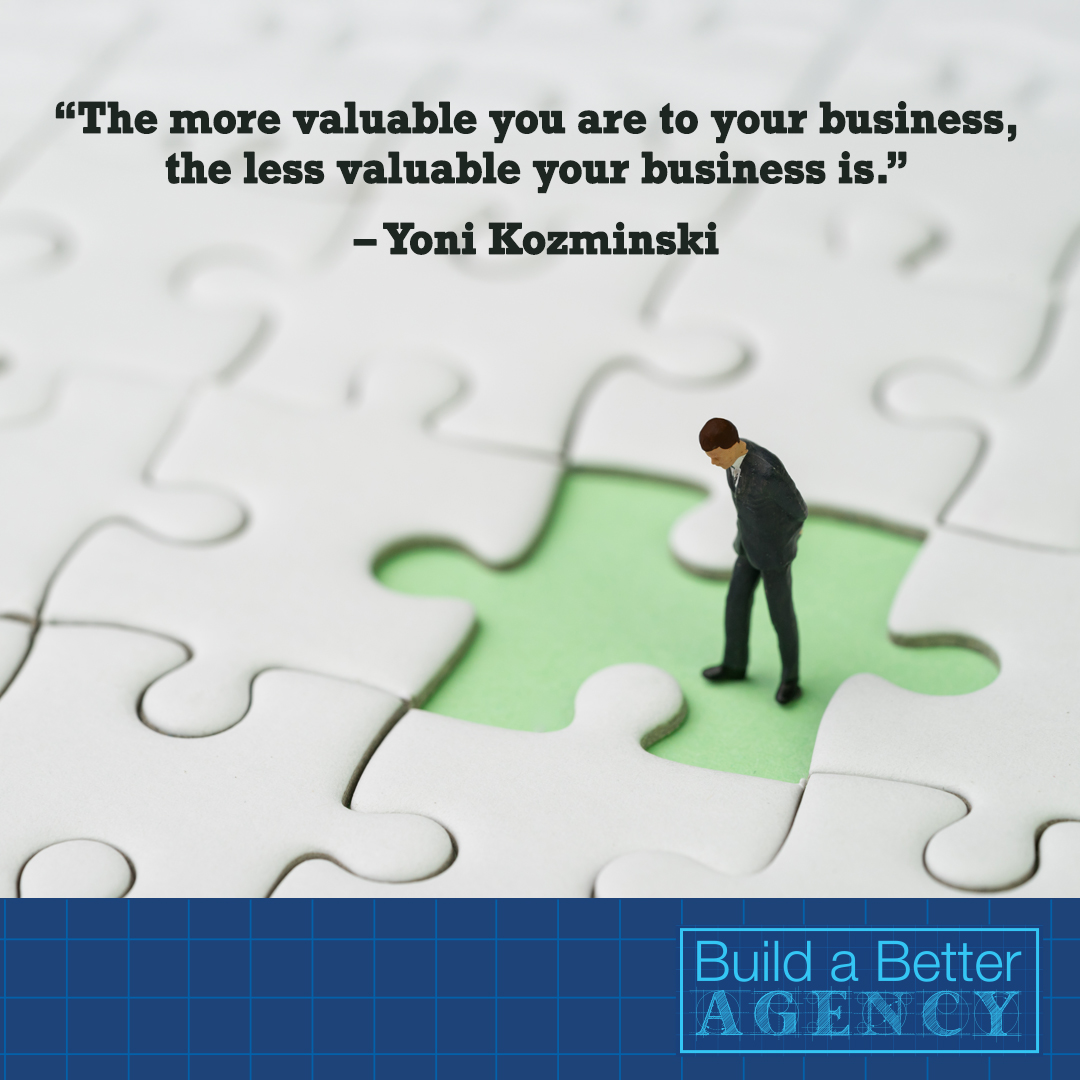
Yeah, I mean, you touched on two really critical points and things that come up often in not just my line of work, but the conversations that I’m having with so many agency owners and business owners. One, your line, this is how I frame it. And I don’t know if I’ve stolen it or coined it, it’s probably the former. But the more valuable you are to your business, the less valuable your business is. And so I think on that second part is it’s the mental reframe. So as the business founder, as the owner, as the visionary, as the person who’s trying to drive forward, you’re always going to be one of the most critical pieces in the evolution of the business. And so your objective is to make yourself redundant in things that you can be replaced, where your focus can be put on key pieces, like where are we taking the agency? You know, if we’re an SEO agency, is there an opportunity to spin off into content? Can we start supporting other businesses in link exchange? Are we able to add on performance capabilities like what are the other boltons? Or can I acquire these capabilities? What are the things where you can start to elevate yourself to thinking through the vision and spending 80% of your time on building? I mean, I know we haven’t gotten into the you piece of it, but I think one interesting thing that people would probably like, and it should resonate with a lot of founders and agency owners, is that, you know, when we were looking through the work we did with you, Drew, and I see a lot of me in you too, it’s that we have another. I mean, again, these are all just nonsensical or, I mean, they’re highly valuable. But the terminology we use, we have an index called the bme, the Build, Manage, Execute index. And essentially it looks at every individual person’s contribution to the business and are they building? So are they creating new things? Are they executing on tasks or are they managing people? And there’s no one size fits all. And so when we were looking at Drew, when we were looking at you, you were doing building, you were doing executing, and you were doing very little management. And when we had that conversation with you, you don’t want to go away from building. You want to be a creator and an engine, and you probably were executing and were the bottleneck on executions in many areas that you shouldn’t be. So it’s. How do you look at what is my perfect reality look like? What do I actually want to be working on? I mean, for me, and I know we touched on it a little bit, you know, I’m. It’s not even borderline, I’ll admit it. I’m obsessed with AI and, and what we’re able now to create. And my whole BME index shifted from minimal build and almost no operational context to now heavy involvement. I’m probably on the 80% of building, but I have the management structures. I get on a single meeting a week. I have a whole context. If there’s issues, I already see them preemptively and can simply guide. And that’s one hour a week of my time to get a holistic picture. So, you know, coming back to it, I think, you know, if you’re listening to us have this conversation, there is no one Size fits all. And you really need to sort of be introspective in thinking, how do I. How do I want to show up what I want to be doing? And who knows, maybe you just love managing people. You don’t want to build, you want to execute, or vice versa. It’s about building your capabilities forward and then building the business around it and not the other way around.
Drew McLellan [00:17:57]:
Yeah. I think for most agency owners, it’s really about where one of the conversations I have with agency owners all the time is if they’re not doing their job because they’re doing things that other people could do, no one’s doing the owner’s job. And again, that is that looking forward, that is that visioning. I mean, we’re certainly in a moment in time with AI and all of that, where all of us are being called to reimagine our business in this sort of new world. And if you have no bandwidth to do that, then it becomes super challenging. For sure. Yep. So before we get into sort of where we’re at at AMI and some of the learnings that we’ve taken away from that, just walk people through the typical journey from the very first time you have a conversation with someone to actually beginning to implement, like, what are the major stages that your company takes an agency through? To get to the point where I have a game plan and I am. What. What’s the end game?
Yoni Kozminski [00:18:56]:
Yeah, yeah. So there’s three critical stages in. In how we operate. And these all. Everything that I’m sharing with you right now, Drew, are things that, you know, anyone listening can sort of take and do their own version of internal assessment. But the first phase for us is assessment. So before you. I mean, I think this is sound advice for anyone and this is the practice I take is I’m never, you know, with the experience that I have and the businesses that I’ve built and, you know, the few skills that I’ve picked up through my. My journey, I’m never going to give someone deep, specific feedback on their business and their challenges until I understand it in a material way. I think it’s one of the most dangerous things to assume like, for.
Drew McLellan [00:19:39]:
Like.
Yoni Kozminski [00:19:39]:
Or make these connections that might not be there. And so we have the assessment phase, the design phase, and then effectively the systemization implementation phases, phase three. But in our assessment phase, which is effectively where we sit in our journey today is we’re going in and we are interviewing, shadowing, reviewing, understanding at the nuclear level what is happening in a business. So we have a methodology again. I’m throwing around these words. I feel like bit of an asshole here with all these sort of management consulting speak, but this methodology we have is how we look at business. I think when people talk about standard operating procedures, SOPs, 90% of people get it wrong. They build bottom up. They sort of find a process and they build bottom up. How we and how all of you should be looking at your business is top down. So typically speaking, you’re going to have the core moving functions of your business. You’re going to have your sales engine, you’re going to have your client service delivery, your finance, a degree of operations. And again, it’ll be slightly different. You might have six, seven, eight core functions in a business, but you want to understand those intersections first. And that’s what we do, is we look to understand what’s happening at the top and then how does that actually flow on to the level where we understand what every single person in your operation is actually doing. And that’s not just she said this and he said that. We’ll interview everyone individually and then we do what’s called a validation session where we bring people that exist in a process. Let’s just take client onboarding, for example. So you might have finance needs to bill, you’re going to have the actual client, you know, the client, the account manager, service delivery manager and whatever. Let’s just say that you are a PPC agency, so you might have your PPC strategist or the account manager might be bundled into that. All of you are part of this process. And the finance person might say slightly differently to the account manager, might say it slightly different to the strategist. So we’re trying to understand really clearly what’s happening, looking for all of these areas for improvement with our end objective in this assessment phase to say this is what we’ve seen. These are where the gaps are, These are where all the issues are. Management’s too in the weeds. They’re not able to deliver on what they’re supposed to. You’re leaving all of this money on the table because you can’t actually service clients. You can’t. You’ve got this incredible capability, but if you onboarded one more client, your business would, would fall apart. So all these types of things in that assessment phase, that’s what we’re trying to deliver. I might pause there for a second. Drew, I don’t know if you want to talk about any of these things or I’m happy to just continue on onto phase two and phase three.
Drew McLellan [00:22:24]:
Well, so let’s stop for here. So basically what you’re doing, and for context for the listener, is you’re basically scoring things like people, process and technology from. On a scale of. We’re kind of making it up as we go along to. This is fully defined and managed. Right. That’s sort of the scale that you’re looking at at this assessment. And then at the end of the assessment, and we’ll get into this in a second, you sit down with the agency owner and say, all right, I’m going to. We’re going to walk you through what your business looks like from our lens, and then you give me feedback on right or wrong. And that sort of ends the assessment process, right?
Yoni Kozminski [00:23:05]:
Yep. Yeah.
Drew McLellan [00:23:06]:
Okay. So then after the assessment, so and. And again with full disclosure. So we are embarking upon this together. We’ve done that meeting and I was like, I don’t like what I see, necessarily. I don’t like. There are some parts of it that I like a lot, but there are some parts of it that I’m like, yeah, I’m not happy about that at all. And we’ll get into that in a second. But yes, I agree. So now what happens after that, after the business owner is like, yep, that is an accurate view of my business as it is today. And I agree with you, it could be better slash different.
Yoni Kozminski [00:23:46]:
So two things here. One, when Drew says he’s not happy with what he’s saying with the scores and the recommendations that he’s sort of seeing from a looking internally perspective, you know, what we’re talking about here is how close you are into. If Drew needs to step away from the business tomorrow for an extended period, there’s going to start to be challenges and relatively quickly across his people, his process and his technology. That’s what he doesn’t. That’s the aspect. It’s not that it. In all of this. And I think it’s just important for the audience.
Drew McLellan [00:24:20]:
Right. And by the way, not one bit of it was a surprise. Like, you know, it’s sort of like when you go to the doctor and the doctor’s like, well, you know, this, that or the other thing. A lot of times you know that you should exercise more, eat less sugar, do whatever it is that he’s saying. So it’s not. It’s not like a shock. It’s just not like you’re like, okay, I don’t really want to look at this, but I know I need to. Same sort of thing, right?
Yoni Kozminski [00:24:44]:
Exactly, exactly. And you know, the exciting thing in all of this, when you find sort of, you know, more initial leaning businesses is that the blue ocean upside and the transformation that you can have in a relative short period of time is pretty exciting. So again, if we were to work, you know, I say this for the audience more so than for you, Drew, is that, you know, everyone loves that, to see where they sit against, you know, the 150 other businesses that we’ve worked with to understand where they sit on the maturity analysis. But the reality is it just means how dependent are key people. Which, coming back to your point, if you’re dependent on key people, then it’s a less sellable asset. And so in this, it’s probably important just to add as well in the assessment, it’s not just this is what it looks like. We’re also making a whole slew of recommendations. It’s a pretty dense circa 70, 80 page presentation that we go through that shows as an example from leadership and governments and governance and Drew’s involvement and things like that, this is where we see it today and this is how we believe things should shift. And this is how if Drew Spence, you know, is spending 70% on execution, how do we take him from 70% to 25% and rework that? And the same goes for every key team member and every key personnel. And I think the other interesting thing that we’re going to get into now to your question about phase two is when we’re moving forward, there’s lots of ways to optimize your operational efficiency. So, you know, I mean, I could sit and talk about AI to the end of time at this point, but, you know, we have a team that is 95% based in the Philippines, and we grew a company in five years from bootstrap to north of 10 million in revenue with a 95% offshore team. So it’s about how do you build the future state where your onshore strategic team members are now, you know, 2, 3, 4, 5x more efficient while also potentially bringing in specialized capabilities that enhance all of it and, you know, really sort of expands massively. So coming back to sort of the future of what life looks like, we have in phase two, our design phase. So like, like Drew said, we’ve just gone through the assessment, we’ve shown him where he sits. We’ve been able to also very clearly just, you know, articulate. This is where we see the direction and we’re looking for validation where we’re making sure everyone is different. And while, you know, most business problems are not drastically different, you’re building the business to align with where the team is at. Not, you know, a lot of people will say, just build us the future state. We don’t care about what our business looks like today. We just want to what’s perfect. If you as an example, have Never drone a McLaren and you don’t know how to actually turn the thing on and use the shift paddles and you know, and drive it 200 miles an hour, you’re going to crash it instantly. So it’s about where we are we’re at and where we see your specific path and how we optimize in that unique way. So in phase two, what we’re doing is we’re saying, I mean, Drew was great in the sense that he just aligned with all of our recommendations and let’s go now we’re going to design the future state. So what that means is how do we rework these very detailed process maps? How do we restructure the accountability in the organization? How do we build the change management and organizational plan so that we move from everything needs to be approved by Drew to giving key people defined areas of operation correctly incentivizing them to do the right things and driving toward an outcome? You know, we haven’t discussed any of these things, but let’s say that the goal was to deliver 3x the value in service for every single AMI member and 10x or 3x the actual number of members that exist inside of AMI. So that we’re not saying we’re not only going to increase membership, but we’re going to increase value. And so how do we actually, if that’s the vision, how do we actually get close to that? So we’ll design the future state. We’ll actually design everything from what does the hiring roadmap look like? What does the org shift look like as we bring on 600, 700, 800 members, what actually changes operationally? So you’re no longer sort of taking it from a, all right, we got to this next level, now what do we do? We’re actually now, right, we’re looking and we’re saying we know what the plan is and these things change. It’s not like you can build a three year strategy and say nothing’s going to change, but you can at least build. I love the, I love the phrase, what gets measured gets managed. You, you need to build the measurements, you need to build the direction, you need to build a plan. And Even if it’s 80% of the way there, it’s better than not having one at all right.
Drew McLellan [00:29:49]:
I think one of the truths for most agencies is that, you know, a lot of times there’s a lot of heroics because, you know, clients throw you a left curve or whatever. And I think what you’re talking about is that a lot of people doing hero work, but maybe there are very few systems in place that reduce the number of heroics that have to be. That have to happen. And that’s. That’s really where we’re at. And so again, you know, the meeting where we did the assessment, and then we’ll get back to kind of what the third phase is. It’s a little like holding up a mirror after. After kind of a late, long night. Like, again, there are a lot of things that we talked about that I was really proud of and happy with, and I know the impact that we have. And again, I think this is important. This isn’t about if your company or your agency is broken or not profitable or anything like that. You can be wildly profitable. I mean, AMI and. And a lot of you are doing quite well. It’s not that. It’s just that you. There are chokeholds that keep you from going to the next level or serving people at the depth that you want to serve them, or serving the volume of people that you want to serve, or offering the kinds of services you want to serve. All of those are bottlenecked, often by the owner or a few people in the organization, which sort of limits you. That’s really what this is about. It’s about removing the governor so that the limits are not in place. Right?
Yoni Kozminski [00:31:17]:
Absolutely. I mean, I’ve got, like, a key example, and I think this will probably land to most of you listening. I would guess, particularly in the early stages, two aspects. One is if you’re spending a significant amount of time executing or getting pulled into issues that crop up from client service delivery and things of that nature. But you’re the main engine room to bringing in new opportunities, and you’re not able to get to them. Think about how much. What. How valuable your time is in that cost. If you were able to effectively delegate, maybe you still need to get drawn into that escalation, but there’s ways in which you can be brought into it at the right time. And if you can focus your attention on the things one, in that assessment piece, where is the value that you create? And how do we get you in that zone of genius? Or how do you get yourself in that zone of genius? And so even just as an assessment, like something that I love to suggest on, at a, at a personal level, and this is a practice that I have done, continue to do for many years is every single. I mean, I’m a, I’m, you know, I’m a bit of a systems guy in how I think. I’m not, I’m not the system’s executor. Like, I’m not, you know, I’m, I think, talking to everyone on, on, on the pod here like, I am you and you are me. I definitely have obviously had exposure into systems thinking, but how I operate is every single meeting that I have and every work output that I do, I’m putting it in my calendar. I’m, I’m time blocking to work on what I’m doing. It’s all color coded. I use Google Calendar. You can actually align the names of what it is and it starts to give you a breakdown of how you’re spending your week. If I know that I’m a big driver in the relationships that I build and that often leads to new opportunities, then I know I need to be stacking my time toward that as opposed to having 50% of my calendar filled up with internal meetings where I’ll add value, but maybe I don’t need to be in all of them. So for you at home, this is what I would suggest. If this isn’t a practice that you’re doing today, start putting in all the things that you do in your calendar. After a couple of weeks, you’ll start to get a good sense of it. But where it starts to get really interesting for you is I would look back. So at the end of the week, look back and say, looking at each of these meetings, how critical was I to what value did I add? Rank it from 1 to 5. One being I didn’t really add that much value. I didn’t know that I need to be there. I could delegate aspects of it. And a five, it had to be, you know, I couldn’t give this podcast to anyone else on my team. This is something that I need to be able to articulate. And so looking at it from that lens and pretty quickly you start to build clarity on where is your value and where is your time. And you can start to just, you know, gradually nudge yourself in a way where you start to be a little bit more critical of your time. And I think, you know, if you carry a practice like that even for a couple of months, you probably see some, some pretty healthy upside on what that means for your business. In the most simplistic, you know, the most simplistic way you could sort of exercise some of this at home right now.
Drew McLellan [00:34:24]:
Yeah, well, I, to paraphrase something you said, I’m a firm believer in what you measure matters. And so having clarity around how you spend your time and the value proposition of each hour is, I think, critical for all of us to think about. And, you know, that’s, that’s kind of where we were with our assessment is, you know, it was not, you know, we weren’t a dumpster fire, but we were a lot of times relying on tribal knowledge. And all of you have heard me talk about these things in your businesses. And, you know, we’re a small team. We’re only a handful of people. So tribal knowledge, goodwill and a lot of hustle and maybe a lack of systems in a lot of places that would remove some friction for us to get things done better, faster, at a higher scale, for sure. We’ll take a quick break and then we’ll be right back. I want to take a quick moment to reassure you that when we bring sponsors on the show, these are people that we know and trust. And that is absolutely true of our friends at Job Rack. When agencies ask us about long term remote hiring, we often introduce them to Noel at jobrack. We’ve spent time with him. We see how he approaches hiring decisions, and we’re confident sending AMI agencies his way. That’s why we’re thrilled to have them on board as a paid sponsor of this podcast. If international hiring is something you’re thinking about this year, they’ve put together a really thoughtful hiring playbook with lots of tips and [email protected] AMI Again, one more time, jobrack.com AMI. You’re definitely going to want to take advantage of some of the great advice that’s in that playbook. So go grab it now while you can, and let’s get back to the show. Hey, everybody, just want to remind you before we get back to the show that we have a very engaged Facebook group. It’s a private group just for podcast listeners and agency owners that are in the AMI community. And to find it, if you’re not a member, head over to facebook.comgroups/b a b a podcast. So again, facebook.comgroups/bab podcast. All you have to do is answer a few questions to make sure that you are an actual agency owner or leader and we will let you right in. And you can join over 1700 other agency owners and leaders. And I’m telling you there’s probably 10 or 15 conversations that are started every day that are going to be of value to you. So come join us. All right, we are back. Okay, so the last phase is so, so we’ve done the assessment, we’ve designed what the future state looks like and how we could get there. And then what is the, what’s the final phase?
Yoni Kozminski [00:37:06]:
Well, I mean, you teed it up perfectly there, Drew, even though you haven’t gone through phase three yet. That’s exactly it. So when we talk about that design phase, we’ve now mapped up every single action, every single decision that’s being made throughout the business or the core functions that we’re focused on. We understand what’s happening. And once we align on that with founder key operators, you know, we’re working typically with businesses that probably start from about a million dollars in revenue, but up to 250, typically in that 5 to 25 million is where we’ve had the most exposure and experience. But for where we’re trying to take it and what that next stage looks like is how do you harness that tribal knowledge? Right. So in this methodology that we have, we document every single standard operating procedure at the individual delivery level. So you look at. And it’s always hard to discuss these things without the visual cues. I mean, I don’t know, maybe we can send some packets or even some resources I’d be happy to throw out there so people can see and even have an example of an agency and they can play around with how they could build their own. It may make sense, it might not make perfect sense, but it may be helpful here.
Drew McLellan [00:38:16]:
Yeah, we’ll give them a URL at the end where how they can access that and we’ll also include that in the show notes. I do think the visuals will be helpful for sure.
Yoni Kozminski [00:38:24]:
For sure. I’m even talking about building some mirror boards that sort of a typical agency and some of the typical examples of process maps. But if you download the asset, what we’re talking about here is what we would define as level three, which is each of the different steps that an individual takes and what happens then we’ll build out the purpose of that step, who’s involved, what inputs you need, and in the step by step guide of how to perform it. And so at the end of phase three, when we’ve worked through across the whole business, every single process is documented. Not only that, but you can plug it into your knowledge base. It becomes your knowledge base so you can understand if there’s gaps in your knowledge about your own business. If you want to Onboard someone, all of a sudden it’s all accessible. There’s no more tribal knowledge because it’s codified in, you know, tools we we typically use would be trainual, or we build it in ClickUp or Trello or Asana, where we’ll sort of not reverse engineer, but we’ll build it in a way where, you know, for us, simplicity is key and not having too much noise is key. So if you can build, for example, and ClickUp your knowledge base, that connects to your workflows and your automations, where it’s always pinging you back to it. You’re not looking at your sops daily. Like, if someone’s performing the standard, operating the standard processes every day, typically they’re going to be fine, but sometimes you’ll forget or you’re able to come back and assess. So the outcome at the end is every single aspect of your business is documented. So if you want to onboard someone, well, you can take that and turn that into an onboarding framework. If you want to sell your business, all of a sudden you’re able to open up the prospective buyer pool. We work with a lot of investment banks and brokers who will just bring us in to document out the process. And then, you know, instead of having that founder dependency or the tribal knowledge, you can see everything that’s happening in the business. So that’s, you know, that’s another example of a use case that we see often. But I mean, that’s really it. You’ve got your workflows, your knowledge base. So I’ll just give one example and then I’ll turn it back over to you, Drew. But when coming back to the notion of onboarding a new client, you’ll need a folder structure that you create, typically where the assets, the deliverables, what are the stages, who’s the account manager, who’s the dedicated team members, what are the steps that need to happen, when are we checking in, et cetera? We’ll build that into a templatized workflow automation where New client one. Great, here we go. Everything’s mapped out. You’re just literally tagging who’s responsible. And it’s built in timelines. You can sort of like how I would define the feeling, you know, hopefully six months on for you, Drew, is that mental load and the burden of shit, did I get to that? What did that client get? What they needed is the account manager briefed in. Did I. All that starts to melt away and you get to live a reality like I do, where, I mean, often I Won’t even get on my weekly L10 meeting. We run on a version of EOS which I can only imagine has come up in conversation for you.
Drew McLellan [00:41:40]:
Of course.
Yoni Kozminski [00:41:41]:
Right, of course. How could it not? But I now have. We have our own dashboards that we built attached to it and our head of biz ops will record a 10 minute recording talking about it. I need to watch that 10 minute video if I want to get a sense of any thing that might be a two week, two month, six month issue. Is our pipeline healthy? Do we have issues around service delivery? What are the idea is like you get to a point where I know where we’re headed, I know what we’re trying to achieve here and I have really early warning signs of, you know, there’s not enough leads or you know, again, I sit for context as well. I mean I’m the CEO and co founder of the business, but my passion is marketing and agency and you know, I sit across our marketing and sales function and I have, you know, my own internal agency of eight team members from SEO strategist and content writer to designers, ux, ui, webflow developer, et cetera. And I’m coming back to the whole build, manage, execute. I love it. I love doing this. And so even though there’s all these other things I could be working on, I’m building up, you know, I’ve got a strategic CFO that sits more on some of those pieces because I’m just passionate about agency life and marketing and sales. I love it. So I guide my reality to be inside of that environment.
Drew McLellan [00:43:07]:
Well. And I think, I think when you and I first met, one of the things that appealed to me is it’s not like I didn’t know we needed to have more systems and process. I mean, and I think anybody listening knows that their agency is running a little bit by the instincts and intuitions and directives of the agency owner or maybe the leadership team, depending on how big they are, but that most agencies are not as system oriented or have everything sort of documented the way they should. I already knew that and I probably could have done a lot of the assessment myself and identified all of a lot of our weaknesses. But what I didn’t know how to do, and this is why we’re working together, is number one, I didn’t know how to fix it. Number two, I couldn’t fathom having the time or the attention to fix it because again, already, I’m already the bottleneck. I can’t have my team doing it without my input. So I Think part of what is appealing to your clients about your process is that you actually help them build out the systems and the processes. You’re not just saying to them, hey, here are a list of systems and processes you should build. Thank you very much for your business. You’re actually showing them how to build them out and building them in the tools that they’re either maybe already living in or suggesting some new tools that will help them, as you said, codify everything so that it’s not just an awareness campaign, but it is, it’s really about change management.
Yoni Kozminski [00:44:41]:
Totally. And that’s a really important distinction. It’s something I, you know what, I’m like every business owner, I’m so close to it that this has just become my reality, that I’m not going to call out those types of things. So just for everyone listening for context, that we’ve put one and a half management consultants onto the AMI project. That’s 250 hours a month that they’re working to produce this outcome where Drew might have to get on a call not even once a week through the journey, a little bit more work on the onboarding and then the delivery and you know, obviously that mountain of information we’re going to sit through over the course of an hour to an hour and a half to explain all of the things that we’ve found and identified. But it’s the team that are actually delivering this isn’t like a, a coaching situation or even like a, a done with you experience. It’s a done for you where you’re critical in the inputs. But, and you’ve only seen the assessment. I mean the design phase is not, you know, I mean it takes time, but it’s not, you know, it’s not months of work. It’s, it’ll be relatively short compared to phase three where that’s where the heavy grunt work comes in. That’s where they’re actually building out every SOP word for word, every single workflow and every single system and automation. As we have started to venture into the world of AI automations and some of the implementation pieces that we’re doing, we’re actually building that with the five plus years of knowledge that we’ve focused on. The small to medium enterprise and particularly in the E commerce and agency land is where we have most of our experience that we’d originally taken from Ernst and Young, which was where all of my management consultants in the early days came from until we were able to start building our own. So coming back to sort of the Delivery and the execution. This isn’t. Here’s a pretty long deck that no one’s ever going to implement. This is we’re going to do this all for you, essentially. And I think there’s two parts that create value. If I’m to now take your lead and, you know, reassess, it’s one you’re having sort of this external critical person or people that have not been living your reality for the likes of 5, 10, 15, 20 years, however long you’ve been running your business. But at the same time, they’re actually delivering on the work and doing added research to support that.
Drew McLellan [00:47:10]:
So we’re already almost at the top of the hour, which is crazy because I have a lot more that we want to talk about, but that’s why we’re going to do multiple episodes. But I think for me, the outcome of this first assessment was you paint a picture of a future state where, and I think this is true for most of the listeners. It’s not only that the work I could do if I had the bandwidth is different, it’s that the, this is what matters to me the most, is the impact that I can have. The way I can change the lives of agency owners and how many agency owners lives I can change and help them build the business of their vision was exponential. And so it’s not really just about getting your ducks in a row and having your work be more efficient, but it is, I think for most agencies, and I’m curious if you’ve had other clients say this. It’s about getting them closer to their, to their ideal future state where they are really impacting the audience that they serve, the clients they serve in a deeper, more meaningful way that really does get closer to their mission statement. That’s really, for me, at the end of the day, the assessment was like, Drew, you guys are getting in your own way of being able to be as productive and valuable in the world as you could be.
Yoni Kozminski [00:48:33]:
Yeah. So I think when I look at it from that lens, I almost take the ethereal feeling and relationship to what you have with the business. So going right to the start of our conversation, you know, none of us started this to be the bottleneck and the person running the business and the business at a point in time starts to run you and not the other way around. And so I think the big sort of transformational experiences and the things that, you know, we’ll get on our testimonials or it’s like I felt all of these things were challenges and I kind of knew that I needed to get, get them. But you’re always thinking about what you’re going to build from a value add. It’s the age old adage of, you know, the leaky, that the plumber always has the leaky faucet at home. And I think the same is true, say for agencies. You’re probably not updating your website. You’re not doing the, you’re not doing any of the things, you know, you’re going analog on how you win business while you’re winning, you know, millions of dollars for your clients. And I hope you’re laughing. And one of the takeaways for you now is let’s start applying the things that I do great for my clients to my business. But that’s actually even one of the takeaways in all of this is how do I not just build a business that’s sustainable, that’s profitable, but how do I live my best life and enjoy that journey through the course of it? And I think, you know, often, and I’m guilty of this too, like, you know, even with a company like this, you’re not impervious to any of these things. And I think it’s like a, a critical thing that you’re always taking that, that introspective stop gap and saying, am I doing the things that fill me up? Am I spending the time with my family, Am I investing the time I want into free time and all those things. So I think like the big aha moment, usually 6 to 12 months on is I’ve got a better business, it’s operating independent of me, I’m living my best life and, you know, I’m seeing growth in whatever that means to you.
Drew McLellan [00:50:30]:
Yeah, I think this is a great way, I think for us to sort of wrap this first episode is I think it’s about being the founder at this sort of strategic altitude. Everybody on the team knows their own lane, owns their lane. They understand where you intersect and where you don’t. The systems are doing the heavy lifting that you were sort of making it up as you went in the past. And that and most important, that clients are having a better elevated experience that adds even more value to them, which ultimately of course adds more value to the agency as well. That I think that’s the future state that every agency owner aspires to and that I think that so far I remain hopeful. And again, you know, Johnny and I promise we’re going to be really candid in these conversations. So if this goes south, we’re going to do A show and talk about how it went south. But right now, I know what we need to fix. I’ve known what we need to fix. But now I feel like I finally have a way to get these things fixed so that we can just deliver greater value. And that already, even though we haven’t done the work yet, even though we’re still sort of gearing up for all of that, I’m excited to be able to leverage my talents in a way that’s even more meaningful and ultimately creates more value for clients, which creates more value in terms of. Am I. I mean, that should be everybody’s goal and equation as they build a business, right?
Yoni Kozminski [00:52:02]:
Absolutely. I mean, that’s like, my ethos is, is how do you value first? How do you create so much value that, you know, it would be silly not to work with us? One question for you, Drew, because we’ve talked about it a few times, how it’s like, it’s clear in your mind the things that are clearly there, but, you know, whether you’re not going to get to or. I think in a lot of cases, people are just not wired to do that kind of work. They’re the visionary type that are thinking 10 years ahead and not like, how do I fix my operation? But, you know, seeing the process map, seeing the areas for improvement. I. You know, I almost. I don’t want to create a leading question here, but I kind of am. I think one of the interesting things, and I’d love to know if it sort of hits for you, is, like, when you start to see your whole business mapped out, every process, like, does it. Does it change your lens or your perspective on what you thought was happening? Does it just validate it? Like, how. What is that feeling when you first see what’s actually happening on the back of that validation?
Drew McLellan [00:53:05]:
I think it’s actually kind of reassuring. What it’s saying is that what I’ve always. And again, I think this is probably true of every agency owner listening. But what I have aspired to have and build, I now see a path to do it. So basically, what I want for AMI is what I want for every agency owner is I want less fragility. I want more options. I can keep the business small. I can make it ginormous. I have. I have more choices when the systems and processes are in place and that I want to be able to choose from strength and where I can add more value as opposed to sort of choosing from exhaustion, like, I just can’t do another thing. So I. I think it’s I think it creates a future state that is, that feels more achievable.
Yoni Kozminski [00:53:55]:
Yep. Yeah, I love it.
Drew McLellan [00:53:56]:
Yeah, this has been great. All right, so we, we need to wrap up. Yanni, thank you for doing this work with AMI first and foremost, but also thanks for coming on the show and helping me unpack it. If folks want to learn more about the work, if they want to track down you, what’s the best way for folks to reach you? And then we’ll talk about how folks can get a hold of the resources that we’ve been talking about.
Yoni Kozminski [00:54:19]:
Yeah, I’m active on LinkedIn, Yanni Kosminski. You can find me there or feel free to email me Yanni at either we are scala.com or [email protected] either one of those will land in my inbox. So would welcome to have those conversations I wanted to share as well. And it’ll be in obviously the footnotes, but we’ll come out with a special AMI packet that will have sort of some of these examples, some of the things we’ve talked about, as well as a working model example of these process maps and maybe even some explainers of how you can apply it to your business. So we’ll wrap that up in a neat little bow and you guys can have those types of assets to understand how to sort of apply to your business today.
Drew McLellan [00:55:03]:
So we’ll put Yanni’s contact information and a link to all of those assets in the show notes so you’ll be able to grab them there. Yanni, thanks for coming on. Thanks for going on this journey with us. I know we have a lot more to talk about in the months ahead, but super excited about where we’re at right now. So thanks for being with us.
Yoni Kozminski [00:55:22]:
Awesome, Drew. Thanks for having me.
Drew McLellan [00:55:23]:
You bet. All right, everybody, so please go and access these resources and start doing some of the self diagnosis again. This isn’t about whether or not you hire a scholar or somebody else to do this. This is about it starts with realization of where you’re at and where you want to be. And then again, you can build all this stuff yourself. You can use AI to do it, you can reach out to Yani. There’s lots of solutions. But don’t stay stuck. That’s, that’s the homework today is do not stay stuck. Identify where you’re stuck, where the tribal knowledge is driving the business, where you are perhaps a bottleneck in a place that is uncomfortable and you don’t really enjoy it and it makes you dread Mondays. Maybe a little more than you should. We own the joint. We should be excited about going to work every day, every day and every week because we get to design our future. And the agency, the agency’s future and the future we create for clients. So don’t stay stuck. That is the homework. Before I let you go, of course, I want to say, as I did at the top of the hour, a big shout out and thank you to our friends at white label IQ that they’re presenting sponsors. So check them [email protected] AMI and guess what? I’ll be back. And I promise we will continue to be really transparent about sort of where AMI is and how we’re doing, how we’re sort of gutting through all of this, because I want you to learn from our experience. So we’re not perfect. I know you aren’t either. But maybe we can get better together. All right, see you next week. That’s a wrap for this week’s episode of Build a better agency. Visit agencymanagementinstitute.com to check out our workshops, coaching and consulting packages, and all the other ways we serve agencies just like yours. Thanks for listening.