
Episode 538
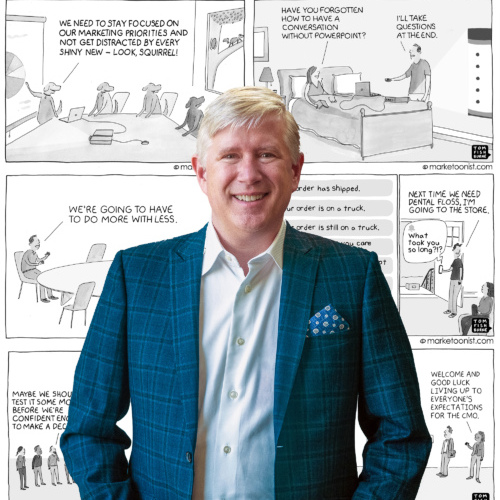
Welcome to another insightful episode of Build a Better Agency! This week, host Drew McLellan is joined by legendary cartoonist and marketer Tom Fishburne, best known for his “Marketoonist” series that has humorously and astutely captured the nuances of agency life for over two decades. If you’ve ever laughed (or cringed) at a cartoon that perfectly depicts a creative brief gone wrong or the infamous “shiny object syndrome” in marketing, there’s a good chance it was one of Tom’s.
In this fast-paced conversation, Drew McLellan and Tom Fishburne explore the enduring themes and challenges of agency culture, creativity, and client relationships, using Tom’s cartoons as a lens for the ever-evolving world of marketing. Tom shares how his unique background on both the agency and client sides has shaped his perspective and provided endless inspiration. He opens up about his creative process, how stepping back for “analog thinking” allows him to push past predictable ideas, and why intentional humor can break down barriers and foster connection inside agencies and with clients.
Listeners will also hear fresh insights on the changing role of data and AI in the industry, and how agencies can stand out by marrying “analog intelligence” with digital tools—without losing the essential human touch. Drew McLellan and Tom Fishburne discuss why so much work is met with indifference, the importance of a well-crafted creative brief, and the power of dedicating time to unstructured thinking, even in today’s deadline-driven environments.
Whether you’re a fan of Tom’s cartoons or new to his work, this episode will inspire you to reframe how you approach creativity and culture in your agency. You’ll walk away with practical homework on integrating humor, empathy, and analog thinking into your agency’s DNA—fueling better work, stronger teams, and more memorable client relationships. Don’t miss this blend of wit, wisdom, and actionable advice for building a truly distinctive agency.
A big thank you to our podcast’s presenting sponsor, White Label IQ. They’re an amazing resource for agencies who want to outsource their design, dev, or PPC work at wholesale prices. Check out their special offer (10 free hours!) for podcast listeners here.
What You Will Learn in This Episode:
-
- Bringing humor and humanity into agency work
- The evolving relationship between agencies and clients
- Why creative briefs often go wrong—and how to fix them
- Using analog thinking to spark creativity and originality
- Avoiding indifference by moving beyond data-driven sameness
- Balancing AI tools with the irreplaceable value of human insight
- Creating space for deep, focused thinking in a fast-paced industry
“The most valuable creative work often looks unproductive while it’s happening.” - Tom Fishburne Share on X
Marketers are obsessed with the new, but chasing trends without strategy is a trap. Tom Fishburne explains how shiny object syndrome still plagues our industry. Share on X
You can’t fake connection. Tom Fishburne shows how humor breaks the ice and makes clients, teams, and ideas click in ways nothing else can. Share on X
The pressure to be instantly productive kills great ideas. Tom Fishburne champions the art of letting your mind wander—and why every agency should make space for it. Share on X
AI may change agency workflows, but human creativity is more valuable than ever. Tom Fishburne reflects on the irreplaceable edge of analog intelligence. Share on X
Ways to contact Tom:
- LinkedIn: https://www.linkedin.com/in/tomfishburne/
- Website: https://marketoonist.com
Resources:
- BaBA Summit May 18-20, 2026: https://agencymanagementinstitute.com/babasummit/
- Drew’s Book: Sell With Authority
- AMI Facebook Group: https://www.facebook.com/agencymanagementinstitute
- AMI Preferred Partners: https://agencymanagementinstitute.com/ami-preferred-partners/
- Agency Edge Research Series: https://agencymanagementinstitute.com/agency-tools/agency-edge-research-series/
- Upcoming workshops: https://agencymanagementinstitute.com/advertising-agency-training/workshop-calendar/
- Weekly Newsletter: https://agencymanagementinstitute.com/newsletter-sign-up-form/
- Agency Coaching and Consulting: https://agencymanagementinstitute.com/advertising-agency-consulting/agency-coaching-consulting/
Drew McLellan [00:00:01]:
It doesn’t matter what kind of agency you run, traditional digital media, buying, web dev, PR or brand, whatever your focus, you still need to run a profitable business. The Build a Better Agency podcast presented by White Label iq, will expose you to the best practices that drive growth, client and employee retention, and profitability. Bringing his 25 plus years of experience as both an agency owner and agency consultant, please welcome your host, Drew McLellan.
Drew McLellan.
Hey everybody, Drew McLellan here, you guessed it. I am back with another episode of Build a Better Agency. And today’s guest is someone that I have literally followed for, I bet 20 years. Never met him before today, so I’m super excited about our conversation. But he has been a part of my professional life for a very long time and I’m looking forward to getting to know him a little better and having you get to know him as well. And he really has been, for me, kind of an idea starter. And so I’m interested in exploring sort of where he gets his ideas, which we’ll get into in a minute.
I’ll tell you a little bit more about him, but before I do that, I want to thank our friends at White Label iq. As you know, they are the presenting sponsor of this podcast, been with us for a really long time. They support not only the podcast, but they are also the presenting sponsor of the Build a Better Agency Summit every May. So. So we’re super grateful to them and we’re grateful for all they do for agencies. And much like our guest today is sort of an idea starter. One of the things that’s interesting about the way White Label works with their clients is that they take ideas that agencies have and they help them kind of bring them to life. So one of the things that really impresses me about them is they don’t just crank out the code, but if you talk to them, if you’re one of their clients and you talk to them about an idea that you would like to turn into something real, they will help you do that.
So a great example of this is a project that they named Collage. It actually started as an idea inside Huebner Marketing, which was kind of the mother of White Label. And then the White Label team built it out into a full blown commercial web app that actually ended up being sold. And remember, this is what they do every day for agencies all over the world. Whether it’s design, dev or paid media, they know how to take an idea off the whiteboard and make it real. So whether you need their help with a client or you have an idea, some intellectual property that you want to expand on or explore. They would be a great resource for that. And so I love that about them. I love that at the end of the day, agencies are always bubbling up and brimming with ideas. And the folks at White Label have demonstrated time and time again that they can help you bring those ideas to life. So check them [email protected] ami and as I always ask you to do, and I really hope every once in a while you actually do it, pop in there and just send them a quick note and tell them how much you like the podcast and how grateful you are that they sponsor it. That would make me very, very happy.
Okay. All right, so let me tell you about our guest today. Somebody who brings ideas to life. So Tom Fishburne is a cartoonist, but he’s been around forever. Many of you will. If you don’t recognize his name, you. You would recognize his cartoons. They’ve been around for a very long time and he started them as kind of a lark when he was. He’s worked on both agency side and client side. He started them as a lark to kind of comment on marketing and marketing professionals and the work that we do. Then 20 some years later, it’s still his gig. Now it’s his full time gig. And he really just has been a student of somebody who has studied our business for a really long time.
Drew McLellan [00:03:53]:
So I want to talk to him about a lot of things, about how we bring a sense of humor to our work and some of the trends that he’s sort of patterned and noticed throughout his cartoons. But in general, just how he gets his ideas and where those come from and what we can do to sort of tap into that creativity that he taps into every week. So without further ado, I would love for us to dig into the conversation. So let’s welcome Tom to the show. Tom, welcome to the podcast.
Tom Fishburne [00:04:19]:
Thanks so much for having me.
Drew McLellan [00:04:21]:
So I’m sure a lot of our listeners are very familiar with you and have probably followed you for many years like I have. But for the few that have not heard of you or seen your work, tell us a little bit about your background and the work you do and why most people listening would have heard of you.
Tom Fishburne [00:04:36]:
Yeah, so I have kind of a funny background as both a marketer and a cartoonist. I started drawing a weekly cartoon 23 years ago about my day job and my life kind of became a bit of both. I had worked on the agency side, on the client side, and so had been in the marketing trenches and just saw so many funny things happening around me. So started drawing a weekly cartoon right out of business school. I had done a business school cartoon, but when I graduated I started just putting it online. Had a sign up feature for people to get my email newsletter. When I was working in General Mills as a associate brand manager, I thought I would just entertain my colleagues. But it started to grow from there and now it’s been going on for 23 years and I realized so many of these issues are everywhere. So it’s been a weekly cartoon called Mark a Tunist and every week I draw cartoons about what I observe and write a little short post about it.
Drew McLellan [00:05:26]:
Well, and you’ve done lots of other things with the cartoons. It’s not, it’s not. Not that it’s not just the cartoons but. But you’ve. You’ve really made a career out of your cartoons.
Tom Fishburne [00:05:35]:
I have. It was initially a hobby and then I made the jump in 2010 to start a whole business around it really on an agency model to help companies communicate using cartoons. So I’ve worked with over 200 different businesses now, two thirds of which is relates to their external marketing and maybe a third related to their internal culture change, type work and the idea that cartoons can be a great way to bring out a sense of humor about a topic and give us permission about things to go deeper. And then along the way, I started doing a lot of speaking at conferences and I spent about a third of my time on that right now.
Drew McLellan [00:06:07]:
Yeah. So I’m curious if you think back over the sort of the span of your cartoons, what themes are still as true today as they were when you drew your first cartoon.
Tom Fishburne [00:06:21]:
I observed very early on that marketers are often excited about new trends even before they have a strategy to figure out how to make sense of those trends. That never gets old. I feel like I continue to come to that. Whatever it is, I think it’s exciting to work in marketing. We often get exposed to things early and it’s fun to jump on it, but very often it can be a look squirrel kind of shiny object syndrome approach to some of the new things that come around. So that’s an evergreen topic for sure. And I started drawing these before social media. So social media came and every new technology wave after that, there’s been endless material to work from. So that’s definitely been one. The agency client dynamic is another evergreen topic. And I have a lot of personal experience on both sides of the table that I tap into a lot of times when we’re just trying to create, work together, navigate creative feedback. How do we make things happen together? These challenging, really organizational issues continue to come up on both sides of that table.
Drew McLellan [00:07:23]:
I’m curious, you’re talking about being on both sides of the table. I’m curious, did your cartoons change depending on which side of the table you were on? And which side do you think is in air quotes more true or are they true depending on which side you’re on? Right. Do you understand what I’m asking?
Tom Fishburne [00:07:43]:
100%. Yeah. I always thought if there was ever a butt of the joke, it was usually myself. I was trying to hold up the mirror to myself or where I was grappling with issues. And so usually if I was on the client side of the table, I was often making fun of the client and if I was on the agency side of the table, I was making fun of the agency. And in a way it gave me a bit of empathy to how things come across because I observed when I was on the call client side that we were terrible at writing briefs. For instance, it was an afterthought. We’d take some brief from a few years before and copy and paste a few things into it, if that.
Drew McLellan [00:08:17]:
Right, right. And then expect the agency to come up with brilliance.
Tom Fishburne [00:08:22]:
Yes, exactly. Just to read minds, I drew a cartoon once about exactly that topic. Like the first person saying, I’m afraid the work doesn’t meet the brief. And the agency’s like, what brief? We got a one line text from a bar.
Drew McLellan [00:08:37]:
Right, Right.
Tom Fishburne [00:08:39]:
And going on and on and on is like, you know, why even bother you? Talking about a brief and punchline is so I can blame you when you’re. When it doesn’t meet it, you know, there’s just that kind of. There’s some truism into that I found later on when I was on the client side, I was sometimes used as cartoons as part of the kickoff meeting to help level set and just have have a conversation about some of those issues in a way that was non threatening because we were laughing at them together. We’d all seen that happen.
Drew McLellan [00:09:04]:
Right.
Tom Fishburne [00:09:05]:
And, and so I often will have that conversation when I’m sitting down with a new why we need to go deep on the brief up front, for instance, and I’ll share some of these cartoons and when we’re laughing about it, it just makes it a non threatening conversation.
Drew McLellan [00:09:18]:
So what are some of the themes that you find today? That when you think back over your career didn’t exist when you started? How have things shifted? Do you think in the business as a reflection of the work you’ve done.
Tom Fishburne [00:09:34]:
I feel like I’m often interested about specialization versus generalization in marketing, and there’s some ebbing and flowing over time. I’ve kind of naturally felt like I’m happiest when I’m a generalist, when I get to touch lots of different things. And so I feel like I. Early on in some of my cartoons when I would describe marketing as general management, it’s touching, all these different things. People would kind of understand the big picture. And now I feel like sometimes people think of their role in a very siloed way sometimes in marketing, you know, I’m just doing this one little bit of, you know, of comms work or, you know, search engine optimization. And so that’s one shift I notice. I’m definitely interested in the trends around AI, just in how not just the technology, but how we choose to adopt the technology.
Drew McLellan [00:10:22]:
Yeah.
Tom Fishburne [00:10:23]:
And so that’s one major shift I’m seeing just in how, you know, there’s an evergreen aspect to it because we oftentimes when new technology comes on board, the temptation is to treat it like a tick box and you’re doing the same thing as everybody else.
Drew McLellan [00:10:36]:
Right.
Tom Fishburne [00:10:36]:
And yet in this case, there really is a fundamental difference in how we can work with AI and use some of these tools. So I’m finding myself going a little bit deeper than I used to to try to understand it myself.
Drew McLellan [00:10:49]:
Right.
Tom Fishburne [00:10:49]:
Just so that I can understand it well enough to actually make fun of some of the dynamic that comes up.
Drew McLellan [00:10:54]:
Yeah. So I think one of the things that is clearly a theme that runs through your career is bringing a sense of humor to the work that you’re doing, whether you were on the agency side, the client side, and now back in sort of an agency setting. Talk a little bit about. I mean, while I think everybody can argue that having a sense of humor is a good thing as a general rule, I know for you it was sort of part of how you approach doing business and how you saw it layered into the business relationship. So, you know, I think sometimes when agency people are by themselves or clients are by themselves, I think they’re much funnier than they are when they’re together. Right. I think there’s like. I think they. Everybody puts on a seriousness when you have a mixed group of people. And I’m just curious about your thought about humor’s place in good work in the relationship. And just in general, you’re talking to a bunch of agency owners and leaders on this show what do you want to make sure they don’t forget about having a sense of humor?
Tom Fishburne [00:12:04]:
Yeah. I think we could sometimes take ourselves a bit too seriously. And I think we sometimes can discount some of the powerful benefits of humor as a building mechanism, as a connecting mechanism. I’ve always loved this vaudeville expression that laughter is the shortest distance between two people. And I found myself working in a wide variety of office environments, some that were very conducive to that and some that weren’t. And I found in some of those environments when I was working there personally, a lot of it was my own self editing. I was just reluctant to bring that side of myself. And I think it’s fairly common to think of humor as a bit. As a bit frivolous or think about some of the worst examples of humor misapplied in the workplace and think, I don’t want to make that mistake. But I found that when I focus explicitly on the form of humor known as affiliative humor, laughing with other people at some shared experience, it can be a bonding experience. And I had the experience early on at General Mills drawing this cartoon and my co workers telling me that I was going to get fired for drawing it, particularly because I would often come out of a meeting with an idea and then draw something. And a few of my colleagues are like, I know exactly where that came from. Right, right.
Drew McLellan [00:13:17]:
We know that was Phil, so.
Tom Fishburne [00:13:18]:
Right, yeah, exactly. Yeah. And then I got summoned into a meeting with the chief marketing officer and I thought he was going to yell at me, and instead he said, I love what you’re doing. I’m glad that you’re laughing at some of these things that are getting in the way. And I want you to keep doing it. I hope you always continue to do this because we need more of that. And I found that the more I did it, the more I would see things pop up around me and the more I worked kind of in organizations where someone in a leadership role was making it clear that this was okay.
Drew McLellan [00:13:48]:
Right.
Tom Fishburne [00:13:48]:
Culture just felt more open. If you’re. If you feel comfortable laughing with openly with a group, you’re more comfortable sharing your best ideas with that group. And so it’s a bit of an entry point. I think you can use it as an icebreaker. You can set the tone of what’s acceptable and just the culture feels a lot better. And I find over time, I do a lot of speaking at companies and I use a cartoon caption contest as a kind of an engagement fun thing I do in the. In the events. And um, it’s really interesting, I can tell, kind of tell in the response rate of what comes back a little bit of a signal on what the culture is like in those places. And I find that when there’s. When it’s clear that a sense of humor is kind of, you know, we’re, we’re going to feel comfortable doing this. Like, like ultimately the conversations run easier. Not you don’t have the situation as much of the junior people deferring to the senior people.
Drew McLellan [00:14:37]:
Right.
Tom Fishburne [00:14:37]:
It’s level setting and it also lets you talk about what’s ultimately really going on. I found a lot of my challenges, both the agency side and the client side were around communication, like just trying to get at what’s the real deal, like what’s really holding us back. And so the more we can do to kind of open up the floodgates, the better, I think.
Drew McLellan [00:14:58]:
Is there a time when you think it’s inappropriate?
Tom Fishburne [00:15:02]:
I think types of humor are inappropriate for sure. But I’ve never come across a situation where there wasn’t some shared challenge where a little bit of levity couldn’t make that easier. And sometimes humor doesn’t necessarily mean being laugh out funny. It can just. It can ultimately mean just be a little bit human, being able to be human about this situation. And I had this experience a few years ago getting to know a few professors at Stanford who were teaching a course on humor in business. And the first homework they gave everybody was to go find an email that everybody had written that was full of the typical way we communicate in business that’s a little jargony and technical, and then rewrite it with just a little bit of levity. And it wasn’t trying to make the person laugh, but it just came across like a human wrote it. And I think that’s the first step often.
Drew McLellan [00:15:51]:
Yeah. That’s interesting that the humor is. Assuming that doesn’t cross a line or whatever. But the humor is, if nothing else, humanistic. And it is person to person connection, regardless of which side of the table you’re on or what, how many, you know, what your title is or how long you’ve been there. There is a universality to laughing about something.
Tom Fishburne [00:16:18]:
Yes, yes. I think that there’s a pendulum kind of from kind of an empathy pendulum, from aggressive humor to this affiliative humor. And if you stay in the high empathy zone, it has a lot of benefits.
Drew McLellan [00:16:30]:
Yeah, yeah. Talk a little bit about sort of your. The observations that you’ve had over the years about because you’ve been on both sides of the equation. And you in essence, it’s interesting through your work, you in essence are almost like an archeologist that you have studied like the evolution of the civilization of our business. Right. I mean you’ve, you’ve studied agency people, you’ve studied clients. Talk a little bit about sort of how you see how have agency people, how is the agency civilization if you will, how’s it changed over the years? What have you observed?
Tom Fishburne [00:17:12]:
Yeah, it’s, it’s funny to hear it described that way. I’ve never thought it quite like that. And yet I find having this, this weekly schedule where I take a step out, I just kind of try to pay attention to it. It’s made me better at my non cartoo job too. I think there’s room for us to have a bit of that. We can sometimes be so in the weeds on it. It’s good to take a step back and sort of see where things stand. I’ve seen, I’m not sure if it’s a total evolution over the history of that 23 years that I’ve been drawing the cartoons, but I’ve definitely seen varied approaches in how that collaboration between agencies and clients work. And I’ve seen very productive agencies, agency client relationships and some that have got been very, very dysfunctional.
Drew McLellan [00:18:00]:
Right.
Tom Fishburne [00:18:01]:
I’ve actually some of the most amazing brands I’ve been a part of on the client side were started by ex agency people who decided to start brands. And so I guess if there’s any sort of a trend it’s trying to put seeing, I’m thinking particular individuals are coming to mind. Seeing people who can put themselves in the shoes of their, of their collaborators and make them feel like they’re part of one group. I remember when I was at meth soap company started by an agency person, we would sit down to meet with a new agency and this felt like the opposite of what I had seen of barely caring about briefs. He said agencies have A teams and B teams and if you come to work with an agency and you want to work with the A team, you can often get them excited by doing things that are non monetary. You can take care of things like putting the best brief ever.
Drew McLellan [00:18:52]:
Yeah.
Tom Fishburne [00:18:53]:
You know, really pay attention to that.
Drew McLellan [00:18:55]:
Yeah. It’s respectful, right?
Tom Fishburne [00:18:57]:
Yeah, respectful. And also thinking about what their incentives are because people in an agency want to do great work. They don’t want to get, they don’t want to, they don’t want to end up in that death by a thousand cuts. And so I found that very powerful. And it’s. It’s a. It’s a. I think it was part of the secret to Method success as a brand that they had these very deep relationships with agencies that created phenomenal work far beyond the budgets that we had to work with. And so I went from a stage of never having seen that before to seeing it with Method and agencies and then going forward, seeing that more frequently. So I guess, if anything, I feel like if there’s projects where I see a chasm between agency and client, it feels like. It feels like an old legacy thing. And what I see going forward, hopefully, is more. Having seen it more linked up.
Drew McLellan [00:19:43]:
Yeah, it’s interesting. When I think of your work, when I think of the body of your work, I almost think of, like, going to a gallery or a museum where you’re seeing photographs over a period of time. Like, there’s a great museum in New York that is the history of New York. And so as you’re walking through the museum, you’re seeing New York back in its original days, and then as the city has evolved and grown. And I sort of think of your. Your work that way that they are moments in time like an archeologist would dig up, like they’re an artifact of this moment. And each of them individually is a. Is a complete thought or thing. But when put together in, like, a book and some of the other things you’ve done, they tell a story of an industry and of the people of that industry. And so that’s where I think my head went, was just that you. You have had the luxury, in some ways of being among them, if you will, but also studying them at the same time.
Tom Fishburne [00:20:46]:
Yeah, it’s kind of been my public diary. It’s been my own diary. But then by. By putting it out there, I get to hear from other people what their experiences are like, too, which has been pretty. Pretty fun.
Drew McLellan [00:20:55]:
We need to take a break. But before we take a break, I’m curious. Is there one cartoon that consistently, if people meet you or talk about you, is there one or two that everybody remembers or has, you know, taped on a. On a bulletin board or references? Is there. Is there. Are there some just classic cartoons that just come up year over year over year?
Tom Fishburne [00:21:17]:
One of my earliest cartoons featured the eight types of bad creative feedback. And that one comes back again and again and again 23 years later. Oftentimes people will even write down people’s names they’ve come across in their career and send them back to me. Yeah, so that one definitely gets played again and again and again. And then I’ve done a couple on AI recently that in the last three years that are now some of the more popular ones that I’ve ever done. So it just goes to show, it just keeps changing. There’s never a shortage of material.
Drew McLellan [00:21:51]:
Well, but also that there’s such a commonality in our experience that the moments that you’ve captured people feel like you were watching them, you were observing them or they’ve lived that cartoon a million times.
Tom Fishburne [00:22:06]:
Right, Exactly. I always like that as a medium because it’s a two way thing. I create something and yet whoever’s looking at it has to figure out why these words go with this picture and they inherently put their own bit into it. And so I often hear from people, they took totally different interpretations than I meant from the original cartoon. And that’s great. I love seeing where it goes. I love thinking about having something as a conversation starter that gets people talking about where they are.
Drew McLellan [00:22:32]:
Yeah, that’s interesting. All right, let’s take a quick break then we’re going to come back and I want to just get your take on the business and sort of again, having sat in the observation seat that you have some, some of the issues that you see us kind of coming up against and, and, and where we’re going with that. But first, let’s take a quick break. Are you tired of juggling multiple tools to manage your agency? Meet Deltech Workbook the all in one solution for marketing and communications agencies. Streamline your projects, resources and finances all in one place. With real time dashboards and reporting, you’ll have full project visibility. You can plan team capacity weeks ahead to avoid bottlenecks and keep your budgets on track to maximize profitability. It’s perfect for both agencies and in house marketing teams looking to work more efficiently. PCI is a certified Deltec partner offering expert implementation and support to ensure your success. If you’re ready to transform your operations, visit PCI US Podcast for a free consultation today. Hey everybody, thanks for listening today. Before I get back to the interview, I just want to remind you that we are always offering some really amazing workshops and you can see the whole [email protected] on the navigation head to how we help. Scroll down and you’ll see workshops and you can see the whole list there with descriptions of each workshop. They are all in Denver and we’ve got them throughout the year for agency owners, account Execs, agency leaders, CFOs. We have a little something for everybody. No matter what it is that you’re struggling with. People, new business, money, all of those things we’ve got covered. So check them out and come join us. All right, let’s get back to the show. All right, we are back with cartoonist Tom Fishburne, who I probably have been following for probably most of the 20 years. You’ve been drawing your cartoon. Like, I, I can picture myself early, early in my career, like subscribing and getting the cartoons when I was just a, you know, obviously much younger than I was now, 20 years later, but just that it was such an interesting insight into the business. And so you have, you have a unique catbird seat into the industry. And so I’m curious, talk a little bit about sort of, you know, back in the day when you started and when I started, the idea of the data that we had and some of the, like, you know, how we, how we designed ads, how we thought about campaigns, how we thought about messaging was very different than it is today. I mean, a focus group was. That was a big thrill to have that kind of data. Right. People’s opinion that was like, that could shape a whole campaign. So talk a little bit about your observation as a storyteller, because that’s really what you are as a storyteller. Talk a little bit about how you see the industry sort of interacting with data and all of the technology and the media and the channels. How are we doing, do you think, with that? And where could we be doing it better?
Tom Fishburne [00:25:49]:
I kind of feel like we’re in an awkward adolescent period where the data is there, tools are there, technology’s there, but we’re still figuring out how to make sense of it. I think that the path of least resistance can often lead to creating a lot of work that looks the same. And a lot of times there’s a one size fits all that. Too many agencies look like one size fits all a bit. I think there’s benefits in specializing and being known for your point of view and not just having access to it, but then what do you do with it that’s unique and takes it in exciting and interesting places.
Drew McLellan [00:26:27]:
Right.
Tom Fishburne [00:26:28]:
There’s a piece of work from a company in the UK called System One that measures advertising over time and they measure emotional responses to the advertising and, you know, happiness, sadness, etc. And the number one response, like 54% of the response to the advertising is indifference.
Drew McLellan [00:26:49]:
Right.
Tom Fishburne [00:26:49]:
And. And that indifference, you know, 54%, that’s a pretty. It’s. It’s a higher number than I would have thought and for us to. For sure, yes.
Drew McLellan [00:26:58]:
Right.
Tom Fishburne [00:26:58]:
And for us, for us to create things that are really going to move the needle means going far beyond that. And so I think it means taking all the data that we have, the tools, technology, which is kind of table stakes. But then what do you do with that that’s really meaningful and memorable and takes it in new and exciting places. I get excited about the potential of it, but I feel like in this awkward adolescence stage sometimes we don’t go to the next level. That’s the thing I’ve observed the most, I think.
Drew McLellan [00:27:24]:
So I think what I’m hearing you say is that we take the data as the end point rather than the launching point. Like now that I have all this information and this data, what does it tell me about the humans on the other side of this conversation and how do I connect with them in a way that is going to give them anything but indifference?
Tom Fishburne [00:27:45]:
Exactly, exactly. And to lead you to, and lead you to a different place than any other agency working with the same information. Like how would you, how would you take that and take it to a different place?
Drew McLellan [00:27:55]:
Yeah, yeah. It’s an interesting thought. You had mentioned cartoons about creative briefs and I think that’s the bane, like, much like timesheets. I think creative briefs are often the bane of agencies existence that you know, even inside an agency they’re frustrated when the account person doesn’t give them a good brief, let alone when the client doesn’t give them a good brief. So given that you’ve played roles on both sides of the table and again you’re a storyteller which sort of lends itself to sort of that. How do I capture this story and give it to whoever’s going to do something with it? Where do you think we get that? Why do you think we get that so wrong? I mean, when you think about it, that shouldn’t be that hard for us.
Tom Fishburne [00:28:38]:
Yeah, I think on the client side, I mean everybody is phenomenally busy first of all. So you’re working on a million things at once and you’re just trying to make it all happen.
Drew McLellan [00:28:46]:
Right.
Tom Fishburne [00:28:47]:
And on the client side you’re, you know, you’ve got this jam packed day and you’re just like the easiest thing to do is just take a creative wreath that’s been written, add a little bit into it and let the creative people do the creative bit. And a lot of people in the client seat haven’t been on the agency side before. They haven’t seen that world. You know, it’s a lot of it’s an. It’s an education thing, but it’s a. Where you spend your time kind of thing.
Drew McLellan [00:29:08]:
Yeah.
Tom Fishburne [00:29:08]:
I think a lot of it comes to. I think a lot of. On the client side, a lot of it comes to educating and helping them understand how important this is. You know, garbage in leads to garbage out. And if you put the work on.
Drew McLellan [00:29:19]:
It’S an interesting idea to think about. If you gave a new client a bad brief and said, okay, you write an ad based on this bad brief.
Tom Fishburne [00:29:27]:
Yes.
Drew McLellan [00:29:28]:
So you can see how hard it is. To your point, garbage in, nothing but garbage is coming out.
Tom Fishburne [00:29:34]:
That’s it exactly. And I’ve tried to get better. So on the client side, like, I mean, we are on the agency side, we receive bad briefs all the time. And the easiest thing to do is say, okay, great, thank you. We’ll do something with this. A harder thing to do, but a really important thing thing to do is to kind of hold up the mirror and say, I don’t have enough to work with yet.
Drew McLellan [00:29:52]:
Right.
Tom Fishburne [00:29:53]:
And I feel like that. That sometimes doesn’t happen because you want to be amenable, you want to be an easy client, et cetera. But there’s a role, I think, to play to. Part of what we’re being hired for as an agency is to make sure we have everything we need to work with and to push back on some of that. And so I’ve tried to get better in my own career at drawing a line of what is, what is, you know, enough for me to really do my best work. And the second part of that is I’ve tried to get more comfortable of walking away from opportunities if I don’t feel like I’m set up for success that way. I feel fortunate in a way that the vast majority of clients I get to work with are people who followed my cartoons for a while. And so I’m generally somebody who. The advice, I always say, is if you can get hired by your fans, that’s the best situation. The meetings are great. They’re happy with the work. They want to work with you for a reason. And so I think if there’s a version of that where you can get hired by your fans, you’re already in a great place, and then you have a little bit of trust built in to say, hey, excited to work with you on this. I see what you’ve sent me so far. I need more to go deeper to do what we need to do. I often will rewrite the brief and send it back to them kind of knowing what I know. So I don’t expect them to go 100% of the way, particularly when they’re working with something like cartoons that have humor and they’re not familiar with that. But I will say, hey, to really take this all the way, I need to understand X, Y and Z pain points better. I need to understand those issues so I can be close enough to it to find things that are funny in that. And we’ll often go back and forth to make sure that I have enough to then say, okay, great, now I have enough to move forward. And I think, and what I’ve observed is that sometimes that doesn’t happen. It’s, you know, the client’s busy and sends over something and thinks they’ve sent everything over and the agency is busy and receives it and says, well, I kind of think I see what they’re going with this. Let’s create something out of this. But then because you’re guessing, you’re always kind of. You end up playing it a little bit safe.
Drew McLellan [00:31:50]:
I think, I think one of the, I think one of the reasons why that indifference score was so high is because I think there’s a lot of sameness in our work. Right. And I think part of that is, as you said, we kind of all get the same data points and stop there and then produce work from the exact same sort of location. And so it’s hard to, you know, if we’re all standing in the same spot, we have the same view, right?
Tom Fishburne [00:32:22]:
Yes.
Drew McLellan [00:32:22]:
But it’s about moving to a different spot so that you have a different view. So I’m curious, how do you do that in your work? Like, how do you find a different place to stand? So your view is fresh and unique and gives you something real and kind of raw to work with.
Tom Fishburne [00:32:42]:
Yeah, it’s a great question. I’m thinking about it from two angles. One, when I’m creating any sort of cartoon, the humor works partly because it’s unexpected. And so usually the first idea I get is not deep enough. Like, I have to go deeper to make it get to an unexpected point where you actually have the laugh. And so it helped me, I found in my non cartooning life because I was like, wait, we just, this is our first pass. And I think we can’t leave it here because somebody else would come to this exact same first pass. So I think some of it is just having the willingness to like, you know, to keep. To keep, you know, pushing at it. And I think part of it too, I find there’s Simplicity on the other side of complexity. And so oftentimes for me, it’s trying to get to that, get through the complexity to get to a couple of clear insights that I feel like make me say, oh, that’s interesting. There, there’s something there.
Drew McLellan [00:33:34]:
Right.
Tom Fishburne [00:33:34]:
And that’s usually my starting point to then create work. I also find in some ways there’s a benefit to the type of specialty I picked because there just isn’t that much. Cartooning as a marketing vehicle isn’t done as commonly. And so that’s.
Drew McLellan [00:33:48]:
And there’s only so much landscape. Right. You can’t do a 27 window cartoon.
Tom Fishburne [00:33:55]:
Yes, exactly. Right, yes. Yeah. It forces you to keep it simple onto one insight there too.
Drew McLellan [00:34:01]:
So I’m curious, how do you. So in the beginning we all see the same thing, so it’s simple. And then you push past it a little bit and you get to the messy complex. Boy, this is a lot of data points, lots of different points of view. How do you sift through the complexity to get to a new simple? Do you have a mental process you take a journey through to get there?
Tom Fishburne [00:34:28]:
I do. I found that when I went from just being a. A cartoonist with a day job to making this my main focus, my output had to be a lot higher. So I actually had to build a system around it. And so my, my personal approach is it involves at least two hours of deep thinking time every day. I’m more creative early in the morning, so that’s when I usually schedule it. And I have a process where I sit down. I usually have two or three kind of active clients at a time. So I’ll. I’ll have. I kind of set myself up the night before with everything I need to make that a productive time. I have all that complexity and research and the things I’m trying to thinking about that haven’t really turned into something as my stimulus waiting for me. And then I go through a very sort of free form, deep idea period to just play with ideas, not sure if they’ll turn into anything. And usually I find that if I have a session like that, at the end of the session, I go from complete complexity to a couple of eight directions which could be interesting. And then I sleep on it. And then those directions start to congeal into something that could turn into something. I start to feel my intuition leading me into a couple places. And after about a week, I have a couple ideas I’m pretty happy with. And over the course of that, the way I look at the ideas shifts from being Pure creative to being more like an editor. So at the beginning, I’m just trying to get ideas out there, draw nonlinear connections, find things that have promise, and toward the end, I’m trying to think like an editor. What’s the simplest way to get across this particular idea and then throw away the rest? And that’s the process that tends to be most productive for me, that gets me to a different place than I can get just trying to problem solve because I have to find inspiration in the cartoons that I create. It’s kind of the creative process. I don’t want to shortchange that.
Drew McLellan [00:36:19]:
Yeah. So when you’re sifting through all of the complexity, are there things that happen, or is there something that happens in your brain? Is there something that happens with your eyes? Is it where your head wander? Like, what are the clues for you that you’re on a path that might lead to that? Aha. Like, oh, this is interesting.
Tom Fishburne [00:36:44]:
It’s funny. I. I recognize it, and I don’t always know why I recognize it. I kind of have a separate. When something. When an idea gets to that point, my internal vocabulary for that, I kind of call it my stub. Like a Wikipedia stub. Like, there’s a stub that I’m putting there. This is something here. I don’t know what it is yet, but I can feel that there’s something here. And then I’m going to put it in a special pile, and I’m going to work on it with some energy because I feel like there’s something there. Sometimes I don’t figure that out for a little while. And sometimes in my own work, where I’m not working on a client deadline, sometimes I’ll put something away in the stub pile and. And six months later, I come across it, and then the light bulb goes off, and I’m like, oh, this is how I could make this work. And oftentimes it’s just a partial idea not quite there yet, and I need to let it ruminate. And so I find in my own process, I need to have. I need to allow for that. I needed to build up some time without distractions where I could just let that happen. Because the real magical ideas come out in that space of mind. The rest of my day can be super productive, but if I don’t have that, then everything ends up as, like, the most expected result, rather the more interesting result.
Drew McLellan [00:37:56]:
It’s interesting that you describe that as not productive. Right. Because I was thinking as you were talking, I was like, this is one of the Problems that our industry faces is that we have not figured out how to, in, in the business model of being an agency, we have not figured out how to put a value on that air quote, non productive time. Like I’m not, I’m not writing something, I’m not drawing something, I’m not coding something, I’m not making the thing. I’m literally just sitting and thinking or rereading or reviewing. And is that billable or not billable? Yeah, like I, like as you were talking, I was thinking back. So I started out as a writer in my agency life and I can remember back in the day when we all lived in an office together. I can remember we had all of these reference books and they were old annuals of other ad campaigns, they were, you know, trade pubs. I mean, we had dictionaries, we had the sources, we had, we had all kinds of stuff. And we would go in this room and back in that day, as a writer, I was paired up with an art director and we would get an assignment, we would go in that room and we would sit in there for hours and we would just talk and flip through books and go, oh, this is interesting and I wonder about this. And we’d write down questions. And it was, to your point, completely non productive time in that we did not leave that room with an ad campaign or a headline or a radio commercial or whatever. But we had ideas, we had more questions, we had more curiosity, we had ideas that were sort of threads we wanted to pull on. And then we would usually come back with a subset of those, some answers to some of the questions. And then we would get down to doing the work right, like to making the thing, whatever that was. And I think about the work, the way we work today, and it’s a mix of we’re not in the same room anymore, we don’t have those kind of resources. We rely on the Internet for everything. If it’s not a billable, if it’s not baked in as a billable hour, we don’t have the time to do it. And I think, what, what is the solution? So no wonder 54% of our work creates indifference. I mean, it does. It’s not worthy of anything more than that because we didn’t do the deep work that it takes to come up with some of the iconic work that has come out of our industry over the years. So I’m curious, as someone who has again been in the business for a while, has observed both sides of the fence, I’m curious about your take on what I just said, but also, what’s the cure for that?
Tom Fishburne [00:40:50]:
I 100% feel that. And I found I was such a relief when I was able to start my own thing and schedule the week the way I wanted to, because I found in my previous roles, my schedule was booked for me. My to do list was taken from my inbox, my calendar was set for the meetings I had to be a part of first thing in the morning. And so finding time for that is really hard. I see it as the most important part of my day. And so I make it non negotiable. I can sometimes be flexible about what time. I work with some clients in India and Europe and so sometimes I’ll do those calls first, but I always have that two hour window as non negotiable time because it’s the most important part. Even though to your point, at the end of it, sometimes all I’m left with is just an envelope with a bunch of scribbles on index cards. There’s nothing I can point to and say, this was productive. And yet I know if I do that two hours a day for a week, that’s the most valuable asset that I have and that leads to everything else. So I see it, I’ve proved it to myself now by now how important that time is. And I feel like the antidote, I think, for everybody is to find some way to do that. In my previous work, I used to have to. I mean, I was in an office five days a week and I used to schedule fake meetings just to leave the office to get some of that time, you know, to go to a coffee shop with a stack of index cards for two hours and try to work on the business problems. But it was tension there. It’s hard. It’s hard to make that happen. But I find that it’s a little bit like scheduling exercise that when you do make it happen, it builds muscle memory that, you know, for me as it is now when I sit in the chair and I have my little rituals when I’m in that space. I even listen to the same album on repeat. For some reason I’ve just. Yeah, this Miles Davis album, for some reason I’ve just been doing that since the beginning. And the moment I put on the headphones and the music comes in, I’m like a Pavlovian dog. I’m like.
Drew McLellan [00:42:47]:
Your brain just goes into that deeper thinking mode.
Tom Fishburne [00:42:50]:
Yeah, yeah. It’s just I’m trained myself that that’s the time to go in that deeper thinking mode. And then I can start playing with the ideas. And I know that the rules of my work operate differently in that time than it does the rest of my day. I give myself permission to follow these tangents in random places and I don’t quickly judge whatever I’ve scribbled down. I let myself play with ideas in that messy, imperfect period of time when creativity just needs to stretch. And then, and then later on when the headphones are off and I’m looking at it with fresh eyes, I’m like, oh, okay, yeah, this one actually maybe has some potential. That one. Not sure I can be more analytical, editorial, more productivity driven afterwards, but I still treat that time as sacred.
Drew McLellan [00:43:36]:
Yeah, it’s really interesting about the music you listen to. Like, I think about how, you know, some people have rituals around, as you said, exercise or meditation or something else that there are things that trigger putting them in a certain state.
Tom Fishburne [00:43:52]:
Yes.
Drew McLellan [00:43:52]:
That allows them to perform in a different way. And so, you know, really that’s what you’re talking about is you’re putting yourself into a state of creativity and non linear thinking and being able just to explore. Which allows you then to use that air quote, non productive time in a productive way.
Tom Fishburne [00:44:15]:
Exactly, exactly.
Drew McLellan [00:44:18]:
Yeah. It’s interesting, I think about how time starved everybody is in their work today. I think how in the world would someone bake that kind of time in? Especially if you’re not the boss. Like you and I can do it because we own the companies, right. So nobody, nobody’s going to yell at us if we sit in a chair for an hour and listen to music and doodle. But if you’re, you know, a senior art director or you know, you’re a strategist inside an agency. I’m just, I’m think, I’m just thinking in my own head, like how, how would I help agencies, A, recognize the value of that and B, how do we, how in our business model do we leave room for that?
Tom Fishburne [00:45:07]:
I think it doesn’t have to start with two hours. Like I think finding a, I think everybody could find a half an hour.
Drew McLellan [00:45:12]:
Yeah.
Tom Fishburne [00:45:13]:
And I think this, there’s a. Sometimes we, we tell ourselves like slack has to be on, I have to be available. Messages have to come in, I need to be on. Like this is all the stuff I have to do. The reality is like the world’s not going to blow up in 30 minutes. Right. And by saying, yeah, we’re not saving lives. Yeah.
Drew McLellan [00:45:30]:
Right.
Tom Fishburne [00:45:30]:
For this 30 minute period, I’m going to focus on my creative muscle. If you have to black out time and do cheats to make that time happen. By investing in yourself and making it repeatable, it puts you more in control of your day. I think it makes the remaining part of your day that much more productive because you’ve had that.
Drew McLellan [00:45:52]:
Yeah. It almost feels like you’re making room in your brain for the. Again, air quotes. Productive work by getting all of that other stuff kind of out and captured somewhere where it can sort of ferment and take root and maybe turn into something.
Tom Fishburne [00:46:11]:
Exactly. And I think there’s also the thing that oftentimes busy work is not the most productive work. And so I think this allows us to have the time on what really matters, separate from being distracted by whatever happens to be coming across your phone at that moment.
Drew McLellan [00:46:28]:
Yeah. And in some ways, it’s the ultimate anti AI, Right. I mean, it’s just to let your brain just bounce around and play with ideas and pull on threads is sort of the opposite of give your brain a prompt and your brain has to spit out productive things. You know, I think a lot of people are thinking right now about sort of what is AI’s role in the industry and how do I leverage it to my advantage, the client’s advantage. There’s no argument that it’s an amazing set of tools that is going to change our industry forever. There’s no doubt about that. But I’ve been increasingly having conversations and talking to people and thinking about there are certain things that humans can do that AI will never be able to do. And when we can capture that and marry it with what AI can do, that’s when agencies become indispensable. You and I are recording this at the tail end of the year of 2025. It’ll air in 26. But everybody is asking me, like, what is 2026 hold for agencies? And what is the, you know, how do I future proof my agency? And so that question, those questions have been banging around in my brain a lot. And I’ve been thinking about sort of, what can humans do that AI cannot replicate? And kind of what you’re talking about is that that sort of free thinking, just letting your brain wander. AI is trained to follow a path.
Tom Fishburne [00:47:58]:
Yes.
Drew McLellan [00:47:58]:
Right. And what you’re saying is we have to take some time to let our brain not follow a path and just sort of see where it goes, because that’s where the interesting connections happen.
Tom Fishburne [00:48:09]:
That’s absolutely right. I love how Anne Handley has been writing about this lately as the other AI, analog intelligence. And you put analog intelligence with artificial intelligence and it can be pretty powerful, but you need to have the analog intelligence. I think part of that indifference opinion. I mean, the path of least resistance using AI tools leads to more indifference and finding. I think a lot of it’s going to relate to thinking about the workload of an agency from start to finish. And there are pieces of that workload that I can do help in phenomenal ways.
Drew McLellan [00:48:45]:
Yep.
Tom Fishburne [00:48:45]:
You know, and I certainly, I use it when I’m distilling conversations with clients and trying to surface themes and all the stimulus that I, that I need to package in a certain way to make, to make me most creative. I’m happy using AI tools for that. Then when I then, then I sit down with all that and I. My analog intelligence flips on and I can go deep and use what makes me uniquely me to then create ideas that take it into different places. And I feel like if you try to jam AI into every single stage of that workflow, you’ll end up just creating more of the same.
Drew McLellan [00:49:16]:
Yeah, yeah, yeah. It’s a fascinating time to be in the business, for sure. It is, yeah. Yeah. And it’s sort of interesting to think about the fact that what you and I are talking about is kind of old school agency life marketing expertise kind of having a resurgence as we try and find a place to make sure the human is ever present in the work that we do.
Tom Fishburne [00:49:43]:
That’s right, yes.
Drew McLellan [00:49:44]:
Yeah.
Tom Fishburne [00:49:45]:
I think that’s going to be a major thing looking forward is people are looking for the human. I mean, there’s no doubt, there are plenty of studies are coming out. When something looks like it’s AI generated, there’s a distaste. And I feel like even some of the big, even the AI companies are hiring human writers to put the human touch on things. So I think it’s something that we are going to be working on and figuring it out. And I think agencies that can build the human into what they do clearly will give them a little bit of an advantage.
Drew McLellan [00:50:13]:
Yeah, well, and as I think about like the legacy of your work, one of the things that is uniquely human is a sense of humor and the things that we find funny. It’s hard to imagine a machine being able to replicate that. And so, you know, in some ways your work becomes even more relevant today as we struggle to make sure that humanity sticks around in our work. You know, you’re always going to have a gig because what you do is uniquely human and connects, as you said, and as we said in the early part of the conversation is a connector of people and ideas, and so that’s good for all of us.
Tom Fishburne [00:50:53]:
Yeah. I think we all need our sense of humor more than ever, I think, to help navigate it.
Drew McLellan [00:50:58]:
Yep. This has been fascinating. Tom, thank you so much for spending the hour with me. This is. This has been a great conversation, and I feel like, in some ways, we’ve been sort of doing a little bit of analog. You know, I had a set of questions to ask you, and we went off on a bunch of tangents that I didn’t really anticipate we would go on, which I think are the best conversations. But super grateful that you joined us on the show today and shared your. Your experience and your observations about the world that we’ve shared for so long. So thank you.
Tom Fishburne [00:51:28]:
Thank you so much for having me. It’s been great.
Drew McLellan [00:51:30]:
So, Tom, if people want to find out more about your work, they want to catch up on all the cartoons they’ve missed. If they want to do all of that, what’s the best way for them to track you down and learn more about your work?
Tom Fishburne [00:51:42]:
Yeah. Markatunas.com is the hub for everything, and you can find my newsletter there. So every Monday morning, I send out my latest cartoon with some of my thinking behind it. So that’s the best place to stay in touch.
Drew McLellan [00:51:53]:
Yeah. That’s awesome. Thank you so much for being with us.
Tom Fishburne [00:51:56]:
Thank you.
Drew McLellan [00:51:57]:
You bet. All right, guys, so here’s the interesting homework out of this. You know, I love to pull homework out of every episode. I want you to find 30 minutes and just do that analog thinking. Pick the album of your choice on Spotify. Doesn’t have to be Miles Davis, although that’s a fine choice. But pick something that just takes your brain in a different place and just let your brain wander a little bit. Give itself. Give it a problem to solve or a question to answer, and just see where it takes you. And I know for me, one of the challenges is my brain immediately goes to judging, like, nope, bad idea. Yep, bad idea. So try and avoid that. I will do the same. But just let your mind wander and however you take notes. So some of you might draw on an iPad. Some of you might draw on a pad of paper. Some of you might type into a keyboard. Whatever it is, just sort of capture those random thoughts and tuck them away. And, you know, we’ve had several guests who’ve talked about sort of this idea of idea collection, and how do you store them in a way that you can access them later? So maybe that’s part of this process for you. But just give your brain permission to wander and stop deeming it as unproductive and recognize that it is. It is the exercise your brain needs to get past the obvious, to get past the indifferent, and to get to something fresh. And so give yourself permission to do that and give your team permission to do that. If you’re listening to this and you’re the owner of the join or you’re the boss, maybe make it a group activity that it’s just something that you all do. Maybe everybody does it at the same time. Maybe everybody does it on their own time, but just carve out 30 minutes a week. That’s it. If you can do more, great. But give yourself 30 minutes a week to just let your brain do its magic in a way that only the human brain can do and see what happens. I would love to hear that. A, you tried it. B, what worked and didn’t work and see what were some of the ideas that popped into your brain as you let it kind of wander free. I would. I would love to hear that. And you all know how to get a hold of me. So send me, send me those thoughts. All right, before I let you go, two quick things. Of course, you know, I want to thank our friends at White Label iq. They’re the presenting sponsor of the podcast, as I told you at the top of the hour. Super grateful to them. So whitelabeliq.com ami and last but never least for me is I love that I get to have these conversations and I love that you get to be alongside me for these conversations. If it weren’t for you listening for the last decade, I wouldn’t have gotten the chance to have this conversation with Tom. I wouldn’t have gotten the chance to meet him. I wouldn’t have had the thoughts that I had today. And so by being able to do this with and for you, it makes me better at my work. And so I am super grateful that you find the time to hang out with me every week and that you are loving the guests the way I love them and you’re loving the new ways of thinking and that you let me know that you are enjoying it and the kind of things you want to talk about in the future. I’m really grateful that I get to do this with you, and so I do not take it for granted that you have a very limited amount of time and you spend a little bit of it with me every week. So thank you for listening and I’ll be back next week. Hope you will, too. See you then. Come back next week for another episode designed to help you build a stronger, more stable and sustainable agency. Check out our workshops, coaching and consulting packages and other professionals development opportunities at agencymanagementinstitute.com.