
Episode 517
Welcome to another thought-provoking episode of Build a Better Agency! This week, host Drew McLellan is joined by returning guest Michael Farmer, a renowned consultant and author with decades of experience advising both global agency holding companies and independent shops. Together, they pull back the curtain on one of the agency world’s most persistent and problematic issues: the disconnect between the value agencies provide, the scope of work they deliver, and the fees they collect.
Michael shares candid insights from his 30-plus years helping agencies navigate profitability challenges, particularly around scoping, resourcing, and pricing work appropriately. He recounts eye-opening stories from inside major agencies, including how a lack of clarity around deliverables and the overuse of creative resources can quietly erode margins—and ultimately, agency health. Michael breaks down his approach to rigorous scope management, explaining why developing a detailed, data-driven understanding of agency output is essential for both profitability and sustainability.
Drew and Michael explore why so many agencies—especially large holding companies—fall into the trap of doing too much for too little, and why today’s independent agencies are uniquely positioned to break that cycle. Their conversation highlights how smaller agencies can differentiate themselves by adopting a consulting mindset, engaging more meaningfully with clients about business outcomes rather than just deliverables, and leveraging freelance talent for maximum flexibility.
If you’re ready to move beyond being a “deliverable shop” and reposition your agency as a true strategic partner, this episode is a must-listen. You’ll walk away with actionable advice on scoping, pricing, business model evolution, and why now is the perfect moment for independent agencies to lead the industry forward by focusing on the work that truly moves the needle for clients.
A big thank you to our podcast’s presenting sponsor, White Label IQ. They’re an amazing resource for agencies who want to outsource their design, dev, or PPC work at wholesale prices. Check out their special offer (10 free hours!) for podcast listeners here.
What You Will Learn in This Episode:
-
- Why agencies must shift from delivering quantity to delivering strategic value
- The dangers of undervaluing agency work and over-delivering for too little revenue
- The critical importance of scoping, pricing, and tracking deliverables accurately
- How smaller, independent agencies are positioned to outpace big holding companies
- The need for deeper alignment with client business goals, not just creative output
- Leveraging freelance and specialized talent to extend agency capabilities
- Preparing for the future: consulting mindset, strategic focus, and harnessing AI responsibly
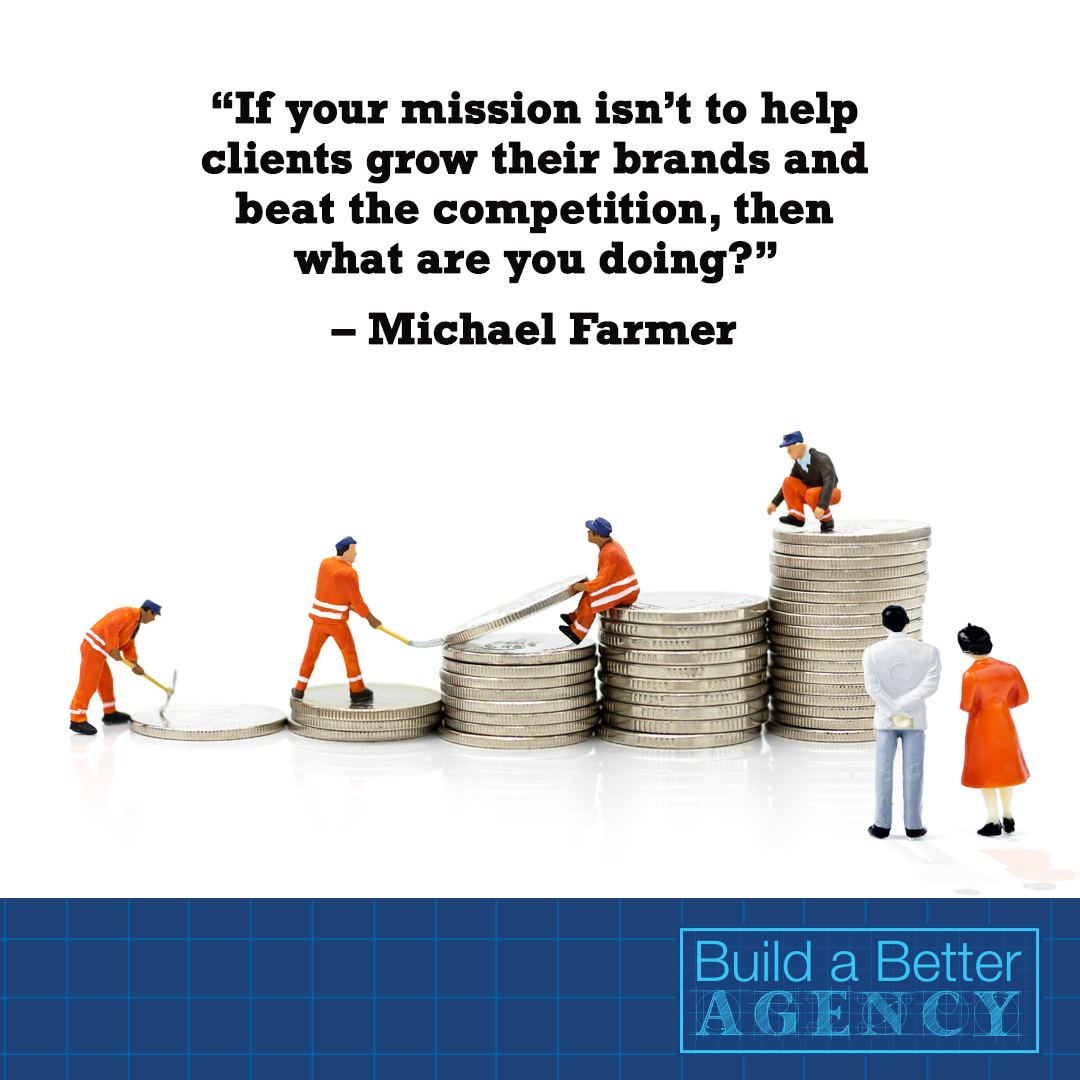
“If your mission isn’t to help clients grow their brands and beat the competition, then what are you doing?” - Michael Farmer Share on X
“I think the only people that really expect marketing to deliver value and growth are the CEOs and the CFOs.” - Michael Farmer Share on X
“Agencies are doing too much work for too little money, and they respond by liquidating their talent. That’s the wrong way to run a talent business.” - Michael Farmer Share on X
“Agencies oversell the notion of creativity. Clients don’t need another agency that makes ‘stuff’—they need one that helps brands grow.” - Michael Farmer Share on X
“AI will take out the work of the junior people. What’s left is strategy—and that’s where independents can win.” - Michael Farmer Share on X
Ways to contact Michael:
- Website: https://www.farmerandco.com/
- LinkedIn (Personal): https://www.linkedin.com/in/michaelfarmer/
- LinkedIn (Business): https://www.linkedin.com/company/farmer-&-company/
Resources:
- Michael’s Book: Madison Avenue Manslaughter
- BaBA Summit May 18-20, 2026: BaBA Summit May 18-20, 2026: https://agencymanagementinstitute.com/babasummit/
- Drew’s Book: Sell With Authority
- AMI Facebook Group: https://www.facebook.com/agencymanagementinstitute
- AMI Preferred Partners: https://agencymanagementinstitute.com/ami-preferred-partners/
- Agency Edge Research Series: https://agencymanagementinstitute.com/agency-tools/agency-edge-research-series/
- Upcoming workshops: https://agencymanagementinstitute.com/advertising-agency-training/workshop-calendar/
- Weekly Newsletter: https://agencymanagementinstitute.com/newsletter-sign-up-form/
- Agency Coaching and Consulting: https://agencymanagementinstitute.com/advertising-agency-consulting/agency-coaching-consulting/
Drew McLellan [00:00:37]:
Hey everybody. Welcome to another episode of Build a Better Agency. Super excited for this conversation. Our guest is someone who I always love talking to. I, I learn when I have a conversation with him, he has just amazing insights and, and so I’m always grateful when he’s willing to come back on the show. But before I tell you about Kim, let me just remind you that every month Danielle and I host a Q and a. It’s live, we’re there, we answer any questions you may have. And the best way for you to find out about when the Q and A is because it moves around every month, different times a day, different days of the month is one of two ways. So you can either go into the Facebook group, the Build a Better Agency Facebook group, and we always announce it there, or you can subscribe to our weekly newsletter. Our weekly newsletter is well read and well respected because we’re not trying to sell you anything. We’re just trying to be informative. We’re just, just like the podcast, we’re just trying to teach. So the way to sign up for that is go to agencymanagementinstitute.com/newsletter-sign-up-form sorry, painful again. Agencymanagementinstitute.com newsletter-sign-up-form so sign up. You’ll get a newsletter every Wednesday and we tell you about the Q&As there. So happy to have you come join us. We answer questions about everything and anything. It might be about employees, it might be about new business operations, pricing, you name it. We field those questions and we love having those conversations with you. So please, please join us every month for the live Q and A. So without further ado, speaking of sitting around talking about the business, I love it when Michael Farmer comes on the podcast. So Michael is a consultant who primarily works with the big holding company agencies, but now more and more is working with smaller independent agencies like yours and mine. And Michael comes out of a like a McKenzie Bain world and he helps agencies specifically around the idea of how to be more profitable by being better about the scope of work that they build out and the way they price against that scope of work. So we’re going to talk about what’s happening in the agency space right now and where he thinks we need to be looking and moving our agencies to be competitive in the future. So I know he’s going to have a lot to say, uh, be ready to take plenty of notes. And this is gonna be a podcast where you really wanna sort of lean in, listen, because there’s gonna be a lot to think about and learn. So without further ado, let’s welcome Michael to the show. Michael, welcome back to the podcast. Glad to have you back.
Michael Farmer [00:03:28]:
Thank you, Drew. It’s a delight to be here with you.
Drew McLellan [00:03:31]:
So, you know, you have spent a lot of time in the agency space. For anybody who’s not familiar with your work or your books, give everybody kind of a Michael Farmer 101 on how you have come to have this sort of overview of our industry.
Michael Farmer [00:03:48]:
Fair enough. And it goes back away. It goes back a little bit. Over 30 years, I had been the head of Bain and Company in Europe. I ran a couple of offices. And in 1990, I decided to start my own firm in London. And one of the first potential clients who called me out of the blue was Ogilvy uk. Mike Walsh was running it at the time. And he said, you know, I think we, we need help from a strategy consultant because we got bought by WPP a few years ago and we’re already not making our numbers. I think at the time he was obliged to make a 10% margin. And he said, you know, I’ve done everything I can, but there’s something funny going on with our business.
Drew McLellan [00:04:36]:
Yeah.
Michael Farmer [00:04:37]:
And so I took on that, that challenge. And, you know, as a business consultant, I’m not about creativity or any of that other stuff. I wanted to know how they ran as a company. And there were three things I needed. I needed to know how much work and of what type they did for each client, how much they got paid for that, and what it took in the way of resources for client service, strategic planning, creative and production. I found then that they didn’t have or didn’t keep records of what they were actually doing.
Drew McLellan [00:05:12]:
Interesting.
Michael Farmer [00:05:13]:
And so instead of just jumping in and doing the analysis as I had hoped, we had to spend seven weeks reconstructing their scopes of work for that year. It was, what, 1992. And then developing a model that would help us to understand why they needed 52 creatives, 75 account people, a certain number of strategic planners, and a certain number of production people. So we work pretty Heavily with the creatives, understanding the resourcing of scopes of work. And of course, we learned they assign multiple teams, their levels of rework. Some briefs are more complicated than others. But we went through that whole drill, and by the end of the day, we figured out what was going on, which was they weren’t making money because the executive creative directors were putting three, four, and five teams on every single brief as a way of trying to create competition and get the quality up. This was unknown to the managing director, and he thought it was an excessive use, given his challenges, an excessive use of resources. And so he put in. Mike, put in what he called the farmer rule, which was every brief would get one creative team, would do a standard amount of rework, and only in exceptional cases would they start to use multiple creative teams. And of course, that changed the staffing of the agency on each client very, very significantly, allowed him to do some downsizing so that he started to make his margins. And I then drew. I realized that after doing some work around the Ogilvy network and then later with Gray, that it didn’t look like anybody kept track of scopes of work. And so, you know, it. It became my specialty to go into agency offices or work with clients, reconstruct their scopes, model them, and show them what was generally wrong. And if I were to summarize 30 years of experience, it’s that they’re doing too much work for too little money. And they respond to the too little money by liquidating their talent. In other words, by downsizing. And it just struck me that that was the wrong way to run a talent business, that what they needed to do was to shift the way they were being paid to getting paid for the work they did. In other words, when they got a client, a creative scope of work from a client, use my methodology to figure out how much work that was, how many people it would take, and price the deliver on that basis. You know, I’ve been singing that song for 30 years, and it’s gotten a lot more sophisticated. The model has grown and grown. We now have over 3,000 different types of deliverables on our database that provide a. A workload value. And, you know, we’ve done it with the help of Toyota and Saatchi, Ogilvy, bbdo, Kraft, American Express, a lot of people. It’s a valid database, but for some reason, that still escapes me. It’s very difficult to get a managing director of an agency to want to charge for the work they do rather than agree to some estimate of man Hours for an unknown quantity of work. So, you know, I’ve been. I wrote a book about it. I wrote Madison avenue manslaughter in 2015 with two more editions in 17 and 19. I’m now writing a book about media because media agencies have kind of the same problem.
Drew McLellan [00:08:56]:
Right.
Michael Farmer [00:08:56]:
You know, their fees have been going down and. And the complexity of what they do has been going up. So they find other ways of making money than trying to make money on the base business. I just think it’s wrong, and I think it’s certainly wrong for the holding companies and the agencies to downsize in response to a poor way of being paid, you know, being paid inadequately.
Drew McLellan [00:09:19]:
And do you think as you’re talking I’m sort of smiling? Because this does not seem like rocket science, like, keeping track of how you do work and how much time it takes you to do the work and what your costs are to do the work should kind of be the basics.
Michael Farmer [00:09:37]:
Well, I think part of it is that, what am I doing, Drew? I’m counting deliverables. I’m counting TV ads, you know, Facebook posts, search, email marketing. I’m counting those things up. By the way, the numbers are staggering.
Drew McLellan [00:09:57]:
Yeah.
Michael Farmer [00:09:57]:
You know, Ogilvy UK, back in the day, 1992, I remember they did 360 briefs for 50, created 50 odd creatives. So they were doing about, you know, seven per year each creative. I did an Ogilvy office a couple years ago that had 50 creatives, big office. They were doing 15,000 little pieces of work, doing 300 per head. And I think part of the problem is that agencies believe that they’re not doing deliverables, they’re doing big ideas, or they’re creating brand equity, or they’re delivering creativity and you can’t measure it. And they completely ignore the fact that they’re actually factories delivering highly sophisticated products that have a purpose.
Drew McLellan [00:10:45]:
Right.
Michael Farmer [00:10:46]:
Listen, to make it worse, once their clients started shifting to digital and social after 2005 or so, usually about 2009, their growth rate stopped. So that if you look at the sales growth of major advertisers, once things. Once the scopes of work significantly expanded and everyone was doing digital and social scopes to work, the growth rate of the products stopped. So not only are they doing too much work for too little money and responding by firing people to make their margins, they’re also doing too much work that isn’t delivering value. And the brands aren’t growing. P and G has only grown at a half a percent per year since 2009 the same is true of Nestle and Colgate and Unilever. So it can’t even be argued that they’re sacrificing themselves for the benefit of their clients. They’re actually doing a ton of work that doesn’t deliver value. And I think that shame on the clients and shame on the agencies for not spending more time thinking about what work in the digital era is actually needed to get the brands moving again.
Drew McLellan [00:12:00]:
Yeah. What’s meaningful to do and what’s the appropriate price, do you think? When you sort of look at how, I mean, we’ve talked a little bit about how it’s broken, but when you think about why it’s broken, is it, is it that brands don’t actually appreciate the value of what agencies do is that we don’t articulate the value appropriately. Like, where’s the disconnect? Because the reality is there is clearly a disconnect if agencies can’t make more than 10%, which I would argue is anemic, maybe at the holding company level, but at a smaller. In the AMI world, we shoot for a minimum of 20% profit. So if you can’t be profitable and you’re basically just treading water to swap payroll and even for the agency owner, it’s a job rather than a wealth building machine. Where’s the disconnect? Where’s the value disconnect, do you think?
Michael Farmer [00:13:01]:
Well, here’s, here’s the crazy thing I think, I don’t think either clients or the agencies use as a standard of the agency mission we are in business to help clients grow their brand and be more competitive and kill the competition.
Drew McLellan [00:13:18]:
Right.
Michael Farmer [00:13:19]:
That isn’t part of any scope of work I’ve seen. It isn’t the answer that I get when I talk to senior client executives that are running big accounts. You know, often after I’ve gathered the scope of work and started the modeling, I’ll say, why is this a scope? What is it trying to accomplish? Thinking that maybe they can say, well, we’ve uncovered a segmentation problem and if we can close this gap, the brands can get growing again. They don’t say anything like that. It’s more like, well, this is what the client wants to do and the clients are not holding the agency to brand growth. The agencies are not holding them up to that level. They think they’re delivering something else. We’re providing creative solutions or something along those lines at low cost. And I think the only people that really expect marketing to deliver value and growth are the CEOs and the CFOs. Certainly the CMOs are getting sacked every four years or so because they’re not delivering growth. All the industry surveys show its failure to deliver. But then when you get into the ecosystem between the CMO and the agency, somehow that isn’t the goal. And I think that if it were, then agencies would spend more time figuring out, well, why did the brand stop growing about 2009? What changed? Is it private label competition? Is it E commerce? Is it a change in consumer behavior from Gen Z? What is it? I don’t see agencies trying to figure that out, at least not in the same way that consulting firms would try to figure it out if they were given that task. I spent 20 years with Boston Consulting Group and Bain and you know, I’ll tell you, in the first three months of any engagement, we were always trying to figure out what was getting in the way of improved performance. That was, you know, goal number one. Because you couldn’t put together a work plan unless you knew what kind of a problem you were trying to fix.
Drew McLellan [00:15:29]:
Right.
Michael Farmer [00:15:30]:
Somehow in the agency world that discipline does not exist. And I think it goes back to the early days, you know, like the 1960s and 70s and 80s when the economy was growing, there was a strong tailwind for brand growth and there were very few media types and agencies were, you know, absolutely dedicated to doing great creative work. All of that seemed to work. So if we were creative, the brand seemed to grow. That may not have been because the advertising was creative. It might just have been because there were strong tailwinds.
Drew McLellan [00:16:08]:
Well, and you bought enough media and there wasn’t as much competition.
Michael Farmer [00:16:14]:
Yeah, if you had enough media and there were few choices and you had great creative work, everybody was happy. But then things shifted to fees. Then there was, you know, change in economic growth. Around 1990, things slowed down considerably. Then you had digital and social come in around, you know, between 2004 and 2009 and everybody was still thinking, if we’re creative, you know, will still get success. And it just hasn’t worked out. So I really think that leadership needs to step back from that and say, wait a minute, what are we doing in these relationships and how do we have to organize ourselves to be successful?
Drew McLellan [00:16:55]:
I think that’s one of the big shifts from the holding company to the listeners of this show, which are privately held, closely held, you know, 30, 50, 100 person agencies. I think it’s different. So I believe, and I’m curious what you think. I believe this is the era of the small to mid sized agency who already does understand that their job is to help their clients grow.
Michael Farmer [00:17:20]:
I totally agree with you on this.
Drew McLellan [00:17:22]:
And because they are not media driven, media commission driven agencies, they are more like a consulting firm in terms of being more strategic and understanding that their job and the KPI that matters most is some mix of customer retention, customer growth, new customer growth, margin growth, all the, all the business things that you did back in your consulting days. I think smaller agencies have to play at that field. So I think they’re actually ahead of the holding companies in terms of actually measuring what matters.
Michael Farmer [00:17:59]:
Absolutely. I think like you, I think this coming decade, I think the holding companies are going to fall out of bed. I mean, right now I think they’re struggling to survive. They’re not growing, they’re not delivering the profits that Wall street wants. The CFOs are having to do all kinds of financial re engineering things to make the stock price attractive. Procurement’s having to do the same thing. And I think they’re so locked into that that it creates a fabulous opportunity for independent agencies that like you say, and I have had the same experience in working with them, they’re much more committed to making their clients successful. They know that that’s how they’re going to pry open the door. And it’s not about being low cost, it’s about being most effective. And I think the smaller privately owned agencies are in a much better position to do that. Plus they’re more senior, the people running the accounts are more senior than the holding companies who have just a bunch of kids cranking out banner ads. Now every time WPP merges an agency or they take senior costs out and they’re just left.
Drew McLellan [00:19:10]:
I was gonna say they lay off all the senior people and the 22 year olds are running the accounts.
Michael Farmer [00:19:16]:
That’s the game, Drew. When you think about it, when AI really flexes its muscle for the holding company agencies, it’s gonna take out the work of the junior people and then what’s left.
Drew McLellan [00:19:26]:
Right, right.
Michael Farmer [00:19:27]:
So now listen, my heart is with the independents because I think this is a fabulous competitive opportunity for them.
Drew McLellan [00:19:35]:
Yeah, I think so too. So I’m curious, based on your work and you know, you have worked with large, the largest of the large holding companies and independent agencies as well. What are the warnings or the lessons that the people listening to this show need to take from the mistakes that you’ve seen the holding companies make? What are the two or three? Like these are the chasms you cannot cross or these are the red flags you’ve got to Watch for if you want to be a profitable independent agency today, be of value to your clients. What have the holding companies over the course of your career done wrong? What should we be avoiding?
Michael Farmer [00:20:15]:
Well, I think first of all, I think that a professionally run agency needs to be engaged in a much more vigorous debate about what’s in the scope of work.
Drew McLellan [00:20:27]:
Talk a little more about that.
Michael Farmer [00:20:28]:
I think scopes of work are way too oriented towards programmatic and the belief that targeted advertising has to be better than the kind of mass advertising that people call traditional advertising. But there’s, there’s scant evidence that it’s anything other than bottom of the funnel promotional stuff that isn’t building brands. And so I think agencies need to engage in a debate with clients about what’s in the scope of work, saying what do we need to accomplish? What are the brand problems that we need to solve, what’s the nature of them? And what kind of a media scope of work, you know, media spend and media mix or what kind of a creative scope of work has the highest probability of doing that? That dialogue does not go on right now, for the most part. Again, it’s a dialogue that independent agencies can do better because they’ve probably got a smaller piece of the action. They can really create the dialogue. The second thing is I think that they need some understanding about whether they can afford to do all the work that the client wants to do for the fees that the client’s prepared to pay instead of saying, oh yeah, sure, we can handle that.
Drew McLellan [00:21:45]:
You know, that always fascinates me. Clients have a budget and then they have a list of deliverables or goals and there’s no correlation between the two. Right? It’s like, I have a million dollars, I have a half a million dollars, I have a quarter of a million dollars, I have $10 million, doesn’t matter. And then here’s the list of things. But so often I think what agencies do is they take the list, they look at the thing and they’re like, well, I don’t know that we can do all of that for that. But I want the money, I want the win. Gotta, I gotta make payroll, gotta keep a roof over all the employees, heads, etc. Etc. Etc. So I’m going to compromise and I’m going to get my foot in the door by taking this contract. Then I’m going to figure out how to make it profitable as opposed to saying, I totally get that you want a house, a car, a plane and a vacation, but you can’t have all of that for $100.
Michael Farmer [00:22:38]:
Right, exactly.
Drew McLellan [00:22:40]:
So either we can build out a multi year budget that will get you the house, the car, the plane and the vacation, or we have to increase the budget because they don’t correlate.
Michael Farmer [00:22:52]:
Yeah, well, see, the missing link is what I’ve had to spend my career developing, which is how big is the scope of work?
Drew McLellan [00:23:02]:
Right.
Michael Farmer [00:23:02]:
How big are the deliverables? What is the scope of work made up of? What is the composition of the deliverables by media type? Whether they’re adaptations or originations, what their creative complexity is, you have to go through and you have to know what is in the scope of work. And then you have to have some way of costing it out that’s rigorous. Instead of sticking your finger to the wind and saying, yeah, I think we can do that. I teach a course to graduate students in marketing at City College, and I give him an exercise every year. I take an actual scope of work that came from, oh long 10 years ago, okay. Came from Radio Shack after its first bankruptcy, and it was reviving itself and it was putting out an RFP for a new agency. And it was one of the few documents that actually laid out what they wanted. It was a 22 page Word document that in the pros sort of laid out what they wanted. And I asked my students one at a time, they have to take it away for a week and figure out how big it is and what the fee should be. And I give them my model so that they can actually even model it. Well, they always come up with a range of 20 million to 70 million. And I remember when my own people looked at it, they said, this is a $20 million scope of work. Yeah, well, when I took it to the agency that I was then working with, they said, oh, that’s interesting, because we heard Radio Shack fired its last agency and was paying them 9.
Drew McLellan [00:24:41]:
Right.
Michael Farmer [00:24:43]:
You know, and it was a $20 million scope of work. This thing goes on all the time, Drew. And I just, I don’t understand it because. Well, I do understand why the holding company agencies won’t do anything now. Because they’re afraid to rattle, they’re afraid to push back on anything. They just want to say, yes or no, sir. Three bags full. We can do anything because we need the revenue.
Drew McLellan [00:25:05]:
Yeah, right.
Michael Farmer [00:25:06]:
But the independent agency, I think, can actually be much more vigorous and say, you know, first of all, we don’t think this is the right scope of work to deliver the brand. And we think we can come up with a better one. You know, I’VE worked with a number of independent agencies that have taken this tackle. I do my analysis, I show them how big the scopes are and how it’s too big. And I had one CEO say, I know what I’m going to do. I’m going to go back to each of my clients and say, you know, for the first time, I am now aware of what we’re actually doing for you, deliverable by deliverable. And I’m embarrassed to say that I think that we could be doing a better scope of work. Would you let me take a crack out of it? No change in feet. I’ll come up with a better scope of work that I think will deliver more brand value. And they come up with it. It’s less work. It’s better work. It makes money. He doubled his profits in one year just by going back to his clients. And he said, 75% of my clients agreed to that. And we went forward and we delivered much better work. Less work, same fees, we doubled our margin.
Drew McLellan [00:26:19]:
Well. And better results. Getting back to the conversation of, well, of course we have to stop selling deliverables by the dollar and we have to actually care about the KPIs. And one of the things that we preach all the time at AMI is it’s your job to help your client not get fired by helping them hit the KPIs that the C suite actually cares about so they can have their job for more than two or three years before the next CMO gets cycled in.
Michael Farmer [00:26:46]:
I think it would be pushing on an open door to go to a CMO and say, look, you know, we are in business to help you succeed, to help you grow these brands again. Yeah, we think the secret to doing that is taking a very hard look at why the brands themselves have changed in their growth trajectory, understand the reasons for it, and then come up with more tailored scopes of work that address that problem rather than drinking the Kool Aid. The targeted advertising just has to be better than traditional.
Drew McLellan [00:27:17]:
Yeah. Yeah.
Michael Farmer [00:27:18]:
So I think that any agency that approaches a client with that kind of a dialogue is going to be pushing on an open door and will be highly competitive with holding company agencies, who I think will never do that. Not now.
Drew McLellan [00:27:34]:
Let’s take a quick break. And when we come back, what I want to talk about is how do we as agencies help our clients have a better sense of the value of what we do? So, because again, whether it’s procurement or a client or whatever, back to the conversation of client has a dollar but wants $20 worth of work. And if we don’t take it for a dollar, here’s what every agency owner will say to me is if I don’t take it for the dollar, another agency will. So let’s take a quick break and let’s come back and talk about how we better translate the value we provide so we don’t have to be the Walmart of agencies. We’ll be right back. Are you tired of juggling multiple tools to manage your agency? Meet Deltec Workbook the all in one solution for marketing and communications agencies. Streamline your projects, resources and finances all in one place. With real time dashboards and reporting, you’ll have full project visibility. You can plan team capacity weeks ahead to avoid bottlenecks and keep your budgets on track to maximize profitability. It’s perfect for both agencies and in house marketing teams looking to work more efficiently. PCI is a certified Deltec partner offering expert implementation and support to ensure your success. If you’re ready to transform your operations, visit PCI US Podcast for a free consultation today. Hey everybody, Just want to remind you before we get back to the show that we have a very engaged Facebook group. It’s a private group just for podcast listeners and agency owners that are in the AMI community and to find it, if you’re not a member, head over to facebook.comgroupsbabaPodcast. so again, facebook.comgroupsbab podcast. All you have to do is answer a few questions to make sure that you are an actual agency owner or leader and we will let you right in and you can join over 1700 other agency owners and leaders. And I’m telling you, there’s probably 10 or 15 conversations that are started every day that are going to be of value to you. So come join us. All right, we are back with Michael Farmer and we’re talking about agencies and the struggles from Michael’s perspective, both at the holding company size but also at our size. We all talk about this all the time that it is. It’s our job to make sure that the clients understand the value we provide and part of that is us understanding how the client gets evaluated. The KPIs that are being talked about in a boardroom or at the C suite level and tying our work to those KPIs. So Michael, right before the break I said, you know what? What I hear all the time is agencies will bemoan the fact that that a client’s budget and the deliverables they want don’t line up, but they feel like if they don’t Take the deal, if you will, that there is another agency out there that absolutely will do it for that dollar amount. And, you know, everybody is under a lot of pressure to win new business and to keep the doors open and to keep everybody paid. And employees are more expensive than they used to be. Yada, yada, yada, yada, yada. So from your perspective, how do agencies better communicate the value they deliver so that they don’t have to nickel and dime with a client over every single thing they do?
Michael Farmer [00:30:58]:
I think it comes back to the way an agency thinks about what its business is and how it adds value. It’s not like all agencies are the same. All agencies are creative. Creative adds value, and it’s not appreciated. That’s. That’s not what this situation is. I think the agency that declares that its mission is to help clients grow its legacy brands in a complicated marketplace, any agency that takes that on says that’s our mission, is in a position to have a different dialogue with its clients now, because they can say, if you are looking for an agency that will do everything that you want to have them do for the lowest price possible, that isn’t us. That is not how we work with clients. Those are not the kind of clients we seek. We don’t think those kinds of relationships add value. What is it that we do? We are focused on your success. We think we are good at understanding how to solve brand growth problems through an improved design and execution of fill in the blank media scopes of work or creative scopes of work. That’s what we’re good at. And in that respect, we stand outside the rest of the industry because that is not the basic positioning of most other ad agencies. So I think that rather than go too far down the road of competing and communicating like all the other agencies, you have to start with a completely different proposition, a different business model. You know, we are in the business of helping clients grow brands. We understand brand problems, we understand what types of scopes of work will do the best job, and we expect to be paid for the work we do. Not a guess at the man hours.
Drew McLellan [00:33:03]:
Right?
Michael Farmer [00:33:04]:
And that’s a completely different business model. Now, I’ll say this, Drew that. You know, I was lucky enough to be with Bain in the very early days when we went through this identical situation. Bill Bain always said, I don’t want to be another consulting firm. This is back in the 80s, so, I mean, we’re talking 40 years ago. I don’t want to be another consultant that responds to RFPs from businesses that have budgets. And then, you know, you go through that whole drill. He said, I want to be in the business of making CEOs successful. And so in order to do that, he told us from here on in, and when I say the US, there were 10 of us that were allowed to go out and develop new clients. And he said, we are not going to take on any work with anybody under any circumstances unless we’ve had a three hour private meeting with the chief executive. Wow. Yeah. Can you believe it? And we said, you got to be kidding. First of all, CEOs don’t call up consulting firms. And the person that you’re usually talking to is someone who manages consulting relationships, often is the person with a budget. And we would have to say, gee, we’d really love to work with you, but we have to have a three hour meeting with your boss and you can’t be there. Believe it or not, Drew, for as many times as we got turned down, when you got one of those, it was unbelievable.
Drew McLellan [00:34:37]:
Does take some chutzpah though, right?
Michael Farmer [00:34:39]:
Oh, it took, it takes chutzpah. But listen, do you want to be in a commodity business or do you want to have chutzpah? And listen, the thing is, the CMOs today are in a comparable position that the CEOs were in back in the 80s when they were acquiring companies like crazy and didn’t know how to make money in all their businesses.
Drew McLellan [00:35:00]:
Right.
Michael Farmer [00:35:01]:
Well, okay, what have we got now? We’ve got CMOs that are advertising in I don’t know how many different channels, 20 to 30 different channels in different ways, in different amounts. And then tying the creative, you know, or creating the creative that’s going to fill those channels, and they don’t know what works. In fact, the truth is, they don’t even know what’s in their scopes of work. Anytime I work with an advertiser and I tell them I need to gather the scopes of work, they’ll say, oh yeah, you better go to the agency. I mean, you know, they’ve got a better handle on that than we do. Well, that’s because the clients dribble out their scopes of work every quarter or every month. There isn’t a thing that says, here’s what we’re going to do, even in decide where they don’t have it, or in Excel, you know, it’s, it’s random. And then they think the agencies have it and the agencies don’t either. So if you don’t know what’s in the work, you know, how can you evaluate how good it’s going to be? An agency says, we are in the business of helping clients grow. That’s how we want to be evaluated. It takes a long term relationship to do it. It takes an understanding of the brand problems. It takes better scopes of work that are negotiated between the two of us. And to keep it fair, we want to be paid for the work we do. And we’ve got a system for that. And that’s how we work. But if you’re looking for, you know, an agency to come and go in three years at the lowest price possible, cut every, every year by procurement, that’s not who we are. And there are plenty of other people that’ll do that work. That’s what I would do if I were running an agency today based on my experience. And I think it’ll work well.
Drew McLellan [00:36:45]:
And I think the other part of that is as the deliverables get more commoditized, whether it’s with freelancers or AI or whoever it is that can bang out to your point, when a lot of the deliverables don’t move the needle anyway, they don’t have to be brilliant, they just have to be done. So if somebody can commoditize that work, all the more reason why we have to stand for something more than we can make more stuff than the other people for the same dollar amount, because otherwise we’re going to be compromised right out of business.
Michael Farmer [00:37:19]:
Yeah, well, look at the IAB has developed standards for what is a viewable ad, right? A certain number of pixels, certain place in the page, certain duration. That’s total commoditization of a measure, Right? So they’re not asking, is it creative? Is it not creative?
Drew McLellan [00:37:39]:
Yeah. Did anybody click on it? Did anybody buy it?
Michael Farmer [00:37:42]:
Anybody clicks on it, you get paid.
Drew McLellan [00:37:43]:
Right?
Michael Farmer [00:37:44]:
So in a scope of work, like say a scope scopes of work at a 50 creative agency, that adds up to 15,000 deliverables. Believe me, those are commodities deliverables too. They can have a commodity weight, a value that can be used to price it out. I think agencies really oversell the notion of creativity. You know, I mean, you don’t hear consulting firms say we’re analytical, right? That’s why we’re successful. We’re really analytical. You should see what we can do with a spreadsheet or Excel graphs or historical data. They don’t say that. They say we develop work plans that add value. Why does an agency say we help develop scopes of work that help brands grow? That’s what CMOs need, right? And so it is hotspot, but there’s nobody doing it. So maybe it’s actually the golden egg. Who knows? I think it’s worth a try.
Drew McLellan [00:38:44]:
We do have agencies in our space that very much have that attitude that, look, we’re in this for the long haul. You have serious business problems, we can help you with those serious business problems, but we’re not going to solve them overnight. And it has to start with an understanding of those problems and a strategy to solve those problems. And so the first piece of work is, you know, we, we in our world, and I’m sure you have heard this a million times, but in our world, we talk about, like, look, it’s like building a house. You got to have the blueprint first. You have to have the architect. Then once we know what we’re building, then we know what materials to buy and what materials to make. And so I think for a lot of agencies, they’ve gone right to the list of materials. We’re just going to go to the lumberyard, going to buy the nails and the wood and the things. And I think the agencies that are really doing well today are the ones that are like, look, we got to have the blueprint first. We have to. We have to mutually agree on what we’re building. And is it a two story with a pool? Is it, you know, a ranch with a whatever? Once we know what we’re trying to solve for, then we can figure out what are the marketing tools that will help us accomplish that. And I think that’s, at the end of the day, what matters.
Michael Farmer [00:39:51]:
Drew, I think you’re right, and I suspect that you have more experience seeing that with your clients than I have historically seen. You know, I’ve sort of busted my pick trying to get the holding companies and holding company agencies to do the right thing, because that’s where I started, you know, I mean, started with Ogilvy, then went to Gray and, and later to Publicis and Omnicon agencies. I’ve worked with all of them and spent less time with the independents. So you probably see more of those successful interactions and relationships than I’ve seen. But what I’m aware of now is that the holding companies and their agencies have dug such a hole for themselves. They so liquidated their talent, they’re so terrified of change right now because they’re afraid it will disrupt their ability to make their numbers, which is the only thing they’re held to, let’s face it. So I really think that there is a huge competitive opportunity for your clients and for others. And you know, I’ve worked with Worldwide partners and with Magnet and Tribal and all those other quasi holding company type organizations of the independent agencies and they really get this pitch. They really do understand it.
Drew McLellan [00:41:11]:
So if you are running a 50 person agency, not 50 person creative department, but a 50 person agency today, would you always start with the, if you will, the blueprint strategy and then how would you decide? Because you made a really interesting point. I think one of the challenges for agencies in the, in our world is different than the holding companies. If you’re a 30 person agency, you can’t possibly be good at all the things clients need today. Can’t possibly do it. It’s just too complicated. So how would you evaluate the ability? Like how would you decide? Here’s, here’s the laundry list of things we’re going to do in house. And then how would you solve for the things that you can’t do in house?
Michael Farmer [00:41:55]:
Well, well, I have a very close friend, Rhodes Ponser, who was a co teacher of mine at City College who is just joined a crowdsourcing investment firm for real estate investments and he’s as a chief marketing officer and he’s faced the question of, you know, how do I get create a brand out there, who do I go to? Yeah, he has extensively now Rhodes, I should say He’s Exachi, ex DBWA, you know, with about 20 years of duration. He knows a lot of people. But he has gone out to the very extensive network of senior freelancers out there and he’s found the individuals that he needs for television, for video, for search, for email marketing. These are a handful of people, these are senior people that get their hands dirty who get the work done in 1/10 the time at a fraction of the cost. Yeah, and we know how many are out there. They can be reached many, many different ways. But because the holding companies have, have done so much downsizing over the last 20 or 30 years, there’s a huge talent pool out there of people that have done, been there and done it. They know what is wrong with the old model. Yeah, they know how to get it done fast. They have almost no overhead so that they can get the work done fast and they spend their time listening. So if I had a 30 man agency and I had a limited capability, I would develop an understanding of who is out there on a freelance who. Senior people are out there on a freelance basis that get their hands dirty, will do the work themselves and will work with us to expand our capability. And I think that is absolutely the right way to go.
Drew McLellan [00:43:51]:
Yeah. Well, the good news is for the listeners that that has been the evolution. So you know, smaller agencies today are almost always a mix of full time people, part time people today, international talent, global talent and a bunch of of great freelancers who have areas of specialty that we don’t do enough of that work to have somebody on staff full time. But we know we have to be able to solve that problem for a client. So I, like you, feel like this is the independent agencies moment. Like this is, this is their time to just take bigger brands to better places because they’re not bloated in a system that was built in the Mad Men days and has not evolved.
Michael Farmer [00:44:38]:
Listen, even to the extent to which an independent agency needs someone who has a strategy consulting background.
Drew McLellan [00:44:45]:
Right.
Michael Farmer [00:44:46]:
There is an association of freelance consultants that are ex all ex McKinsey, Bain, BCG, Carney, PwC, Accenture, Deloitte called Umbrex. And you know, these are people with everything from 5 to 15 years experience that didn’t want to stick it out with a big firm. So I think there’s almost nothing you can’t get in terms of talent in the gig economy. You just have to poke around and I even think that querying AI to say where can I find like a bane level strategy consultant to help me on this brand issue or on this pricing issue that one of my clients has. Yeah, you could put it in and you would get, you would get the answer that you need. So we don’t need everything in house. We shouldn’t have everything in house. We should be trying to keep overhead as low as possible and to devote the client monies that we get to paying the talent for problem solving instead of paying for overhead. Again, an independent agency that is willing to go outside for freelance talent across any possible discipline is going to knock the pants off of a downsized holding company agency. In terms of capability, I think you’re right.
Drew McLellan [00:46:07]:
All right, last question. Look in your crystal ball 10 years from now, so 2035, what do agencies look like? Will the holding companies exist, do you think? And if so, how will they be competitive to our size agencies or will we have run them into the ground and will we be at the top of the mountain? What do you think is going to happen in the next decade?
Michael Farmer [00:46:32]:
I am not optimistic about the prospects for holding companies because they’re failing financially.
Drew McLellan [00:46:39]:
Yeah.
Michael Farmer [00:46:40]:
And they’re locked into the ways that they do business. They can’t change because they’re afraid that they will stop making numbers the way they know how to make numbers. Yeah, but I think it’s, listen, it’s inevitable that Wall street or the city in London is going to say, you know something, I think the parts are worth more than the whole and that shareholders need to realize value from the holding company. So I think, I think there’s a very high probability that they will be starting to sell their pieces off to private equity firms which will are more likely to do the right things with those organizations. Now on the other hand, I see AI coming in with its fabulous capabilities, capable of not only doing media planning and media buying, but also of doing certain types of creative executions. Yeah, but I don’t think they’re ever going to be much better at developing the strategic understanding or doing the strategic problem solving. So I think the sort of bottom, the low end employees from the agencies are going to be replaced by AI by the way, that will take out man hours and revenue. They better do something about that now.
Drew McLellan [00:47:58]:
Right.
Michael Farmer [00:47:58]:
Because otherwise their revenue is going to disappear. But I think it’s going to be, you know, it’s going to become more consulting type marketplace. If anything, the consulting firms are better poised to take advantage of that situation if they can deploy AI to do media and creativity, make the stuff they’ve never had the capability or understanding. And if the AI platforms to allow it, then small, medium size and large consulting firms have the, let’s say, analytical discipline to take over the top end of that. Agencies have liquidated that or the holding company agencies have liquidated that level. So it’s going to be hard for them to get back in the game. But I think that freelance senior people or consulting firms are in a good position to provide the strategic knowledge that will be required to serve clients. Because I think clients are going to have a harder time doing what they’re doing. If anything, I think the big brands that we’re familiar with face so much private label competition right now with very large price gaps. I’ve been looking into that recently for my book. I mean we’re talking 30, 30 and 40% price gaps so that, you know, the legacy brands are now all premium price brands in the supermarkets or at retail, but they’re not doing any of the advertising that justifies the price premium. So they’re going to get clobbered.
Drew McLellan [00:49:32]:
Yeah.
Michael Farmer [00:49:33]:
And even brands I think at the advertisers are under threat, the big brands because it’s going to be hard for them to justify why they exist.
Drew McLellan [00:49:43]:
So my takeaway from that is we, meaning the independent privately held agencies have Been positioning ourselves more on the strategy side than the deliverable side for a while at least. The smart ones have, the profitable ones have. So we have a decade to anchor ourselves into that position before the holding companies get piecemealed. And now the venture capital agents, agencies are now stepping down space. So we have a decade to own that mountain and be the one. We would be the one who is the market leader that those new sort of micro agencies that are created by the implosion of the holding companies would have to chase after. So the trick for us is to do it now. To do it before they do it. Yeah, to do it right now. To be the strategic agency. Back to something you said before to say, okay, look, that’s not the kind of agency we are. We believe that if we’re not strategy first for not solving your business problems, then we’re not worth a dime. So that’s the way we work is we want to, we want to create a long term relationship with you, which means we have to solve your business problems, which means we’re not going to give you a dollar a price sheet for a bunch of deliverables. We’re going to talk about the business problems we need to solve and how we’re going to solve them together. We can do that now. We’re, we are poised to do that now. And so that’s the competitive advantage, whether it’s against holding companies, AI freelancers, or a mix of all of those things that we can own today. That’s my takeaway from what you and.
Michael Farmer [00:51:12]:
I think from a pricing standpoint. Drew, when you think about it, if you have proposed to a client, we’re going to help you solve this problem. And this is the kind of team that I’m going to put in place for it. And this is what we’re going to charge. And that’s exactly what consultants do.
Drew McLellan [00:51:32]:
Right.
Michael Farmer [00:51:32]:
It doesn’t get down to what’s the man hour? What’s your overhead rate, what’s your profit margin? This is the price of our solving that service. Bear in mind the consultants charge five times the cost to their people.
Drew McLellan [00:51:44]:
Right.
Michael Farmer [00:51:44]:
And agencies get two to two and a half times if they’re lucky and the people are cheaper. So I think it will, I think the consulting firms offer a pattern that the independent agencies can emulate as they move more and more in the strategic space.
Drew McLellan [00:52:04]:
I think so too.
Michael Farmer [00:52:05]:
And accumulate specialized resources through freelancers as opposed to onboarding.
Drew McLellan [00:52:11]:
Yeah, thinkers in house. Doers off to the side when you need.
Michael Farmer [00:52:15]:
Absolutely. Listen, it’s what I do in my own consulting operation. I’ve got, I have a bunch of people that I’ve worked with over the last 10, 15 years that understand how to do what I do, but aren’t, you know, aren’t full time employees. They work for a lot of different people. They have much more satisfying and profitable lives than if they relied on me for their day to day paycheck.
Drew McLellan [00:52:38]:
Right.
Michael Farmer [00:52:38]:
So I think it’s a good way to go.
Drew McLellan [00:52:40]:
I think it is too. This has been a great conversation. Thanks for, thanks for coming back on the show. If people want to keep track of your thought leadership and want to know when the book is out and all of those sort of things, what’s the best way for people to follow you and to reach out to you?
Michael Farmer [00:52:55]:
Well, two ways. First of all, they can always reach me through my website, www.farmerandco F A R M E R A n d c o.com but I write a weekly column on substack called C Suite Blues. C Sweet Blues. And I’m really writing about the challenges of leadership, the failures of leadership in certain cases and the programs for leaders to do a better job on behalf for their clients. So it is. I have free subscribers. I have paid subscribers on C Suite Blues. I also offer as a technical service Scope Metrics, which is my system for calculating the size of scopes of work and the prices that should be charged for them. And you know, it’s a very robust system. It’s had a lot of scrutiny over the last 30 years. So anybody that wants to work with us can have access to this scopemetric database and then it may help with fee setting in today’s environment.
Drew McLellan [00:54:06]:
Perfect.
Michael Farmer [00:54:06]:
But anyway, we love to help agencies do a better job. We love to see people create companies that have sustainability and rewarding work for its employees and happy clients because their problems are being solved. Just like you, Drew. And you do a fabulous job with AMI and the clients that you work with.
Drew McLellan [00:54:27]:
Thank you. Yeah, you’ve been a great resource and I learn from you every time I read something you write. So I’m grateful you come back on the show and looking forward to the new book. So thanks for being with us.
Michael Farmer [00:54:37]:
Thanks, Drew. Enjoyed being with you.
Drew McLellan [00:54:40]:
All right, everybody, so this wraps out another episode. But understand that this is a mandate. If you are still just a deliverable shop, if you are just cranking out work and you are feeling yourself being marginalized left and right, know that you are in the tailwind of what the holding companies have been going through for years. And we have we are nimble enough, we are small enough, it’s easier to. For us to rejigger our ship than it is their ship. We have a decade, if that, to own the mountain and let them start chasing after us. All you have to do is actually do why you got into the business in the first place. Nobody, no, not one of us owned an agency or owns an agency because we wanted to crank out mediocre work. Nobody, no, no one said, I want to hang up a shingle and do that. We said is, I love the strategy. I love the hard problems. I love the big ideas. I like helping clients win at something. So build the business. Shift the business to be that first. All of you do it at some level. Some of you give it away for free, which, you know, I think is insane. Some of you do it on the back end of a scope of work. If you use that as the, you know, what is that? The point of the arrow, right? That’s how you start every engagement of, look, we’re going to help you solve your problems, and that’s how we’re going to. That’s how we’re going to price out our work is the value that we bring in solving those problems. We actually can be the king of the mountain. And you have every opportunity to do that, and many of you are already doing it. I know it works. I see it working. So if you’re not there yet, now is the time to start. If you are there, it’s time to double down. Because we have this window of opportunity when, honestly, there isn’t a lot of competition in that space. There’s a lot of competition to make the stuff, but there’s not a lot of competition for being the smartest, most strategic agency that helps clients move the needle. So step into that. Step into that big and hard now so that you’re the one they’re chasing after. And they will always chase after. You’ll always be ahead of the game. So that’s homework is figuring out how do you. How do you begin to reposition your agency to be focused on the solving of the problems that actually matter, as opposed to making this stuff. And I know I’ve been beating that drum for a while, and you’re probably like Drew heard it a million times, but that doesn’t mean we’re doing it. So again, now you’re hearing it from me, you’re hearing it from Michael. So I just want you to bang it around in your own head, sit down with your leadership team and talk about how do we incrementally move in this direction in a way that is meaningful for our clients and meaningful for the agency because it’s a huge opportunity for us. So with that, thanks for listening. Huge shout out and thank you to our friends at White Label iq. They’re the presenting sponsor of the podcast. Love these people. These are good human beings born out of an agency. Understand how to serve agencies. So just like Michael was saying, can have everything in house. So if you want a better design dev or PPC team, head over to white labeliq.com ami because they’re your outsourced partners to do this work so that you don’t have to have it in house. You don’t have to have those expensive developers on staff if you’re not doing enough of that work. They work with agencies all over the world every day. Great partners really understand how to help you make money and make your clients happy. So check them out and when you do, make sure you say thank you, thank you, thank you for sponsoring the podcast. They make it possible for me to.
Michael Farmer [00:58:12]:
Hang out with you every week, which.
Drew McLellan [00:58:13]:
I love to do because I get to talk to people like Michael. So I’ll be back next week. I hope you will too. Talk to you soon.
Michael Farmer [00:58:20]:
Come back next week for another episode designed to help you build a stronger, more stable and sustainable agency. Check out our workshops, coaching and consulting packages and other professional development [email protected].