
Episode 521

Welcome to another data-driven episode of Build a Better Agency! This week, host Drew McLellan sits down with returning guest Lee McKnight to break down the results of RSW/US’s freshly released 2025 Agency New Business Survey. Together, Drew and Lee unpack the real-world challenges and emerging opportunities that agencies—especially small and midsize firms—are facing as they gear up for the rest of 2025 and look ahead to 2026.
Drew and Lee explore the survey’s biggest takeaways, including the persistence of economic uncertainty, longer sales cycles, and increasing client budget constraints—all pain points that seem to be universal across the agency landscape right now. You’ll hear candid discussions about the so-called “pipeline crisis,” with a striking 93% of respondents saying their agency’s growth engine isn’t firing on all cylinders. But it’s not all doom and gloom—Lee shares evidence that more agencies are stepping up their business development game, investing in content, and getting proactive with new business strategies.
The conversation dives into specific tactics agencies are leaning into, from ramping up their content marketing efforts to productizing service offerings and rethinking referrals. They unpack why building a sustainable, always-on new business machine matters more than ever, and touch on the evolving relationship between agencies and in-house teams. Plus, the duo discusses how smart use of AI is shaping prospecting, research, and content—while still emphasizing the irreplaceable value of the human touch.
Don’t miss this in-depth analysis if you’re determined to make your agency stand out in a crowded marketplace. You’ll walk away with actionable insights on increasing your agency’s visibility, keeping your new business pipeline healthy, and navigating the rapidly shifting marketing landscape with confidence. If you’re looking to end the year on a high note and get ahead of the competition in 2025, this episode is packed with the expert perspective you need.
A big thank you to our podcast’s presenting sponsor, White Label IQ. They’re an amazing resource for agencies who want to outsource their design, dev, or PPC work at wholesale prices. Check out their special offer (10 free hours!) for podcast listeners here.
What You Will Learn in This Episode:
-
- Navigating agency growth during economic uncertainty
- Building a consistent and sustainable new business pipeline
- Leveraging content and thought leadership to improve visibility
- Rethinking reliance on referrals and embracing diversified lead generation
- The evolving role of AI in agency business development
- Productization of agency services—opportunities and caution
- Competing and collaborating with in-house agencies in today’s landscape
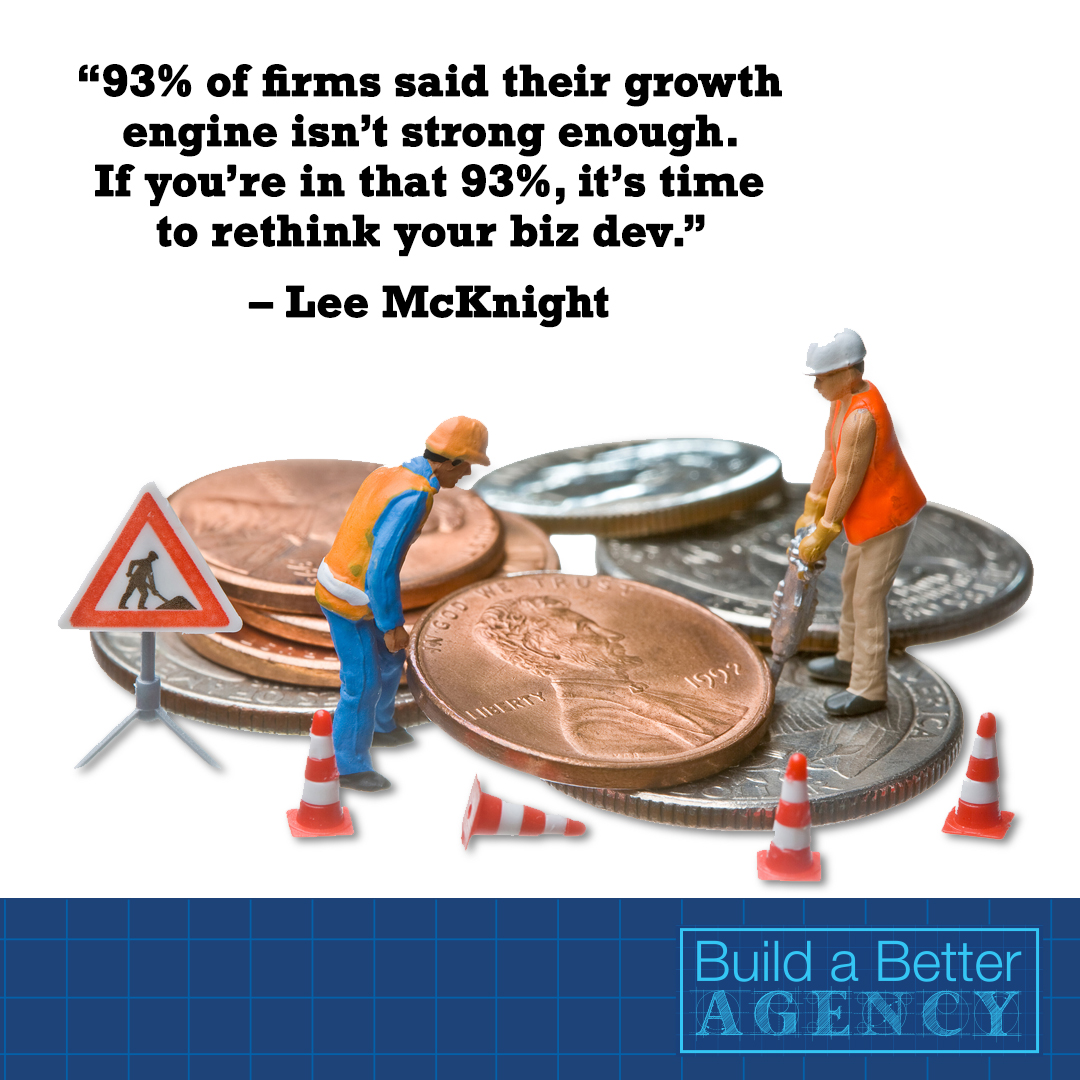
“93% of firms said their growth engine isn’t strong enough. If you’re in that 93%, it’s time to rethink your biz dev.” - Lee McKnight Jr Share on X
Agency pipelines are weak, but recovery is underway. Drew McLellan and Lee McKnight discuss how small and midsize firms can adapt to longer sales cycles and tighter client budgets. Share on X
When referrals run dry, agencies feel the pain. Drew McLellan reveals why relying solely on word of mouth isn’t a strategy and what firms should do instead. Share on X
Want to keep your pipeline moving? Lee McKnight shares why agencies with a clear niche and consistent content win more meetings and keep prospects interested. Share on X
Content is king, but not just any content. Drew McLellan explains why agencies investing in quality thought leadership are building stronger pipelines. Share on X
Ways to contact Lee:
- Website: https://www.rswus.com/
- Email: [email protected]
- LinkedIn (Personal): https://www.linkedin.com/in/leemcknightjr/
Resources:
- BaBA Summit May 18-20, 2026: https://agencymanagementinstitute.com/babasummit/
- Drew’s Book: Sell With Authority
- AMI Facebook Group: https://www.facebook.com/agencymanagementinstitute
- AMI Preferred Partners: https://agencymanagementinstitute.com/ami-preferred-partners/
- Agency Edge Research Series: https://agencymanagementinstitute.com/agency-tools/agency-edge-research-series/
- Upcoming workshops: https://agencymanagementinstitute.com/advertising-agency-training/workshop-calendar/
- Weekly Newsletter: https://agencymanagementinstitute.com/newsletter-sign-up-form/
- Agency Coaching and Consulting: https://agencymanagementinstitute.com/advertising-agency-consulting/agency-coaching-consulting/
Drew McLellan [00:00:01]:
Hey everybody, Drew McLellan here. Guess what? You got it. Another episode of Build a Better Agency. Super excited to be back with you again, as always. You know, there’s something about these conversations that always makes me feel a little smarter, a little more plugged in. And certainly what I love about some of these conversations is I get a sense, I get to compare what I believe is happening in the industry with all of you with somebody else who talks to a lot of you on a regular basis just to sort of double check that what I think is happening and the trends I’m seeing are really consistent across the board. And that’s really what we’re going to do in this conversation today.
So our friend Lee McKnight from RSW is back with another piece of research that they just came out of the field with and super excited to bring this information to you and have you sort of learn how other agencies are thinking about the fourth quarter and what they’re thinking about from for 26 and when it comes to new business. And one of the things we’re going to talk about are sort of how agencies are leveling up the pitching that they’re doing. And one of the ways a lot of agencies are doing that certainly is they’re using AI to help them get smarter and dig a little deeper before they write a proposal or, or respond to an rfp. And another way they’re doing that is they are partnering with other agencies. They are bringing skill sets together to have a more powerful offering.
And that’s one of the things that our presenting sponsor, White Label does with a lot of agencies. They really understand agency life and they know that when an agency is up for a new piece of business, sometimes they need a partner who is going to help them pitch that business and sort of dig in and do the homework, whether it’s scoping or quoting, whether it’s doing the pitch with them, whether it’s providing case studies. And that’s one of the things they do for their clients. They do all of that for free. There’s no nickel and diming. There’s no extra barrier. It’s Just part of their commitment to their clients to help them win more business, which they know is going to serve them well too. So they work with agencies and they do white label design, dev and paid media. And they know exactly how critical it is to walk into a pitch with some of that data. So you are ready to have a deeper conversation with that prospect long before you won the business. And so that’s one of the cool things they do. If you want to talk to them about that or anything else they do, head over to whitelabeliq.com ami you can read a little bit more about them and reach out to them while you’re there. If it turns out that maybe now is not the time for you to work with them or maybe it is the time. Either way, letting them know that you appreciate this podcast and their sponsorship would make me very happy. So please send them a little love note or a little thank you note, if nothing else, just to let them know that we are grateful that they helped bring this show to all of us every week.
Okay, so with that, let’s stay on this conversation of new business. Let’s welcome Lee to the show, and let’s find out what his research told us about what’s going on with agencies. All right, Lee, welcome back to the podcast. Thanks for coming back.
Lee McKnight [00:03:57]:
Yeah, thanks again so much for having me back, Drew. It’s. It’s always awesome to be here. Really appreciate it.
Drew McLellan [00:04:02]:
So you guys just released a brand new study. So tell us a little bit about the study and what prompted it and then we’ll dig into the, into the findings.
Lee McKnight [00:04:11]:
Yeah, absolutely. So we just released our 2025 survey report, rolling towards 2026. And the subheading is what to expect, what to do. And you know, we, we do these reports every year. This year we did it a little bit differently. We stacked them a little bit closer together for the reason that we have all lived through, which is that first quarter especially. How do we describe that? Was nuts.
Drew McLellan [00:04:36]:
Yeah, right.
Lee McKnight [00:04:37]:
And I think just in terms of I got everyone so tired of this word, but uncertainty. Right. And I think that was the mantra and I will say, and we’ll talk about this, that thankfully we’re coming out of that to a good extent, but the report itself, one thing we know, and I think it’s why, like ami, for example, is one of the reasons why it’s so important and your own content and what we strive for too, is that agencies, especially small mid sized firms, really like to hear what’s going on with their peers.
Drew McLellan [00:05:07]:
Yeah.
Lee McKnight [00:05:07]:
And they don’t always get to do that. Right. It’s not always a consistent thing because you’re head down, you’re working for clients and trying to get those new, new clients. And, and so that’s, that’s why we’ve always done these survey reports where we’re surveying our peers and asking them these questions around predominantly business development but then the other facets of it, whether that’s tech or you know, challenges they’re facing. And so that’s what we did this year, just put it out there last week. So. Yeah, and you know, there were some, some stats that, that should cause a little concern but also again, reasons to, you know, to really take what hopefully you can learn from this and apply it. And there’s some good things happening too.
Drew McLellan [00:05:46]:
Yeah. I think for agency owners, I think particularly when things are, when you’re struggling a little bit, it is reassuring to know that others, I mean it’s sort of a shared misery but it’s reassuring to know it’s not something just you are doing. Like it’s not that we’re bro. But it is, you know, the reality doesn’t mean that we can’t get better too. And I think that’s important that you can’t blame all of it on economic uncertainty or fill in the blank. The problem of the day. You have to keep getting better as well. But it is comforting to know that some of this is from outside influence. Doesn’t mean you don’t have to keep at it. It just means that it’s not, it’s not all sitting at your feet.
Lee McKnight [00:06:27]:
Yeah. No. 100% agree. Yeah. And I think that’s, that is important to remember for these firms. So, so yeah. No. You want to get into it?
Drew McLellan [00:06:36]:
Yeah, let’s do it. So.
Lee McKnight [00:06:37]:
Okay, cool.
Drew McLellan [00:06:38]:
The state of the world. And again this gets back to the. Is everybody seeing what I’m seeing? And you know, the data was pretty telling that you know the biggest challenges agencies are facing. And again, remember this is self diagnosed. So sometimes we don’t look in the mirror as closely. But interestingly all of these are external factors. So you know, 55% of people said client budget constraints, 56% folks said longer sales cycle, 38% economic uncertainty. Those were the big three. Low lead volume is the next closest at 36. So talk a little bit about that in terms of even what you’re seeing is, is that align with what you guys are seeing in the work you’re doing for agencies as well?
Lee McKnight [00:07:26]:
Yeah. So generally yes, I think for us you Know that as I said going back to that first quarter. So what, what I, I’ve talked to agencies, you know, and as I know you have as well. And I think partly what happened after that first quarter, enduring it, a lot of frustration and agencies, especially small mid sized firms, which is who we both predominantly, if not exclusively work with, it’s hard enough for them to do new business already. It always has been. And self serving. I mean that’s why RSW exists. Quite frank. But I really think a lot of them got to the point where because often they’re not equipped for that business development, they don’t have that business development chromosome sometimes like to call it. And what we were seeing out there was okay, the average was six to eight touches typically, well that first quarter it turned into more like 10 or 11 to 14. And I think agencies just, you could tell them that all day long they’re giving up where not completely giving up, but they’re getting the frustration level to the point where all right, well we’re going to go back and we’re going to, you know, hey, referrals ideally will keep coming in and you know, the fallbacks. But if they kept going, I mean what we saw with our own clients was okay, we are still getting in those doors but it is taking longer. And so I think what happened is from that first quarter into the second, it kind of bled to where now and we’ll get into it and we are as we speak. Right, but we are seeing more meetings, we’re seeing sales cycles start to get back to where they were. I’m not going to say it’s like a gushing hose at this point, but it absolutely is better. I definitely want agencies to think about that, if nothing else from this podcast at this early stage especially, but that you need to be out there and doing it. Because what agencies told us was, and this one was we called it the pipeline crisis, which is very hyperbolic, but it’s pretty close to an actual truth where 93% of firms said their growth engine was not strong enough. We can flip that and say, well only 7% said they had a growing pipeline. And I mean that is concerning and it should be and you know, it’s not, I’m not a sky is falling type of person but man, I mean that agency is really to think about that because where they are now, if you’re still feeling that way, you’ve really got to think about what you’re doing and how you can parse out a manageable business development process.
Drew McLellan [00:09:48]:
Yeah, well, and again, this gets back to the. You cannot just sit back and wait for it to happen. And so a lot of agencies will have, okay, well, I’m going to put together a list and I’m going to send three emails, and then I’m done. As opposed to really having a content machine that. That actually attracts and hold someone’s interest because it’s important and valuable to them. And so, you know, when you’re producing content on a regular basis, those touches come a lot easier, and you don’t have to invent them in the moment because you already have a cadence of whether it’s LinkedIn videos or podcasts or whatever, whatever your content machine is. So I think we’re seeing anyway that the agencies that really understand they’ve got a niche down, they have to have a point of view, they have to be teaching through some platform on a regular basis. They were having better luck in keeping the pipeline. Again, maybe not flowing freely, but at least there was some people banging around in there at different levels because they were just staying the course. I think it’s much harder for an agency who has to keep recreating a new business machine.
Lee McKnight [00:11:00]:
Yeah.
Drew McLellan [00:11:00]:
As opposed to somebody who just has one, that they just know that, you know, whether we’re busy, you know, the other problem, and I’m sure you see it too, agency lands a client, they’re so busy onboarding, they drop the ball on all of their new business activity. Then they start over from scratch because they’ve let that conversation go dormant and now they got to stir it back up again. As opposed to somebody who says, you know what, look, we produce a podcast every week. Doesn’t really matter how busy we are. This is just part of the machine. And so they get those touches more consistently than somebody who’s trying to manually create it on the fly.
Lee McKnight [00:11:35]:
They really do. And, you know, what we thought was good in tandem with that stat I gave you was, okay, well, you have that 7%. But taking it a step further, then we had 50% of firms that said their pipelines, yes, are weak but improving. And that was really heartening to see. And ideally now, today, that’s kicking in for them, because we asked again, what’s working the best for you? And not shockingly, although I think this is the highest it’s ever been, 75% of firms saying they rely on referrals as their number one lead source.
Drew McLellan [00:12:09]:
Yeah.
Lee McKnight [00:12:10]:
And we’ve talked about this on this podcast before. Referrals are fantastic. But again, they are just not predictable. And I’ve talked to way too many firms over the last six and eight weeks that are saying that exact thing. Like, yeah, it’s always been number one. It should be in that mix. Absolutely. Because they’re amazing, they’re fantastic.
Drew McLellan [00:12:28]:
Why wouldn’t it be in the mix? Right. I mean, if somebody who already knows, likes and trusts you, tell someone else to call you. Of course a. Of course that should go well. Of course you should close that faster and more likely. But unless you’ve got people on the payroll out there telling people about you and also discerning which ones they should tell about you and which ones they shouldn’t, it cannot be the only part of the machine.
Lee McKnight [00:12:53]:
Yeah, right. Yeah, no. 100%. And I do want to go back when you talk just a moment ago about content. And you know, I think agencies now understand because for years you’ve been saying it. I know we have as well to have some form of that. But I think what again, what was optimistic, 48% of firms say they plan to increase marketing, business development, investment. That’s fantastic. But also agencies need to see that. Okay, if that’s true, if literally half essentially of our competitors and or peers are revving this up, okay, you need to get that fire started yourself, whatever cliche we want to use. Because what I like then was 59% of firms are saying that specifically we’re going to invest in content, in going to events or maybe even in outsourced sales firms. But what I thought was interesting was only 15% said that they would prioritize any kind of digital advertising for themselves, which I thought was a pretty low number. But I think that content, you really nailed it. And that is today. And we talked a little bit about this in the report, but I ended up writing a whole post against it about a month ago. But that content now has become so important. And I know we, and I know you’re the king of it yourself. But you know, we’ve been writing this newsletter and this blog for 18 years and always tried to have more quality type of content there versus clicking on links, right. But I think now you look at things like GEO and there’s eight other acronyms for it, but that Generative Engine Optimization, whenever we as consumers, right. Are searching on Google AI is that first thing that pulls up and they’re pulling that from that content. And I can say, you know, with authority, we’ve seen our own tracking in terms of agencies or professional services firms hitting our site. We are seeing more and more come from things like chat because we can See that source and see that it came from a post we had written in some cases one from a year ago.
Drew McLellan [00:14:51]:
Right.
Lee McKnight [00:14:52]:
And that’s going to be really important. I mean, SEO as we know, we don’t have to say it, but whatever’s happening to it, it’s not. No, it’s not being destroyed or going away today. But that things like GEO or I looked up, there’s like six other acronyms. One is gaiso. I’m not even going to say what all that means, but it’s true that more and more they’re pulling from that content you’re creating. So it’s never been more important to have that voice. And as you said, whether it is a podcast or blogging, or even just writing long form posts on LinkedIn, that’s going to be more and more important in terms of being found.
Drew McLellan [00:15:25]:
Yep. Yeah, it is critical. You know, one of the things that I thought was interesting is that a lot of your survey respondents believe that things are going to get better this calendar year.
Lee McKnight [00:15:39]:
Yes.
Drew McLellan [00:15:39]:
So I’m curious, what’s your take on why they think it’s going to get better? Is it just desperation, like it has to get better? Are there, are there, are they referring to signs that they’re seeing that things are getting better? What is the data behind that hopeful assumption?
Lee McKnight [00:15:58]:
Yeah, it’s funny, I mean, I think part of it comes from lessons that a lot of these firms have learned depending on how long they’ve been in business. So our president and our founder, Mark Snyder, obviously, who you know, but he wrote a post here recently where he talked briefly about, look, the same thing that we’ve seen in 08 that we saw at Covid. It’s like this thing happens and everyone freaks out and they stand still, there is stasis and then they realize we got to do something.
Drew McLellan [00:16:28]:
Yeah.
Lee McKnight [00:16:28]:
And I think, I think that we got to do something phase is what we’re in with a lot of these prospects and marketers. So I think part of it might be a little bit of desperation in that sense. But I really do think also, and there’s some logic to it, is agencies seeing that, okay, they, they can’t stand still forever. I mean, I think, you know, we talk about spend where this was one where they, you know, they said 68% of firms feeling like current client spend, you know, is going to be about the same and maybe even less. Now that means that net new business has got to be one of your paths to growth. However, what they’re also seeing, and I think this to answer your question as well, where 45% of them are saying that prospects are getting more serious about making changes and this stat is both good and bad. I always like to kind of look around as we release these reports. What other reports are out there. And there was McKinsey 2025 B2B Pulse Survey here not too long ago. 78% of buyers that are open to switching providers, which is great on the new biz track, but then also makes you realize that yeah, you better make sure that client retention is a big piece of what you’re doing as well. So I think those are some of the factors that are kicking in to clients, I should say agencies being more optimistic and, and there are just, we are seeing concrete signs of that. So that, that is a good thing. But agencies again need to capitalize on it.
Drew McLellan [00:17:51]:
Well and I, I think at the end of the day, good times, bad times, you know, you and I have been preaching this for I think as long as we’ve known each other. Yeah, new, new business has to be a consistent behavior. I mean that it just is, it is critical that you cannot allow, whether it’s raining money or you know that it’s a drought of opportunity. You have to just sort of stay the course and be present and know that you’re going to ride that wave. Ebb and flow. But what really compromises the opportunity is when you keep jumping out of the water and have to jump back in the water as we said.
Lee McKnight [00:18:31]:
Yeah, yeah, no 100%. And I think agencies inherently know this in their heart of hearts. I do think that it has, I hate to use the word easy. It has gotten easier today versus even a year or two ago for small and mid sized firms to adopt tools that don’t cost an arm and a leg. I mean there’s a point where just, I mean you can only do so much and budgets are only so much for your, your biz dev activities. But you know, there are some of these and we talk about AI and we can get to that here in a moment. But that human element for us like in our own programs is so important because I don’t care. Well today anyway. Yeah, where, where AI is, it can be very helpful from a business development standpoint. It is not going to build the prospecting list for you and be perfect. It is absolutely not there.
Drew McLellan [00:19:27]:
Right.
Lee McKnight [00:19:28]:
But will it cut that time in half? Even the free versions? Yes, it will. Especially, especially to find new clients because that’s where agencies tend to struggle is that targeting is like, I mean how many Businesses are out there within either either our niche or whatever verticals we’re going after. There’s less and less of an excuse these days for you not to be doing some kind of ongoing biz dev process. Again, whether it’s doing it yourself internally, whether it’s a group like ours, there’s no excuse, as I said. And I think today there’s so many tools out there to help you, whether it’s content creation, whether it’s, as I said, list building. But again, the one thing I’d certainly say, and well, I’ll go ahead and throw it out there, but one of the agencies I think are being smart about it for the most part, but seeing that as AI can help you with certain foundations, but it’s not a replacement. And I’m speaking differently from the work you’re doing and how you might be using it for clients. I’m talking specifically about biz dev that they said 77% of agencies are already using it in terms of specifically biz Dev and then 80% expect to increase that. And that’s not a huge shock. Right. But I think that we certainly can see some of that over reliance and especially in content today. Right. Because you can see it’s just so evident whether it’s the M dash which has been ruined by AI, but I think obviously there can be that overuse where everyone can tell what you’re doing, especially in your reach outs. There’s got to be a balance there. But it was, it was good that, you know, the numbers were that high for agencies incorporating it into what they’re doing. And we’re still in the learning phase, you know, in terms of what, what’s.
Drew McLellan [00:21:02]:
Really working well and it changes every day. So even if you learned it. Yes, different today, but you know, we’re seeing a lot of agencies that are using it for deeper research so that they’re prepared, their RFP response is tighter, has more industry data, they have a better understanding of, you know, sort of what the competitive set looks like. Yeah, but to your point, especially when you get back to sort of the, you know, the search results being AI driven and how chat and some of the other tools are driving people, you can’t let the machine make the content because the machine will recognize its own, its own content. Yeah, right. And so it just, it actually puts you further behind as opposed to creating an opportunity for yourself. So I do think most agencies are being smart about it, that it’s, they again, they’re using it for initial list building research, things like that. But they understand that it is the human element that is going to develop the trust with a prospect enough to get them to open their wallet and go, I pick you.
Lee McKnight [00:22:03]:
Yeah, yeah. I mean that’s of course, that’s where AI is pulling it all from, from the human endeavor. I think agencies, to your point, and as I said earlier, are being smart about it. I’ll ask you, I mean, I do think that the there was that jolt of fear not that long ago or we’re all going to be replaced within this industry. And I do feel like, knock on wood, that that has subsided to where now we’re seeing, okay, kind of seeing how this works. And I’ve talked to so many firms that they’re not saying this to clients. Right. But they’re like, okay, if they thought that they could replace us all with this, they found out that that’s just not true.
Drew McLellan [00:22:38]:
That’s right.
Lee McKnight [00:22:39]:
And that’s a good thing. Right. And I think agencies consistently remind yourselves of that. But at the same time, to your point, it does change every day. It is really hard. I mean, I try to set aside even a half hour every day just to get a little bit of a leg up on kind of what could help us as a company and for myself within AI. And it’s the avalanche that it is. It is. And I try to do that and I generally have and that’s been helpful. But at the same time it’s wow. Yeah, it really is overwhelming. So I think obviously it’ll be interesting to see where, of course, where it goes. But I do think that fear has subsided and I think it’s allowed agencies to now focus on. All right, now really, how can we, you know, have this help us and our clients? And I think what’s really important that we haven’t mentioned it is making sure you’re communicating that to your clients. Right. Is this is how we’re using it or this is the research we’re doing. Here’s how it could potentially help you not replace us. But I think that, you know, that’s always been important. I think agencies forget that a lot because again, they’re head down part of that biz dev even reaching out to your prospects and your current clients, making sure they understand here’s some things we’re doing. I think there’s some agencies out there, especially on, you know, platforms like LinkedIn, that are doing a fantastic job of having posts be about that. Right. You know, where they’re not giving away secret sauce, some even are giving away some things. But it’s not in the end of the day, it’s not going to hurt them, it’s going to help them. And I make sure to try to comment on those, you know, self servingly because, you know, it’d be great to have them as a client. But even more importantly to say this is fantastic what you’re throwing out here and these prospects need to pay attention and your other agency peers should be paying attention to this because you’re doing a nice job with it. So.
Drew McLellan [00:24:19]:
Yeah, well, as you know from the summit, you know, the agency Edge research this year was all about how clients are feeling about AI. And one of the big takeaways was clients want to know if, when and how you’re using it. And they want to know not because they’re suspicious of it, but they feel uncomfortable not knowing, number one. And number two, they want to know so they can use it internally too. They want to learn from you about what you’re learning. And so again, to your point, the agencies that are part of their content strategy is talking about how they’re using the latest technology, which is really what this is, the latest tools and technology to benefit themselves and their clients. All it does is show that you are hungry to keep learning, hungry to keep getting better, looking for new ways to be more efficient and effective for your clients and for your own business. And none of that is going to land flat with a prospect who’s looking for an agency.
Lee McKnight [00:25:16]:
Yeah, yeah, absolutely. And I think what’s nice about that is again, I think it’s a great time in the sense of sharing things like that with your clients. I know over the past decade and over the years agencies would always struggle with that. At least many that I would talk to in terms of. Yeah, okay, I hear you. They know the work we’re doing for them. What else should I be cluing them into? Or you know, and it, yeah, I always was kind of fascinated by that because like there’s always something, you know, that. And I think you just don’t think about it that way because you’re all doing it internally and you are not sharing it with clients. And man, you should be because that’s the one thing I know in our past surveys, I know I’ve heard you talk about it before. You know, one of the main reasons, you know, that clients leave is they just don’t feel like the agency is giving them anything above, you know, the work order, you know, and that’s phoning it in. Yeah, phoning it in. I mean, however we want to describe it and the Big shame. A lot of those times is that’s actually not what they’re doing, but it is coming off as such.
Drew McLellan [00:26:13]:
Right.
Lee McKnight [00:26:14]:
Because that line of communication just isn’t, isn’t there. And that’s tough to hear. But you know, it’s something that agencies need to be doing ongoing and again, that’s a great place to do it. And it’s something that when you do a little bit of that research, it can go a long way to your point of helping those clients, both that work, their doing for them, but internally as well, to their higher ups, you know, and they’re going to know that that ideally came from you.
Drew McLellan [00:26:36]:
That’s right. That’s right. You’re the hero. Forgive them for sure.
Lee McKnight [00:26:40]:
Absolutely.
Drew McLellan [00:26:41]:
All right, let’s take a quick break and then when we come back, I want to talk a little bit about where agencies think they’re going to invest more energy and time and dollars in some cases with their new business. So that as everyone’s listening, they’re like, oh, okay, so my competitors are going to try this or that. So we’ll come back and we’ll talk a little bit about what your research showed, where agencies are sort of leaning in when it comes to new business for the back half of the year. So we’ll be right back. Are you tired of juggling multiple tools to manage your agency? Meet Deltec workbook the all in one solution for marketing and communications agencies. Streamline your projects, resources and finances all in one place. With real time dashboards and reporting, you’ll have full project visibility. You can plan team capacity weeks ahead to avoid bottlenecks and keep your budgets on track to maximize profitability. It’s perfect for both agencies and in house marketing teams looking to work more efficiently. PCI is a certified delltech partner offering expert implementation and support to ensure your success. If you’re ready to transform your operations, visit PCI US podcast for a free consultation today. Hey everybody. Just want to remind you before we get back to the show that we have a very engaged Facebook group. It’s a private group just for podcast listeners and agency owners that are in the AMI community. And to find it, if you’re not a member, head over to facebook.comgroups/b a b a podcast. So again, facebook.comgroups/bab podcast. All you have to do is answer a few questions to make sure that you are an actual agency owner or leader and we will let you right in. And you can join over 1700 other agency owners and leaders. And I’m telling you there’s probably 10 or 15 conversations that are started every day that are going to be of value to you. So come join us. All right, we are back with Liam Ignite and we are talking about the survey that RSW recently did around sort of the state of things as they are now and what agencies are thinking about as they sort of look at both the fourth quarter of this year, but also looking beyond into 2026. So one of the questions that you asked was around where A, are you planning on investing more in your own new business efforts in the back half of the year and B, where are you going to invest it? So it looks like about 48% said they’re going to increase, 48% said they’re going to hold steady, and 4% said we’re going to ratchet back. So, you know, I think agencies have been pretty tight with their budgets recently because clients have been tight. So agencies discretionary spend has been a little lower. So that doesn’t surprise me that you’re not seeing a lot of decrease. Nobody’s been overspending in business for sure. But what surprised you in terms of where they were going to invest was there, was there something that caught you, caught you by surprise?
Lee McKnight [00:29:47]:
Yeah, I think. Well, the one thing, and we just touched on it briefly already, but the fact that where they’re not spending, we can start there quickly because we did mention it, but is in that digital advertising space where only 15% said they were going to put it there. It’s always fascinating to me that they, they’ve never really, they agencies have never really done at least small and midsize firms. I’ve always seen very few to put money against that. So I thought that was just interesting that that number stays I think really quite low. But having said that, what we’ve seen and some of the breakouts are it was around 22% talking about in terms of SEO slash content, which I think mixing those two together, maybe next time we like to separate those to really get a little more granular. But I think that was, I thought that’d be a little bit higher, but that was a little bit surprising. But having said that, I think when you think about investment, there’s obviously time and dollars. So I think part of that is them talking dollars. So in that respect it makes a little more sense. The events and the conferences, again that was at 18, so I thought that that was a little low. But having said that, I think we had a big return in terms of investing in conferences and we still have some clients who that is, I won’t say they’re bread and butter, but still plays a rather large part a lot of that. Obviously, given what vertical they’re in, where it makes good sense in those cases. But I think it just is all somewhat evenly spread. Where they had others where they’re looking at 20 or 30%, they might outsource in that sense. And I thought it was pretty even keel in terms of where they thought they were going to invest. So to me, it was some of the areas where they weren’t investing as much. But I will say in terms of. And maybe this is a good time perhaps to get into it. I think one of the things that they talked about, and if this is the same as investment in dollars in that sense, but I think in terms of their offering is the productization piece that was a little bit surprising to me. And we’ve talked about this before and I am eager to hear what you have to say about it. But the numbers I thought were higher than I thought they would be, and that is that 62% of firms say they’re already using productized offerings to win business, and then 86% say they plan to increase that approach. I was surprised at that because I would not have thought that it would be that high in terms of agencies already engaged. Now we know, of course, that, you know, whether it’s an SEO firm or website design or performance marketing, like, that’s kind of what they’ve always been doing. So in that sense, that is not a huge surprise. It’s the creative firms, and I’ve seen some, especially some of the bigger independents, talking about how they’re doing it in terms of the creative, whether that’s something like a subscription model, what have you. And all you have to do is Google it to get in and kind of see the way that they’re handling some of it. But you get that ultimately the productization makes the selection easier for prospects and it scales agency margins. I see a lot of that. I see the positivity that is potentially inherent in it. But you’ve got the arguments against it. And I know there was one that you mentioned the last time we talked that a lot of times it seems like it’s almost, and I’m putting words in your mouth, this isn’t exactly what you said, but as I recalling it, that it’s kind of like, all right, we’ve got to do something, and so we’re just going to call it productization. And here’s that package. What kind of thought was put behind that and is this something you’re going to abandon two quarters from now?
Drew McLellan [00:33:19]:
That’s right, yeah. Is it the flavor of the month? Right.
Lee McKnight [00:33:22]:
Yeah. Yeah. What is your take on. Do you think that’s a high number at this point or is that.
Drew McLellan [00:33:27]:
I do think it’s a high number, but we’ve been seeing this shift, so we’ve, we’ve been seeing it too. And I think there’s a couple reasons for it. So I think agencies want an easier hook to talk to a client about what they have to sell. So, you know, the minute you name something or you, you have a diagram that explains it or something, it’s easier than just, you know, sort of the nebulous creative strategy or the brand strategy. So I think that’s part of it. Number two, it allows them to put a price tag to it. It’s hard to put a price tag to a service line as opposed to a thing.
Lee McKnight [00:34:05]:
Yeah.
Drew McLellan [00:34:06]:
And as more and more agencies move to flat fee pricing or value pricing versus time and materials, I think it lends itself to that. I think it allows clients. And like you said, certain kinds of agencies have always done it. They’ve always had the silver, gold and platinum package or whatever. Whatever the shtick was. Right. But one of the things that I find fascinating is that clients are telling us because remember a lot of our research is with agency clients and clients are telling us, I don’t want a productized package because what that makes me feel like is you don’t know that my business is unique and I need special things and I don’t want an off the shelf solution that everybody gets. So I think the interesting sweet spot is going to be what parts of your business can you productize that is enticing to a client that helps them understand what it is you do and what you’re going to deliver. And then how do you show within that productization the customization or the personalization that is done to make your silver package different than my silver package.
Lee McKnight [00:35:14]:
Right. Yeah. Right. And sorry to cut you off, but I think that is interesting how then you, what you thought would help and possibly define your offerings now start to look like everyone else’s because we all have these tiers of. And that’s really interesting and I hadn’t actually thought about that as much, but I think that’s absolutely a way it could go if they’re not careful.
Drew McLellan [00:35:37]:
Right. So I think there is some merit to it and I think it also depends. You know, we’ve talked forever. You know, there’s, there’s the whole wonder bread factory versus the artisanal bakery. And I think more wonder bread factory you are, the easier that is, the easier that productization is and the more expected it is from the client’s perspective as well. But when you are the artisanal bakery and everything you do is custom and bespoke, then it’s about. All right, well, is part of your discovery process sort of packaged or productized or is the way you roll something out? So what parts of your business, how do you find that balance? And so we’re watching a lot of agencies wrestle with that. So I did think your numbers in the survey, I too was surprised at how high they were. But I also understand from an agency’s perspective that if I can just sell, look, we have white bread and wheat bread and you get it sliced and that’s it. That’s a whole lot easier to talk about to create content around than it is to do everything custom where no two projects look the same, no two clients look the same. And I think we’re getting to a place where especially for the small to mid sized, independently owned agencies, more and more of them are recognizing the day of the generalist is over. You cannot be everything to Everybody anymore at 15 people.
Lee McKnight [00:37:04]:
Yeah. Yeah. Yes. And I, you know, it’s funny because I just had a conversation and got pushback on that.
Drew McLellan [00:37:11]:
Gosh.
Lee McKnight [00:37:12]:
Two weeks ago with a prospect. And it was a good conversation, but it was, I was trying to get this person to wrap their head around that very notion while he was saying. And look, far be it for me. I get it. Like we’ve been this way, we’ve been generalists for X amount of you. I mean they were easily 15 year old firm.
Drew McLellan [00:37:32]:
Yep.
Lee McKnight [00:37:33]:
Who am I to argue and say, well, you’re wrong when there’s like, well, like no, I, we’re not wrong. I can, you know, I’ve got, I got my numbers. But you know, having said that, one thing that I, and I cautioned him is respectfully, because it was a respectful conversation, of course. But his question was more around, okay, so because we’re generalists, like, like huge generalists, like everything under the sun almost.
Drew McLellan [00:37:56]:
Yeah. Butcher, baker, candlestick maker. Right?
Lee McKnight [00:37:58]:
Yeah. And so his, his and the question there was, all right, so what should we be going after? What’s hot right now? And I’m like, that is like the exact opposite of how we look at it. Because. Yes. I mean there is a way you can have success with that. Of course, because yes. What you’re in his services of course did, because it was, it was essentially performance marketing agency. They were slightly different in that sense. But okay, yes, at a concrete level, you could work with any type of company. You know, on paper, yes. However, you chasing the hottest thing is ultimately going to just drive you nuts.
Drew McLellan [00:38:32]:
Yeah, it’s exhausting.
Lee McKnight [00:38:33]:
It’s exhausting. And there’s, I mean, is it going to work? Because you’re not coming from a place where you have a right to win. I mean, you’re from your services. You could argue that you are right and you may be having success with that. But, man, I said, I really. I’m going to urge you not to look at it that way because. And what we talked about as the conversation went on was, you know what? He did have places where they had a right to win. Where there were five or six verticals, of course.
Drew McLellan [00:38:59]:
Right.
Lee McKnight [00:38:59]:
You know, and it’s like they always.
Drew McLellan [00:39:01]:
Have done, oh, well, we’ve done five banks or. Oh, we’ve all. Okay, well, maybe start there. Right?
Lee McKnight [00:39:07]:
Absolutely. Yeah, of course. And that’s where that conversation ended up going and went well. But, man, it was a little bit of a struggle at first because he was really. And I’m sure you’ve maybe seen some of this too, where, man, they get kind of, for lack of a better word, a little indignant. And it’s like, look, I’m not besmirching your business model at all. And I know maybe you’re tired of hearing that you have the niche down, but, man, this is 2025, and these folks want to know, and again, how are you going to. How are you going to be found as a generalist, is so much harder, you know, in. In that sense, especially as we. Everything we’ve been talking about right now, you know, in terms of AI and GEO and the things that are. That are ultimately going to get you found.
Drew McLellan [00:39:51]:
Well, it’s sort of like somebody saying cars were manual transmission for years and years and years. There’s no reason to have an automatic transmission. Well, yes, it was that way, but technology and time and other improvements and other consumer demands have changed it. So you’re right. You can lock in and say, I’m only going to make manual transmission cars. And there is a subset of people who will always want that. Sure. But you also have to be mindful of the fact that things evolve and change. And back in the day when there were a lot of small generalist agencies, the Internet wasn’t a big deal. People wanted to work with somebody that they could drive and meet with.
Lee McKnight [00:40:36]:
Yeah.
Drew McLellan [00:40:37]:
We didn’t have zoom and things like that. And so working with somebody from across the country or in a different country was a lot harder to find them. And. And the work was harder. You know, I can remember early, early in my career, you know, we would. Every day, the FedEx guy would show up and we would be sending hard files to publications across the country to client. Like, we would have a FedEx stack like, you know, right. 10 inches tall every day of things going out. And then all of a sudden, we could email PDFs. Well, could we have still FedExed?
Lee McKnight [00:41:13]:
Sure, sure.
Drew McLellan [00:41:14]:
Right. But you evolve with the time. And so I think for a lot of generalists, the logical reasons that they argue that they shouldn’t specialize are really, they are sort of true, but they are flawed truth. They are shadowed truths in that it doesn’t take into account the context of the world around them anymore. So I have. We work with an agency and we’ve worked with him for years, and he will argue, and he’s probably, you know, 60 people. He will argue all day, every day that they are better off because they’re generalists.
Lee McKnight [00:41:46]:
Okay.
Drew McLellan [00:41:47]:
But the reality is they have three niches. Right. And they’re sort of connected, but not really.
Lee McKnight [00:41:54]:
Yeah.
Drew McLellan [00:41:54]:
And most of their new. Most of their outbound new business effort is in one of those niches. Now, if somebody knocks on their door that’s from a niche they’ve never served before, they’ll gladly take that conversation and take that business if they win it. But they’re not quite as generalist as he would like to position himself. So I get, I get it. I get it’s an attitude. I get it’s. In some cases, it’s a. It keeps our creative fresh or fill in the blank.
Lee McKnight [00:42:20]:
There’s right. Arguments for the team. Happy. Right, right, right.
Drew McLellan [00:42:24]:
But the reality is, what clients will tell us over and over and over again is I don’t want to teach someone my business. I want someone to understand my industry and my business and be good at their business. And so, you know, we’re seeing, and I know you’re seeing too, that to get someone to have a meeting with you if you don’t already know their industry, that’s challenging.
Lee McKnight [00:42:46]:
It is, and we consistently see it and, you know, we will, I guess, push back is maybe the right phrasing there. But, you know, there’s. And you just kind of touched on it. I mean, there’s ways to do it where you can still feel comfortable. You know, we had a client. This is not Going to be a huge surprise to folks listening or watching. But you know, where they were in the same boat and they realized, well, there is this thread. And the thread, ultimately I’m not going to. This is not literally exactly what they called it, but essentially was like healthy living where they had a focus of an umbrella. And to me, I always loved that version because they go after many different. Anywhere from food to beverage to apparel to vehicles. But it all has a thread. And all right, to win and everything’s framed around that. It doesn’t mean you have to do it that way. And I know these are preaching to the choir here to you, I know on that. But. But I think that that is certainly one way. And that’s what I got into with, with this gentleman. And, and it was interesting how he hadn’t thought about it that way and which surprised me. And so I thought, okay, well, yeah, there you go. Think. Chew on that for a little while. You know, because ultimately we found that there are threads where that, that could easily work for, for that, that firm.
Drew McLellan [00:44:02]:
Well, and, and this data from this study you did, you know, after referrals, it’s inbound. And so, yeah, again, if inbound, if most agencies are getting most of their leads by someone knocking on their door, they have to know where your door is before they can knock on it. And so what are they searching for? What are they looking for? Is it geography? Is it area of expertise? Is it deliverables? Is it you understand their industry and you have a depth of experience in it. You’ve got to figure that out for yourself. But you’ve got to figure out how do I drive the right prospects and to my front door and get them to knock on it, whatever that may be.
Lee McKnight [00:44:39]:
Right, right. Yep. No 100%. And I think that’s certainly what we try to preach to our clients and, you know, to folks that are finding us for the first time. So I totally agree.
Drew McLellan [00:44:51]:
So one of the other questions you asked in the study was about the arch nemesis in house agencies.
Lee McKnight [00:44:58]:
Yes.
Drew McLellan [00:44:58]:
So arch nemesis. Well, every agency hates them with all the passion in the world. Right. Just feels like they take away our work. Of course, every agency thinks they don’t do it as well and oftentimes they’re challenging to work with. So what was the takeaway for you on what’s happening with the. On the in house front?
Lee McKnight [00:45:20]:
Yeah, that was interesting because I think ultimately it was 50%, saw no reduction in house teams, and I believe it was. And I’m pulling that up again. I think 23% saw kind of cuts internally. You know I looked it up and, and you know we talk about size of company here but the ANA 2025 report here recently that 82% of brands now have in house agencies. Now that was mostly content and media apparently. But I, you know, I thought it was interesting. It’s so cyclical and I think again especially in that first quarter and a couple of quarters behind it where AI is exploding and with this in house team we can get rid of some of our own people and this agency again, I mean just speaking in general terms but again I think that now that that’s settled to an extent, even though as you said it’s changing every day. I was curious at that 50% where they, that many thought that there would really be no. It would stay the status quo.
Drew McLellan [00:46:31]:
Yeah, well I think in house teams are here to stay. I think, I think marketing is complicated. I think now in many, you know, one of the things Covid did was it, it collapsed down marketing and sales and client or customer service and in many cases those used to be three different departments and now they’re either one department or they’re run by, they’re over overseen by someone even if they have fractional departments underneath that. And so to think all of that’s going to go away and that they’re going to give all of that work to agencies I think is probably highly unlikely. And we I think have to figure out how to be the in house agency’s best friend and best partner and help help them get smarter. And I do think again back to the agency edge research. We did one of the things that one of the big takeaways there was clients telling us we not only want our agencies using AI for the work we hire them to do, but we want them to come and show our in house team how to do it. So I think it’s a revenue opportunity for a lot of agencies to really be because they’re always going to be able to experiment better. We are going to be better, quicker to experiment, try new things in house. They’re going to be tied up with legal and all kinds of other things. But if we can walk in with a proven case study of oh, here’s an AI tool that will help you do this. Let me show you how to do that, let me train you how to do that, let me coach you on that and then every quarter I’m going to come and give you an update on how that tool has changed. You know, that’s revenue that we’ve never Met most agencies have never had before.
Lee McKnight [00:48:09]:
Yeah.
Drew McLellan [00:48:09]:
And it’s a great way to become the hero to that in house agency.
Lee McKnight [00:48:13]:
Yeah, I totally agree. And I think, you know, we also asked them, as you look out over 2H25, do you expect to see more companies reduce or eliminate in house teams? I thought it was odd that 17% said yes, although, well, we did say reduce as well. But I thought, well, that seems a little naive. Even though 17% is not a huge percentage, but most of them were. Well, look, we just dug 51%. We’re just, we’re not sure. And I think that’s probably the right answer because we’re not. But I do think, I mean, you’re exactly right. I mean it’s something where of course you are going to have to make friends. But what we had been seeing up until this report was that it seemed like agencies were getting a little more work, that they were starting to reduce some in house teams to a certain extent. And some of that is, you know, whether that’s literally from a stat from a report or just us hearing it from clients.
Drew McLellan [00:49:05]:
Sure.
Lee McKnight [00:49:06]:
So I think that’s going to be really interesting. But I think at the end of the day you nailed it. I mean, it’s got to be a situation. And that goes back to what we talked about earlier, earlier of being more than the order taker. And especially within these in house teams that these agencies that you’re working with, that we’re working with, I mean they really are going to bring a lot more to the table just inherently because that’s what they’re doing every day. But again, they’ve got to communicate that. And so if you make your clients and these folks maybe on some of these in house teams kind of the hero, maybe not too much, but make sure that they’re seeing that value and it’s impossible to ignore. You know, given what, as you said, what you’re bringing to them and what you’re bringing to the table, whether it’s the work itself or whether it’s talking to them about how you’re doing this and the trends and what could improve their business outputs, I think that’s where agencies shouldn’t worry. I mean, you should always be a little bit worried. Right. Or that maybe that’s just me, but where at least you can be confident that we’re bringing this to the table and it’s going to be, you know, a card or carbs that we’re holding that will always be there in that sense ideally. So I think yeah, they’re not going anywhere though. And I think agencies know that at this point.
Drew McLellan [00:50:21]:
Well, and honestly I think there’s, I think there’s a subset of work that is hard for us to do profitably. If we can teach the in house agencies how to do that work and we can be their partner and say, look, rather than paying us X to do this, we can set you up with technology tools and some training so that your in house team can do this. You’re going to save some money. And now we can spend our time doing sort of higher level strategic things for you that you need that outside perspective in. Now all of a sudden we become the hero too. We’re helping those people keep their jobs, we’re teaching them how to be better at their jobs. Our clients feel like we’re being a good steward of their money and frankly we stop taking the work that is a lost leader to get other work. Right now our average billable rate goes up because we’re not doing something where we’re losing our shirt every day.
Lee McKnight [00:51:13]:
Do you think though that there’s a subset of agencies that just have a, I’ll just say it, I mean, have a fear of that, that we’re giving up? Yes, everything you’re saying is logical, but if we give up that loss leader now, we’re kind of naked in that sense of well, we better bring this strategy to the table. I think it’s an excellent way to look at it and I think agencies need to really incorporate that and force, if that’s what needs to be done, force themselves to take that step. But I’m betting, and I even had some conversations that kind of touched on that with agencies that they’re pretty nervous about taking that plunge. But I think that, I don’t know if you’ve seen that, but I think you’re, and maybe, maybe you can kind of take baby steps along those lines. But I think ultimately you are going to be seen as that hero. And if you can make sure that you translate all these benefits of everything you’ve just said about around that training and about how they can take care of some of these things and that’s a good thing. But I don’t know, I think it’s a hard sell for some firms.
Drew McLellan [00:52:22]:
Well, I think if the way you’ve made money, so this goes back to the manual transmission conversation, think of the way you’ve always made money historically is by making stuff for clients, then I think it’s harder to have that attitude. But I think if you sort of pay Attention to what’s happened in the industry and how most clients are bringing work in because they think they can do it faster and less expensively than their agency. And it’s table stakes work so they can hire a kid right out of school, they can stick them in front of a computer and they can bang out social media posts or whatever it is.
Lee McKnight [00:52:58]:
Right.
Drew McLellan [00:52:59]:
If you understand that that is true and you understand the value you bring is the marketing knowledge, the strategic insights, that outsider’s perspective that yes, you understand the industry but you’re not so quagmired in it that you can’t have a fresh idea, then it’s not that big of a deal to give up some of that, some of that table stakes work to get the higher margin work of being paid for being smart and insightful and imaginative which ultimately are the things by the way, that AI can’t do. And so sooner or later, if it’s not an in house agency, it’s going to be some other tool that can whip up an illustration or something pretty quickly. We have to figure out where we belong in the value chain. And that, that I think is one of the big challenges. You and I could talk about that for another two hours and I have to let you get back to work. But that I think is one of the bigger challenges of our industry right now is where do we genuinely add value in the short term and in the long term.
Lee McKnight [00:53:59]:
Yeah, yeah, I would agree. Yeah, I would. And I would just go back to that, you know, 45% of firms that we surveyed seeing prospects being more serious about change. Keep that in your head as you’re thinking about your business development strategy because one thing we haven’t mentioned, and I’ll throw it out there there quickly in some of the open ended comments that we got back from agencies, more of them bringing up the guerrilla clients than they have in the past. And I thought that was interesting, having that one big client that’s fantastic but also makes you a little nervous.
Drew McLellan [00:54:33]:
Yeah.
Lee McKnight [00:54:34]:
If God forbid they go. So I don’t want to leave folks with that, a parting and having doom and gloom or fear. But it just is the reality. And so again, I’ll throw it out there. Now is the time to be, however you do it, prospects are we are seeing them kind of wake up for lack of a better word. So it’s a great time, you know, to be incorporating all these things that you and I have just been talking about and getting it into play.
Drew McLellan [00:54:59]:
So yeah, for sure. This has been as always, great conversation. Leah. Folks Want to download the report or all the other content that you guys produce? What’s the best way for them to do all of that?
Lee McKnight [00:55:09]:
Yeah, absolutely. Thanks. So it’s rswus.com and the resources tab at the top right of our site and everything from survey reports to our blog to one pagers that kind of help prepare you for things like first meetings and checklists that will help you do just that. So that’s where they can find it.
Drew McLellan [00:55:27]:
Yeah. Lots of great tools there, for sure. Thank you for joining us again. It’s always great to have you on the show and really appreciate how committed you all are to the research that you do and the insights that you provide. As we said at the outset of the show, it is very comforting and very insightful for agency owners to see the landscape out there of what’s going on so they know when it is them and when it’s not just them.
Lee McKnight [00:55:52]:
Yeah, absolutely. No. Thanks again for having me back, Drew. Always a pleasure. I really appreciate it.
Drew McLellan [00:55:56]:
You bet. All right, guys, so this wraps up this episode. Couple pieces of homework for you. So number one, I want you to really think about if things are starting to open up, if prospects are starting to get more serious, if if sales cycles maybe are shortening a little bit. What are you doing today to be findable so that when that prospect is ready to hire an agency and they’re serious about it, you are in the consideration set. Understand that if they don’t know about you, they’ve never heard of you, they don’t know anything about you, you can’t be in the consideration set. So you’ve got to figure out how do. How do I make sure I am on their radar screen? I have no control. It’s like dollar cost average investing. I have no control over when they’re going to need an agency, but I want to make sure I’m on their radar screen. So on that day, I at least get the email or the RFP or the phone call and I get a shot. That’s really what it’s about. I want to get a shot. So figuring that out and if you have a struggle to answer that, you need to get that answered soon. And for sure you need to have a hard plan that by 2026. So you have, you have the rest of this year to make hay in a way that you did not have great luck at it the beginning of the year. So this is the time to really invest the time and agency owners get out of the client work, get out of the other stuff. This is your job. Unless you have a salesperson on your team, this is your job to own this. Again, whether you do it in house, whether you bring in somebody like rsw, doesn’t matter. Somebody inside has to own this responsibility and it’s almost always the owner or somebody at that leadership level. So make sure somebody owns it. It’s not a committee thing. And make sure you are dedicating enough time and energy to take advantage of what is hopefully an opening up of the floodgates so that we can finish up the year stronger than we started the year. All right, that’s your homework before I let you go. Big shout out. And thanks to our friends at White Label iq, the presenting sponsor of the podcast. As you know, you can read more about [email protected] AMI so be sure you let them know that you listen to the podcast and that you’re grateful for them. And I will be back next week with another guest, so come on back and I will see you then. Thanks for listening. That’s a wrap for this week’s episode of Bill A better agency. Visit agencymanagementinstitute.com to check out our workshops, coaching and consulting packages and all the other ways we serve agencies just like yours. Thanks for listening.